Home Blog Page 154

As China’s 996 culture spreads, South Korea’s tech sector grapples with 52-hour limit

0


As the world races to stay ahead in the deep tech revolution — from AI and semiconductors to quantum computing — innovation has become the new currency of power. For many companies, that pressure has translated into heavier workloads and more intense work cultures. Yet they face a real dilemma: they can’t simply ease up while competitors across the globe push harder to win.

When I came across news about the intense “996” work culture — working 9 am to 9 pm, six days a week, a 72-hour work week — spreading from China to Silicon Valley, it made me wonder how different countries approach work hours and workplace cultures in the tech industry. I was especially curious about how things compare here in South Korea, where I’m currently based.

In South Korea, the standard workweek is 40 hours, with up to 12 hours of overtime, usually paid at 1.5 times the regular rate or more. Employers who violate these rules risk fines, executive imprisonment, and civil liability.

The 52-hour workweek, introduced in 2018 for large companies with over 300 employees and public institutions, was gradually extended to all businesses and fully took effect on January 1, 2025.

Earlier this year, South Korea rolled out a special extended work program that lets employees work beyond the 52-hour weekly limit, with both worker consent and government approval, up to 64 hours. For deep tech sectors like semiconductors, approval periods were temporarily extended from three to six months, though local media reports suggest that only a few companies actually took advantage of it. Looking ahead, the South Korean government plans to scale back these special exemptions and tighten working-hour regulations, even as some lawmakers argue that the current guidelines are sufficient, per the report.

TechCrunch spoke with several tech investors and founders based in South Korea about how the 52-hour workweek limit affects their businesses and their R&D projects as they try to compete with global companies.

“The 52-hour workweek is indeed a challenging factor when making investment decisions in deep tech sectors,” Yongkwan Lee, CEO of South Korea-based venture capital firm Bluepoint Partners, told TechCrunch. “This is particularly relevant when investing in globally competitive sectors like semiconductors, artificial intelligence, and quantum computing. Labor challenges are particularly complex in these sectors, where founders and teams often face intense workloads and long hours during critical growth phases.”

Techcrunch event

San Francisco
|
October 27-29, 2025

At Bluepoint, early-stage investments are often made before the underlying technologies are fully developed or products are ready for market. In this context, Lee noted that strict limits on working hours could potentially impact the pace at which key business milestones are reached.

In South Korea, 70.4% of employees at startup companies responded that they would be willing to work an additional 52 hours per week if adequate compensation is provided, per local reports.

Bohyung Kim, CTO of LeMong, a South Korean startup backed by LG Uplus that delivers agentic AI solutions to more than 13,000 small and medium-sized enterprises in the food and beverage sector, said the country’s 52-hour workweek system often feels more like a restriction than a protection.

“Engineers work to find practical solutions to complex problems,” Kim said. “Our work isn’t about completing predefined tasks within fixed hours. It’s about using creativity and deep focus to solve challenges and create new value. When an idea strikes or a technical breakthrough happens, the concept of time disappears. If a system forces you to stop at that moment, it breaks the flow and can actually reduce efficiency.”

Kim added that while short-term, intense focus is crucial as project deadlines approach or when refining key algorithms, rigid legal limits can sometimes get in the way, including depending on the kind of engineering role someone holds. “Even among engineers, production roles in manufacturing differ from R&D positions,” Kim explained. “In manufacturing, productivity is directly linked to working hours, so schedules need to account for industrial safety. Overtime should also be fairly compensated.”

When asked about workplace flexibility, Huiyong Lee, co-founder of LeMong, which makes comment management software, said he thinks figuring out a monthly average would be more practical than adhering strictly to the country’s 52-hour weekly limit. He noted that work intensity often varies depending on the stage of R&D and project timelines in deep tech companies.

“For companies like ours, intensive development efforts are often required for approximately two weeks prior to a product launch, after which the workload eases once the product stabilizes,” Lee said. “A system with monthly flexibility would allow us to work around 60 hours per week before a launch and 40 hours per week afterward, maintaining an average of 52 hours while ensuring operational efficiency,” Lee continued. “I also believe it is worth considering differentiated standards for deep tech and R&D-focused companies. At the same time, for startups with fewer than 10–20 employees, it is essential to establish more flexible criteria to accommodate their unique operational needs.”

Kim also noted that there is a clear link between performance and hours worked. High-performing team members often tend to put in longer hours, he said. But rather than seeking rewards for the extra time, these top performers focus on achieving results and advancing quickly within the company.

“Engineers are far more motivated to dive in when their efforts are recognized, whether through performance bonuses, stock options, or acknowledgment of technical contributions,” Kim said. “In high-tech, R&D, and IT industries, as well as in globally competitive firms where technical expertise is key, decisions about flexible work hours should be driven by market logic.”

Another Seoul-based venture capitalist, who invests in startups, downplayed the impact of the 52-hour workweek limit on investment decisions.

“At the moment, there don’t appear to be any major concerns. While it’s always difficult to predict how labor regulations or monitoring practices might evolve, many venture companies today do not strictly track employees’ working hours. To my understanding, there’s currently no requirement for companies to submit formal evidence proving that employees stay within the 52-hour weekly limit.”

If an employee were to file a complaint, the VC noted, “the absence of detailed time records could raise compliance questions. That said, most R&D or deeptech firms typically employee highly self-motivated professionals who manage their own schedules responsibly, so such cases seem relatively uncommon.”

The greater challenge likely lies in more labor-intensive industries, such as logistics, delivery, or manufacturing, where a large portion of workers earn close to the minimum wage. “In those sectors, the 52-hour workweek regulation can significantly increase labor costs due to mandatory overtime pay and paid leave. As a result, maintaining productivity and achieving economies of scale can become more difficult for businesses operating under tight margins,” this investor said.

How other countries work

To understand where South Korea’s 52-hour limit fits in the global landscape — and why its deep tech companies feel squeezed between competing pressures — it’s worth examining how other major tech hubs regulate working hours.

In Germany, the UK, and France, standard workweeks typically range from 33 to 48 hours. In Australia and Canada, the standard workweek is 38 and 40 hours, respectively, with mandatory overtime pay, offering a balance between labor rights and workplace flexibility.

In the U.S., the Fair Labor Standards Act (FLSA) sets a standard 40-hour workweek. Non-exempt employees earn time-and-a-half for any overtime, and there’s no limit on total hours. (In California, the rules only require double-time pay for certain overtime.)

In China, the standard work schedule is also 40 hours per week, or 8 hours a day. Overtime is paid at higher rates: roughly 150% of regular pay on weekdays, 200% on weekends, and 300% on public holidays. In Japan, the standard workweek is 40 hours, with limits of 45 hours of overtime per month and 370 hours per year under normal circumstances. Employers who exceed these limits can face fines and administrative penalties, as in other countries.

Singapore’s workweek is slightly longer at 44 hours, with a maximum of 72 overtime hours per month. If spread evenly, that’s roughly 62 hours per week. Overtime pay rates are similar: 1.5 times for weekdays, 2 times for rest days, and 3 times for public holidays.

South Korea’s 52-hour cap sits in the middle of this spectrum, stricter than the U.S. and Singapore but more flexible than much of Europe. Either way, for deep tech founders competing globally, the question isn’t just about the number — it’s about whether rigid weekly limits can accommodate the intense, uneven workflows that characterize early-stage R&D.


Source link

Reddit sues Perplexity and three other companies for allegedly using its content without paying

0


Reddit is suing companies SerApi, OxyLabs, AWMProxy and Perplexity for allegedly scraping its data from search results and using it without a license, The New York Times reports. The new lawsuit follows legal action against AI startup Anthropic, who allegedly used Reddit content to train its Claude chatbot.

As of 2023, Reddit charges companies looking access to posts and other content in the hopes of making money on data that could be used for AI training. The company has also signed licensing deals with companies like Google and OpenAI, and even built an AI answer machine of its own to leverage the knowledge in users’ posts. Scraping search results for Reddit content avoids those payments, which is why the company is seeking financial damages and a permanent injunction that prevents companies from selling previously scraped Reddit material.

Some of the companies Reddit is focused on, like SerApi, OxyLabs and AWMProxy, are not exactly household names, but they’ve all made collecting data from search results and selling it a key part of their business. Perplexity’s inclusion in the lawsuit might be more obvious. The AI company needs data to train its models, and has already been caught seemingly copying and regurgitating material it hasn’t paid to license. That also includes reportedly ignoring the robots.txt protocol, a way for websites to communicate that they don’t want their material scraped.

Per a copy of the lawsuit provided to Engadget, Reddit had already sent a cease-and-desist to Perplexity asking it to stop scraping posts without a license. The company claimed it didn’t use Reddit data, but it also continued to cite the platform in answers from its chatbot. Reddit says it was able to prove Perplexity was using scraped Reddit content by creating a “test post” that “could only be crawled by Google’s search engine and was not otherwise accessible anywhere on the internet.” Within a few hours, queries made to Perplexity’s answer engine were able to reproduce the content of the post.

“The only way that Perplexity could have obtained that Reddit content and then used it in its ‘answer engine’ is if it and/or its co-defendants scraped Google [search results] for that Reddit content and Perplexity then quickly incorporated that data into its answer engine,” the lawsuit claims.

When asked to comment, Perplexity provided the following statement:

Perplexity has not yet received the lawsuit, but we will always fight vigorously for users’ rights to freely and fairly access public knowledge. Our approach remains principled and responsible as we provide factual answers with accurate AI, and we will not tolerate threats against openness and the public interest.

This new lawsuit fits with the aggressive stance Reddit has taken towards protecting its data, including rate-limiting unknown bots and web crawlers in 2024, and even limiting what access the Internet Archive’s Wayback Machine has to its site in August 2025. The company has also sought to define new terms around how websites are crawled by adopting the Really Simple Licensing standard, which adds licensing terms to robots.txt.


Source link

How to add a Play Points card to Google Wallet on Android

0


Besides seeing your status in the top-right corner, Play Points can now be viewed in Google Wallet for Android.

Play Points can now appear as a Google Wallet pass below your carousel of credit or debit cards. Featuring the Google Play logo, it notes your status: Bronze, Silver, Gold, Platinum, or Diamond. 

The fullscreen page features a simple graphic with your Play Points total and the current Year. Below that is a card explaining how many points you are earning per dollar. A progress bar notes how far you are from the next level. “Open Play Points” at the bottom opens the Google Play page. 

re: 20,199. Since 2019/launch, I’ve only redeemed Points once or twice

Advertisement – scroll for more content

To add, go to that page and the “Perks” tab for an “Add Play Points to your Wallet” card.

  1. Tap “Add to Google Wallet”
  2. In Google Wallet, sign in or select your account, and tap “Add”
  3. You will be able to view your Play Points information in a new card on Wallet

Tapping the three-dot menu in Google Wallet reveals details like “Member since” and links to Play Points history and Level benefits. There’s the ability to Archive or Remove.

In other developments, the Google Play “Diamond Valley” mini-game is back for a second year. This treasure hunt involves collecting in-game diamonds for a chance to win a Pixel Watch 4, Pixel Tablet, Pixel Buds Pro 2, Nest Learning Thermostat, Nest Audio, Nest Mini, Nest Hub, and other prizes. It’s available in the US until November 9. Diamond Valley is coming to the UK and Brazil in November. 

More on Google Play:

FTC: We use income earning auto affiliate links. More.


Source link

Teen arrested in connection with burning Northampton post office American flag

0


A 16-year-old was arrested in connection with the burning of an American flag at a Northampton post office.

The teenager, who was not identified by police, faces charges of vandalizing property, burning personal property, disorderly conduct and setting fire in the open, the Northampton Police Department wrote in a press release on Facebook.

On Oct. 21 at 7:07 p.m. officers responded to a report of a fire at the Northampton post office at 37 Bridge St.

Parts of the flag, which was still attached to the flagpole, appeared to be burning simultaneously, as if sparks ignited multiple sections, the press release reads.

Police said the teenager was arrested after he previously fled the scene.

The Northwestern District Attorney’s Office, which represents Northampton, did not immediately respond to requests for comments on Wednesday.

If you purchase a product or register for an account through a link on our site, we may receive compensation. By using this site, you consent to our User Agreement and agree that your clicks, interactions, and personal information may be collected, recorded, and/or stored by us and social media and other third-party partners in accordance with our Privacy Policy.


Source link

YouTube chess superstar Daniel Naroditsky, 29, has died : NPR

0


American chess grandmaster Daniel Naroditsky died this week at 29 years old — just two weeks shy of his 30th birthday. His peers remember him as humble despite his immense skill.


MARY LOUISE KELLY, HOST:

American chess grandmaster and YouTube sensation Daniel Naroditsky died this week at 29 years old. His peers and his rivals remember him as an incredibly skilled and deeply humble player. NPR’s Alana Wise reports.

ALANA WISE, BYLINE: Naroditsky’s club, the Charlotte Chess Center in North Carolina, announced his death on social media. It shocked the chess community, where he made a mark as both a talented player and ambassador of the sport.

SAM SHANKLAND: So Daniel wore many hats for me over the course of his life.

WISE: That was fellow grandmaster Sam Shankland. He described Naroditsky as a little brother to him. They first met when Shankland was 12 and Naroditsky was 7.

SHANKLAND: I remember playing with him when his father had to bring a booster seat ’cause he was too small to see over the board. And then, as he grew up, we became rivals, as we were the two best players in California pretty quickly.

WISE: Naroditsky grew up in the Bay Area and made a name for himself as a child prodigy in the chess world. He achieved the title of grandmaster at just 18 years old. Over the years, Naroditsky picked up additional titles, including chess instructor and streaming sensation, with popular channels on YouTube and Twitch, where he promoted chess content.

SHANKLAND: When it became clear he wasn’t really going to make it to the absolute top of the playing tier, he transitioned and became a great chess content creator who grew the game enormously.

WISE: Shankland said he found out about his friend’s death yesterday before a match at the U.S. Chess Championships in St. Louis.

SHANKLAND: I don’t want to blame that for my loss. I lost because I didn’t play as well as my opponent. But I definitely felt during the game I wasn’t focusing as well ’cause I was thinking a bit about Daniel.

WISE: Shankland said that even though chess was a huge part of Naroditsky’s life, he also made time, sometimes too much, for his second love, basketball. When they played together in Armenia, Naroditsky was so focused on a basketball game, he almost didn’t sleep.

SHANKLAND: And so me and a couple other teammates almost had to stage an intervention ’cause he was watching the finals when – like, in Armenia, at, like, 2 in the morning instead of, like, getting ready for the game. Like, Daniel, you got to go to sleep. You got to play.

WISE: Shankland said he wanted people to remember Naroditsky both for his skill and his kindness to the people around him.

SHANKLAND: Through all of these times, the second hat he wore was he was my friend, and he was a really positive influence on my life in the time that I spent with him.

WISE: Naroditsky was just two weeks shy of his 30th birthday.

Alana Wise, NPR News.

Copyright © 2025 NPR. All rights reserved. Visit our website terms of use and permissions pages at www.npr.org for further information.

Accuracy and availability of NPR transcripts may vary. Transcript text may be revised to correct errors or match updates to audio. Audio on npr.org may be edited after its original broadcast or publication. The authoritative record of NPR’s programming is the audio record.


Source link

Snapchat makes its first open prompt AI Lens available for free in the US

0


Snapchat is making its new “Imagine Lens,” the company’s first open prompt image-generation AI Lens, available to all users for free. The Lens was initially launched in September but only for paid subscribers. With the Lens, users can edit their own Snaps using custom prompts or generate their own.

For instance, you could prompt the app “turn me into an alien” after snapping a selfie, or request an image of a “grumpy cat.” The company suggests you could use the Lens to try on Halloween costume ideas, or reimagine your friend in a new look, among other things.

The results can be shared with friends, posted to your Story on Snapchat, or shared beyond the app.

The broadened availability of the AI Lens follows the launch of AI video-generating apps from Meta (Meta AI) and OpenAI (Sora), which compete for young people’s attention with even more advanced AI tools and features than photo modifications.

For instance, Sora lets users generate videos of themselves after providing the app with a one-time video and audio recording to capture their appearance. Friends can share these AI personas, dubbed “cameos,” with one another, so they can star in videos together.

That puts pressure on other social apps like Snapchat to keep up, so making the AI image Lens free to use seems a worthwhile investment for the app maker.

Until now, Snapchat’s AI Lens was only available to Lens+ and Snapchat Platinum Subscribers, the company says. With the expanded rollout, Snap is making a limited number of image generations available to all free users, as well. At launch, free users in the U.S. will be able to access the new Lens, with plans for other markets underway, starting with Canada, Great Britain, and Australia.

Techcrunch event

San Francisco
|
October 27-29, 2025

The Lens is found near the front of the in-app Lens Carousel, or you can search for it by name. To create, tap the caption to edit your prompt, or use one of the preloaded suggestions if you need inspiration.

The company notes that Snapchat users access Lenses more than 8 billion times per day.


Source link

The first e-bike from Rivian spinoff Also has a virtual drivetrain

0


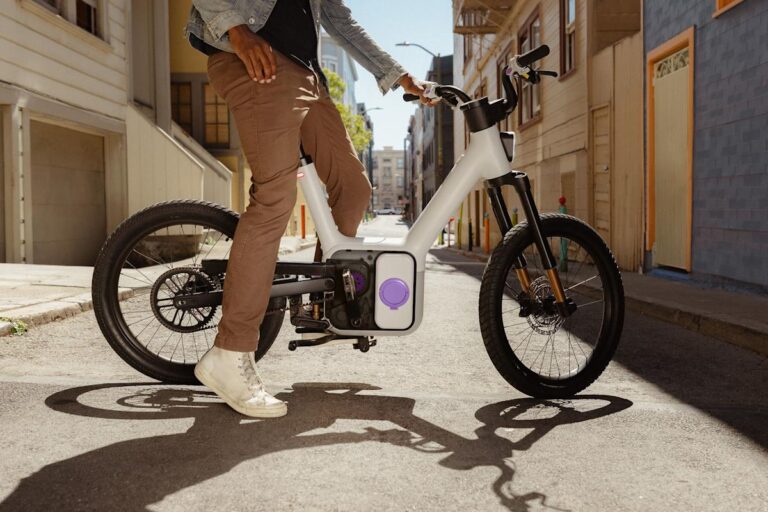
Ever since Rivian spun off its “micromobility business” into a standalone startup called Also earlier this year, there’s been much speculation about what kind of vehicles the company is working on. Now, Also is showing off its first products: a lineup of e-bikes and two pedal-assisted electric quads.

The TM-B e-bike is Also’s attempt at a do-it-all e-bike that can adapt to different use cases whether that’s daily commuting, trail riding or kid and cargo-hauling. It sports a modular frame that can also accommodate a bench seat or rear cargo rack that supports up to 35KG of weight. It only comes in one frame size, but Also says it should be able to adapt to “multiple body sizes.”

The removable USB-C battery comes in two sizes: standard, which can power up to 60 miles of riding, and large, which maxes out at 100 miles of range. In terms of power, the TM-B’s throttletops out at 20MPH. Also is taking an interesting approach to its drive system, with a setup it’s labeled “DreamRide.” Instead of a mechanical connection between the bike’s rear wheel and the pedals, the TM-B uses “software-defined pedaling,” which will make the riding experience more customizable, according to Also.

The Also app and Portal display.

The Also app and Portal display.

(Also)

Given the bike’s roots at Rivian, it’s not surprising that there are also a bunch of other tech-enabled features, including a 5-inch touchscreen display, called “Portal,” that supports navigation, music playback and calling features via an accompanying app. There’s also a built-in security system that automatically locks the frame and rear wheel when you walk away.

Also is selling the TM-B in three configurations. The first to ship next spring will be the $4,500 TM-B Limited Launch Edition, which has a range up to 100 miles, support for standard and sport ride modes and features transparent purple accents. The $4,500 TM-B Performance has the same features as the limited edition model, but has a slightly different color scheme, and will be available within the “first half” of 2026. Finally, there’s a base-level TM-B model with a range of up to 60 miles that only comes with standard ride modes. Also hasn’t announced an exact price, but says it will cost less than $4,000 when it ships “later in 2026.” Pre-orders for the Launch Edition are open now and the other two bikes are available to reserve with a $50 deposit. The bikes will also be on display in Rivian showrooms later this year,

Also's quad for commercial uses cases (left) and a smaller quad for families (right).

Also’s quad for commercial uses cases (left) and a smaller quad for families (right).

(Also)

The company also previewed two electric, pedal-assisted quads it’s calling TM-Q. The smaller quad is apparently meant for “families and individuals seeking a safe, compact alternative to cars” that can still haul “significant loads.” The larger TM-Q, on the other hand, is meant for commercial deliveries. Also has partnered with Amazon to develop fleets of such vehicles that can be used by delivery drivers. Both quads are intended to be used in bike lanes, according to Also.

The company didn’t share details about when these vehicles might be available or how much they’ll cost.


Source link

GM will remove CarPlay and Android Auto from more cars

0


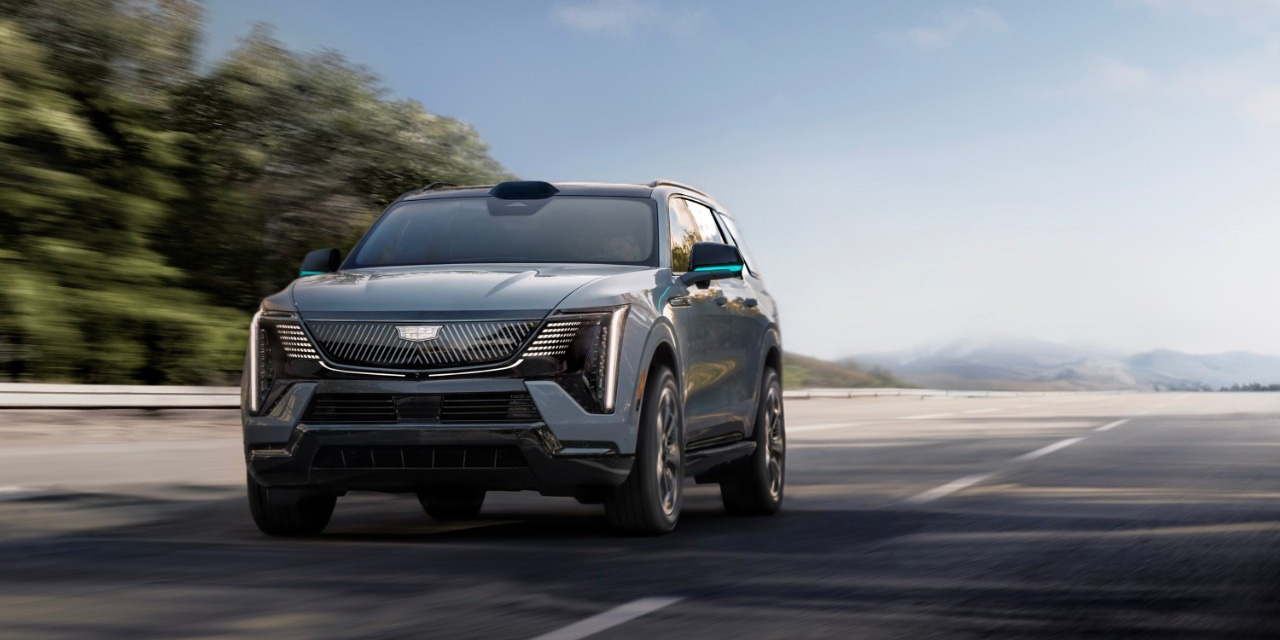
GM continues its crusade of removing Android Auto and CarPlay from its vehicles, and that’s now going to include future gas vehicles instead of just EVs, while the carmaker is also building out a Gemini-powered assistant.

GM today announced that future vehicles under the Buick, Chevrolet, Cadillac, and GMC brands will feature a new AI voice assistant powered by Google Gemini. There aren’t a ton of details on this experience yet beyond it supporting “natural conversations” that can integrate both with phone-based services like messages as well as features of the car such as navigation. It would feature access to vehicle data, meaning the assistant would be able to provide more native and personalized information.

GM explains:

Beginning next year, GM vehicles will feature conversational AI with Google Gemini, making it possible to talk to your car as naturally as you would to a fellow passenger. In the future, GM will introduce its own AI, custom-built for your vehicle. With your permission, it will be fine-tuned with your vehicle’s intelligence and your personal preferences, all connected by OnStar. This could include explaining one-pedal driving in your new vehicle, spotting a maintenance issue early, or finding the perfect place for dinner en route to your destination.

That’s set to arrive sometime next year, but also in the pipeline is a further war on phone-projection systems like Android Auto and CarPlay.

Advertisement – scroll for more content

In an interview with The Verge, GM’s Mary Barra and Sterling Anderson engage in yet another discussion about GM’s support, or lack thereof, for Android Auto and CarPlay. GM ripped out this functionality on EVs in recent years, and it seems future gas-powered vehicles are next in line.

When asked why GM’s gas-powered vehicles don’t remove Android Auto and CarPlay, Barra said that it “depends on when you do an update to that vehicle,” referring to an overhaul of the vehicles’ software stack. Directly asked if “we should expect new gas cars will not have smartphone projection,” Barra replied that “that’s the right expectation” as GM’s new software gets to a “major rollout.”

The whole interview is an interesting listen – including a bizarre comparison that tries to say phone-projection a car doesn’t make sense for the same reason you wouldn’t use phone-mirroring apps on a laptop – but we’ve time-coded the YouTube embed below to the relevant discussion about CarPlay (and, by extension, Android Auto).

More on Android Auto:

Follow Ben: Twitter/XThreads, Bluesky, and Instagram

FTC: We use income earning auto affiliate links. More.


Source link

Norfolk DA drops charges in a witness intimidation case against ‘Turtleboy’

0


Days before a deadline to appoint a new prosecutor, Norfolk County District Attorney Michael Morrissey’s office is set to drop charges against the blogger Aidan Kearney, known as “Turtleboy,” in one of the three pending cases against him.

Last month, a judge gave the district attorney’s office 30 days to find a new prosecutor for the 2024 indictments against Kearney after Robert Cosgrove, the retired judge prosecuting the case, withdrew. Cosgrove withdrew from the case after Lindsey Gaetani, an ex-girlfriend of Kearney’s who is the named victim in the indictment, filed a counterclaim against him in a separate defamation case brought by Kearney.

The other special prosecutor on the case, Ken Mello, was disqualified by Doolin because of communications with Gaetani during the time of the incident.

As a result, no one was left to prosecute Kearney, with the district attorney’s office having recused itself from the case.

“This afternoon, the Norfolk District Attorney filed a Nolle Prosequi in Norfolk Superior Court on [a Kearney case],” a spokesman for the district attorney’s office said, citing the official court case number. “The remaining two dockets against Aidan Kearney continue to be prosecuted by Special Prosecutor Robert Cosgrove.”

Kearney also faces two other cases on indictments handed up in 2023 and 2025. His lawyers recently moved to dismiss the indictments in the 2023 case. They have also sought to disqualify Cosgrove from the 2023 case.

“These cases should have never been brought, and are outrageous expressions of unlawful viewpoint discrimination and a perversion of the First Amendment,” said Tim Bradl, a lawyer representing Kearney, said on Wednesday afternoon. “We expect the remaining matters to meet the same fate, whether through the district attorney filing additional writs of nolle prosequi, or through a jury verdict of acquittal.”

Another lawyer representing Kearney in the case, Mark Bederow, said the “evidence was never credible.”

The case was ”always a disaster,” he added.

Prosecutors say Kearney harassed and intimidated witnesses in the Karen Read case. His lawyers have said Kearney’s conduct is protected by the First Amendment.

If you purchase a product or register for an account through a link on our site, we may receive compensation. By using this site, you consent to our User Agreement and agree that your clicks, interactions, and personal information may be collected, recorded, and/or stored by us and social media and other third-party partners in accordance with our Privacy Policy.


Source link

Grandmaster Daniel Naroditsky remembered for his impact on the chess world

0


Chess grandmaster Daniel Naroditsky has died at the age of 29. NPR’s A Martinez talks with reporter David Cox about the impact Naroditsky had on the chess world.


Source link