Home Blog Page 276

3 more days to save up to $210 on your TC All Stage pass

0


The countdown is on — you have just 3 days left to save on your pass to TechCrunch All Stage, happening July 15 in Boston’s SoWa Power Station. After Sunday, June 22 at 11:59 p.m. PT, prices go up, and this opportunity to lock in savings disappears.

If you’re a founder looking to scale, a VC hunting for breakout talent, or an operator ready to level up, this one-day founder summit is built to move you forward — with tactical insights, candid conversations, and high-impact networking from start to finish.

Register here to save $210 on your Founder pass and $200 on your Investor pass.

TechCrunch All Stage 3 days left

Build smarter, connect faster, grow bigger

TC All Stage isn’t about buzzwords and big stages. It’s where builders meet backers and real strategy takes center stage.

You’ll experience:

  • Actionable sessions on funding strategy, growth-stage scaling, and real-world AI use
  • Roundtable discussions that cut through the fluff and get to the hard truths
  • The live So You Think You Can Pitch competition — with unfiltered investor feedback
  • Side Events hosted across Boston — where deeper conversations happen after hours

Big names. Real talk.

Here’s just a sample of the speakers and sessions on tap, but keep checking the full speaker lineup on the event site as big names are being added daily.

  • Charles Hudson (Precursor Ventures) – on what VCs are really evaluating at pre-seed
  • Cathy Gao (Sapphire Ventures) – on raising a Series C and navigating growth-stage capital
  • Jahanvi Sardana, partner, Index Ventures
  • Ellen Chisa, partner at Boldstart Ventures — on building from inception
  • Charles Hudson, founder and managing partner at Precursor Ventures — on what VCs are really evaluating at pre-seed
  • Cathy Gao, partner at Sapphire Ventures — on raising a Series C and beyond
  • Tiffany Luck, partner at NEA — on how strategy and storytelling shape the perfect pitch
  • Jennifer Neundorfer, co-founder and managing partner at January Ventures — on AI’s impact on company building
  • Chris Gardner, partner at Underscore VC — on the evolving mix of human and AI product development
  • Mo Jomaa, partner at CapitalG — on IPO readiness and long-term planning
Early Stage 2024 Fidelity breakout
Image Credits:Halo Creative

Last chance to save and fuel your startup’s scaling

Prices go up Sunday, June 22, at 11:59 p.m. PT — don’t miss your chance to save. Join founders and investors at every stage in Boston for a full day of growth-focused programming at TechCrunch All Stage.

Make your move while there’s still time. Grab your pass before prices go up.


Source link

ZeniMax and Microsoft ratify union agreement

0


Members of the ZeniMax Workers United-CWA union have ratified the contract agreement with parent company Microsoft. This agreement with the union representing the video game studio’s quality assurance employees marks the first time Microsoft has entered into any union contract in the US. ZeniMax Studios is probably best known for its work on The Elder Scrolls Online. Stephen Totilo first reported on this news; we’ve reached out to Microsoft and the Communications Workers of America for additional comment.

As with many organizing efforts, this step has been a long time coming. The group of employees to unionize in 2023, and Microsoft immediately recognized ZeniMax Workers United-CWA following the vote results. Microsoft also made its policy of neutrality toward union organizing at ZeniMax in 2024. The QA workers from ZeniMax and Microsoft reached a this May.

The contract includes provisions for wage increases and minimum salaries, as well as industry-specific content such as a clearer crediting policy recognizing the role of QA and protections for the employees regarding use of AI.


Source link

Gemini on Android can finally identify music with Song Search

0


Ahead of the Google Assistant deprecation later in 2025, the Gemini app on Android can now identify songs with help from Google Search.

As of late April, Gemini’s response to “what song is this” would still direct you to “Use a music recognition app.” Google Assistant would start listening for music and show you the result.

In recent weeks, Gemini on Android was updated to launch the Google app’s excellent “Song Search” capability. This opens the fullscreen interface with a pustulating sphere, with results opening the Google app. The bottom of the screen notes how “Songs that match will open in Google Search. Tap close to cancel.”

It’s not native and inline, but better than Gemini not being able to help and giving you a long text response about it.

Advertisement – scroll for more content

Old vs. new

Google Assistant was how I looked up songs. With the switch to Gemini, I ended up using the homescreen or Quick Settings shortcut for Song Search in an annoying habit change. 

I’m glad that I can return to using voice commands to find music playing in the real world. Gemini made this change in recent weeks on Android. On iOS, “what song is this” doesn’t open Song Search.

More on Gemini:

FTC: We use income earning auto affiliate links. More.


Source link

Wind advisory in place for 7 Massachusetts counties until Friday evening – gusts may reach 50 mph

0


On Friday at 12:03 a.m. the National Weather Service released a wind advisory valid between 8 a.m. and 6 p.m. for Northern Worcester and Southern Worcester as well as Franklin, Middlesex, Essex, Hampshire, Hampden, Norfolk and Suffolk counties.

The weather service states, “West winds 15 to 25 mph with gusts up to 50 mph expected.”

“Gusty winds will blow around unsecured objects. Tree limbs could be blown down and some power outages may result,” describes the weather service. “Winds this strong can make driving difficult, especially for high profile vehicles. Use extra caution. Secure outdoor objects.”


Source link

The Robinhood founder who might just revolutionize energy (if he succeeds)

0


When Baiju Bhatt stepped away from his role as Chief Creative Officer at Robinhood last year, only those close to him could have predicted his next move: launching a space company built around tech that the aerospace industry has largely dismissed, and which might be more groundbreaking than anyone realizes.

If people aren’t paying much attention, that’s just fine with Bhatt, who co-founded the trading app in 2013, five years after earning his master’s degree in mathematics at Stanford. It means less competition for his new company, Aetherflux, which has so far raised $60 million on its quest to prove that beaming solar power from space isn’t science fiction but a new chapter for both renewable energy and national defense.

“Until you do stuff in space, if you happen to be an aerospace company, you’re actually an aspiring space company,” Bhatt said on Wednesday night at a TechCrunch StrictlyVC event held in a glass-lined structure on Sand Hill Road in Menlo Park. “I would like to transition from ‘aspiring space company’ to ‘space company’ sooner.”

Bhatt’s space ambitions date back to his childhood. He says that his dad, who worked as an optometrist in India, spent a decade applying to graduate physics programs in the United States, eventually taking a hard left turn and landing at NASA as a research scientist.

He then proceeded to use the powers of reverse psychology on his son, says Bhatt. “My dad worked at NASA through my whole childhood” and “he was very adamant: ‘When you grow up, I’m not going to tell you you should study physics.’ Which is a very effective way of convincing somebody to do exactly that.”

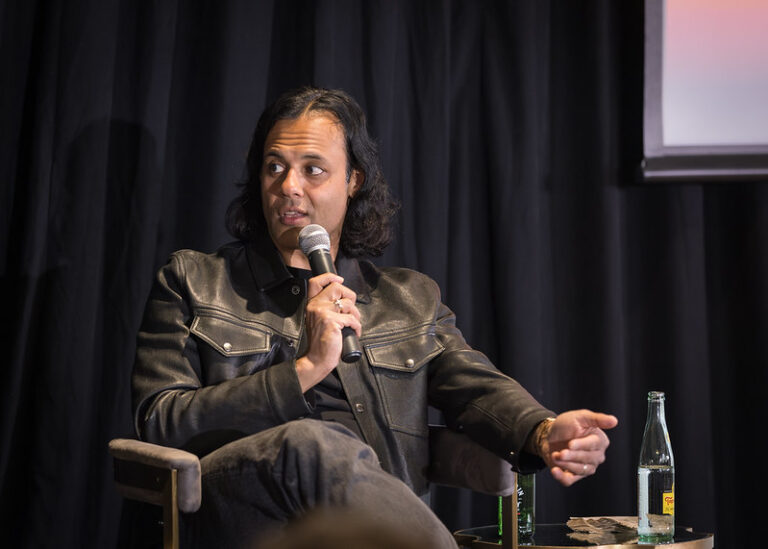
Image Credits:Slava Blazer Photography / TechCrunch

Now, at roughly the same age his father was when he joined NASA, Bhatt is making his own move into space, seemingly with an eye toward creating even more impact than at Robinhood. 

He’s certainly taking a big swing with the effort.

Traditional space solar power concepts have focused on massive geostationary satellites, using microwave transmission to beam energy to Earth. The scale and complexity made these projects perpetually “20 years away,” Bhatt said Wednesday night. “Everything was too big . . .The size of the array, the size of the spacecraft was the size of a small city. That’s real science fiction stuff.”

His solution is both far smaller and more nimble, he suggested. Most notably, instead of massive microwave antennas that require precise phase coordination, Aetherflux’s satellites will use fiber lasers, essentially converting solar power back into focused light that can be precisely targeted at receivers on the ground.

“We take the solar power that we collect from the sun with solar panels, and we take that energy and put it into a set of diodes that turn it back into light,” Bhatt said. “That light goes into a fiber where there’s a laser, which then lets us point that down to the ground.”

The idea is to launch a demonstration satellite in June of next year.

National security, first

While Bhatt envisions eventually building “a true industrial-scale energy company,” he’s starting with national defense. In fact, the Department of Defense has approved funding for Aetherflux’s program, recognizing the military value of beaming power to forward bases without the logistical nightmare of transporting fuel. “It allows the U.S. to have energy out in the battlefield,” Bhatt explained.

The precision Bhatt is promising is pretty remarkable. Aetherflux’s initial target is a laser spot “bigger than 10 meters diameter” on the ground, but Bhatt believes they can shrink it to “five to 10 meters, potentially even smaller than that.” These compact, lightweight receivers would be “of little to no strategic value if captured by an adversary” and “small enough and portable enough that you can literally bring them out into the battlefield.”

While much remains to be seen — pretty much the whole shebang, really — success for Aetherflux could potentially change the game for American military operations worldwide. 

So why hasn’t someone already done what Aetherflux is attempting? As noted last year in Space News, a 2007 study found promise in the approach and recommended more research, but no one acted on the report (and Bhatt said at the time that he wasn’t aware of it). Either way, to Bhatt, it’s the kind of overlooked opportunity that an outsider is well-positioned to seize. Indeed, in addition to his own father, Bhatt said that he draws inspiration from someone else who has proved that if you’re curious and willing to work hard, you can master multiple industries: Elon Musk. That outsider perspective “is actually an advantage,” Bhatt told the crowd.

Of course, unlike the iterate-fast mentality of companies like Robinhood that can roll out, and also sometimes roll back, software features, space hardware involves much higher stakes. You only get one shot when your satellite launches.

“We build one spacecraft, we bolt it to the fairing inside of the SpaceX rocket, we put it in space, and it detaches, and then the thing better work,” Bhatt said. “You can’t go up there and tighten the bolt.”

Asked during the sit-down how he pressure-tests that spacecraft, Bhatt said that Aetherflux is pursuing a “hardware-rich” approach, which means building and testing components while refining designs. “The right balance is not waiting five years, 10 years, 15 years, 20 years, as is the case with many important space programs,” he said. “People’s careers are oftentimes shorter than that.”

He also noted that if Aetherflux succeeds, the implications extend far beyond military applications. Space-based solar power could provide baseload renewable energy, or solar power that works day and night, anywhere on Earth. That might mean turning upside down the ways we currently think about energy distribution, offering power to remote locations without massive infrastructure investments and providing emergency power during disasters.

Aetherflux has already hired a mix of physicists, mathematicians, and engineers from Lawrence Livermore Labs, Rivian, Cruise, and SpaceX, among other places, and Bhatt said the 25-person organization is still hiring. “If you are the kind of person that wants to work on stuff that’s super, super difficult, please come and contact us,” he told attendees.

Bhatt has more than his reputation riding on what happens from here. He self-funded Aetherflux’s first $10 million, and he says he also contributed to a more recent $50 million round that was led by Index Ventures and Interlagos, and included Bill Gates’s Breakthrough Energy Ventures, Andreessen Horowitz, and NEA, among others. 

Aetherflux’s timeline is aggressive, too. The plan is to launch a demonstration satellite precisely one year from now, which is basically around the corner.

Still, there’s a prototype for Bhatt’s approach. GPS started as a DARPA project before becoming ubiquitous civilian infrastructure. Similarly, Aetherflux is working closely with DARPA’s beaming expert, Dr. Paul Jaffe, who Bhatt called “a pretty good friend to our company.” Jaffe also works with other companies developing similar technology, positioning DARPA as a bridge between military applications and commercial potential.

“There’s this precedent of doing stuff in space where there’s a really important part of working with the government,” Bhatt said. “But we actually think, over time, as the technology matures and things like [SpaceX’s reusable super heavy-lift launch vehicle] Starship really open up commercial access to space, this is not going to be just a Department of Defense thing.”


Source link

Midjourney adds AI video generation

0


AI company Midjourney has its first video model. This initial take on AI-generated video will allow users to animate their images, either ones made in Midjourney or uploaded from a different source. The initial results will be five-second clips that a user can opt to extend by four seconds up to four times. Videos can be generated on web only for now and require at least a $10 a month subscription to access.

Midjourney was one of the early names in the space for AI-generated still images, even as other platforms have pushed the forefront of the discussions around artificial intelligence development. Google’s latest I/O conference included several new tools for AI generated video, such as the text-to-video and a tool for filmmakers called . OpenAI’s Sora, which last year, is also a text-to-video option, while the more recent from Adobe can create video from a text or image prompt.

But being a little late to the video game hasn’t stopped it from drawing the ire of creatives who allege that its models were trained illegally. In fact, this video announcement follows hot on the heels of a lawsuit against the company. Disney and NBCUniversal Midjourney last week on claims of copyright infringement. And as with any AI tool, there’s always a potential for misuse. But Midjourney has nicely asked that people “please use these technologies responsibly” so surely nothing will go wrong.


Source link

Samsung has its own earthquake alerts system [Gallery]

0


Samsung often builds its own alternatives to Google services, and it turns out that the company is building its own version of Android’s earthquake alerts system, and it has some options Google should perhaps consider.

As spotted by @GalaxyTechie, One UI 8 includes Samsung’s own version of an earthquake alerts system, though it’s not live in current beta versions of the update. Like Google’s overarching system for Android devices (which is available on Galaxy devices), Samsung’s system can detect an earthquake and provide an alert just before the seismic effects are felt “in your location.” A full-screen warning is displayed with an audible alert.

It’s unclear how well Samusng’s system would work compared to Google’s, as the larger Android system works across phones from other brands. However, given the wide use of Galaxy phones worldwide, it’s reasonable to assume it could accomplish the same goal.

What makes Samsung’s version of an earthquake alert system stand out compared to Google’s is that it has a few additional options.

Advertisement – scroll for more content

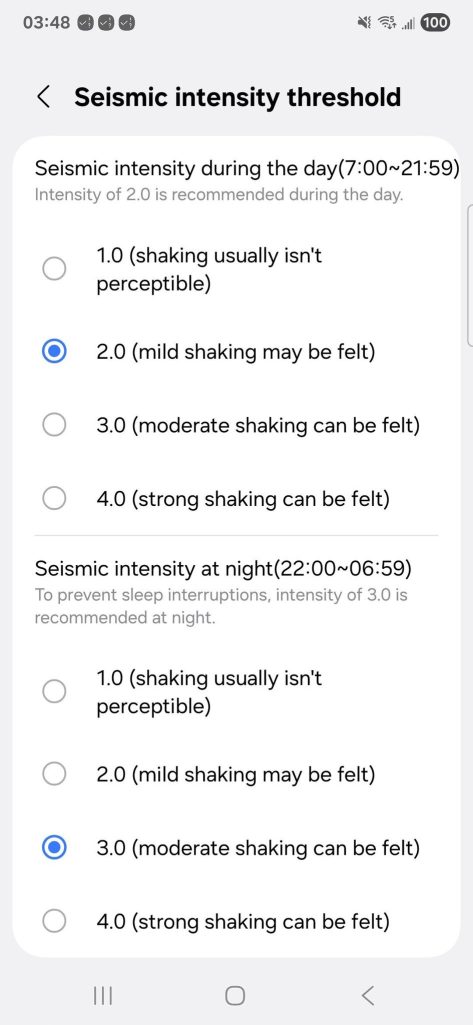
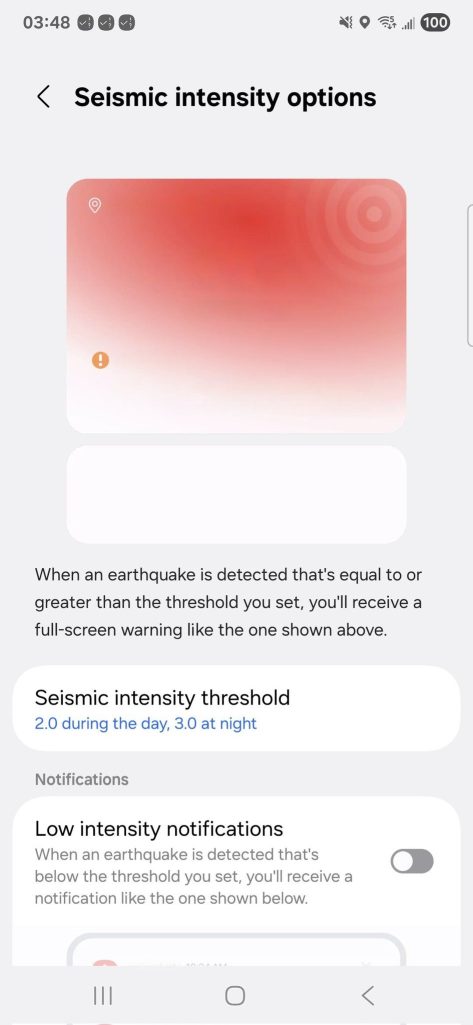
Samsung lets you preview what these warnings look like, as well as logging previous warnings. You can also customize when the warnings arrive based on the seismic intensity both day and night. Samsung also shows a list of nearby emergency shelters and can show your emergency contacts and medical info on the display, something helpful for first responders.

Google’s version is presumably still more robust in terms of actual functionality, but I think it would be nice to see a few of these options in Android’s earthquake alerts system. In particular the ability to show emergency details and to trigger a preview of the system on demand.

The big question, though, is why this exists in the first place. Why does Samsung have its own earthquake alert system when Google already provides one to all Android phones? Being a separate APK, it’s relatively clear that this isn’t just Google’s offering. It’s possible this is for other regions, perhaps like China, where Google’s system isn’t running. This same user previously showed One UI’s hidden Android Auto alternative for China, so it wouldn’t be unprecedented.

Whatever the case, it’s a nice feature to see on Samsung’s part.

More on Samsung:

Follow Ben: Twitter/XThreads, Bluesky, and Instagram

FTC: We use income earning auto affiliate links. More.


Source link

Martha’s Vineyard doughnut shop named one of the best in the country

0


A Cape Cod doughnut shop has been named as one of the best in the country.

Back Door Donuts in Oak Bluffs placed fifth in USA Today’s 10Best best doughnut shops. It was the only New England doughnut shop to place in the top 10.

USA Today teams with an expert panel to identify doughnut shops that serve up an array of flavors that cater to every palate.

Then, 10Best readers have the opportunity to vote for their favorite.

Back Door Donuts’ history on Martha’s Vineyard began in the late 1940s, the website said. It has been selling hot doughnuts from the bakery’s back door since 1971, famously offering them from 7 p.m. to midnight after being open earlier in the day from 8 a.m. until 2 p.m.

The business specializes in apple fritters, raspberry jelly donuts and a variety of other fried doughnuts.

Back Door Donuts also has a pop-up shop on Landsdowne Street, selling doughnuts out of a side door at Loretta’s Last Call from 7 p.m. to midnight, according to its website.


Source link

Every fusion startup that has raised over $100M

0


Over the last several years, fusion power has gone from the butt of jokes — always a decade away! — to an increasingly tangible and tantalizing technology that has drawn investors off the sidelines.

The technology may be challenging to master and expensive to build today, but fusion promises to harness the nuclear reaction that powers the sun to generate nearly limitless energy here on Earth. If startups are able to complete commercially viable fusion power plants, then they have the potential to upend trillion-dollar markets.

The bullish wave buoying the fusion industry has been driven by three advances: more powerful computer chips, more sophisticated AI, and powerful high-temperature superconducting magnets. Together, they have helped deliver more sophisticated reactor designs, better simulations, and more complex control schemes.

It doesn’t hurt that, at the end of 2022, a U.S. Department of Energy lab announced that it had produced a controlled fusion reaction that produced more power than the lasers had imparted to the fuel pellet. The experiment had crossed what’s known as scientific breakeven, and while it’s still a long ways from commercial breakeven, where the reaction produces more than the entire facility consumes, it was a long-awaited step that proved the underlying science was sound.

Founders have built on that momentum in recent years, pushing the private fusion industry forward at a rapid pace.

Commonwealth Fusion Systems

With a $1.8 billion Series B, Commonwealth Fusion Systems catapulted itself into the pole position in 2021. Since then, the company has been quiet on the fundraising front (no surprise), but it has been hard at work in Massachusetts building Sparc, its first-of-a-kind power plant intended to produce power at what it calls “commercially relevant” levels. 

Sparc’s reactor uses a tokamak design, which resembles a doughnut. The D-shaped cross section is wound with high-temperature superconducting tape, which when energized, generates a powerful magnetic field that will contain and compress the superheated plasma. In Sparc’s successor, the commercial-scale Arc, heat generated from the reaction is converted to steam to power a turbine. CFS designed its magnets in collaboration with MIT, where co-founder and CEO Bob Mumgaard worked as a researcher on fusion reactor designs and high-temperature superconductors.

Backed by Breakthrough Energy Ventures, The Engine, Bill Gates, and others, Devens, Massachusetts-based CFS expects to have Arc operational in the early 2030s. The company has raised a total of $2 billion, according to PitchBook.

TAE

Founded in 1998, TAE Technologies (formerly known as Tri Alpha Energy) was spun out of the University of California, Irvine by Norman Rostoker. It uses a field-reversed configuration, but with a twist: after the two plasma shots collide in the middle of the reactor, the company bombards the plasma with particle beams to keep it spinning in a cigar shape. That improves the stability of the plasma, allowing more time for fusion to occur and for more heat to be extracted to spin a turbine. 

The company raised $150 million in June from existing investors, including Google, Chevron, and New Enterprise. TAE has raised $1.79 billion in total, according to PitchBook.

Helion

Of all fusion startups, Helion has the most aggressive timeline. The company plans to produce electricity from its reactor in 2028. Its first customer? Microsoft.

Helion, based in Everett, Washington, uses a type of reactor called a field-reversed configuration, where magnets surround a reaction chamber that looks like an hourglass with a bulge at the point where the two sides come together. At each end of the hourglass, they spin the plasma into doughnut shapes that are shot toward each other at more than 1 million mph. When they collide in the middle, additional magnets help induce fusion. When fusion occurs, it boosts the plasma’s own magnetic field, which induces an electrical current inside the reactor’s magnetic coils. That electricity is then harvested directly from the machine.

The company raised $425 million in January 2025, around the same time that it turned on Polaris, a prototype reactor. Helion has raised $1.03 billion, according to PitchBook. Investors include Sam Altman, Reid Hoffman, KKR, BlackRock, Peter Thiel’s Mithril Capital Management, and Capricorn Investment Group.

Pacific Fusion

Pacific Fusion burst out of the gate with a $900 million Series A, a whopping sum even among well-funded fusion startups. The company will use inertial confinement to achieve fusion, but instead of lasers compressing the fuel, it will use coordinated electromagnetic pulses. The trick is in the timing: All 156 impedance-matched Marx generators need to produce 2 terawatts for 100 nanoseconds, and those pulses need to simultaneously converge on the target.

The company is led by CEO Eric Lander, the scientist who led the Human Genome Project, and president Will Regan. Pacific Fusion’s funding might be massive, but the startup hasn’t gotten it all at once. Rather, its investors will pay out in tranches when the company achieves specified milestones, an approach that’s common in biotech.

Shine Technologies

Shine Technologies is taking a cautious — and possibly pragmatic — approach to generating fusion power. Selling electrons from a fusion power plant is years off, so instead, it’s starting by selling neutron testing and medical isotopes. More recently, it has been developing a way to recycle radioactive waste. Shine hasn’t picked an approach for a future fusion reactor, instead saying that it’s developing necessary skills for when that time comes.

The company has raised a total of $778 million, according to PitchBook. Investors include Energy Ventures Group, Koch Disruptive Technologies, Nucleation Capital, and the Wisconsin Alumni Research Foundation.

General Fusion

Now its third-decade, General Fusion has raised $440.53 million, according to PitchBook. The Richmond, British Columbia-based company was founded in 2002 by physicist Michel Laberge, who wanted to prove a different approach to fusion known as magnetized target fusion (MTF). Investors include Jeff Bezos, Temasek, BDC Capital, and Chrysalix Venture Capital.

In an General Fusion’s reactor, a liquid metal wall surrounds a chamber in which plasma is injected. Pistons surrounding the wall push it inward, compressing the plasma inside and sparking a fusion reaction. The resulting neutrons heat the liquid metal, which can be circulated through a heat exchanger to generate steam to spin a turbine.

General Fusion hit a rough patch in spring 2025. The company ran short of cash as it was building LM26, its latest device that it hoped would hit breakeven in 2026. Just days after hitting a key milestone, it laid off 25% of its staff.

Tokamak Energy

Tokamak Energy takes the usual tokamak design — the doughnut shape — and squeezes it, reducing its aspect ratio to the point where the outer bounds start resembling a sphere. Like many other tokamak-based startups, the company uses high-temperature superconducting magnets (of the rare earth barium copper oxide, or REBCO, variety). Since its design is more compact than a traditional tokamak, it requires less in the way of magnets, which should reduce costs. 

The Oxfordshire, UK-based startup’s ST40 prototype, which looks like a large, steampunk Fabergé egg, generated an ultra-hot, 100 million degree C plasma in 2022. Its next generation, Demo 4, is currently under construction and is intended to test the company’s magnets in “fusion power plant-relevant scenarios.” Tokamak Energy raised $125 million in November 2024 to continue its reactor design efforts and expand its magnet business.

In total, the company has raised $336 million from investors including Future Planet Capital, In-Q-Tel, Midven, and Capri-Sun founder Hans-Peter Wild, according to PitchBook.

Zap Energy

Zap Energy isn’t using high-temperature superconducting magnets or super-powerful lasers to keep its plasma confined. Rather, it zaps the plasma (get it?) with an electric current, which then generates its own magnetic field. The magnetic field compresses the plasma about 1 millimeter, at which point ignition occurs. The neutrons released by the fusion reaction bombard a liquid metal blanket that surrounds the reactor, heating it up. The liquid metal is then cycled through a heat exchanger, where it produces steam to drive a turbine.

Like Helion, Zap Energy is based in Everett, Washington, and the company has raised $327 million, according to PitchBook. Backers include Bill Gates’ Breakthrough Energy Ventures, DCVC, Lowercarbon, Energy Impact Partners, Chevron Technology Ventures, and Bill Gates as an angel.

Proxima Fusion

Most investors have favored large startups that are pursuing tokamak designs or some flavor of inertial confinement. But stellarators have shown great promise in scientific experiments, including the Wendelstein 7-X reactor in Germany.

Proxima Fusion is bucking the trend, though, having attracted a €130 million Series A that brings its total raised to more than €185 million. Investors include Balderton Capital and Cherry Ventures.

Stellarators are similar to tokamaks in that they confine plasma in a ring-like shape using powerful magnets. But they do it with a twist — literally. Rather than force plasma into a human-designed ring, stellarators twist and bulge to accommodate the plasma’s quirks. The result should be a plasma that remains stable for longer, increasing the chances of fusion reactions.

Marvel Fusion

Marvel Fusion follows the inertial confinement approach, the same basic technique that the National Ignition Facility used to prove that controlled nuclear fusion reactions could produce more power than was needed to kick them off. Marvel fires powerful lasers at a target embedded with silicon nanostructures that cascade under the bombardment, compressing the fuel to the point of ignition. Because the target is made using silicon, it should be relatively simple to manufacture, leaning on the semiconductor manufacturing industry’s decades of experience.

The inertial confinement fusion startup is building a demonstration facility in collaboration with Colorado State University, which it expects to have operational by 2027. Munich-based Marvel has raised a total of $161 million from investors including b2venture, Deutsche Telekom, Earlybird, HV Capital, and Taavet Hinrikus and Albert Wenger as angels.

First Light

First Light dropped its pursuit of fusion power in March 2025, pivoting instead to become a technology supplier to fusion startups and other companies. The startup had previously followed an approach known as inertial confinement, in which fusion fuel pellets are compressed until they ignite. 

First Light, which is based in Oxfordshire, U.K., has raised $140 million, according to PitchBook, from investors including Invesco, IP Group, and Tencent.

Xcimer

Though nothing about fusion can be described as simple, Xcimer takes a relatively straightforward approach: follow the basic science that’s behind the National Ignition Facility’s breakthrough net-positive experiment, and redesign the technology that underpins it from the ground up. The Colorado-based startup is aiming for a 10-megajoule laser system, five times more powerful than NIF’s setup that made history. Molten salt walls surround the reaction chamber, absorbing heat and protecting the first solid wall from damage.

Founded in January 2022, Xcimer has already raised $109 million, according to PitchBook, from investors including Hedosophia, Breakthrough Energy Ventures, Emerson Collective, Gigascale Capital, and Lowercarbon Capital.

This story was originally published in September 2024 and will be continually updated.



Source link

The best budget gaming laptops for 2025

0


Gaming laptops have come a long way, and you no longer need to spend a fortune to enjoy smooth gameplay. While most gaming laptops can be pricey, there are now affordable options that deliver impressive performance without compromising too much on features. Whether you’re diving into esports titles or exploring expansive open-world games, the best cheap gaming laptops offer a balance of power and value.

These budget-friendly machines often come equipped with high-refresh-rate displays, ensuring fluid visuals during intense gaming sessions. Some even boast OLED screens, providing vibrant colors and deep blacks that enhance the gaming experience. While they might not match the premium build of high-end models, many of these laptops can still run modern games at high settings. And if you’re transitioning from a cheaper laptop or a Chromebook, you’ll appreciate the added versatility and performance these gaming laptops bring to the table.

Image for the large product module

Will Lipman Photography for Engadget

Screen size: 15-inch | Touchscreen: No | Processor: 13th-gen Intel Core i5/i7 | RAM: Up to 16GB | Storage: Up to 512GB | Weight: 2.81 pounds | Battery life: Up to 6.5 hours | Screen refresh rate: 120Hz

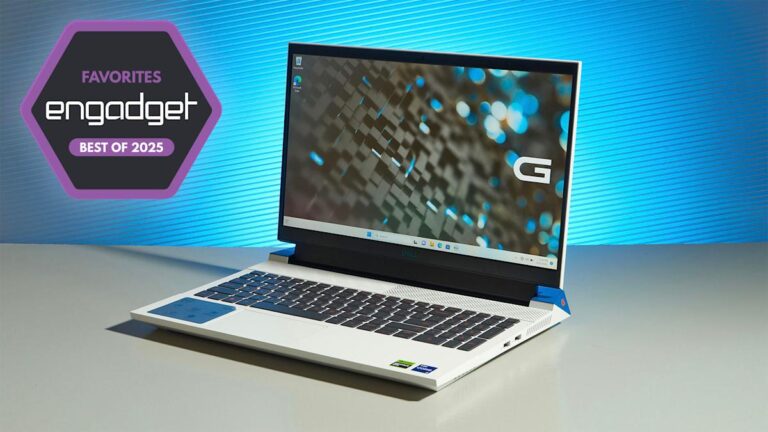
Dell was one of the first PC makers to combine a decent amount of graphics power in a sub-$1,000 system. The latest G15 builds on that experience. It starts at $800 with Intel’s 13th-gen i5-13450HX, an RTX 3050 laptop GPU and 8GB of RAM, making it one of the best budget gaming laptop choices around. We’d recommend bumping up to the $1,000 model with 16GB of RAM, a 512GB SSD and a 165Hz 1080p screen with NVIDIA’s G-SYNC technology, ensuring high fps and smooth gaming performance.

While it’s no Alienware, the G15 carries over some of that premium brand’s design cues with a sharp, angular case and LED-backlit keys. It’s also surprisingly sturdy for the price, with a durable chassis that should hold up to years of use. And while it doesn’t go all-in on RGB, it still delivers an attractive gaming aesthetic without over-the-top lighting effects.

$1,289 at Amazon

Image for the large product module

acer

Screen size: 15-inch | Touchscreen: No | Processor: 12th-gen Intel Core i5 | RAM: Up to 16GB | Storage: Up to 512GB | Weight: 4.8 pounds | Battery life: Up to 8 hours | Screen refresh rate: 144Hz

The Acer Nitro 5 is another great affordable gaming laptop option, though we’ve yet to see it get Intel’s 13th-gen chips. Still, the 12th-gen model is no slouch: It’s equipped with 16GB of RAM, NVIDIA’s RTX 3050 and 512GB of storage. Just like Dell, Acer has plenty of experience building PC gaming machines, so this will likely survive years of extreme play. The Nitro 5’s multi-colored RGB backlit keyboard and rear red accents also give off a stronger gamer vibe than the G15. Side note: Acer’s Nitro 16 may also be worth considering if it dips below $1,000, since it features newer CPUs and GPUs and improved Wi-Fi capabilities for better online gaming.

$878 at Amazon

Image for the large product module

HP

Screen size: 15-inch | Touchscreen: No | Processor: AMD Ryzen 7 5800H | RAM: Up to 64GB | Storage: Up to 4TB | Weight: 5 pounds | Screen refresh rate: 144Hz

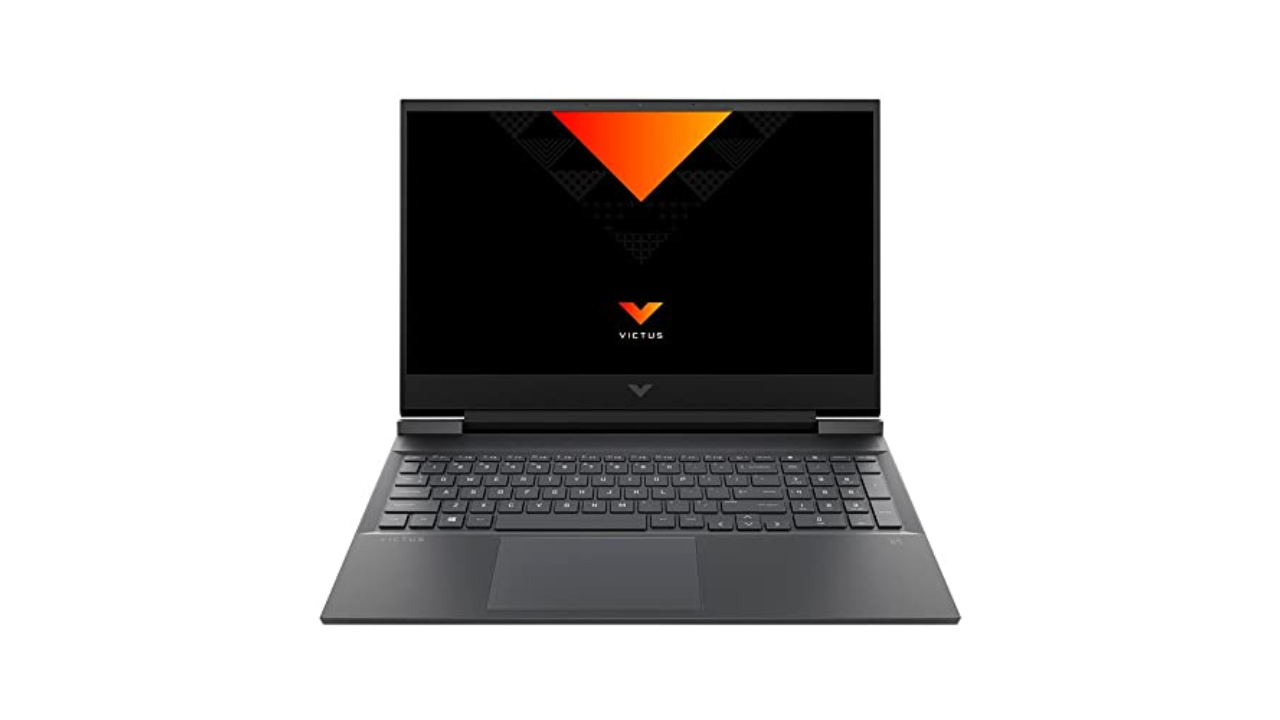
The HP Victus 15 is the ideal affordable gaming laptop for someone who doesn’t want to be seen with a gaming laptop. Its all-black chassis is sleek and understated, making it a great option for those who need a laptop for both gaming and web browsing. The laptop display is impressive for the price, offering a 144Hz FHD screen that helps maintain smooth frame rates in fast-paced games.

Under the hood, it still packs enough graphics power to handle modern titles, featuring an AMD Ryzen 7 CPU, NVIDIA’s RTX 3050 Ti, 16GB of RAM and SSD storage of up to 4TB. It also includes a solid selection of connectivity options, including USB-C and HDMI 2.1, so you can easily hook it up to an external monitor. While it may not have flashy RGB lighting, its solid performance and subtle design make it a great choice for gamers who want a balance between work and play.

$739 at Amazon

To get a high-end gaming experience, you can easily spend $5,000 on a fully tricked-out notebook like the Razer Blade 18. But when it comes to the best budget gaming laptops, we’re focusing on the other end of the pricing spectrum: laptops under $1,000. It used to be tough to find a gaming option with decent performance at that price point but, as PC prices have fallen, they no longer seem like unicorns.

Stepping up a bit to systems between $1,000 and $2,000 puts you firmly in mid-range territory, which is beyond the scope of this guide. Still, it’s worth keeping an eye out for sales that can push those higher-end models below $1,000. Be sure to check out our guide to the best gaming laptops for a general overview of what to look out for in these more expensive systems.

Cheap gaming laptops are definitely worth it if you’re trying to save money and are being realistic about what you can get at this price range. You can expect to find Intel and AMD’s latest (but not greatest) CPUs, as well as entry-level GPUs like NVIDIA’s RTX 3050. Budget models are also typically paired with FHD screens running at a respectably high refresh rate of 120Hz or beyond — ensuring smooth frame rates in your favorite games. There are some exceptions though: Dell’s G16 (currently discounted to $900) is notable for its 16-inch quad HD+ screen.

Many cheap gaming laptops also skimp on specs like RAM and hard drive space. We’d recommend getting at least 16GB of RAM and SSD storage of at least 512GB. Modern games need a decent chunk of memory to run, and they also tend to be large, so you wouldn’t be able to fit much alongside Windows 11 on a 256B SSD. You might be tempted to jump on one of those dirt-cheap gaming laptop deals from Walmart or Best Buy, but it’s just not worth it if you’re stuck with 8GB of RAM or a tiny SSD.

As for build quality, expect to find more plastic than metal on budget gaming machines. Still, the best budget gaming laptops we’re recommending should be sturdy enough to last a few years. Affordable systems will also be heavier and thicker than mid-range and higher-end models, and often don’t have the best Wi-Fi or connectivity options. Battery life is another trade-off, though even the most expensive gaming laptops can struggle with longevity.


Source link