Home Blog Page 29

Robinhood’s startup fund stumbles in NYSE debut

0


Retail investors are famously locked out of the startup world. Robinhood is attempting to change that by allowing the general public to invest in a portfolio of what it calls “some of the most exciting private companies operating today.”

To do this, the company that pioneered the commission-free brokerage model has secured access to eight startups—including Databricks, Stripe, Mercor, and Oura—grouping them into a vehicle called Robinhood Ventures Fund I. The fund, which also includes Ramp, Airwallex, Revolut, and Boom, set out last month with an ambitious $1 billion target, but demand for this novel way of investing in private companies was lower than expected.

On Thursday, Robinhood announced the fund had raised $658.4 million — which could reach $705.7 million if underwriters exercise their full allotment. The shares, priced at $25 in the offering, began trading on Friday and closed the day at $21, a 16% decline.

RVI’s reception on Wall Street stands in stark contrast to another attempt to give individual investors exposure to buzzy startups. When Destiny Tech100 — a publicly traded, closed-end fund holding stakes in 100 venture-backed companies including SpaceX, OpenAI, and Discord — direct-listed on the NYSE in March 2024, its shares surged from a reference price of $4.84 to an opening trade of $8.25, eventually closing its first day at $9.00.

Destiny Tech100 has kept climbing since its public debut. The fund closed trading on Friday at $26.61, a 33% premium to its net asset value of $19.97, meaning its shares trade well above the actual value of its underlying holdings.

So what explains why retail investors aren’t nearly as excited about Robinhood’s fund as they are about Destiny Tech 100? The most likely explanation is RVI’s lack of exposure to the companies widely expected to go public at enormous valuations: OpenAI, Anthropic, and SpaceX.

Robinhood is looking to address this. RVI intends to add more startups to the fund, eventually aiming to hold what Robinhood Ventures President Sarah Pinto described to TechCrunch as “15 to 20 of the best late-stage growth companies out there.”  The company’s CFO, Shiv Verma, told Axios Pro on Friday that Robinhood is eyeing exposure to OpenAI.

Techcrunch event

San Francisco, CA
|
October 13-15, 2026

But securing access to these high-profile companies is far from straightforward. Robinhood is aiming to get directly onto their cap tables directly through primary capital raises or secondary share sales — and that’s difficult even for a firm with deep roots in Silicon Valley.

A cap table — the official record of who owns equity in a company — is closely guarded at most high-profile startups, and winning a spot on one requires either being invited by the company or purchasing shares from existing investors with the company’s blessing.

“It’s very difficult to get into any of these companies, and the investment rounds are very expensive,” acknowledged Pinto.

That is just one of the reasons democratizing private markets is easier said than done, and why the companies most retail investors actually want to own remain, for now, out of reach.


Source link

Valve doesn’t sound confident the Steam Machine will ship in 2026

0


As part of a Year in Review blog detailing changes Valve made to Steam in 2025, the company shared a minor update on its hardware plans that doesn’t sound good for anyone hoping to buy a Steam Machine, Steam Controller or Steam Frame in 2026. Specifically, the company is now opening up the possibility its new hardware won’t ship this year at all.

In February, when Valve acknowledged the ongoing memory and storage shortage had delayed the launch of its hardware and could lead to higher prices, the company was still committing to a (fairly wide) window of when its hardware would ship:

“Our goal of shipping all three products in the first half of the year has not changed. But we have work to do to land on concrete pricing and launch dates that we can confidently announce, being mindful of how quickly the circumstances around both of those things can change.”

As of the company’s latest post, however, things somehow sound even less certain. “We hope to ship in 2026, but as we shared recently, memory and storage shortages have created challenges for us,” Valve wrote in its Year in Review post. “We’ll share updates publicly when we finalize our plans!”

While Valve’s air of secrecy can make it easy to read too much into the limited information the company does share, moving from “the first half of the year” to “[hoping] to ship in 2026” certainly gives it wiggle room to not release new hardware this year. And considering the difficulties other companies are facing sourcing memory and storage, it wouldn’t be all that surprising.

HP said in February that RAM accounts for a third of its PC costs, and industry analysts expect the RAM shortage could radically alter the PC landscape as companies are forced to raise prices. Valve’s already struggling to keep the Steam Deck in stock due to its issues securing RAM, it stands to reason sourcing components for even more devices wouldn’t make that process any easier. Then again, the company hasn’t updated its launch timing FAQ, so there’s still reason to hope the Steam Machine ships in 2026.


Source link

Google Home voice command update should be faster

0


Google Home is rolling out more updates to address ongoing issues with voice commands, with the latest fixes apparently making everything “snappier” and less prone to errors.

Gemini for Home started rolling out in early access last year and, while it does indeed deliver a bunch of extra functionality, it hasn’t been the revolutionary update that many were hoping for after years of a crumbling Google Assistant. But Google has continually been working on this and is now rolling out another update to voice commands that should bring “noticeable” improvements.

Google Home chief Anish Kattukaran revealed on Twitter/X that a “major under-the-hood” update for Google Home voice commands has just finished rolling out which was “targeting hundreds of your most common smart home device commands” in an effort to speed up latency.

Kattukaran explains:

Advertisement – scroll for more content

We’ve slashed latency by 30%-40% for these top requests, and we’re seeing error rates drop significantly across the board. Your smart home should feel noticeably snappier today. Still more to come but try it out in Early Access and let us know if you’re feeling the speed improvements for these kinds of queries.

This comes just days after a Google Home app update launched with a lot of performance, functional, and bug fix updates throughout. Combined with this under-the-hood update that speeds everything up, it all sounds like a welcome improvement.

As mentioned, this update is already widely available, so the fixes and upgrades should just start showing up as you use voice commands as normal. Let us know in the comments if you’ve noticed any improvements lately!

More on Google Home:

Follow Ben: Twitter/XThreads, Bluesky, and Instagram

FTC: We use income earning auto affiliate links. More.


Source link

Bernard LaFayette, Selma voting rights organizer, dies at 85 : NPR


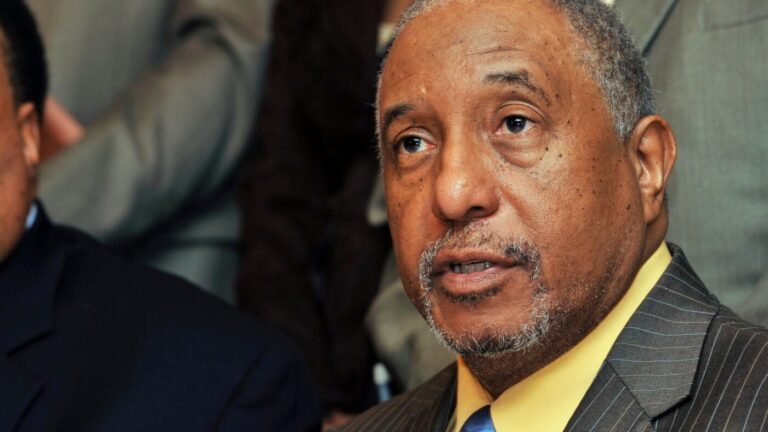
Southern Christian Leadership Conference spokesman Bernard LaFayette speaks to reporters after attending a SCLC meeting on March 6, 2010, in Atlanta.

Southern Christian Leadership Conference spokesman Bernard LaFayette speaks to reporters after attending a SCLC meeting on March 6, 2010, in Atlanta.

Gregory Smith/AP


hide caption

toggle caption

Gregory Smith/AP

NASHVILLE, Tenn. — Bernard LaFayette, the advance man who did the risky groundwork for the voter registration campaign in Selma, Alabama, that culminated in the passage of the Voting Rights Act of 1965, has died.

Bernard LaFayette III said his father died Thursday morning of a heart attack. He was 85.

On March 7, 1965, the beating of future congressman John Lewis and voting rights marchers on Selma’s Edmund Pettus Bridge led the evening news, shocking the nation’s conscience and pushing Congress to act. But two years before “Bloody Sunday,” it was LaFayette who quietly set the stage for Selma and the advances in voting rights that would follow.

LaFayette was one of a delegation of Nashville students who in 1960 had helped found the Student Nonviolent Coordinating Committee, which organized desegregation and voting rights campaigns across the South. SNCC crossed Selma off its map after some initial scouting determined “the white folks were too mean and the Black folks were too scared,” LaFayette said.

But he insisted on trying anyway. Named director of the Alabama Voter Registration Campaign in 1963, LaFayette moved to the town and, with his former wife Colia Liddell, gradually built the leadership capacity of the local people, convincing them change was possible and creating momentum that could not be stopped. He described this work in a 2013 memoir, “In Peace and Freedom: My Journey in Selma.”

The many dangers LaFayette faced included an assassination attempt on the same night Medgar Evers was murdered in Mississippi, in what the FBI said was a conspiracy to kill civil rights workers. LaFayette was beaten outside his home before his assailant pointed a gun at him. His calls for help brought out a neighbor with a rifle. LaFayette found himself standing between the two men, asking his neighbor not to shoot.

LaFayette said he felt “an extraordinary sense of internal strength instead of fear” at that moment. Rather than fight back, he looked his attacker in the eyes. Nonviolence is a fight “to win that person over, a struggle of the human spirit,” he wrote.

Dr. Martin Luther King, accompanied by the Rev. Bernard Lafayette (right), talks about a planned march on Washington during a news conference, Jan. 16, 1968, in Atlanta.

Dr. Martin Luther King, accompanied by the Rev. Bernard Lafayette (right), talks about a planned march on Washington during a news conference, Jan. 16, 1968, in Atlanta.

Charles Kelly/AP


hide caption

toggle caption

Charles Kelly/AP

He also acknowledged that his neighbor’s gun may have been what saved his life.

LaFayette was already working on a new project in Chicago by the time his work in Selma came to fruition in 1965. He had planned to join the Selma-to-Montgomery march on day two, so he missed Bloody Sunday when the march was stopped by tear gas and club-wielding state troopers before it even got out of Selma.

“I felt helpless at a distance,” he wrote. “I was stricken with grief, concerned that so many people in my beloved community were hurt, possibly killed.”

But he shifted quickly, rounding up people in Chicago and arranging transport to Alabama for a second attempt. They set off two weeks later on what had become a victory march: President Lyndon Johnson had introduced the Voting Rights Act to Congress.

Inspired by his grandmother

LaFayette grew up in Tampa, Florida, where he recalled trying to board a trolley with his grandmother when he was 7 years old. Black passengers had to pay at the front, then walk to the back to climb on. But the conductor began to pull away before they could board, and his grandmother fell. He was too little to help.

“I felt like a sword cut me in half, and I vowed I would do something about this problem one day,” he wrote in his memoir.

It was his grandmother who decided he was destined to become a preacher. She arranged for him to attend Nashville’s American Baptist Theological Seminary (now American Baptist College), where he roomed with Lewis, and both helped lead the nonviolent civil disobedience campaign that led to Nashville becoming the first major Southern city to desegregate its downtown accommodations.

President Obama spoke about the roommates in a eulogy after Lewis died in 2020, recalling how they integrated a Greyhound bus while riding home for Christmas break (Lewis to Troy, Alabama, and LaFayette to Tampa, Florida) just weeks after the Supreme Court banned segregation in interstate travel in 1960.

The two sat up front and refused to move, angering the driver, who stormed off at every stop, all through the night.

“Imagine the courage of these two people … to challenge an entire infrastructure of oppression,” Obama said. “Nobody was there to protect them. There were no camera crews to record events.”

LaFayette has said they didn’t fully realize the impact of all this work at the time.

“We lived through this, but this was our daily lives,” he told The Associated Press in a 2021 interview. “When you think about it, we weren’t trying to make history or trying to rewrite history. We were responding to the problems of the particular time.”

Freedom Rides of 1961

In 1961, LaFayette dropped out of college in the middle of final exams to join an official Freedom Ride, one of many that sought to force Southern authorities to comply with the court’s ruling. He was beaten in Montgomery, Alabama, and arrested in Jackson, Mississippi, becoming one of more than 300 Freedom Riders sent to Parchman Prison.

LaFayette later trained Black youth to become leaders in the Chicago Freedom Movement and helped organize tenant unions.

“The tenant protections we have today are really a direct outcome of that work in Chicago,” said Mary Lou Finley, a professor emeritus at Antioch University Seattle who worked with LaFayette in Chicago in the 1960s.

And when he learned that one of his secretaries had two children sickened by lead — a huge problem that was not well understood at the time — Lafayette organized high school students to screen toddlers for lead poisoning by collecting urine samples, and prodded Chicago to help develop the nation’s first mass screening for lead poisoning, Finley said.

“Bernard has always worked quietly behind the scenes,” said Finley, who later collaborated with LaFayette on nonviolence training. “He has avoided the spotlight. In some ways, I think he felt like he could do more if he were doing it quietly.”

LaFayette also worked alongside Andrew Young and the Southern Christian Leadership Conference to prepare for the Rev. Martin Luther King Jr.’s ill-fated Northern campaign. Several of King’s marches were attacked by white mobs, but LaFayette and Young challenged the notion that the Chicago movement was a failure.

Young noted in a 2021 interview that in Chicago they were trying to organize a population 20 times larger than Birmingham’s, while pursuing a range of difficult issues, from neighborhood integration to the quality of schools and jobs. “In each one of those we made progress,” Young said.

By 1968, LaFayette was the national coordinator of the King’s Poor People’s Campaign and was with King at the Lorraine Motel on the morning of his assassination. King’s last words to him were about the need to institutionalize and internationalize the nonviolence movement. LaFayette made this his life’s mission.

After King died, LaFayette returned to American Baptist to complete his bachelor’s degree and then earned a master’s and doctorate from Harvard University. LaFayette later served as director of Peace and Justice in Latin America; chairperson of the Consortium on Peace Research, Education and Development; director of the Center for Nonviolence and Peace Studies at the University of Rhode Island; distinguished senior scholar-in-residence at the Candler School of Theology, Emory University, Atlanta; and minister of the Westminster Presbyterian Church in Tuskegee, Alabama, among other positions.

“Bernard did work in Latin America. He did nonviolence workshops in South Africa with the African National Congress. He went to Nigeria when the civil war was happening there,” Young said. “Bernard literally went everywhere he was invited as sort of a global prophet of nonviolence.”

In his memoir, LaFayette wrote that the ever-present threat of death during those early years of organizing taught him that the value of life “lies not in longevity, but in what people do to give it significance.”



Source link

Anthropic’s Claude found 22 vulnerabilities in Firefox over two weeks

0


In a recent security partnership with Mozilla, Anthropic found 22 separate vulnerabilities in Firefox — 14 of them classified as “high-severity.” Most of the bugs have been fixed in Firefox 148 (the version released this February), although a few fixes will have to wait for the next release.

Anthropic’s team used Claude Opus 4.6 over the span of two weeks, starting in the javascript engine and then expanding to other portions of the codebase. According to the post, the team focused on Firefox because “it’s both a complex codebase and one of the most well-tested and secure open-source projects in the world.”

Notably, Claude Opus was much better at finding vulnerabilities than writing software to exploit them. The team ended up spending $4,000 in API credits trying to concoct proof-of-concept exploits, but only succeeded in two cases.

Still, it’s a reminder of how powerful AI tools can be for open-source projects — even if they bring a flood of bad merge requests alongside the useful ones.


Source link

COPPA 2.0 passes the Senate again, unanimously this time

0


Today the US Senate unanimously passed proposed legislation known as COPPA 2.0. This measure, fully named the Children and Teens’ Online Privacy Protection Act, aims to create new protections for younger users online, such as blocking platforms from collecting their personal data without consent.

COPPA 2.0 is a modernized take on the Children’s Online Privacy Protection Act of 1998, attempting to address recent changes in common online activities, like targeted advertising, that could prove harmful to minors. Lawmakers have made several attempts to get this bipartisan bill through. While it has made varying amounts of headway in the Senate, none of the COPPA 2.0 bills to date have gotten past the House of Representatives. Industry groups such as NetChoice have previously opposed COPPA 2.0 and other measures around minors’ online activity such as KOSA, the Kids Online Safety Act. NetChoice members include Google, YouTube, Meta, Reddit, Discord, TikTok and X. Google specifically has since changed its stance to support COPPA 2.0, however.

“This bill expands the current law protecting our kids online to ensure companies cannot collect personal information from anyone under the age of 17,” Senate Democratic Leader Chuck Schumer (D-NY) said in a statement about the latest result. “This is a big step forward for protecting our kids. We hope the House can join us. They haven’t thus far.”

However, there has been a bigger push both domestically and internationally toward restrictions on when and how younger people engage online. Several states — Utah, California and Washington to name a few — have enacted laws requiring some level of age verification, either to access mature content online or to use social media apps at all. Many of these efforts have raised concerns about privacy regarding where and how people’s personal information is stored and protected. COPPA 2.0 might wind up benefitting from the privacy debates since it emphasizes giving teens and parents ways to protect themselves from having their data used against them rather than asking adults to give up data in order to use the internet as usual.

Update, March 6 2026, 11:38AM ET: Article updated with additional context on Google.


Source link

Claude AI reports record signups as it tops app charts

0


Claude is gaining significant traction, with a new report stating that the company is seeing in excess of one million user signups on a daily basis. If that trend continues, it could surpass other AI firms like OpenAI.

A new shift is becoming apparent, as users seem to be on a search for better AI models for their own, varying use cases. According to a new report from Anthropic, the company is seeing a massive surge of users creating Claude AI accounts to use its generational and conversational models.

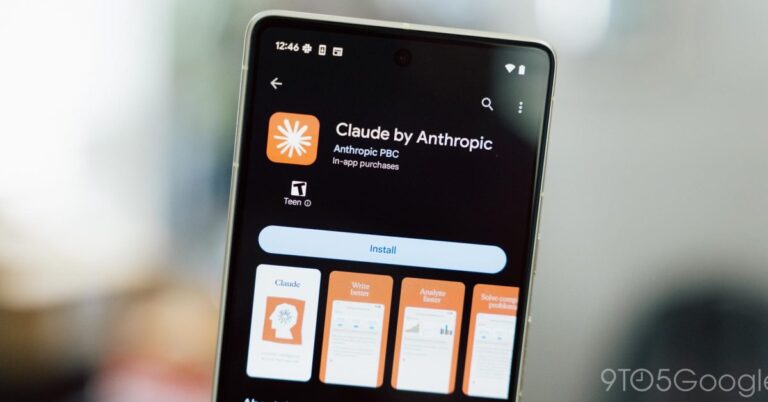
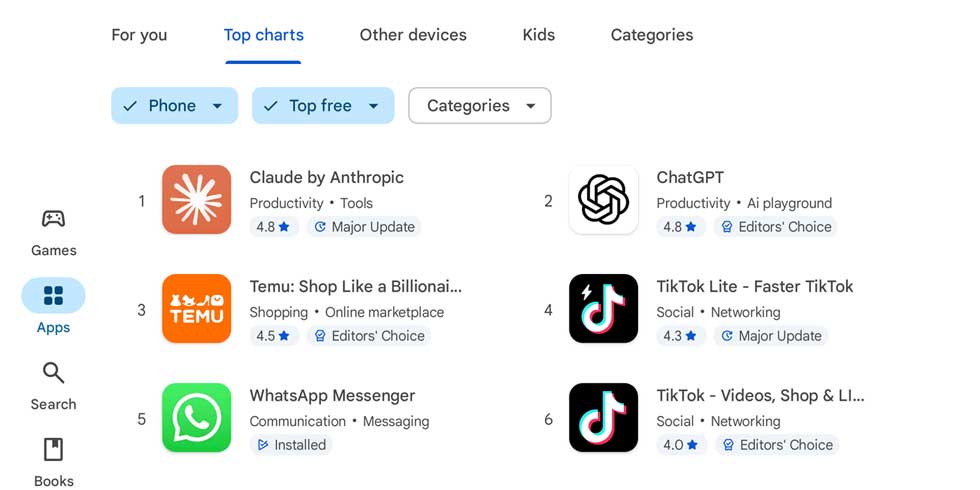
Anthropic doesn’t get too specific with the signup numbers, but it notes “more than a million people are now signing up every day.” That number refers to global signups, as current data suggests the Claude AI app has become the number one free app on both the Google Play Store and App Store in the US and other regions. That puts it right above ChatGPT, according to AppFigures at the time of writing.

This comes as OpenAI has been hit with some controversy as it officially entered a partnership with the US Department of War to deploy AI for classified applications – something, it seems, Anthropic and Google employees were unwilling to do without heavy guardrails in place.

Advertisement – scroll for more content

OpenAI claims its safety measures are satisfactory, noting that ChatGPT or internal models can not be used to deploy autonomous weapons or be used for mass surveillance. It says that since initially turning down the opportunity because of lackluster safety measures, the company says it has “been working hard to ensure that a classified deployment can happen with safeguards to ensure that red lines are not crossed.”

Anthropic has since been designated a “supply chain risk” by the DoD, which it plans to challenge in court. The company stated that it or any other company has no role in operational decision-making with regard to mass surveillance and autonomous weapons.

The fallout seems to be taking the form of increased user activity for Claude over ChatGPT as signups hit record numbers for Anthropic. As of the end of February 2026, OpenAI reported 900 million active users per week, with over 50 million consumer subscribers.

FTC: We use income earning auto affiliate links. More.


Source link

Homegoing service will celebrate civil rights leader Jesse Jackson in Chicago


Chicago native Jennifer Hudson is among the singers performing at a memorial for the civil rights leader who died last month. Former presidents Bill Clinton, Barack Obama and Joe Biden will attend.

(Image credit: Kris Connor)


Source link

Anthropic to challenge DOD’s supply-chain label in court

0


Dario Amodei said Thursday that Anthropic plans to challenge the Department of Defense’s decision to label the AI firm a supply-chain risk in court, a designation he has called “legally unsound.”

The statement comes a few hours after the DOD officially designated Anthropic a supply-chain risk following a weeks-long dispute over how much control the military should have over AI systems. A supply-chain risk designation can bar a company from working with the Pentagon and its contractors. Amodei drew a firm line that Anthropic’s AI will not be used for mass surveillance of Americans or for fully autonomous weapons, but the Pentagon believed it should have unrestricted access for “all lawful purposes.”

In his statement, Amodei said the vast majority of Anthropic’s customers are unaffected by the supply-chain risk designation.

“With respect to our customers, it plainly applies only to the use of Claude by customers as a direct part of contracts with the Department of War, not all use of Claude by customers who have such contracts,” he said.

As a preview of what Anthropic will likely argue in court, Amodei said the Department’s letter labeling the firm a supply-chain risk is narrow in scope.

“It exists to protect the government rather than to punish a supplier; in fact, the law requires the Secretary of War to use the least restrictive means necessary to accomplish the goal of protecting the supply chain,” Amodei said. “Even for Department of War contractors, the supply chain risk designation doesn’t (and can’t) limit uses of Claude or business relationships with Anthropic if those are unrelated to their specific Department of War contracts.”

Amodei reiterated that Anthropic had been having productive conversations with the DOD over the last several days, conversations that some suspect got derailed when an internal memo he sent to staff was leaked. In it, Amodei characterized rival OpenAI’s dealings with the Department of Defense as “safety theater.”

Techcrunch event

San Francisco, CA
|
October 13-15, 2026

OpenAI has signed a deal to work with the DOD in Anthropic’s place, a move that has sparked backlash among OpenAI staff.

Amodei apologized for the leak in his Thursday statement, claiming that the company did not intentionally share the memo or direct anyone else to do so. “It is not in our interest to escalate the situation,” he said.

Amodei said the memo was written within “a few hours” of a series of announcements, including a presidential Truth Social post saying Anthropic would be removed from federal systems, then Defense Secretary Pete Hegseth’s supply-chain risk designation, and finally the Pentagon’s deal announcement with OpenAI. He apologized for the tone, calling it “a difficult day for the company” and said the memo didn’t reflect his “careful or considered views.” Written six days ago, he added, it’s now an “out-of-date assessment.”

He finished by saying Anthropic’s top priority is to ensure American soldiers and national security experts maintain access to important tools in the middle of ongoing major combat operations. Anthropic is currently supporting some of the U.S.’s operations in Iran, and Amodei said the company would continue to provide its models to the DOD at “nominal cost” for “as long as necessary to make that transition.”

Anthropic could challenge the designation in federal court, likely in Washington, but the law behind the decision makes it harder to contest because it limits the usual ways companies can challenge government procurement decisions and gives the Pentagon broad discretion on national security matters.

Or as Dean Ball — a former Trump-era White House adviser on AI who has spoken out against Hegseth’s treatment of Anthropic — put it: “Courts are pretty reluctant to second-guess the government on what is and is not a national security issue … There’s a very high bar that one needs to clear in order to do that. But it’s not impossible.”


Source link

Anthropic says it will challenge Defense Department’s supply chain risk designation in court

0


In a new blog post, Anthropic CEO Dario Amodei has admitted that it received a letter from the Defense Department, officially labeling it a supply chain risk. He said he doesn’t “believe this action is legally sound,” and that his company sees “no choice” but to challenge it in court. Hours before Amodei published the post, the Pentagon announced that it notified the company that its “products are deemed a supply chain risk, effective immediately.”

If you’ll recall, the Defense Department (called the Department of War under the current administration) threatened to give the company the designation typically reserved for firms from adversaries like China if it didn’t agree to remove its safeguards over mass surveillance and autonomous weapons. President Trump then ordered federal agencies to stop using Anthropic’s tech.

Amodei explained that the designation has a narrow scope, because it only exists to protect the government. That is why the general public, and even Defense Department contractors, can still use Anthropic’s Claude chatbot and its AI technologies. Microsoft told CNBC that it will continue using Claude after its lawyers had concluded that it can keep on working with Anthropic on non-defense related projects.

The CEO has also admitted that his company had “productive conversations” with the department over the past few days. He said that they were looking at ways to serve the Pentagon that adheres to its two exceptions, namely that its technology not be used for mass surveillance and the development of fully autonomous weapons, and at ways to “ensure a smooth transition if that is not possible.” That confirms reports that Anthropic is back in talks with the agency in an effort to reach a new deal. In addition, he apologized for a leaked internal memo, wherein he reportedly said that OpenAI’s messaging about its own deal with the department is “just straight up lies.”


Source link