Home Blog Page 310

Carvana, a Used Car Retailer, Thinks Tariffs Could be Good for Business

0


Automakers are worried that President Trump’s tariffs on imported cars and auto parts will soon increase their costs and start eating into profits.

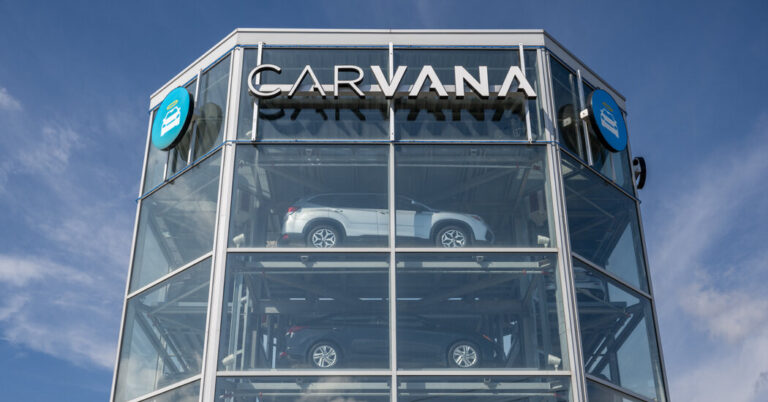
But at least one business in the auto industry thinks the tariffs could give it a lift. That company is Carvana, an online retailer of used cars that has gained fame for storing vehicles in distinctive “vending machine” towers.

The Trump tariffs, which include levies of 25 percent on vehicles made in Mexico, Canada, Germany and many other nations, are widely expected to raise the prices new cars and trucks, forcing more car shoppers to opt for a used vehicle. An agreement to lower tariffs on Chinese imports that the administration announced on Monday will not change the tariffs on cars and auto parts.

“To the extent that car prices go up, Carvana is probably positioned to be relatively advantaged as consumers look for high-quality cars at a lower price,” the company’s founder and chief executive, Ernie Garcia, said in an interview last week. “We think that will cause them to shift into used vehicles and into the savings that are available via online buying.”

Mr. Trump has said he imposed tariffs in hopes of forcing manufacturers to make more goods and create more factory jobs in the United States, although he has also claimed that tariffs would help achieve other goals like reducing unauthorized immigration and drug smuggling.

Automakers are bracing for the impact.

In the past several days, General Motors said the tariffs would increase its costs by $2.8 billion to $3.5 billion this year, even accounting for measures the company is taking to adapt. Ford Motor, which makes more vehicles domestically than G.M., estimated the tariffs would cost it $1.5 billion on a net basis. Toyota Motor, which imports many vehicles from its home country of Japan, said the tariffs would cost it $1.3 billion in March and April alone.

Analysts have predicted that the prices of some imported vehicles could rise by up to $10,000, and that sales of new vehicles could slow sharply this year.

Alan Haig, whose consulting firm in Fort Lauderdale, Fla., advises car dealers, said Mr. Garcia was on the right track about how consumers were likely to react.

“I think you’re going to see an increase in used car sales because of the tariffs, and I do think there will be more customers visiting Carvana websites because that’s essentially their sole focus,” he said.

But there could also be a downside. If the tariffs cause a recession, or vehicle prices rise too much, sales of both used and new automobiles could decline. Already, used cars sell for about $1,000 more in auctions, on average, than just two months ago.

Mr. Haig said it would take some time for the full impact to be felt. The prices of most vehicles on dealer lots haven’t increased significantly, yet. The first batches of imported models affected by the tariff on vehicles, which went into effect in early April, are just starting to arrive. Tariffs on imported engines, transmissions and other components went into effect on May 3.

Whatever happens next, Carvana is on much sounder financial footing than it was just a couple of years ago.

When the Covid pandemic set off a boom in used car sales and online buying, Carvana became a favorite of investors, and its stock soared. But as demand softened, the company was left holding a large inventory of vehicles purchased at relatively high prices, and it began losing a lot of money.

At the same time, interest rates rose after Carvana had taken on billions of dollars in debt to buy Adesa, a used car auction company. Because of the heavy debt load and mounting losses, some analysts feared Carvana might not survive. By February 2023, its stock had crashed.

But Mr. Garcia was able to renegotiate its debt, reduce costs and streamline Carvana’s operations. Over many months, the company cut jobs, sold off cars and turned Adesa into a provider of affordable cars and trucks. More recently it has built up facilities at 11 Adesa locations to repair and recondition used vehicles.

The work is now paying off. Last week, Carvana reported record results for the first three months of the year, with profits of $373 million, up from $49 million a year earlier. It sold 133,898 used vehicles, 46 percent more than in the first quarter of 2024. Average gross profit on each vehicle was just under $7,000.

The company accomplished this while keeping fewer cars in its inventory, spending less on advertising and employing about 4,000 fewer people than it did three years ago. Its stock has recovered much of the ground it lost.

“From 2017 to 2021, the company focused on growth,” Mr. Garcia said. “We spent the last two years unlocking efficiencies. I think that is what has driven the dramatic improvement in our performance.”

Mr. Garcia is now aiming, within five to 10 years, for Carvana to sell three million cars and trucks annually, from about 500,000 now.

Many Wall Street analysts are again confident about the company’s prospects, but see at least one hurdle. Auto mechanics are very hard to find, and Carvana needs hundreds more to reach its goal of fixing up used cars for sale.

“Labor is the key bottleneck,” Ronald Josey, a Citi analyst, wrote in a recent report.

Mr. Garcia said he was confident about Carvana’s business now that it had restructured its operations, and he thinks it can do well regardless of how U.S. trade policy changes.

“I think it’s now proven that, yes, customers have shown they are willing to buy cars online, and an online business model can deliver value,” he said.
Source link

Trump’s Plan to Take Jet From Qatar Heightens Corruption Concerns

0


During President Trump’s first term, the idea that special interests and governments were buying meals and booking rooms at his hotels set off legal and ethical alarms about the potential for corruption.

Mr. Trump’s second term is making those concerns look trivial.

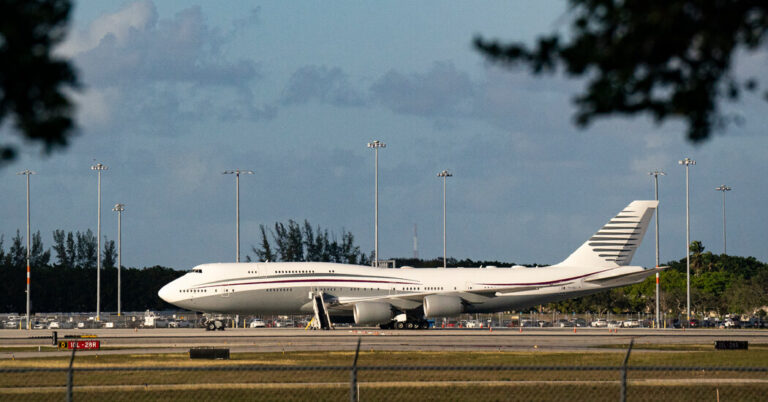
The administration’s plan to accept a $400 million luxury jet from the Qatari royal family is only the latest example of an increasingly no-holds-barred atmosphere in Washington under Trump 2.0. Not only would the famously transactional chief executive be able to use the plane while in office, but he is also expected to transfer it to his presidential foundation once he leaves the White House.

The second Trump administration is showing striking disdain for onetime norms of propriety and for traditional legal and political guardrails around public service. It is clearly emboldened, in part because of the Supreme Court’s ruling last year that granted immunity to presidents for their official actions and because of the political reality that Mr. Trump’s hold on the Republican Party means he need not fear impeachment.

Mr. Trump’s inaugural committee raked in $239 million from wealthy business interests hoping to curry his favor or at least avoid his wrath, more than doubling the previous record, $107 million, set by his inaugural committee in 2017. There is no way to spend a quarter of a billion dollars on dinners and events, and the committee has not said what will happen to leftover funds.

Before returning to office, Mr. Trump also started a meme cryptocurrency, $TRUMP, which allows crypto investors around the world to enrich him. His family has already made millions on transaction fees, and its own reserve of the digital coin is worth billions on paper.

This month, Mr. Trump went further by auctioning off face-to-face access to himself through sales of the coin, announcing that top buyers would get a private dinner at one of his golf courses and that the largest holders would get a tour of the White House. The contest injected new interest in the coin, even though it has no intrinsic value.

The removal of such constraints extends to law enforcement.

In April, the Trump administration disbanded a Justice Department unit dedicated to investigating cryptocurrency crimes.

Earlier, Mr. Trump had also ordered the department to suspend enforcement of the Foreign Corrupt Practices Act, which makes it a crime for companies that operate in the United States to bribe foreign officials.

And Attorney General Pam Bondi, herself a former highly paid lobbyist for Qatar, narrowed enforcement of a law requiring lobbyists for foreign governments to register such relationships and disclose what they are paid.

The administration has not made public its legal analysis concerning the agreement with Qatar.

A person familiar with the matter said that Ms. Bondi had personally signed a Justice Department memo blessing the plan as lawful, although the person added that it had been drafted and cleared by lawyers in the department’s Office of Legal Counsel.

To be sure, aspects of the cultural shift predate Mr. Trump. In 2016, the Supreme Court unanimously made it harder to prosecute public officials for corruption by narrowing what counts as an “official act” for federal bribery laws, vacating the graft conviction of a former Virginia governor.

And Washington has always been a place where money and politics can mix in unseemly ways, with no party having a monopoly on people eager to exploit public office for private gain.

Last year, for example, a Democratic senator from New Jersey, Robert Menendez, resigned from office after being convicted of taking bribes.

And Hunter Biden gained a lucrative seat on the board of a Ukrainian gas company while his father, Joseph R. Biden Jr., was the vice president. Trading on his father’s status in that way was widely seen as unbecoming even if the facts of the arrangement were overshadowed by a conspiracy theory, peddled by the right, that it also involved bribes by a Russian oligarch.

But the current moment, coming as Mr. Trump’s crypto gambit merges into his intended acquisition of a Qatari plane, is particularly remarkable for the openness with which the president, his immediate family and entities in his orbit are unabashedly leveraging his position to accrue personal benefits or to otherwise advance his personal agenda separate from governmental policymaking.

Mr. Trump has pressured several major law firms to donate tens of millions of dollars in free legal services toward his favored causes, using the threat of official actions, like prohibitions on them and their clients from government business, as a cudgel. (Other law firms have fought his directives in court, with growing success.)

He has also found other ways to extract money from tech companies. Amazon reportedly paid $40 million for the rights to stream a future documentary about the first lady, Melania Trump.

Meta agreed to pay $25 million to the nonprofit that will build and run Mr. Trump’s future presidential museum, settling a lawsuit over Facebook’s suspension of his account after his lies about the 2020 election culminated in the Jan. 6, 2021, attack on the Capitol.

Corporate owners of news media organizations are also settling lawsuits with Mr. Trump that many media lawyers had considered winnable. ABC News agreed to pay $15 million to the Trump museum foundation.

Paramount, which needs Trump administration approval for a sale to a Hollywood studio, is considering a similar settlement with Mr. Trump in a lawsuit he brought against one of its subsidiaries, CBS News, over how “60 Minutes” edited an interview with Vice President Kamala Harris last year.

Mr. Trump’s plan for the Qatari plane appears to be to use it as Air Force One until the end of his presidency, while Boeing finishes building a new generation of presidential aircraft. The Pentagon would then transfer it to his museum foundation. (He called it his “library,” but presidential libraries are research facilities run by the National Archives. They often adjoin museums run by private foundations that are dedicated to former presidents.)

Mr. Trump compared that plan to one by Ronald Reagan’s museum in Simi Valley, Calif., where a presidential Boeing 707 is now a star attraction. But that plane was at the end of its life span — it had been used as Air Force One from 1973 to 2001 before being decommissioned. It also remains the property of the Air Force and is merely on permanent loan.

The Qatari plane will still be nearly new in 2029, raising the question of whether Mr. Trump’s museum foundation, which is run by his allies, would allow Mr. Trump to keep using the plane after he leaves office. On Monday, Mr. Trump denied that this was his intent.

Even if so, it was unclear why it would benefit the U.S. government to decommission an expensive and nearly new aircraft. Parking it at a future Trump museum would, however, contribute to glorifying Mr. Trump.

On Monday, Mr. Trump also signaled that he viewed Qatar’s offer of a plane as something of a quid pro quo, emphasizing that the United States had provided security to the Gulf country and “we will continue to.”

He added that he considered the gift “a very nice gesture” from the Qataris. Only a “stupid person,” he said, would turn down a “free very expensive airplane.”


Source link

U.S. Inflation Mild Ahead of Expected Jump From Tariffs

0


U.S. inflation cooled slightly in April in what economists warn could be a final lull before a likely surge in consumer prices stemming from President Trump’s trade war.

The better-than-expected report is welcome news for the Trump administration and the Federal Reserve, which has been trying to wrestle inflation back down to its 2 percent target since the pandemic. But policymakers and economists do not expect the reprieve to last, forecasting prices to begin accelerating in the coming months as import taxes start to bite.

The Consumer Price Index rose 2.3 percent from a year earlier, the slowest annual pace since early 2021, data released by the Bureau of Labor Statistics showed on Tuesday. Over the course of the month, prices rose 0.2 percent, an acceleration compared to March’s 0.1 percent decline.

A closely watched measure of underlying inflation, which strips out volatile food and energy items, climbed 2.8 percent compared with the same time last year, in line with March’s year-over-year rise. On a monthly basis, prices rose 0.2 percent, slightly outpacing the previous month’s 0.1 percent increase.

Egg prices fell nearly 13 percent in April, which helped to pull down food-related costs by 0.1 percent for the month. Gas prices were down, too, falling 0.1 percent. Used car and truck prices fell 0.5 percent, while new vehicle prices were flat. Airfares dropped 2.8 percent, extending a 5.3 percent drop in March.

Furniture costs rose, however, alongside those for personal care services and motor vehicle insurance.

The data come on the heels of a significant U-turn from the Trump administration on its tariffs with China. On Monday, officials in Washington and Beijing agreed to temporarily reduce what had been punishing, tit-for-tat tariffs for 90 days.

The United States agreed to drop its tariffs on Chinese goods to 30 percent from the minimum 145 percent level that has been in place since last month. China reduced its tariff on American goods to 10 percent from 125 percent.

While the pause reduced the odds of a much more severe economic shock, economists and policymakers — including those at the Fed — have warned that the scope and scale of the tariffs that Mr. Trump is likely to keep in place will eventually stoke inflation while simultaneously denting growth.

A 10 percent tariff is still in place against nearly all of America’s trading partners and combined with the reduced duties on China, economists estimate that consumers still face an effective tariff rate of around 15 percent.

The full effects of these levies will take time to show up in the economic data, with the bulk of related price increases potentially not materializing until the summer.

There are many reasons for the delay. In anticipation of import taxes, many companies raced to build up inventories before the tariffs kicked in to avoid the higher costs. Companies — some of which have already been reluctant to raise prices in fear of driving away cash-strapped consumers — will be able to first draw down those stockpiles without having to sell new products at higher prices. Tariffs on intermediate goods, which are used to produce other products, also pass through to consumer items slowly.

What is not yet clear is if tariffs will cause just a one-time increase in prices or feed into a more persistent inflation problem. The Fed is worried about the latter scenario and has made clear that its priority for the time being is to ensure that expectations about inflation over a longer time horizon do not shift significantly higher.

The fear is that if consumers expect higher prices and ultimately demand higher wages to compensate for those increased costs, that could set in motion a period of significantly higher inflation that ultimately is harder for the Fed to root out.

The central bank has put interest rate cuts on hold for the time being until they gain more clarity about the economic impact of Mr. Trump’s policies. The bar to lower borrowing costs is high, suggesting officials will wait to see substantive signs that the labor market is in jeopardy before taking action.


Source link

Jerome Powell, a Potential Winner from the Trade Reprieve

0


In the span of 24 hours, the “buy America” trade is back on and the odds of a U.S. recession have dipped. And pressure on the Fed to cut interest rates has abated despite the uncertainty surrounding Tuesday’s Consumer Price Index report.

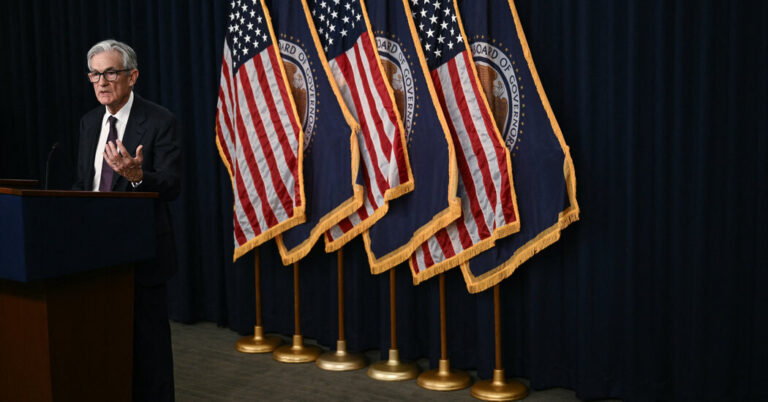
That has made Jay Powell one of the biggest beneficiaries from Monday’s U.S.-China tariff truce. The Fed chief may feel vindicated for holding steady on borrowing costs even as Wall Street second-guessed him and President Trump called him a “fool” for refusing to cut.

The markets have come around to the Fed’s thinking. Futures traders now see roughly two cuts this year. That’s down from five on April 7 and in line with the central bank’s March forecast that market watchers had widely questioned. Some economists see even fewer, especially with resurgent signs of inflation.

While many investors worry that Trump’s tariffs on Chinese imports may stick, the pause signals that such duties won’t be cripplingly high — and that the Fed won’t be forced to cut rates in an effort to bolster the economy.

At a U.S.-Saudi investment conference in Riyadh on Tuesday, Treasury Secretary Scott Bessent said there was momentum for forging more trade deals, including with Indonesia, South Korea and Taiwan. “At the end of the day, we will reach a satisfactory conclusion,” he said, adding that it could take longer to reach an accord with the European Union.

That said, companies aren’t taking their chances. They have begun frantically rushing their orders from China to take advantage of the temporary tariffs relief. “Ninety days is not a long runway for people in our business,” Gene Seroka, the executive director of the Port of Los Angeles, told The Times.

Will panic buying show up in Tuesday’s C.P.I. data? Some economists expect to see the first signs that consumers are getting squeezed by Trump’s trade war, with so-called core prices — which strip out food and fuel — having risen by a predicted 0.3 percent month-on-month.

More evidence of that could come with Thursday’s retail sales report. David Mericle, a Goldman Sachs economist, wrote in a research note on Monday that he expected to see “a boost from consumers front-loading purchases ahead of tariffs.”

All that points to Powell and the Fed sticking to their guns. That could once again anger Trump. But such a move would align with the growing consensus that there’s no risk in the central bank continuing to wait until the trade-war fallout becomes clearer.

Bill Adams, the chief economist for Comerica Bank, wrote in a research note that he saw no cuts this year. He added that the Fed “won’t think it necessary to cut interest rates this year with fewer fears of recession, and with fiscal policy set to provide more support to growth in 2026.”


DEALBOOK WANTS TO HEAR FROM YOU

We’d like to know how the tariffs are affecting your business. Have you changed suppliers? Negotiated lower prices? Paused investments or hiring? Made plans to move manufacturing to the U.S.? Or have the tariffs helped your business? Please let us know what you’re doing.

UnitedHealth Group names a new C.E.O. The giant health insurer said on Tuesday that its chair and former chief, Stephen Hemsley, would replace Andrew Witty, who was stepping down for “personal reasons.” The company also said it had suspended its 2025 financial outlook. Shares in UnitedHealth were down 10 percent in premarket trading.

Newark airport experiences more delays amid signs of strain. Flights to Newark Liberty International were delayed by as much as seven hours yon Monday, as the airport suffered staffing shortages. (As few as three air traffic controllers were scheduled to work last night, far fewer than the target of 14 controllers for most of those hours.) That said, the C.E.O. of United — Newark’s biggest carrier — told customers that flights to and from there were “absolutely safe.”

Pharmaceutical stocks rise as executive order on drug prices proves limited. While President Trump had promised that “drug prices will come down,” the order he signed on Monday merely pushes drugmakers to voluntarily reduce prices and doesn’t explicitly seek to link U.S. costs to those of other countries. Shares in Merck jumped 5.9 percent on Monday, while those in Pfizer climbed 3.6 percent and those in Eli Lilly rose 2.9 percent.

The Trump administration may sell chips to an Emirati A.I. company. Officials are weighing the sale of hundreds of thousands of artificial intelligence processors to G42, which the U.S. government had previously scrutinized for its ties to China, The Times reports. It’s one of several deals the White House is negotiating with Middle Eastern countries, as Trump tours Saudi Arabia, Qatar and the United Arab Emirates, with hopes of striking over $1 trillion worth of business agreements.

Hollywood presses Trump for tax breaks to revive U.S. film production. Groups including the Motion Picture Association and the main writers’ and actors’ guilds called for new tax incentives to persuade production companies to make more movies and TV shows in the U.S. It follows up on Trump’s (since minimized) threat to impose tariffs on movies made outside the country, which set off panic in Hollywood.

Criticism has done little to dissuade President Trump and his family from seeking to profit from crypto. The latest example: A Bitcoin mining business backed by Eric Trump, one of the president’s sons, plans to go public via a merger with a competitor.

But that — and Trump’s intention to proceed with a dinner for the biggest holders of his memecoin — further illustrate how the Trumps have turned to crypto to bolster their fortunes.

Example A: American Bitcoin, which said on Monday that it planned to combine with the publicly traded Gryphon Digital Mining and take over its Nasdaq listing. It’s a small deal, with Gryphon’s market value before the agreement was announced standing at about $36 million. Existing American Bitcoin shareholders are expected to own about 98 percent of the company.

A publicly traded American Bitcoin provides a way for people to invest in a Trump family business — potentially attractive for those seeking favor from the president. Consider that shares in Gryphon soared Monday on the news, giving it a market value of $98.5 million, with more than 259 million shares trading hands. (The average trading volume for Gryphon is far, far lower than that, and just last week it was trading well under a buck.)

Example B: $TRUMP. The president on Monday ended an auction in which the top 220 holders of his memecoin would win seats at a dinner with him set for next week, a contest that crypto investors worldwide raced to participate in. The top holder, according to the contest’s website, was identified as “Sun” — which The Times, with the help of two crypto forensics companies, identified as an overseas exchange linked to the crypto entrepreneur Justin Sun, whom the S.E.C. had sued for fraud in 2023.

Buying $TRUMP coins helps Trump in a couple of ways. The frenzy of investments pushed up the paper value of the Trump family’s holdings. And the Trumps and their business partners collect a fee from every transaction involving the memecoin, to the tune of $1.3 million in a matter of weeks, according to The Times.

Critics point to potential conflicts of interest, including the possibility of seeking to influence Trump. Several buyers of $TRUMP explicitly said that they wanted to lobby Trump directly: The C.E.O. of a transportation logistics company announced last month that he would buy $20 million worth of the token to press the president to lower tariffs on Mexican goods. (The company later said it “currently does not have plans” to have a representative at the dinner.)

Buying the memecoin or shares in American Bitcoin also offers an end-run around U.S. ethics laws: While noncitizens can’t donate to political campaigns, they can invest in those assets.

“It looks very corrupt,” Senator Ron Wyden, Democrat of Oregon, told The Times. And Senator John Kennedy, Republican of Louisiana, previously told The Times that he would support a ban on “all public officials” using their positions to profit from digital currencies.

Crypto isn’t the only area critics are concerned about. Trump on Monday angrily brushed off concerns about accepting a Boeing 747 from Qatar: “You should be embarrassed asking that question,” he told one reporter.


Tuesday will be a big one for Republican lawmakers, who are set to begin debating an expansive tax bill meant to fulfill key parts of President Trump’s campaign pledges on taxes.

Congressional Republicans are aiming big. But they will need to find huge savings in the federal budget to offset generous tax cuts.

What’s in the draft legislation:

  • Raising the capital gains tax on some types of university endowments, which could hit schools like Harvard and Yale that already face funding cutbacks after the White House’s assault on higher education.

  • Targeted cuts to Medicaid, including stricter citizenship checks and work requirements for some recipients, and tougher screenings for health care providers. (Still, Republicans are fearful of political blowback.)

  • A phaseout of electric vehicle tax credits, including a popular $7,500 commercial-vehicle credit. Many of these were first introduced under the Biden administration. The rebates and tax breaks were a significant driver of E.V. sales in recent years, and come as the sector has been clobbered by Trump’s tariffs.

Homeowners and wage earners could get some relief. Some tips and a portion of overtime pay would be spared from the I.R.S., a prominent Trump campaign promise. And taxpayers would be able to deduct up to $30,000 of their state and local tax tab, up from $10,000 now, though extending the deduction often known as SALT has long been a tough ask within the party as it would most benefit affluent homeowners in blue states.

A tax on the wealthiest Americans, which Trump had called for last week, isn’t currently in the package.

What’s next? Some major House committees will debate their portions of the bill before sending them to the full chamber for a vote. They include:

But some Republican lawmakers have already challenged parts of the plan, making it harder for party leaders to pass their package in the face of what’s expected to be unified Democratic opposition.

Deals

  • Perplexity, the A.I.-powered search engine, is said to be in talks to raise new funds at a $14 billion valuation. (WSJ)

  • SoftBank’s efforts to raise money for the immense Stargate A.I. data center projects have reportedly stalled amid economic uncertainty stoked by President Trump’s tariff policies. (Bloomberg)

Politics, policy and regulation

Best of the rest

We’d like your feedback! Please email thoughts and suggestions to dealbook@nytimes.com.


Source link

Jack Draper: British No 1 to face Carlos Alcaraz in Italian Open quarter-finals after beating Corentin Moutet | Tennis News

0


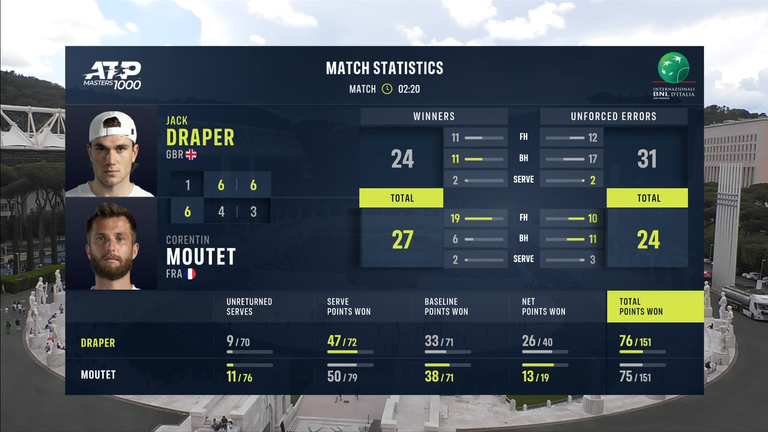
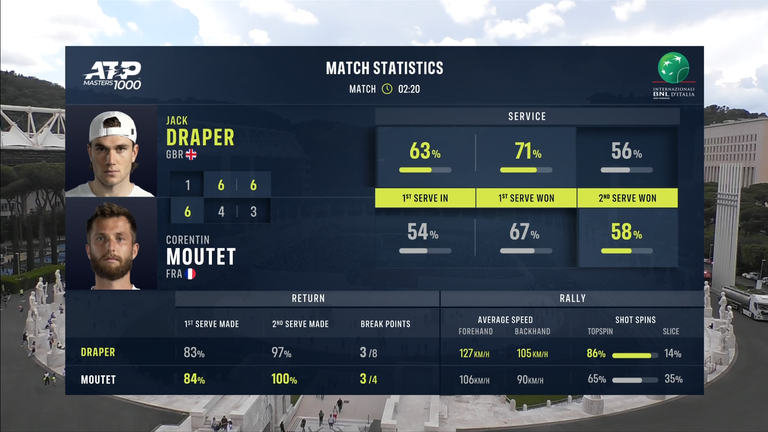
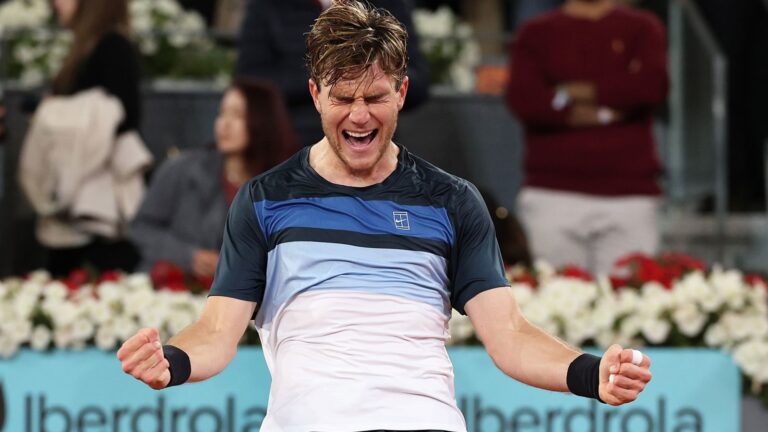
Jack Draper set up a mouth-watering Italian Open quarter-final showdown with Carlos Alcaraz after defeating flamboyant Frenchman Corentin Moutet to progress in Rome.

Draper was unable to cope with Moutet’s magic in the first set, but he soon composed himself and battled back to claim a 1-6 6-4 6-3 victory on the red clay courts of the Foro Italico.

Draper: I felt like I was on a string

Please use Chrome browser for a more accessible video player

Draper reflected on a difficult battle with Frenchman Moutet as he reached the quarter-finals in Rome

“Honestly, I was a bit bamboozled at the start, to be honest. I haven’t played someone like that, well, ever, I don’t think,” Draper admitted to Sky Sports Tennis’ Gigi Salmon.

“I felt like I was on a string, like I didn’t know what I was doing. And then I came out in the second set and just fought for every point and found a way in the end to pick up my level and it was a good one to come through. It feels good.

“You don’t know what’s happening shot to shot. You can almost get sucked into his way of playing. I was all over the court.

“At one point, I was looking at the slides that I’ve been doing in one game. I was literally covering the whole court with drop shots. I don’t know what was going on. I’ve got a dizziness from it. Credit to Corentin. He honestly played a great match. To come through that one was amazing.”

Tale of the Tape

Jack Draper: Tale of the Tape

Watch the ATP and WTA Tours, as well as the US Open in New York, live on Sky Sports in 2025 or stream with NOW and the Sky Sports app, giving Sky Sports customers access to over 50 per cent more live sport this year at no extra cost. Find out more here.


Source link

4 Memorable Moments From Presidential Visits With Saudi Leaders

0


American presidents have been visiting Saudi Arabia for decades, and the trips have often produced memorable moments — some dramatic, others downright odd.

As President Trump returns to Saudi Arabia, here is a look back at four moments from past presidential trips to visit leaders of the oil-rich Gulf state.

The relationship between the United States and Saudi Arabia appeared to be wilting before President Joseph R. Biden Jr. visited Jeddah in 2022.

Mr. Biden, as a candidate in 2019, had vowed to turn Saudi Arabia into a “pariah” over the killing of the Washington Post journalist Jamal Khashoggi, which the C.I.A. said had been ordered by the Saudi crown prince, Mohammed bin Salman.

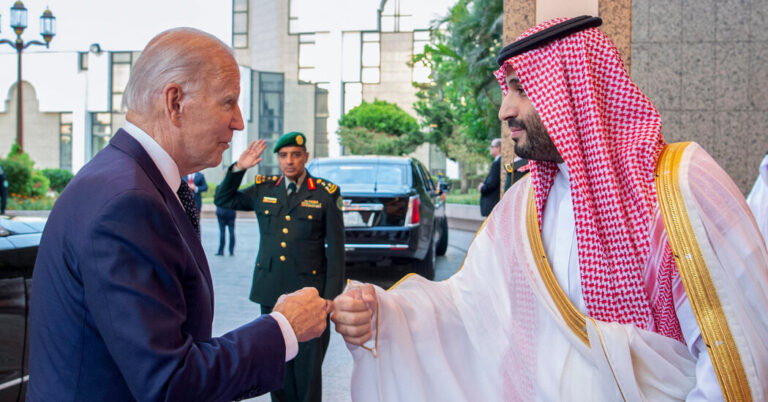
But as Mr. Biden worked in 2022 to manage oil prices, which spiked after Russia’s full-scale invasion of Ukraine, the president took a different tack. Arriving at the Royal Palace, Mr. Biden, grinning slightly, gave the crown prince a fist bump as a bank of cameras rolled.

The Saudi government quickly posted an image of the fist bump on social media. Mr. Biden later told reporters that he had privately confronted Prince Mohammed about the killing, and that the prince “basically said that he was not personally responsible for it.”

Back in Washington, Mr. Biden became impatient when pressed on the fist bump. “Why don’t you guys talk about something that matters?” he chided a reporter.

Within months, Mr. Biden acknowledged that the trip had not produced the surge in Saudi oil production that he had sought.

It looked like something from a children’s movie.

During a visit to Riyadh, the Saudi capital, early in his first term, Mr. Trump found himself laying hands on a glowing white orb.

Beside him, King Salman of Saudi Arabia and President Abdel Fattah el-Sisi of Egypt also placed their hands on the sphere. An image of the men touching the orb — with the first lady, Melania Trump, looking on — circulated widely on social media, with memes multiplying in short order.

One meme likened the image to that of Saruman, the “Lord of the Rings” villain, tapping into a seeing stone.

But the orb in Riyadh was not, it turned out, magical.

The sphere was a translucent globe, apparently decorative, at a facility filled with computer terminals and devoted to combating extremist ideology.

President Richard M. Nixon met a warm reception in Jeddah during a five-nation sweep through the Middle East in the spring of 1974.

Nixon arrived hoping to encourage the country to help reduce oil prices, according to passages of his memoirs published by the Richard Nixon Foundation.

But he also came with another goal — pushing Saudi Arabia to use its considerable regional influence to push for peace in the Middle East.

In remarks at the State Palace, he emphasized to his hosts that he did not come just to win cheaper oil.

“We can use oil, but we need more, something far more than oil,” the president said. “We need wisdom.”

Though he did not travel to Saudi soil, President Franklin D. Roosevelt met with the founder of Saudi Arabia, King Abdulaziz al-Saud, on a U.S. warship in the Great Bitter Lake, part of the Suez Canal in Egypt.

Roosevelt charmed the king, who struggled to walk, by presenting him with the gift of a wheelchair.


Source link

Robert Shapiro, Who Made NutraSweet a Household Name, Dies at 86

0


Robert B. Shapiro, a brash former law professor turned corporate executive who performed a marketing miracle by branding aspartame as the sugar substitute NutraSweet and making it a household name that consumers demanded in thousands of products, died on May 2 at his home in Chicago. He was 86.

The cause was pancreatic cancer, his son James Shapiro said.

Aspartame was invented by chemists at the pharmaceutical company G.D. Searle in Illinois in 1965 and approved by the Food and Drug Administration for use in soft drinks in 1983, a year after Mr. Shapiro became chief executive and chairman of what the company was already calling its NutraSweet subsidiary.

Unlike its chief rival, saccharin, which had dominated the market in the 25 years since it was approved, aspartame leaves no bitter aftertaste and wasn’t suspected of being linked to cancer. (In 2023, however, the World Health Organization identified aspartame, on the basis of “limited evidence,” as “possibly carcinogenic.”) It has virtually no calories and, despite its brand name, virtually no essential nutritional value.

In 1985, Searle sold $700 million worth of aspartame, identified as NutraSweet by the tiny but distinctive red-and-white swirl logo that appeared on the packaging of food and drink products that appealed to dieters and other consumers who wanted to avoid sugar.

“Shapiro built a marketing campaign around that trademark, convincing consumers that NutraSweet (and no other company’s version of the very same sweetener) was the key to losing weight,” Daniel Charles wrote in “Lords of the Harvest: Biotech, Big Money, and the Future of Food” (2001).

Mr. Shapiro’s role in branding and marketing NutraSweet, which costs more than saccharin but is sweeter, earned him a place in the “business history books,” Jesse Meyers, the publisher of the industry newsletter Beverage Digest, told The New York Times in 1989. Products had been branded routinely, but rarely had a single ingredient that they contained.

Federal authorities approved Simplesse, a fat substitute developed by NutraSweet, as an ingredient in frozen desserts in 1988 and, later, in other products.

Searle was bought by Monsanto in 1985. Mr. Shapiro was named president of the parent company in 1993 and chief executive in 1995, as Monsanto transitioned from mostly manufacturing chemicals to making drugs and genetically modified seeds, fertilizer and food additives.

Mr. Shapiro and his colleagues insisted that biotechnology products created by the company reduced the need for pesticides and weed control, expanded the food supply and reduced the amount of land needed to farm.

When Mr. Shapiro became Monsanto’s chief executive, “he carried the company’s already serious commitment to biotechnology to a whole new level, both psychologically and financially,” Rachel Schurman and William A. Munro wrote in “Fighting for the Future of Food: Activists Versus Agribusiness in the Struggle Over Biotechnology” (2010).

“Shapiro was by all accounts a persuasive, inspiring and motivational leader,” the authors added. “Indeed, Monsanto employees described him as a ‘visionary’ who swept people up with his larger sense of purpose and broad perspective on the technology.”

But environmental critics accused Monsanto of tampering with nature by concocting potentially dangerous vegetation and monopolizing the market for seeds. The company soon found itself struggling in the face of legal challenges, regulatory rulings and adverse public opinion in the United States and Europe.

“In retrospect, it seems incredibly naïve,” Mr. Shapiro said, but “we painted a big bull’s-eye on our chest.”

In a video address to the environmental advocacy group Greenpeace in 1999, Mr. Shapiro acknowledged: “Our confidence in this technology and our enthusiasm for it has, I think, widely been seen, and understandably so, as condescension or indeed arrogance. Because we thought it was our job to persuade, too often we forgot to listen.”

William C. Miller acknowledged in his book “Flash of Brilliance: Inspiring Creativity Where You Work” (1998) that “some of Monsanto’s products are controversial.” But, he added, “What you can’t argue about Bob Shapiro is that within his belief system, he’s absolutely sincere about doing what he thinks is the way to go to address hunger and address nutrition, as the world population explodes from six billion to 10 billion.”

Robert Bernard Shapiro was born on Aug. 4, 1938, in Manhattan. His father, Moses Shapiro, was the chairman and chief executive of the electronics company General Instrument. His mother, Lilly (Langsam) Shapiro, had worked for ASCAP, the music licensing organization.

He attended the Horace Mann School in the Bronx before earning a bachelor’s degree in 1959 from Harvard College, where he studied English and history, and a law degree in 1962 from Columbia Law School.

Mr. Shapiro practiced law in New York (he represented rent strikers in East Harlem and the poet Allen Ginsberg, among others, without fee) and taught at the law schools of Columbia, the University of Wisconsin and Northeastern University. He was a lawyer for the U.S. Transportation Department during the Johnson administration before joining General Instrument, where he worked from 1972 to 1979 as vice president and counsel.

He joined Searle in 1979. After Monsanto merged with Pharmacia & Upjohn in 1999, he served as chairman of the combined company, Pharmacia Corporation, until early 2001.

A liberal Democrat who had no formal training in science, Mr. Shapiro was more comfortable playing the casual college professor than the high-powered lawyer. He offered his employees free silent meditation retreats and performed as a folk guitarist. (His children Nina and James were in the alternative rock band Veruca Salt in the 1990s.)

After stepping down as chairman of Pharmacia Corporation, he was a founder of Sandbox Industries, a venture capital firm. He was also an early board member of Theranos, the blood-testing company established by Elizabeth Holmes, who was later convicted of fraud.

In addition to his son James and his daughter Nina Gordon, both from his marriage to Berta Gordon, he is survived by his wife, Ginger Farley; two children, Kai and Gabe Shapiro, from his later marriage to Kemery Bloom; his stepchildren, Harley Mac Cionaodha and Lydia Link; his sister, Susan Garfield; his brother, Bill Shapiro; and four grandchildren.

“We did proceed on the basis of our confidence in the technology,” Mr. Shapiro said of Monsanto in an interview with The Wall Street Journal in 1999. “And we saw our products as great boons both to farmers and to the environment. I guess we naïvely thought that the rest of the world would look at the information and come to the same conclusion.”


Source link

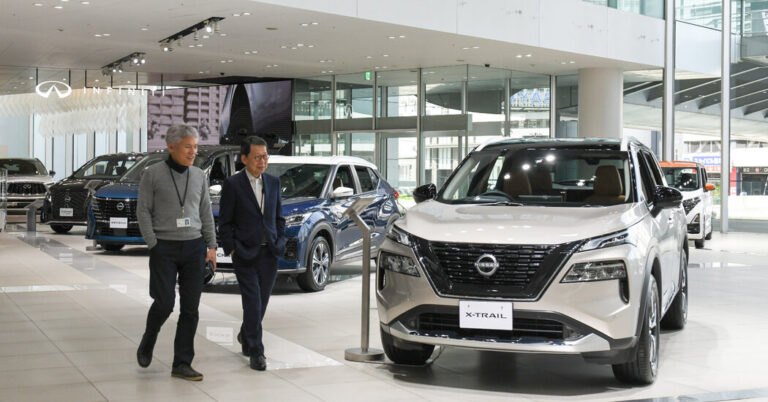
Tariff Misery in Japan: Honda and Nissan Forecast Plunges in Profit

0


President Trump’s decision to negotiate a break for China on tariffs is galling for Japan, which is reeling from auto sector levies that the White House has shown no sign of willingness to lift.

Japan, a top U.S. ally in Asia, was eager to advance trade negotiations with Washington, even as Mr. Trump imposed tariffs on automobiles, and threatened an across-the-board 24 percent tariff on Japanese goods.

While Beijing and others assembled plans for retaliatory tariffs, Japan rushed to Washington for trade negotiations, armed instead with commitments to buy more American goods and boost investments in the United States to $1 trillion.

Now in Tokyo, the sting is palpable.

On Tuesday — one day after the Trump administration agreed to temporarily nix most of its tariffs on China — two of Japan’s top automakers issued dire profit forecasts, weighed down by the effects of U.S. car tariffs.

Honda Motor said that its operating profit would fall nearly 60 percent for the fiscal year that began in April. It attributed the downgrade to a whopping $4.4 billion hit from tariffs.

Nissan Motor suspended its profit forecast for the current year, and said that it would likely swing to an operating loss in the first quarter. The automaker, which was already restructuring its global operations before the U.S. tariffs, said it would slash an additional 11,000 jobs on top of the 9,000 cuts it announced in November.

In Japan there is a sense of disbelief and indignation among business leaders and government officials that the Trump administration backed down on China tariffs, while maintaining punishing levies on allies like Japan with significantly smaller trade imbalances.

The fact that the U.S. prioritized China over many other trade partners in reaching a tariff agreement showed that “at this stage, allies like Japan are at a disadvantage,” said Kazuhiro Maeshima, a professor of American politics and diplomacy at Sophia University in Tokyo. “This can only be seen as disregard,” he said.

Earlier this month, a 25 percent U.S. tariff on vehicle imports was extended to cover auto parts as well. Those two levies are particularly painful for Japan because automobiles and car parts are by far its biggest export to the United States.

Economists estimate that the higher auto tariffs alone could put a big dent in economic growth in Japan this year. Factoring in broader disruptions from U.S. tariff policy, officials have predicted that growth could be more than halved.

That is because the auto sector is the backbone of Japanese industry. Nissan has already planned to shift some manufacturing to the United States to skirt tariffs, and if such moves are replicated by others, it could spark a broader hollowing out of industrial production in Japan.

Japan’s biggest automaker, Toyota Motor, said last week that while it aimed to protect production and jobs in Japan, U.S. tariffs would likely cost it more than $1 billion in April and May alone.

Honda’s chief executive, Toshihiro Mibe, said on Tuesday that the company plans to expand manufacturing in the United States to try to recover some of the billions of dollars of tariff losses it forecast. That includes moving some domestic production of its hybrid Civic to a factory it operates in Indiana, he said.

Japan is also negotiating with the United States regarding the proposed 24 percent “reciprocal” tariff, which the Trump administration announced last month and then delayed until early July. The next round of trade talks is expected later this month, but progress has stalled.

Japan has said lower tariffs on cars are a necessary condition of any trade deal, a position that Prime Minister Shigeru Ishiba reiterated in parliament on Monday.


Source link

How the Columbia River Treaty Got Tangled in Trump’s Feud With Canada

0


Caught up in the tariff spat between the United States and Canada is a little-known treaty that shapes the lives of millions of Americans and Canadians.

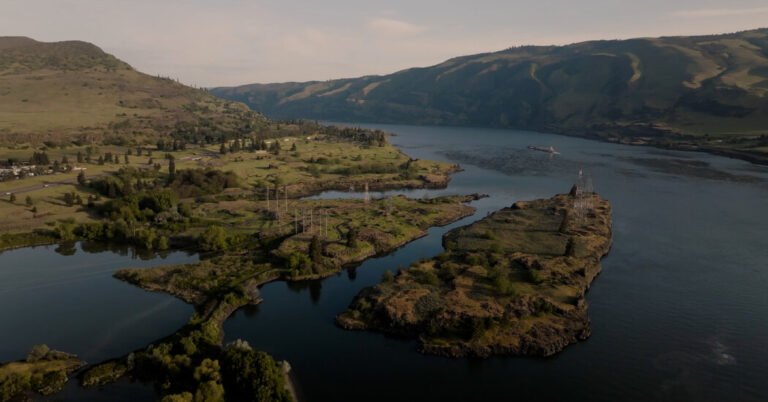
The 60-year-old treaty governs the water rushing down the Columbia River, which snakes from British Columbia through Montana, Idaho, Washington and Oregon, and provides the single largest source of hydropower in the United States. But parts of the treaty expired around the U.S. presidential election.

Negotiators were still weeks away from completing the details of an updated version of the treaty when President Joseph R. Biden Jr.’s term ended. Then a decade of talks crashed into President Trump’s hostility toward Canada. He called Canada the “51st state,” slapped tariffs on Canadian exports and fixated on tapping its water as a “very big faucet.”

In a contentious call in February with Canada’s prime minister at the time, Justin Trudeau, Mr. Trump included the treaty among the ways he said Canada had taken advantage of the United States. The implication was clear: The treaty could become a bargaining chip in a broader negotiation to remake the relationship between the two counties.

Prime Minister Mark Carney and Mr. Trump turned down the heat during their meeting at the White House last week. But the Trump administration has made even treaties with benefits for both sides feel like a negotiation on the edge of a knife. Mr. Trump’s erratic trade policies have thrown uncertainty into the future of the Pacific Northwest, creating new worries around everything from electricity to flood control.

Data centers that power the internet and artificial intelligence run off the Columbia River’s power. Twilight soccer games duke it out at riverfront parks funded by local dams. Irrigation from its reservoirs supplies water to rolling acres of Pink Lady and Gala apple orchards. Coordinated dams hold back floods in Portland, Ore., and elsewhere.

Mr. Trump touched a raw nerve among Canadians, who have long worried that the United States sees their resources — water in particular — as its to plunder. “They want our land, they want our resources, they want our water, they want our country,” was a mantra Mr. Carney repeated during his successful run for prime minister.

“The Canadians feel such a sense of betrayal,” Jay Inslee, until recently the governor of Washington, said in an interview. The treaty ties together an intricate web of cultural and economic interests. “It is not easy to negotiate that,” Mr. Inslee said, “and it makes it much harder when the guy across the table thinks you are a snake in the grass.”

A spokesman for British Columbia said there had not been “any movement at all” since the U.S. State Department paused the negotiations as part of a broad review of the country’s international commitments. While that’s typical after a change in administration, “that sounds like a strange euphemism for what’s going on,” Adrian Dix, the province’s energy minister, told almost 600 people in a virtual town hall in March.

Mr. Dix said local residents had pulled him aside at the Save-On-Foods market to ask if Canada should pull out of the treaty altogether. “For the people of the Columbia Basin, this is visceral,” he said. “This is part of their lives and histories and souls.”

If the pact were to blow up, the United States expects it would become “more difficult to control and predict” hydropower production, and increase uncertainty for preventing floods in the Pacific Northwest, according to a nonpartisan congressional report. The region’s electricity needs could double in the next two decades, according to new estimates from an interstate power council.

The State Department declined to comment.

The treaty’s roots date to Memorial Day in 1948. After a heavy spring rain, a 15-foot wall of water wiped out Vanport, Ore., a city just outside Portland that had housed thousands of shipyard workers during World War II. The devastation left 18,000 people homeless and kicked off negotiations with Canada on how to better manage the Columbia River.

On one of President Dwight D. Eisenhower’s final days in office, he signed the Columbia River Treaty, which traded between two priorities: Canada agreed to build several dams that would bear the brunt of flood control for the United States, and America agreed to give Canada half of the additional electricity produced on the river by jointly managing the flow across American dams.

The original pact went into effect in the fall of 1964, with some provisions expiring after 60 years.

The discussions to update the treaty before parts expired in 2024 started during the first Trump administration. Mr. Biden paused them briefly, then resumed. In March 2023, the entire congressional delegation from the Pacific Northwest urged getting a deal done. After the slow start, the United States and Canada announced the rough outlines of agreement last summer that reflected a reality far different from what the treaty writers in the 1960s anticipated.

The power generated under the original treaty ended up being much more valuable than originally expected, with Canada’s half totaling roughly $300 million a year. That was far more than it needed, so Canada sold a lot of power back to the United States, much to the chagrin of U.S. utilities.

The updated plan cut Canada’s take by roughly half over time. That allows the United States to keep more power just as energy demand is growing for the first time in decades.

The river’s cheap, clean hydropower has been a major draw for tech companies looking to build data centers over the past two decades, even more so as artificial intelligence increases their hunger for power.

“The country, as a whole, needs to understand how important the Pacific Northwest is in that emerging picture,” said David Kennedy, who studies the history of the region at Stanford.

In return, Canada under the updated treaty reduced how much water it had to guarantee to store for flood control, giving it flexibility to prioritize the communities and ecosystems around the reservoirs. The original treaty created drastic fluctuations in the height of the water, exposing miles of dirt when the water was drawn down to prepare for snowmelt.

“Each year, this dry bottom creates terrible dust problems,” one resident near Valemount, British Columbia, told Mr. Dix at the town hall.

The new plan created more stable heights for the reservoirs so Canada can restore the ecosystems along the shores, and create better recreation.

The negotiations involved Indigenous tribes, which had no say in the initial treaty even as their fishing grounds and towns were decimated by dams.

Jay Johnson, a Canadian negotiator from the Syilx Okanagan Nation, said in the virtual town hall that the tribes on both sides of the border found common ground in restoring salmon migration. The updated plan created provisions for extra water in dry years, which he called “essential for the survivability of salmon, particularly in the context of climate change.”

In the fall, when some provisions of the original treaty expired, the countries signed a three-year interim agreement, though parts still require additional congressional appropriations. Either side must give a decade’s notice before leaving the treaty.

“It provides benefits on both sides of the border, and absent that treaty, you’ve got a lot of problems,” Jonathan Wilkinson, Canada’s minister of energy and natural resources, said in an interview.

No one is quite sure what will happen next. Some of the people who worked on the deal were still in place, but Mr. Trump has not yet appointed an assistant secretary for Western Hemisphere affairs. The situation is all the more precarious because of Mr. Trump’s attempt to reduce the work force at key federal agencies involved in the treaty talks, including the National Oceanic and Atmospheric Administration and the federal power authority.

With the negotiations up in the air, people close to the talks in the region are hopeful the updated treaty can still be resolved.

Barbara Cosens, a law professor at the University of Idaho, said that while the Trump administration might not care about salmon habitats or the involvement of Indigenous groups, Canada did. Water may flow downstream, but salmon swim upstream, so keeping environmental provisions in play can give the United States leverage, Ms. Cosens said.

And supporters point to years of bipartisan support from Senators Maria Cantwell of Washington, the ranking Democrat on the Senate commerce committee, and Jim Risch of Idaho, the Republican chairman of the Senate Committee on Foreign Relations.

“There is zero daylight between the Republicans and Democrats on this one,” said Scott Simms, chief executive of the Public Power Council, which represents the consumer-owned utilities in the region.

The stakes are not hypothetical. In 1996, after heavy snow, a so-called pineapple express storm dumped warm rain in the Portland area, unleashing a torrent of water. The Army Corps of Engineers worked for days, manipulating more than 60 dams in the Columbia River system with its partners in Canada to hold water at bay.

A smaller river that flows into the Columbia still flooded, killing eight people. With makeshift levees built from plywood and sandbags, Portland’s downtown was just barely spared.

Ivan Penn contributed reporting from Houston, and Matina Stevis-Gridneff from Toronto.


Source link

U.S. Could Lose $12.5 Billion In International Travel Spending This Year, Tourism Council Says

0


The U.S. welcome mat is rolling up — at least that’s how some international travelers see it, according to the World Travel & Tourism Council, a global organization representing the travel and tourism industry. And the cost for that hospitality lapse will be high.

The United States is on track to lose $12.5 billion in international travel spending this year, falling to less than $169 billion from $181 billion in 2024, according to the latest Economic Impact Research, published by the W.T.T.C. on Tuesday.

That’s a 22.5 percent decline from the U.S. international spending peak of $217.4 billion in 2019 — and it comes after months of Trump administration policies that have deterred foreign travelers from visiting because they either feel unwelcome or unsafe.

Julia Simpson, the president and chief executive of the W.T.T.C., said that while last year U.S. travel spending remained below 2019 levels — mainly because the dollar’s strength made it expensive for international travelers — the downward projection for this year is driven by negative sentiment in the wake of tourist detentions and steep tariffs.

“The near neighbors, Canada and Mexico, are not traveling,” Ms. Simpson said, referring to a decline in travelers from those countries in reaction to immigration crackdowns, tariffs and politically charged statements on the part of the Trump administration. “There are also concerns over visas — whether they’ve got the right visa or might accidentally get arrested, which has made people quite fearful.”

The United States is the only country among the 184 economies analyzed by the W.T.T.C. and the global economic advisory firm Oxford Economics that is forecast to see an international visitor decline in 2025. As the United States tightens immigration and scrutinizes visitors at its borders, other countries, like China, are relaxing visa requirements, aiming to encourage international tourism.

“While other nations are rolling out the welcome mat, the U.S. government is putting up the ‘closed’ sign,” Ms. Simpson said. “I’m quite sure President Trump, with his background in hospitality, understands that holiday makers just want to come and enjoy the beautiful country and the people and the history and then go home again,” she said. “They don’t want to live there.”

The United States still has the world’s largest tourism and travel market, which contributed $2.36 trillion to the nation’s economy last year. But 90 percent of tourism spending in 2024 came from domestic tourists.

The W.T.T.C. says not encouraging international tourism to the United States is a missed opportunity because that’s where the real growth lies. Foreign travelers spend an average of $4,000 per trip — eight times more than domestic travelers, according to the U.S. Travel Association. In 2024, the United States welcomed 72.4 million international visitors, 7 million fewer than in 2019. International arrivals have steadily declined this year, with significant drops in March from key markets like Canada, Britain and South Korea, according to U.S. Department of Commerce data.

While part of that decline can be attributed to the fact that Easter fell late this year, pushing back a popular travel window — particularly from Western Europe — many U.S. travel companies have revised their projections for the summer to reflect the downward trend.

“Without urgent action to restore international traveler confidence, it could take several years for the U.S. just to return to prepandemic levels of international visitor spend,” Ms. Simpson said.


Follow New York Times Travel on Instagram and sign up for our Travel Dispatch newsletter to get expert tips on traveling smarter and inspiration for your next vacation. Dreaming up a future getaway or just armchair traveling? Check out our 52 Places to Go in 2025.


Source link