Home Blog Page 312

With Guarantees Galore, Christie’s Has a Rocky Start to Auction Week

0


Chandelier bidding. Quiet phone banks. Executives wiping their brows.

One of the most anticipated auctions of the season proved to be anticlimactic on Monday evening at Christie’s in New York, where many objects were presold to guaranteed bids and there was little evidence of the enthusiastic buyers who defined the market’s peak in 2022. Experts said the sale was marred by the economic uncertainty surrounding President Trump’s tariffs and how they might hurt the global art market.

Louise Riggio consigned nearly 40 works from the collection she built with her husband, the Barnes & Noble founder Leonard Riggio, who died last year. A second auction on Monday night, called the 20th Century Evening Sale, fared better, with more artworks selling above their estimates and livelier bidding on the phones and in the room.

The auction house had guaranteed the consignors an undisclosed minimum amount for their entire collection and then worked feverishly in recent days to offload the auction house’s risk, object by object, by finding outside buyers to leave their own pre-sale bids on works by modern masters like Piet Mondrian, Pablo Picasso and Alberto Giacometti.

At first glance, the Riggio collection appeared to have done fine with a $272 million total, including buyer’s fees. But stripped of the fees, the sale fell short of the auction house’s pre-sale expectations that included a low estimate of $252 million.

“Coming in? It should be now, ideally,” said the auctioneer, Adrien Meyer, at one point, struggling to find bidders on one of the lower-priced items in the sale, a terra-cotta vase by Picasso that ultimately sold within its estimate for $567,000, including fees.

The top lot of the Riggio sale was a 1922 gridded painting by Mondrian that had once greeted visitors in the grand entryway of the bookstore tycoon’s Park Avenue apartment. It sold for $47.6 million, including fees. The canvas, “Composition with Large Red Plane, Bluish Gray, Yellow, Black and Blue,” fell short of the previous record for a Mondrian, $51 million, set just three years earlier at Sotheby’s.

The canvas — no bigger than a throw pillow, at nearly 21 inches square — was still a showstopper in a bleak sale.

The art dealer Brett Gorvy said the Mondrian’s failure to spark a bidding war was a result of its aggressive estimate, about $50 million. “This wouldn’t have been such an issue a year ago when real depth of bidding was a major factor for driving prices.” he said. “Overpricing at the start was a deterrent with many collectors, despite the quality and rarity of the work.”

As the first major sale of the auction season, the Riggio collection was seen as a bellwether for this week’s major sales at Christie’s, Sotheby’s and Phillips, which have a combined estimate from $1.2 billion to $1.6 billion.

The 20th Century Evening Sale that followed finished with a total of $217 million including fees, against a low estimate of $194 million — squeaking by when taking into account the buyer’s fees. A major setback came mid-auction when the company announced it was withdrawing the season’s most expensive Warhol painting, “Big Electric Chair,” which had carried an estimate of about $30 million.

“The weakness of the Warhol market is a definite takeaway.” said the art adviser Jacob King after exiting the auction floor. “There is so much uncertainty in the financial markets, the response of the auction houses was to put guarantees on everything.”

But there were some signs of life. Paintings by Gerhard Richter, Vincent van Gogh and Helen Frankenthaler sold for above their high estimates, a sign of demand in the art market.

“Peupliers au Bord de l’Epte, Crépuscule,” an 1891 Monet painting of poplar trees sold for nearly $43 million including fees, after a five-minute bidding contest. The lawyer Thomas Danziger, who represented the anonymous seller behind the canvas, said the purchase — within the auction house’s estimate of $30 million to $50 million — was a positive sign.

“The world has obviously changed since the frothy art market of 2022,” said Danziger. “When it’s a choice between a blue chip painting and a more speculative artwork, a savvy collector is likely to say ‘Show me the Monet.’”

Not all sales were created equal, however, and some successful transactions demonstrated how far the market had fallen for certain artworks.

A painting by Lucio Fontana that had sold for nearly $14 million at Christie’s in 2017 (or $17.4 million when adjusting for inflation) returned to the auction house on Monday evening. It sold for just $7.5 million, including fees.

Bonnie Brennan, the chief executive at Christie’s, said the company had a positive performance. “It was a solid result,” she said. “Would we have liked to see even more excited bidding in the room? Of course.”

As Alex Rotter, Christie’s global president, added: “It’s a healthy market. One needs to work it very hard.”



Source link

With Guarantees Galore, Christie’s Has a Rocky Start to Auction Week

0


Chandelier bidding. Quiet phone banks. Executives wiping their brows.

One of the most anticipated auctions of the season proved to be anticlimactic on Monday evening at Christie’s in New York, where many objects were pre-sold to guaranteed bids and there was little evidence of the enthusiastic buyers who defined the market’s peak in 2022. Experts said the sale was marred by the economic uncertainty surrounding President Trump’s tariffs and how they might hurt the global art market.

Louise Riggio consigned nearly 40 works from the collection she built with her husband, the Barnes & Noble founder Leonard Riggio, who died last year. A second auction on Monday night, called the 20th Century Evening Sale, fared better, with some artworks selling above their estimates and livelier bidding on the phones and in the room.

The auction house had guaranteed the consignors an undisclosed minimum amount for their entire collection and then worked feverishly in recent days to offload the auction house’s risk, object by object, by finding outside buyers to leave their own pre-sale bids on works by modern masters like Piet Mondrian, Pablo Picasso and Alberto Giacometti.

At first glance, the Riggio collection appeared to have done fine with a $272 million total, including buyer’s fees. But stripped of the fees, the sale fell short of the auction house’s pre-sale expectations that included a low estimate of $252 million.

“Coming in? It should be now, ideally,” said the auctioneer, Adrien Meyer, at one point, struggling to find bidders on one of the lower-priced items in the sale, a terra-cotta vase by Picasso that ultimately sold within its estimate for $567,000, including fees.

The top lot of the Riggio sale was a 1922 gridded painting by Mondrian that had once greeted visitors in the grand entryway of the bookstore tycoon’s Park Avenue apartment. It sold for $47.6 million, including fees. The canvas, “Composition with Large Red Plane, Bluish Gray, Yellow, Black and Blue,” fell short of the previous record for a Mondrian, $51 million, set just three years earlier at Sotheby’s.

The canvas — no bigger than a throw pillow, at nearly 21 inches square — was still a showstopper in a bleak sale.

The art dealer Brett Gorvy said the Mondrian’s failure to spark a bidding war was a result of its aggressive estimate, about $50 million. “This wouldn’t have been such an issue a year ago when real depth of bidding was a major factor for driving prices.” he said. “Overpricing at the start was a deterrent with many collectors, despite the quality and rarity of the work.”

As the first major sale of the auction season, the Riggio collection was seen as a bellwether for this week’s major sales at Christie’s, Sotheby’s and Phillips, which have a combined estimate from $1.2 billion to $1.6 billion.

The 20th Century Evening Sale that followed finished with a total of $217 million including fees, against a low estimate of $194 million — squeaking by when taking into account the buyer’s fees. A major setback came mid-auction when the company announced it was withdrawing the season’s most expensive Warhol painting, “Big Electric Chair,” which had carried an estimate of about $30 million.

“The weakness of the Warhol market is a definite takeaway.” said the art adviser Jacob King after exiting the auction floor. “There is so much uncertainty in the financial markets, the response of the auction houses was to put guarantees on everything.”

But there were some signs of life. Paintings by Gerhard Richter, Vincent van Gogh and Helen Frankenthaler sold for above their high estimates, a sign of demand in the art market.

“Peupliers au Bord de l’Epte, Crépuscule,” an 1891 Monet painting of poplar trees sold for nearly $43 million including fees, after a five-minute bidding contest. The lawyer Thomas Danziger, who represented the anonymous seller behind the canvas, said the purchase — within the auction house’s estimate of $30 million to $50 million — was a positive sign.

“The world has obviously changed since the frothy art market of 2022,” said Danziger. “When it’s a choice between a blue chip painting and a more speculative artwork, a savvy collector is likely to say ‘Show me the Monet.’”

Not all sales were created equal, however, and some successful transactions demonstrated how far the market had fallen for certain artworks.

A painting by Lucio Fontana that had sold for nearly $14 million at Christie’s in 2017 (or $17.4 million when adjusting for inflation) returned to the auction house on Monday evening. It sold for just $7.5 million, including fees.

Bonnie Brennan, the chief executive at Christie’s, said the company had a positive performance. “It was a solid result,” she said. “Would we have liked to see even more excited bidding in the room? Of course.”

As Alex Rotter, Christie’s global president, added: “It’s a healthy market. One needs to work it very hard.”


Source link

County Championship: Essex salvage remarkable draw against Yorkshire as Ollie Robinson stars for Sussex | Cricket News

0


Essex completed a remarkable rearguard action to salvage a draw in their County Championship match with Yorkshire, closing with an unbroken last-wicket stand that lasted 13.4 overs.

Jonny Bairstow’s side started the day with an insurmountable lead and six wickets to take but fell one short at Chelmsford, frustrated by some doggedly determined batting.

Matt Critchley (75 off 246 balls) and Michael Pepper (68 off 229) occupied the crease for a combined total of almost 10 hours to lead the resistance before both fell to George Hill.

Yorkshire kept pushing for a much-needed Division One win, leaving the hosts nine down with just under 40 minutes remaining, but Simon Harmer chewed through 115 deliveries and number 11 Jamie Porter kept him company until the close.

At Hove, out-of-favour England seamer Ollie Robinson put the finishing touches to Sussex’s victory over Worcestershire, with Jake Libby’s one-man show ultimately in vain.

Both sides entered the final day of the match with realistic hopes of winning – the Pears needing 244 runs and the hosts chasing seven wickets.

Libby was outstanding, turning his overnight 64 into 167, but the game slipped through Worcestershire’s fingers when he was eighth man out to Fynn Hudson-Prentice with 75 still required.

Robinson, who played his last Test 16 months ago but has expressed his desire to earn another chance, then picked off Fateh Singh and Ben Gibbon to seal a 47-run win.

The result lifted Sussex to third in the table, while Worcestershire remain winless in bottom spot.

Another England discard, Ben Foakes, ensured defending champions Surrey left Edgbaston with a share of the spoils.

In a run-fest against Warwickshire, the wicketkeeper made 174 not out to dash the home side’s hopes of forcing a result. His diligent batting with the tail, something the national selectors felt he did not always do well enough, carried the Brown Caps to 504 all out, 161 behind but entirely safe.

The pretence of a follow-on was initiated for five overs before the sides shook hands.


Source link

Trump Administration Considers Large Chip Sale to Emirati A.I. Firm G42

0


The Trump administration is considering a deal that could send hundreds of thousands of U.S.-designed artificial intelligence chips to G42, an Emirati A.I. firm that the U.S. government has scrutinized in the past for its ties to China, three people familiar with the discussions said.

The negotiations, which are ongoing, highlight a major shift in U.S. tech policy ahead of President Trump’s visit to the Persian Gulf states this week. The talks have also created tension inside the Trump administration between tech- and business-minded leaders who want to close a deal before Mr. Trump’s trip and national security officials who worry that the technology could be misused by the Emiratis.

The Trump administration has embraced cutting direct deals for A.I. chips with officials from the Middle East, as it looks to strengthen U.S. ties in the region, said the people, who spoke on the condition of anonymity because the negotiations are ongoing. The approach marks a break from the Biden administration, which had rejected similar A.I. chip sales over fears that they could give autocratic governments with strong ties to China an edge over the United States in developing the most cutting-edge A.I. models in coming years.

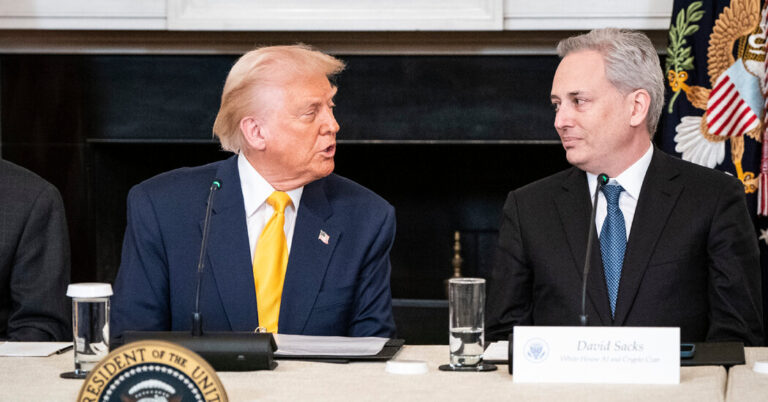
In the talks with G42 and officials from the United Arab Emirates, David Sacks, the White House A.I. czar, has been working on an agreement that would give the Emirati firm access to chips with limited oversight. Some of the chips would go to a partnership that G42 has with the U.S. firm OpenAI, while others would be sent directly to G42, one of the people said, adding that a deal is not yet final.

The Trump administration is also expected to announce a deal this week with officials in Saudi Arabia, two people with knowledge of the agreement said. The deal would give the Saudi government and its new A.I. company, Humain, access to tens of thousands of semiconductors and technology support from Nvidia and its A.I. chip rival, Advanced Micro Devices.

The United States began requiring a license for the purchase of A.I. chips during the Biden administration because of their value in helping governments develop military and surveillance technologies.

The Trump administration’s changes have the potential to reshape an arms race among nations, and countries eager to develop A.I. Major chip sales would be a boon for G42, potentially catapulting the Emirati firm to be one of the most powerful A.I. companies outside the United States. It would be a powerful catalyst for the businesses of Nvidia, the world’s leading A.I. chip maker. And it would fulfill OpenAI’s multiyear effort to bring more computing power to the Middle East.

Alasdair Phillips-Robins, a fellow at the Carnegie Endowment for International Peace and a former official in the Commerce Department, said a sale that included hundreds of thousands of advanced chips would risk handing “control of the future of A.I. to countries that have political systems that we shouldn’t fundamentally trust.”

“There’s a reason why these countries are so keen to get these chips, and it’s not purely the financial returns,” he said. “A.I. is going to be the backbone of militaries.”

The White House and G42 did not respond to requests for comment. OpenAI declined to comment.

Mr. Sacks has been in the Middle East for several days working on this and other deals. On Sunday, he posted a photo of himself on social media with Sheikh Tahnoon bin Zayed Al Nahyan, the national security adviser of the Emirates, who is also chairman of G42, saying they had discussed their nations’ A.I. plans and opportunities.

“The U.S. must make itself the partner-of-choice for our friends and allies — otherwise others will fill that gap,” Mr. Sacks wrote on X, the social media platform.

Sheikh Tahnoon said in a social media post that the discussions were part of strengthening economic ties between the countries. He added that “collaboration in advanced technologies serves as a cornerstone for building a smart, sustainable digital future that meets the aspirations of future generations.”

G42 is at the forefront of an Emirati effort to build an artificial intelligence industry and to lessen its dependence on oil income. The firm is controlled by Sheikh Tahnoon. It includes a $10 billion technology investment fund, an Arabic-language A.I. model, a tech talent platform, a health care company and a genome-sequencing program.

The firm has been clamoring for access to U.S. chips for several years, but negotiations with the Biden administration were slowed by concerns over its ties to China. In previous years, American spy agencies issued warnings about G42’s work with Chinese companies, including the telecom firm Huawei, and warned that G42 could be a conduit for siphoning advanced American technology to China. G42 has denied any connections to the Chinese government or military.

In 2023, a congressional committee wrote a letter urging the Commerce Department to look into whether G42 should be put under trade restrictions because it had partnerships with Chinese firms and employees who came from government-connected companies in China.

Before agreeing to sell chips to G42 in 2024, the Biden administration spent months negotiating security protections and a partnership with Microsoft. Under that agreement, Microsoft managed the chips to train and develop A.I. models, and G42 had permission to sell Microsoft services that use those chips.

But after cutting that deal, G42 pressed U.S. officials for more chips and wanted to be able to operate them directly. Sam Altman, the chief executive of OpenAI, also lobbied the U.S. government to approve more chip sales to the region.

Mr. Altman had been working with Emirati officials to expand global computing power because there had been a shortage of it in the United States. He wanted to increase the supply of chips and data centers because he believed it would allow OpenAI to build more powerful A.I. systems.

(The New York Times has sued OpenAI and its partner, Microsoft, accusing them of copyright infringement regarding news content related to A.I. systems. OpenAI and Microsoft have denied those claims.)

MGX, an Emirati investment firm, is an investor in OpenAI. Last year, it joined a group of investors that contributed $6.6 billion to the start-up.

A former Biden administration official said G42 had requested roughly 200,000 A.I. chips for its partnership with Microsoft, as well as at least 500,000 chips by 2026 that would be solely owned and operated by G42. Senior Biden administration officials, even those who were open to cooperation with the gulf states, saw those levels of sales as a nonstarter, the person said.

As Mr. Trump travels around the Middle East this week, he is expected to hail deals made with both governments and companies. The administration is also expected to showcase deals and negotiations across the region by American tech companies, including AMD, Nvidia, Microsoft, Google and OpenAI, according to six people familiar with the plans.

The Trump administration has also announced that it plans to repeal a Biden administration rule that capped the number of A.I. chips that could be sent to certain countries, in favor of direct deal-making with governments.

The Middle East is most likely to be the first beneficiary of this change. Officials from the Emirates and Saudi Arabia have been negotiating with the Trump administration over the past two months to strike agreements that would provide them steady access to A.I. chips, deals which may be announced this week.


Source link

Hollywood Groups Call for Tax Changes After Trump’s Tariff Threat

0


Several Hollywood industry and labor organizations wrote to President Trump on Monday asking for tax breaks that they said would help bring more film and television production back to the United States.

Their letter was sent in response to Mr. Trump’s declaration on Truth Social this month that he would put a 100 percent tariff on films made outside the United States. It was signed by the Motion Picture Association, which represents the major Hollywood studios; the main writers’ and actors’ guilds; and the actors Jon Voight and Sylvester Stallone, two of Mr. Trump’s chosen Hollywood advisers.

“Returning more production to the United States will require a national approach and broad-based policy solutions,” the letter said.

The White House quickly walked back Mr. Trump’s tariff threat, but not before his post had put a spotlight on the declining levels of film and TV production in California and the United States. Gov. Gavin Newsom of California, who has long supported doubling his state’s tax credit for production, countered Mr. Trump by calling for a $7.5 billion federal tax credit.

The letter sent Monday focuses instead on three requests for changes to the tax code:

  • Extending a tax provision that allows up to $15 million of qualified film and television production expenses to be deductible in the year the expenses are incurred, instead of the year a film or television show is released. The group also asked for the limit to be raised to $30 million.

  • Allowing studios and production companies to carry losses to prior and future tax years.


Source link

Trump’s China Deal Frees Up Shipping. Will Goods Pour Into the U.S.?

0


For weeks, Jay Foreman, a toy company executive, froze all shipments from China, leaving Care Bears and Tonka trucks piled up at Chinese factories, to avoid paying President Trump’s crippling 145 percent tariff.

But as soon as his phone lit up at 4 a.m. on Monday alerting him that Mr. Trump was lowering tariffs on Chinese imports for 90 days, Mr. Foreman, the chief executive of Basic Fun, which is based in Florida, jumped out of bed and called his suppliers, instructing them to start shipping merchandise immediately.

“We’re starting to move everything,” Mr. Foreman said. “We have to call trucking companies in China to schedule pickups at the factories. And we have to book space on these container ships now.”

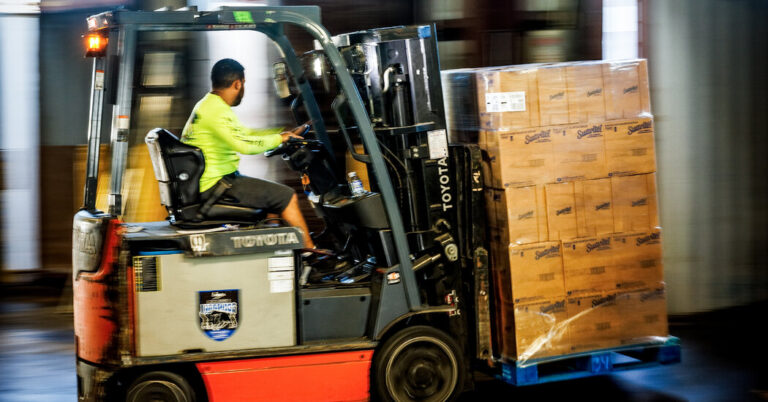
If other executives follow Mr. Foreman’s lead, a torrent of goods could soon pour into the United States. While logistics experts say global shipping lines and American ports appear capable of handling high volumes over the next three months, they caution that whiplash tariff policies are piling stress onto the companies that transport goods around the world.

“This keeps supply chain partners in limbo about what’s next, and leads to ongoing disruption,” said Rico Luman, senior economist for transport, logistics and automotive at ING Research.

After talks this weekend in Geneva, the Trump administration lowered tariffs on many Chinese imports to 30 percent from 145 percent. China cut its tariffs on American goods to 10 percent from 125 percent. If a deal is not reach in 90 days, the tariffs could go back up, though Mr. Trump said on Monday that they would not rise to 145 percent. Some importers may hold off on ordering from China, hoping for even lower tariffs later.

Importers weighing whether to rush goods in over the next 90 days must also determine if suppliers in China can fill those orders and get them onto vessels by the end of July. Voyages from Chinese ports to the West Coast of the United States can take two to three weeks.

Because the timing is tight, Gene Seroka, executive director of the Port of Los Angeles, does not expect a huge surge of imports in the coming weeks. “Ninety days is not a long runway for people in our business,” he said.

Mr. Seroka added that big retailers might have sufficient products at least for a while because they had brought in large volumes of goods before Mr. Trump’s tariffs took effect in April.

The 30 percent tariff is still high by historical standards, so importers may decide to pay it only for goods they really need.

But others may rush in shipments across the board. Mr. Foreman of Basic Fun said that while the 30 percent tax would pose a challenge to a medium-size company like his, it was manageable. He said he could discuss splitting the higher cost with his suppliers and the retailers that sold his products. At this tariff level, consumers can expect a roughly 15 percent increase in the price on some toys, he added.

The tariffs are one of many shocks to supply chains in recent years.

Spending during the coronavirus pandemic led to a deluge in imports that overwhelmed ports and shipping companies. And freight costs surged. Separately, low rainfall reduced the amount of water available to the Panama Canal, allowing fewer vessels to pass through. Then, in 2023, the Houthi militia in Yemen started attacking ships in the Red Sea, forcing most shipping lines to take a long detour around the southern tip of Africa. A dockworkers’ strike last year at ports on the East Coast of the United States caused more disruption.

Overall, supply chains functioned quite well after the upheavals of the pandemic.

Using the huge profits they earned during the pandemic, shipping lines bought scores of new vessels. As a result, they had the spare capacity to handle surges in volume and big disruptions like the detour around Africa.

The impact of Mr. Trump’s tariffs has been easy to spot in trade data. In the last five weeks, bookings to ship containers from China to the United States were 45 percent below the level in the same period last year, according to data from Vizion, a logistics technology company, and Dun & Bradstreet.

The Port of Los Angeles received 31 percent fewer containers last week than during the same week in 2024, while the number of vessels visiting the port was down 20 percent, Mr. Seroka said.

Now, shipping lines may have to reorganize their networks again, straining capacity. As a result, shipping rates could rise as much as 20 percent in the short term, said Peter Sand, chief analyst at Xeneta, a shipping market analytics company.

Lazaro Gamio contributed reporting.


Source link

Elon Musk’s Boring Company Is in Talks With Government Over Amtrak Project

0


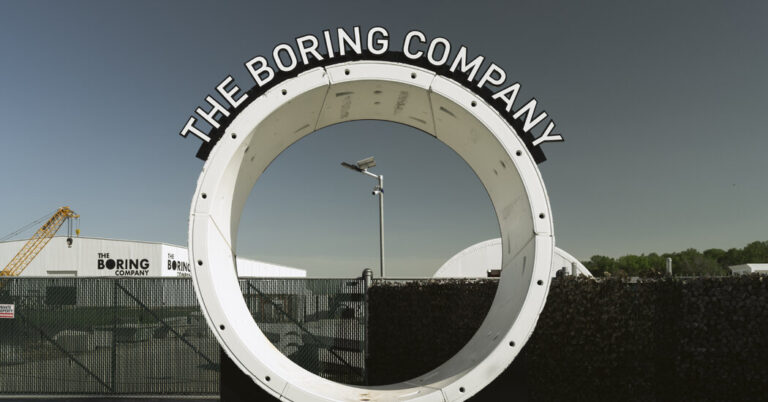
The Federal Railroad Administration, the nation’s railroad agency, has brought in the Boring Company, the tunneling firm founded by Elon Musk, to help with a multibillion-dollar Amtrak project, according to three people familiar with the discussions.

Federal Railroad Administration officials have talked with employees at the Boring Company about assessing the costs and progress of the Frederick Douglass Tunnel program, a new tunnel along a busy Amtrak stretch connecting Baltimore to Washington and Virginia. Amtrak initially expected the development to cost $6 billion, but now estimates it could cost as much as $8.5 billion.

As part of the talks, officials with the Department of Transportation, which oversees the Federal Railroad Administration, met with employees from the Boring Company last month and were told that the firm could find ways to build the tunnel more cheaply and efficiently, according to two of the people familiar with the discussions.

A Transportation Department spokesman, Nathaniel Sizemore, confirmed that the Boring Company was one of several firms being consulted for the purposes of awarding a new engineering contract. He declined to name the other companies.

The talks have raised concerns about Mr. Musk’s conflicts of interests as he juggles his businesses, along with his role as a top adviser to President Trump. Mr. Musk leads or owns at least six companies, including the electric automaker Tesla and the rocket company SpaceX. At the same time, he has overseen the so-called Department of Government Efficiency, which has slashed jobs and resources at federal agencies that regulate his businesses.

In at least a few instances, the conflicts of interest have become public. Mr. Trump hawked Tesla cars from the White House lawn in March, while federal agencies have pushed for the wider use of SpaceX’s Starlink satellite internet service.

Last month, amid concerns from investors that he was neglecting his work at Tesla, Mr. Musk said he would pare back the time he spent cost-cutting in Washington.

The Department of Transportation said in a statement that the estimated price for the tunnel had increased by $2.5 billion, and that Amtrak had not yet found ways to reduce costs.

“The department has had conversations with many stakeholders in the infrastructure-engineering space to understand opportunities to get this project back on track,” Mr. Sizemore said.

Amtrak did not have immediate comment. The Boring Company and Mr. Musk did not respond to requests for comment.

The Frederick Douglass Tunnel is set to replace the 152-year-old Baltimore and Potomac Tunnel, a 1.4-mile route along Amtrak’s Northeast Corridor. It is the “single largest infrastructure effort” led by Amtrak, according to a report last year by Amtrak’s inspector general office, which also expressed concerns over ballooning costs and missed deadlines. The tunnel was expected to be completed by 2035.

Last year, Amtrak selected a joint venture between two construction companies, Kiewit and J.F. Shea, to build the tunnel. The firms did not immediately respond to requests for comment.

Previously, Republicans including Senator Ted Cruz of Texas and the current vice president, JD Vance, criticized the awarding of federal funds to the project for “favoring Northeastern states over the rest of the country.”

Mr. Musk has also attacked Amtrak and other large-scale rail projects. In March, he proposed that the federally owned railroad be privatized.

“If you’re coming from another country, please don’t use our national rail,” Mr. Musk said about Amtrak at a March conference with bankers. “It’s going to leave you with a very bad impression of America.”

Mr. Musk and his companies have previously weighed in on matters at the Department of Transportation. After a deadly collision between an Army helicopter and a commercial jet in January, Transportation Secretary Sean Duffy brought SpaceX employees to the Federal Aviation Administration’s Air Traffic Control command center in Virginia to make safety suggestions the next month.

Mr. Musk has also been pushing the F.A.A. to cancel a multibillion-dollar air traffic control contract with Verizon in favor of a system from Starlink.

Over the years, Mr. Musk has promoted his own transportation ideas, including Tesla’s electric cars, SpaceX’s rockets and a hyperloop, a vacuum tube to propel people and goods at high speeds. The Boring Company, which has raised more than $900 million in venture capital funding, has completed few of its proposed U.S. plans.

In 2017, Mr. Musk tweeted that he had received “verbal govt approval” to build an underground hyperloop connecting New York City, Philadelphia, Baltimore and Washington, claiming that it would take passengers from New York to the nation’s capital in less than 30 minutes.

Two years later, the Boring Company submitted plans to the Department of Transportation to build a 35-mile underground loop for cars between Baltimore and Washington, and said it could be completed in two years. That project was removed from the Boring Company’s website in 2021 and now appears to be dead.

The Boring Company’s leader, Steve Davis, has been working with Mr. Musk and the Trump administration on the Department of Government Efficiency, known as DOGE. One of the billionaire’s most trusted lieutenants, Mr. Davis was appointed by Mr. Musk to head the tunneling company in 2018 and was deputized to execute Mr. Musk’s cost-cutting vision for the federal government.

Mr. Musk had been frustrated by the Boring Company’s lack of success under Mr. Davis, whom he privately criticized for not completing projects. In a recent interview with Fox News, Mr. Davis framed his efforts with DOGE as an attempt to prevent the country from going bankrupt and said he and others had been “willing to kind of put our lives on hold” to help Mr. Musk.

Mr. Davis did not respond to a request for comment.

Alain Delaquérière contributed research.


Source link

Emphatic win sends Sheff Utd to Championship play-off final

0


Highlights of the Sky Bet Championship play-off semi-final second leg between Sheffield United and Bristol City.


Source link

‘MAGA Accounts’ and No Tax on Tips: Republicans Plan to Inject Trump Into Tax Code

0


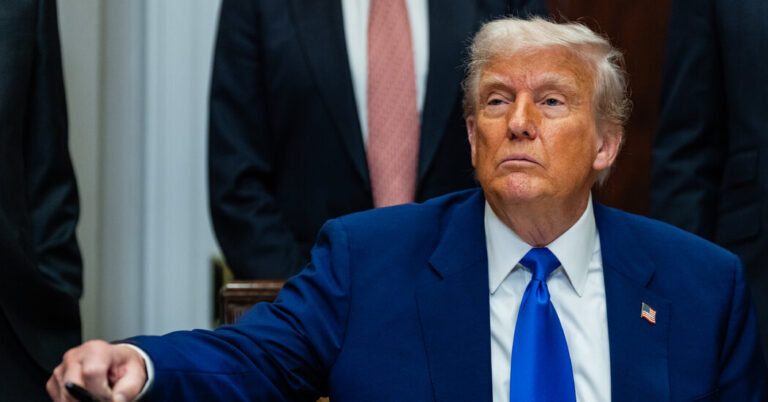
House Republicans on Monday outlined their plans for an expansive tax bill that would temporarily enact President Trump’s campaign pledges not to tax tips or overtime pay, roll back subsidies for clean energy and create a new type of tax-advantaged investment account for children.

The bill, which the Ways and Means Committee will formally take up on Tuesday, amounts to the first full attempt at detailing Republicans’ plans for cutting taxes this year. But it quickly faced criticism from some House Republicans, nearly all of whom will need to support the legislation in order for it to pass over what is expected to be unified Democratic opposition.

For example, the draft calls for increasing the limit on the state and local tax deduction to $30,000 from $10,000. A group of four Republicans from New York have agitated for a much higher cap and called the $30,000 limit “insulting” last week. Representative Nick LaLota, Republican of New York, wrote on social media on Monday that he was “still a hell no.”

Much of the bill consists of extending provisions from President Trump’s 2017 tax law. Many of the measures in that previous law, including lower marginal income tax rates and a larger standard deduction, are set to expire at the end of the year. That has motivated Republicans to move forward with a tax bill this year, given that not extending the provisions would amount to a tax increase for most Americans.

But Mr. Trump and Republicans on Capitol Hill have sought to go far beyond simply preserving their last tax cut. The legislation includes several new tax breaks that would last through most of Mr. Trump’s term and fulfill the president’s campaign-trail promises not to tax tips, overtime and Social Security. It also temporarily raises the standard deduction by $1,000 for individuals and the child tax credit by $500.

Those tax cuts would come with limitations. The tax exemption for tips, for example, would apply to federal income taxes, and only Americans under an income limit set at $160,000 this year would be eligible. In the bill, Mr. Trump’s plan not to tax Social Security benefits takes the form of a $4,000 bonus deduction for older Americans that shrinks as income rises.

House Republicans are also hoping to create a new type of investment vehicle, called a “MAGA account,” into which Americans could invest up to $5,000 per year on behalf of their children. Earnings on those investments could be withdrawn to cover school expenses and job training, buy a home or start a business. Children born in the next few years would also receive a $1,000 credit to their MAGA account.

All of those tax cuts will be expensive, so Republicans are also planning to raise taxes as part of the package to help make their budget math work.

The legislation ends some of the clean-energy tax credits Democrats passed under President Joseph R. Biden Jr., with a $7,500 consumer subsidy for purchasing an electric vehicle largely eliminated. Other provisions would be phased out over the next several years, and the bill would also add several new rules that are likely to make it harder for companies building solar and wind power to receive tax benefits.

University endowments are also targeted, with a tax on their investment income rising as high as 21 percent from 1.4 percent. People in the United States sending money to their families overseas would also face a 5 percent tax on those remittances.

The tax bill is just one component of the broader legislation Republicans are hoping to enact in the coming weeks. Other pieces of the bill focus on making cuts to Medicaid, the health care program for the poor, and food stamps, all while increasing spending on the military and immigration enforcement.


Source link

Tariff Truce With China Demonstrates the Limits of Trump’s Aggression

0


President Trump’s decision to impose, and then walk back, triple-digit tariffs on Chinese products over the past month demonstrated the power and global reach of U.S. trade policy. But it was also another illustration of the limitations of Mr. Trump’s aggressive approach.

The tariffs on Chinese goods, which the United States ratcheted up to a minimum of 145 percent in early April, brought much trade between the countries to a standstill. They caused companies to reroute business globally, importing less from China and more from other countries like Vietnam and Mexico. They forced Chinese factories to shutter, and brought some American importers to the verge of bankruptcy.

The tariffs ultimately proved too painful to American businesses for Mr. Trump to sustain. Within weeks, Trump officials were saying that the tariffs the president had chosen to impose on one of America’s largest trading partners were unsustainable, and they were angling to reduce them.

Trade talks between the world’s largest economies in Geneva this weekend concluded with an agreement to reduce stiff levies on each other’s products by more than many analysts had anticipated. Chinese imports will face a minimum tax of 30 percent, down from 145 percent. China will lower its import duty on American goods to 10 percent from 125 percent. The two countries also agreed to hold talks to stabilize the relationship.

It remains to be seen what agreements can be reached in future negotiations. But the talks this weekend, and the tariff chaos of the past month, did not appear to generate any other immediate concessions from the Chinese other than a commitment to keep talking. That has called into question whether the trade disruptions of the past month — which resulted in many American businesses canceling orders for Chinese imports, freezing expansion plans and warning of higher prices — were worth it.

“The Geneva agreement represents an almost complete U.S. retreat that vindicates Xi’s decision to forcefully retaliate,” said Scott Kennedy, a China expert at the Center for Strategic and International Studies, referring to Xi Jinping, the Chinese leader.

Although Mr. Trump and his advisers contend that the United States holds the strongest cards in trade negotiations, the president’s acquiescence revealed some of the limitations of his hand.

Through his so-called reciprocal tariffs and maximalist levies on China, the “Art of the Deal” president is employing a strategy that involves manufacturing trade crises in hopes of extracting quick economic concessions. But when confronting an economic power with similar might and perhaps more willingness to endure pain, Mr. Trump opted to stand down, declaring China’s agreement to join him at the negotiating table a win.

On the U.S. side, officials essentially said they had determined that they did not want — or intend — to go down the path that the president’s tariffs had set the United States on, of fully decoupling its economy from China.

“We concluded that we have a shared interest,” Treasury Secretary Scott Bessent said at a news conference in Geneva. “The consensus from both delegations is that neither side wanted a decoupling.”

That language was a stark change from Mr. Bessent’s earlier proclamations that the trade war would be much worse for China given its reliance on exports to the United States.

“They have the most imbalanced economy in the history of the modern world,” Mr. Bessent said on the Fox Business Network last month. “And I can tell you that this escalation is a loser for them.”

The tariffs proved painful for China, but they were also disruptive for the U.S. economy. American companies had started to warn of coming pain for consumers in the form of higher prices and less availability of products.

U.S. manufacturers were particularly concerned about China’s export restrictions on vital minerals and magnets. And while shipments from China to the United States plunged 21 percent in April from a year earlier, its exports to Southeast Asian countries surged 21 percent, suggesting it was finding some other channels to continue feeding its export machine.

The decision to temporarily lower tariffs on China provides a welcome reprieve for businesses, but it will also do little to ease longer-run uncertainty that is weighing on U.S. firms. The two governments now have until mid-August to make progress toward a trade deal.

Speaking on Monday morning, Mr. Trump said that if the countries did not reach an agreement in that time, tariffs on Chinese products would rise again to be “substantially higher,” though not to 145 percent.

“At 145, you’re really decoupling because nobody’s going to buy,” he added.

Retailers and other importers expressed relief that more trade would once again be able to flow between the countries, but they were crossing their fingers that the reprieve would last longer than 90 days.

Matthew Shay, the chief executive of the National Retail Federation, which represents large and small retailers, called the temporary pause “a critical first step to provide some short-term relief for retailers and other businesses that are in the midst of ordering merchandise for the winter holiday season.”

Gene Seroka, the executive director of the Port of Los Angeles, said on Monday that the 30 percent tariff that remained on China was still substantial, and that the enthusiasm of American consumers and the companies that rely on their shopping habits had been damaged by the threat of tariffs. Ninety days is also a relatively brief time frame for companies to try to restart stopped shipments from China, he said, given how long it can take to book space on ocean liners and move products by sea.

“This still is kind of uncharted territory, so we’ll see how people respond,” Mr. Seroka said. “But I don’t think based on consumer sentiment, consumer confidence, people are willing to jump in right away and say: ‘OK, this is really great. Let’s get going.’”

Trade experts warned that 90 days was also a very brief window to make substantial progress on the long list of trade spats between the United States and China, including Beijing’s ballooning trade surplus.

Wendy Cutler, the vice president of the Asia Society Policy Institute, said that three months was “an extremely short amount of time to address the range of contentious trade matters that remain between the U.S. and China, including dealing with excess manufacturing capacity, excessive subsidization of Chinese firms and transshipment efforts by Chinese companies.”

“Similar negotiations typically take well over one year,” she added.

Mr. Trump has said that talks would be focused in part on “opening up” China to American businesses. Officials said they had agreed to set up a regular cadence of talks with China, and suggested that some of those could center on Chinese purchases of U.S. products that would help to balance trade.

It is not clear what might differentiate these efforts from past negotiations with China. Trump officials have criticized the kind of recurring, low-level dialogues that past U.S. administrations held with the Chinese as essentially a waste of time.

Chinese officials also agreed to significant purchases in a 2020 trade deal signed with Mr. Trump that were meant to help balance trade between the countries, but they ultimately did not fulfill them.

Still, the Trump administration now appears intent on reviving that deal. In an interview on CNBC on Monday, Mr. Bessent said the 2020 deal could serve as a “starting point” for future talks and blamed the Biden administration for failing to enforce the agreement.

During his confirmation hearing, Mr. Bessent said he intended to push China to honor its commitments to purchase more American farm products. While the Trump administration has said broadly that it wants China to lower its “nontariff” trade barriers and open up its market to American firms, the latest trade clash could ultimately result in the revival of Mr. Trump’s old trade deal.

“Everyone thought in advance that the most important thing is to get Chinese adherence to the 2020 Phase 1 agreement that for many issues provides a foundation for going forward,” said Michael Pillsbury, who was a top China adviser to Mr. Trump in his first term.

Other analysts said that the Trump administration would most likely continue to push China to stem the flow of fentanyl precursors to the United States and try to make progress on other trade issues, like China’s vast subsidization and dominance of certain industries.

“The two governments have given themselves a window to get something done on fentanyl and purchases,” said Myron Brilliant, a senior counselor at DGA-Albright Stonebridge Group who advises clients on China. “But what else will China agree to remains a big question going forward, given our longstanding persistent concerns over their trade policies.”


Source link