Home Blog Page 318

‘The Interview’: Can Whitney Wolfe Herd Make Us Love Dating Apps Again?

0


That was Andrey Andreev, who was the head of Badoo and was a co-creator of Bumble. And then you faced another workplace scandal after Bumble started, involving him. In 2019 Forbes published an investigation, and he was accused of creating a toxic and sexist work environment at Badoo’s London headquarters. He denied these allegations but ended up selling his majority stake not long after the article was published. It’s striking that you had to deal with a second high-profile case of alleged male bad behavior in your professional life at the same time you were building a company whose brand was about empowering women. What do you make of that now? I mean, horrible. Absolutely the worst-case scenario. I obviously felt sick for anybody that felt the way they felt, and I did not know about any of these allegations, which to a lot of people, they’re like: “Whitney’s a liar. Of course she knew all these things, and she’s covering up for this guy.” The frank truth is I was in Austin running Bumble very much as a stand-alone business. It’s not like I was sitting in [Badoo’s London] office all day and intersecting with those people, and so it was gutting to me. When Forbes called me and told me this, I was speechless. I was shocked. It was really important to Andrey that I be honest about my personal interactions with him, which, the frank truth is, I had never seen anything to that degree. However, I would never question a woman or another person in their experience, and I said that. And I believe those allegations were stemming from several years prior. They were not active.

There was a range of allegations from different times. Right. But I think the bulk of the article was covering things that had been earlier days. I’m not trying to recuse myself from anything. That’s not what I’m doing. I’m trying to say if you look at the early 2010s, we’ve all seen the movies. The WeWorks and the Ubers. When you close your eyes and think about a tech company in 2012, you see beer pong and all the men together. I don’t think you close your eyes and think back on a progressive office space. What do you take away from this? I don’t know. Maybe I just found myself in two of the only situations, or was this painting a bigger theme of what was pervasive in tech culture at the time?

The other thing about that period is that it’s such a moment of tech optimism. All these apps were coming out, they were backed by incomprehensible amounts of money. They promised to solve so many of the world’s problems. Did you believe that back then? I did. To be able to get on an app, see who’s around you, instantly connect with them and all of a sudden end up on a date with someone that you never would have met if it had not been for this interface, that felt really transformational. So did being able to order a black car on Uber. We were just at this moment — gosh, if any Gen Z people are listening to us right now, they are going to be like: “These people, what? Did they live in the dark ages?” [Laughs]

Hey, listen, I remember the time before cellphones. So you know where I’m going with this. That was a huge leap in terms of efficiency and ease. I couldn’t believe we were in the center of this, and then — and I don’t say this in a self-promotional way at all — it’s really hard to do it twice. So many people over the years have been like, “Gosh, she’s just lucky, she wore a lot of yellow, she’s blond.” I’m not entirely sure people realize just how hard it is to get critical mass on an app twice.

The next era of Bumble, you had a lot of growth during the pandemic when everyone was stuck on their apps. It was a huge moment. You go public in 2021, ring the bell, baby on your hip, and the very next year user growth starts to slow down. What do you think was happening? My opinion is that I ran this company for the first several years as a quality over quantity approach. A telephone provider came to us early on. They said, “We love your brand, we want to put your app preprogrammed on all of our phones and when people buy our phones, your app will be on the home screen, and you’re going to get millions of free downloads.” I said, “Thank you so much but no thank you.” Nobody could understand what in the world I was doing, and I said it’s the wrong way to grow. This is not a social network, this is a double-sided marketplace. One person gets on and they have to see someone that is relevant to them. If you flood the system just endlessly — you’re not going to walk down the streets of New York City and want to meet every single person you pass. Why would you assume that someone would want to do that on an app? This is not a content platform where you can just scroll and scroll and scroll and scale drives results. What happened was, in the pandemic and throughout other chapters, growth was king. It was hailed as the end all be all.



Source link

The Shifting Conversation Around Canada’s Opioid Crisis

0


The conversation we’re having about opioids in Canada is starkly different from one year ago.

Where Canadians were once squarely focused on health policies to reduce the high number of opioid deaths — especially last spring, amid British Columbia’s drug decriminalization rollback — our attention has lately shifted, from the people who use drugs to those who sell them.

That’s in large part because of President Trump.

Mr. Trump has said that Canadian criminals send “massive” amounts of illegal fentanyl into the United States, one of the pretexts for his earlier punitive tariff measures.

[Read: Trump Calls Canada a Big Player in the Fentanyl Trade. Is It?]

Less than 1 percent of the fentanyl intercepted by U.S. Customs and Border Protection last year was linked to Canada. Still, Canada made concessions, appointing a “fentanyl czar” and investing in drones and helicopters at the border. As I previously reported, the government agreed to pour millions of dollars into new intelligence-gathering projects and staffing increases at the Canada Border Services Agency.

I worked at the agency’s Toronto regional offices as a university student about a decade ago, sometimes assisting with tours for broadcast media crews at a major postal facility where border officers would demonstrate how they screen packages for illicit fentanyl. At the time, the agency was undergoing one of its many border modernization efforts, reimagining the border not as something that starts at Canada’s geographic extremities, but as a bubble that extends beyond. The concept of pushing out the border simply meant identifying and intercepting security threats long before they had the chance to land at our doorsteps.

Or, as then was the case for fentanyl, in Canadian mailboxes.

Small amounts of fentanyl, a powerful synthetic opioid, can yield huge profits for criminal organizations. For context, 500 grams of fentanyl, which is the weight of about four bananas, has a street value of at least 30,000 Canadian dollars, the police say.

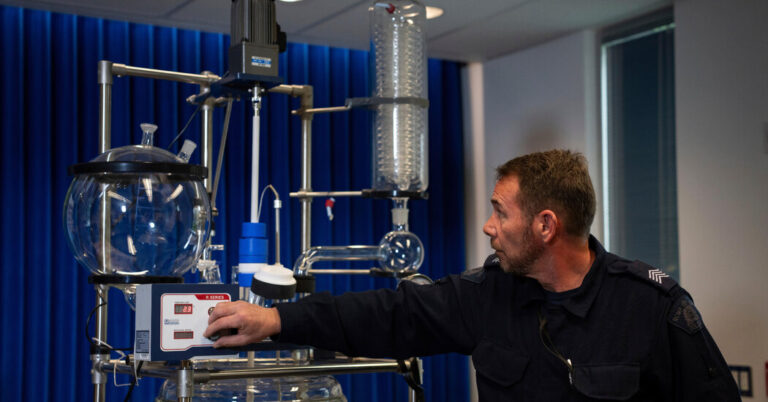
Sticking with home economics, instead of four bananas, picture a medium-sized kitchen. That’s about the footprint that some criminal organizations require to chemically synthesize millions of doses of fentanyl.

(My colleagues in Mexico, Natalie Kitroeff and Paulina Villegas, visited a kitchen lab in the Mexican state of Sinaloa, a hub for fentanyl production. You can read their story here.)

Canadian officials have said that crime groups are shifting to domestically producing fentanyl using chemical ingredients, called precursors, that are harder to intercept because many have legitimate industrial uses.

Border officers saw a “dramatic increase” in the import of precursor chemicals in 2021, according to a report by Canada’s public safety department. That year, officers intercepted more than 5,000 kilograms of precursor chemicals, 10 times that of the previous year.

These chemicals mostly arrive from China and Hong Kong on cargo ships, the report notes.

Policing the ports, including the Port of Vancouver, Canada’s largest, is up to a patchwork of law enforcement agencies. In 1997, the dedicated port police force was disbanded.

The Port of Vancouver processes about three million containers each year, and is made up of facilities along the metro Vancouver area, including the neighboring cities of Delta and Surrey.

During a recent pre-election reporting trip to British Columbia to cover housing, I stopped by the office of Delta’s mayor, George Harvie.

Mr. Harvie has been sounding the alarm about port security for years and commissioned a report into the issue, published in 2023, by Peter German, a lawyer, retired federal police officer and well-known anti-money-laundering expert in the province.

Mr. German made the argument for any kind of uniformed police presence as a replacement, especially to assist border officers. While the Canada Border Services Agency did not release the portion of containers that are X-rayed to view their contents, Mr. German said the number is less than 2 percent, with less than 1 percent physically searched.

Mr. Harvie, who became mayor in 2018, said that the government had since the start of his tenure promised to deliver rolling cargo scanners to help examine more shipments, but those still haven’t come. He hoped the 2023 report would get Ottawa’s attention.

“But again, it fell on deaf ears,” Mr. Harvie told me.

“The biggest help I had was President Trump saying that he was concerned about the amount of fentanyl coming back from Canada into the States,” he said. “I don’t know about those numbers, but certainly, there is fentanyl coming into Canada.”

When Mr. Harvie has toured other ports, including those in Singapore and Australia, and as close to home as Seattle, he often leaves feeling frustrated, he said, by the more advanced systems other countries seem to have in place.

“There’s a huge gap,” Mr. Harvie said. “We do more work at our land borders than we do at that port.”


Vjosa Isai is a reporter at The Times based in Toronto.


How are we doing?
We’re eager to have your thoughts about this newsletter and events in Canada in general. Please send them to nytcanada@nytimes.com.

Like this email?
Forward it to your friends, and let them know they can sign up here.


Source link

Worried About the Economy Amid Trump’s Tariffs? Building an Emergency Fund Can Help.

0


Vanguard, the big mutual fund company, suggests setting aside $2,000, or half of one month’s expenses, whichever is greater, as a buffer to cover unexpected but common “shocks,” like a car or home repair or medical bill. Then, to protect against a possible job loss, it suggests continuing to save to build a buffer of three to six months of living expenses so you can pay your bills while looking for another job. (The average span of unemployment was just under six months, according to the latest jobs report.)

With roughly $2,000 on hand, people can generally cover unforeseen costs without resorting to credit cards, which carry double-digit interest rates, said Paulo Costa, a senior behavioral economist at Vanguard who is also a certified financial planner. “The initial $2,000 is really what makes a big difference,” he said, by helping people avoid becoming financially derailed by common, if unanticipated, expenses. “Having it when you need it provides people with a lot of peace of mind.”

Even smaller amounts can help, Dr. Costa said. “Saving something is better than saving nothing.”

Some research has shown that for lower-income families, savings of as little as $250 to $750 can significantly reduce the likelihood of serious financial woes, like missing a utility payment or being evicted.

Also, take your family’s circumstances into account, said Spencer Betts, a certified financial planner in Lexington, Mass. If you are married and both you and your spouse make good salaries, maybe saving three months of expenses is sufficient. But if you’re in a niche or low-demand industry and it may take a while to find a new job, you may want to put aside enough money to cover six months of expenses or more. He recommended setting both a number and a time frame. “The more specific the goal is,” he said, “the easier it is to save for.”

J. Michael Collins, a professor at the University of Wisconsin in Madison and a household finance specialist, said the three- to six-month guideline might be too daunting for many people. He suggested that people consider these questions: “What keeps you up at night? Making the rent or mortgage? A car payment?” Aim to set aside enough to cover a month or two of those expenses, he said.


Source link

Elon Musk’s Use of X Mimics Hearst’s and Ford’s Manipulation of Media

0


An entrepreneur who revolutionized the automobile business decides he now needs to change how the world thinks, so he buys a media property to use as a megaphone. His rants validate many people’s worst impulses while also encouraging enemies of democracy around the world.

This sounds like Elon Musk and his social media site X in 2025, but it was also Henry Ford and his paper, The Dearborn Independent, in the 1920s. Ford, the inventor of the Model T, bought a suburban weekly and remade it to push his antisemitic views. The Dearborn Independent published a long-running series called “The International Jew,” which blamed Jews for the world’s ills, and publicized “The Protocols of the Elders of Zion,” a hoax document. The Nazis gave Ford a medal.

Ford was perhaps the most blatant example in a long tradition of moguls who bought media platforms and then used them to promote odious views. These tycoons often used the latest in technology to reach the widest audience, whether it was high-speed newspaper presses or, in Ford’s case, his network of car dealerships.

Drive off in your new Model T and there would be The Dearborn Independent on the seat. Newspapers at the time were local businesses. With the dealerships, The Dearborn Independent became one of the highest-circulated papers in the country, printing more than 750,000 copies of each issue at its peak.

After Henry Ford bought The Dearborn Independent, it published a long-running series called “The International Jew,” which repeated antisemitic tropes and blamed Jews for the world’s ills.Credit…Library of Congress

The biggest difference between Ford and other media titans like Rupert Murdoch was that the latter generally promoted their views by hiring like-minded editors and anchors. The Dearborn Independent announced on its cover that it was the “Ford International Weekly,” and it included a full-page editorial signed by Ford.

Mr. Musk’s actions signal a return to Ford’s personal approach. The Tesla and SpaceX billionaire has enthusiastically posted, reposted and endorsed incorrect or inflammatory claims on X that Social Security is fraudulent, that the Democrats are importing immigrants to win elections and that the federal judges who are ruling against the Trump administration should be impeached.

There are plenty of precedents for what Mr. Musk is doing with X. But he has taken the process to a level unimaginable even a short time ago. The site says he has 220 million followers, an assertion impossible to verify. Even if it is only a fraction of that number, X has been optimized to blast its owner’s posts as widely as possible. People see them and hear about them.

Mr. Musk’s $44 billion purchase of what was then Twitter in 2022 at first seemed to be a mistake, even to him. Then it was perceived as a billionaire’s toy. In last year’s election, it became a weapon. He used his political views to form an alliance with Donald J. Trump, which he then leveraged to put himself into the government expressly to shut down as much of it as possible.

The repercussions are still unfolding. But for Mr. Musk, it was a clear victory. In the name of government efficiency, agencies fired regulators who were in a position to oversee his empire. Mr. Musk now has a much freer hand with his cars and rockets. (An X spokesman did not provide a comment.)

“This is like nothing we’ve ever seen,” said Rick Perlstein, author of a four-volume chronicle of modern American conservatism. Noting Mr. Musk’s frequent use of memes and images, the historian added: “It’s the politics of the nervous system, not the higher functions of the brain. There’s no argument, just fear mongering.”

Moguls in the United States and Britain have owned media with the purpose of exerting influence since the creation of the modern newspaper in the late 19th century. During World War I, Viscount Northcliffe of Britain controlled roughly 40 percent of the morning circulation and 45 percent of the evening circulation there. His properties included The Daily Mail, read by the working class, and The Times, read by the elites.

The viscount, whose name was Alfred Harmsworth, played a crucial role in deposing Prime Minister Herbert Asquith in December 1916. Winston Churchill wrote that the press baron “aspired to exercise a commanding influence on events.” Viscount Northcliffe’s influence on the war was so great that the Germans sent warships to assassinate him in 1917, shelling his seaside home.

In the United States, the control of the media was often more of a local phenomenon. In West Texas in the early 1960s, the ultraconservative Whittenburg family owned The Amarillo Daily News, the NBC television station and the dominant radio station. There were few competing voices.

“If you feed people a far-right media diet, you’ll end up with a population almost exclusively on the far right,” said Jeff Roche, a historian who wrote “The Conservative Frontier,” a forthcoming study of the politics of the region. “Amarillo became the most right-wing city in America.”

“Media ownership and political influence have gone hand in hand since the earliest days of the newspaper industry,” said Simon Potter, a professor of modern history at the University of Bristol who studies mass media. “For just as long, people have worried about this intimate relationship between the media and politics — does it really serve the public interest?”

Behind that question is another: Does their megaphone really give them power, or is it shouting into a void? An American forerunner of Mr. Musk — William Randolph Hearst — provides an answer. Hearst, the owner of the upstart New York Journal, sent correspondents to Cuba in 1897 to cover a war with Spain. His interests were less humanitarian than promotional. He was in a circulation war.

The New York Journal from March 25, 1898. William Randolph Hearst had sent correspondents to Cuba cover a war with Spain.Credit…Library of Congress

One version of how that story played out showed Hearst as an all-powerful media magnate:

The Journal correspondents discovered there was no war. “Everything is quiet,” Frederic Remington, the paper’s illustrator, cabled Hearst. “There will be no war.” They wanted to leave.

Hearst replied: “Please remain. You furnish the pictures and I’ll furnish the war.” He then agitated in his papers for the war that President William McKinley in short order began. It liberated Cuba and acquired for the United States prized parts of the Spanish empire.

The story was first published in a book by a colleague of Hearst’s named James Creelman and later immortalized in Orson Welles’s “Citizen Kane.” It has been thoroughly debunked over the years. There was no evidence that Hearst ever said he would supply a war. The correspondents found plenty to illustrate. But the anecdote persisted because it showed a mogul so powerful that he could make wars out of nothing.

When Hearst tried to move on from his wartime endeavors to advance his own political career, he stumbled. He secured a seat in the House of Representatives in 1902, but bids to become the mayor of New York faltered twice. He lost a 1906 campaign for New York governor, too.

David Nasaw, who wrote “The Chief: The Life of William Randolph Hearst,” thinks Mr. Musk’s use of X to rally supporters is as illusory as Hearst’s supposed creation of a war.

“I haven’t seen anywhere that Twitter gets out the MAGA vote,” he said.

Hearst, in Mr. Nasaw’s view, reflected the sentiments of his readers rather than leading them. But the historian agreed that something new was going on with Mr. Musk. Hearst, Ford, even Viscount Northcliffe and the other British press lords before World War II, all had something in common that ultimately limited them.

“They were outside the room, screaming,” Mr. Nasaw said. “Twitter was important for Musk but only to get him inside the room, into the government. He’s unique in being both inside and outside with no constraints on his behavior. There’s never been anything quite like that.”

Tesla sales are plunging. Hearst and Ford could have warned Mr. Musk: Courting controversy with hateful views is bad for your reputation and usually bad for your business, too.

Ford was sued for libel over The Dearborn Independent and became the subject of boycotts. He closed the paper in 1927, although he did not repent his views. A stain lingered.

Hearst went up against President Franklin D. Roosevelt in the 1930s, putting his anti-Roosevelt screeds on the front page of his papers. As the editorials became increasingly abusive, readers had to choose: Whom are we going to support, the president or the publisher?

“They chose Roosevelt,” Mr. Nasaw said. “Which meant Hearst eventually destroyed himself and his newspapers.”


Source link

England should have picked Jacob Bethell for Zimbabwe Test and ended his IPL spell early, says Michael Atherton | Cricket News

0


Michael Atherton says England should have named Jacob Bethell in their squad for the one-off Test against Zimbabwe rather than let him continue his Indian Premier League spell.

Warwickshire batter Bethell impressed immensely in his debut series in New Zealand over the winter, scoring three half-centuries from the No 3 spot during a 2-1 victory.

However, the 21-year-old was not called back from his stint with IPL franchise Royal Challengers and is currently set to miss the Trent Bridge Test from May 22, live on Sky Sports.

England's Jacob Bethell, left, and teammate Joe Root walk from the field following their eight wicket win in the first cricket test against New Zealand at Hagley Oval in Christchurch, New Zealand, Sunday, Dec. 1, 2024.(John Davidson/Photosport via AP)
Image:
Bethell (left) scored three fifties in his first Test series, against New Zealand in late 2024

That could potentially change with the IPL suspended for at least a week amid the tensions on the India-Pakistan border that have led to the Pakistan Super League being postponed indefinitely.

Former England captain Atherton told the Sky Sports Cricket Podcast: “My own view is that Bethell should have been picked.

“That’s the point of an England central contract – that you’ve got control over your players.

“If you’re going to put a player on a full central contract – Bethell had been moved from an incremental contract to a full deal after doing so well in New Zealand – then bring your player back.

“It’s a Test match. It’s an international fixture and international fixtures should have priority over domestic franchise competition.

“I know the policy is players should see through their IPL deals but I don’t particularly agree with it.”

Please use Chrome browser for a more accessible video player

Mark Wood has given his backing to the out-of-form Zak Crawley and says he should keep his place at the top of the order

‘England saved from making tricky decision’

Bethell’s absence means Ollie Pope and Zak Crawley, both of whom have struggled for runs of late, are set to retain their places against Zimbabwe.

England may be forced into a “tricky decision”, according to Atherton, when Bethell is available ahead of of the India series, which begins at Headingley from June 20.

The left-hander earned his chance in New Zealand due to Jamie Smith’s paternity leave and then a thumb injury sustained by Jordan Cox but Smith has now returned.

Atherton added of Bethell missing the Zimbabwe Test: “In many ways, it saved the selectors from a very difficult call.

England's Jamie Smith plays a shot during the day one of third test cricket match between Pakistan and England, in Rawalpindi, Pakistan, Thursday, Oct. 24, 2024. (AP Photo/Anjum Naveed)
Image:
England’s Jamie Smith will return against Zimbabwe after missing the New Zealand series due to paternity leave

“Bethell looked to the manner born in New Zealand but then they would have had the tricky decision as Smith obviously comes back.

“They could bring Bethell into the squad but I’m not sure they will because they are probably happy not to have the difficult call yet.”

Cox was named as back-up batter for the Zimbabwe Test only to suffer another cruel injury blow – an abdominal issue sustained while scoring a ton for Essex in the County Championship.

That handed an opportunity to Somerset’s James Rew, 21, who is the youngest Englishman to score 10 first-class hundreds since Denis Compton in 1939.

Watch England’s one-off, four-day Test against Zimbabwe, live on Sky Sports Cricket from 10am (11am first ball) on Thursday May 22.

James Rew, Somerset, County Championship (Getty Images)
Image:
James Rew has been added to England’s Test squad to face Zimbabwe

England men Test matches this summer ☀️

All games at 11am UK and Ireland; all live on Sky Sports

  • vs Zimbabwe: Thursday May 22-Sunday May 25 – Trent Bridge
  • vs India: Friday June 20-Tuesday June 24 – Headingley
  • vs India: Wednesday July 2-Sunday July 6 – Edgbaston
  • vs India: Thursday July 10-Monday July 14 – Lord’s
  • vs India: Wednesday July 23-Sunday July 27 – Emirates Old Trafford
  • vs India: Thursday July 31-Monday August 4 – The Kia Oval

Ashes series in Australia 2025-26 🏏

All times UK and Ireland

  • First Test: Friday November 21-Tuesday November 25 (2.30am) – Optus Stadium, Perth
  • Second Test: Thursday December 4-Monday December 8 (4.30am) – The Gabba, Brisbane
  • Third Test: Wednesday December 17-Sunday December 21 (12am) – Adelaide Oval
  • Fourth Test: Thursday December 25-Monday December 29 (11.30pm) – Melbourne Cricket Ground
  • Fifth Test: Sunday January 4-Thursday January 8 (11.30pm) – Sydney Cricket Ground


Source link

Trump Calls for 20,000 Extra Officers to Help With Deportation Efforts

0


President Trump ordered the Department of Homeland Security on Friday to increase the deportation force of the United States by 20,000 officers, a move that would lead to an enormous expansion of immigration enforcement if realized.

In a provision tucked into a presidential proclamation focused on pushing undocumented immigrants to leave the country voluntarily, Mr. Trump called on the Department of Homeland Security to soon begin “deputizing and contracting with state and local law enforcement officers, former federal officers, officers and personnel within other federal agencies, and other individuals.”

It was unclear how such an effort would be funded, one of several major logistical hurdles to such a large operation. There are now around 6,000 officers focused on deportation efforts at Immigration and Custom Enforcement.

Mr. Trump has pushed to deputize state and local law enforcement officers for immigration enforcement before, and Department of Homeland Security officials have already signed a series of agreements with local law enforcement in the months since took office. Late last month, local law enforcement officials in Florida assisted ICE in an operation that led to the arrest of more than 1,100 migrants across the state.

The Trump administration has spent the past few months attempting to make good on the president’s promise of mass deportations by conducting sweeping raids in major cities, arresting international students and allowing officers more freedom where they make arrests, like in courthouses. But it has still struggled to reach the pace that would be necessary for Mr. Trump’s expansive deportation goals.

In recent weeks, the Trump administration has turned to pushing for migrants to leave the country on their own accord, a concept known as “self-deportation.” Earlier this week, department officials said they would pay migrants $1,000 and the cost of their travel if they left the country voluntarily and used a government app to do so.

In his proclamation Friday, Mr. Trump repeated that call, labeling it “project homecoming.”

“This proclamation establishes Project Homecoming, which will present illegal aliens with a choice: either leave the United States voluntarily, with the support and financial assistance of the federal government, or remain and face the consequences,” the proclamation read.

Mr. Trump ordered the Department of Homeland Security and the State Department to begin a “nationwide communications campaign” to tell migrants of the self-deportation offer and to warn them that not doing so would lead to stiffer consequences.

Beyond being arrested and deported, the proclamation warned that migrants could face “fines as consistent with applicable law for immigration-related crimes; the garnishment of wages; and the confiscation of savings and personal property, including homes and vehicles.”


Source link

Chinese Factories Are Moving Manufacturing to Vietnam to Escape Trumps Tariffs

0


In the scrum to keep the wheels of trade turning, Chinese companies are pivoting to neighboring countries to escape President Trump’s crippling tariffs.

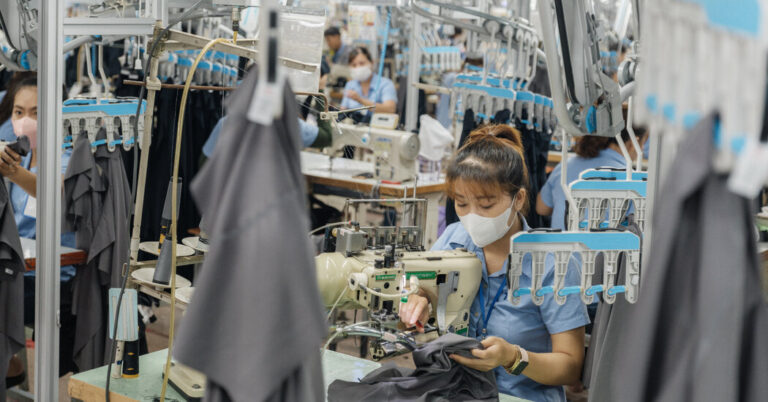
The hustle is on show in Vietnam. Factories that make everything from jeans to Christmas wreaths are trying to get there fast. The ones that have already moved are ramping up. The Chinese e-commerce platforms Alibaba and Shein are helping companies find manufacturing alternatives in Vietnam.

The race to get out of China has gathered so much pace in recent weeks that a social media genre of fixers has surfaced to offer tips on how to reroute goods through not only Vietnam, but places like Thailand and Malaysia too.

The cost of sending products to the United States has soared in recent weeks, forcing factories to find new trade routes. Last month, China’s exports to Southeast Asia surged as shipments to America plunged, Chinese government data released on Friday showed.

While Mr. Trump has imposed 145 percent tariffs on China, he has paused new tariffs on Vietnam and other Asian countries until early July. Factories across the region have gone into overdrive.

“It feels like everybody is rushing to find a Vietnamese partner,” said Vu Manh Hung, who owns seven factories in northern Vietnam and was inundated with requests from Chinese businesses.

They were hoping that his factories could take on orders that were now impossible to fulfill in China with such high tariffs. He did not seal any deals. But that was partly because his manufacturing lines were already busy, under pressure from American clients to deliver orders before July.

This sense of panic in the Chinese supply chain is familiar.

In 2018, during his first term, Mr. Trump’s tariffs on China caused many multinational companies to search for alternative locations to manufacture their goods. Those tariffs were not steep enough to kick off an exodus. Now, Mr. Trump’s tariffs are so high they have all but stopped trade between the two countries, even pushing Chinese businesses out of China.

For many Chinese companies, Vietnam is both a long-term solution and short-term fix. The countries share a border, and Vietnam has a large population of young people willing to do grinding factory work.

But there are challenges for Vietnam.

Along with the dozens of other countries whose tariffs are on hold, Vietnam is trying to work through a trade deal with American officials who want to limit China’s use of Vietnam as an alternative way into the United States for exports.

During the first U.S.-Chinese tariff war, Chinese companies built factories in Vietnam. Many of those factories are now ramping up orders. One of them is QIS Sport Goods, which opened operations in Vietnam in 2019.

“We are stronger now, and we can offer competitive prices to customers,” said Nguyen Jan, who is Vietnamese and joined the company three years ago. “Everything has been busier.”

QIS Sport Goods makes water sporting products like kickboards, surfboards and stand-up paddle boards at two factories, one in the southern Chinese city of Dongguan and another in northern Vietnam.

The company employs around 150 people in China and 400 in Vietnam, where it is hustling to hire more.

Another Chinese company, Dongguan Box, recently completed a production line in its Vietnamese factory just for its American customers like Tiffany & Company and Hallmark.

Rita Peng, the marketing manager, said the calls from her American customers started coming in April, when Mr. Trump began to escalate tariffs on Chinese goods. They asked: Could she quickly shift their production to Vietnam?

She was happy to oblige, but Ms. Peng said the change made little sense to her. Picking up an elaborate red gift box with a paper flower and a two-sided opening, she explained why.

“If I make this in China, this box is very easy to make,” she said. “Very easy. But if I make this whole box in Vietnam, the cost will be very high.”

A box that costs $1 to make in China costs $1.20 in Vietnam, she said, mostly because she needs to ship the raw materials. She said her clients still wanted her to use her Chinese factories to fill orders going to Europe.

Dongguan Box used to have 1,000 workers in China, but that number has been cut down to 200. In Vietnam, there are now 600 workers. But Ms. Peng said she was optimistic and thought that the situation was only temporary.

“I believe the U.S. will solve these problems soon,” she said.

E-commerce platforms are doing their part to help Chinese factories find substitutes.

The fast fashion platform Shein is offering incentives to Chinese factories to help with the cost of moving to Vietnam, according to one factory owner. And the e-commerce giant Alibaba, which helps merchants find business partners, has dispatched employees in Vietnam to help businesses find alternatives to China before the pause on tariffs in Vietnam ends, a Vietnamese account manager at Alibaba said.

Shein did not respond to a request for comment.

On Chinese social media, a flurry of agents have cropped up offering tips on how to skirt trade rules. For instance, one recent post on Xiaohongshu, the Chinese app also known as RedNote, outlined how to hide a product’s made-in-China origin by shipping it to Malaysia or another nearby country and repackaging it before sending it to the United States.

“Folks, the high tariffs imposed by the United States on China have reached an astonishing level,” the post said. “But it can’t stump us smart folks.”

The interest in Vietnam was evident recently in the southern Chinese city of Guangzhou. Nie Shiwen, who owns a garment factory, said some of his peers had started to expand in Vietnam. For now, he has decided against doing this because of the logistics of getting fabric and other materials to Vietnam, which can take weeks.

“Nowhere is as fast as China,” Mr. Nie said.

But Jia Yue Technology, a Chinese company that makes Christmas ribbons, stockings, wreaths and gift bags, has already made the leap to Vietnam. Over the past three years it has shifted more than half its production from China, said Jack Xu, who was acting as a translator for a company representative at a trade fair in Ho Chi Minh City. And now it is mulling whether to do more in Vietnam because most of Jia Yue’s customers are in the United States.

“You know Christmas items,” Mr. Xu said, pointing to a wall of green, plastic wreaths. “Americans, they need it!”

Mr. Xu said he was confident that Jia Yue Technology would be able to weather the trade war since it had a foot in both countries. But he said he hoped that China and the United States could come to a deal.

“For most Chinese, we still want to sell things to Americans,” Mr. Xu said.

Reporting was contributed by Tung Ngo from Ho Chi Minh City, Zixu Wang from Hong Kong, and Meaghan Tobin and Siyi Zhao from Guangzhou, China.


Source link

With US Trade Deal, UK Steel Industry Feels Some Much Needed Relief

0


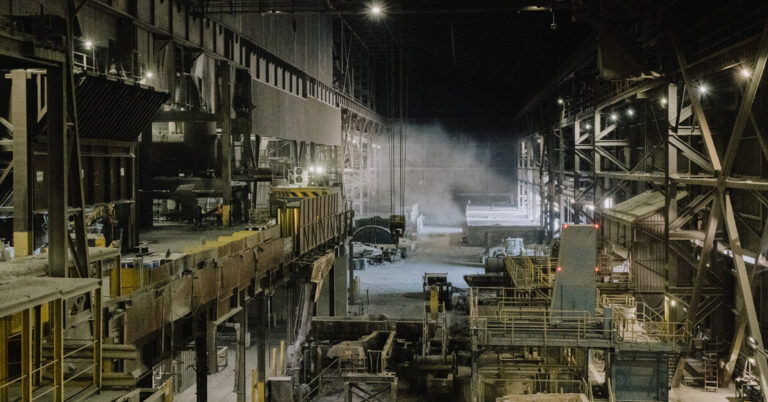
The call from a supervisor came to the steel shop floor in Sheffield, England, on Thursday afternoon: The tariffs were off. “Everything had changed for us,” said Richard Bott, as he stood near stacks of steel slabs still radiating waves of heat from the mill.

In a trade deal with Britain announced with much fanfare on Thursday, President Trump agreed to lift the 25 percent tariffs on steel that had posed a dire threat to Britain’s struggling industry and to Mr. Bott’s employer, Marcegaglia Stainless Sheffield.

The cavernous plant is one of the last remaining large steel-making facilities in a city that since the 18th century was a hub of innovation in the industry.

The plant is now old and dusty, but it is in some ways avant-garde. It uses an electric furnace, a technology the government wants other mills to adopt to reduce emissions, to melt piles of sparkling stainless steel scrap into molten metal.

Marcegaglia, part of a family-owned company in Italy, ships more than 100 million pounds’ (or about $133 million) worth of steel from Britain to the United States annually, around a quarter of the country’s steel exports.

The U.S. tariffs, which were announced in February but went into effect in March, added substantial costs and complexities to what was already a declining industry. British steel makers are struggling with weak demand, outside competition, and high energy and environmental costs.

The difficulties were highlighted recently when the government took control of Britain’s last major steel mill, at Scunthorpe, about a 90-minute drive from Sheffield, fearing that the plant’s Chinese owners would shut it down.

Marcegaglia, which ships finished and semifinished stainless steel products to the United States, where it has a mill in Richburg, S.C., was seeing “a slowdown in demand as customers decided whether they wanted to pay the 25 percent duty or not,” said Liam Bates, a Marcegaglia president.

In one effort to mitigate the damage, Marcegaglia raced to load a barge with steel and send it across the Atlantic to arrive before the tariffs took effect, but it arrived too late, adding millions of dollars in costs.

On Friday, there was a cautious sense of relief at the plant, which employs 440. “It’s good news for the company and the country,” said Ryan Johnson, a project engineer.

Christian Bruggmann, the plant’s chief operating officer, said he had thought tariffs would be lifted on much of the material that Marcegaglia exported to the United States. “At least some of our customers in the U.S. will pick up the phone and try to make it work,” he said.

Company officials, though, say they still don’t know what the deal means for products that are shipped from Britain to European Union countries like Sweden for further processing and then on to the United States.

The 25 percent tariff on steel imported into the United States is still in place for other countries. What tariffs will wind up applying to the European Union remains to be seen, creating a large unknown for a British business that sends large amounts of its output to both Europe and the United States.

The Trump administration’s impulsive approach to trade policy also creates uncertainty and saps confidence, they say.

“There doesn’t seem to be a structure, so you can’t plan anything,” said Tracey Wilshaw, the plant’s planning manager. “Which doesn’t give us any stability at all.”

Still, Ms. Wilshaw said she was more optimistic after Thursday’s announcement.

Steel UK, an industry group, welcomed the easing of tariffs, saying the United States was Britain’s second-most-important market for steel after the European Union, accounting for about 9 percent of sales by volume.

Britain’s prime minister, Keir Starmer, has risen to the defense of the domestic steel industry recently, but these businesses are dwindling and remain endangered. Only 35 percent of demand for steel in Britain is now met by domestic production, according to Steel UK.

Dave Brooks, the manufacturing manager at Marcegaglia, recalled joining the steel business as a 16-year-old trainee in 1986 and having the opportunity to work at other facilities, including a research and development center.

These units, he said, have all been closed in the waves of corporate takeovers and consolidations in the British and European industry in recent decades.

Still, steelworkers seem to be a resilient community that mostly enjoys the work and sees little point in looking at the downsides.

“Just grin and bear” it, said Simon Flynn, a contractor.


Source link

US and China Meet for First Time Since Trump Imposed Tariffs

0


Top economic officials from the United States and China are poised to meet in Geneva on Saturday for high-stakes negotiations that could determine the fate of a global economy that has been jolted by President Trump’s trade war.

The meetings, scheduled to continue on Sunday, will be the first since Mr. Trump ratcheted up tariffs on Chinese imports to 145 percent and China retaliated with its own levies of 125 percent on U.S. goods. The tit-for-tat effectively cut off trade between the world’s largest economies while raising the possibility of a global economic downturn.

While the stakes for the meetings are high, expectations for a breakthrough that results in a meaningful reduction in tariffs are low. It has taken weeks for China and the United States to even agree to talk, and many analysts expect this weekend’s discussions to revolve around determining what each side wants and how negotiations could move forward.

Still, the fact that Beijing and Washington are finally talking has raised hopes that the tension between them could be defused and that the tariffs could ultimately be lowered. The impact of the levies is already rippling across the global economy, reorienting supply chains and causing businesses to pass additional costs onto consumers.

The negotiations will be watched closely by economists and investors, who fear that a U.S.-Chinese economic war will lead to slower growth and higher prices around the world. Businesses, particularly those that rely on Chinese imports, are also on high alert about the talks as they grapple with how to cope with the new taxes and the uncertainty about whether they will remain in place.

“Both the U.S. and China have strong economic and financial interests in de-escalating their trade hostilities, but a durable détente is hardly in the offing,” said Eswar Prasad, a former director of the International Monetary Fund’s China division.

“Nevertheless,” he added, “it represents significant progress that the two sides are at least initiating high-level negotiations, offering the hope that they will temper their rhetoric and pull back from further overt hostilities on trade and other aspects of their economic relationship.”

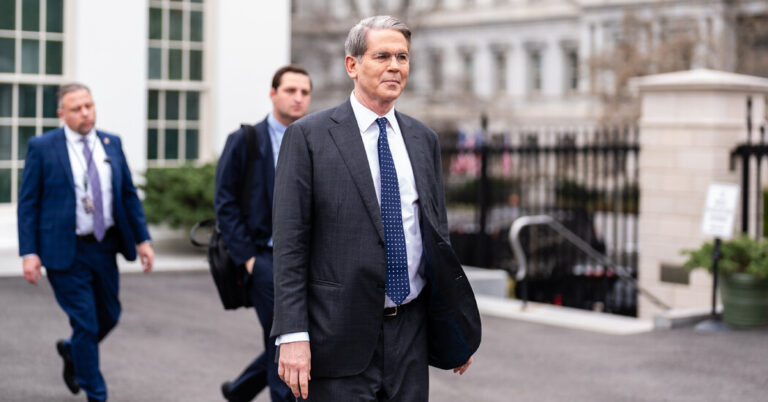
The Trump administration’s negotiators are being led by Treasury Secretary Scott Bessent, a former hedge fund manager who has said the current tariff levels are unsustainable. He will be joined by Jamieson Greer, the U.S. trade representative, who helped design Mr. Trump’s first-term trade agenda, which included a “Phase 1” deal with China. Mr. Trump’s hawkish trade adviser, Peter Navarro, was not scheduled to participate in the talks.

He Lifeng, China’s vice premier for economic policy, is leading the talks on behalf of Beijing. The Chinese government has not confirmed who else will be with Mr. He at the meetings or if Wang Xiaohong, China’s minister of public security, who directs its narcotics control commission, will attend. Mr. Wang’s participation would be a sign that the two sides might discuss Mr. Trump’s concerns about China’s role in helping fentanyl flow into the United States.

The trade fight has started to take a toll on the world’s largest economies. On Friday, China reported that its exports to the United States in April dropped 21 percent from a year earlier. Some of the largest U.S. companies have said they will have to raise prices to deal with the tariffs, cutting against Mr. Trump’s promise to “end” inflation.

On Friday, Mr. Trump signaled that he was prepared to begin lowering tariffs, suggesting that an 80 percent rate on Chinese imports seemed appropriate. Later in the day, referring to the China trade talks, Mr. Trump said, “We have to make a great deal for America.” He added that he would not be disappointed if a deal was not reached right away, arguing that not doing business is also a good deal for the United States.

The president also reiterated that he had suggested lowering the China tariffs to 80 percent, adding, “We’ll see how that works out.”

The Trump administration has accused China of unfairly subsidizing key sectors of its economy and flooding the world with cheap goods. The United States has also been pressuring China to take more aggressive steps to curb exports of precursors for fentanyl, a drug that has killed millions of Americans.

China has been steadfast in saying it does not intend to make trade concessions in response to Mr. Trump’s tariffs. Officials have insisted that the nation agreed to engage in talks at the request of the United States.

“This tariff war was launched by the U.S. side,” Liu Pengyu, the spokesman for the Chinese Embassy in Washington, said this week. “If the U.S. genuinely wants a negotiated solution, it should stop making threats and exerting pressure, and engage in talks with China on the basis of equality, mutual respect and mutual benefit.”

An 80 percent tariff, while a big drop from the current 145 percent, would still most likely shut off most trade between the countries.

China and the United States could take other concrete gestures to help pave the way for future negotiations, other experts said.

One option would be to scale back tariffs to about 20 percent, where they were in early April before Mr. Trump announced 34 percent levies on goods from China and mutual retaliation ensued, said Wu Xinbo, the dean of the Institute of International Studies at Fudan University in Shanghai.

“If we can scale back to that stage, then I think it will be a major progress in leading towards more constructive negotiations,” Mr. Wu said.

He said China was prepared to talk about fentanyl as a separate issue, adding that China had offered to sit down with the Trump administration in February after Mr. Trump first announced plans to impose tariffs on Chinese goods, citing the flow of illegal fentanyl into the United States.

The United States and China are meeting in proximity to the headquarters of the World Trade Organization, which has sharply criticized Mr. Trump’s tariff wars. The group has forecast that the continued division of the global economy into “rival blocs” could cut global gross domestic product by nearly 7 percent over the long run, particularly harming the world’s poorest countries. A spokesman for the W.T.O. said it welcomed the talks as a step toward de-escalation.

The alternative — a world in which the United States and China no longer engage in trade — could be economically painful and destabilizing. American consumers, who have come to rely on cheap goods from China, could soon confront thinly stocked store shelves and high prices for the products that remain.

The National Retail Federation said on Friday that import cargo traffic in the United States is expected to decline this year for the first time since 2023, when supply chain problems were persistent, and attributed the decline to Mr. Trump’s tariffs.

“We are starting to see the true impact of President Trump’s tariffs on the supply chain,” said Jonathan Gold, the retail federation’s vice president for supply chain and customs policy. “In the end, these tariffs will affect consumers in the form of higher prices and less availability on store shelves.”

The Trump administration has been racing to make trade deals with 17 other major trading partners after the president’s decision to pause the reciprocal tariffs he announced in April. On Friday, he hailed a preliminary agreement with Britain as evidence that his tariff strategy was working.

Economists have been heartened by signs that the White House appears ready to scale back tariffs.

“This rush to demonstrate progress on ‘deals’ reveals a rising desperation within the administration to roll back tariffs before they hit G.D.P. growth and inflation,” Paul Ashworth, chief North America economist for Capital Economics, wrote in a note to clients. “With the slump in incoming container ships from China raising fears of imminent shortages in the U.S., the pressure is building on the Trump administration to de-escalate that tariff buildup.”

Capital Economics estimates that if the United States lowered its tariffs on China to 54 percent, the overall effective tariff rate on imports for the United States would fall to 15 percent from 23 percent. That would put its growth and inflation forecasts back in line with its estimates from earlier this year that were based on Mr. Trump’s campaign pledges.

It remains unclear whether Mr. Trump would accept a 54 percent tariff rate.

On Friday, he suggested that he was prepared to lower tariffs to 80 percent as he gave Mr. Bessent the authority to make a deal.

“80% Tariff on China seems right! Up to Scott B.,” Mr. Trump wrote on Truth Social, his social media platform.

Later in the day, his press secretary, Karoline Leavitt, said that 80 percent figure was not an official offer and was instead “a number that the president threw out there.” She added that Mr. Trump would not lower tariffs on China unless Beijing also reduced its levies.


Source link

Tom Curry suffers injury scare in Sale defeat to Leicester after being selected for Lions tour | Rugby Union News

0


Tom Curry has suffered an injury scare just a day after being selected for the British and Irish Lions squad.

Curry departed during the first half of Sale’s Premiership clash with Leicester with a leg injury.

“It was a hamstring problem which will need assessing,” Sale director of rugby Alex Sanderson said.

“Tom is a tough lad and he tried to run it off for 10 minutes but he had to come off as a precaution as we need to rotate our squad ahead of a difficult run-in.”

In the match Sale matched their opponents with five tries but the exemplary goal-kicking of Handre Pollard proved the difference. Ollie Hassell-Collins and Emeka Ilione both scored two tries as Leicester took a 44-34 win in a pulsating contest to make them firm favourites for a home Premiership semi-final.

Please use Chrome browser for a more accessible video player

Former Lions captain Brian O’Driscoll – speaking as a Howden Ambassador – believes the Lions have a ‘great opportunity’ to defeat Australia.

Leicester trailed 26-16 at one stage but their bonus-point victory takes the second-placed Tigers seven points clear of Sale with two league games remaining, one of which is a home fixture with bottom club Newcastle.

Pollard missed nothing by kicking three penalties and five conversions, with Adam Radwan also on Leicester’s try-scoring sheet.

Rob du Preez scored two of Sale’s tries with Luke Cowan-Dickie, Rekeiti Ma’asi-White and Arron Reed also crossing and George Ford converting three and adding a penalty.

Please use Chrome browser for a more accessible video player

Head Coach Andy Farrell explains why his son Owen was not selected for the British and Irish Lions tour to Australia this summer.

It took Sale less than two minutes to open the scoring. They won a penalty at the first scrum and from the resulting line-out Cowan-Dickie was shoved over the line.

However the response was swift as Tigers built a period of sustained pressure before a break from Pollard sent Radwan flying over for the wing’s seventh try in six games since joining the club from Newcastle.

Pollard converted and added a penalty after it was Sale’s turn to infringe at the scrum but the home side proceeded to bungle the restart.

That gave Sale an attacking platform and they made it count when Ma’asi-White ran a neat line off a well-timed pass from Du Preez to evade Freddie Steward and score.

Please use Chrome browser for a more accessible video player

British and Irish Lions head coach Andy Farrell spoke highly of youngster Henry Pollock, who was selected despite only having one international cap.

Ford converted for Sale to lead 12-10 at the end of a hectic first quarter.

A second penalty from Pollard put his side back in front but the lead was short-lived as an elusive run from Ford split the defence to send Reed in under the posts.

Sale then suffered two blows in quick succession. First, Curry limped off to be replaced by his brother Ben, before Pollard reduced the arrears with his third penalty.

With the last move of a breathtaking first-half, Sale collected their bonus point when a pumped-up Ford sent Du Preez over before converting to leave his side with a deserved 26-16 half-time advantage.

Please use Chrome browser for a more accessible video player

20-year-old Henry Pollock produced the biggest cheer of the day at the British and Irish Lions squad announcement, sending the O2 arena into raptures after the Northampton star was included.

Sale began the second half strongly but crucially missed a couple of opportunities to score and they were made to pay when Hassell-Collins collected a cross-field kick from Pollard to finish in style.

Minutes later, Hassell-Collins scored his second when he latched onto a stray pass to bemuse the visitors’ defence with a mazy run to the line.

Pollard converted but Ford kicked a penalty to leave Sale trailing by just a point with 18 minutes remaining.

The game was in the balance but Sale were becoming error-prone and ill-disciplined and it cost them as Ilione finished off a driving line-out but the visitors immediately replied with a second try for Du Preez.

In the final minute, Sale lock Jonny Hill was sin-binned and Tigers took full advantage when Ilione again finished off a driving line-out to leave Sale with just a single point.

Watch the Lions tour of Australia live on Sky Sports in 2025
Image:
Watch the Lions tour of Australia live on Sky Sports in 2025

Sky Sports will exclusively show the 2025 British and Irish Lions tour of Australia, with all three Tests against the Wallabies and six warm-up matches to be shown exclusively live.


Source link