Home Blog Page 321

Cadillac F1 team: Graeme Lowdon says outfit will only select American driver ‘on merit’ for 2026 season | F1 News

0


Cadillac F1 boss Graeme Lowdon says the team will only select an American driver “on merit” after narrowing down a shortlist ahead of their debut season in 2026.

The General Motors-backed entry will join the grid next year as an 11th F1 team but they are yet to decide on their driver line-up.

Lowdon, who will be team principal, revealed Cadillac have a “fairly good idea” as to who they want to sign.

“We’ve narrowed it down quite a bit. But we’re out of sync with the rest of the teams at the moment,” he told Sky Sports F1.

“We were effectively kept out of the last round of driver discussions because we didn’t have an entry so we’re in a slightly unusual position. But it also means there’s a lot less competitive tension and we can take a little bit of time.

“Quite obviously, the number one priority for us as a team is to have something for the driver to drive and that is where a lot of the management bandwidth is focused.”

Valtteri Bottas and Sergio Perez
Image:
Valtteri Bottas and Sergio Perez are among the favourites to get a Cadillac seat

Sergio Perez is expected to be one of the candidates to drive for the team after he was dropped from Red Bull at the end of last season and is having a year out.

Likewise, Valtteri Bottas is a reserve driver for Mercedes after his dismissal from Sauber. Both drivers would provide Cadillac experience, which is important for a new team.

Given a major factor behind the team’s admission to the sport is their perceived ability to grow F1’s popularity in the United States, it is widely expected that they will sign at least one American driver for their debut campaign.

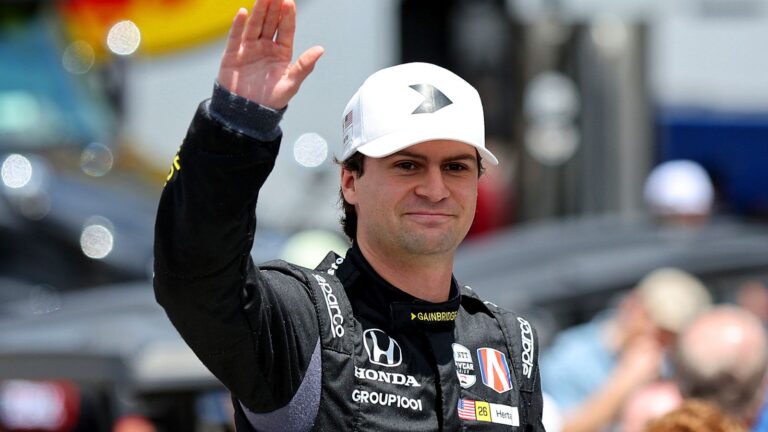
IndyCar star Colton Herta was linked to an F1 seat three years ago and would be the most obvious American driver to join Cadillac. However, Lowdon was keen to stress drivers will not be chosen on nationality.

“I think everyone would love to see an American driver in an American team with an American engine at some stage,” he said.

“But, also, this is a world championship, we have to select everyone on merit and, as we’ve said before, there’s nothing stopping a girl or boy with an American passport driving for an American Formula 1 team.

“We will select on merit. If the driver happens to be an American, then I think it’s something the fans would really like, but this is a world championship, we’ve got to respect it, and we want to be as competitive as we can. So we choose everyone in the team on merit.”
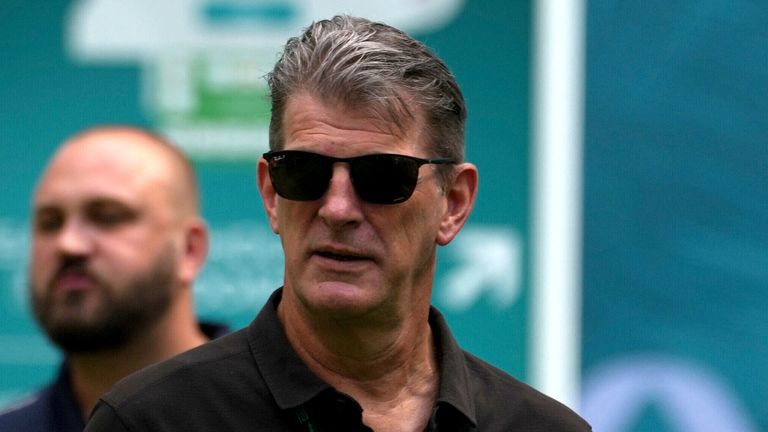
Graeme Lowdon was the team principal of the old Manor team which left F1 at the end of 2016
Image:
Graeme Lowdon was the team principal of the old Manor team which left F1 at the end of 2016

Are Cadillac in a race against time to be ready for 2026?

Car giant General Motors and US group TWG Global have formed the Cadillac entry and TWG Motorsport chief executive Dan Towriss said it will be a “challenge” to be ready for the 2026 season, which is set to begin with pre-season testing at the end of January.

Lowdon said “a race against time sounds dramatic” even though the team are also building a new US manufacturing base in Indiana, meaning work will have to be done elsewhere.

“As everybody knows, they’ll be tuning into the first Grand Prix next year and we have to be there. We can’t turn up a week later and do the race behind everyone else,” said Lowdon.

Please use Chrome browser for a more accessible video player

Ted Kravitz, Karun Chandhok and Bernie Collins reacted to the news that the Cadillac team will join an expanded grid from the 2026 and who their drivers might be

“So we have a deadline. Teams have a countdown clock in every garage that I’m aware of on the TV monitors and it shows when the start of the session is happening, and we’ve got those in every room of our multiple factories at the moment counting down to the first Grand Prix of 2026.

“So there’s a few days on there and it’s to remind everyone that time tends to accelerate when you’re when you’re up against a solid object. So it’s just there to remind everyone, and it’s a good thing as well. We’re in the game; we’re not racing on the track yet but we’re racing in the factory.”

F1’s European season begins with the Emilia Romagna Grand Prix on May 16-18, live on Sky Sports F1. Stream Sky Sports with NOW – no contract, cancel anytime

Source link

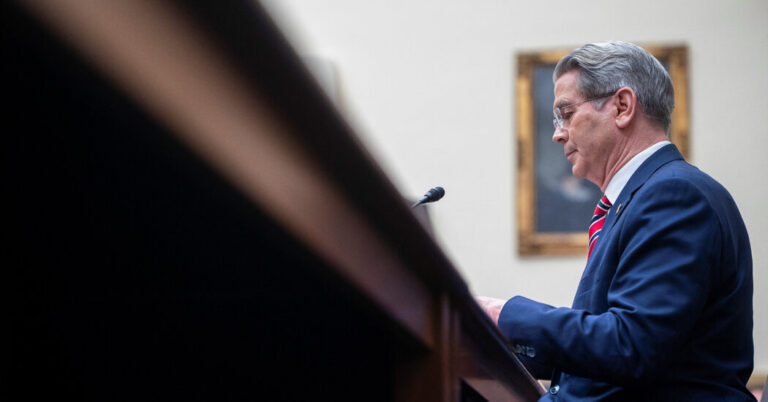
What Can Treasury Secretary Scott Bessent Win in China Talks?

0


President Trump hailed an agreement with Britain as a breakthrough — but far tougher negotiations, including with China, beckon.


Source link

How iPhone Apps Are Changing After a Recent App Store Ruling


In recent days, iPhone apps have been changing. The Kindle app now lets people buy books directly from its site. Spotify is offering users free trials. And Patreon, a subscription service, is letting people pay creators more money.

The changes are an early look at how a recent court ruling could transform the shopping experience on an iPhone. Last week, a federal judge ordered Apple to start allowing apps to offer promotions and collect payments directly from users. The decision makes it possible for apps to offer people new conveniences, like buying books directly from their website. The ruling also lets apps bypass a 30 percent commission that Apple collects on every app sale, which could lead to lower prices for consumers.

For more than a decade, Apple required that apps use its payment system for purchases and collected commission on the sales.

Now, all of that is open to change. Here’s what could be different in the future and why.

Judge Yvonne Gonzalez Rogers, who began working on this case after Epic Games sued Apple in 2020, ruled that Apple could no longer take commissions from sales that link out from the app. She also restricted the company from writing rules that would prevent developers from creating buttons or links allowing people to pay apps directly for their goods and services, and said it could not create messages — known as warning screens — that discourage users from leaving the App Store.

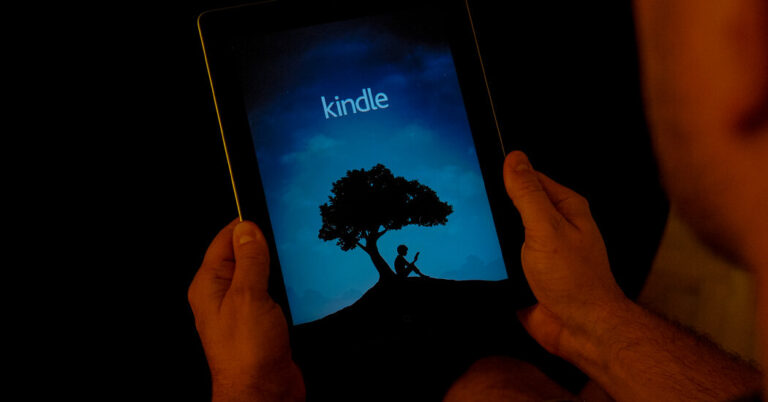
Amazon asked to update its Kindle app to allow people to buy books.Credit…Kindle

For years, Kindle has not sold books on its app to avoid Apple’s 30 percent commission. Now, it has added a “Get Book” button that directs users to its website to buy books. Similarly, Apple prevented Spotify from offering free trials to new customers, but now Spotify has a button on its app for a three-month trial.

Other apps could begin offering links for buying directly from stores online, which would allow the business to avoid having to pay Apple’s 30 percent commission. Without having to pay those fees, apps could offer users lower prices, reducing a $10 monthly subscription to $7.

Apple makes $11 billion a year from app sales in the United States, according to estimates by Morgan Stanley. It won’t lose all of that, but the bank estimates that $2 billion of that is now at risk.

How much Apple loses will come down to how willing people are to change their behavior. The decade-old process for buying software and services on apps is not only familiar but also quick. People trust Apple with their credit card information. And the company makes it easy for people to cancel their subscriptions — keeping them all in one place. Many people may be reluctant to leave the App Store to make their purchases, and apps may prefer to maintain the current system.

Now that Apple is required to allow apps to collect payment directly, without paying the company a commission, in the United States, other countries are going to press for similar concessions. Regulators in Europe, Japan and South Korea, which have been asking Apple to loosen its grip on the App Store, would not want their own citizens or developers to have to pay more than Americans did.

Apple said it planned to appeal the ruling, but it would be challenging for the company to have the decision overturned. In 2021, the judge wrote a less prescriptive ruling. Apple skirted the rule by introducing a 27 percent commission for app sales. The U.S. Court of Appeals for the Ninth Circuit sided with the judge’s initial ruling from 2021 and is unlikely to change its position, said Mark A. Lemley, a professor of antitrust and technology law at Stanford. “They should take their licks and let it be,” he said.


Source link

Panasonic to Cut 10,000 Jobs in Major Overhaul

0


Japanese tech giant Panasonic is planning to pare troubled business lines and its work force by thousands as it aims to reorient itself for a technological era no longer dominated by its traditional electronics.

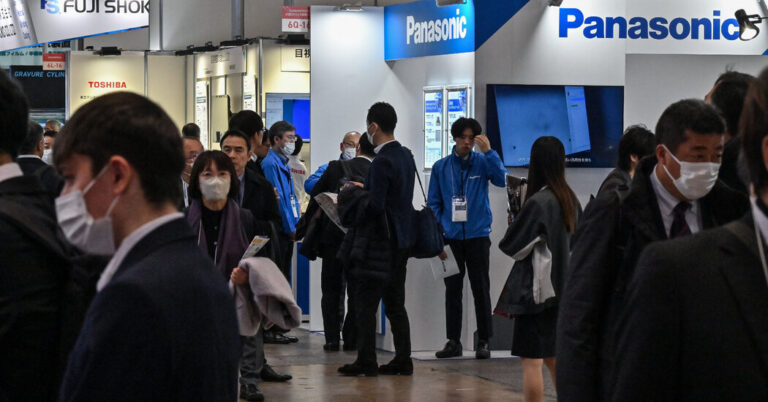
In a statement on Friday, Panasonic said that it would cut about 10,000 jobs globally, or about 4 percent of employees, primarily within the fiscal year that started in April. The cuts include 5,000 jobs in Japan and 5,000 overseas. As part of its effort to bolster profitability, the company said it would “promote the termination of loss-making businesses with no prospect of improving profit.”

Founded in Osaka over a century ago, Panasonic has maintained an array of businesses from televisions and digital cameras to mobile phones and kitchen appliances. Once a leader in consumer electronics, the company over the past two decades has grappled with how to reorient its sprawling operations.

Panasonic’s profitability began to decline in the mid-2000s, culminating in significant losses in the early 2010s. Under its former president, Kazuhiro Tsuga, who assumed the role in 2012, the company cut struggling businesses such as plasma televisions. By the mid-2010s, Panasonic was no longer bleeding red ink.

Since succeeding Mr. Tsuga in 2021, the current president, Yuki Kusumi, has continued this strategic overhaul, aiming to free up cash to invest in new areas of growth. Under Mr. Kusumi, the group has invested large sums of money in factories to supply automakers like Tesla with batteries for electric vehicles.

Panasonic has also been working to grow its presence in software and artificial intelligence technologies. This was highlighted by its more than $7 billion acquisition of Arizona-based software company Blue Yonder, which was finalized in 2021.

On Friday, Panasonic said that it expects restructuring costs of roughly $895 million for the current fiscal year. Panasonic said that through its overhauls, it aims to improve profits by at least $1 billion.


Source link

Bad Apple, the Rise of the A.I. Empire and Italian Brain Rot


“I have rarely read a judge who is so obviously angry at a tech company.”


Source link

2 Men Found Guilty of Felling Britain’s Sycamore Gap Tree


Two men have been found guilty of felling Britain’s beloved Sycamore Gap tree in 2023, in what prosecutors called a “moronic mission” that shocked the nation.

Daniel Graham, 39, and Adam Carruthers, 32, denied cutting down the tree, but both were convicted on Friday on charges of criminal damage.

The tree, a celebrated landmark that stood by Hadrian’s Wall, a UNESCO World Heritage Site in northern England, was found illegally cut down on Sept. 28, 2023.

Prosecutor Richard Wright told Newcastle Crown Court during the trial that the two friends drove to the site from the nearby city of Carlisle and committed the “act of deliberate and mindless criminal damage” together, filming the felling on a cellphone.

The prosecutor said that Mr. Graham kept a wedge of the tree’s trunk as a trophy, and that messages between him and Mr. Carruthers showed them “reveling in” international news media coverage after the tree was found. They will be sentenced on July 15.

The tree, which stood for more than 100 years in a picturesque dip between two hills, had long been a way marker and memory maker for both British locals and tourists from around the world. It also appeared in the 1991 film “Robin Hood: Prince of Thieves.”

Mr. Wright said that the tree, which had been planted in the late 1800s, had been cut down with a chain saw in minutes on the night of Sept. 27, 2023.

Jurors were shown footage of the tree being felled under the cover of darkness, which was taken on Mr. Graham’s cellphone. The phone also contained photographs of a wedge of wood next to a chain saw in the trunk of his Range Rover.

This is a developing story. Please check back for updates.


Source link

Pope Leo XIV, First American Pontiff, Will Face a Fractured American Church


The last several months for American Catholics have been a story about the ascent of the Catholic right. In January, a parade of right-wing Catholic power began streaming into President Trump’s remade Washington. Just weeks later came the hospitalization and decline of Pope Francis, who often seemed to stand alone in offering a different vision of global Christian influence.

Vice President JD Vance, a Catholic in the new conservative style, was one of the last people to see Pope Francis alive, a brief meeting between representatives of two contrasting visions for Catholic values in the world.

Then came the stunning arrival on Thursday of a new pope: an American, Chicago-born — and a prelate whose priorities for the church seemed to place him in the mold of Francis. He is potentially another countervailing voice against the country’s newly powerful strain of right-leaning Catholics.

The elevation of Robert Francis Prevost, known to some as Bob, to the throne of St. Peter electrified Catholics across his home country on Thursday afternoon. But the first American pope arrives at a time of extraordinary complexity and tension in the church in the United States.

Now the new pope, Leo XIV, faces the task not just of shepherding the world’s 1.4 billion Catholics, but of unifying a fractured American church where the church hierarchy, ordinary Catholics, an influential right-wing Catholic media ecosystem and Catholic power in Washington are often at odds.

The pope assumes the role at a moment of extraordinary muscle and visibility for a certain kind of Catholicism in American public life. More than a third of the members of President Trump’s cabinet are Catholic. So are two-thirds of the Supreme Court, which has issued a remarkable run of rulings expressing an emphatic vision of religious liberty, often favorable to Christian interests.

The second Catholic president in the nation’s history, Joseph R. Biden Jr., left office just months ago.

The rise of a new right-wing Catholicism in Mr. Trump’s Washington contrasts with a broader decline of the presence of the church in American life. Waves of Catholics left the church following revelations of widespread sexual abuse by clergy, and American culture overall has become more secular. Today, about 20 percent of Americans describe themselves as Catholic, a share that has remained stable over the past decade, according to the Pew Research Center.

Mr. Vance, who converted to the faith in 2019, posted his well-wishes to the new pontiff online on Thursday afternoon. “Congratulations to Leo XIV, the first American Pope, on his election!” he wrote. “I’m sure millions of American Catholics and other Christians will pray for his successful work leading the Church. May God bless him!”

Mr. Trump, who denied posting an image of himself as the pope on his own account on his own Truth Social platform this week, told reporters on Thursday that the selection was “such an honor for our country.”

Pope Francis clashed with Mr. Trump, most recently and fervently over immigration. In February, just months before he died, the pope harshly criticized Mr. Trump’s policy of mass deportations in an open letter to American bishops, calling it a violation of the “dignity of many men and women, and of entire families.” The letter was also seen as an indirect message to other members of the administration, including Mr. Vance, who used a Catholic theological concept to defend the administration’s crackdown on immigrants.

Pope Leo is seen as likely to share Pope Francis’ priorities on a range of social issues. An X account that appeared to belong to the new pope reposted a message in April critical of the Trump administration’s “illicit deportation” of Kilmar Abrego Garcia, the man mistakenly deported to El Salvador in March. The same account has also shared several articles critical of Mr. Vance.

“This pope is clearly going to keep speaking out of for justice, for peace, refugees, the poor and the hungry,” the Rev. Thomas J. Reese, a longtime Vatican analyst, said. “If this gets him in trouble with the Trump White House, so be it.”

On Thursday night, some right-wing Catholic media outlets were beginning to express skepticism of Pope Leo’s orthodoxy. The website LifeSiteNews published “5 worrying things you need to know about Leo XIV,” written by its editor in chief. The list included the new pope’s criticisms of Mr. Trump’s immigration policies.

Still, Catholic doctrine does not map neatly onto American political disputes, and it’s not clear whether Pope Leo will have his predecessor’s appetite for sparring. Inserting himself directly into the American political landscape could be thornier for an American.

For some American Catholics, his selection was a sign that the church here is entering maturity. The country is approaching its 250th birthday next year, but the Catholic Church claims an age about 1,750 years older.

The United States was still considered mission territory for the Catholic Church as recently as the beginning of the 20th century, said Kim Daniels, director of the Initiative on Catholic Social Thought and Public Life at Georgetown University. “A pope from the U.S. is in some ways a sign of our coming into our own in global Catholicism,” she wrote in an email, calling his election “an extraordinary gift” to the life of the American church.

The American church is now the fourth largest in the world, behind those in Brazil, Mexico and the Philippines. The U.S. is the first among them to birth a pope.

For leaders of Catholic institutions and ministries across the country, the selection was a moment of optimism for their church and their country.

“It’s wonderful news, it’s amazing,” said Curtis Martin, founder of the American-based Catholic ministry FOCUS, about the selection of an American pope. The name feels auspicious to him, too: Mr. Martin named one of his sons after the turn-of-the-century Pope Leo XIII, who was born in Italy.

Mr. Martin said he saw Pope Francis as a leader who excelled at listening, especially to those who did not understand the church or agree with its teachings. He hopes Pope Leo will be able to take the next step, listening but also speaking more directly about church teachings.

“What hasn’t happened yet is the opportunity to enter into a real dialogue,” Mr. Martin said. “The church has maybe never listened better than it did under Pope Francis, but now it’s an opportunity to speak.”

He added, “I think Pope Leo might be able to lead that.”

The Rev. Robert A. Dowd, the president of the University of Notre Dame, said that he hoped that Leo’s election could prove “a uniting moment” for the American church.

“He’s an American with a global perspective, but he’s an American,” Father Dowd said. “He understands, I think, the state of the church here in the United States.”

As significant as the moment felt to many American Catholics, the new American pope has spent much of his adult life overseas, in Peru and Italy. Pope Francis, who was born in Argentina, never returned to his own home country as pope, and he visited the United States only once in his 12-year papacy.

Leaders of the American church, who are generally more conservative than much of the global church, expressed their welcome and emphasized that the new pope now belongs to the world.

“Certainly, we rejoice that a son of this nation has been chosen by the cardinals, but we recognize that he now belongs to all Catholics and to all people of good will,” Archbishop Timothy P. Broglio, president of the United States Conference of Catholic Bishops, said in a statement. “His words advocating peace, unity, and missionary activity already indicate a path forward.”

Alan Blinder contributed reporting.


Source link

‘How Do I Survive?’: Tariffs Threaten U.S. Market for Traditional Chinese Medicine

0


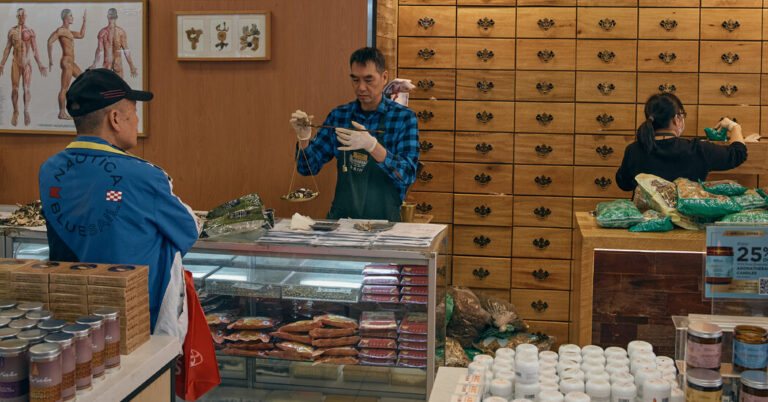
At a pharmaceutical factory in Chengdu, China, an order that Thomas Leung placed from Manhattan in January is sitting on hold.

The shipment includes a variety of concentrated herbal granules used in traditional Chinese medicine. There’s dang gui, also known as angelica root, which is used to treat gynecological ailments; chai hu, or bupleurum root, an herb that is often used to calm nerves; and huang qi, or astragalus root, a tonic herb that promotes immune strength.

It is not clear when the shipment will land at Kamwo Meridian Herbs, a New York City staple for more than half a century that claims to be the largest traditional Chinese medicine dispensary on the East Coast. When it arrives, the herbs will be dispensed to practitioners and patients looking to treat colds, pain and other ailments — but for now, the herbs must sit.

Dr. Leung, Kamwo’s chief executive, put a stop on the order after President Trump placed a minimum tariff of 145 percent on all Chinese goods last month. China responded by raising tariffs on U.S. goods to 125 percent, and the resulting standoff has effectively frozen trade between the two countries.

Traditional Chinese medicine is just one of many industries that has been upended by the tariffs and the uncertainty over when, or whether, they may be lifted. Already, fewer ships are arriving in American ports, and consumers could begin seeing empty shelves by early June.

The trade war has caused paralysis among importers, said Dr. Leung, a fourth-generation herbal pharmacist and the third member of his family to lead Kamwo. Even if he were willing to pay the import duty, he said, he would risk being stuck with prohibitively expensive stock that few people would be willing to buy if the tariffs are reversed.

“No one’s doing anything until we know what the heck is happening,” he said.

Since it opened its doors in 1973, Kamwo has filled prescriptions written by traditional Chinese medicine practitioners and sold herbs by the pound. Recently, however, it stopped advertising bulk sales. With imports effectively paused, there has been a run on herbs and supplies that has already caused prices to jump, Dr. Leung said.

Space and time also limit how much the typical traditional Chinese medicine dispensary can stock up on these supplies. Herbs can go bad or grow stale, and even if it were possible to stockpile a large supply, there is the question of where to store it all.

Before the tariffs were announced, Kamwo had expected to take in $6.5 million in revenue this year, Dr. Leung said. Kamwo is fortunate to be a bigger company that has “maybe eight months worth of herbs” on hand, he said, but “not every smaller company is going to have that luxury.”

Traditional Chinese medicine, or T.C.M., has boomed over the last 20 years, driven by immigration and a willingness among American consumers to try something new when seeking relief, said Arthur Dong, a teaching professor at the McDonough School of Business at Georgetown University.

It’s unclear exactly how large the T.C.M. industry is in the United States. China exported nearly $5.5 billion in traditional Chinese medicine in 2023, up from $3.6 billion in 2017, according to Statista.

A protracted trade war would harm the T.C.M. industry just as it would other niche but popular sectors that rely largely on imports. Jaya Wen, an assistant professor at Harvard Business School, said T.C.M. “is likely to be highly adversely affected relative to other industries.”

Many dispensaries are small mom-and-pop shops operating on razor-thin margins. Once they run out of stock, they’ll be left with bare shelves, no incoming business and a rent check that’s due every month. The tariffs also could threaten the livelihoods of people all along the supply chain, including the store associates who gather the orders and the truckers who haul these ingredients to their final destinations.

Many of the herbs used in T.C.M. can’t grow outside China, Dr. Leung said, and they are processed by skilled workers, following highly specialized methods that were established generations ago.

“If I make a list of all the things that we need to do to foster that, like a home Chinese herb industry in the United States, it’s impossible,” he said. “It’s literally impossible.”

The disruption to T.C.M. in the United States “will be pretty widespread, and this is just one narrow industry,” Dr. Dong said. “This is one of thousands of industries that are going to be affected.”

Because Mr. Trump changes his mind frequently, Dr. Dong said, it’s hard for companies to plan for the future. That’s why “you’ve seen the gears of commerce come to a grinding halt.”

“No C.E.O. of any company, whether it’s large or small, is willing to make investments or take out loans or increase a trade or commit to anything beyond like the next two months due to this uncertainty,” he said.

Still, despite the economic challenges, G.A. Donovan, a fellow at the Asia Society Policy Institute, said he would “not count this industry out.”

T.C.M. practitioners in China experienced a “very turbulent 20th century,” he said, referring to the violent political upheaval of Mao Zedong’s Cultural Revolution. As a result, he added, they “have the resilience to manage this.”

“You could expect them to respond to this challenge with a great deal of ingenuity,” he said.

Kamwo ships to all 50 states, Canada and Europe, and about 75 percent of its customers are not Chinese, Dr. Leung said.

Among them is Lyn Pierre, 58, who walked into Kamwo on a sunny Friday afternoon looking to fill her prescription. A runner, she has used T.C.M. at various points in her life to stay injury free, but now she worries that the already pricey medicine she takes will cost even more.

“Of course I’m worried,” Ms. Pierre said, sitting on a stool inside the shop, adding, “I think it’s going to be a bit expensive.”

Ms. Pierre said it’s already hard to earn a living, especially in these days of soaring costs. The idea of herbs costing even more than they already do is daunting.

“It’s not easy,” she said. “It’s really a struggle.”

Acupuncture, the ancient Chinese medical technique for pain relief, could also feel the impact of the trade war.

Dr. Beth Nugent, the president of the Acupuncture Society of New York, said that most acupuncture practitioners “operate on very slim margins,” adding that she and her colleagues “tend to not charge people a lot because we just love what we do.”

Herbs, tonics and needles are essential to Dr. Nugent’s practice. While there are other sources for some items, like needles, they “may not be as high quality as the ones we can get from China,” she said.

“If I could charge somebody the minimum amount that they can afford so that they come for acupuncture, that’s what I’m going to do,” she said, “but if it gets to a point where I can’t keep the lights on in my practice, then how do I survive as a practitioner?”

She worries that patients who may not seek her out if she is forced to raise prices, perhaps because they will no longer be able to afford the treatments. She thinks of the hockey player she helped get back on the ice, the couple who finally conceived after fertility struggles and the patient with vertigo who got back on their feet.

“This is not something esoteric or something that’s out of the realm of everyday people,” she said. “It is everyday people that are getting this treatment.”


Source link

U.S. v. Google: What Both Sides Argued in a Hearing to Fix Its Search Monopoly


For the past three weeks, the Justice Department and Google have questioned more than two dozen witnesses to try to sway a federal judge’s decision over how to address the company’s illegal monopoly in internet search.

On Friday, that hearing in the U.S. District Court for the District of Columbia is expected to conclude. To fix the monopoly, the government has proposed aggressive measures that include forcing Google to sell its popular Chrome web browser and share proprietary data with competitors. Google has argued that small tweaks to its business practices would be more appropriate.

Both sides will offer closing arguments at the end of the month. Judge Amit P. Mehta, who is presiding over the case, is expected to reach a decision by August. His ruling could have significant implications for Google, its rivals and the way that people look for information online.

Here’s what to know about what was argued at the hearing.

In August, Judge Mehta ruled that Google had broken antitrust law when it paid companies like Apple, Samsung and Mozilla billions of dollars to automatically appear as the search engine in browsers and on smartphones. He also ruled that Google’s monopoly allowed it to inflate the prices for some search ads, adding to its unfair advantage.

Judge Mehta convened the hearing last month to determine how to best address the search monopoly through measures called remedies. Executives from Google, rival search engines and artificial intelligence companies — alongside experts — testified about Google’s power over the internet.

The only way to end Google’s dominance in search is by taking significant action, government lawyers said at the hearing.

Lawyers argued that Google should be forced to spin off Chrome and share search results and ads with rivals, allowing them to populate their own search engines. Other search engines and some artificial intelligence companies should get access to data on what Google users search for, as well as the websites they click on.

The government warned during the hearing that if Judge Mehta didn’t take action, it could propel Google into dominance of another technology, artificial intelligence. Search is in upheaval as A.I. and chatbots, like Google’s Gemini, change the way people find information on the web.

“This court’s remedy should be forward looking and not ignore what’s on the horizon,” said David Dahlquist, the government’s lead litigator. “Google is using the same strategy that they did for search and now applying it to Gemini.”

Eddy Cue, an Apple executive called as a witness by Google, said that “in the past two months for the first time in over 20 years,” Google search queries had declined in the company’s Safari browser for the first time. He attributed the drop to the growth of A.I.

Google’s lawyers said the government’s proposal would endanger products that consumers love and imperil privacy and security for internet browsing.

“I think it definitely will have many unintended consequences,” testified Sundar Pichai, Google’s chief executive.

Sharing Google’s data with its competitors would undermine the privacy of its users, the company’s lawyers said. They pointed multiple times to a 2006 incident in which AOL released search data to aid academic researchers. Journalists were able to use leaked data to identify an individual based on her searches.

There’s also plenty of competition in A.I., they said, noting the success of OpenAI’s ChatGPT and other examples.

Google’s lawyers instead proposed that its contracts with web browsers and smartphone companies should offer more freedom to work with competing search and A.I. services. Mr. Pichai testified that Google had already started altering its contracts with other companies to align with its proposal in the case.

(The New York Times has sued OpenAI and its partner, Microsoft, for copyright infringement of news content related to A.I. systems. They have denied wrongdoing.)

During the hearing, several Google competitors, including OpenAI and the chatbot company Perplexity, said they would be open to buying Chrome if it was put up for sale. Government witnesses said access to Google’s search and ad data would give A.I. companies an advantage as they tried to compete with Google.

When Judge Mehta questioned witnesses throughout the hearing, he provided a window into his thinking.

At times, he pushed witnesses to say whether any rivals could compete with Google’s search dominance absent the court’s intervention.

Many of his questions revolved around A.I. and its significance, as Google battles its rivals to develop the technology that has become a major force in the tech industry.

When Mr. Pichai was on the witness stand, Judge Mehta said he had observed the rapid development of A.I. since the lawsuit went to trial in the fall of 2023, signaling he was aware of how the growth of the technology had become the backdrop for the hearing.

“One of the things that has struck me, Mr. Pichai, about these proceedings is, when we were together not so long ago, the consistent testimony from the witnesses was that the integration of A.I. and search or the impact of A.I. on search was years away,” he said, referring to testimony during the 2023 trial. “By the time we’ve gotten here today, things have changed dramatically.”


Source link

Love The Darts podcast – Sky Sports | Darts News

0


Love The Darts podcast keeps you up to date with all the latest news and talking points from the world of darts.

Emma Paton is joined by Sky Sports’ top darts pundits and speaks to players past and present, including Luke Littler and Luke Humphries, to discuss the action at the oche.

There are weekly verdicts from every Premier League Darts event, plus episodes to analyse all the big tournaments from the World Darts Championship at Alexandra Palace to the World Matchplay at Blackpool’s Winter Gardens.

Love the Darts – latest episodes

Follow darts with Sky Sports

Keep track of the latest darts news, see the 2025 darts schedule and watch live darts – including the Premier League – on Sky. Not got Sky? Get Sky Sports or stream with NOW


Source link