Home Blog Page 324

Trump Administration Live Updates: President to Detail Trade Deal With U.K.

0


President Trump is expected to announce on Thursday that the United States will strike a “comprehensive” trade agreement with Britain.

Hours after teasing that an agreement would soon be announced, Mr. Trump said in a social media post that a deal had been reached that would “cement the relationship between the United States and the United Kingdom for many years to come.”

“Because of our long time history and allegiance together, it is a great honor to have the United Kingdom as our FIRST announcement,” he wrote. “Many other deals, which are in serious stages of negotiation, to follow!”

Mr. Trump is expected to announce the deal from the Oval Office later Thursday.

The president had not specified which nation would part of the deal in his post late Wednesday night. On Thursday, a senior British official confirmed that a deal with the United States had been reached.

The British official, who spoke on the condition of anonymity because of the sensitivity of the issue, did not offer details, beyond saying that the deal would be good for both Britain and the United States.

The agreement would be the first deal announced since Mr. Trump imposed stiff tariffs on dozens of America’s trading partners. He later paused those temporarily in order to allow other nations to reach agreements with the United States.

Details of the agreement were not immediately clear. Both nations have discussed lowering British tariffs on U.S. cars and farm goods, as well as removing British taxes on U.S. technology companies. It also was not clear whether the agreement had actually been finalized.

Timothy C. Brightbill, an international trade attorney at Wiley Rein, said the announcement would probably be “just an agreement to start the negotiations, identifying a framework of issues to be discussed in the coming months.”

“We suspect that tariff rates, nontariff barriers and digital trade are all on the list — and there are difficult issues to address on all of these,” he added.

The Trump administration has been trying to cajole other countries into reaching quick trade deals with the United States. The president imposed punishing tariffs on dozens of its trading partners on April 2, but quickly backtracked after panic ensued in the bond market. Mr. Trump paused most of those tariffs for 90 days so that the United States could negotiate trade deals with other nations.

But he has left a 10 percent global tariff in place, including on Britain. Unlike other countries, Britain was not subjected to higher “reciprocal” tariffs, because it buys more from the United States than it sells to it.

Britain is also subject to a 25 percent tariff that Mr. Trump has placed on foreign steel, aluminum and automobiles, levies that British officials have been pushing their U.S. counterparts to lift.

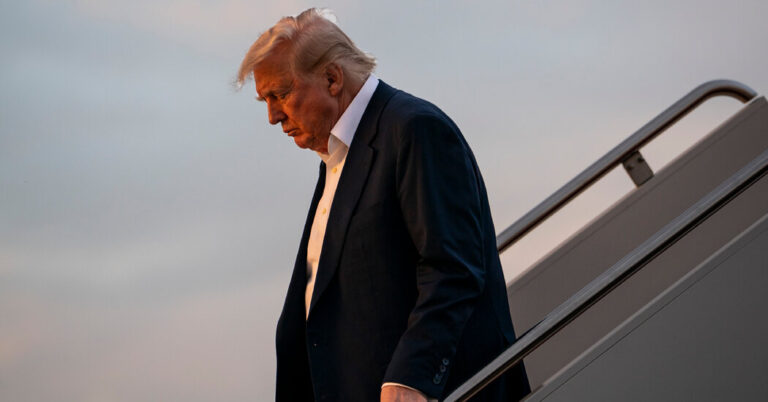
President Trump’s interest in striking a trade deal with Britain dates back to his first term, when his advisers negotiated with the country but didn’t finalize an agreement.Credit…Eric Lee/The New York Times

Mr. Trump’s interest in striking a trade deal with Britain dates back to his first term, when his advisers negotiated with the country but didn’t finalize an agreement. British officials have also been eyeing a trade agreement with the United States since Brexit, as a way to offset weaker relations with Europe. In the Biden administration, British officials continued to push for a deal with the United States but made little progress.

For Britain’s prime minister, Keir Starmer, the trade deal would offer vindication for his assiduous cultivation of Mr. Trump. During his visit to the Oval Office in February, Mr. Starmer turned up with an invitation from King Charles III for the president to make a rare second state visit to Britain.

The Trump administration appears to be nearing deals with India and Israel, and is continuing to negotiate with South Korea, Japan, Vietnam and other nations. Still, Mr. Trump once again displayed his unpredictable approach to economic policy on Tuesday when he downplayed the prospect of trade deals, saying other countries needed such agreements more than the United States.

“Everyone says ‘When, when, when are you going to sign deals?’” Mr. Trump said, at one point motioning toward Howard Lutnick, his commerce secretary. “We don’t have to sign deals. We could sign 25 deals right now, Howard, if we wanted to. We don’t have to sign deals. They have to sign deals with us.”

Trade experts have said that Mr. Trump may be intending to announce far more limited deals than traditional trade agreements, which cover most trade between countries and require congressional approval. Historically, free-trade agreements have taken the United States more than a year to negotiate.

In his first term, Mr. Trump renegotiated several U.S. trade agreements, including a free-trade agreement with South Korea and NAFTA. But he also signed a series of more limited “mini-deals” with countries in which they reduced tariffs on a few kinds of goods or agreed to talk about a few sectors.

British officials have also been negotiating with the European Union, and on Tuesday agreed to a trade deal with India. The India deal would lower tariffs between the countries and secure more access for British firms to India’s insurance and banking sectors, among other changes. The announcement followed nearly three years of negotiations.

Mark Landler contributed reporting.


Source link

Mistrial in Murder Case Against Michigan Officer Who Shot Motorist


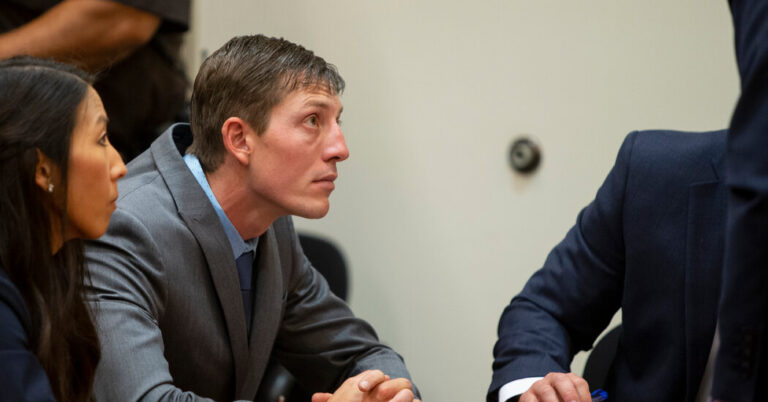
A Michigan jury said it was deadlocked on Thursday in a murder case against a police officer who fatally shot a motorist during a traffic stop.

Judge Christina Mims of the Kent County Circuit Court declared a mistrial after jurors, who had been deliberating for four days, said they were unable to reach a verdict.

The defendant, Christopher Schurr, formerly a police officer in Grand Rapids, Mich., took the stand during the trial and said that he feared for his life when he opened fire at the driver, Patrick Lyoya, after Mr. Lyoya grabbed his stun gun.

“I believe if I didn’t do what I did when I did it, I wouldn’t be here today,” Mr. Schurr told the jury, in his first public remarks about the shooting.

Mr. Lyoya’s death in 2022 set off protests and heightened racial tensions in Michigan, during a national debate over police misconduct and racism that followed the killing of George Floyd by a Minneapolis police officer.

Mr. Schurr, 36, is white. Mr. Lyoya, 26, was Black.

Mr. Lyoya’s killing received extensive media coverage, in large part because it was captured on video from several angles, including by Mr. Schurr’s body camera, a bystander’s cellphone and a nearby doorbell security system.

On a cold, rainy morning in April 2022, Mr. Schurr pulled over Mr. Lyoya in a residential neighborhood because the license plate on Mr. Lyoya’s vehicle was registered to a different car.

Patrick Lyoya moved to the United States after fleeing war in the Democratic Republic of Congo.Credit…Ben Crump Law, via Associated Press

Mr. Lyoya got out of his vehicle and demanded to know why he had been stopped, and then tried to run away, video footage of the traffic stop shows. Mr. Schurr ran after him, and the two engaged in a tussle for several minutes.

At one point, when both men were on the ground, Mr. Lyoya is seen in the videos grabbing the officer’s stun gun. Mr. Schurr then repeatedly demanded that Mr. Lyoya drop the device, but he did not, the videos show. The officer then pulled out his firearm and fired a single bullet into the back of Mr. Lyoya’s head.

Mr. Schurr was dismissed fired from the Grand Rapids Police Department after he was charged with murder.

The central question the jury was asked to weigh in the six-day trial was whether Mr. Schurr’s use of deadly force was justified. In Michigan, officers may lawfully use deadly force if they reasonably believe it is necessary to prevent grave bodily harm or death to themselves or someone else.

Throughout the trial, prosecutors argued that Mr. Lyoya’s actions as he sought to evade arrest did not pose a severe threat to Mr. Schurr. They contended that Mr. Lyoya did not convey a clear intent to harm the officer, even after grabbing the stun gun.

Chris Becker, the Kent County prosecutor, said Monday during closing arguments that at worst, Mr. Schurr was at risk of getting hurt. Mr. Becker said the officer was never at dire risk of death or serious injury.

“You can’t take a life without a darn good reason,” the prosecutor said.

Criminal-law experts say it can be a daunting challenge to obtain convictions against police officers who use deadly force on the job. Juries, they say, often give officers the benefit of the doubt unless there is clear evidence that the officers resorted to violence needlessly.

Veteran Grand Rapids police officers, including trainers, testified as defense witnesses in Mr. Schurr’s trial, lending support to his contention that he feared for his life during the encounter. Other officers who reached the scene soon after the shooting said Mr. Schurr looked drained when they arrived.

Capt. David Siver, a Grand Rapids police trainer, testified that while stun guns are generally not lethal, they do inflict searing pain. After losing control of the stun gun, Captain Siver said, Mr. Schurr had reason to think that he faced a dire threat.

“The chances are, it’s going to be used against you,” Captain Siver testified. “You get disarmed of your firearm, the statistics are out there, it doesn’t end well for officers.”

Officer Jason Gady, who helped train Mr. Schurr, testified that given the circumstances, shooting Mr. Lyoya in the back of the head was not “unreasonable.”

Relatives of Mr. Lyoya are suing the city, seeking $100 million in damages. They contend that Mr. Lyoya was pulled over because of his race and that his killing was unjustified.

According to an autopsy report, Mr. Lyoya had more than three times the legal limit of alcohol in his blood when he was pulled over. He also had an outstanding arrest warrant in connection with a domestic violence case.

Mr. Lyoya and his family, who fled the war in their native country, the Democratic Republic of Congo, lived in a refugee camp for nearly a decade before moving to the United States in 2014.


Source link

Are U.S. Tariffs Affecting Your Business? We Want to Hear From You.

0


President Trump’s trade war has created chaos for companies around the world, snarling supply chains, sowing uncertainty and muddling their ability to plan for the future.

After announcing tariffs that started at 20 percent for nearly all imports from European Union members — and more on other countries — the president has scaled the rate to 10 percent until July, saying his administration will use the time to negotiate bilateral deals with America’s trading partners. At the same time, Mr. Trump has escalated a trade war with China, potentially squeezing European companies.

We are a team of reporters who write about business and economic issues in Europe for The New York Times. In recent weeks, we have covered how tariffs have been affecting the car industry, financial markets and economic expectations for European countries.

To better understand the impact the tariffs are having on companies in Europe, including Britain, we would like to hear from business owners, entrepreneurs, managers and employees. How might the import taxes affect your company or job? Have you delayed hiring, postponed expansion plans or canceled orders? Have you altered your supply chains? We would also like to hear what tariffs mean for your production, and whether you are considering moving some part of it to the United States.

We will read every response and reach out if we are interested in learning more. We won’t publish any part of your response without contacting you first and obtaining your consent. Your contact information will not be shared outside The Times newsroom and we will use it only to get in touch with you.


Source link

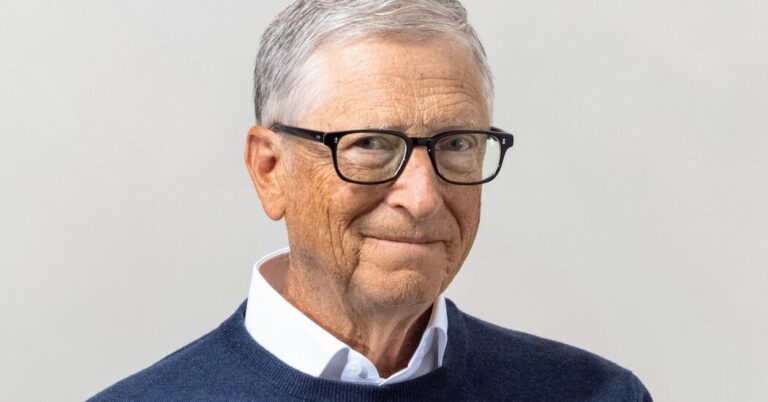
Bill Gates Explains His Plans to Close the Gates Foundation in 2045


Donald Trump is the face of these cuts, but the cruelty of his administration is not the only story. After leaping upward in the 2000s, global giving for health grew very slowly through the 2010s. The culture of philanthropy has changed somewhat, too, with the age of the Giving Pledge — in which hundreds of the world’s richest people promised to donate more than half of their great fortunes to charity — yielding first to the upstart movement called Effective Altruism and then to a new age of extreme wealth defined less by altruism than by grandiosity. After the Gateses’ divorce in 2021, Melinda eventually left the foundation to establish her own philanthropy; Warren Buffett, a longtime supporter, recently announced his plans to leave most of his remaining fortune in the hands of a charitable trust his own children will administer, and to give no additional money to the Gates Foundation beyond his death. After a few years of slow post-Covid decline, this has been the year that foreign aid — as the Gates Foundation’s chief executive, Mark Suzman, wrote recently in The Economist — “fell off a cliff.”

On the ground, progress has been bumpy, too, particularly in the aftermath of the pandemic emergency, when many routine vaccination programs were paused and the world’s poorest countries were thrown, en masse, into extreme debt distress. The share of the world’s population living in extreme poverty fell by almost three-quarters between 1990 and 2014, but it has hardly shrunk since.

To hear Gates and his team tell it, this is the time to go all in — given the yawning gaps produced by post-pandemic setbacks and the Trump assault, and given the promise of biomedical tools and other lifesaving innovations now in the development pipeline, and given A.I., a subject Gates returns to again and again. They even talk excitedly about a world in which the Gates Foundation has made itself unnecessary. That world sounds tremendously appealing. But — given the obstacles — can it be built?

Over two days in late April, I spoke with Gates about the state and legacy of his philanthropic endeavor, its achievements and disappointments thus far and what lies ahead. What follows is an edited and condensed version of those conversations, in which he was sunny, detailed and confident, sometimes to the point of brusque certainty, that the next few decades would yield even more radical improvements in global development than what he called, in retrospect, “our miraculous period.”

Let’s talk about the very present tense, with the Trump administration completely turning its back on foreign aid and leaving not just many millions of people but also most of the world’s global institutions in the lurch. How bad is it?


Source link

CEOs at Milken Conference Fear Tariffs and Hope for Trade Deals

0


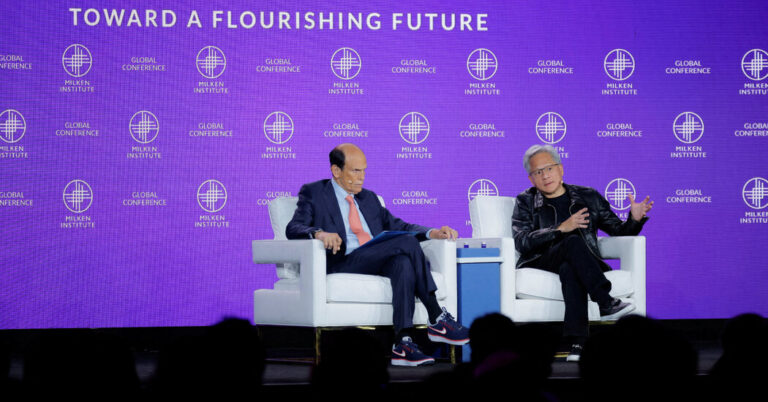
As dealmakers descended on the Beverly Hilton hotel in Los Angeles this week for the annual Milken Institute Global Conference, they were laser-focused on one type of deal: trade deals.

The threat of an intensifying trade war cast a shadow over the event, Lauren Hirsch reports.

Many business giants in attendance — including Bill Ackman, Jensen Huang and Ken Griffin — started the year imagining how good things could be under President Trump. But talk at this week’s event, behind the scenes at least, was about how bad it could get. Speculation ranged from cautious optimism that the U.S. will quickly push through uncertainty to quiet fears of sustained pain.

Dealmakers view Treasury Secretary Scott Bessent as their last hope. Executives including Paul Taubman, the C.E.O. of PJT Partners, lined up early Monday morning to hear from Bessent, whom many executives view as their advocate in the tariff frenzy.

The consensus: The U.S. needs to alleviate the oppressive uncertainty lingering over the American economy by reaching a deal with at least one country quickly. Even if that “deal” is more of a news release than a fully negotiated pact. (More on that below.)

Many are planning for a rough year. Some say the country is already in a recession, and the question is just how steep it will get and how long it will last. Volatility has made it all but impossible to make big investments or do deals, with exceptions like the $9 billion takeover of Skechers proving the rule. As if dealmakers needed any reminder of the unpredictable business environment, many arrived in Los Angeles on Sunday evening as Trump threatened mind-boggling tariffs on the film industry.

A dearth of deals is likely to be particularly difficult for the private equity executives that traditionally descend upon Milken in hopes of raising more cash. Fund-raising is getting harder as a sustained deal-making slump has kept their investors waiting to see returns.

Any concerns didn’t stop them from kicking back, though: one rooftop cocktail party jauntily served “NAV-gronis,” which may be a reference to the loans some private equity firms have resorted to as a way to find liquidity.

Some attendees are still betting on deregulation and tax cuts. They happily noted that Bessent called out permitting overhauls in his Monday speech. (“The president doesn’t want to just ‘drill, baby, drill!’ He wants to ‘build, baby, build!’ he said.) They argued that discontent consumers and falling polling averages may counter Trump’s worst instincts.

And several present still expect tax policies to supersede any current angst. “Tax policy drives investment decisions,” Gary Cohn, who served as director of the National Economic Council in Trump’s first term, said onstage. “One of the most important things that has to happen this year is we have to, at a minimum, extend the Trump tax cuts.”

One potential tax hike consumed conversations. As large universities feel financial pressure from Trump’s funding freezes and threats to revoke their tax exempt status, rumors swirled at the conference that the next budget bill could significantly raise the tax rate on realized profits for certain endowments, which is currently 1.4 percent.

The increasing pressure on university finances could result in more universities following Yale’s lead by reducing their exposure to private equity. One hotly debated topic at the conference: Just how steep a discount would Yale or other universities take when selling off their private equity stakes.


DEALBOOK WANTS TO HEAR FROM YOU

We’d like to know how the tariffs are affecting your business. Have you changed suppliers? Negotiated lower prices? Paused investments or hiring? Made plans to move manufacturing to the U.S.? Or have the tariffs helped your business? Please let us know what you’re doing.

President Trump reportedly may pursue a major Medicare drug price overhaul. He could sign an executive order as soon as next week that would tie the prices the government pays for some medications to what other countries pay, though he hasn’t yet personally approved the plan according to Politico. Separately, Speaker Mike Johnson abandoned a potential big cut to Medicaid, bowing to pressure from politically vulnerable Republicans.

The Trump administration is weighing an overhaul of Biden-era chip export limits. The Commerce Department is planning to change a rule that imposes limits on how many artificial intelligence chips countries like India, Israel and Switzerland can buy, a spokeswoman told The Wall Street Journal. The move led to a jump in shares of chipmakers including Nvidia, which have argued that the Biden-imposed rules were denting American tech exports.

OpenAI hires Instacart’s C.E.O. to oversee its business and operations. The appointment of Fidji Simo, a former Facebook executive who has led Instacart for nearly four years, will oversee huge portions of the artificial intelligence giant, including sales and marketing. It’s meant to solidify the management team at OpenAI, with Sam Altman, who will remain C.E.O., free to focus on overseeing research, computing and safety systems.

Shareholders in Google mostly shrugged off two major antitrust defeats that the company suffered in federal court over the past year. They appear far more worried about the loss of a vital business deal.

Shares in the tech giant tumbled 7.5 percent on Wednesday after a top Apple executive said that the iPhone maker was considering replacing Google as the default search engine for its Safari web browser.

Apple is “actively looking at” adding A.I.-powered search engines as options for Safari, Eddy Cue, the company’s senior vice president of services, testified on Wednesday in the Justice Department’s antitrust lawsuit against Google’s search business.

Apple may eventually add search engines powered by artificial intelligence, including those from Anthropic, OpenAI and Perplexity, as options for Safari, Cue added.

It’s hard to overstate the potential impact. Being Safari’s default search provider means that Google served up billions of queries for iPhone, iPad and Mac users, giving it a huge leg up over search rivals. The arrangement is so powerful that Google pays billions of dollars a year for that right — and federal prosecutors have argued it should end.

Note that Cue testified on behalf of Google, and said he was worried about Apple losing that huge source of income.

Cue’s disclosure also underscores an existential worry for Google. While the company has praised its breakthroughs in artificial intelligence research, the financial engine behind the $1.84 trillion company remains search. The “search and other” division reported $50.7 billion in revenue last quarter, up nearly 10 percent year on year.

Cue noted that search queries on Safari dipped last month for the first time — already a worrying sign for Google — which he chalked up to users relying on artificial intelligence. Anything that poses a threat to the business that funds Google’s pivots to the future, including A.I., are something shareholders clearly take very seriously.


President Trump’s trade war has put Jay Powell and his colleagues at the Fed in the same tricky place as much of the corporate world: in limbo. That was reinforced on Thursday when the president lashed out anew at the central bank chief.

But the uncertainty felt by Powell and corporate bosses could actually ramp up the pressure on the White House to deliver quick-win trade deals, or de-escalate its us-against-the-world tariffs fight. On Thursday morning, Trump teased that the “FIRST” one — with Britain — will be detailed on Thursday, with “many other deals” to follow.

The latest: Toyota and the shipping giant Maersk warned on Thursday that Trump’s levies were clobbering global trade and denting their bottom lines. “The current environment surrounding the auto industry, including trade relations, is in extreme flux,” Koji Sato, Toyota’s C.E.O., said at a news briefing.

Powell also has little visibility. That has essentially handcuffed the Fed on interest rates. The central bank has signaled that it’s in no rush to act, because lowering rates too soon could risk igniting inflation, just as companies warn that tariffs may scramble their supply chains and force them to raise prices.

On the flip side, staying on the sidelines too long could affect economic growth, threatening the labor market.

“It’s really not at all clear what it is we should do,” Powell said on Wednesday. That wait-and-see position is already irritating Trump. The president renewed his attack, writing on Truth Social that “‘Too Late’ Jerome Powell is a FOOL, who doesn’t have a clue.”

The divide between the markets and the Fed is also growing. Futures traders see another rate cut by July, but many economists aren’t so sure. “If our base case of a steady labor market and rising inflation is correct,” Aditya Bhave, a senior U.S. economist for Bank of America, wrote in a research note on Wednesday, “we don’t see a path to cuts in 2025.”

That uncertainty could take some shine off a big Trump announcement. With the president under pressure to show progress on trade deals, he promised that Thursday’s expected deal with Britain will be “full and comprehensive.” Trade specialists told The Times that they expect it to be more of a “framework” agreement than a finalized deal.

There are many questions about the nature of the accord. Will it cover digital services where the U.S. has a commanding trade surplus with Britain and most European countries? What about the billions of dollars’ worth of Hollywood films and TV productions that are produced in Britain, an outflow that Trump wants to stem via tariffs?

And more broadly, could this be a template for future deals?


Disney reported earnings on Wednesday that handily beat estimates, with positive outlooks for its film and streaming businesses.

But the unveiling of a major theme park in Abu Dhabi underscores the importance of that operation to the media giant’s future — and may offer a clue about who could end up succeeding Bob Iger as C.E.O.

The entertainment giant, which owns ESPN, ABC, Disney+ and Hulu, more notably raised its profit outlook for the year at a time when most companies are revising their estimates for lower growth.

Disney said it expected higher earnings from its TV and streaming businesses, as well as its theme parks, the company’s most lucrative division. Shares jumped more than 10 percent, making Disney one of the S&P 500’s best performing stocks on Wednesday.

Then there’s the Abu Dhabi resort. The resort will be built and fully financed by an Abu Dhabi company, the Miral Group, with Disney overseeing the design and some of the management, according to Iger. Disney will not have any ownership and instead will collect a royalty.

Emphasizing the importance of the initiative, Iger greeted shareholders from Abu Dhabi for the company’s earnings call on Wednesday, announcing that the resort would connect “travelers from the Middle East and Africa, India, Asia, Europe and beyond.”

The resort could be insulated from President Trump’s trade war, including threatened tariffs on films produced overseas, since it’s ultimately a regional play, Brian Wieser, an analyst who runs the consulting firm Madison and Wall, told DealBook. (He added, however, that “travel tourism still faces big risks” and that “American brands face risks.”)

Then there’s the succession angle. Josh D’Amaro, the chair of Disney’s theme parks division, appeared with Iger in an interview on CNBC to discuss the Abu Dhabi theme park. Disneyologists are surely wondering whether the high-profile spot for D’Amaro, along with the strong performance of his division, suggests that he has an edge in the race to replace Iger.

His main internal rival is Dana Walden, the co-chair of Disney’s content business, though the board — led by James Gorman, the former Morgan Stanley C.E.O. — is also reviewing external candidates.

Disney said that it would announce Iger’s successor early next year.

Deals

Politics, policy and regulation

Best of the rest

We’d like your feedback! Please email thoughts and suggestions to dealbook@nytimes.com.


Source link

Salford City takeover: David Beckham and Gary Neville lead new consortium in acquiring League Two club | Football News

0


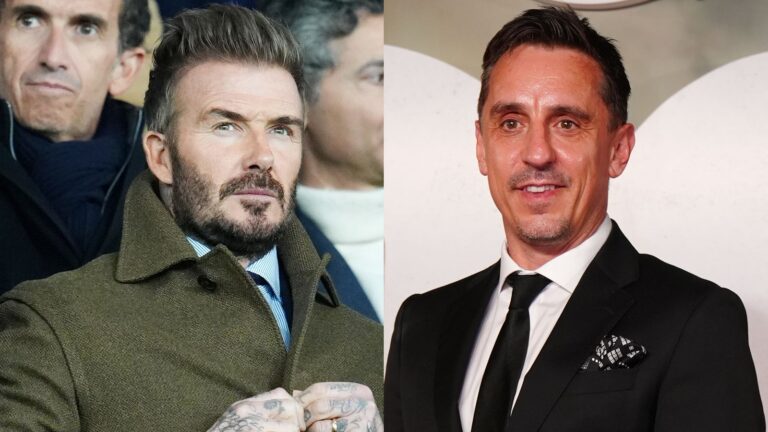
Salford City have been acquired by a new consortium led by David Beckham and Gary Neville that intends to “invest significantly” in the club.

The new shareholders also include US-based businessman Declan Kelly and Lord Mervyn Davies, who will both serve as co-chairs of the League Two side’s board.

Neville and Beckham were already co-owners at Salford alongside their former Class of ’92 Manchester United team-mates Nicky Butt, Ryan Giggs, Paul Scholes and Phil Neville, but they will no longer be shareholders although remain in roles at the club.

Singaporean businessman Peter Lim had been a majority shareholder since the initial takeover in 2014 before Neville acquired his stake last August.

Beckham said: “I grew up in Salford. I have such fond memories of my time living there and the place and its people played such an important part in my early life in football.

“Salford City is at the heart of its community. It has a rich history and I am delighted to be a part of the next chapter.”

Salford City's Peninsula Stadium
Image:
Salford City’s Peninsula Stadium

Salford say the takeover has been “uniquely structured” through a members club made up of nine shareholders including Dream Sports Group (India’s leading sports technology company), Colin Ryan (founder, Clipper Street Capital), Frank Ryan (global co-chair, global co-CEO, and Americas Chair, DLA Piper), Nick Woodhouse (executive vice chairman, Authentic Brands Group), and Shravin Mittal (founder of Unbound).

“These shareholders have extensive experience working with many of the world’s biggest companies and brands,” Salford said. “The membership group has been specifically constructed to include executives drawn from different backgrounds across finance, legal, media, tech and entertainment sectors to maximise the impact and contribution they can have on the club moving forward.”

Neville added: “I am passionate about Salford City. This is a unique partnership with a diverse range of minds and expertise, held together by a love of football. Football will come first, however, it’s critical that we drive the club towards sustainability in the next 4-5 years. I can’t wait for the next part of this journey.”

Salford won four promotions in five seasons to reach the EFL following the Class of ’92’s takeover but their progress has stalled.

They finished a point outside of the play-offs this season under head coach Karl Robinson and will now start to prepare for their seventh consecutive League Two campaign.


Source link

U.S. Trade Deal Could Lift UK Economy, but Won’t Transform It

0


The British government made faster economic growth its No. 1 mission. But efforts to kick-start it have been repeatedly knocked off course by a global economy lurching from one crisis to another.

On Thursday, British officials appeared to secure a win. The country is set to announce some form of trade deal with the United States that will ease the impact of recent increases in U.S. tariffs.

President Trump said on social media on Thursday that the agreement with Britain “is a full and comprehensive one that will cement the relationship between the United States and the United Kingdom for many years to come.”

British officials have been negotiating in Washington for months as they sought to insulate their country from Mr. Trump’s desire to reshape the global trade order. They also wanted to protect an economy that barely avoided a recession at the end of last year and was on course for a relatively strong recovery later this year.

However, officials failed to secure exemptions last month when Mr. Trump hit Britain with the 10 percent “base line” tariffs, which were imposed on America’s trading partners.

Britain is also subject to 25 percent tariffs on cars and steel. And the country’s leaders have been concerned about threatened tariffs on pharmaceuticals and films, two important exports. Like other countries, forecasts for Britain’s economic growth have been slashed because of the trade uncertainty.

The expected deal with the United States will be welcome in Britain for a number of reasons. It’s likely to vindicate overtures that the prime minister, Keir Starmer, has made to the president (including an invitation from King Charles for a state visit) and might overshadow a setback in local elections last week.

The deal could also support certain sectors, including Britain’s auto industry, which was most at risk from high tariffs. Cars make up about 10 percent of the value of British goods exports to the United States. Many of those are luxury cars, like Jaguars, Aston Martins and Bentleys, that are made with custom details in Britain. These automakers have found it economically prohibitive to shift production to the United States and have paused shipments there.

A trade deal is also likely to lift consumer and business sentiment, which have both slumped recently.

But there are limits to how much an agreement would support the British economy as a whole. Although the United States is an important trading partner, trade flows are heavily skewed toward services, with Britain exporting £137 billion worth of services to the United States last year, which were not affected by higher tariffs.

More than 60 percent of businesses reported that they expected U.S. tariffs would have no impact in the next month, according to a recent survey by the Office for National Statistics.

Though Britain has been in trade negotiations with the United States for five years, the deal is unlikely to be a full-blown free-trade agreement that incorporates lowering tariffs across a wide range of goods and increases access to many services, like the trade agreement Britain and India signed this week. An even bigger prize for Britain would be a closer relationship with the European Union, which represents about half of British trade. Some progress on an E.U. deal is expected later this month at a summit in Britain.

The Bank of England cut interest rates on Thursday, lowering them a quarter point to 4.25 percent.

British policymakers have cautiously cut rates since last year over concerns about lingering price pressures and a short-term bump in inflation expected this year. But some had recently emphasized the risk to economic growth from trade uncertainty. Overall, policymakers were divided on this decision. Five members, a majority, voted for the quarter-point cut; two voted to hold and two voted for a larger cut.

Economists have said that the greater threat to Britain is the uncertainty that Mr. Trump’s trade policy has created globally, rather than tariffs on Britain.

As an open economy, Britain is vulnerable to external shocks. So if other major economies such as the European Union, China and the United States fall into recession, it would sap the British economy. The uncertainty is expected to weigh on business investment and consumer spending.

“The center of the U.K. story is not tariffs; it’s domestic factors,” said Benjamin Caswell, an economist at the National Institute of Economic and Social Research, which downgraded its forecast for Britain’s economic growth to 1.2 percent this year, predicting weak business confidence and higher cost pressures. Businesses are also facing higher taxes on wages, which went into effect last month and could push up inflation.

The sluggish economic outlook means the government is at risk of being forced to raise taxes or cut public spending this year. That has left businesses wondering what will happen in the fall, which could lead to less investment and hiring.

“Tariffs have engendered a lot of uncertainty, but I don’t think that should take the government off the hook,” Mr. Caswell said.


Source link

Overnight Clashes Strain Diplomacy Efforts for India and Pakistan


The situation between India and Pakistan remained volatile on Thursday, with reports of heavy overnight shelling and strikes on both sides clouding an international diplomatic push to contain the risk of all-out war.

After a day of violence on Wednesday that opened with Indian airstrikes and Pakistani claims to have shot down aircraft — and reports of dozens of deaths in total — both India and Pakistan seemed to be open to finding a way to de-escalate. Even as leaders on both sides publicly struck victorious tones, Pakistani officials said that security officials from both countries had made initial contact to reopen communication.

President Donald Trump expressed his willingness to help, too, as U.S. officials said they were engaging with leaderships of both India and Pakistan to seek a peaceful resolution.

There were hopeful signs of engagement on Thursday, including a flurry of diplomatic meetings in New Delhi and Islamabad. Top diplomats from Iran and Saudi Arabia, crucial regional players who have close ties to both of the warring countries, were in New Delhi for meetings.

But on the ground, the news was of more violence. The Indian side said that it had received heavy shelling from Pakistani positions along the border areas overnight. Indian officials said they had responded forcefully, and claimed that they had targeted Pakistan’s air defense radars and systems at several locations. Pakistan, for its part, added to its claims of downing Indian aircraft, saying it had shot down drones that had penetrated into Pakistani territory to carry out strikes on Thursday. Many of the details claimed by each side could not be fully confirmed.

In a sign of the escalating violence, the United States issued an alert to American citizens in Lahore, the regional capital of Pakistan’s Punjab Province, near the border with India.

“Due to reports of drone explosions, downed drones, and possible airspace incursions in and near Lahore, the U.S. Consulate General in Lahore has directed all consulate personnel to shelter in place,” the statement said.

The two countries, separated from each other at the end of British colonial rule in 1947, have fought several wars, with the main flashpoint being disputed claims over the Himalayan region of Kashmir, split between them.

The recent escalation came after a gruesome terror attack on the Indian side of Kashmir last month that killed 26 civilians. India accused Pakistan of being behind the attack and vowed military action. Pakistan denied the accusations, and warned that it would respond in kind if attacked.

The diplomatic push this week was being built around the hope that the heaviest military engagement could be contained to the actions on early Wednesday.

Pakistani officials said the national security advisers of both countries had established “some interaction” after Wednesday’s initial strikes. The engagement was first mentioned by Pakistan’s foreign minister, Ishaq Dar, in an interview with the news channel TRT. A second official confirmed the contact, but said it was indirect — suggesting there were mediators in the mix.

Still, in both capitals, it was clear that the risk of escalation was far from over.

In New Delhi, Prime Minister Narendra Modi’s government briefed representatives of the opposition parties on India’s military action, and all of the political figures came out with a statement of support for the government’s action.

“This is an ongoing operation,” India’s parliamentary affairs minister, Kiren Rijiju, said after the meeting.

At the beginning of his meeting with his Iranian counterpart, Foreign Minister S. Jaishankar of India said that the government’s actions against Pakistan had been “targeted and measured.”

“It is not our intention to escalate the situation,” he said. “However, if there are military attacks on us, there should be no doubt that it will be met with a very, very firm response.”

In Pakistan, the country’s leadership also showed a united front. Dominating newspapers and social media were images of a funeral held on Wednesday for a 7-year old boy who was killed in the Indian strikes. Pakistan’s top leadership, including the country’s prime minister, president and its army chief, were all in attendance.

After the funeral, Pakistan’s president, Asif Ali Zardari, condemned India’s actions as “cowardice” and vowed they would be “met with decisive action.”


Source link

Trump’s Threatened Tariffs Are So Large, 10% Feels Like a Relief

0


There has been a mantra spreading among weary corporate executives who are becoming resigned to President Trump’s tariffs while still hoping to avoid the worst of their effects: Ten percent is the new zero.

The statement refers to the 10 percent tariff that Mr. Trump put in place on most U.S. imports one month ago. Such a significant increase in U.S. tariffs would have been unthinkable a few years ago. But it no longer seems like such a big deal, compared with the truly large tariffs that Mr. Trump has already imposed or threatened elsewhere.

Mr. Trump’s “Liberation Day” announcement on April 2 that he was planning tariffs of 10 percent to 60 percent on dozens of America’s trading partners set off a rout in the bond markets and a flight from the U.S. dollar as investors panicked at the prospect of an economically devastating trade war. Mr. Trump also ratcheted up tariffs on China to a minimum of 145 percent amid a trade spat with Beijing, bringing much of the trade between the countries to a halt.

That turmoil appears to have moderated Mr. Trump’s impulses somewhat. The president quickly paused tariffs on most countries, giving them 90 days to negotiate trade deals instead.

Mr. Trump also granted a lucrative exemption from China tariffs for makers of electronics and offered some limited relief for automakers. And he has hinted that he could do more, saying he likes to be “flexible.”

Investors have lapped up any signs of good news, even insubstantial ones. Stock markets have now regained nearly all of the losses they sustained after April 2, buoyed by comments from Trump administration officials that they are working to close trade deals with allies and planning to meet with Chinese counterparts to discuss their standoff.

The speed with which investors have come to accept Mr. Trump’s tariffs reflects an increasing embrace of tariffs as a policy tool. It also shows a decreasing tolerance in America for the predatory trade practices of countries like China, which has dominated global industries and systematically put rival manufacturers around the world out of business.

But it also indicates something about Mr. Trump and his negotiating style. By threatening gigantic tariffs in early April and then walking them back, the president seems to have increased the acceptance, at least in some circles, of the significant tariffs that remain in place.

This is a classic example of the psychological effect known as anchoring, when a certain piece of information, like a high number thrown out in the course of a negotiation, can reset a whole frame of reference.

Sekoul Krastev, a co-founder of the Decision Lab, a company that works with governments and organizations to apply lessons from behavioral science, said the anchoring effect was one of the more rigorous and tested in behavioral sciences. In all types of contexts, researchers have found that by throwing out a large number, they can quickly reset people’s expectations of what is normal and appropriate.

For example, Mr. Krastev said, a car salesman who wants to sell you a $50,000 car will show you an $80,000 one first. But the value doesn’t even have to be related to the decision being made. In experiments, people asked to think about the height of Mount Everest were more willing afterward to spend more on a sofa than they would have spent previously, he said.

“I do think it’s at play,” he said. “Let’s say you set an anchor for really high tariffs — that’s going to make the range of acceptable tariffs much higher than before.”

The truth, of course, is that the tariffs currently in effect still constitute both a major change for global trade and a huge tax increase for the country. The United States still has a 10 percent “universal” tariff in effect on most imports globally, as well as 25 percent tariffs on imported cars, metals and goods from Canada and Mexico. Overall, according to the Budget Lab at Yale, consumers face an average effective tariff rate of 28 percent, the highest since 1901.

Those tariffs may seem manageable compared with triple-digit tariffs now in effect against Chinese products and the double-digit tariffs that have been paused against dozens of other countries. But for some companies, tariffs of 10 to 25 percent are still enough to erase profit margins, stall expansion or hiring plans or even push them out of business. The U.S. Chamber of Commerce has warned that many small businesses in particular might not survive.

Speaking at the Milken Institute Global Conference in Los Angeles this week, Jane Fraser, the chief executive of Citigroup, said companies could withstand lower tariffs, though trade uncertainty had forced them to pause investment and hiring.

“If it is 10 percent, most of the clients we talk to say, ‘Yeah, we can absorb that,’” she said. “If it is 25 percent, not so much.”

Some of the moves that investors are interpreting as good news are also fairly minor retrenchments in a major increase in trade protectionism. The exception given to automakers last Tuesday, for example, was relatively small, though it sent the price of some automakers’ shares higher that day.

And while Beijing and Washington have agreed to meet to discuss their trade standoff, the countries have a long way to go.

The Trump administration said on Tuesday that Scott Bessent, the Treasury secretary, and Jamieson Greer, the United States trade representative, would meet with Chinese officials this weekend in Geneva, where they will discuss trade and economic matters.

The administration might choose to quickly drop some of its tariffs on China as a good-will gesture once the countries restart negotiations — but tariffs have risen so much that the United States might have to cut them by more than 100 percentage points to meaningfully restart trade.

It is also unclear how much progress can be made on the serious economic disputes the countries have. The Trump administration has criticized China for a bevy of unfair trade practices, as well as for failing to stick to the terms of a trade deal the president negotiated in his first term. China, in return, has called Mr. Trump’s tariffs “illegal and unreasonable.”

Perhaps most important, despite being persuaded on occasion to show flexibility, Mr. Trump is still a self-described “tariff man,” reflexively drawn toward the power of an economic tool that he thinks is an effective way to persuade global companies to bring their factories to the United States.

Mr. Trump continues to find ways to deploy tariffs that few had anticipated. In a post on Truth Social on Sunday, he proposed adding 100 percent tariffs to movies produced outside the country and said Hollywood was dying a “very fast death,” arguing that this threatened U.S. national security. On Monday, the president said that tariffs on pharmaceuticals would be coming in the next few weeks and that he had already decided on the rate.

In a speech on Sunday, Maros Sefcovic, the European Union’s commissioner for trade, said that “more U.S. tariff actions could well be on their way,” pointing to investigations into lumber, pharmaceuticals, semiconductors, critical minerals and trucks.

If all those investigations led to tariffs, he said, 97 percent of E.U. exports to the United States would be subject to taxes.

In an interview with NBC’s “Meet the Press” broadcast on Sunday, Mr. Trump insisted that he would preserve the threat of tariffs, no matter what.

Asked if he would take the possibility that some tariffs would be permanent off the table, Mr. Trump demurred.

“No, I wouldn’t do that because if somebody thought they were going to come off the table, why would they build in the United States?” he said.

Jeanna Smialek, Alan Rappeport and Tony Romm contributed reporting.


Source link

A’ja Wilson Now Has a Nike Signature Shoe. Why Did It Take So Long?

0


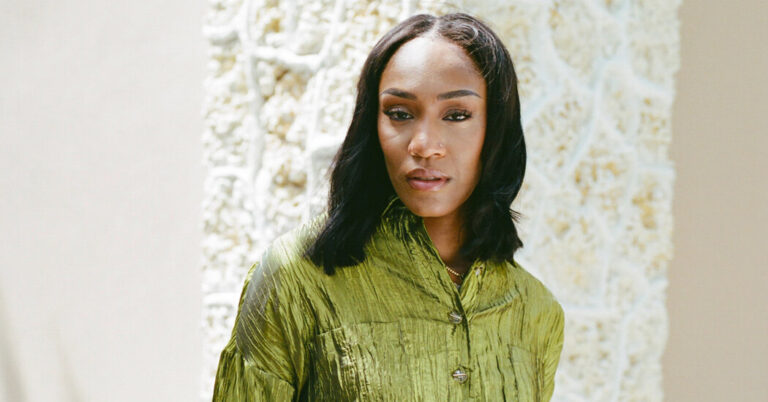
A’ja Wilson, a center for the Las Vegas Aces, is widely acknowledged as the best player in the Women’s National Basketball Association. She is something like the league’s on-court answer to LeBron James or Michael Jordan.

“I don’t shy away from having conversations with her about being the greatest to ever play,” said Becky Hammon, who has coached the Aces since 2022.

Ms. Wilson was the W.N.B.A.’s Rookie of the Year in 2018, won its Most Valuable Player Award in 2020 and 2022 and won a championship in 2022. But while she racked up achievement after achievement, one marker of basketball stardom eluded her: the shoe.

If Ms. Wilson were playing in the National Basketball Association, she would have long ago gotten a signature shoe, the on-court footwear designed with and for a player. More than two dozen N.B.A. players have them.

For years, marketers largely ignored the women’s game. But Ms. Wilson’s star has risen alongside that of the league she plays in, and in early 2023, Nike finally told her that it planned to create a signature shoe for her.

I probably cried for a couple of days,” she said.

The plan remained secret, and her fans got angry as Ms. Wilson continued to dominate on the court — winning another championship in 2023 — without any news of a shoe. Fans were happy last May, however, when Nike announced that it would release her signature shoe, the A’One, this month, alongside an apparel collection.

(The year in between gave them even more reasons to be happy: Ms. Wilson became the first player in W.N.B.A. history to score 1,000 points in a season, won a third M.V.P. Award, was named one of Time magazine’s women of the year and had her jersey retired by the University of South Carolina.)

The A’One went on sale on Tuesday, with a “Pink Aura” version, making Ms. Wilson the first Black W.N.B.A. player to have a signature shoe since 2011.

“It’s time for people to have a shoe and see a shoe from someone like me, considering it hasn’t been done in a long, long time and it comes from a Black female athlete in this world,” she said. “I’m grateful.”

The 28-year-old was speaking in the Saint-Germain-des-Prés neighborhood of Paris, at a hotel suite overlooking Le Bon Marché, the famous department store. Her 6-foot-4 frame was dressed in the athletes’ off-court uniform of sweats, with jewelry in her ears and on both sides of her nose. She was there on behalf of Nike. It was men’s fashion week, so outside the hotel, photographers waited behind a rope in case celebrities emerged.

W.N.B.A. players are bigger stars now than they ever were before, arguably with more cultural impact than they had even in the league’s heady early days in the 1990s, when players like Lisa Leslie and Sheryl Swoopes became household names. Last season, interest in the league spiked, buoyed by the popularity of the rookies Caitlin Clark and Angel Reese. Brands rushed to play catch-up.

That resurgence has happened in the shoe industry, too, where brands have struggled to monetize products connected to female athletes.

The first W.N.B.A. player to have a signature shoe made for her was Ms. Swoopes in 1995. Nike’s Air Swoopes had a tab on the back that made it easy to put on with the long fingernails she liked to sport. Nike made seven editions of it, the most it has made for any female player to date.

Eight other W.N.B.A. players released signature shoes between 1995 and 2001, according to a database kept by ESPN. In 2005 and 2006, Nike made shoes for Diana Taurasi, who starred at the University of Connecticut, for the U.S. women’s national team and for the Phoenix Mercury. After her shoe, Nike didn’t make another signature shoe with a women’s basketball player until 2023.

Nike wasn’t alone in its hiatus. Between 2011, when Adidas released a product with Candace Parker, and 2022, there were no W.N.B.A. signature shoes, according to ESPN’s database. There just wasn’t much of a market, industry observers say.

Women’s models make up a small portion of the basketball shoe business, said Matt Powell, a retail analyst with BCE Consulting, in part because many female basketball players prefer wearing a men’s shoe.

“It costs a tremendous amount of money to develop a shoe and then to build that shoe,” Mr. Powell said. “If sales are not going to be huge, and that is the history of what we’ve seen, any brand is like, ‘How much of an investment can we make here?’”

That all started to change when women’s college basketball became more popular. Social media allowed players to create personal brands, and in 2021 the National Collegiate Athletic Association shifted its rules to allow athletes to capitalize on name, image and likeness (N.I.L.) deals, increasing their visibility with commercials and other advertisements.

Broadcast channels helped, too: ESPN began televising the N.C.A.A. women’s tournament in 1996 but did not air the championship game on its broadcast network, ABC, until 2023. Ms. Reese’s Louisiana State team defeated Ms. Clark’s Iowa for that title, drawing nearly 10 million viewers.

The 2024 championship game drew 18.9 million viewers, beating the men’s championship game by about four million, according to Nielsen. That interest has trickled up into the W.N.B.A. as the players moved there, too.

In July 2023, Nielsen reported a rise in interest generally in women’s sports. It also said surveyed viewers were frustrated by a lack of access to live women’s sports and a lack of media coverage.

“Sneaker companies are always reactive to the public, and they’re always responsive to what they perceive as popular at a given time,” said Brandon Wallace, an assistant professor at Indiana University who has studied the industry.

Sabrina Ionescu’s shoe came out in 2023, her fourth W.N.B.A. season, all with the New York Liberty. It was Nike’s first unisex shoe and is one of the most popular shoes for N.B.A. players to wear during games. Players have said they like its look, which includes intricate embroidery and customizable colors, and how it feels on their feet. The structure is similar to Kobe Bryant’s shoe, which revolutionized the industry.

Nick Depaula, a journalist who covers the sneaker industry, said he expected Ms. Wilson’s to be popular among the men as well. In part because of its design — he cited “the grip and the support and the lightweight element” — and in part out of solidarity.

“She’s worn LeBrons for years and supported his line,” Mr. Depaula said, referring to the Los Angeles Lakers superstar, who also has a deal with Nike. “There’s an element of players excited for her personally.”

Bam Adebayo of the Miami Heat, who has been romantically connected to Ms. Wilson, has already worn her shoe in a game, before its release.

Mr. Powell, the industry analyst, also said he believed that Ms. Wilson’s shoe would do well among women’s basketball shoes, in part because of the heightened interest in the W.N.B.A. and in part because of its relatively low price. Adult sizes are $110 and children’s $90, compared with $190 for Mr. James’s signature shoes or $130 for the Sabrina 2.

The launch of Ms. Wilson’s shoe has not come without controversy.

In April 2024, when news broke that Nike was planning a signature shoe for Ms. Clark, then heading into her rookie season with the Indiana Fever, it set off a firestorm.

The news of Ms. Wilson’s shoe wasn’t public yet. Her fans wondered if racism played a part in giving Ms. Clark, who is white, a shoe before the much more professionally accomplished Ms. Wilson, especially since the only other active players with signature shoes — Ms. Ionescu and Breanna Stewart, a two-time M.V.P. — are both white.

Others noted Ms. Clark’s exceptional popularity: She was selling out arenas and causing opponents to move their games to bigger venues. Games she played in set viewership records.

Strangers debated Ms. Wilson’s merits. Some said that her personality wasn’t charming enough, or that her style of play lacked charisma. Frontcourt players are sometimes thought to be less marketable because their style of play is often less flashy.

“It was very hard for me to navigate, only because in the back of my mind I’m like, ‘Yes, I know a shoe’s coming, but I really have nothing to share,’” Ms. Wilson said. “And to constantly be in those conversations and constantly having my name dragged through the mud and having my résumé dragged through the mud is really hard.”

When the shoe was announced, Nike leaned into the controversy: Ms. Wilson wore a sweatshirt that had “Of Course I Have A Shoe Dot Com” written on it.

Now some writers and fans are wondering why Ms. Clark isn’t getting her shoe alongside Ms. Wilson.

A prominent Substack sports columnist, Ethan Strauss, suggested that Nike was delaying Ms. Clark’s shoe because of Ms. Wilson’s coming product, calling it “corporate malpractice” to not cash in on Ms. Clark’s popularity.

Tanya Hvizdak, Nike’s vice president of global sports marketing, said Nike was not delaying Ms. Clark’s shoe for Ms. Wilson. She said creating a signature shoe took time and disagreed with the characterization that it had taken too long for Ms. Wilson to be awarded a shoe.

“What I would say is we’ve been supporting our women’s basketball athletes for 40 years,” Ms. Hvizdak said.

Mr. Powell, the analyst, said Nike’s recent struggles as a business and its overhaul last year were instructive as well.

With Nike’s stock price falling and cultural relevance slipping, its board announced the abrupt retirement of its chief executive, John Donahue, in September and said Elliott Hill would replace him. Mr. Hill had spent 32 years with the company before retiring in 2020.

“I think we would have seen the Caitlin shoe a lot faster if Elliott had been at the helm,” Mr. Powell said. “His predecessor just did not appreciate product and the value of endorsement.”

Nike is expected to announce a shoe soon with Paige Bueckers, the first pick in this year’s W.N.B.A. draft. Ms. Reese, who plays for the Chicago Sky, has a shoe in the works with Reebok and has already released lifestyle shoes for day-to-day wear.

It confuses the people close to Ms. Wilson that marketing opportunities have come more slowly than her basketball accolades.

“She’s a supportive person,” said Sydney Colson, a teammate for the last three seasons and one of Ms. Wilson’s closest friends. “And not even just superstars, but people like that are just rare to come by.”

Ms. Wilson decorates the lockers of her teammates for their birthdays and buys a cake celebrating Pride for her gay teammates each year. Last year’s Pride cake was pink with disco balls, rainbow frosting and lettering that spelled, cheekily, “Hooray you gay.”

Ms. Wilson is also outspoken. When Mr. James signed a $154 million contract with the Lakers during her rookie year, she posted a tweet saying the W.N.B.A.’s best were hoping just to reach $1 million. At the time, the league’s top players made salaries of $115,500. Ms. Wilson will make $200,000 this season, which opens on May 16.

Nike and Ms. Wilson declined to comment on the size of their overall deal, but The Wall Street Journal and The Athletic have reported that Ms. Clark’s Nike deal is worth $28 million over eight years.

Ms. Wilson has not shied away from discussing the impact of race on why she is sometimes called not marketable.

“It’s 100 percent about race,” she said. “And it’s one of those things where we can sit there and say that all the time, but there’s going to always be someone that’s like, ‘Well, no you’re just making it about race.’”

As new opportunities have come her way Ms. Wilson has used them to cultivate her image. She has especially leaned into the fashion world’s recent embrace of her; Vogue and GQ, for instance, featured her last month in a spread related to the Met Gala.

The collection with Nike includes single-leg leggings like the ones that Ms. Wilson popularized in the W.N.B.A., made in hot pink, and a hot pink sweatshirt with satin-lined hood (because her mother got tired of seeing her wearing a bonnet at the airport, Ms. Wilson said).

When she went on tour last year for her book, “Dear Black Girls,” her team approached the designer Sergio Hudson, who has dressed Michelle Obama, former Vice President Kamala Harris, Beyoncé, Rihanna and Jennifer Lopez, to outfit her.

He knew Ms. Wilson was stylish, and he liked the idea of supporting a W.N.B.A. player, especially one from his home state, South Carolina.

“When I saw her walk out in the first outfit we made for her, I was like, ‘This girl is a star,’” Mr. Hudson said.

“At that time it wasn’t how it is now,” he said. “It wasn’t that long ago, but it’s like overnight things have shifted and the W.N.B.A. girls are prime celebrities, and everybody wants to dress them.”


Source link