Home Blog Page 325

Toyota Says Tariffs Will Erase $1.3 Billion in Profits in Just 2 Months

0


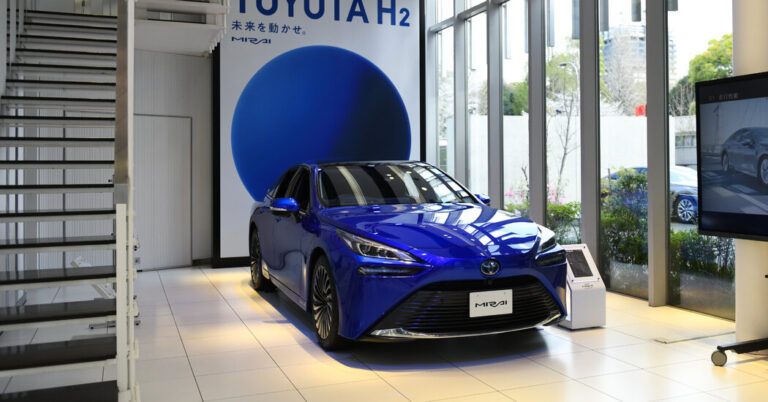
A year ago, the world’s biggest automaker was on a tear. American consumers were snapping up Toyota Motor’s hybrids, and a weak yen inflated the value of the company’s earnings. That May, Toyota reported the highest annual profit ever recorded by a Japanese firm.

On Thursday, Toyota presented a significantly more somber outlook, projecting that its operating profit would decline by about one-fifth for the fiscal year ending in March. It cited headwinds from a stronger yen and predicted a $1.3 billion hit from President Trump’s tariffs in April and May alone.

The company estimated the effect of the auto tariffs, which started in April, only for those two months. Beyond that, their impact is “very difficult to forecast,” Toyota’s chief executive, Koji Sato, said in a briefing on Thursday. “The current environment surrounding the auto industry, including trade relations, is in extreme flux,” he said.

The murkiness of Toyota’s forecast underscores how the whiplash of Mr. Trump’s tariff agenda is upheaving the auto industry and leaving many global companies unable to estimate future prospects. A 25 percent tariff on vehicle imports into the United States, implemented early last month, was extended to auto parts last week.

The pain that Toyota is already experiencing from tariffs also highlights the difficult bind that Japan faces in its ongoing negotiations with the Trump administration.

While Mr. Trump has paused an across-the-board 24 percent tax on imports from Japan until early July, higher auto tariffs are already in place and hurting the country’s mainstay industry. Automobiles and auto parts are by far Japan’s top export to the United States.

Ryosei Akazawa, Tokyo’s top envoy for the tariff talks, said recently that the new U.S. tariffs were costing one Japanese automaker $1 million per hour. Yet negotiations have moved slowly, bogging down at least in part because Washington has signaled that Japan’s primary demand — an exemption from auto tariffs — is not up for negotiation.

In remarks made over the weekend after returning from the latest round of talks in Washington, Mr. Akazawa said the two sides were unable to find common ground. Prime Minister Shigeru Ishiba urged patience, saying that Japan should not rush to reach an agreement that would sacrifice the country’s longer-term interests.

Economists and officials are concerned about the tariffs’ broader potential impact on the Japanese economy, as automakers and their extensive network of parts suppliers form the backbone of industrial production in Japan. Last week, Japan’s central bank more than halved its economic growth forecast, citing the imposition of an “unprecedented level” of tariffs by the United States.

Toyota’s remarks on Thursday suggested a challenging period ahead for the Japanese auto industry as a whole, particularly because most analysts consider Toyota to be among the Japanese carmakers least vulnerable to Mr. Trump’s tariffs.

Smaller Japanese automakers such as Mazda and Subaru sell a significantly higher proportion of imported vehicles in the United States, while Mitsubishi Motors does not have any factories in the country. Japan’s second- and third-largest automakers, Honda and Nissan, are set to announce fiscal year earnings next week.

Automakers outside Japan are also anticipating difficulties. Last week, General Motors lowered its 2025 profit forecast by over 20 percent, citing projected cost increases of $4 billion or more this year because of the Trump tariffs. Many European automakers moved to suspend their financial forecasts for 2025 because of tariff uncertainties.
Source link

OpenAI Hires Instacart C.E.O. to Run Business and Operations


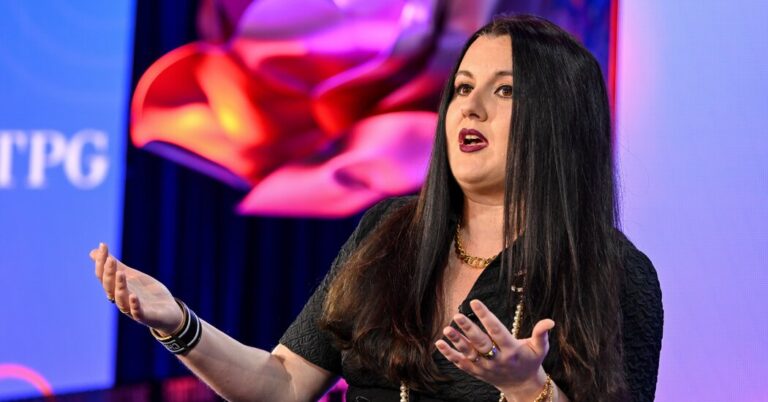
OpenAI said late Wednesday that it hired Fidji Simo, the chief executive of Instacart, to take on a new role running the artificial intelligence company’s business and operations teams.

In a blog post, Sam Altman, OpenAI’s chief executive, said he would remain in charge as the head of the company. But Ms. Simo’s appointment as chief executive of applications would free him up to focus on other parts of the organization, including research, computing and safety systems, he said.

“We have become a global product company serving hundreds of millions of users worldwide and growing very quickly,” Mr. Altman said in the blog post. He added that OpenAI had also become an “infrastructure company” that delivered artificial intelligence tools at scale.

“Each of these is a massive effort that could be its own large company,” he wrote. “Bringing on exceptional leaders is a key part of doing that well.”

Ms. Simo, a member of OpenAI’s board, will oversee sales, marketing and finance. She will report to Mr. Altman.

OpenAI, which ignited a frenzy over A.I. with its ChatGPT chatbot, has grown rapidly and juggled multiple initiatives — sometimes unsuccessfully. The San Francisco company has steadily released new A.I. models and products, including systems that can “reason.” In March, it completed a $40 billion fund-raising deal, led by the Japanese conglomerate SoftBank, that valued it at $300 billion and made it one of the most valuable private companies in the world.

But OpenAI, which was set up as a nonprofit, has struggled to adopt a new corporate structure. As the commercial appeal of artificial intelligence has grown, the company had tried to remove itself from control by the nonprofit. That attracted scrutiny from critics such as Elon Musk, an OpenAI founder who sued the company and accused it of putting profit ahead of A.I. safety. The attorneys general of California and Delaware also scrutinized the restructuring.

On Monday, OpenAI backtracked on the plan and said it would allow the nonprofit to retain its grip on the company.

(The New York Times has sued OpenAI and its partner, Microsoft, accusing them of copyright infringement regarding news content related to A.I. systems. OpenAI and Microsoft have denied those claims.)

In a statement late Wednesday, Ms. Simo said that OpenAI “has the potential of accelerating human potential at a pace never seen before and I am deeply committed to shaping these applications toward the public good.”

She added in a memo to Instacart employees that she had a “passion for A.I. and in particular for the potential it has to cure diseases” and that “the ability to lead such an important part of our collective future was a hard opportunity to pass up.”

Ms. Simo will remain at Instacart for the next few months as the company names a successor, a role she said would be filled by a member of Instacart’s management team. She will also remain on the company’s board as its chairperson.

“Today’s announcement is not a reflection of any changes in our business or operations,” Instacart said in a statement.


Source link

Countdown to Scott Bessent’s Trade Talks With China

0


An Israeli spyware company is ordered to pay Meta $167 million. A federal jury in California awarded Meta damages from the NSO Group, whose Pegasus software was used to hack 1,400 WhatsApp accounts belonging to journalists, human-rights activists and government officials. NSO plans to appeal, but the company has already been blacklisted by the U.S. Commerce Department.

Republicans plan to expand a college pressure campaign beyond the Ivy League. Presidents of schools including Haverford College and DePaul University are set to testify on Wednesday before the House Education Committee about their efforts to combat antisemitism, suggesting that Republicans aren’t stopping at elite schools. Separately, universities including Harvard and Princeton are seeking to sell stakes in private equity funds on the secondary market as they face funding pressures, including from President Trump.

DealBook Series: How tariffs are affecting U.S. businesses

We asked DealBook readers how tariffs have affected their companies. On Wednesday, we’re featuring a response from Thomas Johns, an owner of National Roofing, a private business based in Albuquerque that installs and repairs roofing for commercial clients, such as government and military buildings, hospitals, airports, manufacturing centers, data communications buildings and other facilities.

The business generates as much as $20 million a year and employs between 100 and 150 people.

He writes:

I started this company 50 years ago. I left the day-to-day running of the business, but I’m still an owner. Tariffs directly affect only 1 percent to 2 percent of products we provide in our roofing business. But the uncertain economic conditions have forced our clients to change their posture from growth and renovation programs to a no-spending mode.

That means our costs are ultimately two to five times higher because we’ve had to absorb more risk. We’ve stockpiled material that we may not be able to sell since it appears our clients will pull back on their spending.

That’s what we saw during the pandemic and we’re seeing it again. Back then, we kept our people on the payroll even with the pullback in jobs. We lost $2 million in two years to keep everyone employed. That was to keep families fed and able to get vaccinations. We were buying lunches.

While most of the products we use are made in this country, most of our tools are manufactured overseas. For example, a critical robotic welder we use will go from $10,000 to $30,000 — who can afford that?

There’s also been an issue with manufacturers withholding supplies to drive up prices, something we saw during Covid. We ended up taking a hit of $5 million to $12 million because of that. We expect more of that again.

Right now, I’d say the situation has added an additional 10 to 20 percent to our costs. That of course could get much worse. We do everything we can to not pass on price increases. But that is cutting into our margins.

The other difficulty is in our federal contracts. Most of our economy in this part of New Mexico is driven by government dollars with all the air force bases around here and national laboratories such as the Los Alamos National Laboratory. But the Federal government can be deceptive in its contracts with vendors like us. You sign an agreement to do the project for X dollars, and it’s etched in stone. That’s all you’re getting. If our costs go up, there’s no recourse.

Tariffs have never worked unless you want to punish your own population — which is what this is doing.


Source link

Ben Whittaker commanding respect from rivals? Anthony Yarde and Lyndon Arthur consider controversial celebration | Boxing News

0


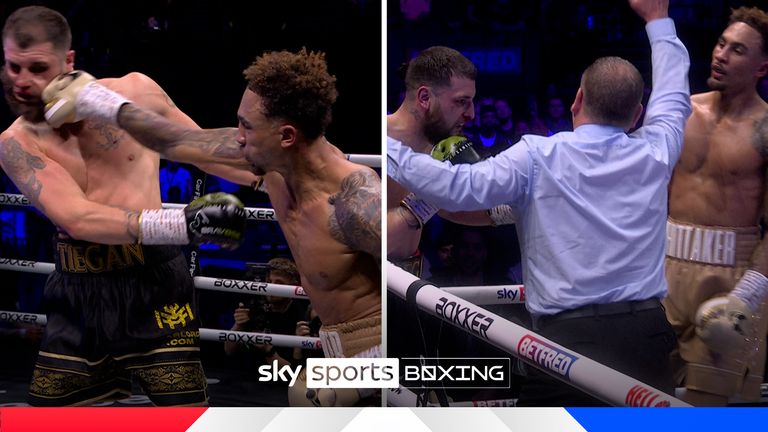
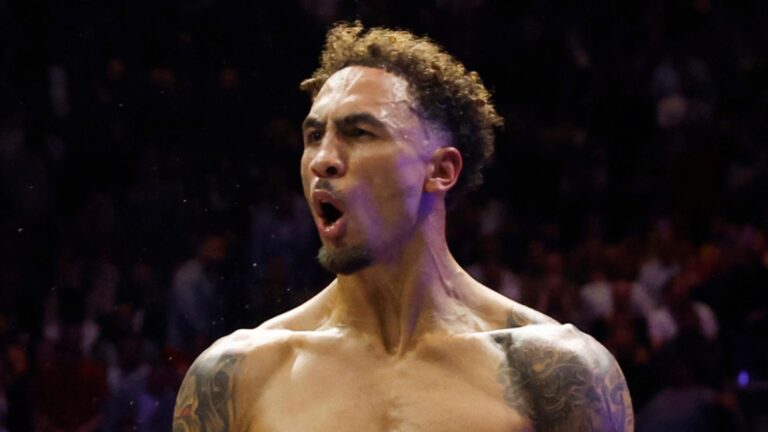
Ben Whittaker made a statement with an emphatic second-round victory in his rematch with Liam Cameron last month.

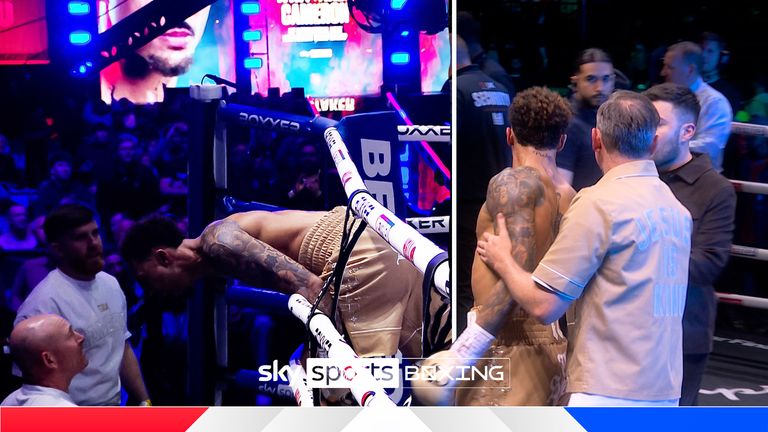
After falling out of the ring in his first fight with Cameron, injury prevented the Olympic silver medallist from continuing and Whittaker’s professional record took its first blemish with a technical decision draw.

Whittaker came under intense scrutiny after that, and celebrated wildly in his opponent’s corner after winning the second fight in style.

That became a talking point after the contest, although Anthony Yarde and Lyndon Arthur, potential future rivals for Whittaker, declined to join in the chorus of criticism.

Please use Chrome browser for a more accessible video player

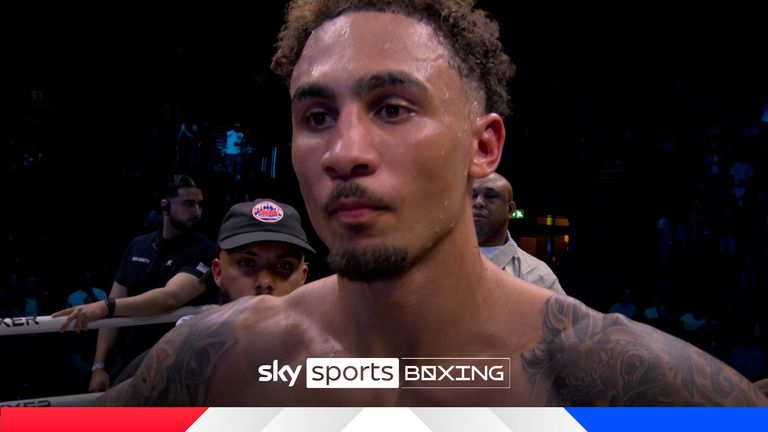
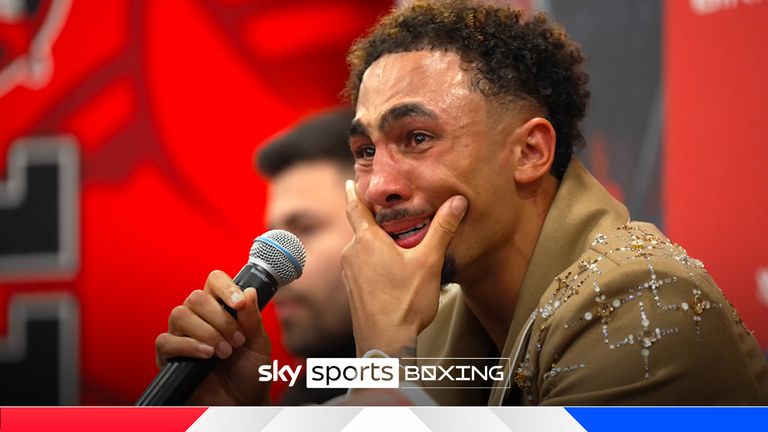
Whittaker was full of emotions during his post-fight press conference following his KO win over Cameron

“After the fight he went to the corner of Cameron,” Yarde told Sky Sports. “He celebrated in their face. Was it justified? I don’t know because I don’t know if Liam Cameron’s team were saying things in the build-up and from what I saw myself Ben Whittaker had gotten a lot of backlash, people saying he’s a cop out, he lied and wasn’t really injured. He had to go through that whole period.

“Maybe in his celebration he was just a bit overwhelmed and it showed in the after-fight press conference when he started crying. The emotions got the better of him.

“Sometimes in the heat of the moment you can’t really judge people for how they act or things they do. It’s sometimes excitement and emotions getting out of control.

Please use Chrome browser for a more accessible video player

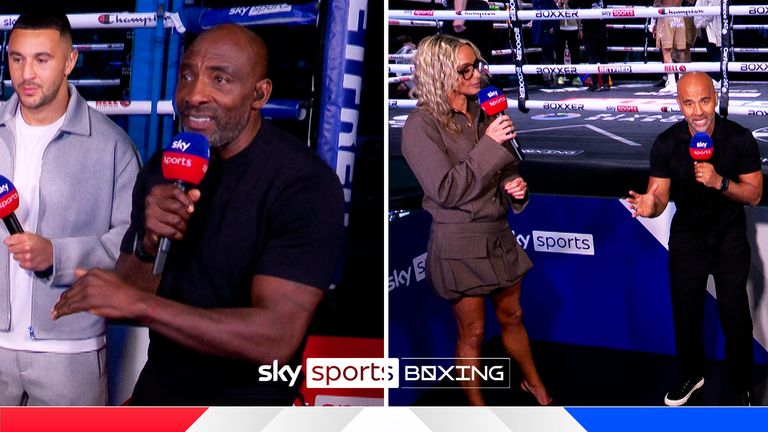
Johnny Nelson and Dave Coldwell disagreed on whether Whittaker had crossed the line with his ring celebrations following victory over Cameron

“Some people are just better at masking it than others,” Yarde added.

“Can you imagine your average Joe walking down the street, how they would react, or people at home if they were ever in that position? They say they would react one way, but how they actually react they don’t know because they’re not in that situation, they’re not in that predicament.”

Arthur, who lost a trilogy fight with Yarde at the end of last month, holds a points win of his own over Cameron.

Reflecting on Whittaker’s celebration, he told Sky Sports: “I don’t think it was right but I think what Andy Lee said – the heightened emotions, he’d been through a lot over the past six months, a lot of doubt, and I think it come out probably by accident.”

Please use Chrome browser for a more accessible video player

Whittaker’s full interview after he beat Cameron and his post-fight clash with his opponent’s corner

Yarde will likely be positioning himself for a world championship fight, though Arthur, who has only lost to Yarde and Dmitry Bivol, the division’s best fighter, could be a possible opponent for a future fight with Whittaker.

Arthur has taken note of Whittaker’s previous comments. “He was talking [rubbish] about me before he quit in the first fight against Cameron. He’s a big name,” Arthur said. “He’s just a bit of a clown. When we were in the ABAs together he posted pictures of me, he was cool.

“That’s boxing. You can have competition, it can be healthy competition, but you don’t have to chat [rubbish] and put people down. But it’s his persona. I don’t hate it. Prince Naseem and everyone, they were the same but they were the kind of boxers I liked, I watched growing up. I can’t hate what he does.

“I understand but because it’s against me or about me I’m going to think [that] naturally.”

Please use Chrome browser for a more accessible video player

Whittaker stuck his head through the ropes and celebrated in the faces of the Cameron’s corner moments after winning by a spectacular knockout in the second round

Promoter Ben Shalom did point out that Whittaker is just 10 fights into his professional career and doesn’t have to be rushed.

“I want to see him get experience with [new trainer] Andy Lee. I want to see him fight different styles. I want to see him box internationally. I want to see him develop as a fighter,” Shalom told Sky Sports.

Please use Chrome browser for a more accessible video player

Whittaker stopped Cameron in the second round of their highly-anticipated rematch

“We believe and know he has the talent and we know he has everything to become a world champion and go down as one of the greats.

“Can we now translate that? Can we give him the experience that that talent deserves so that he can fulfil what his legacy needs to be? That’s what it’s all about after this fight.

“Ten fights, the hype train is absolutely huge but I want to see him get his experience.”


Source link

Are U.S. Tariffs Affecting Your Business? We Want to Hear From You.

0


President Trump’s trade war has created chaos for companies around the world, snarling supply chains, sowing uncertainty and muddling their ability to plan for the future.

After announcing tariffs that started at 20 percent for nearly all imports from European Union members — and more on other countries — the president has scaled the rate to 10 percent until July, saying his administration will use the time to negotiate bilateral deals with America’s trading partners. At the same time, Mr. Trump has escalated a trade war with China, potentially squeezing European companies.

We are a team of reporters who write about business and economic issues in Europe for The New York Times. In recent weeks, we have covered how tariffs have been affecting the car industry, financial markets and economic expectations for European countries.

To better understand the impact the tariffs are having on companies in Europe, including Britain, we would like to hear from business owners, entrepreneurs, managers and employees. How might the import taxes affect your company or job? Have you delayed hiring, postponed expansion plans or canceled orders? Have you altered your supply chains? We would also like to hear what tariffs mean for your production, and whether you are considering moving some part of it to the United States.

We will read every response and reach out if we are interested in learning more. We won’t publish any part of your response without contacting you first and obtaining your consent. Your contact information will not be shared outside The Times newsroom and we will use it only to get in touch with you.


Source link

Voice of America to Receive Feeds From Pro-Trump Network, Administration Says


Voice of America, a U.S.-funded international news broadcaster that was muted by the Trump administration in March, may sound quite different when it returns to the air.

Kari Lake, the former news anchor whom President Trump put in charge of overhauling Voice of America, said Tuesday that it would be fed with content from One America News Network, or OAN, a reliably pro-Trump television channel that has propagated falsehoods about the 2020 presidential election.

Ms. Lake, who in recent years mounted unsuccessful campaigns for governor and senator in Arizona, said OAN had offered to provide free news reports to Voice of America and another American-supported outlet, the Office of Cuba Broadcasting. In a statement on social media, she called the arrangement “an enormous benefit to the American taxpayer.”

“I don’t have editorial control over the content of VOA and OCB programming, but I can ensure our outlets have reliable and credible options as they work to craft their reporting and news programs,” said Ms. Lake, using acronyms for Voice of America and the Office of Cuba Broadcasting.

Patsy Widakuswara, a former Voice of America White House bureau chief who was placed on leave, said she was concerned by the development.

“We’ve worked so hard to build trust for our brand,” she said. “This is 83 years of good journalism that’s going to be destroyed.”

Voice of America was created in 1942 to combat Nazi propaganda, and has long brought news to corners of the globe where reliable journalism is scarce.

In March, Mr. Trump issued an executive order to dismantle the U.S. Agency for Global Media, the congressionally chartered agency that oversees Voice of America, effectively shuttering the news outlet. The president accused the broadcaster of harboring bias against him and branded it the “voice of radical America.” Voice of America’s roughly 1,300 workers were sent home.

The broadcaster’s journalists then sued, saying that Mr. Trump was not authorized to withdraw funding that had been approved by Congress.

A federal judge in Washington sided with the reporters, ordering the Trump administration to bring back programming.

An appeals panel seemed to complicate the matter over the weekend, reversing parts of the lower court’s order that required the Trump administration to restore funding. But the panel left the requirement that Voice of America revive programming.

It is not clear how many Voice of America reporters will return after the court decisions.

“Some have already returned,” Ms. Lake said in an email Tuesday evening. “Some will be returning in the future.”

She declined to comment further.

About 15 employees have been reinstated in recent days, said Ms. Widakuswara, who was not one of them.

Grant Turner, who served as chief executive of Voice of America’s parent agency during the first Trump administration, said that moves to add OAN content would violate a statutory requirement that the broadcaster be “accurate, objective, and comprehensive.”

He predicted that the OAN content would not land well with foreign audiences, either.

“They know what real fake news sounds like,” Mr. Turner said of Voice of America’s listeners, adding, “They want something that’s genuine.”


Source link

Trump’s Threat of ‘Foreign’ Film Tariffs Stirs Anxiety in the U.K.

0


President Trump’s desire to “make Hollywood great again” by wielding his preferred economic weapon — tariffs — has sent a shiver through Britain’s film industry.

British producers, camera workers, costume designers and other film crew woke up Monday to Mr. Trump’s message that he wanted to impose 100 percent tariffs on films made in “foreign lands.” This threat is particularly alarming in Britain, where Hollywood blockbusters are a critical part of the industry.

“It came completely out of the blue,” said Philippa Childs, the head of Bectu, the British union for workers in the creative arts. “It’s pretty frightening.”

Last year, nearly 90 percent of the 5.6 billion pounds, or $7.8 billion, spent on film and high-end TV production in Britain came from abroad, mostly the United States, such as the upcoming “Jurassic World Rebirth” and “The Fantastic Four: First Steps.” Britain’s biggest and most esteemed studios are home to streaming giants like Netflix, Disney+ and Amazon Prime. For decades, productions have been drawn to Britain by its generous tax breaks but also its experienced work force, which has been making Hollywood hits since “Star Wars” in the 1970s.

Mr. Trump has, so far, not followed through on this threat, and it’s not clear how he would carry it out. But the British industry is still recovering from disruptions caused by the coronavirus pandemic and then the 2023 actors’ and screenwriters’ strikes in the United States, and the concern is that uncertainty about tariffs could wipe out that progress.

“Studios around London are really filling up, and people are getting back to work,” Ms. Childs said. “Our fear would be that those studios suddenly become empty again if this were to become a reality.”

Bectu members are still living with the memories of the strikes, Ms. Childs said. Eighty percent of members Bectu surveyed at the time said their jobs had been affected, with three-quarters not working.

Marcus Ryder, chief executive of the Film and TV Charity, which supports industry workers with their mental health and finances, is preparing for an influx of requests for help.

“The uncertainty is really disempowering,” he said. People “have no idea what the tariffs mean, nor how to react to them.” It is “very destabilizing,” he added.

Mr. Ryder said there was a fear among companies and workers that their industry would be decimated if people, concerned that they wouldn’t be able to pay their bills, left their jobs. Support that was given during the pandemic and the strikes, such as cash grants, could not be provided over the long term if tariffs were enforced.

“Even a short-term tariff could have a long-term devastating effect on the work force,” he said.

“The uncertainty is really disempowering,” said Marcus Ryder, chief executive of the Film and TV Charity.Credit…Pool photo by WPA

Mr. Trump’s suggestions of tariffs are “concerning,” said Adrian Wootton, the chief executive of the British Film Commission, which helps attract productions to Britain. He said his organization would meet with the government and other industry figures to discuss its concerns.

The British government is in “active discussions with the top of the U.S. administration” about these potential tariffs and working to establish what might be proposed, Chris Bryant, a minister in the department overseeing culture, told lawmakers in Parliament on Wednesday. “This is a very fluid situation, and we will continue to take a calm and steady approach.”

Mr. Bryant added that a lot of concerned companies had reached out. One of the first was Pinewood Group, which owns the large studio famous for filming the Bond movies.

At the same time, Britain and the United States are reportedly close to agreeing to a pact that would ease some of the impact of recent increases in U.S. tariffs.

Many trade experts question how tariffs on films could be enforced. Major film productions are increasingly international, with cast and crew from different countries and with different aspects of filmmaking, like filming, postproduction, visual effects and distribution, taking place in different locations. Determining what exactly is a “foreign” film and how to impose tariffs on services would be complex.

“I don’t think it can be done,” said David Henig, a trade expert in London. Instead, it’s more likely that American tax breaks would be increased, he said. “Obviously that does make it a threat to the U.K. and lots of other countries that have been handing out tax credits to make films,” he added.

Gov. Gavin Newsom of California countered Mr. Trump’s tariffs suggestion on Monday with his own proposal: a $7.5 billion federal film tax credit. It would be the largest single government subsidy program ever for the industry in the United States, and the first of its kind at the federal level.

Even without tariffs, higher tax incentives in the United States would “inevitably” have an impact on the British industry, Ms. Childs of Bectu said.

To some extent, the increasing dependence on American productions is a challenge for the British industry and its workers. Movies likes “Wicked” and “Mission: Impossible — Dead Reckoning” and TV shows like the “Game of Thrones” spinoff “House of the Dragon” were filmed predominantly in the southeast of England. The British government has increased tax breaks for smaller productions in an effort to bolster Britain’s independent film industry.

Those tax credits will help, Ms. Childs said, “but I don’t think it’s going to fill the void of U.S. investment.”


Source link

China Is Likely to Play Hardball in U.S. Tariff Talks

0


By agreeing to meet with the Trump administration to discuss trade, China is seeking to cast itself as the responsible one in a bruising superpower competition that has roiled the global financial system and set off fears of a recession.

For weeks, China had publicly said that it would not engage in trade talks with the United States under duress, refusing to “kneel down” and compromise with a “bully.” It insisted that Washington should first drop its eye-watering tariffs on China as a condition for negotiations.

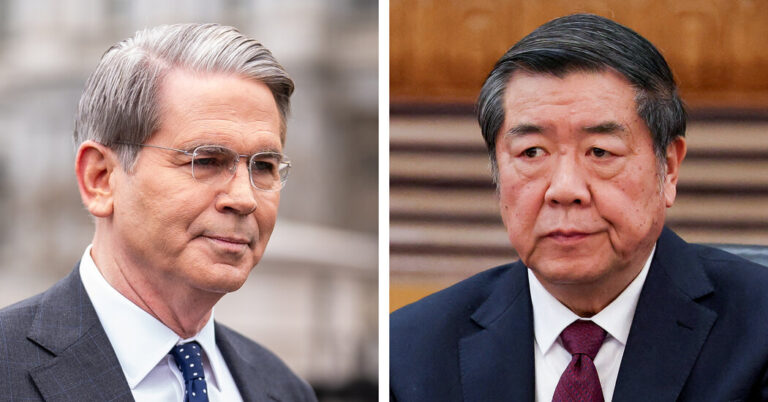
On Wednesday, Beijing indicated it would come to the table after all, saying that its top trade official, He Lifeng, would meet with Treasury Secretary Scott Bessent in Switzerland this week. Even so, it maintained a tough stance, warning Washington against using the talks as “a smoke screen to continue coercion and extortion.”

The Chinese government said it had come to this decision “based on a full consideration of global expectations, China’s interests and the calls of American industry and consumers,” suggesting that it was doing so largely for the greater good.

“China is trying to frame itself as the responsible party, but it’s still a pretty hard-line tone: You better behave yourself in these talks,” said Yun Sun, a China analyst at the Stimson Center.

But the move is still a softening of China’s stance, at a time when economic data has shown that the trade brinkmanship was taking a toll on both countries’ economies.

The Trump administration’s decision to raise tariffs on Chinese goods imported to the United States by 145 percent, and China’s response in hiking its own tariffs on American goods to 125 percent, has effectively frozen all trade between the two countries in recent weeks.

Chinese factories were hit with the steepest slowdown in activity in more than a year, and shipments of Chinese goods to the United States have plunged, triggering a wave of warnings from retailers about shortages. The American economy shrank in the first three months of the year, and companies slashed growth forecasts.

Both the United States and China seem interested in reducing the tariffs, but neither side has wanted to make the initial concession. It also remains unclear if, or how quickly, the two countries might strike any kind of deal, or what its specifics could be.

In an interview with Fox News on Tuesday night, Mr. Bessent said he expected the meeting with Chinese officials in Switzerland to focus on de-escalation rather than any major deal.

“We’ve got to de-escalate before we can move forward,” Mr. Bessent said.

For its part, China wants to show that it will be coming to the negotiations from a position of strength, even though the U.S. had not canceled tariffs first as Beijing had demanded. In recent days it has repeatedly said that U.S. officials had reached out for talks and that it was considering the request.

“The Chinese are trying to avoid the image that the Chinese were eager to talk,” Ms. Sun said.

Chinese officials will likely be treating the trade talks as a fact-finding mission.

“The Chinese want to find out what Donald Trump is really up to, and you can only get this by engaging in direct talks,” said Wang Xiangwei, an associate professor of journalism at Hong Kong Baptist University.

Until now, for instance, it has not been entirely clear to Beijing which Trump officials were in charge of future negotiations with China, Mr. Wang said.

Part of the challenge in dealing with the Trump administration on trade is that the direction of policy seems to vary depending on who is speaking. Peter Navarro, a senior White House trade adviser and the architect of many of President Trump’s trade plans, has defended the tariffs as necessary, while Mr. Bessent has said the U.S. is willing to negotiate with countries.

Even as the Trump administration appeared more willing to find an off-ramp to the trade standoff, there were still some questions about what tone the administration would strike during the talks, which Mr. Bessent said on Fox News would be held on Saturday and Sunday.

China said Mr. He was going to be in Geneva from Friday to Monday for meetings with Swiss leaders and that while he was there he would also meet Mr. Bessent. The Trump administration said Jamieson Greer, the U.S. trade representative, would also attend the meetings, though China did not mention Mr. Greer in its own statements about the talks.

Finding out what Mr. Trump wants from China and what he is willing to concede in negotiations would be useful to Beijing as it figures out its response. China has also been trying to persuade other countries not to cave to pressure from the Trump administration’s efforts to isolate China by imposing tariffs of their own on Chinese products, or by decoupling from Chinese manufacturing.

For Beijing, artfully lowering the temperature without looking weak in the face of Mr. Trump’s tariffs could help its own efforts to revitalize its economy. Chinese officials have been under pressure at home from the fallout of both a multiyear property crisis that has wiped out the savings of many families, along with broader trade tensions with countries other than the United States.

China’s central bank and its financial regulators on Wednesday took their biggest policy steps yet to shield the economy from the trade war, moving to shore up the economy with a series of steps to make it easier for banks to lend money and get people spending.

The Trump administration’s “tariff policies have dealt a severe blow to the international economic and trade order, triggered significant turbulence in international financial markets, and placed considerable pressure on the domestic capital market,” said Wu Qing, China’s stock regulator, at a press briefing with top officials.

The Chinese side also comes to the talks emboldened by the knowledge that Mr. Trump has blinked in the face of a sharp sell-off in U.S. government bond markets, and broader financial market turbulence. The midterm elections in the United States could exert some pressure on Mr. Trump to lower or cut tariffs if consumer prices rise as a result of a shortage of goods.

The Chinese “still have the upper hand, but their economy is slowing,” said Scott Kennedy, a senior adviser at the Center for Strategic and International Studies, a Washington research group. “If they totally stonewall the Trump administration, they could end up looking complicit in bringing the global economy to a halt.”

Zixu Wang contributed reporting.


Source link

Trump Administration to Announce Trade Deal With Britain

0


President Trump is expected to announce on Thursday that the United States will strike a trade agreement with Britain, according to three people familiar with the plans.

Mr. Trump teased a new trade agreement in a social media post on Wednesday night, though he did not specify which nation was part of the deal.

“Big News Conference tomorrow morning at 10:00 A.M., The Oval Office, concerning a MAJOR TRADE DEAL WITH REPRESENTATIVES OF A BIG, AND HIGHLY RESPECTED, COUNTRY. THE FIRST OF MANY!!!” he wrote.

A spokesman for the White House declined to comment beyond Mr. Trump’s post. A spokesman for the British Embassy in Washington did not respond to a request for comment.

The agreement would be the first deal announced since Mr. Trump imposed stiff tariffs on dozens of America’s trading partners. He later paused those temporarily in order to allow other nations to reach agreements with the United States.

A deal between the United States and Britain could be a significant win for both countries, which have long sought closer economic cooperation.

Details of the agreement were not immediately clear. Both nations have discussed lowering British tariffs on U.S. cars and farm goods, as well as removing British taxes on U.S. technology companies. It also was not clear whether the agreement had actually been finalized, or if the countries would announce a framework for an agreement that they would continue negotiating in the coming months.

The Trump administration has been trying to cajole other countries into reaching quick trade deals with the United States. The president imposed punishing tariffs on dozens of its trading partners on April 2, but quickly backtracked after panic ensued in the bond market. Mr. Trump paused most of those tariffs for 90 days so that the United States could negotiate trade deals with other nations.

But he has left a 10 percent global tariff in place, including on Britain. Unlike other countries, Britain was not subjected to higher “reciprocal” tariffs, because it buys more from the United States than it sells to it. Administration officials have said they are not considering removing the 10 percent tariff as part of a trade deal.

Britain is also subject to a 25 percent tariff that Mr. Trump has placed on foreign steel, aluminum and automobiles, levies that British officials have been pushing their U.S. counterparts to lift.

Mr. Trump’s interest in striking a trade deal with Britain dates back to his first term, when his advisers negotiated with the country but didn’t finalize an agreement. British officials have also been eyeing a trade agreement with the United States since Brexit, as a way to offset weaker relations with Europe. In the Biden administration, British officials continued to push for a deal with the United States but made little progress.

For Britain’s prime minister, Keir Starmer, the trade deal would offer vindication for his assiduous cultivation of Mr. Trump. During his visit to the Oval Office in February, Mr. Starmer turned up with an invitation from King Charles III for the president to make a rare second state visit to Britain.

The Trump administration appears to be nearing deals India and Israel, and is continuing to negotiate with South Korea, Japan, Vietnam and other nations. Still, Mr. Trump once again displayed his unpredictable approach to economic policy on Tuesday when he downplayed the prospect of trade deals, saying other countries needed such agreements more than the United States.

“Everyone says ‘When, when, when are you going to sign deals?’” Mr. Trump said, at one point motioning toward Howard Lutnick, his commerce secretary. “We don’t have to sign deals. We could sign 25 deals right now, Howard, if we wanted to. We don’t have to sign deals. They have to sign deals with us.”

On Tuesday, British officials also agreed to a trade deal with India that would lower tariffs between the countries and secure more access for British firms to India’s insurance and banking sectors, among other changes. The announcement followed nearly three years of negotiations.

Mark Landler contributed reporting.


Source link

Kevin De Bruyne: Napoli trying to land deal to sign Manchester City midfielder | Football News

0


Napoli are trying to sign Kevin De Bruyne on a free transfer at the end of the season, according to Sky in Italy.

The deal would be a very complicated one but the Serie A club have started contact and are trying to beat off competition from other big clubs.

Antonio Conte’s side are already planning for next season while trying to wrap up the Serie A title race in Italy.

Napoli hope De Bruyne’s friendship with national team-mate Romelu Lukaku’s and his desire to stay in Europe could have an impact.

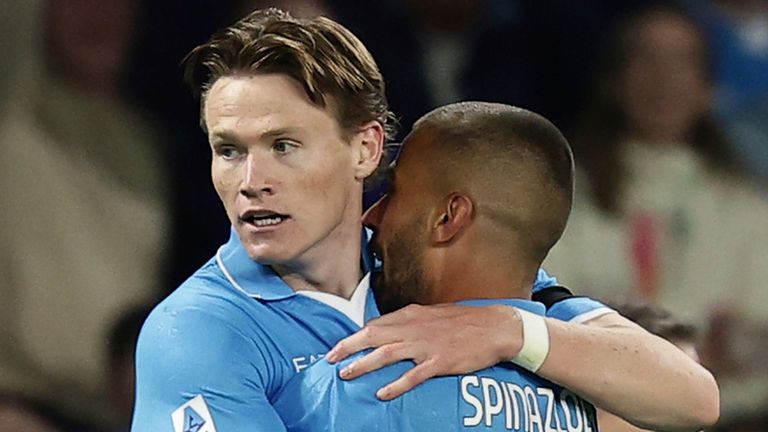
Napoli's Scott McTominay, second right, celebrates after scoring the opening goal during the Serie A soccer match between Napoli and Torino FC in Naples, Italy, Sunday, April 27, 2025. (Alessandro Garofalo/LaPresse via AP)
Image:
Napoli’s Scott McTominay has thrived in Italy under Antonio Conte

Aston Villa have also held internal discussions about a potential move for De Bruyne, Sky Sports News understands.

De Bruyne’s reluctance to uproot his family and prioritising his football and home life when making a decision on his next destination has alerted several Premier League clubs.

The 33-year-old will go down as one of the Premier League’s greatest players after winning six Premier League titles, two FA Cups, five Carabao Cups and the Champions League in an unprecedented period of success for City.

De Bruyne was also part of Pep Guardiola’s treble-winning team in 2022/23.

Guardiola described it as a sad day to see De Bruyne’s exit confirmed and said he “is one of the greatest” players the Premier League has ever seen.


Source link