Home Blog Page 326

Consumers Are Pulling Back, Spooked by Tariff-Related Price Increases

0


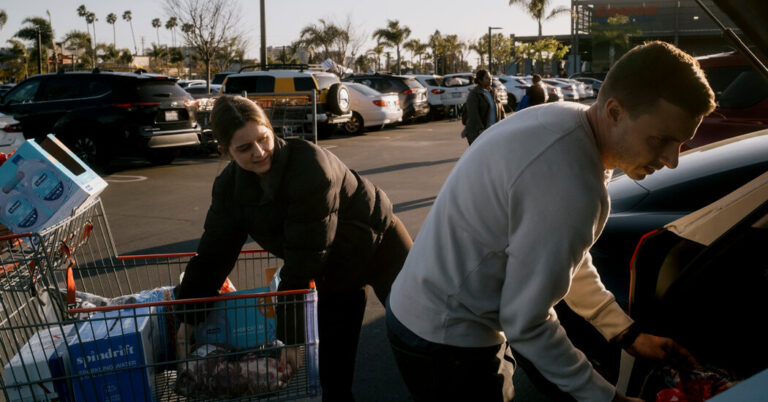
As central bankers weigh the possibility of President Trump’s tariffs reigniting inflation, major companies are foreshadowing price increases and warning that shoppers are tightening their wallets.

Executives at several companies that sell popular consumer products, like toys and wet wipes, this week pointed to signs of a pullback in spending. The comments came against a backdrop of plunging consumer sentiment as many companies have said that they intended to pass the cost of tariffs onto customers.

Signs of slower spending and higher prices pose a challenge for the Federal Reserve, given its dual responsibility for keeping employment steady and inflation stable. Cutting rates could help address an economic slowdown, but the potential inflationary effect of tariffs have made officials cautious. The central bank is widely expected to keep interest rates steady on Wednesday.

“Having both firms and consumers saying prices are going to go up is not a good combination for the Fed,” said Diane Swonk, the chief economist at KPMG. “It’s yet another thing keeping them from doing anything with interest rates until they get more clarity on what the actual impacts are.”

Executives at Clorox said this week that sales fell 8 percent last quarter and that they expected the slowdowns to persist in the current quarter. The company said they will most likely raise some prices.

Linda Rendle, the chief executive of Clorox, said on a call with analysts on Monday that tariffs were changing consumer behavior “dramatically,” with shoppers adopting “a conserving behavior in many of our categories.”

Mattel, the toy company, told analysts on Monday that it was considering raising prices in the United States because of tariff-related cost increases.

Beyond pricing, Mattel executives said the company was taking steps to mitigate the impacts of steep U.S. tariffs on goods from China, where it makes roughly 20 percent of its toys sold in the United States. That involved moving more of its production to other countries, including India.

Mattel also scrapped its full-year financial forecast, citing the “evolving U.S. tariff situation” and the potential for Mr. Trump’s trade war to dampen consumer spending.

Denny’s, a restaurant chain, also reported this week that sales fell in the most recent quarter, which the company attributed in part to consumers’ concerns over tariffs and the job market.

“The tariff impact is how it overall impacts the macroeconomic environment, and what that does to our lower-end consumer that we rely quite a bit upon,” Robert Verostek, the chain’s chief financial officer, told analysts.


Source link

How Lost Radar and Silent Radios Have Upended Newark Air Travel

0


On a recent afternoon in Philadelphia, an air traffic controller began shouting that he had lost his radar feed for planes flying in and out of Newark Liberty International Airport.

Some of his colleagues still had radar but their radios went dead, prompting frantic calls to their counterparts in New York urging them to keep their planes away from Newark’s airspace.

Then, for 30 harrowing seconds until the radios came back, there was nothing more to do but hope — as they had no means of telling pilots how to avoid crashing their planes into one another.

Shortly after that, one controller discovered a trainee, who had been directing Newark traffic under supervision just moments earlier, shaking in the hallway.

That was the chaotic scene on Monday, April 28, according to several people who were present when controllers working the airspace for Newark lost the means to do their jobs.

The failure of the system the controllers rely on left several of those on duty that day with extreme anxiety, requiring a mental health respite that has caused low staffing levels for days since. It has also prompted more than 1,000 flights at one of the nation’s busiest airports to be canceled or delayed, leaving some passengers feeling frustrated and abandoned.

The struggles with staffing are ironic because the Federal Aviation Administration’s decision to relocate some of Newark’s air traffic control operations to Philadelphia last summer was intended to increase head count.

The nation’s air traffic control system has been plagued by years of dysfunction. The controller ranks were depleted by retirements and a cessation in training during the pandemic. Since then, recruiting and certifying new controllers has been difficult. Existing controllers have been fatigued and even sickened by intense stress and long hours, The New York Times has reported. Some have avoided seeking medical attention because doing so could jeopardize the health care clearances they need to do the work. Turnover is frequent, especially amid illnesses, family turmoil or safety scares.

The outage and its aftereffects at Newark have prompted public outrage.

Transportation Secretary Sean Duffy, who oversees the F.A.A., has called for “a brand-new air traffic control system.” Senator Chuck Schumer of New York, the minority leader, has said the F.A.A. “is really a mess.” Scott Kirby, the chief executive of United Airlines, which is Newark’s biggest user, said the airport “cannot handle the number of planes that are scheduled to operate there” and blamed controllers who “walked off the job.”

But current and former controllers, who requested anonymity for fear of retaliation, and people who witnessed last week’s outages said the controllers’ time away from their duties was appropriate under the circumstances, given the hardship of working under such duress. They also described the unnerving incident as the culmination of nine months of technical glitches that have eroded the Newark team’s confidence in the reliability of the tools that are essential to doing its work.

Last August, in an incident that was later blamed partly on a third-party technician who accidentally cut a data feed from a remote location, a controller lost radar for about 90 seconds, according to people who were there. A week later, radar scopes froze several times, according to F.A.A. activity logs that were reviewed by The Times. Then, about eight months later, the April 28 outages, which lawmakers have blamed on a “fried” copper wire, occurred.

“From what we can gather right now, the communication lines that feed the Newark sector, which resides in Philadelphia, are failing,” Dave Spero, the president of Professional Aviation Safety Specialists, a union that represents airway transportation systems technicians, said in an interview. He said contractors, not the F.A.A. itself, were responsible for those lines.

The F.A.A. said it was working closely with facility managers and vendors to address telecommunication issues across the national airspace system, particularly in the Northeast. Mr. Duffy said the F.A.A. had “slowed down the system” to ensure traveler safety at Newark.

The F.A.A. has acknowledged that some Newark controllers have taken time off to deal with the stress of the recent outages. On Tuesday, the agency said it had slowed arrivals and departures at Newark, in part because of staffing shortages. It added that it was “taking immediate steps to improve the reliability of operations” at the airport, including installing new, high-bandwidth data connections, deploying a backup system to Philadelphia and increasing staffing among the Newark controller ranks.

Mr. Duffy is expected on Thursday to announce additional details of a planned air traffic control overhaul, which he has been working on since a midair collision near Ronald Reagan National Airport outside Washington this year killed 67 people.

The F.A.A. said in a statement that it had 22 certified Newark controllers in Philadelphia and almost as many in training.

But that is not the whole picture. Because of mental health leave and other personnel matters, only 16 certified controllers are currently available to call on each day, according to people familiar with the situation, and more than double that number would typically be needed to cover all the shifts.

Aviation experts say — and the F.A.A. acknowledges — that there are no quick fixes to controller shortages.

Being a controller for a busy airspace like Newark’s typically requires years of nuts-and-bolts training and experience in other busy airspaces close to major cities.

Even a veteran controller who joined the Newark team from a hub like Atlanta or San Diego would need up to a year of specialized training to become familiar with the nuances of Newark’s traffic — which typically involves 80 or more departures and landings in a given hour — according to controllers with knowledge of that airspace. In addition to that, Newark controllers handle the traffic at smaller regional airports, including Teterboro, N.J.

Controllers working the Newark airspace from Philadelphia were supposed to be the solution, rather than the problem. The F.A.A. reasoned that the relatively low cost of living near Philadelphia would attract more workers who wanted to purchase homes or raise families, and that the Philadelphia International Airport control tower where they would be stationed was newly renovated.

The move was fraught from its inception. Some controllers resisted leaving their perch in Westbury, N.Y., where they had worked alongside colleagues handling flights in and out of LaGuardia Airport and Kennedy International Airport for years or even decades.

Some controllers who argued to the F.A.A. that the relocation would place undue hardship on their families were permitted to stay in Westbury. Others opted to take their chances in Philadelphia, collecting a $100,000 incentive payment for doing so. Their workstations in the new building, which the F.A.A. had spent $36 million to modernize, were fitted with real-time tracking technology.

They reported to their new posts on July 28.

The controllers for Newark initially worked on a reduced flight schedule to smooth out any kinks. But by mid-August, with summer travel robust, standard traffic levels in and out of Newark had resumed, and flights were proceeding normally.

Then on Aug. 27, a Newark controller in Philadelphia lost radar imagery for roughly a minute and a half after the technician’s mistake, according to two people who were in the control hub that day.

The controller was monitoring half a dozen planes at the moment the radar vanished, including two United Airlines jets, one of the people recalled. With no visual imagery to guide him, he tried to direct the pilots from memory, according to three people with knowledge of the incident.

“Attention all aircraft. Radar contact is lost. Radar contact is lost,” the controller said, according to an audio recording of the event.

By the time radar imagery returned, said two people with knowledge of the incident, one of the flights was well into LaGuardia’s airspace and was flying over the Hudson River.

The controller, who had decades of experience, retired within days of the incident, said the three people with knowledge of the matter.

The trouble in Philadelphia persisted. Less than a week later, Labor Day travelers flying in and out of Newark faced delays and a ground stop — a temporary halt to takeoffs and landings — because of unrelated radar equipment problems, according to the F.A.A. The agency blamed “data transmission issues” in the regional system.

Those were an outgrowth of the way the F.A.A. handled the transfer of Newark flight data to Philadelphia when it moved the controllers, according to government and union officials at the time. Rather than feeding flight data that was generated at Newark straight to Philadelphia, the F.A.A. instead routed the data initially to Westbury, and then to Philadelphia from there, those officials said.

That meant that the data had to travel further and was also vulnerable to being overloaded at times by other hubs in the system that were experiencing glitches, said Mr. Spero, the president of the safety specialists’ union.

“It caused what they call a cascade failure with target freezing,” Mr. Spero said. He was referring to the dots that represent moving aircraft on radar screens that, according to F.A.A. logs of that day, froze in several places, prompting an alert.

The F.A.A. said in a statement that it was establishing a communication system that will not require the Philadelphia facility to rely on a feed from New York.

Controllers said last fall that while data and capacity hitches had not been their chief objection to relocating, they had long been a source of anxiety. It has only gotten worse as the isolated glitches have come to seem like more of a trend, said the people who witnessed the recent events in Philadelphia.

One controller who was there on April 28 made it to his car before breaking into tears, one of those people said. He has taken time off, this person added, and will need to be cleared by a mental health professional before he can return.

Mark Walker contributed reporting.


Source link

Are We Headed for Recession? Economists Look Everywhere for Signs.

0


Americans are spending less at McDonald’s. Fewer container ships are expected at the Port of Los Angeles. Procter & Gamble is raising prices. Mattel is shifting production out of China.

Evidence for the economic impact of President Trump’s trade wars is everywhere — except, for the most part, in economic data itself. Consumer spending hasn’t fallen. Layoffs haven’t risen. Businesses haven’t stopped investing in equipment or buying supplies.

Economists say it is a matter of time before the impact of tariffs and the uncertainty that Mr. Trump’s on-again, off-again approach to trade policy has created begin to show up in the hard data. But until then, they are left sifting through crumbs of evidence that wouldn’t get a second glance in more normal times: customs revenue, hotel bookings in Las Vegas, freight shipments by truck and rail.

It is in some ways a more buttoned down version of the recent social media trend in which users share gloomy economic omens — some serious, some humorous — under the hashtag #recessionindicator.

“The problem is we don’t have much to hang onto at this point,” said Marc Giannoni, chief U.S. economist for Barclays. “We have to rely on anecdotes, on indicators that are nonconventional.”

Among those hunting for tidbits of evidence are officials at the Federal Reserve, who are trying to figure out how to set monetary policy in an environment where tariff policy can shift multiple times between meetings. Policymakers are widely expected to hold interest rates steady on Wednesday, in part because of that uncertainty. But they will be watching for signs that the economy is changing direction faster than the usual indicators can capture.

The situation is reminiscent of the early days of the coronavirus pandemic, when economists scoured the internet for alternative measures — restaurant reservations, attendance at Broadway shows, screenings at Transportation Security Agency checkpoints — that could provide hints of the damage to come. Joe Brusuelas, chief economist at the accounting firm RSM, said he has been getting flashbacks from that period.

“I did not want to go back to looking at traffic and T.S.A. and all these other metrics,” he said.

During the pandemic, however, economists mostly agreed about where to look for evidence, and what the likely effects would be. This time, there is more disagreement. Will the tariffs manifest mostly in higher prices or product shortages? Will consumers pull back spending, leading to layoffs? Or will layoffs come first — perhaps in manufacturing and shipping — with spending to follow as workers lose their income?

“In times when there’s a lot of volatility in the economy, and you’re waiting for the data to catch up with what’s actually going on — because not only does it take time for consumer behavior to change, but also we see this in the data a month or more after it happened — you want to watch these anecdotes to get a sense of where things might be headed,” said Andrew Hollenhorst, chief U.S. economist at Citigroup.

Tariffs have already shown up in the economic data in one way: Consumers and businesses have raced to import goods before new duties take effect. That has led to a surge in the trade deficit, which hit a record $140 billion in March.

But economists disagree about what will happen next. Some argue that as tariffs push up prices, consumers will reduce their purchases, ultimately leading to layoffs and a recession. Others argue that consumers, especially more affluent ones, are in strong enough financial shape that they will be able to keep spending, allowing businesses to pass on their higher costs and pushing up inflation. And of course it is possible that Mr. Trump will roll back tariffs, or that they will prove less damaging than many economists expect.

Top officials from the Trump administration, including Scott Bessent, the Treasury secretary, will meet with their Chinese counterparts in Switzerland this week in the first formal meetings since Mr. Trump imposed a minimum 145 percent tariffs on imported goods from China.

Measures of consumer sentiment have plummeted since Mr. Trump took office, suggesting that shoppers are in little mood to stomach higher prices. But economists have grown more skeptical of such measures in recent years after they failed to predict consumer behavior during and after the pandemic.

“What we learned over the pandemic is that vibes can look bad and yet consumers will still spend,” said Ernie Tedeschi, director of economics at the Budget Lab at Yale.

Hence the focus on anecdotes, which forecasters hope might provide an early indication of which direction the economy is headed.

“It’s kind of asking all of us to act like we’re individual hedge funds and we’re trying to find the data that will give us an advantage,” said Martha Gimbel, a colleague of Mr. Tedeschi.

The trouble is that anecdotes, too, are sending mixed messages. Airline executives have been issuing dire warnings. Southwest Airlines’ chief executive recently said that a recession had already begun in his industry, yet hotel occupancy rates have held up so far. McDonald’s and Chipotle reported declining sales last quarter, but Yum Brands — owner of Pizza Hut, KFC and Taco Bell — saw sales rise despite what its chief financial officer called a “complex consumer environment.” Companies have told varying stories about when and to what extent they will pass on the cost of tariffs to consumers.

Anecdotes and alternative data sources can also be easy to misinterpret. When visits from international tourists plummeted in March from a year earlier, many observers took it as a sign that foreigners were avoiding the United States because of Mr. Trump’s policies. But that drop now appears to have been mostly the result of a late Easter: Tourism rebounded in April.

The conflicting signals pose a problem for the Fed as it weighs when to cut interest rates. The central bank is attuned to mounting concerns that the economy is on the cusp of slowing dramatically under the weight of Mr. Trump’s tariffs. But the risk that they could also unleash a wave of higher consumer prices at a time when inflation is stubbornly sticky has raised the bar for it to take action.

As a result, the Fed will likely need more than just anecdotes. Officials will at least need to see tangible signs that layoffs are on the horizon. Spiking unemployment or slowing consumer spending would give them even greater assurance that they can lower interest rates without worrying about inflation reigniting. But waiting for either to happen raises the risk that they will be late and forced to do more to shore up the economy.

“The anecdotes are really important for the context, but ultimately it will be the hard data that drives Fed action,” said Mr. Hollenhorst.

Danielle Kaye and Madeleine Ngo contributed reporting.


Source link

Claressa Shields to make heavyweight title defence against Lani Daniels in Detroit on July 26 | Boxing News

0


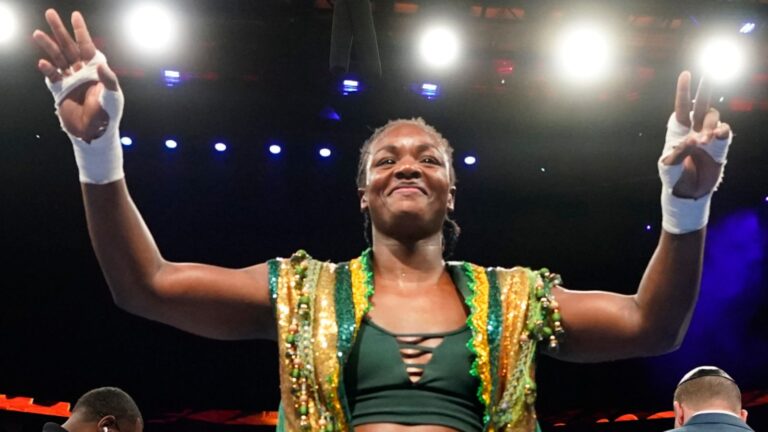
Claressa Shields will return to Detroit to make a heavyweight championship defence on July 26.

New Zealand’s Lani Daniels will challenge Shields for the undisputed heavyweight title at the Little Caesars Arena.

Shields became the first undisputed heavyweight champion in women’s boxing when she beat Danielle Perkins earlier this year to unify the WBA, WBO, IBF and WBC belts.

Shields, a two-time Olympic gold medallist and unbeaten professional champion at super-welter, middle and super-middleweight, dropped Perkins on course to taking unanimous points decision.

Please use Chrome browser for a more accessible video player

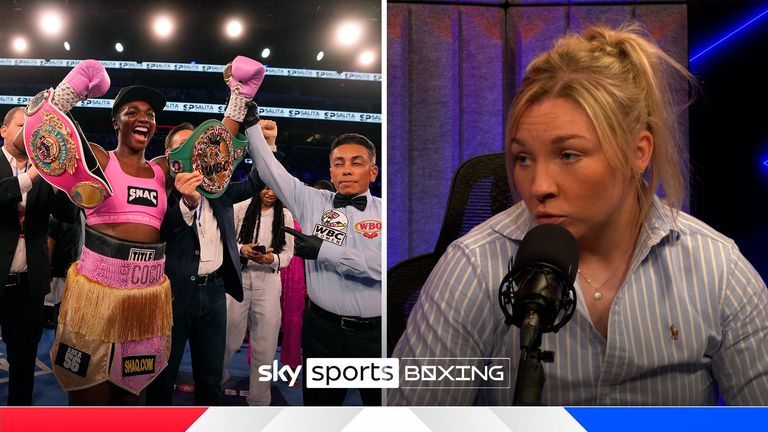
Unified welterweight champion Lauren Price is targeting a future fight with pound-for-pound superstar Shields

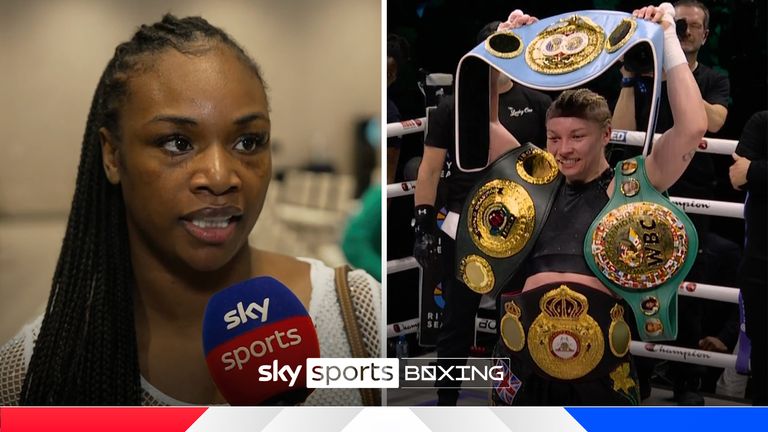
The 36-year-old Daniels is the IBF’s light-heavyweight world titlist, having previously been their heavyweight champion. She is unbeaten in her last nine bouts with a 11-2-2 (1) record.

The home of the Detroit Red Wings and Detroit Pistons opened in 2017, but the Little Caesars Arena didn’t have a boxing card until almost two years ago when Shields was the headliner and beat Maricela Cornejo.

Please use Chrome browser for a more accessible video player

Shields discusses a potential future bout with welterweight world champion Price and what weights either of them would have to jump to

Shields, from Flint, Michigan, was back there last summer when knocking out WBC heavyweight champion Vanessa Lepage-Joanisse in front of about 12,000 fans and will likely be a big draw for a third time in July.

“Women’s boxing has grown by leaps and bounds since Claressa Shields headlined the very first women’s main event on a nationally televised card,” her promoter Dmitriy Salita said.


Source link

Clarence O. Smith, a Founder of Essence Magazine, Is Dead at 92

0


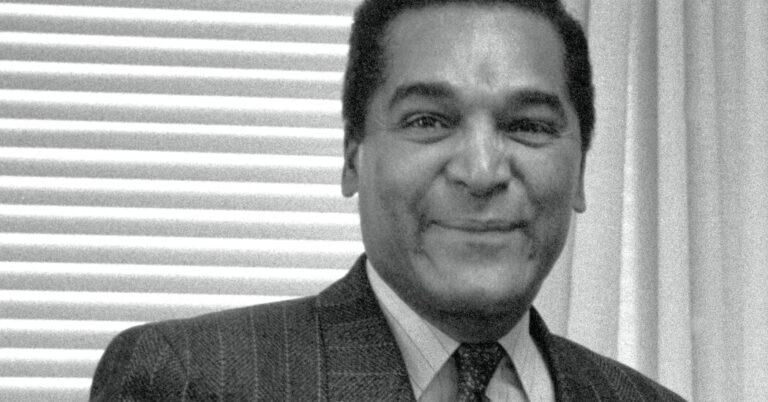
Clarence O. Smith, who convinced skeptical mainstream advertisers of the power and worth of the Black female consumer market as a founder of Essence, the first general-circulation magazine directed at Black women, died on April 21. He was 92.

Mr. Smith, who lived in Yonkers, N.Y., died in a hospital after a short illness, his niece Kimberly Fonville Boyd said. She provided no other details.

Essence began publication as a monthly in May 1970 in an era when negative and sometimes hateful stereotypes of Black women were commonplace, said Edward Lewis, who was one of four founders of Essence and who became its chief executive.

“We had to overcome this perception,” he said in an interview. “Clarence suggested that we start telling the story of Black women as strivers.”

Mr. Smith, as the magazine’s president, in charge of advertising and marketing, made the initial pitch to reluctant companies that there were 12 million Black women in the United States who controlled a market worth more than $30 billion, and that the magazine would target 4.2 million of the more affluent among them — women between the ages of 18 and 45 who were urban, educated and had increasing discretionary income.

A confident and charming extemporaneous speaker, Mr. Smith had come well prepared with market research, colleagues said, but his challenge was evident from the outset: The first issue of the magazine carried only 13 pages of advertising, and the second and third issues fared even worse, with just five pages of ads apiece.

The cover of the inaugural issue of Essence, published in May 1970 and featuring the model Barbara Cheeseborough.Credit…Essence

But while the magazine, with offices in Manhattan, continued to face obstacles, its prospects improved: Circulation went from an inaugural run of 50,000 copies sold to eventually topping 1.1 million. The number of advertising pages grew to more than 1,000 yearly, attracting companies like Estée Lauder, Johnson & Johnson and Pillsbury. And the rate for a full-page color ad went from $2,500 to $48,000 by 2001, according to Mr. Smith.

“Clarence was a relentless champion for the leadership of Black women and the impact of our spending power that was ignored,” Susan L. Taylor, the magazine’s editor in chief from 1981 until 2000, said in an interview.

The seed for Essence began to germinate in November 1968, when a small group of Black professionals — Mr. Lewis, Cecil Hollingsworth and Jonathan Blount, all strangers to one another — met at a Wall Street conference held to encourage African American entrepreneurship. Mr. Smith joined the group two weeks later.

It was a time of social and civil unrest in the United States, with urban riots, the assassinations of Martin Luther King Jr. and Robert F. Kennedy, and the Vietnam War in its deadliest year. But it was also a period — at the intersection of the civil rights movement and the Black women’s empowerment movement — of increasing opportunities for the creation of Black-owned businesses.

The concept of a magazine for Black women was championed by Mr. Blount, according to Ms. Taylor. “His mother would say, ‘Why do I have to read magazines where I see no one who looks like me?’” she recalled.

Mr. Smith, who had been a top salesman for Prudential insurance, had been the most successful of the four original partners, and the oldest, Mr. Lewis wrote in his memoir, “The Man From Essence: Creating a Magazine for Black Women” (2014). He was also the only one with a car. Astutely, he persuaded automotive companies like Ford, General Motors and Toyota to buy ads, something they had seldom done in women’s publications.

The first cover of Essence featured the model Barbara Cheeseborough, who wore an Afro and a look that suggested authenticity as an equal to glamour.

Inside there were photographic essays on fashion and beauty, celebrating models of diverse skin tones. One article, headlined “Sensual Black Man, Do You Love Me?,” explored the topic of Black men dating and marrying white women. Another article focused on women who were active in the civil rights movement, from Rosa Parks to Kathleen Cleaver of the Black Panther Party.

Given a preview of the inaugural issue, Philip H. Dougherty, The New York Times’s advertising correspondent, called it a “handsome piece of work.”

Clarence O. Smith was born on March 31, 1933, in New York City to Clarence Smith and Millicent Frey (sometimes spelled Fry). He grew up in the Williamsbridge section of the Bronx.

In a 2005 interview with NPR, Mr. Smith described the neighborhood of his youth, mostly Black but with integrated schools, as a collegial place where parents taught their children values of both self-improvement and selflessness.

“We had a responsibility to grow up to be people who made a productive life and who looked after the larger community as well,” he said.

At Essence, to please advertisers, he pushed for more ads to be placed in the front pages and encouraged the magazine to produce special issues devoted to beauty or travel as ways to reach advertisers in those particular industries. He also hired an advertising sales staff made up predominantly of Black women, noted Marcia Ann Gillespie, the editor in chief of Essence from 1971 to 1980.

“The resistance of white businesses to associate with a Black women’s magazine was really intense,” Ms. Gillespie said, and Mr. Smith, she added, “was always trying to find a way through and around and was relentless about it. Failure was not on his to-do list.”

Mr. Smith played crucial roles in expanding the entertainment side of Essence with an annual awards show that honored Black women, and with a culture and music festival that continues to draw roughly 500,000 attendees to New Orleans each July.

“He was a futurist,” said Barbara Britton, a former vice president of advertising at Essence.

Of the original four founders, Mr. Smith and Mr. Lewis were the only ones who remained with the company long afterward. But their 32-year partnership began to deteriorate in the 1990s over a tangle of issues, personal and professional.

Their final disagreement, in 2000, was over the sale of 49 percent of Essence to Time Warner. Mr. Smith opposed it. Mr. Lewis wrote in his memoir that it was his belief that Mr. Smith “didn’t want to see a viable Black-owned company sell out to whites.”

By 2002, Mr. Lewis owned more stock than Mr. Smith and had gained the upper hand in the company. Mr. Smith was forced out and received a buyout of $14 million after seeking $40 million, Mr. Lewis wrote. The two seldom spoke afterward.

After leaving Essence, Mr. Smith started a record label and a travel business.

Essence sold the remaining 51 percent of its ownership to Time Warner in 2005. (In 2018, the magazine was sold to Richelieu Dennis, the founder of a large personal-care products company, and became fully Black-owned again. Today it publishes six issues a year and has a robust online presence.)

Along with Ms. Boyd, his niece, Mr. Smith is survived by his wife, Elaine (Goss) Smith, and a granddaughter, Denise Diaz. The Smiths’ two sons, Clarence Jr. and Craig, died before him.

Mr. Lewis said Mr. Smith should be celebrated for helping to validate the value of Black female consumers and to shape the way Black women were perceived.

“He came across as authentic, really believing what he was selling, backed up by research,” Mr. Lewis said, recalling the magazine’s early days. “We were always prepared, because we knew that we were selling a market that no one wanted to be a part of.”


Source link

What the Fed’s Rate Decision Means for Loans, Credit Cards, Mortgages and More

0


The Federal Reserve is expected to keep its key rate steady on Wednesday, after a series of cuts that lowered rates by a full percentage point last year.

That means consumers looking to borrow are likely to have to wait a bit longer for better deals on many loans, but savers will benefit from steadier yields on savings accounts.

The central bank is waiting for more clarity on the economic outlook and the impact of President Trump’s policies on tariffs, immigration and widespread federal job cuts. Mr. Trump has publicly attacked the Fed chair, Jerome H. Powell, and his colleagues for keeping borrowing costs too high.

The Fed’s benchmark rate is set at a range of 4.25 to 4.5 percent. In an effort to tamp down inflation, the central bank began lifting rates rapidly — from near zero to above 5 percent — between March 2022 and July 2023. Prices have cooled considerably since then, and the Fed pivoted to rate cuts, lowering rates in September, November and December.

Mr. Trump’s inflation-stoking polices could prompt the Fed to delay more rate cuts. But at the same time, longer-term interest rates set by the markets have been extremely volatile, influencing a wide range of consumer and business borrowing costs.

What’s happening now: Auto rates have been trending higher and car prices remain elevated, making affordability a challenge. And that is before U.S. tariffs threaten to push prices up even more.

Car loans tend to track with the yield on the five-year Treasury note, which is influenced by the Fed’s key rate. But other factors determine how much borrowers actually pay, including your credit history, the type of vehicle, the loan term and the down payment. Lenders also take into consideration the levels of borrowers becoming delinquent on auto loans. As those move higher, so do rates, which makes qualifying for a loan more difficult, particularly for those with lower credit scores.

The average rate on new car loans was 7.2 percent in March, according to Edmunds, a car shopping website, unchanged from February and March 2024. Rates for used cars were higher: The average loan carried an 11.5 percent rate in March, compared with 11.3 percent in February and 11.9 percent in March 2024.

Where and how to shop: Once you establish your budget, get preapproved for a car loan through a credit union or bank (Capital One and Ally are two of the largest auto lenders) so you have a point of reference to compare financing available through the dealership, if you decide to go that route. Always negotiate on the price of the car (including all fees), not the monthly payments, which can obscure the loan terms and what you’ll be paying in total over the life of the loan.

What’s happening now: The interest rates you pay on any balances that you carry had edged slightly lower after the most recent Fed cuts, but the decreases have slowed, experts said. Last week, the average interest rate on credit cards was 20.09 percent, according to Bankrate.

Much depends, however, on your credit score and the type of card. Rewards cards, for instance, often charge higher-than-average interest rates.

Where and how to shop: Last year, the Consumer Financial Protection Bureau sent up a flare to let people know that the 25 biggest credit-card issuers had rates that were eight to 10 percentage points higher than smaller banks or credit unions. For the average cardholder, that can add up to $400 to $500 more in interest a year.

Consider seeking out a smaller bank or credit union that might offer you a better deal. Many credit unions require you to work or live someplace particular to qualify for membership, but some bigger credit unions may have looser rules.

Before you make a move, call your current card issuer and ask them to match the best interest rate you’ve found in the marketplace that you’ve already qualified for. And if you do transfer your balance, keep a close eye on fees and what your interest rate would jump to once the introductory period expires.

What’s happening now: Mortgage rates have been volatile. Rates peaked at about 7.8 percent late last year and had fallen as low as 6.08 percent in late September. Solid economic data and concerns about Mr. Trump’s potentially inflationary agenda pushed rates a bit higher again, though they’ve steadied in recent weeks.

Rates on 30-year fixed-rate mortgages don’t move in tandem with the Fed’s benchmark, but instead generally track with the yield on 10-year Treasury bonds, which are influenced by a variety of factors, including expectations about inflation, the Fed’s actions and how investors react.

The average rate on a 30-year fixed-rate mortgage was 6.76 percent as of May 1, down from 6.81 percent the previous week and 7.22 percent a year ago.

Other home loans are more closely tethered to the central bank’s decisions. Home-equity lines of credit and adjustable-rate mortgages — which carry variable interest rates — generally adjust within two billing cycles after a change in the Fed’s rates.

Where and how to shop: Prospective home buyers would be wise to get several mortgage rate quotes — on the same day, since rates fluctuate — from a selection of mortgage brokers, banks and credit unions.

That should include: the rate you’ll pay; any discount points, which are optional fees buyers can pay to “buy down” their interest rate; and other items like lender-related fees. Look to the “annual percentage rate,” which usually includes these items, to get an apples-to-apples comparison of your total costs across different loans. Just be sure to ask what’s included in the A.P.R.

What’s happening now: Everything from online savings accounts and certificates of deposit to money market funds tend to move in line with the Fed’s policy.

Savers are no longer benefiting from the juiciest yields, but you can still find returns at online banks of 4 percent or more. “The Fed taking its foot off the gas with rate cuts means that these yields are likely to stay high for a while, but it won’t last forever,” said Matt Schulz, chief consumer finance analyst at LendingTree, the online loan marketplace.

Traditional commercial banks’ yields, meanwhile, have remained anemic throughout this period of higher rates. The national average savings account rate was recently 0.61 percent, according to Bankrate.

Where and how to shop: Rates are one consideration, but you’ll also want to look at providers’ history, minimum deposit requirements and any fees (high-yield savings accounts don’t usually charge fees, but other products, like money market funds, do). DepositAccounts.com, part of LendingTree, tracks rates across thousands of institutions and is a good place to start comparing providers.

Check out our colleague Jeff Sommer’s columns for more insight into money-market funds. The yield on the Crane 100 Money Fund Index, which tracks the largest money-market funds, was 4.14 percent as of Tuesday, down from 5.15 percent in February 2024.

What’s happening now: There are two main types of student loans. Most people turn to federal loans first. Their interest rates are fixed for the life of the loan, they’re far easier for teenagers to get and their repayment terms are more generous.

Current rates are 6.53 percent for undergraduates, 8.08 percent for unsubsidized graduate student loans and 9.08 percent for the PLUS loans that both parents and graduate students use. Rates reset on July 1 each year and follow a formula based on the 10-year Treasury bond auction in May.

Private student loans are a bit of a wild card. Undergraduates often need a co-signer, rates can be fixed or variable and much depends on your credit score.

Where and how to shop: Many banks and credit unions want nothing to do with student loans, so you’ll want to shop around extensively, including with lenders that specialize in private student loans.

You’ll often see online ads and websites offering interest rates from each lender that can range by 15 percentage points or so. As a result, you’ll need to give up a fair bit of information before getting an actual price quote.



Source link

Live Updates: Fed Keeps Rates Steady and Flags Heightened Uncertainty About the Economy

0


The Federal Reserve left interest rates unchanged for a third meeting in a row on Wednesday, as officials stuck to a wait-and-see approach amid heightened uncertainty about how significantly President Trump’s tariffs will raise inflation and slow growth.

The unanimous decision to stand pat will keep interest rates at 4.25 percent to 4.5 percent. Rates have been there since December after a series of cuts in the second half of 2024.

The Fed gathered at a highly volatile moment for the economy and the global financial system amid an onslaught of policy changes from Mr. Trump just months into his second term in the White House.

In a statement on Wednesday, the Fed acknowledged that the labor market was still “solid.” But policymakers also noted that “uncertainty about the economic outlook has increased further” and “risks of higher unemployment and higher inflation have risen.”

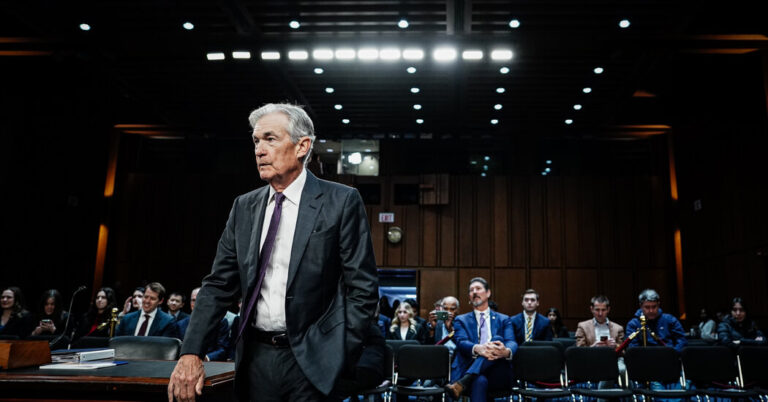
At a news conference after the statement, Jerome H. Powell, the Fed chair, said he could not yet say “which way this will shake out” in terms of whether to be more worried about inflation or growth.

He later captured the uncertainty of the moment, saying “It’s really not at all clear what it is we should do.”

Since the Fed’s last meeting in March, the administration announced and then rolled back aggressive new tariffs as Mr. Trump gave countries time to reach trade deals ahead of a July deadline. Still, a 10 percent universal tariff remains in place, along with additional levies on steel, aluminum and cars. The president has also imposed a minimum tariff of 145 percent on Chinese goods.

The whiplash has unnerved financial markets, stoking volatility as Wall Street digested the various twists and turns associated with Mr. Trump’s trade policy and his subsequent attacks on Mr. Powell for ignoring his demands to lower interest rates. Last month, investors started to flee what are considered financial “safe havens,” signaling that markets had come under strain.

The upheaval has created complications for the central bank. It is struggling to both assess the economic fallout from Mr. Trump’s policies and game out how it will set monetary policy in an environment in which its goals of maintaining a healthy labor market and keeping inflation low and stable may be in conflict.

Officials have grown increasingly worried about how much Mr. Trump’s policies, which also include slashing spending and deporting immigrants, will sap growth. Some companies have already started to warn about sluggish sales as consumers have turned much more downbeat about the outlook; the fear is that the uncertainty will further chill business activity.

But unlike in the past, the Fed is not in a position to respond to early signs that the economy is weakening by preemptively lowering interest rates. That is because of inflation: Price pressures stemming from the post-pandemic surge have not been fully snuffed out, and now Mr. Trump’s tariffs risk rekindling them.

It is too early to tell if the tariff-induced jump in inflation will prove to be temporary, or if it morphs into something more persistent. So far, market-based measures of inflation expectations, to which the Fed pays closest attention, suggest that inflation will indeed remain contained after an initial pop. But officials do not want to make the same mistake as they did just a few years ago, when they underestimated how long lasting inflation would prove to be. While officials originally expected inflation to fade after pandemic-induced supply snags, it instead persisted.

As such, the bar for the central bank to lower interest rates is higher this time.

Officials will most likely need to see tangible evidence that the labor market is beginning to weaken before restarting cuts. If monthly jobs growth grinds to a halt, or turns negative, and layoffs rise, that could be enough to bolster the central bank’s conviction that it can begin to reduce rates.

But waiting to see that show up in the data may mean that the Fed has moved too late, potentially prompting the need for officials to cut more aggressively later on.


Source link

'People's champion?' Eubank MOBBED as he signs egg carton!

0


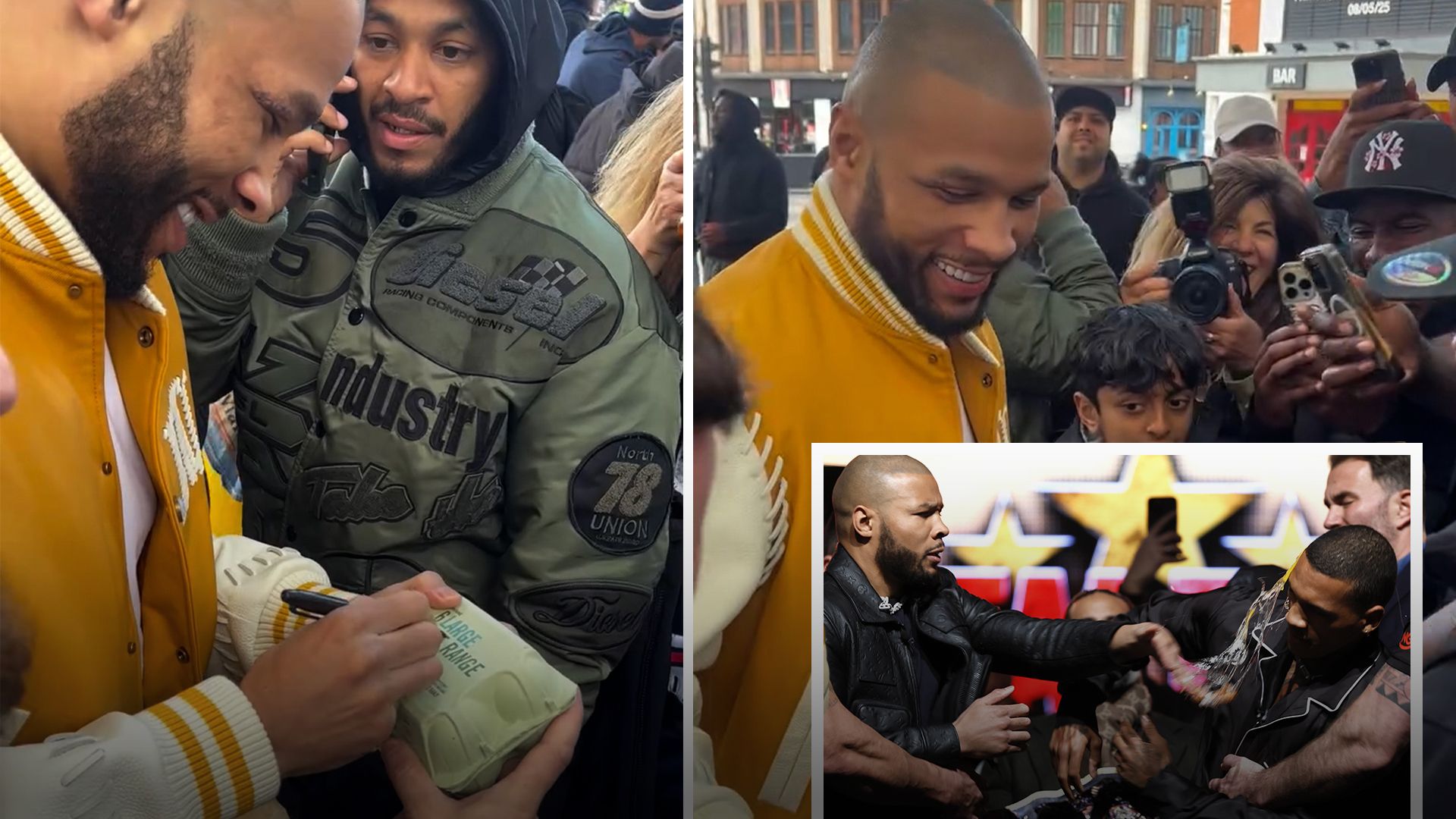
Chris Eubank Jr was mobbed by fans while signing an egg carton following his recent victory over British rival Conor Benn.


Source link

Biden Criticizes Trump in BBC Interview


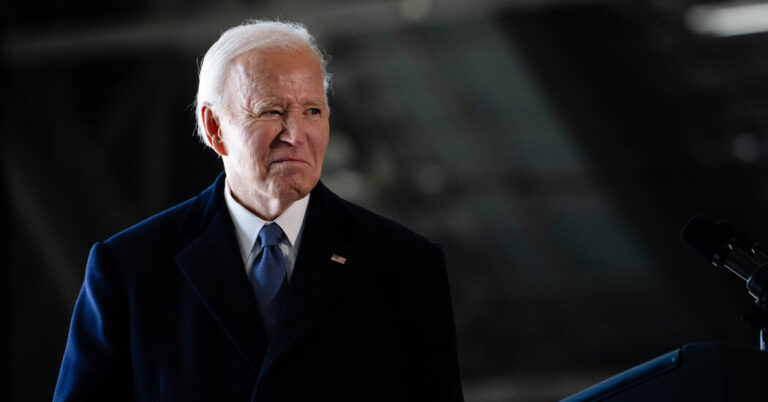
Six months after his party lost the presidential election, former President Joseph R. Biden Jr. is stepping back into the public spotlight with a scathing condemnation of his successor and his handling of international affairs.

In his first broadcast interview since leaving the White House, Mr. Biden attacked President Trump’s management of the war in Ukraine and his dealings with global allies. Speaking to the BBC, Mr. Biden also defended the timing of his own withdrawal from the 2024 presidential campaign.

The former president singled out some of Mr. Trump’s actions on foreign policy — including his combative meeting in the Oval Office in February with President Volodymyr Zelensky of Ukraine.

“I found it sort of beneath America in the way that it took place,” Mr. Biden said of the meeting. He also pointed to calls by Mr. Trump to rename the Gulf of Mexico, take back the Panama Canal and acquire Greenland.

“What the hell’s going on here? What president ever talks like that? That’s not who we are,” Mr. Biden said. “We’re about freedom, democracy, opportunity — not about confiscation.”

While he did not mention Mr. Trump by name, his comments were a striking departure from a long tradition in which former presidents decline to criticize the leaders who follow. The attack suggested that Mr. Biden, 82, sees himself as continuing to have a public role in his party, even as many Democrats blame him for their 2024 defeat and want to focus on a new generation of leaders.

While many Democrats consider it politically damaging to focus too much on their last president, Mr. Biden appears inclined to defend his record and to try to shape his legacy.

In his halting speaking style, Mr. Biden boasted of being “so successful on our agenda.” He again defended his decision to seek re-election last year despite polling that, even before he began his campaign, showed that many Democrats did not want him to run for a second term.

“I don’t think it would have mattered,” he said when asked whether he thought he should have quit before his disastrous debate performance in June. “I don’t think that would have made much difference.”

The interview is part of a public re-emergence by Mr. Biden, who has kept a relatively low profile since leaving the White House in January. In recent weeks, he has been spotted at the opening of “Othello,” a popular Broadway show, and at the Vatican for the funeral of Pope Francis.

On Thursday, Mr. Biden is scheduled to appear on ABC’s “The View” for another interview, where he is again expected to be asked about Mr. Trump and to defend his own record as president.

Mr. Biden routinely avoided engaging with the news media as both candidate and president, with his staff members going to great lengths to keep him away from reporters. He chose a British outlet to make his post-presidential news media debut followed by a daytime talk show, continuing his tradition of eschewing the traditional American press.

Three weeks ago, he gave a speech to disability advocates in Chicago in which he accused the current administration of “taking a hatchet” to the Social Security Administration and slammed Mr. Trump as doing “damage and destruction” to the benefits program.

In addition to expressing his displeasure at Mr. Trump’s leadership, Mr. Biden may also be raising his profile for financial gain.

His speech in Chicago was paid and, according to two people familiar with the matter, he is expected to participate in more speaking engagements in the future. He is also working on a memoir about his time in office and has re-signed with Creative Artists Agency, which represented him from 2017 to 2020.

His family’s post-presidential costs have increased since Mr. Trump took office. While Mr. Biden and his wife, Jill Biden, have Secret Service protection for the rest of their lives, Mr. Trump moved in March to revoke protection for their adult children, including Hunter Biden.

As Democrats search for a path forward, they are unlikely to welcome Mr. Biden’s reminders about the past.

David Axelrod, an early critic of Mr. Biden’s running for a second term, said Mr. Biden’s raised public profile could have the opposite effect of what the former president may intend.

“It’s understandable that President Biden wants to speak, given all that has transpired since January 20th,” said Mr. Axelrod, a former adviser to President Barack Obama. “But it’s likely the only person more eager for him to re-emerge is Donald Trump, who brings Biden up seven days a week and twice on Sunday.”

For years, Mr. Biden and his aides argued that he was the only Democrat who could defeat Mr. Trump — despite the party’s deep bench of governors, senators and other younger officials. By insisting on seeking re-election, then abruptly bowing out under pressure from his own party, Mr. Biden left Democrats scrambling to remake a billion-dollar presidential campaign for a different candidate over 107 days.

Former Vice President Kamala Harris, who replaced him on the ticket, has told friends that she would have beaten Mr. Trump if she had been given more time to campaign — the implication being that Mr. Biden should have quit the race earlier.

Other Democrats argue that if Mr. Biden had acknowledged the signs of his aging earlier and declined to run for re-election, their party could have hosted a robust primary race and emerged with a stronger contender to challenge Mr. Trump.

Mr. Biden, who hinted during his 2020 campaign that he would serve only one term, said in the BBC interview that he had been prepared to hand over leadership to the next generation instead of running again. “But things moved so quickly that it made it difficult to walk away,” he said, adding, “it was just a difficult decision.”

Some of his most loyal aides have insisted that Democrats have only themselves to blame for their loss. Mike Donilon, a longtime adviser, has continued to argue that Mr. Biden was the party’s best chance for keeping the White House.

“Lots of people have terrible debates,” Mr. Donilon told an audience at Harvard University in February. “Usually, the party doesn’t lose its mind. But that’s what happened — it just melted down.”

In the BBC interview, Mr. Biden said he was worried about the future of global democracy if allies no longer saw the United States as a reliable leader. He noted that Sweden and Finland had both joined NATO during his presidency, bolstering the alliance. “And in four years we’ve got a guy who wants to walk away from it all,” Mr. Biden said.

“I’m worried that Europe is going to lose confidence in the certainty of America, and the leadership of America in the world,” he said.

The possibility that the NATO alliance might be dying is a “grave concern,” he said.

“We’re the only nation in position to have the capacity to bring people together to lead the world,” he said “Otherwise you’re going to have China and the former Soviet Union, Russia, stepping up.”

If NATO did not exist, Mr. Biden asked at one point, “do you think Putin would have stopped at Ukraine?” He added, apparently referring to Trump administration officials, “I don’t understand how they fail to understand that there is strength in alliances.”

In his second term, Mr. Trump has often singled out his predecessor for blame — a New York Times analysis found that he publicly mentioned Mr. Biden’s name more than six times a day on average in his first 50 days in office.

Asked whether Mr. Trump was behaving more like a monarch than a president, Mr. Biden put it carefully: “He’s not behaving like a Republican president.”


Source link

Live Updates: Fed Expected to Hold Rates Again

0


The Federal Reserve is expected to keep its key rate steady on Wednesday, after a series of cuts that lowered rates by a full percentage point last year.

That means consumers looking to borrow are likely to have to wait a bit longer for better deals on many loans, but savers will benefit from steadier yields on savings accounts.

The central bank is waiting for more clarity on the economic outlook and the impact of President Trump’s policies on tariffs, immigration and widespread federal job cuts. Mr. Trump has publicly attacked the Fed chair, Jerome H. Powell, and his colleagues for keeping borrowing costs too high.

The Fed’s benchmark rate is set at a range of 4.25 to 4.5 percent. In an effort to tamp down inflation, the central bank began lifting rates rapidly — from near zero to above 5 percent — between March 2022 and July 2023. Prices have cooled considerably since then, and the Fed pivoted to rate cuts, lowering rates in September, November and December.

Mr. Trump’s inflation-stoking polices could prompt the Fed to delay more rate cuts. But at the same time, longer-term interest rates set by the markets have been extremely volatile, influencing a wide range of consumer and business borrowing costs.

Auto Rates

What’s happening now: Auto rates have been trending higher and car prices remain elevated, making affordability a challenge. And that is before U.S. tariffs threaten to push prices up even more.

Car loans tend to track with the yield on the five-year Treasury note, which is influenced by the Fed’s key rate. But other factors determine how much borrowers actually pay, including your credit history, the type of vehicle, the loan term and the down payment. Lenders also take into consideration the levels of borrowers becoming delinquent on auto loans. As those move higher, so do rates, which makes qualifying for a loan more difficult, particularly for those with lower credit scores.

The average rate on new car loans was 7.2 percent in March, according to Edmunds, a car shopping website, unchanged from February and March 2024. Rates for used cars were higher: The average loan carried an 11.5 percent rate in March, compared with 11.3 percent in February and 11.9 percent in March 2024.

Where and how to shop: Once you establish your budget, get preapproved for a car loan through a credit union or bank (Capital One and Ally are two of the largest auto lenders) so you have a point of reference to compare financing available through the dealership, if you decide to go that route. Always negotiate on the price of the car (including all fees), not the monthly payments, which can obscure the loan terms and what you’ll be paying in total over the life of the loan.

Credit Cards

What’s happening now: The interest rates you pay on any balances that you carry had edged slightly lower after the most recent Fed cuts, but the decreases have slowed, experts said. Last week, the average interest rate on credit cards was 20.09 percent, according to Bankrate.

Much depends, however, on your credit score and the type of card. Rewards cards, for instance, often charge higher-than-average interest rates.

Where and how to shop: Last year, the Consumer Financial Protection Bureau sent up a flare to let people know that the 25 biggest credit-card issuers had rates that were eight to 10 percentage points higher than smaller banks or credit unions. For the average cardholder, that can add up to $400 to $500 more in interest a year.

Consider seeking out a smaller bank or credit union that might offer you a better deal. Many credit unions require you to work or live someplace particular to qualify for membership, but some bigger credit unions may have looser rules.

Before you make a move, call your current card issuer and ask them to match the best interest rate you’ve found in the marketplace that you’ve already qualified for. And if you do transfer your balance, keep a close eye on fees and what your interest rate would jump to once the introductory period expires.

Mortgages

What’s happening now: Mortgage rates have been volatile. Rates peaked at about 7.8 percent late last year and had fallen as low as 6.08 percent in late September. Solid economic data and concerns about Mr. Trump’s potentially inflationary agenda pushed rates a bit higher again, though they’ve steadied in recent weeks.

Rates on 30-year fixed-rate mortgages don’t move in tandem with the Fed’s benchmark, but instead generally track with the yield on 10-year Treasury bonds, which are influenced by a variety of factors, including expectations about inflation, the Fed’s actions and how investors react.

The average rate on a 30-year fixed-rate mortgage was 6.76 percent as of May 1, down from 6.81 percent the previous week and 7.22 percent a year ago.

Other home loans are more closely tethered to the central bank’s decisions. Home-equity lines of credit and adjustable-rate mortgages — which carry variable interest rates — generally adjust within two billing cycles after a change in the Fed’s rates.

Where and how to shop: Prospective home buyers would be wise to get several mortgage rate quotes — on the same day, since rates fluctuate — from a selection of mortgage brokers, banks and credit unions.

That should include: the rate you’ll pay; any discount points, which are optional fees buyers can pay to “buy down” their interest rate; and other items like lender-related fees. Look to the “annual percentage rate,” which usually includes these items, to get an apples-to-apples comparison of your total costs across different loans. Just be sure to ask what’s included in the A.P.R.

Savings Accounts and C.D.s

What’s happening now: Everything from online savings accounts and certificates of deposit to money market funds tend to move in line with the Fed’s policy.

Savers are no longer benefiting from the juiciest yields, but you can still find returns at online banks of 4 percent or more. “The Fed taking its foot off the gas with rate cuts means that these yields are likely to stay high for a while, but it won’t last forever,” said Matt Schulz, chief consumer finance analyst at LendingTree, the online loan marketplace.

Traditional commercial banks’ yields, meanwhile, have remained anemic throughout this period of higher rates. The national average savings account rate was recently 0.61 percent, according to Bankrate.

Where and how to shop: Rates are one consideration, but you’ll also want to look at providers’ history, minimum deposit requirements and any fees (high-yield savings accounts don’t usually charge fees, but other products, like money market funds, do). DepositAccounts.com, part of LendingTree, tracks rates across thousands of institutions and is a good place to start comparing providers.

Check out our colleague Jeff Sommer’s columns for more insight into money-market funds. The yield on the Crane 100 Money Fund Index, which tracks the largest money-market funds, was 4.14 percent as of Tuesday, down from 5.15 percent in February 2024.

Student Loans

What’s happening now: There are two main types of student loans. Most people turn to federal loans first. Their interest rates are fixed for the life of the loan, they’re far easier for teenagers to get and their repayment terms are more generous.

Current rates are 6.53 percent for undergraduates, 8.08 percent for unsubsidized graduate student loans and 9.08 percent for the PLUS loans that both parents and graduate students use. Rates reset on July 1 each year and follow a formula based on the 10-year Treasury bond auction in May.

Private student loans are a bit of a wild card. Undergraduates often need a co-signer, rates can be fixed or variable and much depends on your credit score.

Where and how to shop: Many banks and credit unions want nothing to do with student loans, so you’ll want to shop around extensively, including with lenders that specialize in private student loans.

You’ll often see online ads and websites offering interest rates from each lender that can range by 15 percentage points or so. As a result, you’ll need to give up a fair bit of information before getting an actual price quote.



Source link