Home Blog Page 331

Trump’s Return to Power Elevates Ever Fringier Conspiracy Theories

0


People who question whether the Earth is round — a fact understood by the ancient Greeks and taught to American children in elementary school — might have been political pariahs a decade ago. Now, they’re running local Republican parties in Georgia and Minnesota and seeking public office in Alabama.

A prominent far-right activist who has said, despite years of research and intelligence establishing otherwise, that the terrorist attacks on Sept. 11, 2001, were an inside job by the U.S. government commemorated the 9/11 anniversary last year alongside President Trump.

And Robert F. Kennedy Jr., the secretary of the Department of Health and Human Services, pledged the agency’s support last month for a fight involving so-called chemtrails, a debunked theory that the white condensation lines streaming behind airplanes are toxic, or could even be used for nefarious purposes.

Conspiracy theories that were relegated to random and often anonymous online forums are now being championed or publicly debated by increasingly powerful people. Mr. Trump in particular has embraced, elevated and even appointed to his cabinet people promoting these theories — giving the ideas a persuasive authority and a dangerous proximity to policy.

“The real problem with the ideas and the communication of conspiracy theories is when they get evinced by people with the power to act on them,” said Joseph E. Uscinski, a professor at the University of Miami who studies conspiracy theories. “If some guy, somewhere, thinks the Earth is flat, the answer is ‘So what?’ But when people in power have those beliefs, it becomes a serious issue.”

He added: “You can wind up harming many, many people over a fantasy.”

Anna Kelly, a spokeswoman for the White House, said in a statement that the mainstream media “has tried and failed to paint President Trump as extreme for his entire political career” and that his agenda was “common sense.”

Debunked narratives about election fraud and vaccines have proliferated in national discourse over the past five years. A pro-Trump movement known as QAnon, which makes outlandish claims that there is a global sex-trafficking operation backed by the so-called deep state, was found at one point to be as popular in the United States as some major religions.

But the conspiracy theories now graduating into the mainstream were, until recently, far more marginal. And the people voicing them are growing more influential.

Mr. Trump and Elon Musk, the billionaire who has been called the “unelected co-president,” have repeatedly suggested this year, without any evidence and against the assurances of current and former Treasury secretaries, that the Fort Knox gold reserves may have been stolen.

Anna Paulina Luna, a second-term Republican representative from Florida whom Mr. Trump endorsed, has said she believes that two shooters were involved in the 1963 assassination of President John F. Kennedy — a conclusion that past inquiries into the assassination and the release of 64,000 related documents in March have not proved. Ms. Luna is now heading a task force established to examine the “declassification of federal secrets” and has pledged to investigate topics that have long preoccupied conspiracy theorists, including so-called Unidentified Anomalous Phenomena, the Covid-19 pandemic, files related to 9/11 and Jeffrey Epstein’s client list (a recent document dump related to the disgraced financier revealed little).

Representative Marjorie Taylor Greene — a Georgia Republican known for voicing conspiracy theories about Sept. 11, school shootings and wildfires started by Jews wielding space lasers — is in her third term. In the midst of two devastating hurricanes this fall, she posted online that “they can control the weather,” nodding to a false narrative suggesting that the government can manifest storms.

Four years ago, Senator Mitch McConnell of Kentucky, the minority leader at the time, condemned the sorts of “loony lies and conspiracy theories” that Ms. Greene embraced as a “cancer for the Republican Party and our country.” She is now considering either a Senate or a governor bid. When contacted by a reporter, a spokesman for the congresswoman said his only comment was that the reporter was “insane.”

Outlandish theories are being enabled and rewarded by the online ecosystem, said Cynthia S. Wang, a professor at the Kellogg School of Management at Northwestern University, where she runs the Dispute Resolution Research Center. Social media platforms, she said, sort people into echo chambers, facilitate the production of convincingly sleek posts and use engagement metrics to encourage content that provokes a reaction.

Add in a chaotic news cycle, filled with wars, natural disasters, economic turmoil and other anxiety-inducing features, and conspiracy theories become even more appealing because they seem to explain inexplicable things, experts said.

“A lot of people in authority know that this rhetoric is powerful — it is a way to stoke uncertainty and then say, ‘Hey, if you listen to me, I can help you with your uncertainty and make sure that you and your group are going to be OK,’” Dr. Wang said. “That’s really comforting.”

Politicians understand that conspiracy theories are “what scratches our collective psychic itch” at the moment, said John Llewellyn, an associate professor of communication at Wake Forest University who studies urban legends and rhetoric. Repeating such narratives, and promising to act on them, enables a sort of rhetorical sleight of hand, like performing a card trick with the right hand to misdirect from what is happening with the left, he said.

Pursuing policy action on nonexistent dangers of chemtrails, for example, allows officials to deliver “symbolic satisfaction that doesn’t require any tax increases or wrestling with health care challenges or otherwise solve any of the real and emergent problems in our society,” Mr. Llewellyn said.

The wild narratives are causing real-world trouble.

The correlation between support for political violence and the tendency to classify events and circumstances as results of conspiracies tripled in magnitude from 2012 to 2022, according to an essay published in December by several researchers, including Dr. Uscinski of the University of Miami. The researchers theorized that the surge could have been caused by a steady rise in polarization, a decline in trust in institutions or Mr. Trump’s conspiratorial and violent language.

The Institute for Strategic Dialogue, a nonpartisan think tank, identified a rash of violent incidents last year linked to perpetrators influenced by conspiracy theories about chemtrails, 9/11, elections, the pandemic and more. One was a man who — fueled by rage against the government, immigrants, the gay community and the Black Lives Matter movement, according to prosecutors — killed and then beheaded his father, a former federal employee.

“For radicalized individuals, whose worldviews are warped by these theories and who are already primed to commit violence, political developments and other events have the potential to serve as catalysts to action,” researchers wrote.

A feedback loop of conspiracy theories has formed at every level of American government, according to watchdog groups. Efforts to break the chain are weakening: Misinformation and disinformation researchers have faced years of political pressure, including a decision by the National Science Foundation last month to terminate grants related to research in the field.

What other topics are going from shunned to the spotlight? Angelo Carusone, the president of Media Matters, a left-wing advocacy group that monitors misinformation, said he was “pretty bullish on demons as the next big one.”

Mr. Trump referred to “demonic forces” on the campaign trail and called Democrats a “very demonic party.” Days before interviewing both Donald Trump Jr. and Mr. Musk at Mar-a-Lago on Election Day, Tucker Carlson, the former Fox News host, posted a YouTube video claiming he had been attacked in the night “by a demon or by something unseen.” Dan Bongino, a right-wing pundit and podcaster who is now the deputy director of the Federal Bureau of Investigation, said on his show that “demon energy is real.”

“It’s no longer an abstraction — it’s about straight-up demons,” Mr. Carusone said. “The fever swamps are all of our reality right now.”

Source link

What Buffett’s Exit Means – The New York Times

0


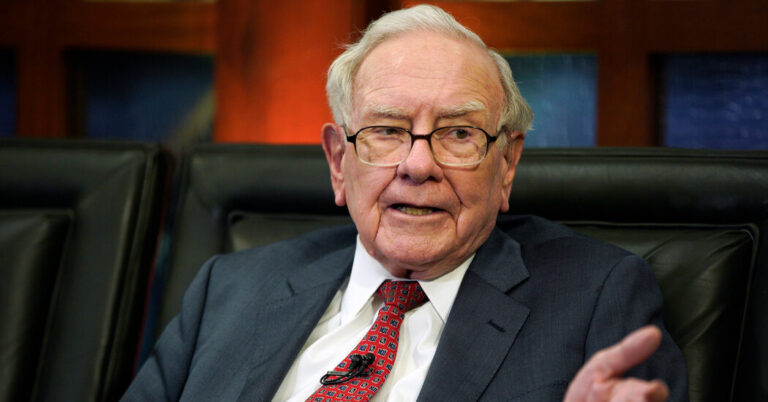
It was closing in on 1 p.m. when Warren Buffett, seated onstage before a rapt audience of about 40,000 at the CHI Health Center in Omaha, said that he was getting a “5-minute warning.”

To most of those there for the annual meeting of Berkshire Hathaway, his company, it was simply a signal that the gathering — known as Woodstock for capitalists — was drawing to a close. No one knew that something historic was about to happen.

After 60 years of running the company he has called his painting, the 94-year-old Buffett said that he planned to step down as chief executive at year end. (Proving how much freedom he has always exercised at Berkshire, he surprised his own board and Greg Abel, his handpicked successor: “I want to spring that on the directors,” he said with a smile.)

People in the crowd, many of whom were in tears, rose from their seats in a standing ovation for a singular figure in the business world.

Buffett is often described as a symbol of American capitalism. The truth is that he has always been an outlier. He is more the conscience of capitalism, willing to speak uncomfortable truths about the system’s ills while others remained silent. (His public comments on issues like tariffs over the weekend are a prime example.)

The billionaire always comes across as a gentleman, and in an age of distrust he became someone people could trust. Fellow business moguls and government officials admired him because of his success, yes — Berkshire reported $89 billion in net profit last year, and it is one of the biggest buyers of U.S. Treasury bonds — but also because he didn’t appear to have changed despite his wealth. He lives in a modest house in Omaha, and for years drove his own car, including to the drive-through at McDonald’s.

Buffett isn’t perfect, something he often acknowledges, and he has urged his followers to stay humble as he discussed his own investing mistakes and misses. But that also got to one of his biggest accomplishments, using his annual Berkshire letters and marathon Q. and A. sessions with shareholders to educate generations about business, investing and life itself.

After the announcement, I was struck by a social media post from someone I wouldn’t have normally considered to be a Berkshire watcher, who perfectly encapsulated the importance of Buffett and his longtime business partner, the late Charlie Munger. “They were the good investors, dealers in reality, patient,” wrote Nick Denton, the founder of Gawker. “When the history of the rise and fall of America is written, one of the chapters will begin in Omaha, with their departure.”

As Buffett prepares to depart, the big question is: What will happen to his masterpiece once it passes to Abel?

It has been apparent for several years now that on a day-to-day basis, Abel is already running large swaths of Berkshire’s operations, so the shift likely won’t be dramatic. But the scrutiny of “Abel’s Berkshire” will undoubtedly increase: The company wasn’t built just as a collection of disparate businesses, but as the vision of one man.

Abel has said he will seek to maintain the culture that his boss meticulously built. But things will inevitably become different. Berkshire’s board gave Buffett an unparalleled degree of autonomy to operate as he saw fit, often learning about significant deals he had struck only after the fact.

Abel will have to work hard to earn even some of that latitude, and under him Berkshire is likely to operate with more guardrails. But there is speculation that Buffett will remain chairman for some period, which could afford Abel more freedom as he grows into the top job.

Nevertheless, Buffett’s success, and the company he built, were exceptional. What investors gathered in Omaha this weekend, and the world over, want to know is what comes next.

Markets brace for central banks and a busy earnings week. On Wednesday, the Fed is widely expected to again hold interest rates steady, potentially further irritating President Trump (though he seems to be backing off calls to fire Jay Powell, the Fed chair). Big companies are also set to report results, with investors focusing on further fallout from the trade war: Ford announces on Monday; Disney, Uber and Novo Nordisk on Wednesday; and Toyota, AB InBev and Shopify on Thursday.

Stocks look set to snap a nine-day winning streak. S&P 500 futures are down, with energy stocks in particular looking weak. Oil prices have fallen roughly 2 percent on Monday — West Texas Intermediate, the U.S. benchmark, is trading around $56.60, well below most domestic drillers’ break-even price — after the OPEC Plus cartel shifted course on Saturday and said it would increase production.

Shell’s shares jump on a report that it’s weighing a bid for BP. The oil giant’s advisers are evaluating a takeover of the struggling BP, Bloomberg reports, and could pounce if oil prices (and its rival’s stock) fall further. The fate of BP has become a much-discussed issue, with Wall Street analysts seeing it as a prime acquisition target as it pursues a turnaround plan under pressure from the activist investor Elliott Investment Management.

Betting on papal elections may be older than the Sistine Chapel. This week’s conclave involves a new twist: It’s the first time that major online prediction markets have turned their focus on the Vatican’s ancient selection process.

And the wagers are flowing in. The Italian cardinal Pietro Parolin has emerged as the odds-on favorite to succeed Pope Francis, according to the prediction markets Polymarket and Kalshi. Even a report last week that the 70-year-old had medical issues, which the Vatican denied, did little to dent that lead.

But while prediction markets claimed vindication in correctly predicting President Trump’s victory in November, picking the next heir to Saint Peter’s throne is likely to be a tougher challenge, experts both inside the Vatican — known as the “vaticanisti” — and outside tell Bernhard Warner and Michael de la Merced.

The wisdom of crowds can likely go only so far. High-tech betting sites “will never be able to break through the complexity, the unpredictability of the decisions made inside,” Franca Giansoldati, a Vatican specialist who writes for Il Messaggero, one of Italy’s biggest daily newspapers, said.

Rajiv Sethi, an economist at Barnard College who has studied prediction markets, noted that when it came to the presidential election, bettors were able to process a wide variety of information sources, including public polls and televised debates. The papal conclave — famously conducted behind closed doors and composed of an expected 133 cardinal electors sworn to secrecy — offers far fewer clues for gamblers.

Consider that a spike in the Polymarket contract betting that a new pope would be picked in 2025 took place after Francis’ death was announced, according to Sethi. Were there inside trading, someone could have made a lot of money. “We can rule out information leakage from cardinals,” Sethi said.

Conclave politics have been highly unpredictable. In 2013, the odds-on favorite was Cardinal Angelo Scola; then-Cardinal Jose Maria Bergoglio, who became Francis, was on few short lists. There are also unexpected developments, most recently when Cardinal Angelo Becciu, who was forced to resign his positions after a financial scandal, briefly sought to crash the upcoming conclave.

Again this time, the cardinals are divided, and many are meeting for the first time — factors that could complicate how long it takes before white smoke emerges from the Sistine Chapel.

Then there are other potential wild cards, including President Trump’s policies (which Francis frequently criticized), Giansoldati noted. Could cardinals even be influenced by a Trump social media post depicting himself in papal vestments? Analysts have seen a kind of Trump effect energizing national elections around the world already this year.

All that is unlikely to deter online bettors. Kalshi’s main contract on who the next pope will be currently has about $5 million in wager volume. “So far, the papal election market is tracking to be as big as the Super Bowl,” which saw $27 million in volume, Jack Such, a spokesman for the prediction market, told DealBook.


Marc Elias, a prominent lawyer for the Democratic Party whom President Trump has targeted by name in his campaign against big law firms, on “60 Minutes.” Trump drew further concern when, during an interview on “Meet the Press” that aired on Sunday, he repeatedly said “I don’t know” when asked if he needed to uphold the Constitution and guarantee the right of due process.


Shares in Netflix were down more than 4 percent in premarket trading this morning as investors weigh President Trump’s latest tariff target: films made overseas.

Never mind that Hollywood has a huge trade surplus with the rest of the world, and that it’s difficult to define how much of a major film is actually produced outside the United States. The proposal, which involves a 100 percent levy on such films, could scramble the economics for major studios and streaming services.

Elsewhere in tariff news:

  • Trump said on Air Force Once that he has no plans to speak with Xi Jinping, China’s top leader, this week as the trade talks between the two stall. But he reiterated that he is willing to lower the levies that have hit commerce between the two countries.

  • Many of the corporate promises to invest big in America, which the White House has said amount to “trillions of dollars in new investment,” are wildly overblown, according to an analysis by The Washington Post.


DEALBOOK WANTS TO HEAR FROM YOU

We’d like to know how the tariffs are affecting your business. Have you changed suppliers? Negotiated lower prices? Paused investments or hiring? Made plans to move manufacturing to the U.S.? Or have the tariffs helped your business? Please let us know what you’re doing.

Deals

Politics, policy and regulation

Best of the rest

We’d like your feedback! Please email thoughts and suggestions to dealbook@nytimes.com.


Source link

Emma Raducanu: British No 2 working with coach Mark Petchey to elevate her serve ahead of Wimbledon | Tennis News

0


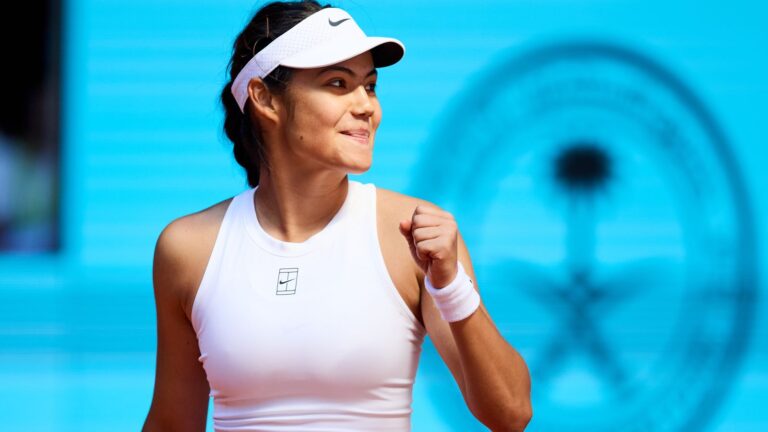
Emma Raducanu’s promising performances at the Madrid Open have not gone unnoticed with coach Mark Petchey working on elevating her serve in time for Wimbledon.

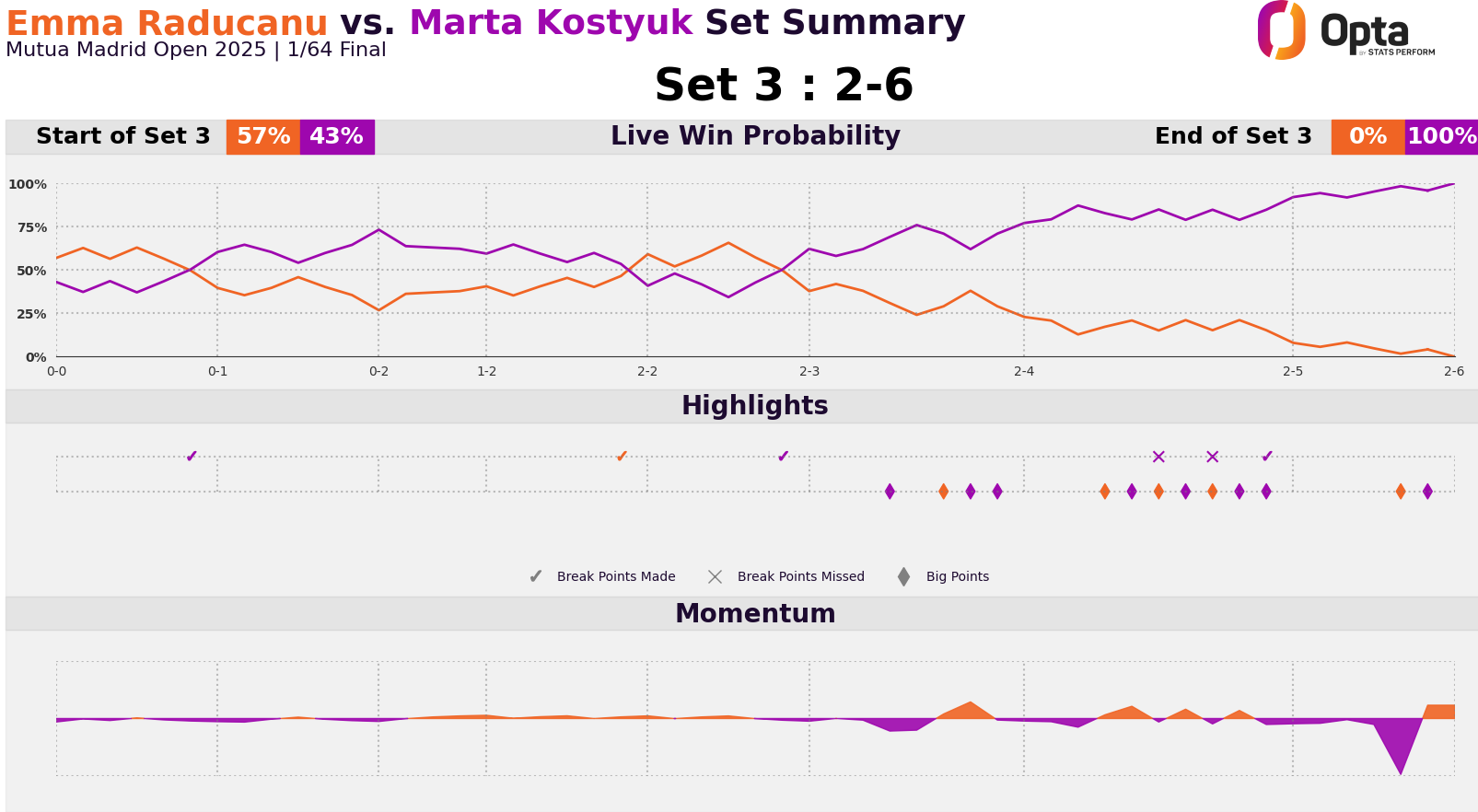
The 22-year-old posted her first win on outdoor clay courts since 2022 with a straight-sets victory over Suzan Lamens in the Spanish capital but her hopes of another strong WTA 1000 run ended with a second-round loss to Marta Kostyuk.

The former US Open champion took a break from the WTA Tour following her run to the Miami Open quarter-finals last month and instead took part in a training block with Mark Petchey ahead of the clay-court swing.

Please use Chrome browser for a more accessible video player

Raducanu says her new, more relaxed mindset is helping her improve

Sky Sports’ Colin Fleming felt clay novice Raducanu could take a lot from her defeat against world No 36 Kostyuk, who is seen as a specialist on the red dirt.

“This was a good level at times on a surface where she hasn’t played a lot of tennis recently,” he said during commentary.

“If she can keep working, keep finding her feet in the clay, her movement, her balance and just comfort on this surface. I think she can still have some great results in this clay-court season and I think it will serve her well for beyond that into the grass and the hard.

“A lot of positives to take from this one.”

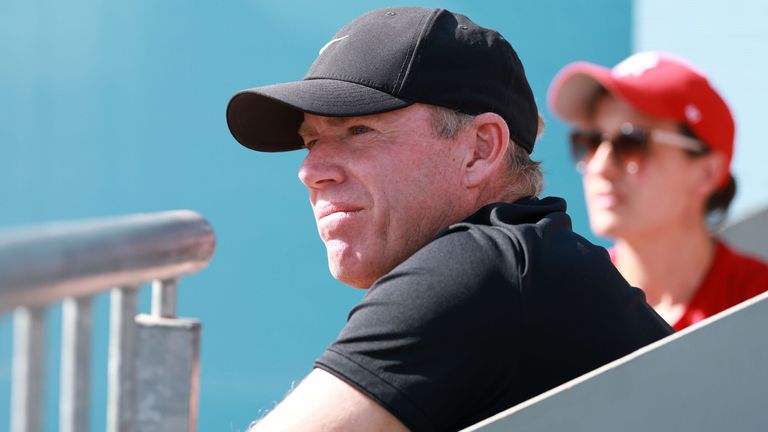
Mark Petchey, coach of Emma Raducanu of Great Britain, watches during her singles match against Marta Kostyuk of Ukraine during day four of the Mutua Madrid Open at La Caja Magica on April 25, 2025 in Madrid, Spain. (Photo by Clive Brunskill/Getty Images)
Image:
Petchey has been working to elevate Raducanu’s serve in time for Wimbledon

Fleming also said Raducanu gave a clear indication of what she has been working on alongside coach Petchey since he came on board for their ad-hoc partnership after mentoring her at the Miami Open.

Petchey has previously coached former world No 1 Andy Murray into the world’s top 50, splitting in 2006 after less than 12 months together, and briefly worked with Greek ace Maria Sakkari.

“She’s gone back to her more natural service motion since working with Mark Petchey recently,” revealed Fleming. “She has done a bit of work with Nick Cavaday [former coach] on adjusting the motion.

“She’s always had a natural, flowing rhythmic service motion, and it became a bit more abbreviated with the work under Cavaday. I understand why! Trying to get the serve bigger, more impactful during matches. It’s back to that longer, flowing rhythm.”

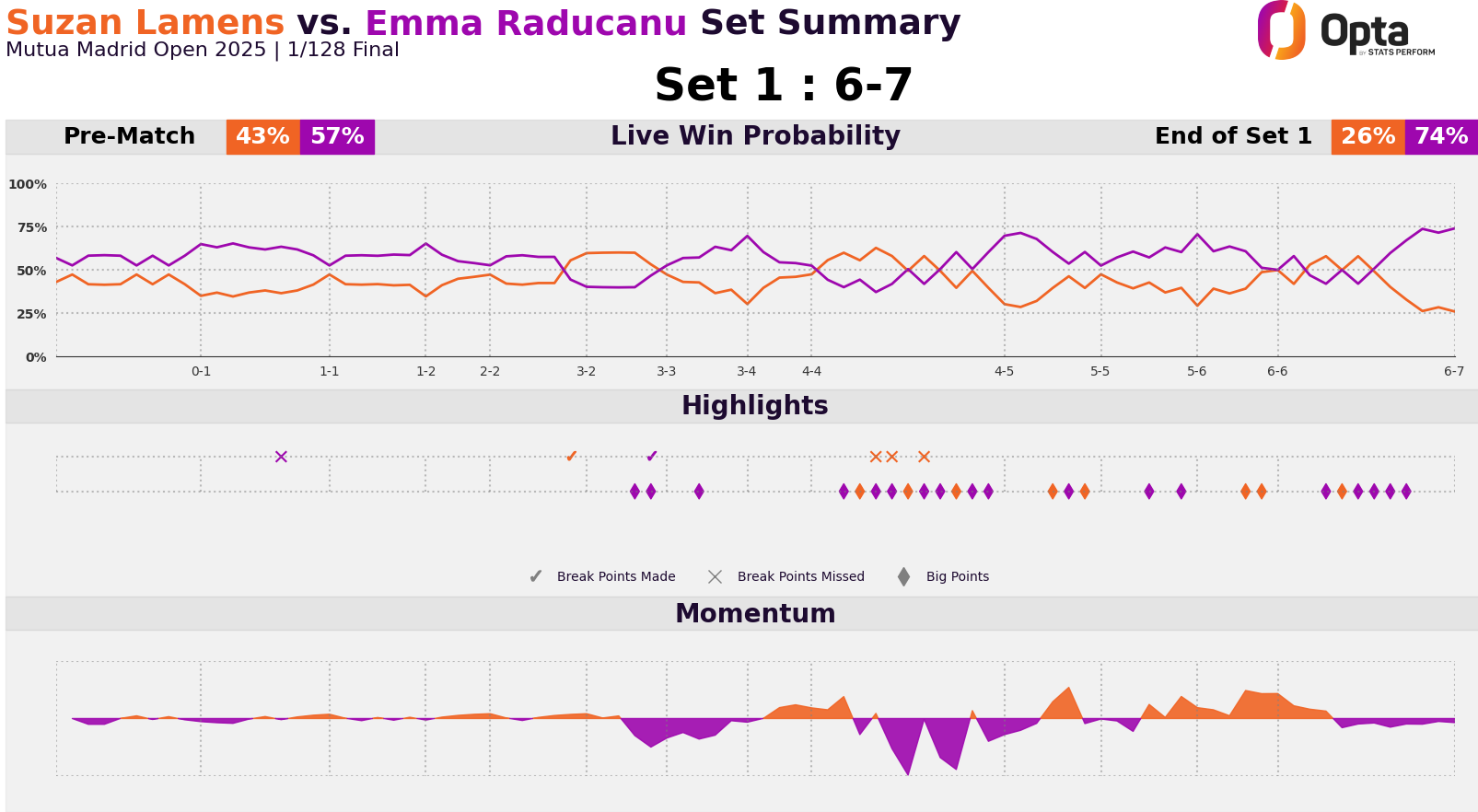
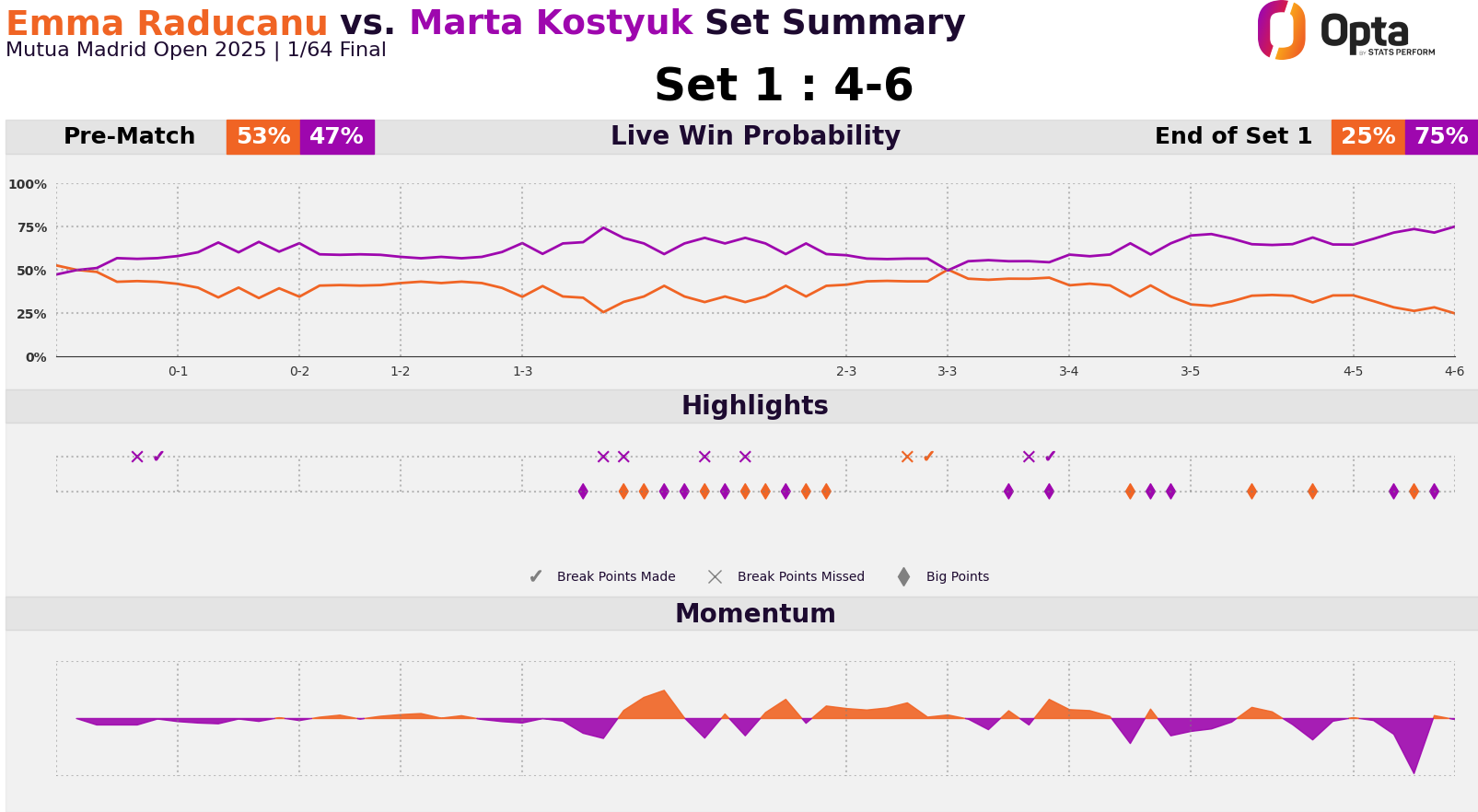
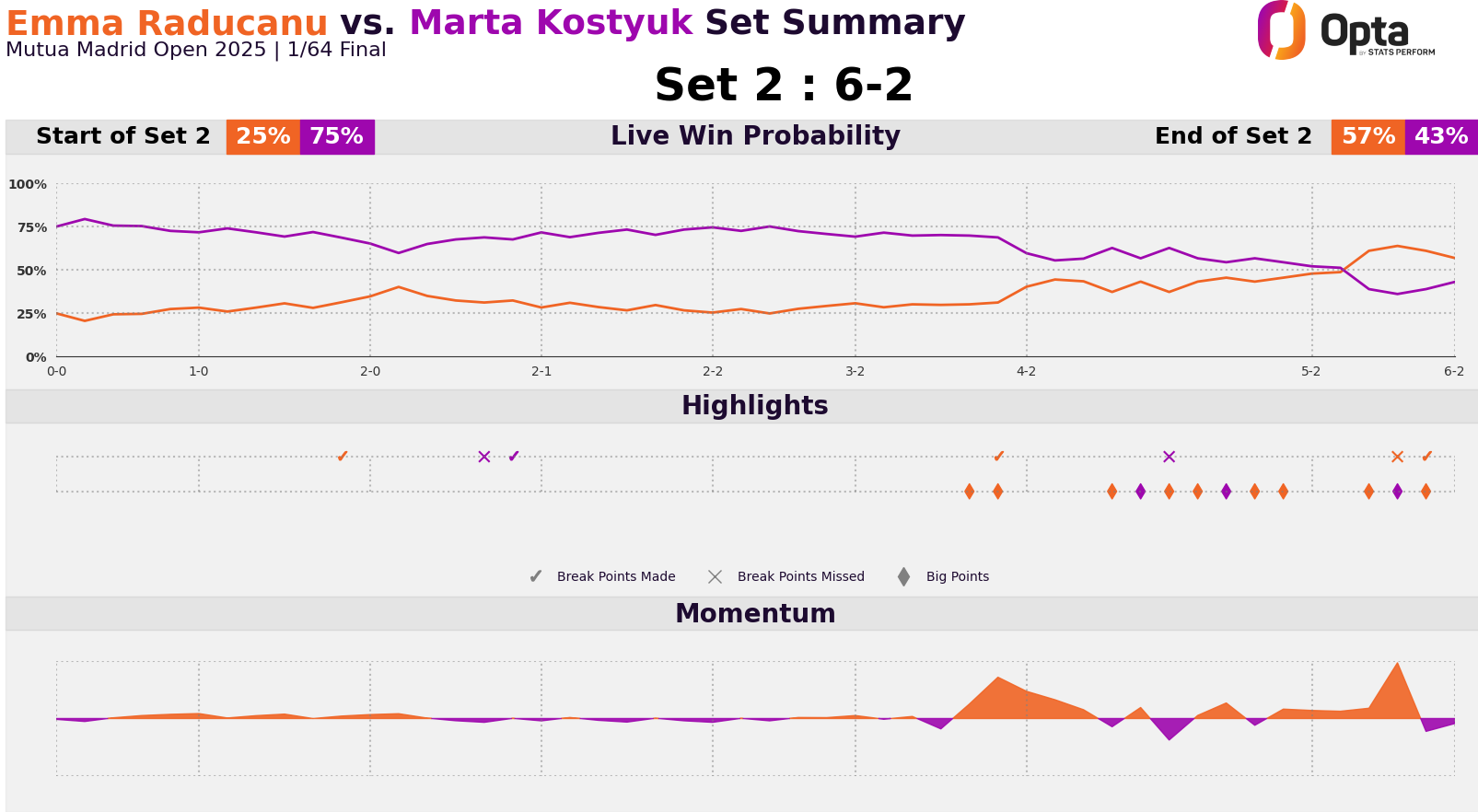
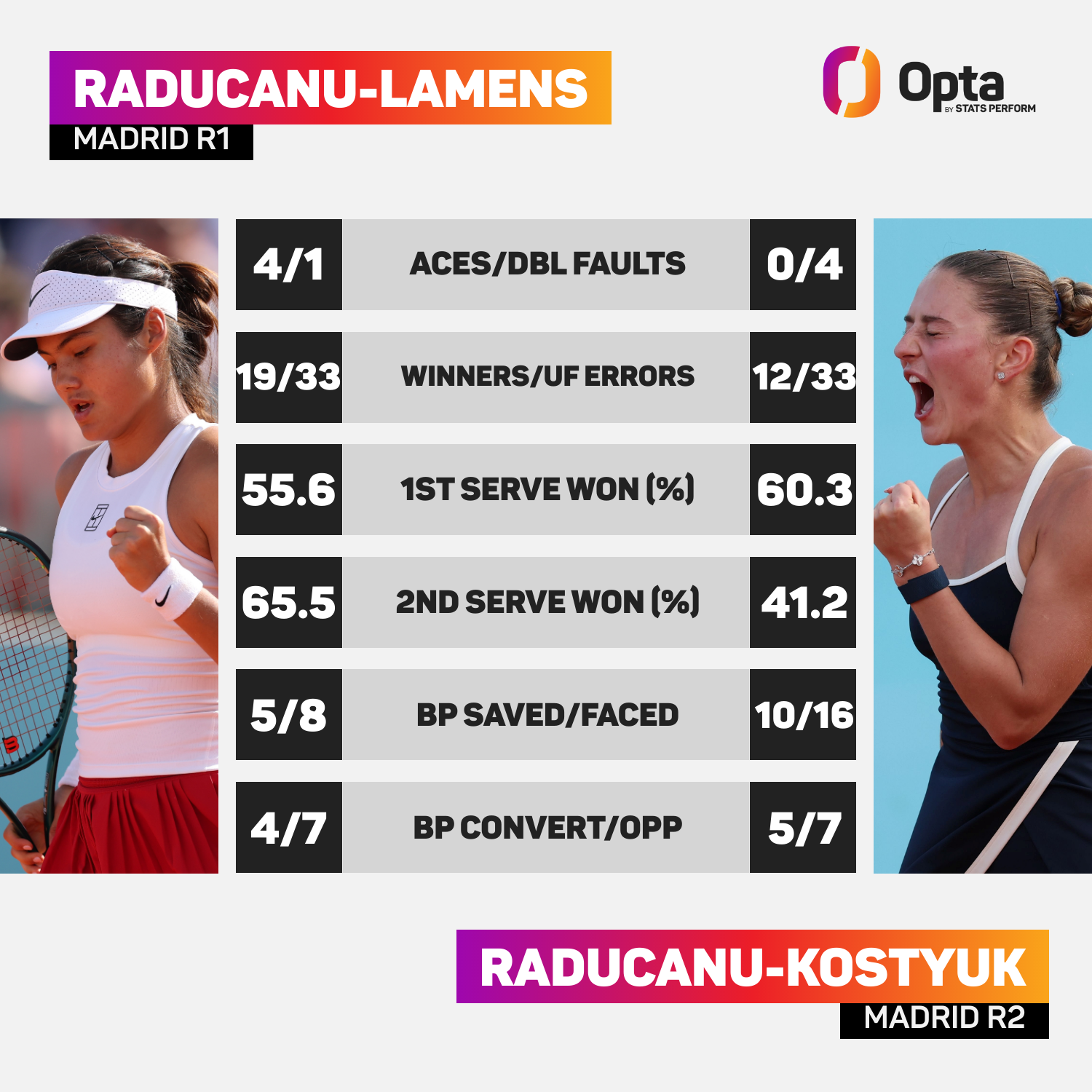
Raducanu served four aces, winning 56 per cent of her first serve points [25/45] and 66 per cent of her second serve points [19/29] with just one double fault during her win over Lamens, while did not serve any aces during her defeat against Kostyuk, hitting four double faults, and winning 60 per cent [35/58] of her first serve points but 41 per cent [14/34] of her second serve points.

Lamens vs Raducanu: Momentum plots

Raducanu vs Kostyuk: Momentum plots

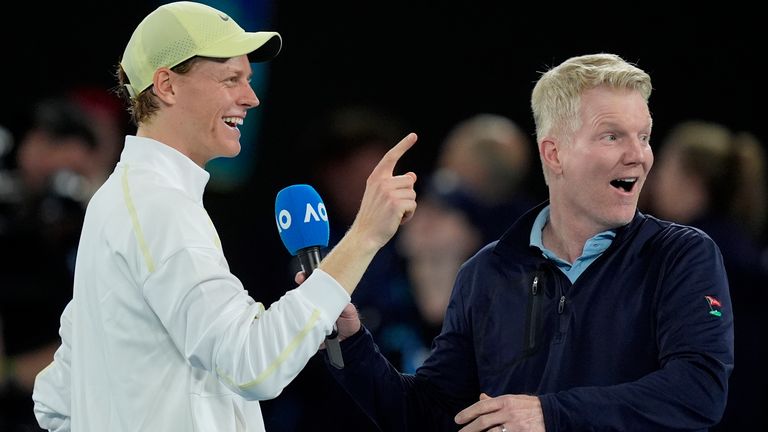
Jannik Sinner of Italy reacts as he is interviewed by Jim Courier after defeating Ben Shelton of the U.S. in their semifinal match at the Australian Open tennis championship in Melbourne, Australia, Friday, Jan. 24, 2025. (AP Photo/Asanka Brendon Ratnayake)
Image:
Jim Courier hopes Raducanu will give Petchey the opportunity to work through the grass season

Former four-time Grand Slam champion turned tennis analyst, Jim Courier, hopes Raducanu will give his colleague Petchey the opportunity to work through the grass season, where he believes she can thrive.

“When Covid-19 hit, they went to work together, in private in the UK, so he knew her before she became a star,” the American said on the Tennis Channel.

“That’s obviously important for her in a time when she’s not been able to find a regular relationship with coaches.

“Relying on someone that she knew before it happened is really important so I don’t know how long it can last, but frankly the fact that they’re spending time together right now is really important. What I do hope is that it’s able to last at least through the grass-court season.

“No one’s expecting her to play well on clay, it’s not a natural surface for her. Grass is a surface where she first surfaced, she made the round 16 at Wimbledon before she won the US Open so for me, it’s about the building blocks for the grass-court season.”

Courier also indicated the young Brit has been working on masking her service motion and adding more potency in preparation for Wimbledon which begins on June 30.

Before the grass season, however, Raducanu competes at the WTA 1000 in Rome before the French Open.

Please use Chrome browser for a more accessible video player

Raducanu says nothing is formal with coach Petchey and is taking on a ‘less is more’ approach to the 2025 season

Courier added: “What I do know already is he’s changed her service motion by adding more shoulder turn which the idea is to try and give her a little bit more disguise and a little more power. But I think overall this is a net positive for her on so many levels, we’ll see where it goes.”

Raducanu has been without a permanent coach since parting ways with Nick Cavaday in January.

Before adding Petchey to her team, the British tennis star had a two-week trial period with Vladimir Platenik.

Watch the ATP and WTA Tours, as well as the US Open in New York, live on Sky Sports in 2025 or stream with NOW and the Sky Sports app, giving Sky Sports customers access to over 50 per cent more live sport this year at no extra cost. Find out more here.


Source link

How Trump’s Closing a Tariff Loophole Will Hurt UPS and FedEx

0


Less than a year ago, executives from FedEx and UPS were talking about how they were handling a flood of packages from China to American consumers.

“Explosive” is how Carol Tomé, UPS’s chief executive, in July described the volume of shipments from e-commerce companies selling Chinese goods in the United States. And FedEx’s chief customer officer, Brie Carere, said about those companies in June, “No one carrier can serve their entire needs.”

But that torrent is expected to slow to a trickle after President Trump on Friday closed a loophole that had allowed cheap goods from China to enter the United States without paying tariffs.

The business of transporting hundreds of millions of low-value shipments on as many as 60 freighter flights a day between China and the United States could now wither.

A falloff in such shipments could deprive companies like UPS, FedEx and DHL of a big source of revenue. Airlines, mainly those that carry only cargo, and smaller logistics companies could also suffer. Passenger airlines may also be hurt somewhat because they carry some of those packages, too.

UPS said last week that it expected the revenue from shipping packages from China to the United States — its most profitable trade lane — to decline roughly 25 percent in the second quarter of this year, from a year earlier. UPS also announced that it would cut 20,000 jobs this year as part of a long-term plan to reduce costs, and said “macroeconomic uncertainty” prevented it from updating its forecasts for revenue and profits for 2025.

Ms. Tomé said UPS’s China-to-U.S. business was responsible for 11 percent of the company’s international revenue. She suggested that the company could take the trade tensions in stride, saying that, when trade between China and the United States declined during Mr. Trump’s first term, it increased between China and rest of the world.

But because Mr. Trump is now waging a more aggressive and broader trade war, logistics companies may not be able to easily make up for lost sales in other places, as they were able to during his first term, analysts said.

“It was a bit of a bumpy ride the last time,” said Jay Cushing, an analyst for Gimme Credit. “It took a little while for things to level out, but this is probably going to take even longer.”

The tariffs that Mr. Trump imposed on Chinese goods during his first term helped set off the gusher of inexpensive goods from China.

To avoid those tariffs, Chinese sellers increasingly sent products to the United States under the loophole that was closed on Friday for imports from mainland China and Hong Kong.

Known as the de minimis exemption, the loophole allowed buyers to import goods worth $800 or less without paying tariffs or filling out detailed customs paperwork. Now that the exemption is gone, American shoppers will have to pay tariffs of as much as 145 percent on Chinese goods, adding $14.50 to the cost of a $10 T-shirt.

Temu, one of the biggest e-commerce companies selling Chinese goods, said last week that it was no longer shipping orders from China directly to American consumers. “All sales in the U.S. are now handled by locally based sellers, with orders fulfilled from within the country,” Temu said in a statement.

As the ending of the exemption loomed, Wall Street analysts pressed delivery companies to predict the impact.

When asked on an investor call in March what share of revenue came from de minimis shipments, FedEx’s chief executive, Raj Subramaniam, said it was a “minority.”

Isabel Rollison, a FedEx spokeswoman, declined to offer a more precise estimate. “In terms of our revenue split by geography, we serve an extremely diversified customer base across more than 220 countries and territories,” she said in a statement.

DHL, based in Bonn, Germany, also declined to say to say what percentage of its business came from de minimis shipments from China. Glennah Ivey-Walker, a DHL spokeswoman, said they represented “only a small portion of our overall U.S.-bound volume and our overall business volume in the U.S. market.”

Ending the exemption might have been worse for the carriers had it not been for a late change to the rules by the Trump administration.

The lower-value goods were set to become subject to strict customs rules that require detailed paperwork. But the administration late last month issued a waiver that allowed the goods to be treated more leniently.

Some trade experts said the administration’s change undermined tariff collection because it deprived Customs and Border Protection of information it needed to make sure that importers were paying the correct amount of import duties.

“If you don’t know exactly what the good is, it’s hard to know what the right potential value is or what the right tariff should be,” said Lori Wallach, director of a trade program at American Economic Liberties Project, an organization that seeks to curb the power of large corporations.

But some customs lawyers said that, even after the waiver, detailed information would still be required.

The waiver came after DHL stopped making some shipments that were subject to the paperwork requirement, and after it had spoken to members of the Trump administration.

Ms. Ivey-Walker, the DHL spokeswoman, said the waiver would not “make it harder to collect tariffs or in any way impede the government’s ongoing efforts to protect its borders.” She added that DHL had spoken to the administration to highlight the delays that might occur if the detailed paperwork requirement was enforced.

A sharp decline in low-value shipments could also shake airlines.

Air cargo shipments had already slowed even before the end of the exemption on Friday.

By mid-April, air cargo traffic from mainland China and Hong Kong to the United States was down about 16 percent from a year earlier, according to WorldACD, an industry data firm. And experts say that traffic is likely to slow further in the coming weeks.

“We expect to see as much as 30 to 40 percent of China-to-U.S. capacity come out of the market,” said Derek Lossing, the founder of Cirrus Global Advisors, an e-commerce and supply chain consulting firm.

The carriers most active in e-commerce trade between China and the United States include two U.S. cargo airline companies, Atlas Air Worldwide and Kalitta Air; Hong Kong’s Cathay Pacific Airways; and the cargo divisions of Chinese airlines, according to several air cargo experts.

U.S. passenger airlines are not as vulnerable because they operate relatively few flights between the United States and mainland China and Hong Kong.

To make up for the losses, Chinese businesses may try to sell more goods to customers elsewhere, including in Europe, Australia, New Zealand and Latin America, experts said.

There are already signs of such a shift. While air cargo shipments from China to the United States were down in the weeks leading up to the expiration of the exemption, flights into Miami, a hub for flights to Latin America, were up slightly, according to Mr. Lossing.


Source link

Tariffs Could Wreck What Bangladesh’s Garment Workers Have Gained

0


It was always going to be a hard year for Bangladesh. Last summer, amid an economic collapse, protesters toppled a tyrant and pushed the country to the brink of chaos.

Then a month ago, as a new government was still working to steady Bangladesh’s economy, came the devastating news that the United States was placing a new 37 percent charge on the country’s goods. Bangladesh relies on revenue from its exports to buy fuel, food and other essentials.

President Trump soon paused those tariffs on Bangladesh and dozens of other countries after the world recoiled. But the possibility they will be reinstated worries the workers who make a living in Bangladesh’s garment factories.

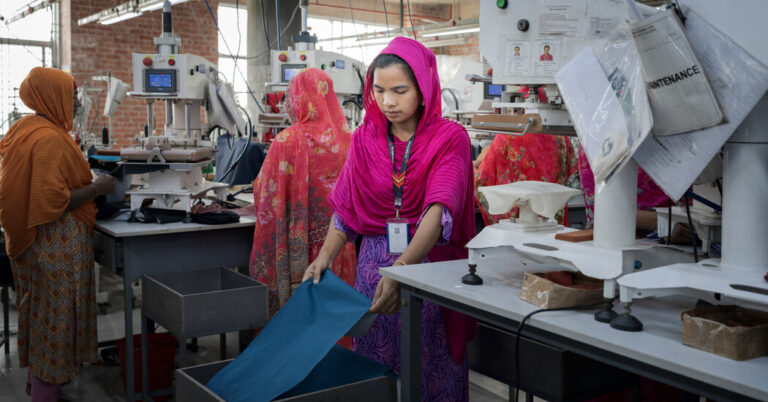
Murshida Akhtar, 25, a migrant from northern Bangladesh living near Dhaka, has been supporting her family from sewing machines for the past five years. One day recently, she and 200 other workers, 70 percent of them women, signed on for new jobs at 4A Yarn Dyeing, in the industrial hub of Savar.

Ms. Akhtar conceded feeling apprehension about the tariffs. But she was excited for the change in jobs. She expected to be paid $156 a month at 4A — slightly more than at her previous job and with a shorter commute and a nicer work environment.

“My worry is that orders will be reduced,” she said. “Then there is less work.”

Bangladesh, a country of 170 million people crammed onto a delta the size of Wisconsin, was derided as an economic lost cause after its violent birth in the 1970s. It has grown steadfastly since the 1980s on the back of its garment industry. Bangladeshi workers, and women in particular, made the country a seamstress to the world. In the process, the average Bangladeshi has become better off than the average citizen of even India, the giant country next door.

Ms. Akhtar is one of about four million Bangladeshis directly employed in the making of garments for export. Perhaps five times as many, including her husband and their son, depend on jobs like hers.

A tariff like the one Mr. Trump has planned, along with side effects like the 145 percent tariff that he applied to Chinese goods, would break the very engine of Bangladeshi growth.

Before Mr. Trump paused the tariff, Bangladesh’s interim leader, the Nobel Peace Prize-winning economist Muhammad Yunus, wrote him a letter asking for a 90-day reprieve. Mr. Yunus promised that his country would buy more American cotton and other goods to help reduce its trade surplus, which last year was $6 billion.

Rashed Al Mahmud Titumir, an economist at the University of Dhaka, was less deferential. He called the tariff threat “an ugly display of power.” It came just as the country, after decades of enviable growth, was facing a recession and vulnerable, he said.

A currency crisis in 2024 weakened the government of Sheikh Hasina, who had come to rule with an iron grip over 15 years. Her ouster caused an immediate security vacuum. Nine months later, Bangladesh has yet to come up with a plan to restore its democracy.

Nearly 85 percent of Bangladesh’s exported goods are garments, and more ship to the United States than to any other country. Even if Mr. Trump does not bring back the 37 percent tariff when his self-defined grace period ends in July, Bangladesh will face the 10 percent tariff that he levied on virtually the entire world.

Even 10 percent is hard to swallow in a low-margin business like the clothing trade. Competition is fierce from China, the only country that exports more, as well as from India, Vietnam, Cambodia and Sri Lanka.

Bangladesh’s political upheaval was viewed as a sign of hope by Western proponents of liberal democracy. India was annoyed at the demise of an alliance it had built with Ms. Hasina. But the administration of former President Joseph R. Biden Jr. welcomed Mr. Yunus.

Bangladesh’s central bank scrambled to contain the fallout from a plundering of the financial system by Ms. Hasina’s regime. It anticipated a year of reduced growth but believed that business would perk up to normal by 2026. Tariffs put an end to that hope. The World Bank has already lowered its expectations for Bangladesh’s next two years of growth.

The country is feeling the heat from the International Monetary Fund, which cleared a $4.7 billion loan last year.

“We are under tremendous pressure from the I.M.F. to reduce subsidies and hike the prices” of fuel, said Fahmida Khatun, the director of the Center for Policy Dialogue, a think tank in Dhaka.

The 10 percent tariff and the prospect of more strike at the heart of a garment sector that has transformed itself. In 2013, a gigantic sweatshop called Rana Plaza collapsed, killing more than 1,100 workers. The grotesque loss of life made foreign buyers, major Western clothing brands among them, doubt that they could stick with their local partners.

But the industry rallied, understanding that it needed to change to survive. There is still a vast space where Rana Plaza once stood, on the main road from Dhaka into Savar. The grim conditions the site represents have guided the future of Bangladeshi manufacturing.

The industry has consolidated. While the number of companies making garments has shrunk, the value of their exports and the number of people employed has grown. Bangladesh is home to 230 garment factories certified under the Leadership in Energy and Environmental Design program, a U.S.-led protocol of best practices policed by inspectors who make periodic visits. That is more than any other country in the world.

Among them is 4A Yarn Dyeing, where Ms. Akhtar works. Despite its name, it hasn’t dyed yarn for years. It concentrates on higher-value outerwear, mostly jackets with fancy zippers, waterproofing and other hard-to-make bits. It proudly lists buyers from American brands ranging from Carhartt to Calvin Klein, but has even more European customers than Americans.

The five working floors of 4A Yarn Dyeing’s factory heave with workers cutting, sewing and stitching the latest for Costco’s Jachs New York series. Giant wall-mounted fans hum against the sewing needles and piped-in music. The space is well lit, airy and pleasant, even in Savar’s premonsoon seasonal swelter.

Signage around the factory floors is in English first, not the local Bangla. Like other Bangladeshi factories, 4A Yarn Dyeing is used to the prying eyes of foreign inspectors.

The exterior of the factory is fronted by a cascade of hanging greenery. The rooftops hold solar panels that help power the operations.

In August, the factory fell under attack during the uprising that took down Ms. Hasina. Khandker Imam, a general manager, recalled with pride how his factory kept operating.

Mobs had gathered outside his factory, as they had at nearly every other; many of Bangladesh’s businesses fell under suspicion of having collaborated with Ms. Hasina. “One thousand people came, to attack our factory,” Mr. Imam said. He donned a helmet and joined his workers to hold back the crowd outside the gate.

In the end, no one was seriously injured, and not a single day of production was lost, Mr. Imam said. The company, like the country, has gotten used to surviving life-threatening disruptions.

“The whole economy of this country depends on this sector,” said Mohammad Monower Hossain, the company’s head of sustainability. The people’s movement that overthrew Ms. Hasina understands this, too. As a country, he said, “we have only our labor.”


Source link

Donald Jr. and Eric Trump Pursue New Deals That Would Enrich President Trump

0


A contest of sorts has played out across Europe, the United States and the Middle East in recent days as President Trump’s two older sons have pursued a blitz of family moneymaking ventures capitalizing on their father’s name and power, each seemingly trying to outdo the other.

It is a rush to cash in that involves billions of dollars with few precedents in American history.

A luxury hotel in Dubai. A second high-end residential tower in Jeddah, Saudi Arabia. Two cryptocurrency ventures based in the United States. A new golf course and villa complex in Qatar. And a new private club in Washington. In many cases these new deals promoted over the last week will personally benefit not only Eric Trump and Donald Trump Jr., but also President Trump himself.

“Challenge everything,” said the brochure for the new $1 billion, 80-story Trump International Hotel and Tower planned for Dubai, where units went on sale for the first time at prices reaching $20 million apiece, after a giant party held in Dubai this past week to honor Eric Trump and the new project. “Stop at nothing.”

The marathon of deal making has been so rapid that many elements have drawn limited public attention in the United States, despite most of it being out in the open. That is in part because the sons appeared before mostly fawning crowds but also because President Trump, his appointees and his billionaire adviser Elon Musk were making headlines with their own steady stream of norm-breaking controversies.

“There’s nothing like it,” said Douglas Brinkley, a Rice University historian who has written books on Presidents Ronald Reagan and Gerald R. Ford, addressing the financial conflicts of interest that have emerged in Mr. Trump’s second term.

Both Trump sons are involved in a wide range of family business ventures. Eric Trump, the president’s middle son, runs the Trump Organization, the main family business, which specializes in real estate. He also serves on the board of a holding company that oversees World Liberty Financial, the family’s crypto firm, and recently joined forces with his older brother, Donald Trump Jr., to start a Bitcoin mining operation, American Bitcoin.

The White House has said there are no ethics issues because Mr. Trump’s sons run the businesses. “The president’s assets are in a trust managed by his children,” Anna Kelly, a White House spokeswoman, said. “There are no conflicts of interest.”

But Mr. Trump’s financial disclosure report, which he is legally required to file, shows that he still personally benefits financially from most of these ventures.

Eric Trump noted that many of the ventures they are promoting — from crypto to real estate — were underway before their father was re-elected. “We are building the most iconic projects on earth and leading the way in the digital revolution,” Eric Trump said in a statement to The New York Times.

Donald Trump Jr. rejected any suggestion that he was trading on his father’s name, saying he has been a businessman his entire adult life. He then took a swipe at Hunter Biden, who sold paintings while his father, Joseph R. Biden Jr., served as president.

“It’s laughable that the left-wing media thinks that I should lock myself in a padded room while my father is president and cease doing what I’ve been doing for over 25 years to earn a living and provide for my five children,” Donald Trump Jr. said in a statement to The Times. “However, if I did do that, I guess I could always take up painting, which I hear can be quite lucrative.”

Indeed, relatives of other presidents — including Billy Carter (brother of President Jimmy Carter) and Neil Bush (brother of President George W. Bush), along with Hunter Biden — have had business dealings that have created questions about potential conflicts of interest.

What distinguishes the work of Mr. Trump’s two sons is that several of these ventures, including the real estate deals and crypto efforts, bring revenues that benefit the president himself as well.

Just in the past 10 days, Donald Trump Jr. made stops in Hungary, Romania, Serbia and Bulgaria on a paid-speech tour he has called “Trump Business Vision 2025,” which also included visits with foreign government leaders and political candidates. During roughly the same time, Eric Trump was shuttling among Qatar, the United Arab Emirates and other Middle East spots to push the family’s real estate and crypto plans.

These pitches played out even as some of Donald Trump Jr.’s business partners were simultaneously rolling out yet another business in Washington that will cash in on his father’s return to the White House: a club called Executive Branch.

At $500,000 a person, the private membership club is slated to open by this summer in Georgetown in a sprawling, but defunct, restaurant called Clubhouse. It will feature two bars, a lounge, a restaurant and boardroom — re-creating the role previously served by the lobby of the Trump International Hotel in Washington, where donors and acolytes of the president gathered until the family sold it off after Mr. Trump’s first term.

The club soon likely will be jammed with Trump family friends, business executives and members of the Trump administration, but will be off limits to members of the public and most members of the news media.

An A-list party was held late last month to celebrate the launch of Executive Branch — while Donald Trump Jr. was in Europe — at a hotel a block from the White House. Attendees included Pam Bondi, the attorney general, and Paul Atkins, the new chairman of the Securities and Exchange Commission.

The founding members of the club, which has already sold many of its membership slots according to organizers, include Cameron and Tyler Winklevoss, the cryptocurrency executives whose company, Gemini Trust, had been targeted by the S.E.C. until Mr. Trump named new agency leaders, who in April put a hold on the federal lawsuit.

Jeff Miller, a lobbyist and top Trump fund-raiser, is another founding member. In the first quarter of this year, he has registered to represent 39 new corporate clients, including the crypto firm Tether, an overseas operation that was a longtime target of U.S. regulators until recently, when it began to establish itself as a major force in Washington and explore opening a U.S. office.

The other owners at the new club, besides Donald Trump Jr., include Zach and Alex Witkoff — the sons of Mr. Trump’s Middle East envoy — and Omeed Malik, who leads 1789 Capital, a Florida-based venture capital firm that recently hired Donald Trump Jr. as a senior executive. The investments for 1789 Capital have included companies such as Plaid, a digital finance firm that had lobbied the Consumer Financial Protection Bureau related to a new set of banking rules — until Mr. Trump’s team effectively shut down the agency and stalled enforcement of the regulation.

David Sacks, who is a crypto adviser to Mr. Trump and another founding member, said the goal is not to create a venue for access. Rather, he said in a recent podcast, “we want a place to hang out in D.C.” for the “younger, hipper, Trump-aligned Republican.”

Even as these real-life ventures were playing out, another push for profit was underway in the virtual world. Investors in the $Trump memecoin are bidding to become the top 220 owners of the collectible coin and win a dinner with the president later this month. A memecoin is a type of cryptocurrency based on an online joke or celebrity mascot that has no practical function other than speculation.

The $Trump memecoin is controlled by a company run by the Trump sons and their business partners, but President Trump has actively encouraged his supporters to buy it.

Javier Selgas, chief executive at Fr8Tech, a shipping company, announced this past week — while Eric Trump and Donald Trump Jr. were abroad — that his Monterrey, Mexico-based company would spend $20 million to buy $Trump memecoin tokens.

Buying the tokens — in essence, giving money to the Trump family — is “an effective way to advocate for fair, balanced and free trade between Mexico and the U.S.,” Mr. Selgas said in a statement, which was also filed with the S.E.C., as his company is publicly traded.

In some cases, the Trump-family announcements over the past week have involved foreign governments, including those of Qatar and the United Arab Emirates.

Eric Trump flew to Doha, the capital of the tiny Middle East nation of Qatar, on Wednesday as a government official there signed a deal with a Saudi-based real estate company to build a new Trump golf course and luxury villa complex, a partnership that will bring millions of dollars in branding and management fees to the Trump family.

This is one of six real-estate projects now planned in the Middle East, sponsored by Dar Global, the international subsidiary of a Saudi-based real estate firm with close ties to the Saudi royal family. The other projects are in Saudi Arabia, Oman and Dubai.

“They always arrive at the word ‘yes,’ which is a beautiful thing,” Eric Trump said while in Dubai this past week, saying that it took only a month to get the required real estate permits from the government there. “They do it quickly.”

On a crypto conference panel in Dubai, Eric Trump sat next to Zach Witkoff, one of the founders of the Trump family crypto firm, World Liberty Financial, who announced that a venture capital firm backed by the government of Abu Dhabi would invest $2 billion using a form of digital currency offered by World Liberty. This deal alone could generate hundreds of millions of dollars in revenue for the Trump family and its partners.

Donald Trump Jr. had gotten a head start on his brother, arriving on April 25 in Budapest, where he had a brief meeting with Hungary’s foreign minister, Peter Szijjarto, and then was paid to appear at a dinner gathering among business leaders.

I’m just here as a business guy, but as someone who understands how the world works,” Donald Trump Jr. told an executive from Portfolio Hungary, the organization that sponsored the event, adding that while he was in Eastern Europe and the Balkans he was looking for possible new deals. “You never know if there is going to be a Trump real estate deal.”

His next stop was Serbia, where the Trump family is planning a new hotel on land owned by the government there. He met with President Aleksandar Vucic, whose administration approved the hotel project, which also includes Jared Kushner, Mr. Trump’s son-in-law, as the developer. “No one has ever said that we are inhospitable: We prepared this pig for Donald Jr Trump,” Mr. Vucic boasted on his Facebook page, about his meal with Mr. Trump.

Donald Trump Jr. then moved on to Bulgaria, where he appeared on a stage along with Antoni Trenchev, the co-founder of a cryptocurrency firm called Nexo that was fined $45 million by the S.E.C. in 2023 and agreed to leave the U.S. marketplace.

With Donald Trump Jr. at his side, Mr. Trenchev announced that Nexo had already talked to United States regulators and it was re-entering the U.S. market. “America is back — and so is Nexo,” Mr. Trenchev said, celebrating his meeting where he paid to be with the son of the president of the United States, as well as the company’s pending return to the market there.

President Trump, in recent days, was doing his part as well to help drive business to the family.

He attended a fund-raising event at his Mar-a-Lago club in Florida this past weekend. That makes his 10th visit to the club since he returned to the White House in January, with many of the weekend visits featuring political gatherings that pay bills to his family.


Source link

Forest find immediate response to Eze penalty but held to draw

0


FREE TO WATCH: Highlights from Crystal Palace’s draw against Nottingham Forest in the Premier League.


Source link

As Backlash to Trump’s Tariffs Grows, Europe Boycotts American Brands

0


For motorcycle lovers in Sweden, Harley-Davidson is the hottest brand on the road. Jack Daniel’s whiskey beckons from the bar at British pubs. In France, Levi’s jeans are all about chic.

But in the tumult of President Trump’s trade war with Europe, many European consumers are starting to avoid U.S. products and services in what appears to be a decisive and potentially long-term shift away from buying American, according to a new assessment by the European Central Bank.

In April, Mr. Trump imposed a 10 percent blanket tariff on America’s trading partners, and threatened “reciprocal tariffs” on many of those, including the European Union. Companies like Tesla and McDonald’s are seeing customers in Europe put off by “Made in America.”

“The newly imposed U.S. trade tariffs on European products are causing European consumers to think twice about what’s in their shopping cart,” the European Central Bank wrote in a blog post about its research on consumer behavior. “Consumers are very willing to actively move away from U.S. products and services.”

Europeans had already begun testing grass-roots boycotts on American products, including Heinz ketchup and Lay’s potato chips, shortly after Mr. Trump took office. His threats to take over Greenland, part of Denmark, energized Danes to organize no-buy campaigns on Facebook. Tesla owners in Sweden slapped “shame” bumper stickers on their cars to distance themselves from Elon Musk, the Tesla chief executive, who is one of Mr. Trump’s top advisers.

But Europeans’ anguish over Mr. Trump’s treatment of America’s longtime allies has hardened as he has moved to rewire world trade with steep global tariffs, the central bank found.

Mr. Trump took particular aim at the European Union, which he called “very, very bad to us” for not buying more from the United States, and threatened the bloc with a 20 percent “reciprocal” tariff last month. Such talk bewildered many Europeans and rattled E.U. leaders, who retaliated with a 25 percent duty on many U.S. goods.

Both sides called a temporary truce after Mr. Trump abruptly reversed course and delayed tariffs until the summer. But the 10 percent base-line tariff is still in place, and a trans-Atlantic trade war could easily flare again.

And even if a trade deal is reached, Europe’s newfound wariness of its longtime ally will not easily be unwound. The European Central Bank’s study found that even if a mere 5 percent tax was placed on American products sold in Europe, Europeans would be inclined to shun them.

What is new, the central bank said, is a “preference” among European consumers “to move away from U.S. products and brands altogether,” no matter what the cost. That was the case even for households that could bear the brunt of higher prices.

“Even though they could afford more expensive U.S. products and services, they consciously choose alternatives,” the bank said. “This suggests that consumers’ reactions may not just be a temporary response to tariff increases, but instead signal a possible long-term structural shift in consumer preferences away from U.S. products and brands.”

In Germany and Italy, developers have created apps that scan grocery and clothing items for people who want to make sure they are not buying American. The top app, BrandSnap, even suggests European alternatives.

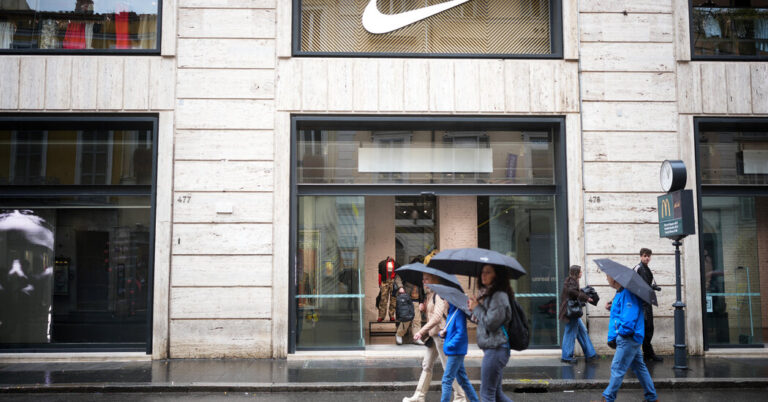
On a French-run “Boycott USA!” Facebook channel with 31,000 members, people boast about buying Adidas, a German brand, over Nike and New Balance, and post stories about avoiding travel to the United States.

In a Danish Facebook group with 95,000 members, people try to help one another figure out if products like Gillette Mach 3 razor blades or Schweppes soda are from the United States. One run from Sweden promotes alternatives to Airbnb and is calling for a European boycott on Meta platforms for a week in May.

Europeans have also posted online to say they have begun canceling subscriptions to U.S. streaming giants, including Netflix, Disney+ and Amazon Prime Video.

Some consumers who have boycotted Amazon have gone online to lament that delivery from alternate e-commerce platforms in their countries is slower or less reliable, but say they are staying the course.

Millions of people still buy American goods and services worldwide, but U.S. companies and investors are keeping a close eye on international markets for signs of anti-American sentiment related to Mr. Trump’s policies.

In Europe, Tesla sales continued a sharp decline in April, data showed, including an 81 percent plunge in Sweden from a year earlier, as protests against Mr. Musk’s political views held steady.

And McDonald’s said it was observing growing negative attitudes abroad toward U.S. brands, especially in Northern Europe and Canada.

International consumers are “going to be cutting back their purchase of American brands, and we’ve seen an uptick in anti-American sentiment,” the burger chain’s chief executive, Chris Kempczinski, said in a call with analysts last week.

The McDonald’s brand does not seem to have been damaged yet — same-store sales in Canada and Europe were down only 1 percent in the first quarter from a year earlier. But there is an “eight- to a 10-point increase in anti-American sentiment,” he said.


Source link

Judge Orders Elections Board to Certify Democrat’s Victory in Contested N.C. Race


A federal judge on Monday ordered the North Carolina Board of Elections to certify the results of a contentious State Supreme Court race, rejecting efforts from the Republican challenger to throw out thousands of votes.

The ruling is the most significant legal victory yet for the Democratic incumbent, Justice Allison Riggs, as the case has ping-ponged through state and federal courts and tested the boundaries of post-election litigation.

Two recounts confirmed that she won in November by 734 votes. But the Republican candidate, Judge Jefferson Griffin, has for months sought to reverse his loss by calling into question the eligibility of thousands of voters.

On Monday, the federal judge, Richard E. Myers II of the U.S. District Court for the Eastern District of North Carolina, ordered that all the challenged ballots should be counted. Not doing so would violate the constitutional due process rights of those voters, he said.

“You establish the rules before the game,” Judge Myers, a Trump appointee, wrote in his 68-page ruling. “You don’t change them after the game is done.”

But he gave Judge Griffin, who sits on the North Carolina Court of Appeals, seven days to appeal. That means that the ruling may not be the end of the case.

The results of the race are the last ones to be certified from the 2024 election.

If Judge Myers’s ruling stands, it will bring closure to an election purgatory that has lasted nearly six months. But election experts warn that the extraordinary series of challenges from Judge Griffin, as well as an openness from the courts to entertain the lawsuits, has already created a blueprint for future efforts to overturn elections.

Judge Griffin had initially argued that some 65,000 ballots should be tossed because of a variety of eligibility issues, filing a protest with the State Board of Elections after it twice certified Judge Riggs’s victory.

In that list he included thousands of military and overseas ballots because, he said, those voters hadn’t submitted a photo ID or an ID exception form with their absentee ballots — even though they were exempt from these requirements before the election.

And he challenged nearly 300 voters who he said were “Never Residents” because they had never lived in North Carolina but were registered to vote there. “Never Residents” typically include people working overseas or children of military parents who turn 18 while their family is stationed abroad. North Carolina passed a law in 2011 allowing such people to vote in the state, but Judge Griffin had argued against it.

In April, the State Supreme Court partially agreed with Judge Griffin, ruling that the military and overseas ballots should be verified, and that the votes from “Never Residents” should be thrown out. Justice Riggs, who has recused herself from the case, appealed the ruling to the federal court.

On Monday, Judge Myers ordered the elections board not to take any other action besides certifying the results. The “retroactive invalidation” of military and overseas ballots would be a violation of those voters’ due process rights, he wrote.

And without an opportunity to challenge their characterization as “Never Residents,” Judge Myers added, there would be “an unconstitutional burden on the right to vote” for those people.

The case, Judge Myers wrote, was a question of whether the U.S. Constitution “permits a state to alter the rules of an election after the fact and apply those changes retroactively to only a select group of voters.” It also presented the question of whether a state could “redefine its class of eligible voters but offer no process to those who may have been misclassified as ineligible.”

“To this court, the answer to each of those questions is ‘no,’” he wrote.

It was not immediately clear whether Judge Griffin would appeal the ruling. Paul Shumaker, a veteran Republican strategist in Raleigh, N.C., who consulted him during his campaign, said in a text on Monday that “the legal team is reviewing and evaluating next steps.”

In a statement on Monday, Justice Riggs declared, “Today, we won.”

“I’m proud to continue upholding the Constitution and the rule of law as North Carolina’s Supreme Court justice,” she said.


Source link

San Diego’s Hotel del Coronado Has a Grand Comeback

0


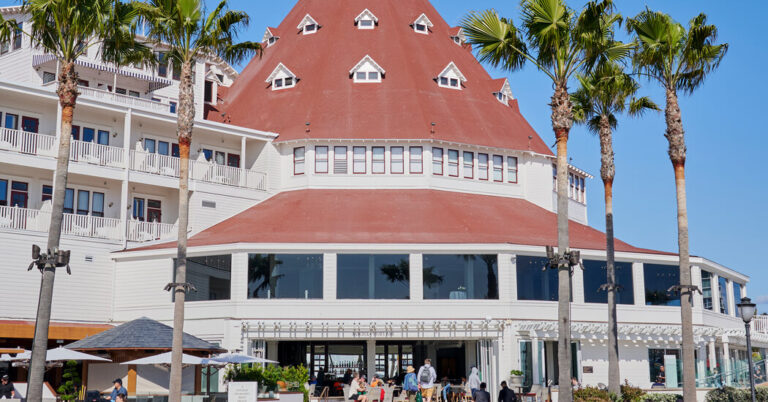
To the people who know it, the Hotel del Coronado in San Diego is not a page of history — it’s a chapter. Opened in 1888 by Elisha Babcock and Hampton Story, it was then the largest hotel in the world. The owners set out to create a resort that would “be the talk of the Western world” — a 750-room Victorian right on the edge of the Pacific.

Charlie Chaplin, Judy Garland, Babe Ruth, Thomas Edison, Henry Ford — they all came to the Del, as it is known. “Some Like It Hot,” was shot at the hotel. Just up the coast from the hotel is the Naval Air Station North Island (as in “Top Gun”), and during World War II, the hotel housed naval officers for $2 a day. “The manager was worried they would lose money renting it so cheap but the officers more than made up for it in the bar,” said Gina Petrone, the hotel’s heritage manager.

Since 2019, the hotel has been undergoing the largest, most ambitious renovation in its history. Meticulously, deliberately — and very expensively — it has been restored to its former glory, and next month, after six years and $550 million, the renovation will be complete. (It is currently owned by the New York-based Blackstone Group.) Construction crews have been pulling out drywall, removing layers and layers of paint, tearing out dropped ceilings and peeling back decades of previous renovations so the Del can reclaim its original grandeur.

David Marshall, the president of Heritage Architecture & Planning, a San Diego-based firm specializing in historic renovation, oversaw the restoration project, with guidance from Ms. Petrone, using original photographs and the hotel’s first set of blueprints to inform as much of the renovation as possible. The elevator cage, the wood in the lobby, the railings on many of the balconies — all original. “We even kept the warping on some flooring,” he said, while standing on the undulating balcony overlooking the lobby. “We secured it so it’s structurally safe, but we wanted to keep that bit of history.” A bit of history that may make you feel drunk if you walk too fast.

Overlooking the lobby is the newly restored Coronation Window — a 700-piece, stained glass depiction of a woman, the unofficial patron saint of Coronado Island, crowning herself. “This window was from 1888 but it was moved several times so it’s even more incredible that it survived,” said Mr. Marshall. (Only a few panes had to be replaced.)

The real crown of the hotel is, well, the Crown Room. Imagine an airplane hangar made of Oregon sugar pine with ceilings 33 feet high and four massive crown-shaped chandeliers hanging down the center panels. (L. Frank Baum, a frequent guest who wrote “The Wonderful Wizard of Oz,” designed the signature chandeliers.) Walking into the Crown Room is like stepping onto the Titanic on dry land.

For the renovation, Mr. Marshall focused on the period from 1888 to 1948, when the hotel was mostly structurally unchanged.

“In the postwar era, people wanted things clean and smooth. They didn’t want ornate designs,” said Mr. Marshall. “They dropped the ceilings and covered anything that showed the hand of the craftsman. Everything was ‘form follows function.’ There was an architect at that time who actually said, ‘ornamentation is a crime.’”

Other changes over the decades were more practical. The hotel’s 750 guest rooms eventually became 371. “No two rooms are alike,” explained Mr. Marshall. “We couldn’t reuse a single drawing.”

“You have to remember that Victorians didn’t swim; they didn’t walk on the beach,” said Ms. Petrone. “Their swimsuits were made of wool. They came here for the sea air so the best rooms back then were the ones facing the garden.” In other words, the most desirable rooms today were the least popular in the late 1800s.

The National Historic Preservation Act of 1966 eventually put an end to the architectural heresy happening at the Del. And in 1977, it was designated a National Historic Landmark — putting it on par with the Statue of Liberty, Mount Rushmore and the Golden Gate Bridge.

But almost 50 years later, the architects had to figure out what was original, what was added later, and perhaps most importantly, what was hidden in the walls.

One afternoon during the renovation, Ms. Petrone called Mr. Marshall and told him to look at a spot in a second floor guest corridor. According to the blueprints, “there should be a window there,” Ms. Petrone told him. Sure enough, behind sheets of drywall, workers found original amber windows embedded in massive wooden panels.

Then a few months before the renovation was complete, Ms. Petrone was in the vestibule to the ballroom when she looked up. The ceiling was covered by construction equipment but there was something just behind the oil cloth. “I couldn’t believe it,” said Ms. Petrone. She had inadvertently discovered the building’s last remaining fresco — a burst of flowers — which has now been uncovered, restored, and marks the entrance to the hotel’s ballroom.

“People come to the Del to have a historical experience so preserving the integrity was very important,” said Mr. Marshall.

Apparently a “historical experience” can take many forms — like the presence of “Miss Kate.” In November 1892, a 27-year-old woman named Kate Morgan checked into the hotel alone under an assumed name. Five days later, she was found dead on the back patio, with a single gunshot wound to her head. But according to many people who stay at the Del, she never left.

“I get pictures every day from guests who have seen the ghost of Miss Kate,” said Ms. Petrone, laughing conspiratorially. “You know we do like to honor the past here.”


Follow New York Times Travel on Instagram and sign up for our Travel Dispatch newsletter to get expert tips on traveling smarter and inspiration for your next vacation. Dreaming up a future getaway or just armchair traveling? Check out our 52 Places to Go in 2025.


Source link