Home Blog Page 334

What’s Behind Technology’s Disembodied Female Voices?


And yet, perhaps after simply being confronted with the possibility of Jessie’s demise, I’ve developed a new fondness for her. Jessie doesn’t pretend to be the ideal woman; she has less in common with the imperfectly perfect Alexa than she does the deep, resonant and pompously put-on voice of authority that Laurie Anderson cultivated in the speech that emerged in her innovative music in the 1980s. (Here’s some unknown pontificator, maybe a retired geology teacher, channeled by Anderson: “There are some things you can simply look up such as the size of Greenland, the dates of the famous 19th-century rubber wars, Persian adjectives, the composition of snow.”) Anderson’s voice was clearly a female one that relied on technology to question masculinity; Jessie could be heard as sending up, also artificially, some stereotype of the featherbrained female. Both play with technology to announce themselves as patently fake.

Give me Jessie, in fact, over many of the other female voices that contemporary media has produced: One typical female voice of Japanese anime is so disturbing it makes me physically queasy — high, young, whispery and querulous, yet somehow sexualized. More maddening is the voice of the wildly popular internet tradwife, who’s soft, calm and gentle as she separates wheat from chaff while her children — drugged on Benadryl? performing with docility, trained on pain of death? — play quietly with sticks off camera. A former Christian fundamentalist wife and mother, Tia Levings, built up a considerable following on TikTok talking about, among other things, her former “fundie voice” — a submissive tone, breathy and high-pitched, gleaned in part from tips in a 1963 book called “Fascinating Womanhood” — which she left behind when she left the church; meanwhile, another new generation of women are learning how to cultivate that same voice from the rise of videos that highlight it against images in soft light.

If the porn of the digital age has distorted, as many sociologists worry, young people’s sense of what an ideal sex life looks like, the ubiquity of narrated media in their lives may have also warped their idea of what the female voice is supposed to sound like — which is another way of saying how females are supposed to be in the world, how much noise they can make and according to which rules. A.I. is likely to learn from those real women’s voices, perhaps even the ones with the most followers, creating a potentially dizzying feedback loop of female murmurings rather than roars.

As the mother of two teenage boys, I became used to hearing the noise, coming from the basement, of some epic anime struggle, those helpless female voices competing with the sound of the local news I tried to concentrate on (as I performed my own gender conformity, making dinner). But when I wasn’t hearing that, I was bombarded with the sound of one son yelling loudly at his computer in the middle of a Fortnite battle. I find it fascinating that my son, like many serious Fortnite players, chose what’s called a female skin for his avatar in the game. This means that, from the time he was maybe 11, he’s spent countless hours identifying incredibly closely with a female character who represents him at his most powerful: shooting, eluding, outfoxing. Maybe he chose a female skin, or avatar, at so young an age because the older gamers he admired also did, and maybe they chose female skins because they’re faceless — the game entails staring for hours at that avatar’s backside (which, in the case of some female skins, is noticeably round and toned). But I’ve also been struck by another facet of his Fortnite avatar, true of her and all her peers: She has never, in all the years he’s been playing the game, uttered so much as a word.

Those avatars are remote cousins of the women on TikTok who rely on Jessie, I could argue: The scores of influencers who choose Jessie’s narration for their videos are, in making use of technology, also making the choice to silence themselves. A crucial aspect of their humanity is entirely absent, with only their beautiful young faces the lasting representation of themselves in front of their thousands of followers.

But I turn it around in my mind again, and I land somewhere else. Perhaps in choosing Jessie, they’re finding a way to protect themselves, making a subtle assertion of power: With their voices kept private, the world can have only so much of them. Jessie may be annoying, but she apparently doesn’t care, which might be why so many women embrace her for their endless “get ready with me” videos — just as they’re priming themselves for the male gaze, they’re making it clear to the male ear that they aren’t entirely packaged for consumption. Jessie’s loud and proud; she’s a pill, so wholly artificial she’s transcendent — entirely above seeking male approval.


Source link

Farmers in Iowa Are Caught in Trump’s Trade War

0


It was time for Beau Hanson to lay down his bets.

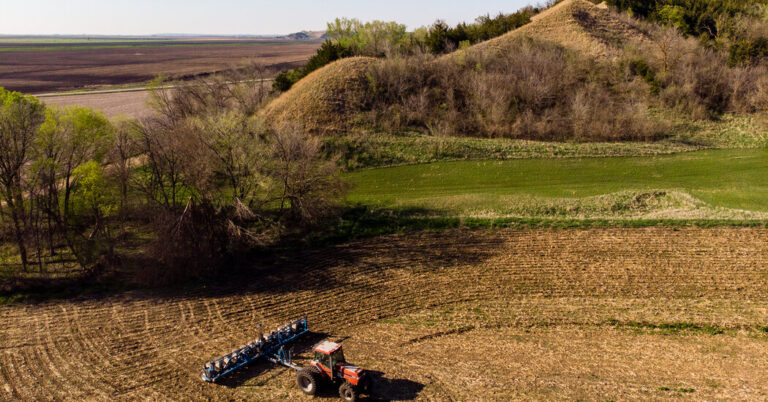
Like other farmers in western Iowa, in early April Mr. Hanson was preparing for spring planting. The decisions he made then could determine whether he would be in the red or the black come fall harvest.

In farming, there are always uncertainties, and all around Monona County, where Mr. Hanson lives, farmers are weighing them. It has been a tough few years. A wet spring in 2024 meant some farmers had to replant three times. This year, it’s too dry. The price of soybeans has been going down, while the cost of seed and fertilizer has remained high, as have the interest rates on the loans that farmers take out to buy those things. Rates have reached 9 percent, more than double what they were three years ago.

And now, there is an extra variable: a trade war.

The 145 percent tariff that President Trump imposed on Chinese imports in April was met with a retaliatory 125 percent tax on U.S. goods going into China. In practice, that means a hefty tax on Midwestern crops. China is the largest importer of U.S. soybeans, buying some $12.8 billion worth last year. The new tariffs, along with various taxes, bring the effective tariff for the crop to 155 percent, according to the American Soybean Association.

Even before Mr. Trump set off the current tariff war, some farmers in Iowa were looking at the possibility of a third consecutive year of losses. Everything is slowing down. Lenders are becoming more cautious. Machinery and heavy equipment sellers feel the mood shift, too, as farmers eke out another year from aging tractors, planters and other big machinery, rather than buy new ones.

“Every year is uncertain,” Mr. Hanson said. “But this year, it’s especially tough.”

Mr. Hanson grew up in Castana, Iowa, and played football at the local high school. After attending Iowa Central Community College, where he was an offensive lineman, Mr. Hanson, 35, returned home and bought the farm next to the house he grew up in. Unlike many of his peers who left farm life for jobs in bigger cities, he is trying to build his future on the fertile soil tilled by four generations of his family.

He farms 700 acres with some combination of soy and corn, and he hedges his bets with 400 head of cattle. His three children, involved in 4-H, care for a few newborn British White Park calves in the barn.

Like many rural Iowa communities, Monona County voted heavily for Mr. Trump, 72 percent, in the election. Mr. Hanson won’t discuss his vote and notes that he sits on the county fair board and sells seed to customers all around the area.

“I don’t want to be political,” Mr. Hanson said, kicking the dirt with his tan work boots and choosing his words carefully. “But a trade war is not likely to help grain prices here.”

Over five days in early April, I crisscrossed rural communities in western Iowa, talking to farmers. The roads were familiar to me. I grew up driving tractors and working the fields on my family’s small corn and soybean farm in Blencoe, about 20 miles southwest of Mr. Hanson’s house.

In my teens in the 1980s, I poured coffee for farmers who sat at long tables at Helen’s Cafe in Onawa. I eavesdropped as they compared rain amounts, crop yields and the size of the fish they caught. I knew we had a good year when Dad bought a new pickup. During a particularly bad year, my birthday present was a clock radio, purchased from the local farm supply store, most likely so my parents could claim it as a farm expense.

The concerns that farmers voice these days are reminiscent of my teenage years. “The ’80s, the ’80s, the ’80s,” said Gary Jensen, who farms land in the Loess Hills, a rugged terrain that juts up abruptly from the Iowa plains. “It comes up all the time.”

The 1980s were a dark time for American farmers. A trade embargo against the Soviet Union led to plummeting grain prices just as the Federal Reserve boosted interest rates to as much as 20 percent in an effort to rein in inflation. Land prices plunged, decreasing the value of the collateral that farmers had used to obtain loans. By some estimates, 300,000 farmers defaulted on loans, resulting in the largest number of bank failures since the Great Depression. The Farm Crisis crushed many a small town.

At 33, Mr. Jensen is too young to have experienced that time, but he has heard enough to know that things can go south fast, and he needs to be careful. When we met, he was preparing his red Case tractor for planting season. When I asked how old the tractor was, he laughed. It was manufactured in 1989, three years before he was born. He’s not planning to replace it. “There’s not going to be any new equipment anytime soon,” he said.

Farmers are tightening their belts, said Barry Benson, a senior vice president of agribusiness banking at FNBO, the First National Bank of Omaha. “They’re going to run the combine one more year or run the tractor another year,” he said.

In the months before spring planting, Mr. Benson and other lenders typically meet with farmers to talk about the size of operating loans they will need for the coming season. Someone with a relatively small farm, around 400 acres, may take out a $250,000 loan to pay for seed, fertilizer and leasing the land, and repay the loan after harvest.

But Mr. Benson estimated that a third of last year’s loans couldn’t be repaid and had to be restructured, which, for some farmers, meant taking out another loan. Others had to sell equipment or land.

Dan Dotzler, the president and chief executive of the United Bank of Iowa in Ida Grove, said his bank had had “some hard and long” conversations with farmers.

“We really try to work things out, do everything we can, because these are longstanding relationships,” he said. “But we also recommend farmers look for ways to get additional income to supplement living costs. You’ve got to go to town and get a job to support yourself and your family. It’s a different environment now than it was a few years ago.”

Mr. Dotzler remains optimistic, believing that if farmers keep expenses down, they will, for the most part, be fine. But he is also worried about high interest rates, costly machinery repairs and the lack of a Farm Bill in Congress. And, of course, tariffs.

“There’s so much unknown about what’s going to happen with the tariffs and how it’s going to affect everything,” Mr. Dotzler said. “There is just a lot of wait and see on that front, which leads to anxiousness.”

One way the farm economy recovered from the 1980s was through exports, particularly with an emerging market: China.

China was booming and in need of soy and other feed for its own livestock industries. From a starting point of zero in the 1990s, China became a critical market for U.S. agricultural goods, hitting a peak in 2022, when it imported $36.4 billion worth of products, including soybeans, corn, sorghum, poultry and pork, according to the U.S. Department of Agriculture.

Export markets like China are essential because American farmers produce way more than U.S. customers can buy. The industrialized farms that cover the Midwestern landscape use modern planters that practically drive themselves using GPS technology and drop seeds at the perfect depth and width, all in a small fraction of the time it takes farmers using older equipment. In addition, the seed itself not only generates more crop per acre, but is better at protecting the young plants against pests and diseases.

The result is ever-increasing yields. Corn, which is used in animal feed and ethanol production, has a larger domestic market, with exports accounting for about 15 percent of the harvest.

Soybeans, however, are much more sensitive to trade wars. Roughly 40 percent of the soybean crop is exported.

“Exports, exports, exports — that’s where the market is,” said Milo Ruffcorn, 66, a farmer from Mondamin, Iowa. “We have to have someone to sell our corn and soybeans to.”

Concerned that a drawn-out trade war between the United States and a major agricultural buyer like China could stifle soybean prices, Mr. Hanson and many other farmers are betting big on corn this year.

Prices for both crops have fallen around 40 percent since May 2022. For farmers, eyeing prices at dismal, potentially money-losing levels, the math is simple: Go for yield. That means corn, which produces more per acre.

Mr. Hanson decided to plant corn on 90 percent of his acres. This year, farmers are expected to plant 95 million acres of corn, the highest amount in five years, according to the U.S.D.A.

On paper, Mr. Hanson calculates that after paying rent on his 700 acres, buying crop insurance, seed and various chemicals and paying back his operating loan, he can make a profit of $60,000, or about $85 an acre, on corn. With soybeans, his calculations come out to a loss.

“It doesn’t make any sense to go into the field and plant a crop, expecting a loss,” Mr. Hanson said, shaking his head.

Karol King tucked into a pork tenderloin sandwich with a side of macaroni salad at Frannie’s Cafe on Main Street in downtown Onawa. My father worked for Mr. King in the 1990s and 2000s, putting up irrigation systems.

A lifelong Republican who voted for Mr. Trump, Mr. King, 78, gives the president high marks for his tough stance on tariffs, particularly against China, even if it causes some pain for farmers like himself.

“It’s going to be tough, but they are weaker than we think,” he said, “and we are their biggest customer.”

But even if there is a standoff with China on trade and grain prices remain low, Mr. King and other farmers believe Mr. Trump will bail them out.

“For some reason, he likes farmers — and blue-collar workers,” Mr. King said. “We’re not going to be hung out to dry.”

Mr. Trump has not discouraged that belief. In mid-April on his social media platform, Truth Social, he posted that American farmers were on the “front line” of a trade war with China, adding, “The USA will PROTECT OUR FARMERS!!!”

During Mr. Trump’s first term, he imposed tariffs on China that were met with Chinese retaliatory duties on soybeans, corn, wheat and other American products. The U.S. government provided an emergency rescue package of about $23 billion to farmers to ease the pain.

President Joseph R. Biden Jr. and Congress continued some of the subsidies, including a $10 billion payout last year to make up for low commodity prices. Mr. Hanson said the money he had received from the government helped him break even on some land and squeeze out a small profit on other fields.

All of the farmers I chatted with in Iowa said they would like to sell their corn, soybeans and other commodities at a good price in the market. And almost all of them said they would take the taxpayer money if it was offered.

“I would prefer to have corn above $5 a bushel and $11 beans,” Mr. Hanson said. “Without that, we’ll need a safety net to protect family farms like mine.”

Still, Mr. Hanson isn’t betting on a handout.

“Are we going to get a government payment to help us out this year?” Mr. Hanson shrugged. Another uncertainty.


Source link

Elon Musk, His 16-Foot Wall and the Feud With His Texas Neighbors


At first, residents of the upscale cul-de-sac in West Lake Hills, Texas, did not know who had moved into the 6,900-square-foot, six-bedroom mansion next door.

Then construction workers arrived to erect a 16-foot chain-link fence around the $6 million property, which is one of four homes on the leafy street. They also installed an outward-facing camera. Next, a fleet of cars — many of them Teslas — began parking on the street. Three times a day, a shift change signaled security personnel coming and going at the house. Once, the driver of a passing car shouted late at night that he was looking for a party at “E’s house.”

No one liked the commotion, or the traffic, or the keypad-activated gate opening and closing for workers and cars at all hours. So even when they learned through word of mouth that their new neighbor was Elon Musk, the world’s richest man, that did not stop some of them from grousing to the City of West Lake Hills about his mansion.

The complaints have since escalated into an uproar over city ordinances, permits and exceptions known as variances — so much so that the matter of Mr. Musk’s house landed in a contentious Zoning and Planning Commission meeting last month. The debate is headed next to a West Lake Hills City Council session, scheduled for May 14.

“Transporting service employees to other houses, leaving their cars on our quiet streets, hauling laundry to and fro to other houses has to stop,” Paul Hemmer, a neighbor and the main complainant, wrote to the Zoning and Planning Commission. The letter was also signed by the occupants of the two other houses on the street.

For the past few months, Mr. Musk, 53, has bulldozed his way across Washington, flouting long-established traditions and hacking away at what he deemed to be unnecessary federal bureaucracy. But in his own backyard outside Austin, the tech billionaire has become mired in a maze of local regulations and red tape. No one, it seems, is rich enough to escape the neighbors.

Moguls including Mark Zuckerberg have sometimes hit the limits of their wealth and connections in disagreements over their luxury homes. So has Mr. Musk, who is so far losing against the municipal bureaucracy in West Lake Hills. He and his employees did not obtain permits for a metal gate and the fence built around the property, making the chain-link structure 10 feet taller than was allowed, local records showed. In total, the construction violated six city ordinances. After some neighbors protested, Mr. Musk’s team tried to gain retroactive permission for the projects.

But Jim Pledger, one of the six commissioners on the West Lake Hills Zoning and Planning Commission, said he and his colleagues voted unanimously last month against recommending that the homeowner — he was careful not to name Mr. Musk — be granted variances for the projects. If an exception was made, Mr. Pledger said, “we’d incentivize people to break the rules.”

Unless the City Council disagrees with that decision, Mr. Musk faces the prospect of tearing down the fence and gate or changing them to comply with the town’s rules.

Mr. Musk did not return requests for comment. A house manager linked to the property declined to comment.

Mr. Musk’s history in Texas is relatively recent. The tech mogul, who oversees six companies, moved most of his business operations to the state from California starting around 2021. He has built factories for his electric vehicle company, Tesla, his rocket company, SpaceX, and his tunneling venture, the Boring Company, around Austin and neighboring Bastrop.

Mr. Musk also moved himself to Austin. He initially wanted to build houses for himself and his children (he has at least 13) on hundreds of acres that he bought there. After the plan fell through, he looked at other properties.

In 2022, Mr. Musk purchased the West Lake Hills home through a limited liability company, which was named after the street where the property sits. The house is in the middle of a residential neighborhood at the bottom of about two acres of sloping land off a narrow public road, making security challenging.

“Castles are supposed to be built on hills, right?” said Anne Yeakel, a longtime West Lake Hills resident who lives around the corner. “These were sophisticated buyers, and if security was the prime directive, this was not the house for it.”

Mr. Musk and his staff did not introduce themselves to the neighbors. Few residents have seen him there. But word traveled fast in the community of 3,400, and soon everyone knew he had moved in.

“It’s common knowledge here,” Ms. Yeakel said.

The mansion was one of three that Mr. Musk bought in the area over the last three years to create a compound for his children and their mothers. At one point, Claire Boucher, known as the musician Grimes, lived with Mr. Musk and their three children in the house. Shivon Zilis, a brain technology executive who has four children with Mr. Musk, lives about a 10-minute walk away. Mr. Musk also purchased another Tuscan-style mansion about a year ago.

Neighbors soon grew frustrated with the constant hubbub at the house. They saw people coming and going carrying gun holsters, as the security team ballooned along with Mr. Musk’s safety concerns. Though Texas has permissive gun laws, the activity stood out.

“I call that place Fort Knox,” said Mr. Hemmer, a retired real estate agent who lives across the street and is president of the neighborhood homeowners association.

The house was quieter on days when Mr. Musk was not in town, neighbors said, especially in recent months, when he lived mostly in Washington to advise President Trump. Now residents are bracing for Mr. Musk’s return, after he said he would spend less time in the capital.

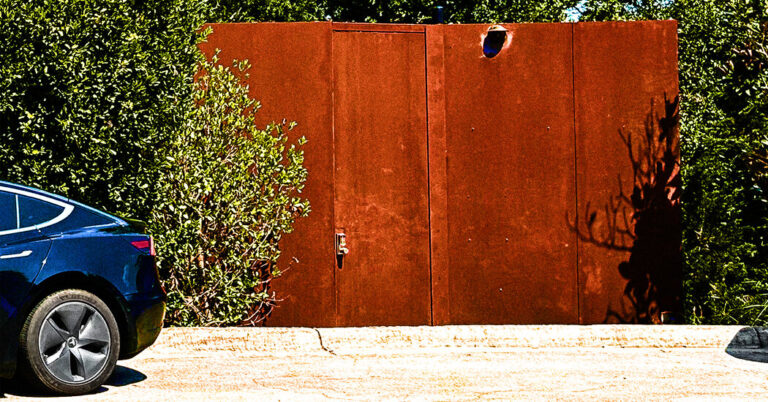
Some neighbors became particularly annoyed at the hulking fence in front of the mansion, as well as the giant metal gate at the other end of the property, which appears to serve as an employee entrance.

Mr. Hemmer, who has long owned a Tesla, grew so frustrated with his neighbor that he began flying a drone over the house to check for city violations, and he keeps a video camera trained on the property around the clock. Last year, he complained to West Lake Hills officials about Mr. Musk’s fence, the traffic and how he thought the owner was operating a security business from the property.

Mr. Musk’s security team also contacted the West Lake Hills Police Department about Mr. Hemmer, according to city records. One security official accused Mr. Hemmer last year of standing naked in the street, according to the records.

Mr. Hemmer denied that he was naked and said he was on his property wearing black underwear. On another night, he said, he was walking his dog fully clothed and stopped when he suddenly needed to urinate — which Mr. Musk’s camera captured.

“The cameras got me,” Mr. Hemmer said. “It’s scary they have guys sitting and watching me pee.”

After repeated remonstrances from Mr. Hemmer, West Lake Hills officials found that Mr. Musk had violated city ordinances with the fence and the gate. Last month, the Zoning and Planning Commission debated whether to grant him variances for the projects.

Before the meeting, Tisha Ritta, a permit expert working for Mr. Musk’s limited liability company, wrote a letter to the planning commission asking for relief from the city rules.

“As a high-profile public official, the property’s resident faces ongoing security threats, making proactive safety measures imperative,” she wrote, according to a copy of the letter. Ms. Ritta did not respond to requests for comment.

Mr. Hemmer and other residents wrote their own letter to the planning commission, admonishing their neighbor for facilitating “bad behavior on our quiet little cul-de-sac.”

For a time, Mr. Musk appeared poised to win the neighborhood battle. Planning and zoning officials recommended that his property be granted “hardship variances,” which would allow him to keep the fence and other projects with only small changes to the property, according to city documents.

But at the planning meeting, the commissioners refused Mr. Musk the variances. When they questioned Ms. Ritta, she blamed a former house manager for failing to get permits for the construction.

“I just met the property owner last year, and unfortunately they were under the guidance of the property manager,” she said, according to a recording of the meeting.

Mr. Hemmer also spoke up at the meeting to say he doubted the homeowner had been misguided.

“If you follow him at all in the news, he’s always guilty of building stuff and then asking for permission later,” he said.

One commissioner, who was not identified in the recording, said she could not believe West Lake Hills staff had recommended that the homeowner receive any exceptions.

“I’m astounded the staff is putting forth any kind of suggestions we bend based on who is asking,” she said.

The planning commission’s decision does not end the process. At the upcoming West Lake Hills City Council meeting, members must decide whether to stick with the commissioners’ recommendation on Mr. Musk’s mansion.

If the City Council votes against him, Mr. Musk could sue the town. And if that does not work — and given his track record in backing candidates — there is always the next local election.

Kirsten Noyes contributed research.


Source link

The Fed Isn’t Likely to Cut Rates Proactively Despite Economic Concerns. Here’s Why.

0


Less than a year ago, the Federal Reserve took decisive action to bolster the U.S. economy. With inflation easing and the labor market starting to soften, the central bank opted to go big, lowering interest rates by half a percentage point and signaling further cuts to come.

Rather than a panicky response to a crisis situation, the decision amounted to the Fed taking out some insurance to protect the labor market from weakening too much.

In a barrage of attacks on the central bank recently, President Trump called on Jerome H. Powell, the chair, to lower borrowing costs in a similar fashion to prevent the economy from slowing down. But the Fed no longer has the flexibility to move pre-emptively.

Mr. Trump’s tariffs and the inflation spike they could potentially unleash have left officials much more cautious about restarting interest rate cuts despite rising risks of an economic slowdown. The Fed is widely expected to keep interest rates steady when officials gather this week, extending a pause that began in January after a series of cuts last year.

But forecasts for when the Fed will have the confidence to cut again are in a constant state of flux, injecting yet more volatility into an already tenuous moment for the economy and the global financial system. Officials will need to see tangible evidence that the labor market is starting to weaken and people are struggling to find work before taking action. If it takes time to materialize, the Fed could be on hold for even longer than expected.

That risks keeping tensions simmering with Mr. Trump, who on Sunday again criticized Mr. Powell while saying that he would not replace the chair before his term ends in May 2026.

“It’s too uncertain to be pre-emptive,” said Ellen Meade, who served as a senior adviser to the Fed’s board of governors until 2021 and is now at Duke University. “The date for a cut is the time that the slowing of the economy outweighs, in their view, the overshoot in inflation.”

Making a big policy pivot is never an easy judgment call, but the current circumstances have made it uniquely fraught. The Fed is having to contend with an ever-changing backdrop amid Mr. Trump’s whipsawing plans for tariffs, tax cuts and other campaign promises.

The White House says trade deals will be worked out ahead of a self-imposed 90-day delay to large levies initially announced in early April. But no one knows for sure how those are progressing, or even if the administration is in communication with one of its biggest trading partners, China. It is not yet clear what will happen after the July deadline lapses if deals are not reached. The administration has also set a July 4 goal to fulfill Mr. Trump’s promise to enact sweeping tax cuts, but the contours of that bill are still being worked out.

The uncertainty alone has already chilled business activity, causing paralysis in many industries as companies put off big investments and hiring until they get clearer direction from the White House. As recession odds have crept up alongside expectations about inflation in the year ahead, consumer sentiment has plummeted. Already, many consumer-oriented brands, from Chipotle to PepsiCo and Procter & Gamble, have reported sluggish sales.

When confronted with similar harbingers of an economic slowdown after Mr. Trump started a tit-for-trade war with China during his first term, the Fed opted to take action. It lowered interest rates three times in 2019, keeping a record expansion chugging along as price pressures stayed subdued.

But the Fed does not have the “luxury of 2019,” said Esther George, who retired as president of the Federal Reserve Bank of Kansas City in 2023. In Trump’s first term, the tariffs were much smaller in scale and inflation was consistently below the Fed’s 2 percent target. “In that world, you would probably see the Fed leaning in harder to a more proactive stance. I don’t think they can afford to do that right now.”

Consumers are still grappling with the fallout of the worst inflation shock in four decades that hit after the pandemic. Price pressures have eased significantly since peaking in 2022, but have not been snuffed out entirely.

Tariffs, which are a tax on imports, are widely expected to reignite them. The question is by what magnitude and for how long. In theory, tariffs should only lead to a short-term increase that fades over time. But that is by no means assured in an environment in which consumers are already jittery about inflation.

“Inflation is as much a psychology as it is a measurement that you can really pinpoint,” Ms. George said.

The Fed pays closest attention to longer run measures of inflation expectations, especially those based on the U.S. government bond market. For now, they suggest a temporary burst in inflation that ultimately fades.

Proponents of this view argue that tariffs will indeed raise prices, but those increases will not persist because there are few forces to keep it going. Unlike the post-pandemic period, the labor market has significantly less momentum, consumers are in worse shape financially and the government does not appear ready to ride to the rescue again with generous stimulus measures.

Christopher J. Waller, a Fed governor, recently argued that tariff-induced inflation will be temporary. Yet even he has acknowledged that looking past this surge will not be easy. “It’s going to take some courage to stare down these tariff increases in prices with the belief that they are transitory,” he said in an interview last month.

Many economists warn that dismissing tariff-related price increases altogether would not be prudent either.

Jean Boivin, the former deputy governor at the Bank of Canada who is now head of the BlackRock Investment Institute, expects tariffs to induce a supply shock similar to what happened during Covid, when empty shelves led to higher prices and, in turn, persistently higher inflation. Businesses and consumers have already pulled forward purchases in an attempt to get ahead of Mr. Trump’s tariffs, and ports along the coasts are already reporting a sharp drop in traffic.

In what he calls a “supply driven recession,” Mr. Boivin forecasts that consumers will still want to spend but shortages will make that harder to do. When products do become available, consumers will be willing to pay the higher prices, translating to higher inflation that lingers for longer than it otherwise would have even as spending on the whole falls.

“It does raise a question about what the right medicine is,” said Raghuram Rajan, a former governor of the Reserve Bank of India, of the potential unintended consequences if the Fed lowers interest rates as shortages hit.

“Having demand pick up once again while supply is hugely constrained by these high tariffs may not be the best answer,” he said.

The health of the labor market has taken on new significance against this backdrop.

So far it appears to be holding up, according to the latest jobs report released on Friday, which showed the unemployment rate steady at 4.2 percent. But economists do not expect that resilience to last. Layoffs are still low, but employers are posting fewer vacancies, hiring has slowed and wage growth has stalled, undeniable signs of softening.

Because the Fed sees little urgency to lower interest rates until there are clearer signs that the labor market is in jeopardy, a June cut looks increasingly improbable. Traders in federal funds futures markets now wager the Fed will reduce rates in July and deliver around four quarter-point cuts this year. But it is easy to see how the timing could be pushed back even further given expectations that the economic data will not deteriorate in a more noticeable way until July at the earliest.

James Knightley, the chief international economist at ING, now sees even odds that the Fed will restart rate cuts in July with a quarter-point reduction or move aggressively by half a percentage point in September. The longer the Fed waits, the higher the chances that it will need to provide more relief faster to contain the economic fallout.

“The Fed is equally at the mercy of the administration’s policies as everybody else. And with volatile policies, it is hard to anticipate what they will be and then react accordingly,” said Mr. Rajan, who is now at the University of Chicago Booth School of Business.

“It may well be that both the Fed and the administration move in the same direction if and when they see tremendous damage done, but evidence of the damage is needed for them to move.”


Source link

A.I. Hallucinations Are Getting Worse, Even as New Systems Become More Powerful


Last month, an A.I. bot that handles tech support for Cursor, an up-and-coming tool for computer programmers, alerted several customers about a change in company policy. It said they were no longer allowed to use Cursor on more than just one computer.

In angry posts to internet message boards, the customers complained. Some canceled their Cursor accounts. And some got even angrier when they realized what had happened: The A.I. bot had announced a policy change that did not exist.

“We have no such policy. You’re of course free to use Cursor on multiple machines,” the company’s chief executive and co-founder, Michael Truell, wrote in a Reddit post. “Unfortunately, this is an incorrect response from a front-line A.I. support bot.”

More than two years after the arrival of ChatGPT, tech companies, office workers and everyday consumers are using A.I. bots for an increasingly wide array of tasks. But there is still no way of ensuring that these systems produce accurate information.

The newest and most powerful technologies — so-called reasoning systems from companies like OpenAI, Google and the Chinese start-up DeepSeek — are generating more errors, not fewer. As their math skills have notably improved, their handle on facts has gotten shakier. It is not entirely clear why.

Today’s A.I. bots are based on complex mathematical systems that learn their skills by analyzing enormous amounts of digital data. They do not — and cannot — decide what is true and what is false. Sometimes, they just make stuff up, a phenomenon some A.I. researchers call hallucinations. On one test, the hallucination rates of newer A.I. systems were as high as 79 percent.

These systems use mathematical probabilities to guess the best response, not a strict set of rules defined by human engineers. So they make a certain number of mistakes. “Despite our best efforts, they will always hallucinate,” said Amr Awadallah, the chief executive of Vectara, a start-up that builds A.I. tools for businesses, and a former Google executive. “That will never go away.”

For several years, this phenomenon has raised concerns about the reliability of these systems. Though they are useful in some situations — like writing term papers, summarizing office documents and generating computer code — their mistakes can cause problems.

The A.I. bots tied to search engines like Google and Bing sometimes generate search results that are laughably wrong. If you ask them for a good marathon on the West Coast, they might suggest a race in Philadelphia. If they tell you the number of households in Illinois, they might cite a source that does not include that information.

Those hallucinations may not be a big problem for many people, but it is a serious issue for anyone using the technology with court documents, medical information or sensitive business data.

“You spend a lot of time trying to figure out which responses are factual and which aren’t,” said Pratik Verma, co-founder and chief executive of Okahu, a company that helps businesses navigate the hallucination problem. “Not dealing with these errors properly basically eliminates the value of A.I. systems, which are supposed to automate tasks for you.”

Cursor and Mr. Truell did not respond to requests for comment.

For more than two years, companies like OpenAI and Google steadily improved their A.I. systems and reduced the frequency of these errors. But with the use of new reasoning systems, errors are rising. The latest OpenAI systems hallucinate at a higher rate than the company’s previous system, according to the company’s own tests.

The company found that o3 — its most powerful system — hallucinated 33 percent of the time when running its PersonQA benchmark test, which involves answering questions about public figures. That is more than twice the hallucination rate of OpenAI’s previous reasoning system, called o1. The new o4-mini hallucinated at an even higher rate: 48 percent.

When running another test called SimpleQA, which asks more general questions, the hallucination rates for o3 and o4-mini were 51 percent and 79 percent. The previous system, o1, hallucinated 44 percent of the time.

In a paper detailing the tests, OpenAI said more research was needed to understand the cause of these results. Because A.I. systems learn from more data than people can wrap their heads around, technologists struggle to determine why they behave in the ways they do.

“Hallucinations are not inherently more prevalent in reasoning models, though we are actively working to reduce the higher rates of hallucination we saw in o3 and o4-mini,” a company spokeswoman, Gaby Raila, said. “We’ll continue our research on hallucinations across all models to improve accuracy and reliability.”

Hannaneh Hajishirzi, a professor at the University of Washington and a researcher with the Allen Institute for Artificial Intelligence, is part of a team that recently devised a way of tracing a system’s behavior back to the individual pieces of data it was trained on. But because systems learn from so much data — and because they can generate almost anything — this new tool can’t explain everything. “We still don’t know how these models work exactly,” she said.

Tests by independent companies and researchers indicate that hallucination rates are also rising for reasoning models from companies such as Google and DeepSeek.

Since late 2023, Mr. Awadallah’s company, Vectara, has tracked how often chatbots veer from the truth. The company asks these systems to perform a straightforward task that is readily verified: Summarize specific news articles. Even then, chatbots persistently invent information.

Vectara’s original research estimated that in this situation chatbots made up information at least 3 percent of the time and sometimes as much as 27 percent.

In the year and a half since, companies such as OpenAI and Google pushed those numbers down into the 1 or 2 percent range. Others, such as the San Francisco start-up Anthropic, hovered around 4 percent. But hallucination rates on this test have risen with reasoning systems. DeepSeek’s reasoning system, R1, hallucinated 14.3 percent of the time. OpenAI’s o3 climbed to 6.8.

(The New York Times has sued OpenAI and its partner, Microsoft, accusing them of copyright infringement regarding news content related to A.I. systems. OpenAI and Microsoft have denied those claims.)

For years, companies like OpenAI relied on a simple concept: The more internet data they fed into their A.I. systems, the better those systems would perform. But they used up just about all the English text on the internet, which meant they needed a new way of improving their chatbots.

So these companies are leaning more heavily on a technique that scientists call reinforcement learning. With this process, a system can learn behavior through trial and error. It is working well in certain areas, like math and computer programming. But it is falling short in other areas.

“The way these systems are trained, they will start focusing on one task — and start forgetting about others,” said Laura Perez-Beltrachini, a researcher at the University of Edinburgh who is among a team closely examining the hallucination problem.

Another issue is that reasoning models are designed to spend time “thinking” through complex problems before settling on an answer. As they try to tackle a problem step by step, they run the risk of hallucinating at each step. The errors can compound as they spend more time thinking.

The latest bots reveal each step to users, which means the users may see each error, too. Researchers have also found that in many cases, the steps displayed by a bot are unrelated to the answer it eventually delivers.

“What the system says it is thinking is not necessarily what it is thinking,” said Aryo Pradipta Gema, an A.I. researcher at the University of Edinburgh and a fellow at Anthropic.


Source link

Today on Sky Sports Racing: Windsor and Bath host live action | Racing News

0


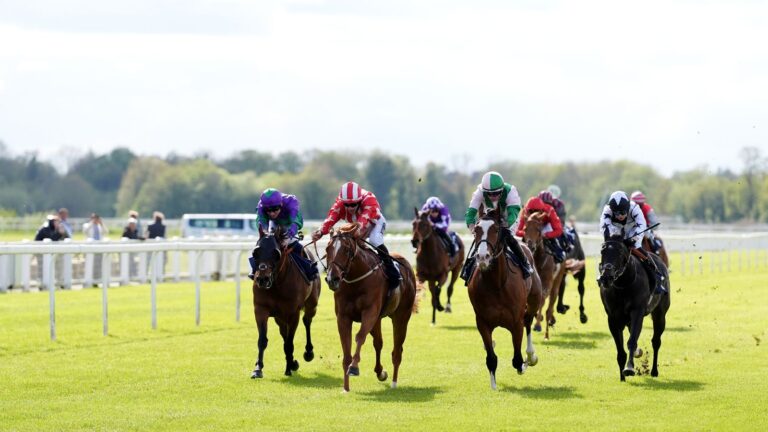
Windsor and Bath are the venues for today’s live Flat racing, with all contests being shown on Sky Sports Racing.

4.50 Windsor – Spring Bloom and Many A Star clash

Eight-year-old Many A Star kept on well at Southwell recently in what was a tougher race than he faces here. He has run well here before and was a good third over course and distance off a 1lb higher mark.

Mason Paetel has been in good form this season and gets the leg up on Spring Bloom who looks to have every chance having finished a very respectable second at Goodwood recently.

Havana Pusey was well-backed in the King Richard III Cup when finishing 10th but is fancied to bounce back and hit the frame here under William Carson.

Asinara is relatively unexposed compared to several here and ran a mighty race to finish third following a 238-day layoff recently. She is a big player here with that run under her belt for Charlie Hills.

4.35 Bath – Commanding Prince seeks hat-trick on Handicap debut

Archie Watson’s four-year old Commanding Price has won the last twice, which both came at Newcastle under Hollie Doyle. Luke Morris takes over and this unexposed sort is fancied to take another step forward on handicap debut, despite carrying topweight off a mark of 82.

My Ambition has already won three times over course and distance and is likely to go well off a mark of 61 for Denis Coakley.

Richard Hughes’ Star Pupil has only been seen on the all-weather surface, notching up three wins. He makes his turf debut here and must be respected under Finley Marsh. His disappointing showing at Chelmsford can be forgiven, as he missed the break.

Thapa Vc finished fourth over ten furlongs at Bath recently and enters calculations, given he is well handicapped and is stepping back to a mile.

Island Bandit is 4lbs below his last winning mark and completes the quintet with Richard Kingscote booked.

4.15 Windsor – Course and distance winner Distant Rumble headlines

Roger Teal’s Distant Rumble was in a great position to kick clear when winning convincingly over course and distance last week. He is set to carry a 6lb penalty which is eased with the booking of useful 5lb claimer Tommie Jakes.

The unexposed Initial Blue won at Chelmsford in November on just his second start when sent off 2/1 favourite. Now gelded and representing the powerful Richard Hannon yard, he makes his handicap debut with expectations high.

Handle With Care arrives in solid form with a fine second at Lingfield. A 2lb rise for that effort looks fair, and she should be firmly in the mix once more for the Marco Botti stable.

Ziggy’s Ariel and Rare Change complete the shortlist, with the former horse arriving in good form after success at Ripon the last day.

Best of the rest

Beauld As Brass will have to defy a 5lb penalty if he is to land the hat-trick in the 2.15pm Silvershine Turf Services Amateur Jockeys’ Handicap at Bath. George Baker’s horse looks the best runner in the race, but may be wary of Marley Head who steps back down in trip for the Tizzard team.

Another horse looking to get the treble up on Monday is Triple Double A in the Cameron Smart Memorial Handicap. Co-owned by Sir Alex Ferguson, this three-year-old starred over this trip at Yarmouth last time out and has subsequently been handed a 6lb penalty.

Scoville – a half-brother to 2022 Melrose winner Soulcombe – headlines the 3.05pm Gabby Fullbrook Memorial Novice Stakes at Windsor. William Haggas’ debutant will meet Persian Vision, who is bred to be useful despite disappointing on his first start at Newmarket recently.

Back at Bath, the 5.10pm Monarch Classic At Bath Racecourse Handicap sees Zappata carry a double penalty.

Watch every race from Windsor and Bath, live on Sky Sports Racing…


Source link

Trump Says He Asked Mexico to Let U.S. Military In to Fight Cartels

0


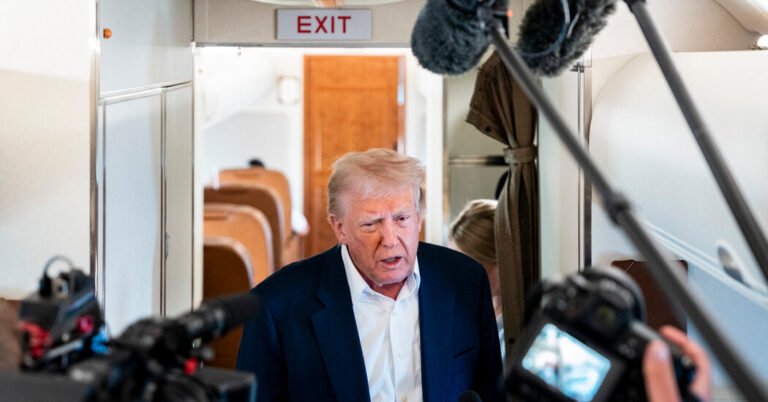
President Trump confirmed on Sunday that he had pressed Mexico’s president to let U.S. troops into the country to help fight drug cartels, an idea she summarily rejected.

Mr. Trump told reporters traveling with him aboard Air Force One from Palm Beach, Fla., to Washington that it was “true” he had made the push with President Claudia Sheinbaum. The proposal, first reported by The Wall Street Journal last week, came at the end of a lengthy phone call between the two leaders on April 16, The Journal said.

Ms. Sheinbaum has also confirmed that Mr. Trump made the suggestion, and that she rejected it. Mexico and the United States can “collaborate,” she recalled telling him, but “with you in your territory and us in ours.”

Mr. Trump said he proposed the idea because the cartels “are horrible people that have been killing people left and right and have been — they’ve made a fortune on selling drugs and destroying our people.”

He said, “If Mexico wanted help with the cartels, we would be honored to go in and do it. I told her that. I would be honored to go in and do it. The cartels are trying to destroy our country. They’re evil.”

He said, “The president of Mexico is a lovely woman, but she is so afraid of the cartels that she can’t even think straight.”

Mr. Trump has had a better working relationship with Ms. Sheinbaum than with Canada’s leaders. But the relationships with both neighboring countries have been strained over trade and immigration.


Source link

Highlights of Warren Buffett’s Life

0


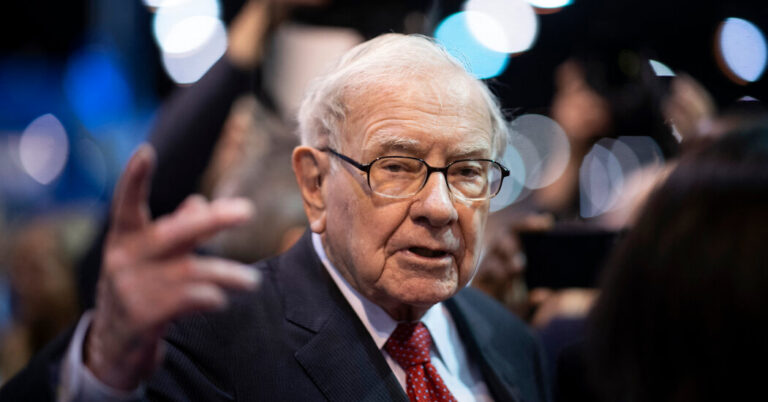
Warren Buffett, the chief executive of Berkshire Hathaway, said he would step down from that position by the end of the year.

Mr. Buffett, 94, transformed Berkshire Hathaway, once a textile company, into a powerful business investor, making billions along the way.

Here’s a look back at some of the defining moments in his life.

Aug. 30, 1930

In August 1930, Mr. Buffett was born in Omaha to Leila and Howard Buffett, an investment banker and future Republican congressman.

At 9 years old, he started studying the stock market.

“I used to chart all kinds of stock, the more numbers the better,” he told The New York Times Magazine in 1990.

He studied at the Wharton School of the University of Pennsylvania, the University of Nebraska and Columbia Business School before returning to Omaha.

1959

In 1959, Mr. Buffett met Charles T. Munger after a doctor in Omaha introduced them to each other. They went into business together soon after and worked together for more than 50 years.

In 2015, Mr. Buffett credited Mr. Munger, who became vice chairman of Berkshire Hathaway in 1978, with creating the structure of the business.

“The blueprint he gave me was simple: Forget what you know about buying fair businesses at wonderful prices; instead, buy wonderful businesses at fair prices,” Mr. Buffett wrote in a letter looking back at the company’s first 50 years.

Mr. Munger died in 2023.

1963

The stock for American Express Company cratered in 1963 after the public learned the company had provided tens of millions of dollars in warehouse receipts for salad oil that did not exist through a warehousing subsidiary. Inspectors had been fooled by tubs of water topped with salad oil, and receipts were forged.

Mr. Buffett, who was not well known at the time, spotted an opportunity and put $13 million into American Express because it had strong assets besides the entities involved with the salad oil scandal.

The purchase is considered one of his earliest investment successes. Berkshire Hathaway is now the biggest shareholder in American Express.

1965

Mr. Buffett first bought shares in Berkshire Hathaway, then a textile company, in December 1962. He continued to buy shares over the years and in May 1965 formally took control of the business, transforming it into a conglomerate holding company.

In the letter commemorating the company’s 50th anniversary, Mr. Buffett said he regretted spending so much money on the Berkshire stock he had acquired in the early 1960s. He closed the textile business in 1985.

1993

Mr. Buffett has been open about his investment mistakes, and in his 50th anniversary letter he called Berkshire Hathaway’s purchase of the company Dexter Shoe in 1993 “the most gruesome” error.

Berkshire Hathaway bought Dexter Shoe, a shoe manufacturer based in Maine, for $433 million, and its value quickly dropped to zero.

“As a financial disaster, this one deserves a spot in the Guinness Book of World Records,” he wrote.

Mr. Buffett was one of the world’s wealthiest people when he said in 2006 that he planned to donate the bulk of his fortune to the Gates Foundation and four other philanthropies.

Four years later, Mr. Buffett and Bill and Melinda Gates enlisted other wealthy Americans to make similar commitments.

Mr. Buffett told The Wall Street Journal in 2024 that the foundation would not receive any more of his money after his death. The money will instead go to a charitable trust overseen by his daughter and two sons.

May 3, 2025

At Berkshire’s annual shareholder meeting on Saturday, Mr. Buffett announced that he was stepping down.

Mr. Buffett said that he wanted Gregory E. Abel, the vice chairman of Berkshire’s non-insurance companies, to take over as chief executive by the end of the year.

Mr. Buffett, Berkshire’s single biggest shareholder with a roughly 14 percent stake that is worth about $164 billion, will remain chairman of the company.


Source link

Trump Says He Wants Alcatraz Restored as a Prison


President Trump said on Sunday that he wanted federal law enforcement agencies to work on restoring Alcatraz, now a museum, to a functioning maximum-security prison.

Repeating one of his constant refrains that the United States had become a dangerous, lawless place, Mr. Trump wrote on social media that he wanted Alcatraz, an island in San Francisco Bay, to be enlarged and rebuilt “to house America’s most ruthless and violent offenders. We will no longer be held hostage to criminals, thugs, and judges that are afraid to do their job and allow us to remove criminals, who came into our country illegally.”

It was not immediately clear how his musing could be put into action, given that any such project would be extraordinarily expensive and that the administration already planned to cut billions of dollars from the Justice Department budget.

Mr. Trump said he had instructed the Bureau of Prisons, the Justice Department and the Homeland Security Department to work on his idea, along with the F.B.I. — a curious choice given that the bureau plays no role in incarcerating people convicted of crimes.

A reopened Alcatraz, Mr. Trump wrote, would “serve as a symbol of law, order, and justice.” The prison captured the public imagination as the home of the “worst of the worst” until it was closed in 1963 and eventually turned into a popular museum attraction.

In addition to holding the gangster known as “Machine Gun Kelly” and Al Capone — whose multiple indictments Mr. Trump often mentioned on the campaign trail to describe himself as unfairly persecuted — Alcatraz is most famous for the escape of three men in 1962. They were never found, and it remains unclear whether they survived the swim from the island, which is more than a mile from shore in cold water with strong currents. Today, Alcatraz is best known as a damp, frigid and nostalgic staple of tourist packages and children’s field trips.

By comparison, the current federal super-maximum security prison in Florence, Colo., has never had an inmate escape.

In California, Scott Wiener, a Democratic state senator representing San Francisco, called Mr. Trump’s idea “absurd on its face” and the latest example of what he called the president’s “continuing unhinged behavior.”

A spokesman for Gov. Gavin Newsom laughed when asked about the president’s order. “Looks like it’s Distraction Day again in Washington, D.C.,” Izzy Gardon, the governor’s director of communications, said.

Mr. Gardon pointed out that it had been more than six decades since Alcatraz operated as a prison, and that turning it back into a facility to house inmates would take many years and significant federal investment at a time when the president has said he wants to slash spending.

Maggie Haberman contributed reporting.


Source link

Miami GP: George Russell keeps podium as Red Bull protest against Mercedes driver rejected by stewards | F1 News

0


George Russell has kept his third-placed finish in the Miami Grand Prix after a post-race protest lodged by Red Bull against the Mercedes driver was rejected.

Russell finished one place ahead of Max Verstappen in the final podium berth on Sunday but Red Bull launched a protest against the Mercedes driver to the stewards afterwards, alleging the Briton had failed to sufficiently slow for a single-waved yellow flag during the race.

Stewards heard representatives from both teams in a hearing in the hours after the race but ultimately rejected Red Bull’s case.

Verstappen finished 2.3s behind Russell – who had jumped the Dutchman by pitting under a previous Virtual Safety Car – so any time penalty for the Mercedes driver could have handed the world champion third place instead of fourth.

In the hearing, Red Bull claimed that “while [Russell] lifted the throttle when the yellow flag was displayed, it did not reduce speed” and so argued the Mercedes car had not adhered to the regulations.

Mercedes representatives, however, said that the “common practice accepted by all teams and the FIA was and still is that significantly lifting the throttle in a yellow flag zone is considered as an appropriate reaction and they therefore complied with the relevant regulations”.

They said that Russell had duly “significantly” lifted off the throttle after seeing the stranded Sauber car of Gabriel Bortoleto at the side of the track.

Please use Chrome browser for a more accessible video player

George Russell doubles over after complaining of stomach cramps in final ten laps of his third place finish at the Miami GP.

Stewards threw out Red Bull’s case – meaning the team also forfeited their protest deposit.

In their conclusions, stewards said: “It was evident from the onboard footage as well as from telemetry that Car 63 [Russell] lifted the throttle when passing the yellow flag zone.

“The throttle was lifted by approx. 25 percent and this resulted in a reduction of torque of approx. 30 percent.

“Article 26.1. a) requires the driver to have “discernibly reduced speed” in a yellow flag zone but does not specify if that means reducing the absolute speed or reducing the speed relative to the regular racing speed in the relevant part of the track.

“The speed of Car 63 in the yellow flag zone was considerably slower than the regular racing speed, but the absolute speed while passing through the yellow flag zone increased slightly.

“The Stewards determine that the requirement of Article 26.1 a) concerning the reduction of speed in a yellow flag zone can only relate to a reduction relative to the regular racing speed as the reduction of the absolute speed can, depending on the part of the track in which the yellow flag is displayed, represent a compliance or a non-compliance with the regulations whereas a reduction of the relative speed always signals that the driver has acknowledged and respected the yellow flag.

Please use Chrome browser for a more accessible video player

Sky F1’s Ted Kravitz reflects on all the big talking points from the Miami Grand Prix.

“For instance, in a braking zone the absolute speed can be reduced without necessarily complying with the regulations.”

The decision means Russell retains his fourth podium finish in six races this season and leaves Miami just six points back on third-placed Verstappen in the Drivers’ Championship.

Second-placed Mercedes are 36 points clear of Red Bull in the Constructors’ Championship, although now 105 behind runaway leaders McLaren after the Woking team’s dominant one-two finish.

F1’s European season begins with the Emilia Romagna Grand Prix on May 16-18, live on Sky Sports F1. Stream Sky Sports with NOW – no contract, cancel anytime


Source link