Home Blog Page 335

China’s Garment Factories Face a Tipping Point After New Tariffs

0


Liu Miao has sold clothing on Amazon to wholesale buyers in the United States for the past five years. That trade has come to an abrupt stop.

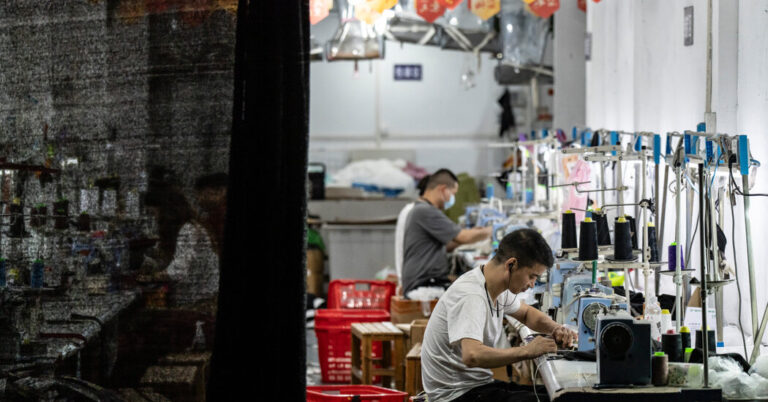
Mr. Liu owns a small factory in Guangzhou, long the center of China’s highly competitive garment industry. He and other factory managers, already dealing with tight profit margins, said last week that the combination of tariffs and President Trump’s new tax on cheap imports had cut deeply into their businesses. Costs along the supply chain are also higher.

The tariffs have made it impossible for Mr. Liu to continue selling on Amazon, where he previously made about $1 on every garment but now just 50 cents. And he felt he could not cut his employees’ pay, Mr. Liu said, as workers at a labor market crowded past his motorbike, which he had parked on the sidewalk with a dress sample draped over the handlebars.

“You can’t sell anything to the United States right now,” Mr. Liu said. “The tariffs are too high.”

Platforms like Amazon, Shein and Temu brought China’s vast manufacturing supply chain to the world’s doorstep. These online marketplaces made it possible for thousands of Guangzhou’s small factories to reach shoppers in the United States. And since packages worth less than $800 could enter the United States tax-free, the factories and, in turn, the platforms were able to charge very low prices.

Exports have been a major driver of China’s economic growth in the past few years. Business has been particularly good in e-commerce. In one Guangzhou neighborhood, foreign luxury cars — Mercedes-Benzes, BMWs and Cadillacs — were parked outside factories that pay workers about $60 a day to churn out clothing sold on apps like Shein and Amazon.

But now as trade tensions force the world’s two largest economies apart, many businesses in Guangzhou are facing a tipping point.

The tariffs compound multiple challenges facing the garment makers. It is getting harder to make a profit as the Chinese government has struggled to get consumers spending more after the collapse of the country’s property market. Without rising home values, many Chinese people are curbing their spending.

That hurt business for Zhang Chen, who used to own six clothing stores in the central province of Hubei. But when shoppers didn’t return after the Covid-19 pandemic and rent stayed high, he decided to close them all.

“In 2020, business wasn’t coming back, and in 2021, it still wasn’t coming back. By 2022 when it was still like that, it looked like it was never coming back,” Mr. Zhang said. Now he makes about $100 a day delivering freshly sewn garments to Shein collection points near the airport.

The factories in Guangzhou are not the automated ones churning out electric vehicles or the manufacturing campuses making semiconductors that are key to China’s yearslong drive to secure geopolitical resilience through advanced technology. Yet China’s garment factories employ millions of workers hustling to make a living.

In interviews, nine factory owners and managers in Guangzhou said they were considering relocating their operations, some to provinces like Hubei, 600 miles away, where they could pay workers lower wages. A few owners said they could possibly move to countries like Vietnam, where many Chinese factories have set up to avoid potential new tariffs as high as those already set on China’s exports.

Many reported declining orders. Others said they had suspended some production lines. All described watching neighboring businesses shut their doors in the past few months.

On Friday as the U.S. policy to end tax-free imports from China took effect, Liu Bin packed up his sprawling garment factory where piles of Shein packages pressed against the windows.

Mr. Liu’s factory specializes in dresses and tops meant to be worn to a beach party or a date night, and Shein typically purchases about 100,000 pieces from him a month. But in April, after the company ordered about half that much, he started moving his production line to the neighboring province of Jiangxi. He could no longer afford rent in Guangzhou.

Mr. Liu said that Shein was offering incentives to help cover the cost of moving operations to Vietnam, and he had considered it, “but then the tariffs on Vietnam got even higher, too.”

He said he had also tried to find buyers on TikTok and Temu, but orders were down on every platform. “They’re all falling, and we are only waiting and watching,” Mr. Liu said.

Shein did not respond to a request for comment. Temu said on Friday it had stopped shipping products from China directly to buyers in the United States.

The Chinese government has been encouraging domestic e-commerce platforms to help small businesses sell to their home market. But with China’s consumers being careful about spending, it will be hard for factories to sell as much domestically as they were exporting.

Han Junxiu, who sells novelty socks on Shein and Temu, said she doubted that the U.S. government would be able to suddenly start collecting tariffs on low-priced packages, which had been coming into the United States at the rate of four million a day.

“I just don’t think it’s that realistic,” Ms. Han said after closing her booth for the night at the Canton Fair, Guangzhou’s annual export trade show.

Fluffy socks for pajama parties are some of her most popular products.

This is exactly the kind of thing Americans will still need to buy from Chinese businesses, Ms. Han said. “Where else are they going to buy all this?” she asked.

Siyi Zhao contributed research.


Source link

Oil Prices Slide Further on Plans to Increase Supply

0


Oil prices resumed their downward slide after the OPEC Plus cartel of oil producers said over the weekend that it would pump more oil, despite concerns that President Trump’s trade war will curb demand.

The U.S. benchmark oil price fell to around $56 a barrel, from $58 on Friday. For many companies, the steady decline means it will not be profitable to drill wells in the United States despite Mr. Trump’s calls for increased production.

Prices were last around this level in early April, just before Mr. Trump said he would pause reciprocal tariffs on most countries for 90 days. That announcement led to rallies in both the stock market and the oil market, though oil prices have since waned.

That is partly because OPEC Plus is raising output at the same time that economists are warning that higher tariffs on most American trading partners will slow global economic growth and potentially cause a recession in the United States.

The eight countries that make up the OPEC Plus cartel said on Saturday that they would further ramp up production in June.

Lower commodity prices are causing some companies to pull back. There are about 9 percent fewer rigs drilling wells in the Permian Basin, the top U.S. oil field, than there were this time last year, when oil was trading near $80 a barrel, according to Baker Hughes.

On Friday, Exxon Mobil and Chevron, the two largest U.S. oil and gas companies, reported their lowest first-quarter earnings in years. Those financial results reflect the market before Mr. Trump further escalated tariffs on China in early April.

“It is clear that this uncertainty is weighing on economic forecasts, causing significant volatility and raising the prospects of slower growth,” Darren Woods, Exxon’s chief executive, told analysts.


Source link

Trump Says He Will Put 100% Tariff on Movies Made Outside U.S.

0


President Trump said he would impose a 100 percent tariff on movies “produced” outside the United States, proclaiming in a social media post on Sunday that the issue posed a national security threat.

Mr. Trump said he had authorized Jamieson Greer, the United States Trade Representative, to begin the process of taxing “any and all Movies coming into our Country that are produced in Foreign Lands.” Mr. Trump added, “This is a concerted effort by other Nations and, therefore, a National Security threat.”

The Motion Picture Association, which represents the biggest Hollywood studios in Washington, declined to comment. The association’s latest economic impact report, based primarily on government data and released in 2023, showed that the film industry generated a positive U.S. balance of trade for every major market in the world.

As often is the case with Mr. Trump’s declarations on social media, it was not entirely clear what he was talking about. Did he mean any movie, including independent foreign-language films destined for art house cinemas and movies that play exclusively on streaming services?

Would such a tariff apply only to movies receiving tax incentives from foreign countries — or to any movie with scenes shot overseas? What about postproduction visual effects work? A single superhero movie can often involve a half-dozen or more specialized firms scattered around the world.

Technically speaking, the vast majority of movies shown in American cinemas are produced in the United States — scripts written, preproduction planning handled, principal actors cast, footage edited and sound added. But Hollywood has increasingly turned to foreign locales for the cameras-rolling part of the moviemaking process because, as with so much traditional manufacturing, it is much cheaper.

Britain, Hungary, Australia, New Zealand, Canada and other countries offer tax incentives that Disney, Warner Bros., Universal Pictures and other major movie companies, including Netflix and Amazon, have used. International locales also often come with lower labor costs.

As a result, thousands of middle-class film workers in the United States — camera operators, set decorators, lighting technicians, makeup artists, caterers, electricians — have seen work evaporate. According to the International Alliance of Theatrical Stage Employees, roughly 18,000 full-time jobs have been eliminated in the past three years, primarily in California.

“We’re allowing California to become to the entertainment industry what Detroit has become to the auto industry,” Michael F. Miller Jr., a vice president at the union, told The Times last month.

Sometimes the cost of shipping props and people overseas ends up costing studios more than they hope to save with tax credits. But more often, producers say, the cost of working in California is prohibitive. The budget is the budget, and those budgets keep getting tighter. Peak streaming is over, fewer people are going to movie theaters, and studios no longer get dollars from DVD sales.

Gov. Gavin Newsom has pushed to more than double the available funding for the state’s tax incentive program. Under pressure from constituents and several coalitions that formed after the recent wildfires in Los Angeles and the surrounding area, California lawmakers have also put forward bills that would increase its film tax credit.

In January, shortly before his inauguration, Mr. Trump said in a social media post that he had named Mel Gibson, Sylvester Stallone and Jon Voight as “special ambassadors” for the purpose of “bringing Hollywood, which has lost much business over the last four years to Foreign Countries, BACK — BIGGER, BETTER, AND STRONGER THAN EVER BEFORE!”

The actors, each an enthusiastic supporter of the president, have yet to do anything publicly, although Mr. Voight, who is Angelina Jolie’s father, has met with a few unions and studio executives on a private fact-finding tour.

Matt Stevens contributed reporting.


Source link

Lewis Hamilton tells Ferrari boss Fred Vasseur ‘don’t be so sensitive’ after radio dispute during Miami GP | F1 News

0


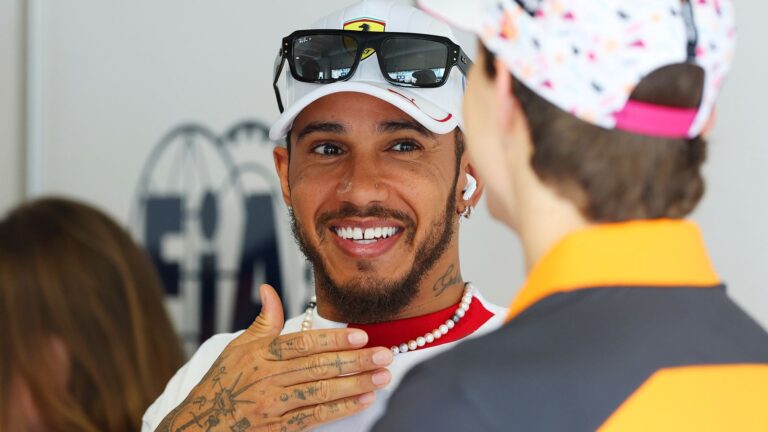
Lewis Hamilton has revealed he told Ferrari boss Fred Vasseur not to “be so sensitive” following a radio dispute between driver and team during the Miami Grand Prix.

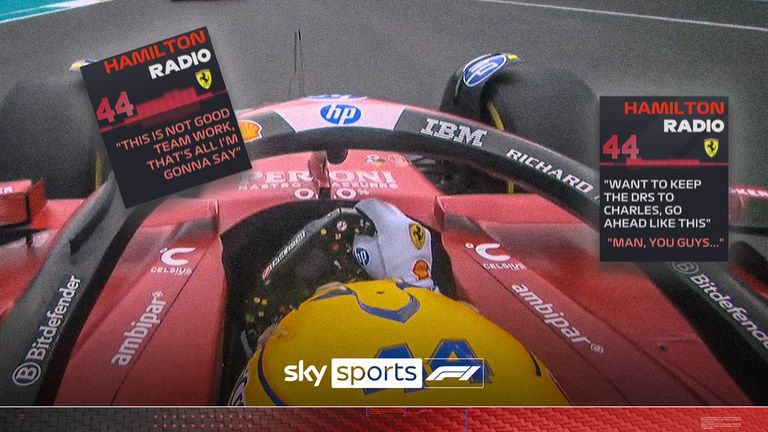
Hamilton became frustrated during Sunday’s race when he closed on team-mate Charles Leclerc with superior pace but was not immediately let through to attempt to chase down the Mercedes of Kimi Antonelli for sixth.

The seven-time world champion sent a series of transmissions expressing his dismay as the pit wall hesitated, rejected and then finally granted his request, by which point Hamilton felt too much life had been taken out of his tyres.

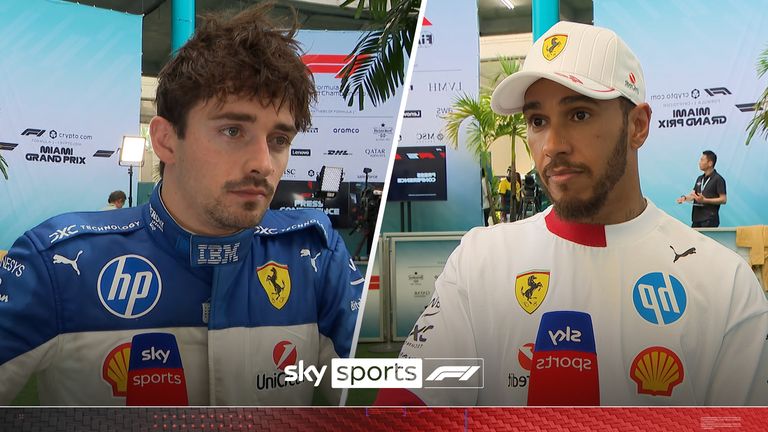
Hamilton told Sky Sports F1: “I lost a lot of time behind Charles and in that moment, for sure, I was like ‘come on, let’s make a decision quick, let’s not waste time.’

“I’m sure people didn’t like certain comments, but you’ve got to understand, it’s frustrating.”

Please use Chrome browser for a more accessible video player

Lewis Hamilton and Charles Leclerc discuss Ferrari’s strategy and team orders dispute during the Miami GP

With the Ferrari pair having started on different tyre compounds, Hamilton, who had progressed from 12th on the grid, found himself on the faster medium compared to Leclerc’s hard following the only round of pit stops.

After they had both passed Carlos Sainz in the same corner to move into seventh and eighth, Hamilton immediately requested on team radio that the pit wall switch the cars.

He was told to wait, before Ferrari then told him they would stick with the current situation and ensure that he remained within DRS range of Leclerc.

Hamilton angrily replied that the call was “not good teamwork” and then referenced the Chinese Grand Prix, when he offered to let Leclerc through when his team-mate was going faster behind him.

Please use Chrome browser for a more accessible video player

Highlights of the Miami Grand Prix

Ferrari then changed course and switched the cars, around the time of which a radio message was played out of Hamilton saying: “Have a tea break while you’re at it, come on!”

Hamilton, who felt crucial life had been taken out of his tyres while he trailed Leclerc, was unable to make major inroads into Antonelli’s advantage, before being told to let his team-mate back through in the closing stages.

Having done so, Hamilton then sarcastically asked if the team wanted him to ‘let Sainz through as well’ when he was told of his margin to the trailing Williams.

Speaking to the written media in Miami, Hamilton was asked whether he had had an opportunity to speak to team principal Vasseur before conducting his post-race interviews.

Please use Chrome browser for a more accessible video player

Carlos Sainz avoided a penalty for this late lunge on Lewis Hamilton at the Miami Grand Prix

He replied: “Fred came to my room. I just put my hand on his shoulder and said, ‘dude, calm down. Don’t be so sensitive.’

“I could have said way worse things on the radio. You hear some of the things other people have said in the past. Some of it was sarcasm.

“You’ve got to understand, we’re under a huge amount of pressure in the cars, you’re never going to get the most peaceful messages come through in the heat of the battle.”

‘I won’t apologise for being a fighter!’

Hamilton has endured a hugely frustrating start to his Ferrari career following his blockbuster switch to the Italian team after 12 years with Mercedes.

Aside from a Sprint pole and victory at the second round of the season in China, it has been a bleak beginning to the partnership between the sport’s most famous driver and team.

Hamilton’s best grand prix finish was fifth in Bahrain, while Miami actually represented a new low for Ferrari, who were expected to contend for titles this year, as both the Brit and Leclerc struggled badly in qualifying.

Please use Chrome browser for a more accessible video player

Lewis Hamilton locks up on his final run in Q2 knocking his Ferrari out of qualifying for the Miami GP

Hamilton explained that his much of his radio frustration on Sunday was caused by the team’s general struggles, and insisted that he wouldn’t apologise for “being a fighter”.

“I don’t know what you’re going to write or whether I was disrespectful or whatever, I honestly don’t feel I was,” he said.

“I was just like, ‘come on, guys. I want to win’. I’ve still got that fire in my belly. I could feel a little bit of it really coming out there, and I’m not going to apologise for being a fighter, I’m not going to apologise for still wanting it.

“I know everyone in the team does too. I truly believe that when we fix some of the problems we have with the car, we’ll be back in the fight with Mercedes, with the Red Bulls.

“It just can’t come quick enough. We’ll try something different at the next race, we’ll keep working on our processes. I look forward to a time when maybe I can fight for a podium, that would be nice.”

Leclerc: No bad feelings for Lewis

Leclerc had comfortably outperformed Hamilton during the previous three rounds but struggled similarly badly in Miami, giving downcast interviews on Friday and Saturday.

The Monegasque was on this occasion the more calm of the two Ferrari drivers over the radio, but joined Hamilton in questioning the team’s decision-making process.

Please use Chrome browser for a more accessible video player

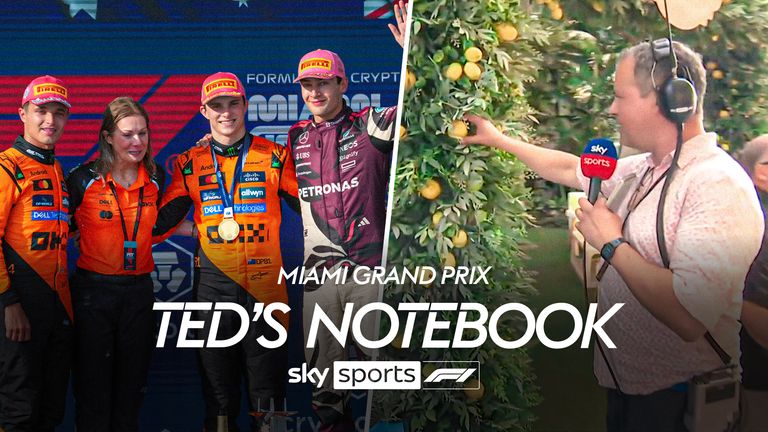
Sky F1’s Ted Kravitz reflects on all the big talking points from the Miami Grand Prix

Leclerc told Sky Sports F1: “It’s a difficult situation. I unfortunately will go for the boring answer and will not comment too much.

“It’s obvious that’s not the way we want to manage a race. We will discuss it internally in order to make better decisions.

“There are no bad feelings for Lewis, absolutely not. It’s just as a team we need to do better and today was a proof of that.

“I’m doing my best. I’m giving everything I have for us to be a better team, to have a better car, to be better. This is where our focus is.”

F1’s European season begins with the Emilia Romagna Grand Prix on May 16-18, live on Sky Sports F1. Stream Sky Sports with NOW – no contract, cancel anytime


Source link

Miami GP: Oscar Piastri eases to victory as Lando Norris fights back from first-lap drama to seal dominant McLaren one-two | F1 News

0


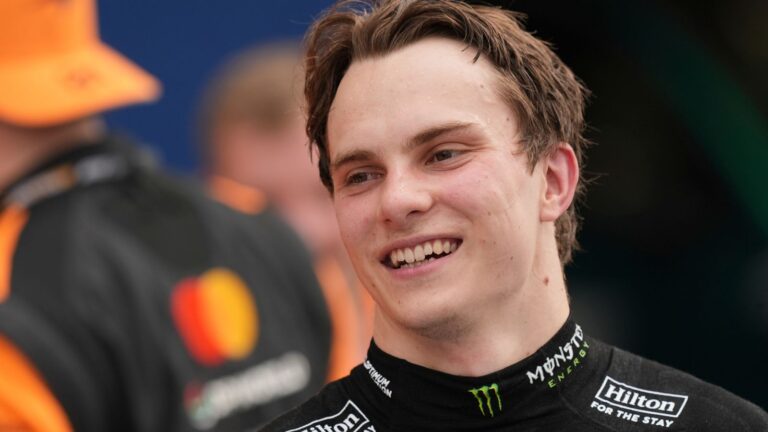
Oscar Piastri extended his world championship lead with a dominant Miami Grand Prix victory as Lando Norris recovered from first-lap drama to seal a McLaren one-two.

Piastri drove a faultless race from fourth on the grid to claim his third successive victory, passing pole-sitter Max Verstappen after a thrilling early battle before cruising clear.

Norris was left to rue what might have been after dropping from second to sixth on the first lap following a skirmish with Verstappen, before scything his way through the field to finish in his starting position.

The Brit valiantly halved Piastri’s lead to four seconds in the closing stages, but was powerless to deny the Australian victory as the McLarens charged more than 30 seconds clear of the rest of the field by the chequered flag.

Having lost out to Norris in Saturday’s Sprint, Piastri’s fourth win in six races this season moves him 16 points clear of his team-mate at the top of the standings.

Please use Chrome browser for a more accessible video player

Oscar Piastri snatches the lead from Max Verstappen, followed by Lando Norris into second after an intense battle at the Miami Grand Prix.

George Russell claimed an opportunistic podium for Mercedes, benefitting from the helpful timing of a Virtual Safety Car to leapfrog Verstappen for third during the only round of pit stops.

Verstappen, who cut a frustrated figure over Red Bull team radio as he struggled for speed throughout, falls 32 points back from Piastri in the standings, denting his hopes of sealing a fifth successive drivers’ title.

Alex Albon matched Williams’ best finish of the season by taking fifth after overtaking the other Mercedes of Kimi Antonelli, having fired up his tyres quicker following the first of the race’s two Virtual Safety Car interruptions.

Please use Chrome browser for a more accessible video player

Lewis Hamilton sends jabs at Ferrari on team radio during the Miami Grand Prix.

Charles Leclerc took seventh ahead of Ferrari team-mate Lewis Hamilton after the latter became infuriated with his colleagues over the radio amid a team orders dispute.

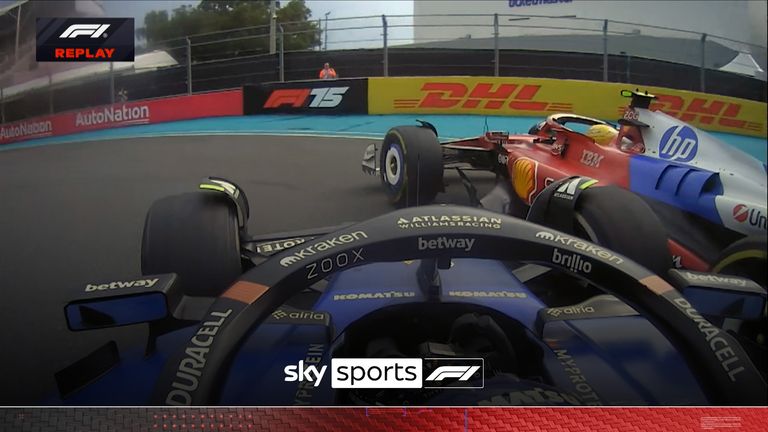
Hamilton had to survive significant contact following a last-lap lunge from the other Williams of Carlos Sainz, which left the Spaniard facing multiple post-race investigations that could see him demoted to ninth.

Red Bull’s Yuki Tsunoda overcame a five-second penalty for speeding in the pit lane to hold off Racing Bulls driver Isack Hadjar by little more than a tenth of a second for the final point.

More to follow…

Miami GP Result

Driver Team Time
1) Oscar Piastri McLaren 1:28.51.587
2) Lando Norris McLaren +4.630
3) George Russell Mercedes +37.644
4) Max Verstappen Red Bull +39.956
5) Alex Albon Williams +48.067
6) Kimi Antonelli Mercedes +55.502
7) Charles Leclerc Ferrari +57.036
8) Lewis Hamilton Ferrari +60.186
9) Carlos Sainz Williams +60.577
10) Yuki Tsunoda Red Bull +74.434
11) Isack Hadjar Racing Bulls +74.602
12) Esteban Ocon Haas +82.006
13) Pierre Gasly Alpine +90.445
14) Nico Hulkenberg Sauber +1 lap
15) Fernando Alonso Aston Martin +1 lap
16) Lance Stroll Aston Martin +1 lap
Liam Lawson Racing Bulls DNF
Gabriel Bortoleto Sauber DNF
Oliver Bearman Haas DNF
Jack Doohan Alpine DNF

F1’s European season begins with the Emilia Romagna Grand Prix on May 16-18, live on Sky Sports F1. Stream Sky Sports with NOW – no contract, cancel anytime


Source link

Trump Says ‘I Don’t Know’ When Asked About Due Process and Upholding Constitution


President Trump said in an interview that aired on Sunday that he did not know whether every person on American soil was entitled to due process, despite constitutional guarantees, and complained that adhering to that principle would result in an unmanageable slowdown of his mass deportation program.

The revealing exchange, on NBC’s “Meet the Press,” was prompted by the interviewer Kristen Welker asking Mr. Trump if he agreed with Secretary of State Marco Rubio that citizens and noncitizens in the United States were entitled to due process.

“I don’t know,” Mr. Trump replied. “I’m not, I’m not a lawyer. I don’t know.”

Ms. Welker reminded the president that the Fifth Amendment says as much.

“I don’t know,” Mr. Trump said again. “It seems — it might say that, but if you’re talking about that, then we’d have to have a million or two million or three million trials.” Left unmentioned was how anyone could be sure these people were undocumented immigrants, let alone criminals, without hearings.

Mr. Trump responded “I don’t know” one more time and referred to his “brilliant lawyers” when Ms. Welker asked whether, as president, he needed to “uphold the Constitution of the United States.”

The comments came amid the many legal challenges to the administration’s agenda, especially Mr. Trump’s aggressive deportation campaign, and as top administration officials have begun to question the president’s obligation to provide due process. Mr. Trump has attacked judges, called for their impeachment and ignored a Supreme Court ruling directing his administration to facilitate the return of a migrant, Kilmar Armando Abrego Garcia, who was mistakenly sent to a prison for terrorists in El Salvador.

Mr. Trump said in the interview that he may seek clarification from the Supreme Court on what it meant by the word “facilitate” when referring to the return of Mr. Abrego Garcia.

Like most conversations with Mr. Trump, the interview roamed over broad territory, covering subjects as diverse as recent economic data, his trade war with China, negotiations between Russia and Ukraine, his musings about an unconstitutional third term in office, and possible Republican successors. The interview was taped on Friday.

The president, perhaps frustrated that President Xi Jinping of China has held firm under the pressure of the administration’s 145 percent tariffs on China, reverted to tough trade talk after weeks of signaling that he was eager for a deal.

Mr. Trump said he was not worried about a recession despite some Wall Street analysts predicting one and suggested that it was a good thing for the United States to have gone “cold turkey” on trade with China through the prohibitively high tariffs.

“We were losing hundreds of billions of dollars with China,” he said. “Now we’re essentially not doing business with China. Therefore, we’re saving hundreds of billions of dollars. Very simple.”

Noting that the U.S. economy shrank in the first quarter, Ms. Welker asked Mr. Trump when he would take responsibility for the economy and call it the Trump economy rather than blaming it on former President Joseph R. Biden Jr.

Mr. Trump’s response encapsulated his lifelong relationship with credit and blame: “I think the good parts are the Trump economy and the bad parts are the Biden economy because he’s done a terrible job.”

Asked about the war in Ukraine and his administration’s efforts to negotiate an end to it, the president said he had come close to walking away from the talks and still might do so.

Mr. Trump claimed during his presidential campaign that he could strike a peace deal between Russia and Ukraine within 24 hours of taking office. About 100 days in, he now claims he was being sarcastic. He has been frustrated by the grinding process and lack of progress. And President Vladimir V. Putin of Russia has ignored Mr. Trump’s public calls to stop bombing Ukrainian cities.

“Well, there will be a time when I will say, ‘OK, keep going. Keep being stupid and keep fighting,’” Mr. Trump said in the interview.

Mr. Trump was asked about his repeated statements about considering an unconstitutional third term in office. In the interview, he went further than he had previously in saying he did not intend to run again, despite the fact that the Trump Organization’s online store is selling Trump 2028 hats.

“There are many people selling the 2028 hat,” the president said, “but this is not something I’m looking to do. I’m looking to have four great years and turn it over to somebody, ideally a great Republican, a great Republican to carry it forward.”

Then he mentioned two Republicans who might fit the bill as his successor: Mr. Rubio and Vice President JD Vance.


Source link

A Scenic Tour of Red Tape: Tracking the Slowest High-Speed Train in the Country


On a recent Friday, Mark Wasser, an eminent-domain lawyer from Sacramento, embarked on a one-day road trip of more than 500 miles. It is one that he has taken often over the past decade.

A tall and trim man in his 70s, dressed in jeans and a flannel shirt, Mr. Wasser folded himself into the driver’s seat of his car and aimed south. He drove toward dozens of California’s high-speed rail construction projects scattered across the vast farmland of the Central Valley.

No one has represented more eminent domain cases involving the rail project than Mr. Wasser. In the long distances between stops, visiting clients and seeing the changing landscape, he pondered something that Gov. Gavin Newsom had said a few days before.

Mr. Newsom was a guest on “Real Time With Bill Maher” when the host blamed lawyers, lobbyists, contractors, environmentalists, unions and others for the delays.

“The biggest delay on high-speed rail,” Mr. Newsom replied, “has been taking 2,270 properties under eminent domain and ultimately getting the environmental work cleared.”

It was a bold and pointed casting of blame for a project that is a running joke — a not-running joke — and a punchline for government inefficiency and bureaucratic entanglement.

California’s high-speed rail exists today mostly as a gauge for whether the country can build big things in the 21st century. So far, the answer appears to be no. Approved by voters in 2008 with the promise of connecting Los Angeles and San Francisco by now, no track has been laid. Initial cost estimates of $33 billion have tripled.

“The Governor is correct to note that right-of-way acquisition has been the biggest delay in the 119-mile initial operating segment,” the authority said in a statement.

The project’s ambitions have been reduced to having trains run 171 miles between Bakersfield and Merced by 2033. Bakersfield? Merced? What happened to Los Angeles and San Francisco? Someday, maybe. Mr. Wasser does not expect to see it in his lifetime.

But he and his 70-some clients — farmers, dairies, irrigation districts and so on — are not to blame, he said. Most are people who had been farming in the Central Valley for years, even generations. Then they were told that progress was coming in the form of a bullet train, and they needed to get out of the way.

“In my opinion, it is not factually accurate to blame eminent domain for slowing the process,” Mr. Wasser said. “It’s part of the process, but it hasn’t slowed anything down.”

On he drove, past the bustle of Fresno and into the rural heart of the Central Valley, to the center of the rail project.

Much of California’s interior is a table-flat landscape lined by ruler-straight roads stretching toward distant mountains. It is an earthen version of graph paper. In the spaces between the lines is some of the world’s most valuable farmland, row after straight row of fruits, nuts and produce.

But the planned route for high-speed rail is a diagonal squiggle, as if someone dropped a length of yarn on the map.

“Farming here is all squares and rectangles,” Mr. Wasser said. “But high-speed rail is at an angle, every single time, so you’re carving things up into little triangles and trapezoids.”

He stopped at the farm of John Diepersloot, between Kingsburg and Laton. Among Mr. Diepersloot’s crops are about 1,000 acres of stone fruits — peaches, apricots and so on — including patented varieties shipped daily during harvest season to Japan, Singapore, China and elsewhere.

The high-speed rail bed — a smooth, wide berm, trackless for now — cuts diagonally across those orchards.

“It carved up all the farmland,” Mr. Diepersloot said. “And it left a lot of remnant pieces that are useless.”

Today, from his piece of agricultural paradise, Mr. Diepersloot sees two fresh overpasses built to carry county roads over the planned rail line.

On one side of the rail route is a flourishing crop of prized nectarines, soon to be picked and packed for global destinations. On the other is a 35-acre triangle-shaped graveyard of dead trees, marooned from the water supply.

Mr. Diepersloot is satisfied with the undisclosed settlement he received for the farmland he lost and the years of headaches he endured while rerouting roads, power supplies and pump stations. He has trouble imagining trains zipping past his nectarines.

“I’m 62 years old,” he said. “If I make it to 90, there’s a chance I’ll see it. But San Francisco to L.A.? Never in my lifetime.”

Mr. Wasser continued south. Born, raised and educated in California, he knows the complexities of the valley from seven years spent representing rural Madera County. He knows eminent domain, both sides of it, from 10 years spent working for the city of Las Vegas.

He voted for high-speed rail in 2008, like a majority of Californians. At the time, details were scarce and dreamy. It was a promise that people would glide at 220 miles per hour and get between California’s two largest metropolitan areas in under three hours. The drive takes twice that, at best.

“I assumed they would go up Interstate 5,” Mr. Wasser said, on the west side of the Central Valley, against the coastal mountains. After all, that path was already blazed as a public right-of-way. The follow-the-interstate strategy is one that a company called Brightline is using on I-15 to connect Los Angeles and Las Vegas. Brightline plans to have that line in service in 2028.

I-5 might have been the more sensible idea — it might still be, sunk costs be damned — but that is a different story, murky and convoluted and long ago. It has to do with the quest to loop in cities on the more populated east side of the valley, such as Bakersfield, Fresno and Merced. (And, someday, linking farther north to Modesto, Stockton and Sacramento.) Officials thought it might provide millions of interior residents quick access to the bigger coastal destinations and would stir investment in a part of the state that could use it.

Another issue still debated, too late, is why high-speed rail began construction in the middle of the route and not at the end points. Officials wanted to bring jobs to a chronically overlooked region and wanted to show progress quickly, hoping momentum would lead to more funding and support.

The Central Valley is flat farmland, mostly. How hard could it be?

Eminent domain is how the government acquires private property for a public purpose — highways, railroads, parks, airports, schools, military bases and so on. A landowner can challenge whether a project serves a “public purpose,” but none of Mr. Wasser’s clients have made that argument against high-speed rail.

“That’s not the fight,” Mr. Wasser said. “The fight is to get your money. Not to be cynical, but get what you can get.”

The Fifth Amendment of the U.S. Constitution states, in part, “nor shall private property be taken for public use, without just compensation.”

In this case, the California High-Speed Rail Authority gives notice and makes an offer. The landowner, in nearly every instance, declines it. The rail authority, then, files an eminent domain lawsuit and, shortly thereafter, a “motion for possession,” routinely granted by the court, so work on the project can proceed while the amount of the landowner’s compensation is negotiated.

That’s the key, Mr. Wasser said, so he repeated it: Design and construction move ahead during the haggle over money. This dynamic, he believes, counters any claims that eminent domain is responsible for delays.

The rail authority confirms this process in its 2025 Project Update Report. “If landowner offers remain unaccepted and parties are unable to reach a mutually acceptable settlement within 45 days, the Authority initiates condemnation to prevent delays to early works and construction,” it reads.

Each side appraises the land and any other damages the landowner will suffer. The amounts rarely match. Negotiating begins. Cases can go to a jury trial. So far, high-speed rail has settled every case before that happens, Mr. Wasser said. Juries in the conservative heart of California might favor farmers, not government.

The authority reports that it has paid more than $1.5 billion in real-estate acquisition just on this middle 119-mile stretch of the project, where construction is happening. (Mr. Wasser bills by the hour, he said, and does not receive a percentage of the settlements.) Some landowners have multiple cases. Some cases have taken a decade to settle. Some are reopened abruptly, or new cases are filed, when high-speed rail revises plans, even slightly, during construction. It happens a lot.

A project of this scale was bound to create vexing circumstances on the ground. But appraisal of agricultural property can be especially complicated. Theoretically, if a farmer has 1,000 acres and is forced to hand 100 acres to rail, he or she should get a tenth of the value of the property. Right?

Maybe that 100 acres (always in a triangle, complicating matters) contains the farm’s primary well, vital retention ponds, farmhouses, processing facilities, equipment storage. Where are the irrigation canals? The pumps? The utilities? The employee housing? How much does it cost to rework or rebuild all of that?

Are all crops equal? Are Mr. Diepersloot’s exotic nectarines worth more than someone else’s field of hay? Are thousands of mature walnut trees or old-vine grapes different from a field of cotton or rows of peppers replanted every year?

Each case is unique. The rail route cut some dairies and farms in half. It split houses from barns and bisected processing facilities. It turned some 100-year-old roads into dead ends, stranding homeowners on inaccessible islands and forcing farmers and their equipment to go miles out of the way simply to work their own land.

“Some schmuck 15 years ago said, ‘This is the route we’re going to take,’” said Bruce Howarth, one of the clients that Mr. Wasser was on his way to see. “And they had no idea of the impact.”

Around lunchtime, Mr. Wasser got to Hanford, a neat city of 60,000, where downtown feels replanted from the Midwest, circa 1950. High-speed rail does not plan many stations (fewer stops, faster trains), but one is being built a couple miles east of town, atop a long viaduct about 60 feet high and as long as an airport runway.

In such a rural setting, the pilings look out of scale and otherworldly. Mr. Wasser pointed out where a small subdivision had been moved out of the way, where a farmer lost 25 acres of cherry trees to a construction yard, where a cheese company was bumped off land it had bought six months earlier to expand its operation.

Mr. Wasser parked in front of Kahn, Soares & Conway. It is a major firm in the world of agribusiness, operating from a modest downtown storefront. The firm began getting calls in about 2013 from people in the area who had received right-of-way notices from high-speed rail. Soon, the firm enlisted Mr. Wasser’s help.

Now Jan Kahn was behind the wheel. Born and raised in Fresno, he co-founded the Hanford firm in 1973 and is co-counsel with Mr. Wasser on rail-related cases. He wore well-shined black shoes and a tie with a crisp, white shirt. Mr. Wasser rode next to him. The duo continued south, bantering and pointing out the windows at the changes taking place.

Mr. Kahn turned west. The road dead-ended at the future rail line, a swath of compacted dirt as wide as a highway, in front of one of the region’s biggest dairies, a 24-hour-a-day operation.

A dozen construction workers in orange vests were preparing to bore a tunnel under the rail line. It will be big enough for semi trucks and solely for the dairy’s use. That is part of a settlement still being negotiated. The rail authority obtained its order of possession in 2019.

Mr. Kahn knows firsthand how high-speed rail’s arrival can alter quiet lives in unassuming places. More than a decade ago, he attended a community meeting where high-speed rail officials unveiled maps of the proposed route. Mr. Kahn’s family lived in a century-old farmhouse outside of Hanford. He learned that the line would cut through his front porch, literally.

A rail official explained that the line in that area would be dug below grade. An old farmer overheard. “I hope you can swim,” he said.

The water table is unusually high there, he explained. Sure enough, some months later, the rail authority flipped the route from the west side of Hanford to the east side.

Mr. Kahn’s house was saved. Now the rail line cuts across the farm of one of his partners. He lost part of his front yard and some corrals so that the road out front could be rerouted for an overpass. It is complete and visible from his front door. Negotiations over a price continue.

“Most people around here think this is the stupidest thing in the world,” Mr. Kahn said.

And he turned toward Alpaugh.

Bruce Howarth is general manager of the Alpaugh Irrigation District, established in 1915. He took over the driver’s seat, since he knew the way, and soon parked on a new road overpass, not yet in operation, above the wide stripe of high-speed rail. It slices through what looks like dry, fallow land.

“Everything you look at on paper isn’t the same as the real world,” Mr. Howarth said.

These are massive retention ponds, shallow reservoirs between berms that fill up during non-drought years, during California’s spring runoff.

The lagoons, as Mr. Howarth called them, are the major water supply for hundreds of area farmers. Other options include pumping water from the ground. That is not cost-effective or environmentally friendly, given the region’s major issue with subsidence.

Of three district lagoons, the rail path now cuts two in half. Another is considered part of a wetland, which caused the rail authority to build another sky-high viaduct over what looks like nothing. Mr. Howarth laughed. “I’m the one who makes it wet,” he said.

Mr. Howarth’s latest frustration was timing. Rail construction has forced the lagoons to remain dry the past two years. That coincided with wet years, meaning no stored water and lots of pumping for area farmers. This spring he learned that rail construction is further behind, so Mr. Howarth faces another year of watching his reservoirs sit dry as nearby Deer Creek swells with spring runoff from the Sierra Nevada.

Mr. Howarth stood on the overpass and looked down at his dry lagoons and the clean stripe of rail bed that cut them in half. He is satisfied with the settlement — $30 million for the irrigation district, he said, much of it for new pumps —but he is certain that he will never see trains run this way.

The overpass’s only purpose, he said, will be to remind people of a silly idea, unrealized.

“This is never going to be completed,” he said. “We’re standing on a monument.”

The others now gone, Mr. Wasser was back in the driver’s seat. He headed north, thinking about Governor Newsom and eminent domain’s role in the tangle of delays that have plagued California’s high-speed rail.

The rail authority later declined to cite any examples “in which right-of-way acquisition” — a process that includes eminent domain — “caused delay to construction activities.” But it noted many secondary reasons the project is so far behind schedule.

The agency “has faced many challenges, including pre-construction activities like third party agreements to acquire right-of-way and relocate utilities in the system’s path, various permitting requirements under state and federal law, time consuming and redundant state and federal environmental review processes, legal challenges related to those reviews, and a lack of full project funding which has resulted in costly delays and inefficient delivery,” it wrote in a statement to The Times.

Those issues have stories of their own. Mr. Wasser thinks most of them are far bigger reasons for the delays than eminent domain.

After dinner in Hanford, Mr. Wasser got back into the car. The sun was sinking to his left. He would be home in Sacramento in about 3½ hours.

Imagine getting there in less than half the time, sitting carefree in a comfortable train car. Imagine zipping past all the places Mr. Wasser had visited over 12 hours, a 220-mile-per-hour blur under all the overpasses and over all the bridges, through the orchards and vineyards, past the headlights of cars stuck in traffic, beyond the twinkling lights of valley cities.

We can dream, can’t we? But if it doesn’t happen, Mr. Wasser thought to himself, it’s not our fault.


Source link

Castleford 8 – 32 Wakefield

0


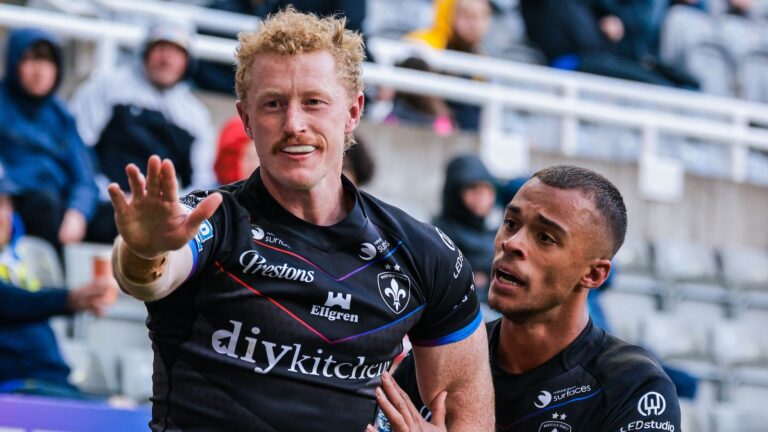
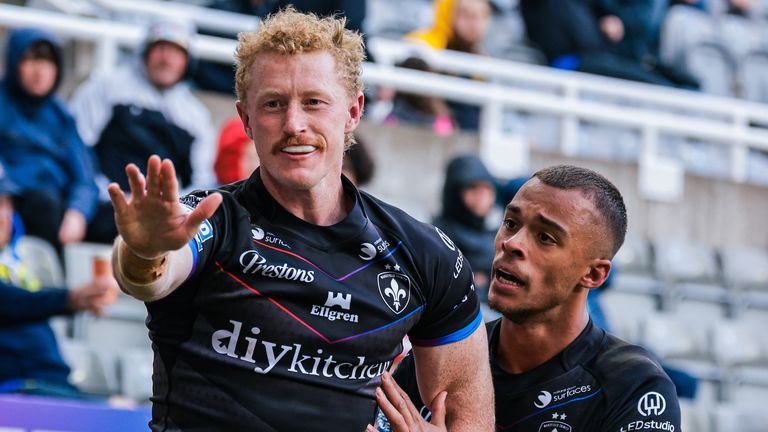
Max Jowitt, Caius Faatili (two), Lachlan Walmsley (two) and Tom Johnstone score tries at St James’ Park as Wakefield Trinity dominate Castleford Tigers at Magic Weekend in Newcastle; Sky Sports is the only place to watch every Super League game live in 2025

Last Updated: 04/05/25 7:32pm

Lachlan Walmsley was a standout as Wakefield Trinity posted a dominant victory over Castleford Tigers in Newcastle

Lachlan Walmsley was a standout as Wakefield Trinity posted a dominant victory over Castleford Tigers in Newcastle

Wakefield Trinity posted a dominant 32-8 Super League Magic Weekend victory over Castleford Tigers, bringing the curtain down on a two-day festival of rugby league at St James’ Park in Newcastle.

Trinity scored six tries in the success through full-back Max Jowitt, prop Caius Faatili (two), right wing Lachlan Walmsley (two) and left wing Tom Johnstone.

Castleford could only respond with two unconverted tries on the day via wing Josh Simm and centre Sam Wood, as the Tigers disappointed with their performance.

The victory moves Wakefield on to 10 points in the standings, level with St Helens, Warrington Wolves and Catalans Dragons as their return Super League campaign continues to impress.

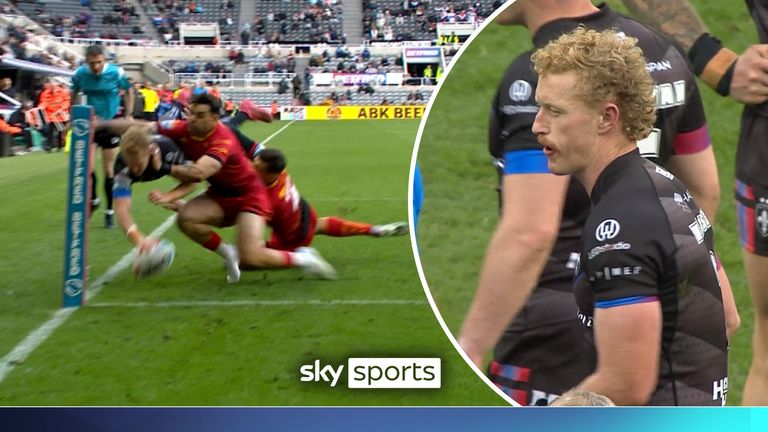
Walmsley increased his side's first-half lead with a stunning finish against Castleford

Please use Chrome browser for a more accessible video player

Walmsley increased his side’s first-half lead with a stunning finish against Castleford

Walmsley increased his side’s first-half lead with a stunning finish against Castleford

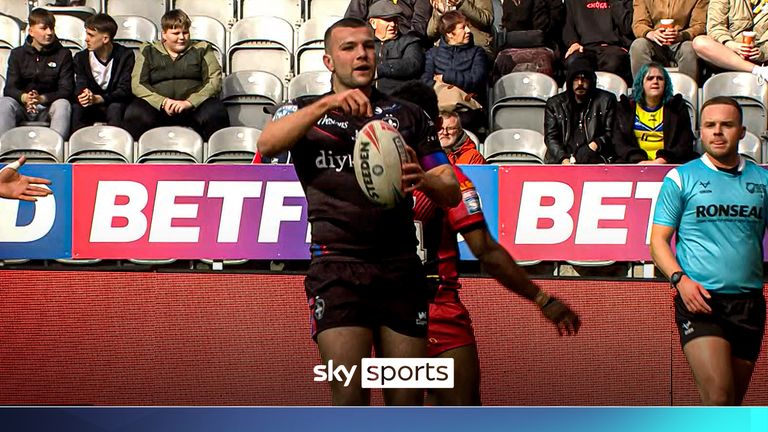
Max Jowitt scored a brilliant opening try for Wakefield against Castleford at Magic Weekend

Please use Chrome browser for a more accessible video player

Max Jowitt scored a brilliant opening try for Wakefield against Castleford at Magic Weekend

Max Jowitt scored a brilliant opening try for Wakefield against Castleford at Magic Weekend

More to follow…

This is a breaking news story that is being updated and more details will be published shortly. Please refresh this page for the latest updates.

Sky Sports brings you live updates as they happen. Get breaking sports news, analysis, exclusive interviews, replays and highlights.

Sky Sports is your trusted source for breaking sports news headlines and live updates. Watch live coverage of your favourite sports: Football, F1, Boxing, Cricket, Golf, Tennis, Rugby League, Rugby Union, NFL, Darts, Netball and get the latest transfers news, results, scores and more.

Visit skysports.com or the Sky Sports App for all the breaking sports news headlines. You can receive push notifications from the Sky Sports app for the latest news from your favourite sports and you can also follow @SkySportsNews on Twitter to get the latest updates.

Round 10 – Magic Weekend

Saturday May 3 – all exclusively live on Sky Sports

Leigh 26-24 Catalans
Hull KR 54-0 Salford
St Helens 4-17 Leeds

Sunday 4th May – all exclusively live on Sky Sports

Huddersfield 12-10 Hull FC
Wigan 22-20 Warrington
Castleford 8-32 Wakefield

Sky Sports will again show every game of Super League live this season – including two matches in each round exclusively live, with the remaining four matches each week shown on Sky Sports+ via the red button.


Source link

How Warren Buffett Changed the Way Investors Thought of Investing

0


Warren E. Buffett’s approach to investing is deceptively simple.

“Forget what you know about buying fair businesses at wonderful prices; instead, buy wonderful businesses at fair prices,” he once wrote to shareholders of Berkshire Hathaway, his business conglomerate.

This method — known as value investing — had existed long before Mr. Buffett, now 94, began his career. But no one did it as well — or for as long — as he did. And in the process, he influenced generations of financiers, including Wall Street hedge fund moguls, and promoted the now-common advice about investing for the long term.

Over the 60 years that Mr. Buffett has controlled Berkshire Hathaway, he used value investing to turn a failing textile manufacturer into a $1.1 trillion conglomerate, corporate takeover machine and microcosm of the U.S. economy. One of America’s largest railroads? Owned by Berkshire. The biggest shareholder in American Express and Coca-Cola? Berkshire, too.

Mr. Buffett amassed a Midas-like personal fortune, valued at about $168 billion, and along the way became the avuncular avatar of American-style capitalism who was called upon for help by both corporate executives and government officials in the 2008 financial crisis.

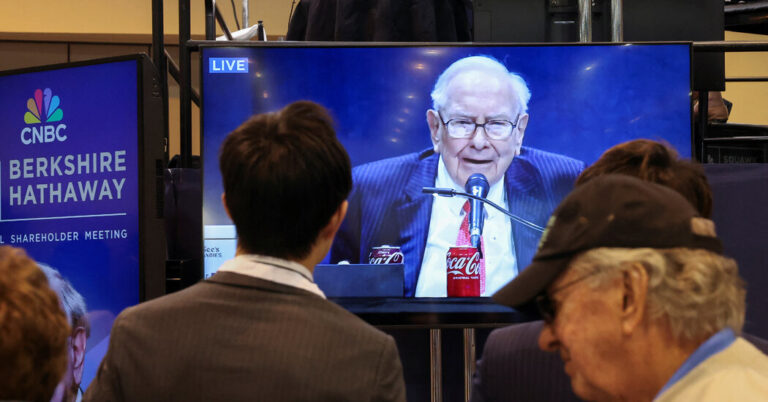
That unparalleled success earned Mr. Buffett millions of admirers around the world. Tens of thousands of them were on hand at Berkshire’s annual meeting in Omaha on Saturday when he declared he finally planned to step down as chief executive.

His announcement was greeted with surprise and then minutes of thundering applause from shareholders — many of whom became millionaires by owning Berkshire stock and hang onto his every financial aphorism.

“I tell people everything I know about investing I learned from Warren Buffett,” Bill Ackman, the billionaire hedge fund manager who was in the crowd, said in an interview after Mr. Buffett’s announcement.

Mr. Buffett has acknowledged that his enormous fortune owes no small debt to pure luck. As he has put it, he won “the ovarian lottery” by being born in the United States, when stock markets were primed to create one of the biggest economic booms in modern history.

He learned about stock picking from a pioneer of value investing, Benjamin Graham, who was his professor at Columbia University. With crucial advice from Charles T. Munger, a fellow Nebraskan who became his longtime business partner, Mr. Buffett turned Berkshire, which he bought control of in 1965, into the best-possible argument for the discipline.

But few lived and breathed the discipline as he did, reading corporate balance sheets for research — and fun — from dawn to dusk.

Mr. Buffett then put that knowledge to work in several ways. Berkshire bought a vast array of successful businesses, including See’s Candy, Fruit of the Loom and the private jet service NetJets. But the most transformative were the acquisitions of insurers like National Indemnity and Geico, which sat on premiums that customers paid but hadn’t yet claimed.

That cash, known as the “float,” became the first financial engine of Mr. Buffett’s deal machine. He used that money, along with profits from the company’s other businesses, to buy what is now a collection of 189 companies. Among the biggest are the BNSF railroad, acquired in 2010 for about $26 billion; and the electricity producer Berkshire Hathaway Energy, purchased in 2000 for $2 billion that was then expanded via its own acquisitions.

As of March 31, that cash pile, which Mr. Buffett has called his “elephant gun,” was nearly $348 billion.

Those who have sat across from Mr. Buffett at negotiating tables over the years have said that he is friendly and courteous — but unyielding when it comes to the numbers. When he is involved, rounds of haggling over price are not in the cards; he is ready to walk away.

“Warren is the most disciplined investor and the clearest thinker I’ve ever known,” said Byron Trott of the merchant bank BDT & MSD, who as a Goldman Sachs deal maker became one of the few bankers Mr. Buffett said he trusted. “His ability to distill complexity into clarity, and to lead with humility and conviction, is unmatched.”

Mr. Buffett also used Berkshire’s cash to buy an array of stocks, with a portfolio that includes American Express, Bank of America, Coke, Chevron and — in one of his most profitable investments — Apple. For those companies, Berkshire’s ownership has tended to be the equivalent of a Good Housekeeping Seal of approval.

And with Berkshire’s huge balance sheet and Mr. Buffett’s unparalleled control, the conglomerate has been able to swoop in at opportune times, buying when others must sell.

Mr. Buffett has been “an extraordinary investor in American Express and a personal friend to me,” Stephen Squeri, the chief executive of American Express, said after the Berkshire announcement.

Another key to his success was holding onto investments for ages — “our favorite holding period is forever,” he has said — letting returns compound again and again, a process that he has compared to a snowball rolling downhill. (A biography that Mr. Buffett cooperated with, but later critiqued, is named after the phenomenon.)

Berkshire’s other advantage for its investors is that it charges no fees, unlike mutual funds or hedge funds. In fact, Mr. Buffett has criticized the size of the fees charged by Wall Street vehicles.

That said, Mr. Buffett has admitted that he made plenty of mistakes over the years. One was passing up opportunities to invest early in technology giants like Amazon and Microsoft, whose businesses he said he didn’t understand at the time.

Still, despite several periods of underperformance, especially in recent years, Mr. Buffett’s track record is astounding. According to his calculations, Berkshire gained 5,502,284 percent from 1964 through 2024, compared with the S&P 500’s 39,054 percent over the same period. His average annual gain was 19.9 percent, while the S&P’s was 10.4 percent.

Mr. Buffett’s approach has inspired countless other financiers, including Mr. Ackman and the mutual fund mogul Mario Gabelli. (Others have sought to copy it more directly, including Sardar Biglari, whose own financial vehicle, Biglari Holdings, shares Berkshire’s initials, website design and investing focus.)

Yet Mr. Buffett transcended business renown and attained actual celebrity, drawing on a folksy Nebraska persona that eschewed the usual trappings of plutocratic wealth. Fans make pilgrimages to his longtime house in Omaha and favorably cite his preferences for mainstream products like Cherry Coke, Dairy Queen Blizzards and See’s fudge. (All, notably, are associated with Berkshire.)

He also became known in pop culture, via cameo appearances on television shows including “All My Children” and “The Office.”

He poked fun at what he saw as the failing of the business world and Wall Street, in particular, regularly deriding professional brokers and traders for turning the markets into a “gambling parlor” that could lure average investors into financial ruin.

He took a more serious stand against Wall Street’s excesses in 1991 when as a major shareholder of Salomon Brothers, he was forced to bail out the investment bank after a trading scandal. It was a low moment in Mr. Buffett’s career.

Called to testify before Congress about Salomon, Mr. Buffett delivered a steely message to the firm’s employees: “Lose money for the firm, and I will be understanding; lose a shred of reputation for the firm, and I will be ruthless.”

His fame also gave him unique sway in Washington, adding weight to his pronouncements on political and fiscal issues. Mr. Ackman said that policymakers also closely followed Mr. Buffett’s comments and annual letters, and acted on his ideas like treating stock options for executives as a corporate expense.

Though a Democrat who endorsed Hillary Clinton for president and whose name graced an Obama-era proposal for higher taxes on the wealthy, Mr. Buffett advised presidents from both parties. That was most visible in 2008, when he was beseeched by corporate executives and the George W. Bush administration to help the global financial system from melting down.

Mr. Buffett eventually agreed to invest billions in Goldman Sachs and General Electric, moves that Mr. Ackman compared with J.P. Morgan’s efforts to save banks early in the 20th century. True to form, however, he charged both companies a then-astronomical interest rate of 10 percent — a burden executives have said they were willing to pay to gain his imprimatur and survive.

“Warren Buffett represents everything that is good about American capitalism and America itself,” Jamie Dimon, the chief executive of JPMorgan Chase, said after Saturday’s announcement.

While the future of Berkshire appears financially solid, with Mr. Ackman calling the company “the Rock of Gibraltar,” longtime Buffett followers say that it may not retain its seemingly mythical status without its chief architect.

Berkshire’s next chief executive, Gregory Abel, is regarded as an excellent operator of businesses and a savvy deal maker, and Mr. Buffett hired Todd Combs and Ted Weschler as high-level investment executives more than a decade ago.

To Lawrence Cunningham, a former law professor at George Washington University and a shareholder, Mr. Buffett has “given Berkshire the best possible chance for the next chapter.”

But other investors worry that the company will become a bit less special, and won’t revolve around the stock picking that put it on the map. Bill Smead, whose investment firm owns Berkshire stock and who attended this year’s annual meeting, said the company has already become less ambitious, eschewing potentially transformative deals.

“It’s the end of an era,” Mr. Smead said.


Source link

How Warren Buffett Changed the Way Investors Thought of Investing

0


Warren E. Buffett’s approach to investing is deceptively simple.

“Forget what you know about buying fair businesses at wonderful prices; instead, buy wonderful businesses at fair prices,” he once wrote to shareholders of Berkshire Hathaway, his business conglomerate.

This method — known as value investing — had existed long before Mr. Buffett, now 94, began his career. But no one did it as well — or for as long — as he did. And in the process, he influenced generations of financiers, including Wall Street hedge fund moguls, and promoted the now-common advice about investing for the long term.

Over the 60 years that Mr. Buffett has controlled Berkshire Hathaway, he used value investing to turn a failing textile manufacturer into a $1.1 trillion conglomerate, corporate takeover machine and microcosm of the U.S. economy. One of America’s largest railroads? Owned by Berkshire. The biggest shareholder in American Express and Coca-Cola? Berkshire, too.

Mr. Buffett amassed a Midas-like personal fortune, valued at about $168 billion, and along the way became the avuncular avatar of American-style capitalism who was called upon for help by both corporate executives and government officials in the 2008 financial crisis.

That unparalleled success earned Mr. Buffett millions of admirers around the world. Tens of thousands of them were on hand at Berkshire’s annual meeting in Omaha on Saturday when he declared he finally planned to step down as chief executive.

His announcement was greeted with surprise and then minutes of thundering applause from shareholders — many of whom became millionaires by owning Berkshire stock and hang onto his every financial aphorism.

“I tell people everything I know about investing I learned from Warren Buffett,” Bill Ackman, the billionaire hedge fund manager who was in the crowd, said in an interview after Mr. Buffett’s announcement.

Mr. Buffett has acknowledged that his enormous fortune owes no small debt to pure luck. As he has put it, he won “the ovarian lottery” by being born in the United States, when stock markets were primed to create one of the biggest economic booms in modern history.

He learned about stock picking from a pioneer of value investing, Benjamin Graham, who was his professor at Columbia University. With crucial advice from Charles T. Munger, a fellow Nebraskan who became his longtime business partner, Mr. Buffett turned Berkshire, which he bought control of in 1965, into the best-possible argument for the discipline.

But few lived and breathed the discipline as he did, reading corporate balance sheets for research — and fun — from dawn to dusk.

Mr. Buffett then put that knowledge to work in several ways. Berkshire bought a vast array of successful businesses, including See’s Candy, Fruit of the Loom and the private jet service NetJets. But the most transformative were the acquisitions of insurers like National Indemnity and Geico, which sat on premiums that customers paid but hadn’t yet claimed.

That cash, known as the “float,” became the first financial engine of Mr. Buffett’s deal machine. He used that money, along with profits from the company’s other businesses, to buy what is now a collection of 189 companies. Among the biggest are the BNSF railroad, acquired in 2010 for about $26 billion; and the electricity producer Berkshire Hathaway Energy, purchased in 2000 for $2 billion that was then expanded via its own acquisitions.

As of March 31, that cash pile, which Mr. Buffett has called his “elephant gun,” was nearly $348 billion.

Those who have sat across from Mr. Buffett at negotiating tables over the years have said that he is friendly and courteous — but unyielding when it comes to the numbers. When he is involved, rounds of haggling over price are not in the cards; he is ready to walk away.

“Warren is the most disciplined investor and the clearest thinker I’ve ever known,” said Byron Trott of the merchant bank BDT & MSD, who as a Goldman Sachs deal maker became one of the few bankers Mr. Buffett said he trusted. “His ability to distill complexity into clarity, and to lead with humility and conviction, is unmatched.”

Mr. Buffett also used Berkshire’s cash to buy an array of stocks, with a portfolio that includes American Express, Bank of America, Coke, Chevron and — in one of his most profitable investments — Apple. For those companies, Berkshire’s ownership has tended to be the equivalent of a Good Housekeeping Seal of approval.

And with Berkshire’s huge balance sheet and Mr. Buffett’s unparalleled control, the conglomerate has been able to swoop in at opportune times, buying when others must sell.

Mr. Buffett has been “an extraordinary investor in American Express and a personal friend to me,” Stephen Squeri, the chief executive of American Express, said after the Berkshire announcement.

Another key to his success was holding onto investments for ages — “our favorite holding period is forever,” he has said — letting returns compound again and again, a process that he has compared to a snowball rolling downhill. (A biography that Mr. Buffett cooperated with, but later critiqued, is named after the phenomenon.)

Berkshire’s other advantage for its investors is that it charges no fees, unlike mutual funds or hedge funds. In fact, Mr. Buffett has criticized the size of the fees charged by Wall Street vehicles.

That said, Mr. Buffett has admitted that he made plenty of mistakes over the years. One was passing up opportunities to invest early in technology giants like Amazon and Microsoft, whose businesses he said he didn’t understand at the time.

Still, despite several periods of underperformance, especially in recent years, Mr. Buffett’s track record is astounding. According to his calculations, Berkshire gained 5,502,284 percent from 1964 through 2024, compared with the S&P 500’s 39,054 percent over the same period. His average annual gain was 19.9 percent, while the S&P’s was 10.4 percent.

Mr. Buffett’s approach has inspired countless other financiers, including Mr. Ackman and the mutual fund mogul Mario Gabelli. (Others have sought to copy it more directly, including Sardar Biglari, whose own financial vehicle, Biglari Holdings, shares Berkshire’s initials, website design and investing focus.)

Yet Mr. Buffett transcended business renown and attained actual celebrity, drawing on a folksy Nebraska persona that eschewed the usual trappings of plutocratic wealth. Fans make pilgrimages to his longtime house in Omaha and favorably cite his preferences for mainstream products like Cherry Coke, Dairy Queen Blizzards and See’s fudge. (All, notably, are associated with Berkshire.)

He also became known in pop culture, via cameo appearances on television shows including “All My Children” and “The Office.”

He poked fun at what he saw as the failing of the business world and Wall Street, in particular, regularly deriding professional brokers and traders for turning the markets into a “gambling parlor” that could lure average investors into financial ruin.

He took a more serious stand against Wall Street’s excesses in 1991 when as a major shareholder of Salomon Brothers, he was forced to bail out the investment bank after a trading scandal. It was a low moment in Mr. Buffett’s career.

Called to testify before Congress about Salomon, Mr. Buffett delivered a steely message to the firm’s employees: “Lose money for the firm, and I will be understanding; lose a shred of reputation for the firm, and I will be ruthless.”

His fame also gave him unique sway in Washington, adding weight to his pronouncements on political and fiscal issues. Mr. Ackman said that policymakers also closely followed Mr. Buffett’s comments and annual letters, and acted on his ideas like treating stock options for executives as a corporate expense.

Though a Democrat who endorsed Hillary Clinton for president and whose name graced an Obama-era proposal for higher taxes on the wealthy, Mr. Buffett advised presidents from both parties. That was most visible in 2008, when he was beseeched by corporate executives and the George W. Bush administration to help the global financial system from melting down.

Mr. Buffett eventually agreed to invest billions in Goldman Sachs and General Electric, moves that Mr. Ackman compared with J.P. Morgan’s efforts to save banks early in the 20th century. True to form, however, he charged both companies a then-astronomical interest rate of 10 percent — a burden executives have said they were willing to pay to gain his imprimatur and survive.

“Warren Buffett represents everything that is good about American capitalism and America itself,” Jamie Dimon, the chief executive of JPMorgan Chase, said after Saturday’s announcement.

While the future of Berkshire appears financially solid, with Mr. Ackman calling the company “the Rock of Gibraltar,” longtime Buffett followers say that it may not retain its seemingly mythical status without its chief architect.

Berkshire’s next chief executive, Gregory Abel, is regarded as an excellent operator of businesses and a savvy deal maker, and Mr. Buffett hired Todd Combs and Ted Weschler as high-level investment executives more than a decade ago.

To Lawrence Cunningham, a former law professor at George Washington University and a shareholder, Mr. Buffett has “given Berkshire the best possible chance for the next chapter.”

But other investors worry that the company will become a bit less special, and won’t revolve around the stock picking that put it on the map. Bill Smead, whose investment firm owns Berkshire stock and who attended this year’s annual meeting, said the company has already become less ambitious, eschewing potentially transformative deals.

“It’s the end of an era,” Mr. Smead said.


Source link