Home Blog Page 336

Houthi Missile Hits Near Tel Aviv Airport


A ballistic missile launched from Yemen struck near the main terminal of Israel’s international airport close to Tel Aviv on Sunday, after the military failed to intercept the projectile seemingly aimed at one of the country’s most sensitive locations.

The strike, carried out by the Iranian-backed Houthi militia, resulted in a temporary suspension of flights. There were no immediate reports of fatalities.

Israel’s military said that several efforts were made to intercept the missile and that an impact was identified in the area of Ben Gurion Airport. The military added that the episode was under review.

The Magen David Adom emergency ambulance service said it was treating four people who were mildly or moderately injured by the blast and two others who were injured while running for shelter.

Prime Minister Benjamin Netanyahu called an urgent consultation of his security cabinet on Sunday. In a video posted shortly after on social media, Mr. Netanyahu stopped short of issuing a specific threat of retaliation.

“We have acted in the past, we will act in the future,” he said of the Houthis. He also noted that the United States was targeting the Houthis in Yemen, in coordination with Israel.

Israel Katz, the country’s defense minister, had suggested soon after the attack that there would be a harsh response.

“Whoever harms us will be harmed by us sevenfold,” Mr. Katz said in a statement.

The airport resumed operations about an hour after the strike, but some international airlines canceled scheduled arrivals and departures.

The Houthi militia began firing missiles at Israel more than a year ago in solidarity with Hamas, the Iran-backed group in the Gaza Strip. It has stepped up its attacks since Israel ended a cease-fire in Gaza in mid-March.

Sunday’s missile, which struck at the start of the workweek in Israel, was the fourth by the Houthis targeting Israel over the past 48 hours. The other three were intercepted.

Israel’s Arrow aerial-defense system, which is able to hit targets high in the atmosphere or beyond the atmosphere, has been successful in thwarting many long-range missile attacks. In October, the United States sent Israel a THAAD advanced missile defense system to assist in fending off attacks by Iran and its allies.

But by slipping through all of the defenses, the strike near the airport was one the biggest successes for the Houthis in recent months — and one of the most serious failures for Israel.

The Houthi military spokesman, Yahya Saree, claimed responsibility for targeting the airport and, in a video statement, warned international airlines to stay away from Ben Gurion for their own safety.

Hamas praised the missile attack, which came hours after Israel’s military announced that it would mobilize thousands of additional reserve soldiers to bolster its campaign in Gaza.

More than 50,000 Palestinians have been killed in Israel’s military campaign against Hamas in Gaza, according to health officials in the enclave, who do not distinguish between combatants and civilians. The war began after Hamas led an attack on Israel in October 2023, killing about 1,200 people and taking roughly 250 others back to Gaza as hostages.

Israel says its military operations in Gaza are aimed at destroying Hamas and pressuring the group into freeing dozens of captives still held there. Mr. Netanyahu on Sunday refused to detail the military plans for Gaza but again vowed to achieve “total victory” over Hamas.

In recent months, Israel had refrained from striking back at the Houthis in Yemen as the United States intensified attacks targeting the group. Since the fall of 2023, the Houthis have repeatedly attacked commercial and naval ships in the Red Sea and the Gulf of Aden in support, they say, of Palestinians under bombardment in Gaza.

After Sunday’s strike near the airport, Israel’s opposition leaders took the government to task for failing to stop the missiles that have set off sirens across the country and sent millions of civilians rushing into bomb shelters, often in the middle of the night.

Benny Gantz, a former Israeli military chief and now the leader of a centrist opposition party, urged Mr. Netanyahu’s government to “wake up” and retaliate against Iran, even as the Trump administration is negotiating with Tehran over curbing its nuclear program.

“This isn’t Yemen — this is Iran,” Mr. Gantz said in a statement posted on social media. “Iran is the one firing ballistic missiles at the state of Israel, and it must bear the responsibility.”

Videos and images posted on social media on Sunday showed a large plume of dark smoke rising from an open area near Terminal 3 at the airport, the main international terminal, as sirens wailed and people ran for cover.

Large missile fragments could be seen on the ground outside the entrance to the building, and a road near the airport appeared to be covered in dirt and shrapnel. Footage on social media showed the police gathered in a muddy field nearby inspecting a large, deep crater.

In a statement shortly before the attack, the Israel Airport Authority said that 422 flights had been scheduled to arrive or depart on Sunday.

Myra Noveck, Adam Rasgon and Gabby Sobelman contributed reporting.



Source link

European Darts Grand Prix LIVE! Updates from final day with Luke Humphries, Gary Anderson and Rob Cross among players in action | Darts News

0


Updates from the final day of the European Darts Grand Prix in Sindelfingen, Germany with Luke Humphries and Rob Cross among the players in action; Luke Littler opted out of the tournament, while Michael van Gerwen, Gerwyn Price and Nathan Aspinall were knocked out in the second round


Source link

Would the Housing Crisis Ease if Boomers Rented Out Their Empty Rooms?

0


Monte Anderson opened a broom closet in his kitchen and pointed to a door handle near a mop and a trash can. Somewhere on the other side lay one small solution to America’s affordable housing crisis.

Mr. Anderson is a developer who rehabs commercial and residential buildings in and around Dallas, including the ranch-style house where he lives, for now, with three kind-of-sort-of roommates. The 2,400-square-foot home has been split into four studio apartments. Each has an outdoor entrance, but also connects to another unit through a door like the one in his kitchen closet.

The connecting doors are locked and hidden because they’re designed to not be used. The main reason for their existence is that they allow Mr. Anderson to claim he lives in a single-family home, in accordance with local zoning codes, when in reality the home contains four apartments in a country that needs more of them.

“This is a suburban retrofit,” Mr. Anderson, 66, said during the tour.

Economists estimate that America needs between four million and eight million more homes. Their prescription is to build a lot of new houses and apartment complexes. It’s a remedy that politicians from both parties agree with in principle, but that is bound to take decades to accomplish.

It takes money to buy land, time to secure permits. In the meantime, construction costs have exploded. That’s why most new homes tend to be luxury rentals or higher-cost houses, rather than something a person with a middle or lower income can afford. Those lower-cost units, however, are the ones in the shortest supply.

This imbalance has turned policymakers and entrepreneurs like Mr. Anderson toward a large and underappreciated market: the 145 million or so homes that already exist.

About two-thirds of America’s housing stock consists of single-family homes. Apartment buildings are essentially banned from large swaths of major metropolitan areas, where most of the land is zoned for low-density neighborhoods. Mr. Anderson is trying to find a loophole by guiding single-family homes toward a new, multifamily life.

There was a time when big houses were what the United States needed. When Mr. Anderson’s house was built in the 1970s, American mothers had more than three children on average, according to the Pew Research Center.

Today that’s shifted: People are marrying at older ages or not at all, having fewer children (an average of two for mothers in 2020, according to Pew) and increasingly living with other adults in their families. The result is a housing mismatch in which older people live in big houses with empty bedrooms while single adults and families with few children are looking for smaller, more affordable places.

The roommate house” — Mr. Anderson’s name for his chopped-up ranch home — is designed for this new world. A serial rehabber, Mr. Anderson has taken on strip malls, a movie theater and a former wax paper plant that now contains some 70 small businesses, including a microbrewery, a boxing gym and a mishmash of artisans who sell things like jewelry and housewares.

All of his projects are scattered around Dallas and its suburbs, a region where he has spent his entire life. But within that area, Mr. Anderson stays on the move, often taking residence in whatever new thing he has just built. For a while, he lived in a boutique hotel, then moved to an apartment complex he had redeveloped. Now he’s in the chopped-up house.

“Sometimes I have to do it for financial reasons, but mostly I do it to see what I’ve done right and what I’ve done wrong,” Mr. Anderson said. “To do the experiment, I have to live in it.”

The units in the roommate house rent for $1,800, including utilities. At that price, it’s not affordable for low-income tenants. But he is providing a haven for a 27-year-old woman who works in an assisted-living facility, a 70-year-old bookkeeper and Mr. Anderson’s 20-year-old granddaughter, who is a real estate agent. And to his way of thinking, the building itself stands for something: a proof of concept for a way of living.

Over the past decade, cities and states around the country have tried to encourage ideas like Mr. Anderson’s by making it easier to add rental units to existing structures. Some have passed laws that allow backyard homes and garage and basement units. Others encourage homeowners to subdivide their lots and sell a portion for development.

The goal is to add housing in existing neighborhoods without creating too much disruption — or stirring up residents who don’t like change. In many cases, the efforts have yielded more significant results than attempts to rezone entire cities or add apartment buildings to streets of single-family houses.

Consider California, home of the nation’s biggest affordability crisis. Since 2016, state legislators have proposed a blizzard of housing laws, from forcing suburbs to allow multifamily housing to stripping cities of land-use authority if they don’t approve housing more quickly. Yet when you look at the number of units that have been built since the Legislature started focusing on housing, the humble backyard cottage — an “accessory dwelling unit” in the jargon of city planners — is the main bright spot.

In 2016, before California passed several laws making A.D.U.s easier to build, local governments permitted about 1,000, which in a state of 40 million people is basically zero. In 2023, the state permitted about 23,000, while the number of new single-family homes and apartment buildings remained essentially flat.

The A.D.U. laws created an entrepreneurial boomlet — a literal cottage industry that helps homeowners get permits, build units and use software to identify suitable lots. Phil Levin, a Bay Area technology executive who has become an evangelist for communal living, recently started Live Near Friends, a company that helps people identify plots whose size and regulations are ideal for multiple families to live on.

Ben Bear is the chief executive of BuildCasa, an Oakland company founded in 2022 to take advantage of new California laws that allow homeowners to subdivide their property and sell their backyards for development. The company is a hybrid real estate play that develops some properties but mostly acts as a broker that connects other developers with homeowners who want to add units.

Mr. Bear estimates that the state could add millions of units this way while unlocking billions in value for homeowners. So far, he said, many of his customers are parents who split their lots to build homes for their adult children or are aging homeowners in search of income.

“It’s boomers who bought a long time ago and have paid off their homes and own the biggest lots,” he said.

Mr. Anderson, in Dallas, sometimes rents his rooms through PadSplit, an Atlanta-based company that is essentially a roommate version of Airbnb: Its software platform connects tenants looking for rooms with homeowners looking for renters.

Living arrangements have always shifted with culture and the economy. During World War II, another grinding housing shortage prompted Americans to carve up homes and create rooming hotels in major cities. The shortage eased during the postwar building boom, as developers mass-built the modern suburbs, often with modest two- and three-bedroom houses.

At the same time, the composition of households shifted from multigenerational groupings toward a mix of nuclear and single-parent households. That trend has started to reverse.

In a new book, “Doubled Up,” Hope Harvey, a professor of public policy at the University of Kentucky, documents how high rents, the precarious job market and the need to care for older parents or young children has made multigenerational households far more common.

This shift is most prevalent among lower-income households and reflects yawning inequality and a fraying safety net, along with the housing shortage. But the trend has moved steadily up the income ladder as rent and home prices have escalated.

“The housing market is so expensive, the child care market is so expensive, that these families feel that to pursue their goals they have to double up,” Dr. Harvey said in an interview.

These are usually economic decisions: Dr. Harvey said most of the people she had talked to for her book described living in someone else’s home as a temporary arrangement. Most people don’t want to deal with grating annoyances like sharing a living room, or immediately cleaning up dishes because they live with a neat freak. Some don’t like never being alone.

Mr. Anderson said his roommate house was designed with this aversion to togetherness in mind. He bought the house for $300,000 when it was borderline uninhabitable — a wrecked kitchen, drained pool, leaking roof — and spent about $1 million renovating it. He also added a backyard house that looks onto a resurfaced pool. A wooden deck, gravel walkways and cactus landscaping give the grounds a midcentury desert vibe.

“It’s not exactly where I want to live myself,” he said. “Although I kind of like it.”

Including the apartment Mr. Anderson currently lives in, the rents would bring in a little over $9,000 a month, which is just enough to cover the mortgage and expenses.

Why build something with so little financial upside? Mr. Anderson’s hope, he said, is that the project will inspire others and show cities that multifamily living can coexist in single-family neighborhoods. This, he argued, would bring in more tax revenue, raise real estate values and possibly inspire others to hire his company to develop more homes like his.

Plus, while the paltry returns might not entice Wall Street, he said, “it’s a financial winner if you have an elderly parent who can live here instead of assisted living.”

As we walked through a newly vacant unit — a consultant who used to live there moved to North Carolina — Mr. Anderson said his aim is to create a happy medium with lower-cost units and a sense of community. But that community only works because people can keep the doors closed and ignore each other.


Source link

My Boss Wants to Sleep on My Couch Every Week

0


Even if it’s already happened. (You say that this is supposed to take place in a matter of weeks, if not sooner.) If this is the case, you must tell your boss that you’ve changed your mind about having her stay over and that she’ll have to make other arrangements.

You are allowed to say “no.”

And you are allowed to say “no” after the fact.

Let me repeat. You are allowed to say “no” after the fact.

It’s interesting that you consulted ChatGPT. More and more of my friends are doing the same thing for advice. I put your exact query, word for word, into the application to see what it would have to say. I wasn’t impressed. The A.I. made all the right points — stressing the importance of maintaining professional boundaries and being aware of power dynamics — but these are things you already know. It also suggested that you offer alternatives “like suggesting a hotel or a nearby rental.” But this is unhelpful. Not only does it suggest that this is your problem to solve, it assumes that, in addition to your boss being unprofessional, she is also stupid. Which might only add fuel to the fire. I mean, this conversation is going to be hard enough as it is.


I work as an administrator in a small firm with two bosses, several partners, and just a few administrators. Our newest administrator has been with us less than a year. The firm allows for flexible work time, and the new admin and I usually work as late as 6:30 (the bosses and the head administrator usually leave around 5 p.m.).

I’ve noticed, when left working late with our new admin, that she frequently spends that time on her phone, not working. It is extremely frustrating, as I have a huge workload and wasting time like that is unthinkable to me. But I don’t know what to do about it — I’m not in a supervisory role to this co-worker, so I tell myself just to do my own work and keep my nose clean.

I think the standard advice would be to let the bosses discover this on their own — but they are rarely there to observe the behavior. Tattling on this co-worker seems childish, but I don’t know if speaking to her directly is wise, either. What should I do?

— Anonymous

“I’m not in a supervisory role to this co-worker, so I tell myself just to do my own work and keep my nose clean,” you write. You’ve already answered your own question. You have to stay out of it.


Source link

Trump Battles Universities, but Especially Harvard and the Ivy League


What is correct is that the president’s war on academia has focused intensely on the Ivy League, the richly endowed collection of eight schools, most founded in the colonial era, that cost $90,000 or more a year, send a disproportionate number of graduates into America’s leadership class and accounted for less than 1 percent of the nation’s undergraduate enrollment in the fall of 2022.

Mr. Trump’s attacks on this elite group — Harvard, Yale, Princeton, Columbia, Cornell, Brown, Dartmouth and the University of Pennsylvania — have endeared him to his political base. He is withholding, or threatening to withhold, billions of dollars in federal funding from six of the eight schools because, he says, they are citadels of antisemitism and liberal indoctrination. Officials in higher education acknowledge failures, but call the president’s crackdown a perilous threat to academic freedom.

The Trump administration has targeted many other colleges and universities for potential antisemitism, some 60 in all. And yet the eight Ivies are cultural touchstones for Mr. Trump. Beyond the politics is a complex brew of resentment and reverence that the president, an Ivy League graduate himself, has long harbored for a club that has never really accepted him.

“They don’t return the love to him,” said Alan Marcus, a business and political consultant who oversaw Mr. Trump’s public relations from 1994 to 2000. After the president’s companies went through multiple bankruptcies in the 1990s, Mr. Marcus said that as part of an attempted comeback for his client he tried to get Mr. Trump to deliver a college commencement address or receive an honorary degree.

“I called a few people I knew on boards,” Mr. Marcus said. “But I got essentially laughed at.”

Timothy L. O’Brien, a biographer of Mr. Trump, said the president’s ire about the upper echelon of academia was not surprising. “He has a long track record of criticizing elites that he desperately wants to be accepted by,” Mr. O’Brien said. As far as the Ivy League, he said, “he could barely wait to get in himself.”


Source link

Who Is Gregory Abel, Warren Buffett’s Successor?

0


Investors had speculated in recent years that Warren E. Buffett might eventually retire. But the 94-year-old billionaire still surprised many on Saturday, when he announced that he planned to step down as chief executive of Berkshire Hathaway after nearly six decades.

Less surprising is who he said he intended to succeed him as the leader of the $1.1 trillion conglomerate he built: Gregory E. Abel, his yearslong heir apparent.

Since 2018, Mr. Abel, 62, has been vice chairman of Berkshire’s non-insurance companies, the 189 operating businesses that include the BNSF railroad, one of the nation’s largest; Berkshire Hathaway Energy, a giant power utility; restaurant chains and retailers like Dairy Queen and the Borsheims jewelry chain; consumer brands such as Fruit of the Loom underwear, Brooks running shoes and Justin Boot; NetJets, the private jet service; and more.

Mr. Abel’s vast responsibilities came after a steady rise through Berkshire’s ranks. A native of Edmonton, Alberta, and an accountant by training, he joined the conglomerate in 2000 when Mr. Buffett bought a controlling stake in what was MidAmerican Energy, where he was president.

Mr. Abel was named vice chairman of Berkshire in 2018, anointing him as a potential successor to Mr. Buffett, a status that Mr. Buffett confirmed in 2021. “The directors are in agreement that if something were to happen to me tonight, it would be Greg who’d take over tomorrow morning,” Mr. Buffett told CNBC at the time.

Aside from his work experience, Mr. Abel is known for his love of hockey, which he played as a child: He is a volunteer coach for his son’s team in Des Moines, where he lives and where Berkshire Hathaway Energy is based.

The relatively low-profile Mr. Abel has won praise from Mr. Buffett and others in the Berkshire orbit over the years for two key qualities.

The first is his operating expertise. He helped lead a string of acquisitions that turned MidAmerican — renamed Berkshire Hathaway Energy in 2014 — into a major power producer. Since his elevation in 2018, he has overseen a much broader collection of businesses that together reported more than $5 billion in operating earnings in the first three months of this year.

Mr. Buffett has praised his heir apparent as an effective executive whom he trusted to make big decisions. By 2023, Mr. Buffett told CNBC, Mr. Abel “does all the work and I take all the bows.” The billionaire added, “He’s a big improvement on me, but don’t tell anybody.”

Mr. Abel’s other quality is that he is seen as fitting the Berkshire mold. He became a more serious contender to take over the conglomerate in 2011, when David Sokol, his former boss at MidAmerican who had been known as Mr. Buffett’s chief fixer, resigned. Berkshire had concluded Mr. Sokol violated company policies by buying about $10 million in shares of Lubrizol, a maker of specialty chemicals, while orchestrating an acquisition of the company.

The lower-key Mr. Abel, however, has been seen as cut from similar cloth as Mr. Buffett. “Greg will keep the culture,” Charles T. Munger, then Berkshire’s vice chairman and Mr. Buffett’s longtime business partner, told shareholders at the company’s 2021 annual meeting. The comment immediately set off succession speculation, which Mr. Buffett confirmed days later.

Mr. Abel has assumed more public duties in recent years, including sitting onstage for hours with Mr. Buffett at Berkshire’s annual meetings to answer investors’ questions.

Though Mr. Buffett won renown as one of the most successful stock pickers of all time, his successor’s strengths lie more in running businesses. That is in part a reflection of what Berkshire is today: an empire of often-disconnected businesses that together employ more than 392,000 workers.

Mr. Abel is not expected to choose the companies that go into Berkshire’s investment portfolio — the company already has two executives, Todd Combs and Ted Weschler, who were hired by Mr. Buffett to help with that. But he will oversee the kinds of big deals that the conglomerate is perhaps uniquely able to strike, given the $347.7 billion in cash that it is sitting on. (Mr. Buffett has called that his “elephant gun.”)

That will present a big challenge, however. For years, Mr. Buffett has not struck those kinds of acquisitions. And he has acknowledged that Berkshire is so large that it is hard to find a takeover target big enough to meaningfully augment its earnings.


Source link

Anthony Joshua needs elbow surgery, boxing return delayed amid Tyson Fury fight speculation | Boxing News

0


Anthony Joshua revealed he will need surgery to resolve an elbow injury.

He expects the procedure to keep him from making a full return to training for six to eight weeks.

Joshua hasn’t boxed since suffering a crushing knockout defeat to IBF heavyweight champion Daniel Dubois last September.

But the former unified titlist does intend to return to the sport.

“When do you want me back?” Joshua said, when speaking to DAZN. “I’m trying to get my body right. I have got to actually have a little surgery on my elbow.

“A small surgery sometime in May. I’m finalising the details,” he continued. “That will see me out of the gym for maybe six to eight weeks, and then when I’m healed, I will be back.”

Please use Chrome browser for a more accessible video player

Boxing promoter Frank Warren says he would fully support Tyson Fury if he decides to make a return to the ring – adding that a showdown with Anthony Joshua is the fight everyone wants to see.

It means Joshua will only box once in 2025.

Speculation is mounting that Joshua could eventually fight long-time rival Tyson Fury in a non-title bout later this year.

Fury, who announced his retirement earlier this year, has posted footage of himself with trainer SugarHill Steward on social media which suggests he is training still himself.

Please use Chrome browser for a more accessible video player

Daniel Dubois says ‘he can do better’ than his fifth-round knockout performance against Anthony Joshua in his rematch with Oleksandr Usyk.

Promoter Frank Warren told Sky Sports: “It’s up to Tyson [if he comes back]. He may want to do that, if he does that’s going to his choice. I am not going to in any way try and get him to do that.”

“It all comes down to Tyson, the deal. We’re ready,” Joshua’s promoter Eddie Hearn told Sky Sports. “But there’s no point calling it out because it’s going to take one man to say let’s give the world the biggest fight in boxing. And we live in hope that he [Fury] decides to get it done.

“[Fury boxing training,] that’s a good sign. I’m sure he will be bored soon. Let’s hope he wants to make the biggest fight in boxing.”

Anthony Joshua was knocked out by Daniel Dubois at Wembley (Picture By Mark Robinson Matchroom Boxing).
Image:
Anthony Joshua was knocked out by Daniel Dubois at Wembley in September (Photo: Mark Robinson/Matchroom Boxing).

‘What else would it be?’

Carl Frampton, a boxing expert and former two-weight world champion, thinks Fury must be coming back, with Joshua his most likely target.

“It looks like it doesn’t it. It looks like he’s coming back. Why else would he be training with SugarHill?” Frampton told Sky Sports.

“It has to be [for a Joshua] fight. What else would it be?”

Watch Naoya Inoue’s undisputed title defence against Ramon Cardenas live on Sky Sports from 1am on Monday morning.


Source link

Trump’s Tariffs Create Fear and Uncertainty at Vietnam’s Factories

0


For Vietnam’s legion of factory workers, the mathematics of making a living was complicated enough before President Trump announced a whopping tariff on the goods they make.

Nguyen Thi Tuyet Hanh worked two factory jobs, six days a week, for nearly a year after her husband lost his job in 2023. She had no other choice to help feed their four children and keep them in school.

“It was brutal,” Ms. Hanh, 40, said. Her husband is working full time again at a factory, but Mr. Trump’s plan to put a 46 percent tariff on imports from Vietnam hangs over their family, which lives in a row of concrete tenements on the outskirts of Ho Chi Minh City.

“My family lived through that difficult time — I don’t want to live it again,” said Ms. Hanh, who earns $577 a month as a line manager overseeing 138 workers making shoes for Nike, the French sporting goods company Salomon and other global brands.

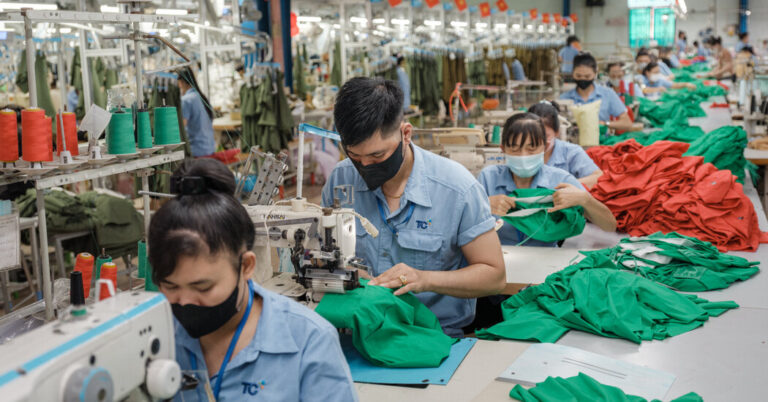
Fear is reverberating on her factory floor, alive with the hum of sewing machines stitching the fabric for shoes that are shipped to the United States. Mr. Trump paused the tariff on Vietnam, and similar levies on dozens of other countries, for 90 days. But it hardly matters here. The destabilizing prospect that the tariffs will be reinstated is already chipping away at Vietnam’s economic growth, which hinges on making things for American consumers.

Vietnam’s textile and garment factories have paper-thin profit margins — an average of 5 percent, executives said. And while some of them have ramped up production to push out orders ahead of the tariff deadline in July, others have started to cut jobs or have frozen hiring as American retailers have begun to cancel orders.

No country has grown more as a manufacturing economy over the past 15 years than Vietnam. But in that time, it has also become increasingly dependent on demand from the United States, which contributed to more than a quarter of its economy last year.

“Everyone is living in great uncertainty now,” said Tran Nhu Tung, chairman of Thanh Cong, a Vietnamese garment manufacturer with factories and a mill in five locations. Its 6,000 workers make clothes for Eddie Bauer, New Balance, Adidas and others.

Mr. Tung’s customers in the United States have started asking Thanh Cong to lower its prices. “This is a great pressure for the company because the profit margin is very low,” he said.

Soon after the tariffs were announced, the management team at Thanh Cong began to discuss other regions where it could sell its wares, like the Middle East and Europe. The company is also talking to its American customers to make sure they can afford hefty new import taxes.

“I don’t want to lay off people,” Mr. Tung said. “We try everything to keep our people here.”

Thanh Cong has gotten requests from some of its American retail customers to increase production, and the company is trying to accommodate that. Mr. Tung is optimistic that his government can strike a deal with the Trump administration. Whatever the two countries settle on will matter for the future of his business.

Hours after Mr. Trump announced reciprocal tariffs on nearly 60 countries, Vietnam’s top leader, To Lam, called him and offered to reduce tariffs on American imports to zero, urging the United States to follow. He then sent a letter to Mr. Trump, requesting a meeting in person with the president in Washington at the end of May to “jointly come to an agreement.”

Mr. Tung, who is also the vice chairman of the Vietnam Textile and Apparel Association, said the breaking point for most factories would be a final tariff that was much more than 20 percent.

Garments from Vietnam are currently taxed at nearly 28 percent. This includes a new tariff of 10 percent that the Trump administration placed on all countries on April 2, in addition to an existing tariff of roughly 18 percent on all Vietnamese garments. A final tariff of 20 percent or more would eat deeply into the profits of both factories and their customers.

“In this scenario, the factory has to reduce its net margin, and then the big buyers from the U.S. would have to reduce their margins and the consumers will have to pay more for their garments,” he said.

While things look bad for Vietnam, there is some hope that it will fare better than its neighbor to the north, China, which has been hit especially hard by U.S. tariffs. China’s loss could be Vietnam’s gain. But a failure to substantially lower the 46 percent figure would be a moment of reckoning for thousands of Vietnamese companies that make things to ship to the United States.

For Mian Apparel, it is the uncertainty that is most worrying. Its seven factories and two laundries, mostly in northern Vietnam, employ 12,000 workers who make swimwear, jeans and jackets for brands like Costco, J.C. Penney, Carter’s, Target, Gap and Walmart.

“Uncertainty is not good for business,” said Vu Manh Hung, deputy chief operating officer of Mian Apparel. Clients are pushing him to deliver goods faster. The factories are taking on more workers and finding other ways to produce more before the 90-day pause in tariffs ends.

Tran Quang, an executive at a candle and home fragrance company, said he had not had to fire any workers at his company’s three factories.

But he is anxious because the next few months are normally peak season for his company, which he requested not be named. This is when his factories are filling orders for the Christmas season. Instead of hiring more workers as he usually does around this time, Mr. Quang is holding tight.

Some 90 percent of his company’s customers are in the United States. For weeks after the tariffs were announced, he heard nothing from them. It was unnerving because orders typically come in weekly. In recent days, some clients have begun to cancel orders while others are holding off on new ones.

Some experts have said that if the United States and Vietnam cannot come to an agreement, the Trump administration could extend the pause in tariffs.

For the factories and their workers, this would be just as bad as a high tariff.

“If there is an uncertainty, customers may redirect their supply chain,” Mr. Quang said. “Why should they wait for another 90 days? What if the result is bad?”


Source link

‘People Who Are Salaried Are Crying’: Taxes on Workers Add to Debt Misery

0


The pay stubs tell the story. Hefty deductions to help cover the cost of Kenya’s new funds for affordable housing and health insurance. More money subtracted for jacked-up contributions to the National Social Security Fund and an increase in the tax rate.

In a matter of months, Kenyans with a 45,000-shilling-a-month salary — roughly $350 — saw their take-home pay shrink 9 percent, to $262.

Pay stubs for an employee at Shining Hope for Communities, a nonprofit in Kenya:

JUNE 2024

“People who are salaried are crying,” said Kennedy Odede, the founder of a self-help association in Nairobi’s Kibera slum.

The increased payroll taxes are one element of President William Ruto’s desperate bid to raise revenue to keep the government running and pay off Kenya’s staggering foreign debt.

New excise taxes were put on sugar, alcohol and plastics. A tax on business profits doubled to 3 percent. Government fees for money transfers and for phone and internet data services went up 15 to 20 percent. A tax on every import, including essentials like wheat and cooking oil, to be used for railroad development was increased to 2 percent from 1.5 percent. Some exemptions for retirees were scrapped. The list goes on.

Tax increases are never popular. But the impact on countries like Kenya, with low incomes and crippling debt, is particularly acute. Years of harum-scarum borrowing and spending combined with economic wallops from the Covid-19 pandemic, soaring interest rates and inflation helped drive up Kenya’s debt to $80 billion.

Kenya has to use nearly 60 percent of its revenue for paying off its loans. It is a common problem across Africa, where many countries spend more on interest payments than on health or education.

At the same time, countries need billions of dollars in new financing for basic medical care, schools, clean water, sewage systems, paved roads and climate-related disaster relief.

Getting the country’s finances in order is a prerequisite for long-term growth. But there are limited options to raise such revenue in Kenya, where 40 percent of its 52 million people live in poverty and youth unemployment is estimated to top 25 percent. Small businesses and subsistence agriculture make up much of the economy.

According to one estimate, 83 percent of the country’s labor force works in jobs that are out of tax collectors’ sight, including as hairdressers, maids, street sellers and drivers.

That means the sliver of the population that works in enterprises that record salaries bears most of the tax burden.

“Our buying power has really decreased because of the taxes,” said Elizabeth Okumu, who works at Shining Hope for Communities, or SHOFCO, the nonprofit organization Mr. Odede started two decades ago.

The country’s economic crisis has pushed the value of the shilling lower in relation to the dollar, meaning that the cost of imports has soared. Six months ago, a thousand shillings ($7.73) were enough for cooking oil, flour, rice and sugar, said Ms. Okumu, chairwoman of SHOFCO’s urban network in Nairobi. Now, she said, she can buy only sugar and flour with that same amount.

Last year, proposed tax increases set off deadly riots in Nairobi, the capital. More than 50 people were killed, and part of Parliament was set on fire. The government temporarily backed down, only to reimpose many of the additional taxes and fees a few weeks later.

The government has been talking to the International Monetary Fund about a new loan package. The fund is likely to ask for additional guarantees that the Ruto administration will cut spending and raise more revenue. But you can’t squeeze much water from a wrung-out towel.

Behind the widespread discontent with specific policies is a deep cynicism about the government’s ability to either pay back the debt or provide essential services.

Regular reports from the country’s auditor general, Nancy Gathungu, detail gross examples of corruption or mismanagement. At the end of last year, for example, she said, the government could not account for more than $1.24 billion that had been earmarked for debt payments. In March, Ms. Gathungu reported that $64 million worth of government-funded Covid-19 vaccines had never been delivered. Critics have also fumed about extravagant spending by government officials.

“Ruto says we need to pay our debts, but there are no public services to show for it,” said Tatiana Gicheru, a student at Strathmore University in Nairobi. “I can’t walk into a government hospital and get any services.”

Ms. Gicheru, 21, sat outside Java House, a coffee chain in Nairobi, and sipped a latte with her friend Jewel Ndung’u. Ms. Ndung’u, 25, graduated from Strathmore two years ago and has been looking for full-time work as an analyst or a developer. From September to January, she said, she applied for 73 jobs. She got half a dozen callbacks and no job offers.

Where is the affordable housing? Where are health services and public transportation? Ms. Ndung’u asked. Ms. Gicheru added, “Suddenly the system is crumbling.”

Ms. Ndung’u said she would rather see Kenyans directly pay off the debt to China, the country’s biggest bilateral creditor, by using M-Changa, a digital fund-raising platform, instead of giving the money to the government through taxes and trusting it to do it.

As taxes rise, Kenyans have grown angrier about the lack of public services. In November, a crowd of people frustrated about dilapidated roads in Syokimau, a few miles south of Nairobi’s main airport, jeered as they forced their council representative to walk through flooded, muddy streets.

In the southwestern part of Nairobi is Kibera, considered the largest urban slum in Africa. Its dirt streets teem with shoppers, pedestrian commuters, peddlers, hustlers, students in neat uniforms and residents filling bright yellow jerrycans with clean water from coin-operated taps. They navigate around piles of garbage and occasional raw sewage as well as motorbikes and bicycles hauling oversize loads better suited to a sport utility vehicle. There are no government-funded sanitation services in Kibera.

The jampacked skyline features ramshackle homes of plasterboard, rusted roofs, and a forest of haphazard poles and wires on which illegal electricity hookups hang like Christmas ornaments.

Benedict Musyoka, a youth community organizer in Kibera, said a young man had told him: “I won’t marry.” Earning enough to support himself is hard enough, let alone with a wife and child. And the man had a degree. “You are taxing hard, and we have no jobs,” Mr. Musyoka said.

With Kenya’s level of debt, there are no easy options, said Thys Louw, a portfolio manager at Ninety One, a global investment firm in London. Expanding the revenue base — bringing more businesses and people who are not currently paying taxes into the system — is crucial, he said. And there are too many exemptions.

In Kenya, taxes amounted to 16.6 percent of the country’s total output in 2022, according to the Organization for Economic Cooperation and Development. The share is not unusual in Africa, but half the amount found in richer industrialized nations.

June will be one year since the riots, and talk of commemorative gatherings and further protests is bubbling. That is also when the government will be finishing a new budget, which could possibly include further tax rises.

Many people like Ms. Okumu at SHOFCO fear there will be more riots. People work so hard, she said, hoping “that tomorrow they’ll see the light.”

“But when tomorrow comes, it’s still darkness.”

Abdi Latif Dahir contributed reporting.


Source link

Voters Approve Incorporation of SpaceX Hub as Starbase, Texas


Members of a South Texas community that has served as the hub of Elon Musk’s rocket launch company, SpaceX, voted on Saturday to formally establish a new city called Starbase, fulfilling one of Mr. Musk’s long-held dreams.

All but six of the 218 people who voted supported incorporating the city of Starbase, according to Cameron County, which administered the vote.

There were 283 eligible voters, said Remi Garza, the elections administrator for the county.

The community, known to locals as Boca Chica, covers about 1.5 square miles on a spit of land that brushes up against the Mexican border.

SpaceX broke ground in the area in 2014, and it has since become the company’s central hub and launch site, as well as home to hundreds of its employees.

On his social media platform, X, Mr. Musk has referred to the area as Starbase more than a dozen times in the past four years.

“My primary home is literally a ~$50k house in Boca Chica / Starbase that I rent from SpaceX,” Mr. Musk wrote in June 2021. “It’s kinda awesome though.”

In December, people living around the company offices and launch site filed a petition to officially establish the city of Starbase, Texas.

The petition described a community of about 500 inhabitants, including at least 219 primary residents and more than 100 children. Nearly everyone is a renter and works at SpaceX, according to the petition.

The municipality would be eligible to create its own police and fire departments, as well as to adopt its own ordinances, though it does not have to.

“Cities are required by law to do very little,” said Alan Bojorquez, a lawyer in Austin who specializes in helping Texans through the process of incorporating new municipalities.

Road maintenance is one of the most significant practical issues and would no longer be handled by the county. But, as a municipality, Starbase would be eligible for state and federal grants, would have certain immunity from lawsuits and could also condemn property, Mr. Bojorquez said.

“Starbase started with one shovel,” Mr. Musk said on X shortly after the vote was finalized.

J. David Goodman contributed reporting.


Source link