Home Blog Page 338

Berkshire Reports Drop in Earnings, Mainly From Investment Losses

0


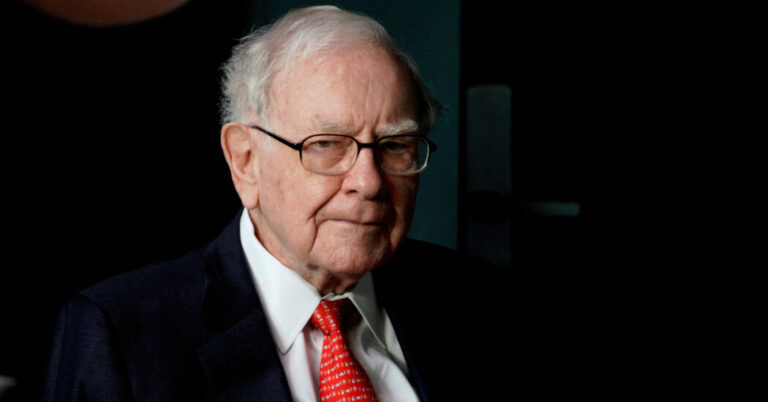
Berkshire Hathaway, the conglomerate run by Warren E. Buffett, reported a sharp drop in first-quarter earnings on Saturday as the company felt the effects of a declining stock market and braced for potential hits from President Trump’s trade policies.

The company reported $9.6 billion in operating income, Mr. Buffett’s preferred measure, down 14 percent from the same time a year ago. Using generally accepted accounting principles, Berkshire reported a nearly 64 percent drop in net income, largely because of paper investment losses.

The company reported that a “majority” of its businesses had lower sales and earnings in the first three months of the year, particularly in insurance underwriting income, which was hit by losses tied to the California wildfires.

One thing that stood out was Berkshire’s cash hoard, which Mr. Buffett has often called his “elephant gun” and used to make major acquisitions, only continued to grow as the investor found few attractive opportunities of size to spend on. Berkshire’s cash pile in the quarter grew to $347.7 billion, a record.

Mr. Buffett also continued to be a net seller of stocks: Berkshire sold $4.68 billion worth of equity in the quarter, compared with $3.18 billion in purchases.

Berkshire is often regarded as a bellwether for corporate America, given its wide array of businesses. The company owns one of the nation’s biggest railroads, BNSF, as well as a powerful insurance operation, an energy utility, many consumer brands — from See’s Candies to Fruit of the Loom — and more.

The financial report was published ahead of Berkshire’s annual shareholder meeting in Omaha, its hometown, where tens of thousands investors flock from around the world to hear directly from Mr. Buffett on a wide range of topics.

A number of prominent corporate and business leaders were on hand on Saturday, including the Microsoft co-founder Bill Gates, Tim Cook of Apple (which is one of Berkshire’s biggest stock holdings) and the billionaire financier William A. Ackman. Two first timers, Hillary Rodham Clinton and Priscilla Chan, the wife of Meta’s chief executive Mark Zuckerberg, were also present.

Perhaps the most highly anticipated issue is what he thinks about Mr. Trump’s tariff threats, which have roiled markets and affected vast swaths of American corporate companies.

Whatever Mr. Buffett does — or doesn’t — say will be particularly noteworthy, since the billionaire, 94, has maintained a lower public profile over the past year.

In a regulatory filing on Saturday, Berkshire warned that Mr. Trump’s trade policies were generating “considerable uncertainty,” which could affect the company’s operating results. “We are currently unable to reliably predict the potential impact on our businesses, whether through changes in product costs, supply chain costs and efficiency, and customer demand for our products and services.”

That said, BNSF’s net earnings rose in the quarter, as the railroad said it benefited from higher volumes in the first three months of the year. During the period, many companies raced to stockpile goods before Mr. Trump’s tariffs took effect.

Andrew Ross Sorkin contributed reporting.


Source link

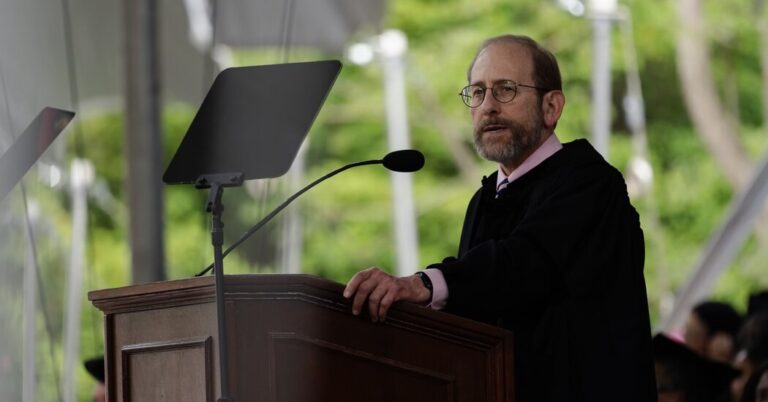
Harvard’s President Alan Garber Talks About His Legal Fight With Trump


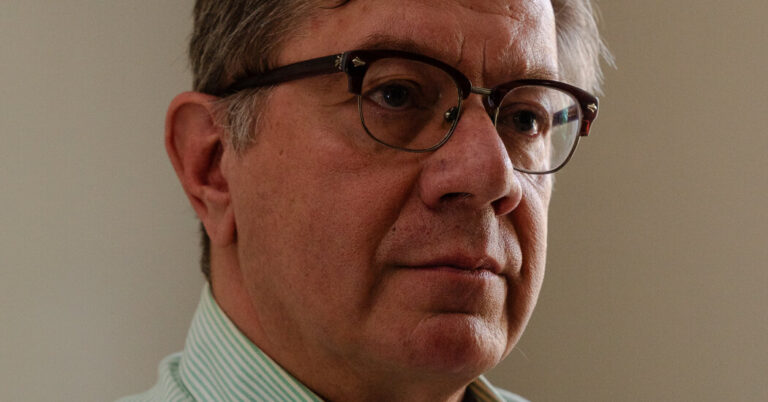
Dr. Alan Garber, president of Harvard, disagrees with President Trump about many things. He is fighting Mr. Trump as the federal government tries to strip Harvard of billions of dollars in research funding and its nonprofit tax status.

But Dr. Garber agrees with Mr. Trump on one point. In one of the rare interviews he has given since Harvard began its battle with the federal government, Dr. Garber said this week that Harvard has a campus culture problem that needs urgent fixing.

Harvard has often shut out voices that many liberals disagree with, he said, and it has allowed antisemitism to go unchecked.

“The issue for me was not principally whether we had problems that we needed to address,” Dr. Garber said in a lengthy interview in Washington.

The problem is the Trump administration’s methods, which are growing more aggressive by the day. Last month, Trump officials said they would cut more than $2 billion in federal funds intended for the university, to force it to comply with a series of demands Harvard says violate the First Amendment. On Friday, Mr. Trump escalated the attack, saying the Internal Revenue Service would take away Harvard’s tax-exempt status, threatening many millions more.

To Dr. Garber, defending and reforming Harvard is not a provincial matter. Americans are questioning a higher education system that many see as disconnected from their values. He believes deep funding cuts would impair the kind of innovative work that has made American research universities the global engine for scientific discovery since World War II.

“This is genuinely unprecedented,” Dr. Garber said in the interview.

“We have so many challenges ahead and we also have so many opportunities,” he said, adding, “this is a time when we should be doubling down on our investments in research, particularly in science.”

Dr. Garber earned three degrees from Harvard before moving to California to study to become a medical doctor at Stanford University. He was there for a quarter-century, studying health policy, raising four children and serving as a physician at the nearby Palo Alto Veterans Affairs Medical Center.

He never planned to be a college administrator, or to leave California.

Now Dr. Garber is Harvard’s president during an unprecedented crisis. And some Democrats, frustrated and forlorn at a lack of leadership in their own ranks, have embraced him as a hero. They celebrated when Dr. Garber penned an aggressive rebuttal to an intrusive list of Trump administration demands last month and then sued the administration.

In a recent message to the Harvard community, Dr. Garber vowed to keep fighting federal intrusion.

But all along, Dr. Garber has been clear — subtly but insistently — that he shares some of the same concerns about Harvard the Trump administration has.

“We still have much work to do,” he has written.

The White House has said Harvard should not receive federal money if Jewish students are targeted and harassed on its campus. “The gravy train of federal assistance to institutions like Harvard, which enrich their grossly overpaid bureaucrats with tax dollars from struggling American families, is coming to an end,” a White House spokesman, Harrison Fields, said last month.

In the eyes of Mr. Trump and many Republicans, Harvard and other elite American universities have become echo chambers — places where students develop intolerance for political perspectives different from their own and shield themselves from ideas they find objectionable.

University leaders often say that criticism exaggerates the issue, claiming that critics want to perpetuate “woke” caricatures of university culture in order to win elections.

But at the same time, many university leaders also worry that Americans have lost trust in academia and no longer see as much value in a college education as they once did. About a third of Americans have little or no confidence in higher education, according to a Gallup poll published last year, up from 10 percent a decade earlier.

Some of Dr. Garber’s most notable decisions during the 16 months he has led the nation’s oldest and wealthiest university have focused on shifting that culture. Under his leadership, Harvard changed how it handles student discipline, manages protests, hires faculty members, challenges antisemitism and weighs in on public controversies.

Dr. Garber has called antisemitism a “serious problem” at Harvard. “It is present on our campus,” he said in March and added that, as a Jew, he had experienced it himself.

In recent days, he also rolled back policies related to diversity and race, for example, ending university support of graduations for various student groups, including Black, Latino and L.G.B.T.Q. students.

“The last few years have been a wake-up call,” said Steven Pinker, a Harvard psychology professor who has warned that his university and other elite institutions have devalued intellectual and ideological diversity at considerable cost to their reputations.

He praised Dr. Garber for recognizing what many other academic leaders have not — at least in public: The Trump administration had not made “an unreasonable request” when it said Harvard must consistently enforce its rules against disruptive demonstrations and swiftly punish antisemitic harassment.

“He’s got principles and courage, to say something about an issue that had not been adequately confronted before,” Dr. Pinker said.

As he has moved to make more changes, he has also faced pushback. Harvard students, writing in an essay in the campus newspaper, The Harvard Crimson, suggested the changes to diversity programs “might be politically expedient for now.”

“But it will not solve Harvard’s public relations crisis,” they went on, adding, “The way to win against authoritarian attacks isn’t by prioritizing optics — it’s by standing up for our values.”

As a health care economist, Dr. Garber focused on some of the American health care system’s most stubborn problems, publishing 129 papers in 25 years.

His questions were probing. And he was unbothered by delivering answers people might not like.

Why does the federal government allow companies to charge what they want for drugs discovered and developed with research paid for by the federal government?

Why can’t we know what our medical bill will be before it arrives? It’s like going to a restaurant and getting a menu without prices, he said.

A fast runner, Dr. Garber trained for and raced in marathons. Once, he spent hours recovering from an injury by running in a pool, listening to “War and Peace” for entertainment. Four months later, he ran a marathon with a time of 3 hours 36 minutes.

In 2011, Harvard’s president, Drew Gilpin Faust, wanted Dr. Garber to be her new provost, the university’s chief academic officer. She had seen him interact on a medical school committee and was impressed by his ability to retain a quiet equanimity and bring about consensus. It was a trait that would serve him well, colleagues said, as the person responsible for interacting with Harvard deans, department heads and professors on a daily basis.

“He had a calm, ethical voice,” Dr. Faust said in an interview.

Repeatedly, she asked him to be provost. Repeatedly, he said no. He relented after he inquired about the job and heard something that appealed to him: It would focus on helping others succeed.

“It’s like this lightbulb went off, and I thought, you know, I’m at a stage in my career where I get much more pleasure out of seeing the people I mentor succeed than me getting another honor or paper accepted,” he said.

He discovered he really liked the job. “You’re deeply embedded in the academic life of the university, ” Dr. Garber said. “And I love that.”

Twelve and a half years passed by, periods of political and social upheaval that transformed higher education, including a Black Lives Matter movement that brought new attention to diversity on campus and a fight over affirmative action that took Harvard to the Supreme Court.

Even before the protests over the war in Gaza, people who have worked with Dr. Garber at Harvard said that he had expressed disappointment with a political climate on campus that could be intolerant of dissent.

“I think that troubled him a lot, actually,” said Robert E. Rubin, a former Treasury secretary under President Bill Clinton and a former long-serving member of the Harvard Corporation, the university’s powerful governing body. “Because he felt that universities should be a place for exchanging all views, as opposed to a place where people exclude certain views. And I happen to agree with that.”

Mr. Rubin recalled one conversation in which Dr. Garber stressed the importance of ideological diversity in higher education. “He said he believed that one of the problems we faced was a conformity of views, and the tendency on the part of some people to suppress contrary views,” Mr. Rubin said.

After over a dozen years as provost, Dr. Garber had decided it was time to return to teaching. A new president, Claudine Gay, took over in 2023. Dr. Garber hoped to leave administrative work by the end of the year.

But within months, Dr. Gay was forced out over her handling of accusations of antisemitism on Harvard’s campus. Dr. Garber had to change his plans.

“The provost is basically a partner to the president, and I probably knew about as much about the job as a person could know without being president,” he said in the interview.

He thought he would stay only until Harvard found a permanent president and would then take a sabbatical. But the list of problems confronting him was long, and growing.

He wanted to clarify rules around protests, and when the university should make public statements, for example. Harvard did not often speak out on issues beyond the campus, “but the policy had not been consistently followed,” he explained. Yet, he added, “we were getting demands from groups in every direction to make statements.”

Prominent faculty members and alumni were also concerned that Harvard had become a “national joke,” as Dr. Pinker, the psychology professor, put it.

The number of early admissions applicants to Harvard had plummeted.

Donors were skittish and angry, and vocal about their frustration with the university.

And one influential free speech advocacy organization ranked Harvard last in its annual survey of 200 institutions.

That spring, Harvard began unraveling policies that Dr. Garber and others believed had fueled some of its political problems. It adopted a policy stating that the university would not issue official statements about issues that did not affect its core functions. Its largest academic division said it would no longer require job applicants to attest in writing their commitment to diversity.

Summer came, and students went home. The tent city that pro-Palestinian students had erected in the Harvard Yard came down after Dr. Garber helped bring about a peaceful end to weeks of student demonstrations.

But many in academia worried that protests would strike up again in the fall. And the list of changes that Dr. Garber wanted to see through was still quite long.

“At some point, all of us in leadership and the corporation decided that this was a lot for an interim president to do,” Dr. Garber said.

On Aug. 2, 2024, the Harvard corporation made Dr. Garber the president through the 2026-27 academic year.

During Mr. Trump’s first term as president, education had often seemed like an afterthought. Soon after he returned to office in January, it became clear his second term would be focused on bringing academia to heel.

Initially, Dr. Garber tried not to antagonize the new president.

After the Trump administration said in March that it was reviewing $9 billion in grants and contracts because Harvard had not done enough to stop antisemitism on campus, Dr. Garber’s response was hardly a manifesto of Trump resistance.

He noted in a message to the Harvard community the steps the university was taking to address the administration’s concerns. He also vowed to cooperate with the federal task force on antisemitism.

On campus, many were pushing him to be more aggressive, and not to negotiate.

He was doing no such thing, he said in the interview. He had simply offered to explain all that Harvard had been doing already, and what else it had planned.

But the administration’s next sally shocked him. It came in the form of an email that arrived late on April 11. It had a list of demands, including allowing the federal government to review hiring decisions, examine admissions decisions and audit the student body, the faculty and the staff to be sure they represented a variety of viewpoints.

Three days later, Harvard published a scathing letter written by Dr. Garber. “No government — regardless of which party is in power — should dictate what private universities can teach, whom they can admit and hire, and which areas of study and inquiry they can pursue,” he wrote.

With that Friday night letter, Dr. Garber added, “they had gone too far.”

“We don’t question appropriate regulation,” he said in the interview. But this appeared to violate the Constitution.

Since that moment, Dr. Garber has been hailed as a defender of academic independence. He has led Harvard in a lawsuit that claims the Trump administration has no legal authority to demand such sweeping changes to the way the university operates.

Not everyone sees his resistance as heroic.

“What this celebration has missed,” two Harvard Ph.D. students wrote in an article for The Nation, “is that Harvard has been quietly complying with Trump’s agenda for weeks.”

In recent days, Dr. Garber released a report outlining problems with both antisemitism and Islamophobia on campus, apologized for both issues and promised more changes.

He has also gone beyond the focus on antisemitism, taking on the hotly contested issue of race and diversity.

Three years ago, Harvard fought all the way to the Supreme Court to maintain an admissions system that considered students’ racial backgrounds, arguing that admitting students of different backgrounds and experiences was essential to providing a well-rounded education.

Last month, Dr. Garber wrote in a public message that Harvard was “adopting important adjustments to the ways we build community,” suggesting that the university “focus on individuals and their unique characteristics rather than their race.”

In a speech, Caleb Thompson, Harvard’s undergraduate student body president, criticized the university’s decision to eliminate graduation celebrations for affinity groups.

“To the Garber administration for the decision that was made to shut down affinity graduations and attack affinity spaces here on campus, my message is this: ‘This was not what you promised when you said you would stand up against the Trump administration,’” Mr. Thompson said.

Dr. Garber’s defenders say he is making moves to preserve the integrity of the university. “He really is doing this as the servant leader,” Dr. Faust said. “This is not about Alan’s greater glory.”

Jeffrey Flier, the former dean of Harvard Medical School, said that he believed Dr. Garber understood the high stakes involved — not just for Harvard but for all of American higher education.

“I believe he is aware of the moment in time,” he said. “He is aware of what needs to be done. He is aware of his important role in getting those things done. He has a huge fraction of the community behind him.”

Dr. Garber’s approach — trying to reform the university while protecting it from attack — is not without risk.

But as the Trump administration turns up the pressure on Harvard, many on campus seem to have looked past their differences, more united than they have been in years as they face the threat outside their gates.

Asked about the end game, Dr. Garber said his goal was not specific to Harvard. It is, he said, “to ensure that universities in the U.S. can contribute to the nation in the ways we’ve always intended to.”

Miles J. Herszenhorn contributed reporting.


Source link

Why OPEC Plus Is Increasing Oil Supplies Despite Falling Prices

0


Oil prices are falling. Economists are cutting forecasts for global economic growth. Oil giants are reporting lower profits.

But on Saturday, eight countries that belong to the oil cartel known as OPEC Plus said they would add about 411,000 barrels of oil a day in June. The move, which follows a similar step by the group to increase oil production at their April meeting, is a major shift in policy that will ripple through the wider energy industry, hitting profits of oil companies and forcing cutbacks.

The group said in a statement that the market was “healthy” and noted that oil inventories remained low.

Saudi Arabia, the de facto leader of OPEC Plus, is signaling that it is reluctant to hold back millions of barrels a day of oil that it could produce, especially when other members of the group, like Kazakhstan and Iraq, are not observing their agreed-upon production ceilings.

“The view from Saudi Arabia, in particular, is that they no longer want to be the ones carrying the heaviest burden if other countries in the group are not showing sufficient commitment to doing their part,” said Richard Bronze, the head of geopolitics at Energy Aspects, a London research firm.

Demand for oil has not weakened significantly. Oil consumption increased by 1.2 million barrels a day in the first quarter of 2025, the most since 2023, according to the International Energy Agency in Paris. Analysts there and elsewhere, though, are cutting their forecasts for demand in anticipation of disruption from global trade tensions, which has already slammed prices.

Prices of Brent crude, the international benchmark, have fallen close to 20 percent since April 3, when the Saudis and other producers signaled they would increase production.

The price of West Texas Intermediate, the American benchmark, slipped this week below $60 a barrel, a threshold where many producers can no longer make a profit, and analysts say that prices could fall further. Under such pressures, producers with higher costs, like shale drillers in the United States, which have been increasing output in recent years while OPEC restrained production, may be forced to cut back.

“To the extent that OPEC Plus cannot or will not reduce output at any time to support prices, the burden of shoring them up would fall on other higher-cost producers,” wrote analysts at S&P Global Commodity Insights.

Saudi Arabia and the United Arab Emirates, considered the main decision makers among oil producers these days, may also be more inclined to bolster the ambitions of President Trump, who is expected to visit Saudi Arabia and other Middle East countries soon, than they were in aiding his predecessor, Joseph R. Biden Jr.

This price drop “represents one of the most important economic bright spots” for the Trump administration, Helima Croft, head of global commodities at RBC Capital Markets, an investment bank, wrote in a recent note to clients. Mr. Trump has promised to lower energy costs, including gas prices, for consumers.

Saudi Arabia and the United Arab Emirates may be hoping for some concessions in deals in defense or artificial intelligence, where both countries have strong ambitions, analysts say. Already, the Trump administration is reviving talks on a nuclear partnership with Saudi Arabia.

Typically, OPEC Plus would be scrambling to cut supplies to bolster markets. Such calculations have clearly changed among a smaller group of eight OPEC Plus members, including Saudi Arabia, Russia and the United Arab Emirates. They have instead been unwinding an earlier agreement to restrain their production by about 2.2 million barrels a day.

Of late, this smaller group has been meeting to make deals, leaving the rest of OPEC Plus in the rear seat. Saudi Arabia, which seems to be running the process, is gaining the largest of the increases.

“It really comes down to whether Saudi Arabia and the United Arab Emirates are willing to cut production further to support prices,” said Bhushan Bahree, an executive director at S&P Global.

So far, the answer is no.

The United Arab Emirates is one of several producers, along with Kazakhstan and Iraq, that has an interest in raising production to accommodate the added output from oil and gas investments by international companies.

Kazakhstan produced about 400,000 barrels a day above its OPEC Plus ceiling in March, according to the International Energy Agency. In the same period, Iraq exceeded its ceiling by 440,000 barrels a day and the United Arab Emirates by 350,000.

Kazakhstan seems reluctant to rein in investors like Chevron and Exxon Mobil, which recently spent tens of billions of dollars to raise production to one million barrels a day at the Tengiz oil field in the country.

“We don’t engage in discussions about OPEC or OPEC Plus targets,” Mike Wirth, Chevron’s chairman and chief executive, told analysts on Friday during an earnings call. Mr. Wirth added that Tengiz was an important source of revenue for the Kazakhstan government and had not been “curtailed” historically.

“We follow national interests, strictly observing our international obligations,” the Kazakhstan Energy Ministry said in an emailed statement.


Source link

Jack Draper seeks Madrid Open glory as clay breakthrough beckons live on Sky Sports | Tennis News

0


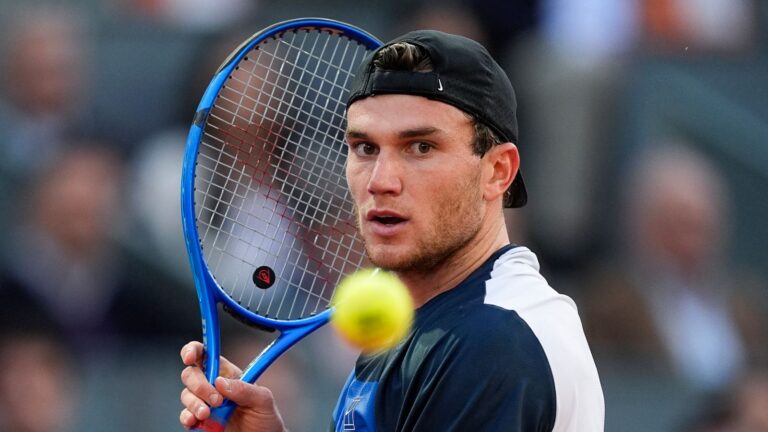
Jack Draper faces Casper Ruud in Sunday’s Madrid Open final – live on Sky Sports – seeking his second ATP Masters 1000 title in as many months.

The British No 1 triumphed on the hard courts at Indian Wells in March and is now one match away from a breakthrough victory on clay in the Spanish capital.

Draper is yet to drop a set in Madrid, overcoming Tallon Griekspoor, Matteo Berrettini, Tommy Paul, Matteo Arnaldi and most recently Lorenzo Musetti to reach the final.

A second Masters title in two months would leave Draper – who has already leapfrogged Novak Djokovic into the world’s top five – only 25 ranking points behind American world No 4 Taylor Fritz.

Please use Chrome browser for a more accessible video player

Highlights of Draper against Lorenzo Musetti at the Madrid Open

Draper confident ahead of ‘big challenge’ in final

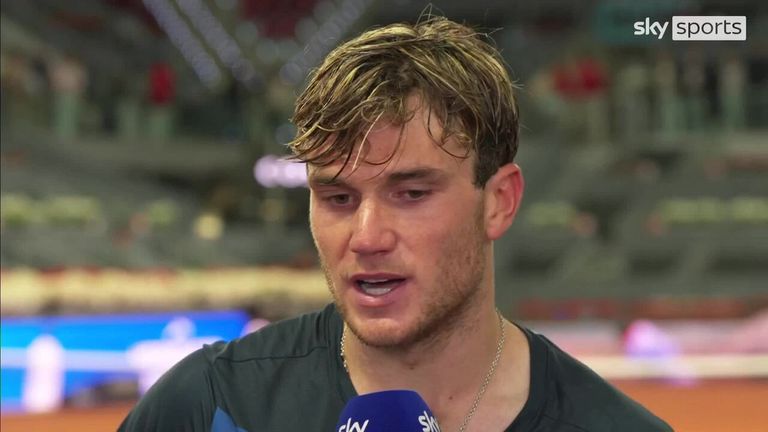
Speaking after his semi-final victory, Draper explained why his recent form and performances had left him confident of overcoming the tough challenge presented by Ruud.

Draper told Sky Sports: “He is a two-time French Open finalist and very accustomed to the clay. A big pro, always gives his best so that will be real, real challenge.

“But I am ready after beating someone like Lorenzo [Musetti]. I feel confident to give it my all and physically good.

“I came through some five-setters at the Australian Open earlier in the year when not at my best and that has stayed in my memory.”

Please use Chrome browser for a more accessible video player

Draper spoke to the Sky Sports team after beating Musetti in straight sets

Three-time Grand Slam finalist Ruud awaits

Ruud showed his class under pressure to overcome Argentina’s Francisco Cerundolo 6-4 7-5 to reach the final.

World No 15 Ruud, who ousted Fritz and Daniil Medvedev in the previous rounds, saved 15 of 18 break points he faced, including seven in a marathon 14-minute game in the second set, to make it through to his third Masters 1000 final.

Sunday will be Ruud’s 18th final on clay, with Djokovic the only active player to have reached more finals (34) on the surface.

Please use Chrome browser for a more accessible video player

Highlights of Francisco Cerundolo against Ruud at the Madrid Open

“I wasn’t sure I was going to be able to finish the match, honestly. I felt something in my rib during the warm-up, just towards the end before going out [on court],” Ruud said.

“I felt it in nearly every shot, especially the serve. Luckily, I got some quick treatment on it. There’s not too much you can do, you only have three minutes [with the physio]. So I will go and check it out more now.”

Madrid Open final live on Sky Sports

Please use Chrome browser for a more accessible video player

Find out all the ways to watch tennis on Sky Sports, including the US Open, ATP and WTA tours

Watch Jack Draper versus Casper Ruud in the Madrid Open final from 5pm this Sunday live on Sky Sports Tennis.

Watch the ATP and WTA Tours, as well as the US Open, live on Sky Sports in 2025 or stream with NOW.


Source link

Cadillac’s Road to Formula 1

0


In every sense, the clock is ticking on Cadillac’s entry into Formula 1 next year.

In March, Cadillac, supported by General Motors and TWG Motorsports, received final approval from Formula 1, expanding the grid to 11 teams for the first time since 2016.

“As soon as we got the entry, one of the things that changed is they put up a countdown clock at the factory in Silverstone,” Dan Towriss, the chief executive of TWG Motorsports, said in an interview in April. The company is a division of TWG Global, which has a sports portfolio that includes the Chelsea Football Club and the Los Angeles Dodgers and Lakers.

“We know exactly how many days to the engine’s fired, how many days to the first race,” he said. “That’s how we have to think about it because there’s so much work to do between now and then. It’s moving faster than I want it to.”

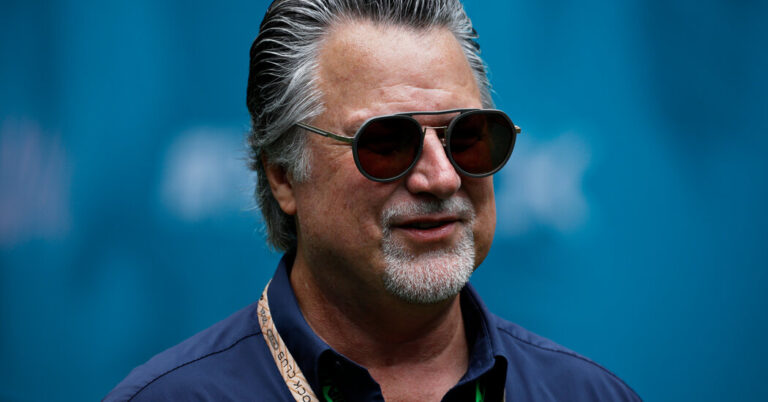
The Cadillac entry started life as Andretti Formula Racing two years ago. The F.I.A., the governing body of Formula 1, approved the proposal from Michael Andretti, the initial force behind the bid. A few months later, it was rejected by Formula 1.

In an interview a year ago with The New York Times, Andretti said he would fight. Last fall, he stepped back as chief executive of Andretti Global, which owns teams in IndyCar, Formula E, Extreme E and Australian Supercars. He decided “it was time to pass the baton” to his business partner Towriss.

“From Michael’s standpoint, he was very magnanimous in a way,” said Towriss, who has known Andretti since 2017. “He didn’t want to stand in the way of this project.

“It was a long process, a taxing process, and so he chose to step away. He wasn’t asked to step away, he wasn’t asked to leave. I think he saw that a level of acceptance wasn’t there for him.”

Towriss said the move “opened the door” with Formula 1. Five months later, Stefano Domenicali, Formula 1 president and chief executive, welcomed Cadillac.

With the commitment of G.M. to bring in a Cadillac team, Domenicali said, “it was an important and positive demonstration of the evolution of our sport.”

Cadillac will become the second U.S. automaker to have a presence in the sport. Ford will provide power units to Red Bull, also starting in 2026.

Towriss is saddened that Andretti stepped down. “Just tremendous respect for what the family legacy is in motorsports, for him personally, for Mario, and the family from that standpoint,” he said, referring to Andretti’s father.

“My personal opinion is that it all felt a bit unfair to be singled out in that way,” he said. “To his credit, at some point, you just have to accept the situation for what it is and move on. With his blessing, that’s what we did.”

Throughout the process, the team did not stand still. Workers were hired, and the facility in Silverstone, England, was opened a year ago to complement its headquarters near Indianapolis. Formula 1’s approval has accelerated the project’s growth.

Without a guarantee from Formula 1 of acceptance, the company still had to make a commitment. “It was not for the faint of heart,” Towriss said.

“It takes a long time to build a Formula 1 team. I don’t think anybody on our side, or anybody who knows the sport, thinks you can just show up and in a short period of time, do that.

“If we had waited until the point we were approved and then said, ‘Great, now let’s start hiring people, let’s start building,’ we’d be a long way from racing at that point.”

Towriss said that Graeme Lowdon, a longtime Formula 1 executive who advised the team, was a great salesperson in convincing people to join the team. Lowdon was chief executive of the now-defunct Manor Racing.

He had also been a consultant on the acquisition in 2020 of the Williams Formula 1 team by Dorilton Capital, a private investment firm whose headquarters are in New York City.

In December, Lowdon was announced as the team principal of Cadillac. “At the very beginning, a big part of the advice was to tell them to start building the team now,” he said in an interview in April.

“Then my engagement changed because they said: ‘OK, we’re happy with all this advice. Now you’re asking us to build a team. Can you go from advising to doing it?’ I guess I must have earned their trust, and they must have had confidence in what I’m doing because they then asked me to be the team principal.”

Being offered the position did not come out of the blue. “Even on our entry, I was down as the team principal,” he said. “For two years now, on our race license — and we have a U.S. race license, and an international race license — it’s my picture on it. That was something that was envisaged fairly early on.”

Throughout the two years, Lowdon never doubted that the bid would fail. “There is absolutely no scenario on earth where you could keep a perfectly good sports team from competing in a world championship,” he said, although there was a consequence.

“The thing that worried me and stressed me enormously, and I have to say it took a toll on me big time, was that it’s one thing saying it will definitely happen, it’s another saying when.

“We completely respected the process. Our role was to answer questions, but there’s only so much of that you can do. That was an unpleasant and enormously difficult period.”

The team has about 350 employees, with a target of 550 by the end of the year. Pat Symonds, former chief technical officer of Formula 1, has become the executive engineering consultant. and Nick Chester, once a technical director at Renault, is the chief technical officer.

“I thought it was going to be super difficult to hire people, but it was much easier than I thought,” Lowdon said. “The reality is, we were very lucky. We were in a position where a lot of the early discussions with key people who came on board shared the vision.”

“On the day our entry was confirmed, we wrote to them, with an old-fashioned letter. It wasn’t an ‘at-all’ email. The reason for that is they’d all taken a bit of a leap of faith, and we wanted to show our appreciation personally.”

For the first three seasons, Cadillac will be powered by Ferrari engines until G.M. builds its power unit, which will debut in 2029.

Mark Reuss, the president of G.M., said in an interview in April that it was “a moment filled with pride, a truly historic event for the entire company” when Formula 1 confirmed the entry.

From 2026 through 2028, G.M. will support Cadillac technically, including aerodynamics, performance engineering and manufacturing as it builds to become “a distinctly American team,” Reuss said.

He is aware of the challenge ahead. “G.M. and Cadillac have been at the forefront of racing and winning in elite series for more than a century,” he said. “We do not underestimate the level of competition nor the level of commitment needed to be included in F1.”

With nine months to go until the first Cadillac/G.M. car hits the track in preseason testing, the race is on, with the countdown clock providing a continual update.

“The last time Dan was across,” Lowdon said, referring to Towriss, “he talked to everyone at Silverstone, and he ended his address by saying, ‘As you can see on the wall, we’ve got X number of days left, so let’s crack on.’

“Everybody knows what the mission is.”


Source link

U.S. Job Growth Remained Strong in April

0


A solid labor market has for months given the Federal Reserve comfort that it could hold off on interest rate cuts until it had more clarity about how President Trump’s policies would impact the economy. New data released on Friday reinforced that patient approach.

Officials at the central bank are widely expected to keep interest rates steady when they announce their next decision on May 7. After lowering interest rates by a percentage point last year, the Fed has since January opted against making additional reductions. That has left interest rates at a range of 4.25 percent to 4.5 percent.

Until this point, officials have felt little urgency to lower interest rates because the economy so far has stayed on solid footing. Mr. Trump’s attempts to reset global trade relations through steep tariffs now risk upending that.

Despite the president’s decision in April to temporarily pause more stringent levies from taking effect on nearly all of the country’s trading partners, businesses have struggled to navigate the uncertainty. Many have shelved big investments and slowed hiring, and some are already raising prices. Surveys suggest that consumers also have turned much more downbeat about the outlook, fueling concern that this pessimism will eventually translate to less spending.

The fear is that consumers will cut back so aggressively that businesses will be forced to lay off workers, worsening the economic slowdown. Jerome H. Powell, the chair of the central bank, has warned that in addition to denting growth, tariffs of the nature Mr. Trump is pursuing also risk stoking inflation.

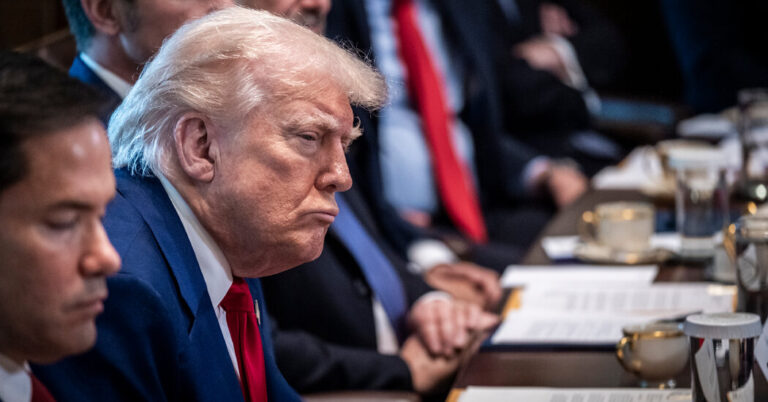
That combination risks putting the Fed in a bind and further in the cross hairs of Mr. Trump. The president has in recent weeks stepped up his attacks on Mr. Powell, railing on the Fed chair to lower interest rates. On Friday, he again renewed that pressures, writing in a social media post: “NO INFLATION, THE FED SHOULD LOWER ITS RATE!!!”

The central bank is responsible for fostering low, stable inflation as well as a healthy labor market. Officials are now having to game out what they would do if their goals for the economy come into tension with one another.

The latest jobs report, which showed better-than-expected monthly payrolls growth and a steady unemployment rate, is welcome news for officials. It follows inflation data earlier this week that confirmed that in March, price pressures stayed somewhat subdued even as it remained above the Fed’s 2 percent target.

Officials are now debating whether the forthcoming surge in consumer prices will just be a temporary adjustment that fades over time, or if it will lead to persistently higher inflation.

Having just grappled with surging inflation in the aftermath of the pandemic, the Fed has stressed the importance of ensuring that tariff-related price pressures do not mushroom into a bigger problem. Last month, Mr. Powell said that containing inflation was crucial to fostering a healthy labor market.

“Without price stability, we cannot achieve the long periods of strong labor market conditions that benefit all Americans,” he said at an event at the Economic Club of Chicago.

That emphasis suggests there is a high bar for the Fed to restart interest rate cuts. Officials will need to see clear evidence that the economy is weakening before taking action, something that could take time.

Christopher J. Waller, a governor, said in a recent interview that he did not expect tariffs to impact the economy in a significant way before July, suggesting no near-term cuts.

Preston Mui, a senior economist at research and advocacy group Employ America, said he expects the labor market to gradually slow over the next couple of months rather than sharply collapse.

“When it gets sharp is when you have these big spikes in layoffs,” he said. That will depend on what Mr. Trump does with tariffs. If the president reverses course by the self-imposed 90-day deadline in early July, the labor market may avoid a more painful hit. If tariffs remain in place, or the uncertainty around trade policy lingers, the damage could start to mount.

After Friday’s report, traders in federal funds futures markets scaled back their expectations for interest rate cuts from the central bank this year. They see much lower odds of a June reduction but continue to forecast a quarter-point cut in July. Over the course of the year, they see the Fed cutting at least three times.


Source link

How Misinformation and Partisan ‘New Media’ Changed a California Town


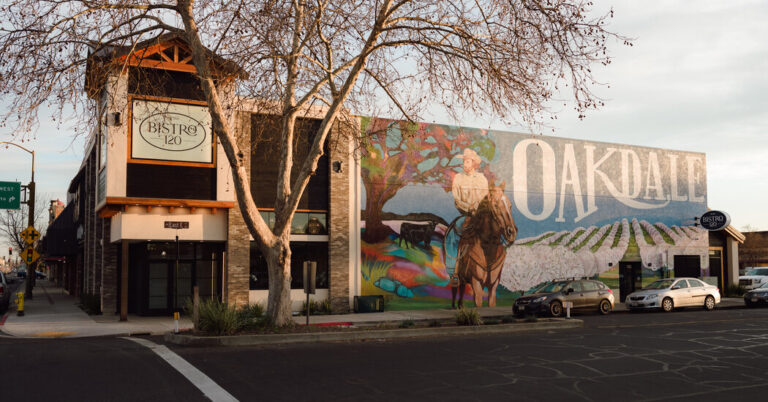
With its horse-trodden roads, endless fields of almond blossoms and cowboy heritage, the 20,000 person town of Oakdale, Calif., fits the American West of imagination. And for decades, its media diet was classically all-American, too.

Nightly news broadcasts played on living room televisions. Copies of local newspapers lined doorsteps on Sunday mornings. The town even had two media outlets dedicated to rodeo and horse roping news.

But that version of Oakdale is a thing of the past.

First the nearby newspapers shrank, and hundreds of local reporters in the region became handfuls. Then came the presidential elections of 2016 and 2020, and the pandemic; suddenly cable networks long deemed trustworthy were peddlers of fake news, on the right and the left.

By the 2024 election, when its county, Stanislaus, was among the 10 in California that President Trump flipped red, it wasn’t just trust in traditional media that had vanished from Oakdale — it was the media itself.

Now, in place of longtime TV pundits and radio hosts, residents turn to a new sphere of podcasters and online influencers to get their political news. Facebook groups for local events run by residents have replaced the role of local newspapers, elevating the county’s “keyboard warriors” to roles akin to editors in chief.

Of the 80 Oakdale residents The New York Times spoke to for this article, not a single one subscribed to a regional news site, The New York Times, The Wall Street Journal or The Washington Post.

Oakdale is not alone: Between news deserts expanding in rural areas and a growing distrust of national outlets, the town’s shift toward new sources of information is becoming commonplace in small communities across the country. That trend is almost certain to accelerate, with the Trump administration moving to claw back funding for NPR and PBS, which would slash local broadcasting stations’ budgets, and prioritizing hyperpartisan “new media” in the White House press briefings.

But seeking truth in a post-journalism world of Facebook groups and online influencers has left some Oakdale residents feeling less informed than before. And efforts to manage misinformation that culminated in an armed militia storming the town in 2020 have changed the very nature of the community.

Tucked between mountain ranges and rivers in the heart of California’s Central Valley, Oakdale is only 100 miles east of the San Francisco Bay Area, but it has the feel of another world.

It’s a place where the highways are dotted with fruit stands and neighbors leave baked goods on one another’s porches, with a large community of Latino immigrants and a proud cowboy history, memorialized in two separate museums. During the pandemic, the town became especially tight-knit, bonded by the uncertainty of the virus, the politics of an election year and the hardship of closing down restaurants and retail stores in a place where small businesses are an economic lifeblood.

As local news outlets shrank throughout the Central Valley in the 2010s, Facebook groups dedicated to local events started popping up in their place. And for years, they were harmless. But that changed in 2020.

With residents stuck at home during the pandemic, the groups thrived. But as new members joined by the thousands, conspiracy theories and political debates overtook posts about school board meetings and local elections.

Then, the militia incident happened.

Julie Logan, an in-home health care worker in Oakdale, can still remember the scene: It was a weekend morning in June, and the downtown farmers’ market had been replaced by a scene resembling a military operation.

Gunmen patrolled the sidewalks dressed head to toe in brown camouflage; store windows were boarded up; some of the men perched from the rooftops in tactical gear, brandishing rifles.

The militia was prepared to defend against an imminent threat: Black Lives Matter protesters, they believed, were plotting to invade the town and would be arriving on buses from the Bay Area at any moment.

They waited and waited. But the protesters never came.

The men were drawn to Oakdale by a false rumor spread in a Facebook group called All Things Oakdale, which over the years had become the town’s primary forum for local news. Started in 2015 by Ms. Logan, the group had amassed more than 17,000 members by 2020.

“That was the moment we knew something had to change,” she said. “We were overwhelmed.”

The militia was hired by the owner of a downtown bar called the H-B Saloon, the police said. The scene confused even the local authorities, and Jeff Dirkse, the sheriff of Stanislaus County, took to Facebook to decry “rumors that are running rampant on social media,” but assured residents there was no threat of an attack. (Reached by phone, the owner of H-B declined to comment.)

Ms. Logan made the Facebook group private and banned political discussions altogether. To help with fact-checking and moderation, she enlisted Kari Conversa, a pet care store owner, and Christopher Smith, an Oakdale City Council member and commercial plumbing distribution manager.

But the new focus on moderation had an unintended effect: Frustrated residents whose comments were removed began to create their own groups in protest, with names like Oakdale Incident Feed First Amendment Approved and Oakdale Incident Feed UNFILTERED. Soon enough, the spinoffs were becoming more popular than the original group.

Toni Ahrens, a wood carving artist, started Oakdale Incident Feed DOUBLE UNFILTERED after “experiencing the filtering first hand,” when a moderator removed a political comment of hers. Her new group now has 9,500 members — three times the number of subscribers of Oakdale’s weekly newspaper.

But Ms. Ahrens acknowledged that certain administrators have prioritized the kinds of misinformation and political discussions that caused them to be banned in the first place. And, more often than not, these residents lean conservative.

Among the largest of these Facebook groups is Stanislaus News, which has 75,000 members and has become the go-to source of information for crime in the area. (The sprawling county has around 500,000 residents.)

The group was founded by Mark Davis, a former bail bonds salesman in the nearby city of Modesto who was himself banned from a different group dedicated to local news in 2019. Along with his wife, Mr. Davis spends hours a day monitoring local police and emergency services scanners, translating the radio codes into updates that are often posted hours ahead of local news reports.

The group has also become a repository for Mr. Davis’s personal musings about Mr. Trump and Elon Musk’s so called Department of Government Efficiency, to the frustration of many residents who just want to read about local happenings.

“THIS PAGE WAS NOT INTENDED FOR POLITICAL PURPOSES,” one commenter wrote on a recent post about Mr. Musk.

The group is closely aligned with the Modesto Police Department, which uses it to make daily posts of its own. “This is a PRO law enforcement group,” reads one of Mr. Davis’s rules. “If you are not, then this is not the group for you.”

Some residents say Mr. Davis’s rules have hurt their efforts to spread important news, like in December, when surveillance footage posted to the group of a fatal shooting at a convenience store appeared to contradict the sheriff’s report of how the altercation began. Members of the group began to post new details about the case — until Mr. Davis stepped in to ban them.

Blake Coronado, who runs a nonprofit that helps find missing people and relies on Facebook groups for engagement, was one of the members who posted. After visiting the crime scene in person to share his findings, Mr. Coronado said, comments on his post were disabled within minutes. A day later, he was banned.

“I was shocked, because to my knowledge we didn’t even break any rules,” he said in an interview. “If we’re not going to hold our police department accountable, how is that helping our community?”

Mr. Davis and the Modesto Police Department did not respond to requests for comments.

Local news around Oakdale hasn’t always been this way. In the early 2000s, the Modesto Bee, the largest regional paper owned by the newspaper chain McClatchy, had over a hundred reporters; it now has around a dozen. Both of its former rodeo and horse roping news outlets are now out of business.

The town is still able to support a weekly newspaper called The Oakdale Leader, which shares a handful of reporters with nine other local newspapers in the Central Valley, all owned by Hank Vander Veen, its publisher and a former circulation director at the Modesto Bee.

“We’re not trying to compete with it,” Mr. Vander Veen said of the Facebook groups in an interview. “I still feel like some people go to us, whether it’s our website or our newspaper, for a more trusted news.”

It isn’t just local news habits that are changing in Oakdale. Since the pandemic, a wider skepticism for everything including vaccines and the price of eggs has changed the way people approach information in general: The thinking is, do your own research, and trust neither side.

Fred Smith, a gun store owner in Oakdale, grew up watching broadcasts of the CBS anchor Walter Cronkite when he was called “the most trusted man in America.” Until recently, he was a regular viewer of CNN and Fox News after work and estimates he spent over $100,000 advertising his store in the print pages of the Modesto Bee in the early 2000s.

But that trust has waned as traditional cable outlets have started to feel “more like entertainment than news,” he said. He’s gravitated toward podcasters like Joe Rogan and Shawn Ryan, a fellow veteran. But he doesn’t necessarily trust all the information on those podcasts, either.

“It used to be you had one source of news and you trusted it,” Mr. Smith said. “Now the news comes from everywhere, and I take it all with a grain of salt.”

He now finds himself inundated with “more news than he’s ever felt in his lifetime” in the first months of Mr. Trump’s second term, and he doesn’t trust any of it. Asked if he ever gets his news from social media, Mr. Smith opened his Instagram feed to show an A.I.-generated image of Mr. Trump riding a bald eagle. “You can’t trust that either,” he said.

Alternative news in Oakdale has even extended into print. In barber shops, clock repair stores and diners across town, copies of a peculiar newspaper appear on tables and bookshelves: The Epoch Times.

The media outlet is affiliated with the Chinese spiritual movement Falun Gong, and it is known to include right-wing misinformation with an anti-China slant. (The outlet did not respond to a request for comment.) A weekly print subscription costs less than $15 a year, but most store owners in Oakdale said they didn’t initially pay for a subscription — the editions just started showing up in the mail during the pandemic.

Beatriz Ortega, a hairdresser in Oakdale, first came across The Epoch Times in the summer of 2020, when free copies arrived at the door of her barbershop. Her husband, John, enjoyed the reporting, so he purchased a subscription. The outlet’s reporting, Mr. Ortega said, “feels straightforward enough,” and the paper has in recent years added a California news section.

The Ortegas’ news habits couldn’t be more different. Ms. Ortega keeps up with current events exclusively through La Mesa Caliente, a Spanish-language talk show on Telemundo hosted by four women. Mr. Ortega gets his news from an orbit of right-wing male YouTube personalities like Ben Shapiro, Charlie Kirk and Dan Bongino, who was recently named deputy director of the F.B.I.

Their differing news diets can often become points of contention, Mr. Ortega said, when it feels like they’re getting information about the same events from entirely different worlds. “But we both just want the facts,” he said.

Sarah Jones, 35, who works at a retail store downtown, said her attitude toward the media changed along with her beliefs about health and wellness in 2018, when she had her first child and began to distrust conventional medical advice.

By 2020, she had gotten rid of her television, replacing cable news programs like CNN and Fox News with mostly female news influencers on Instagram who aggregate the news into short video clips and graphics.

One of the accounts Ms. Jones follows, House Inhabit, is run by Jessica Reed-Kraus, a Robert F. Kennedy Jr. fan who Mr. Trump recently added to the White House press pool. Others accounts she follows like Real News No Bullshit are managed anonymously.

Working alongside Mr. Smith at his gun store is Jimmy Freeman, 50, who is known around the shop as a news hound. But whatever trust Mr. Freeman had in mainstream media disappeared while watching the last Biden-Trump presidential debate.

Watching President Biden struggle to string together complete sentences, he couldn’t help but think that the press corps in Washington that was supposed to keep the country informed — including Oakdale — had let him down.

“It felt like a failure,” Mr. Freeman said. “How could the media not tell us what we were seeing?”

His solution to what he saw as media bias was a website called Ground News, which aggregates reports from different news outlets and gives them each a bias score on the spectrum of left, center and right, along with a “factuality” rating. Users can even toggle between A.I. generated summaries of news stories written from different political perspectives.

“You grab both sides, bring them toward the middle, and that’s usually where the truth is,” Mr. Freeman said. At $8 a month, it is the only news subscription he pays for.

Liberal residents in Oakdale say their news diets haven’t changed as much as their conservative counterparts. Harvey Melgoza, 67, still listens to MSNBC on the radio while working at his shoe repair store downtown, like he has for as long as he can remember. And he will sometimes read The Oakdale Leader on the occasion that his neighbor, Doug, drops off extra copies at his doorstep.

Since the start of the pandemic, he has watched some of his neighbors embrace conspiracy theories, or grow suddenly fearful of Mexican immigrants coming across the border.

MSNBC “might sometimes have a bias,” he said, “but at least it gives me a good sense of what’s happening in the world.”

On April 5, dozens of Oakdale residents prepared to protest Mr. Trump and Mr. Musk in Modesto, among the hundreds of protests happening that day around the country.

Fliers with details of the event were being deleted from Facebook groups, so they turned to email threads to share information instead. Marjorie Sturdy, a therapist in Oakdale and the leader of the town’s progressive club, drove to the protest that day with a pit of anxiety in her stomach, remembering the militia five years ago.

Then came some relief — the Modesto Police assured her, in private, that it was monitoring Facebook for dangerous threats. Aside from a few angry passers-by, the rally drew hundreds and went on as planned.

“It gave me some optimism,” Ms. Sturdy said, “that things could change.”

Audio produced by Sarah Diamond.


Source link

Why Designated Beneficiaries Are Key to Your Estate Planning

0


Before Zygmund Furmaniuk’s aunt Mary died in 2023, she set up a trust to hold her assets and to distribute her estate, which was valued at nearly $1 million.

A retired chemistry teacher, Mary Furmaniuk was single and had no children. Creating the trust, Mr. Furmaniuk said, was her way of making sure her assets ended up where she wanted them — with him and three other nieces and nephews. But even though his aunt had a will, the arrangement caused considerable frustration for Mr. Furmaniuk, of Belmont, Mass., and one of his cousins, who were co-executors.

The hard part wasn’t figuring out the sale of her house and what to do with her valuables. The more complicated part was distributing the money in her individual retirement accounts, which had been placed within the trust — but without designated beneficiaries.

“If she had made us each 25 percent beneficiaries directly on her I.R.A.s at Fidelity, not from within the trust,” Mr. Furmaniuk said, “the monthlong duration of paperwork I had to go through, which ended up the size of a small phone book, would have been unnecessary.”

Major brokerage firms like Vanguard and Fidelity ask savers to name designated beneficiaries — the people they want to inherit the money when they die — when they open individual retirement accounts or 401(k)s. But even having them in place doesn’t cover the assets that wills do. Here is why you should have both.

Wills are legal documents that lay the groundwork for dividing valuable possessions, like real estate, in addition to investments and cash when a person dies. If you die without one, the state where you were a legal resident will take over distributing those assets. And that can become a complicated web.

Every state has its own laws governing who inherits your property if you die without a will. Often, it’s the person’s closest living relatives, such as a spouse, parents or siblings. But defaulting to state laws involves rulings from probate courts, which handle legal decisions when someone dies. Getting those rulings often requires heirs to invest their time and money, and can significantly delay the settlement of an estate.

“When it comes to dying without a will, there’s this idea, and it’s not crazy, that the defaults that states adopt are broadly in line with what people would want to do anyway,” said Gal Wettstein, a senior research economist at Boston College.

A state may distribute houses, accounts and cars to a spouse first, for example. If the spouse has died, those assets may be split among children. But with property like real estate, for example, the division can get complicated. A deed to a house or land has to be clear before the heirs can sell it, Dr. Wettstein said. If there is a disaster, such as a fire or flood, before the property is sold, heirs may also have trouble filing an insurance claim to make repairs.

An important consideration, Dr. Wettstein said, is that state defaults don’t take into account how American families and households have evolved. Defaults “are not well suited to nontraditional family structures,” he said. For example, if a parent hasn’t formally adopted a stepchild, the child may not receive anything when the parent dies.

While wills must be administered by a court, designated beneficiaries may need only to show their identification and the account owner’s death certificate to an institution like Vanguard to receive a payout — but each institution will have its own procedures, so become familiar with them. The key is that naming beneficiaries will help your heirs bypass probate court and its costs.

Keep in mind, though: “One of the misconceptions that sometimes comes up is: ‘If I have designated beneficiaries listed, I don’t need a will,’” said Sabino Vargas, a certified financial planner and senior financial adviser at Vanguard. “That’s a great opportunity to provide some education, because a will does so much more than people think.”

For example, those who have minor children or pets can name guardians for them in their wills. “You can also imagine there are situations involving art, jewelry, collectibles,” Mr. Vargas said. “Unless you want to turn over what happens to your assets and the guardianship of your children to the state, we think a will is a critical piece of an overall estate plan.”

“Ideally, everyone should write up a will, including young people, each individual spouse and people living with partners, even if you think you don’t have much to pass on,” said Marcia Mantell, a retirement consultant in Plymouth, Mass. “Even a computer, cellphone and other tech should be passed to someone you personally name. This helps settle your estate outside of the probate courts.”

Two of the most common ways of drawing up a will are hiring an estate lawyer and using an online template, Ms. Mantell said. For those going the D.I.Y. route, it’s important to note a few technical details. First, because wills are subject to state laws, make sure to include elements your state requires. Sometimes that means recruiting a witness or two to sign the will.

Also, “most states require that you include certain language making clear that you are not being forced into the terms of the will” — for example, that you are of sound mind, Ms. Mantell said.

Getting started is easy, she said — and not necessarily cost prohibitive. “If you can’t afford to see a lawyer, download a PDF and fill it in and sign according to your state’s laws,” she wrote in an email. “Google something like, ‘making a will in [name of your state],’ and options will pop up.”

For an introduction to a study by the Center for Retirement Research at Boston College, Dr. Wettstein and his co-authors outlined the ways in which wills can be transformative, especially for Black and Hispanic families.

“Despite the advantages of having a will, only about two-thirds of households with heads ages 70 and older had a will in 2020, and the share of white households with a will was more than twice that for Black and Hispanic households,” they wrote. People who receive an inheritance, they added, are more likely to leave a bequest for the next generation, and people of color are less likely to report receiving an inheritance.

But transferring wealth often lays the foundation for the kind of future families strive for. The transfer of wealth via inheritance can propel a family into homeownership or a better school district, for example. Reaching those goals solely through earned income may be more of a challenge, the study’s authors noted.

“Wealth can provide a buffer,” Dr. Wettstein said. How it reaches heirs — whether through a trust, a will or a beneficiary designation — doesn’t matter, as long as it reaches them.

Still, from Mr. Furmaniuk’s perspective, it’s worth understanding every line of fine print on estate documents, whether they are issued by a bank, an insurance company or a lawyer.

When the dust settled on his aunt’s estate, “she got the outcome she desired, and things worked out fairly for all concerned,” he said. But if everyone involved had had a better understanding of the intersection of designated beneficiaries and trusts, “it could have been a whole lot easier.”


Source link

Liam Nolan’s ONE Championship comeback cut down by first-round head-kick knockout | WWE News

0


Liam Nolan returned to the sport looking to renew his campaign toward the ONE lightweight Muay Thai world title after spending the past year away from competition.

But, in just 59 seconds, his trail to championship gold became even longer.

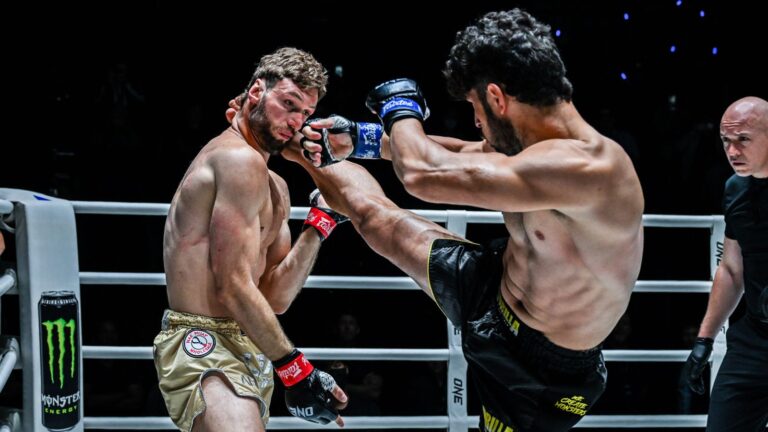
Iranian striker Abolfazl Alipourandi cracked the British star with a head kick that sent him crashing to the canvas, prompting the referee to stop the lightweight Muay Thai battle in the first round at ONE Fight Night 31.

The Londoner was originally scheduled to face Nauzet Trujillo – the last man to defeat him – in a rematch of their February 2024 clash. However, the Spaniard withdrew from the contest during the week of the fight.

Alipourandi stepped in to replace him on five days’ notice, and even though Nolan had more experience and a three-inch height advantage, it ultimately would not matter.

Once the bell rang inside Bangkok’s Lumpinee Stadium, the Iranian fearlessly charged forward with wild punches and immediately put the 27-year-old on the defensive.

Nolan looked to establish his range with kicks, but Alipourandi continued to rush forward with shots in an effort to close the distance and clinched up with him against the ropes.

Liam Nolan looks to fend off Abolfazl Alipourandi with his kicks
Image:
Nolan looks to fend off Alipourandi with his kicks

The referee brought the two back to the centre of the ring, where the Englishman again threw some heavy kicks. Alipourandi responded with pressure, as he threatened his rival with more punches and backed him to the ropes.

But then, as Nolan dropped his left arm to brace for a body blow, Alipourandi fooled him with a head kick that smashed the jaw and wrapped around his neck. The strike knocked out the Londoner, who fell against the ropes and then awkwardly onto the mat.

The referee was preparing to give him the eight-count, but after noticing the Brit was struggling to get up, he called off the fight at the 59-second mark of round one. This loss dropped Nolan’s record to 22-9.


Source link

U.S. Job Growth Remained Strong in April

0


A solid labor market has for months given the Federal Reserve comfort that it could hold off on interest rate cuts until it had more clarity about how President Trump’s policies would impact the economy. New data released on Friday reinforced that patient approach.

Officials at the central bank are widely expected to keep interest rates steady when they announce their next decision on May 7. After lowering interest rates by a percentage point last year, the Fed has since January opted against making additional reductions. That has left interest rates at a range of 4.25 percent to 4.5 percent.

Until this point, officials have felt little urgency to lower interest rates because the economy so far has stayed on solid footing. Mr. Trump’s attempts to reset global trade relations through steep tariffs now risk upending that.

Despite the president’s decision in April to temporarily pause more stringent levies from taking effect on nearly all of the country’s trading partners, businesses have struggled to navigate the uncertainty. Many have shelved big investments and slowed hiring, and some are already raising prices. Surveys suggest that consumers also have turned much more downbeat about the outlook, fueling concern that this pessimism will eventually translate to less spending.

The fear is that consumers will cut back so aggressively that businesses will be forced to lay off workers, worsening the economic slowdown. Jerome H. Powell, the chair of the central bank, has warned that in addition to denting growth, tariffs of the nature Mr. Trump is pursuing also risk stoking inflation.

That combination risks putting the Fed in a bind and further in the cross hairs of Mr. Trump. The president has in recent weeks stepped up his attacks on Mr. Powell, railing on the Fed chair to lower interest rates. On Friday, he again renewed that pressures, writing in a social media post: “NO INFLATION, THE FED SHOULD LOWER ITS RATE!!!”

The central bank is responsible for fostering low, stable inflation as well as a healthy labor market. Officials are now having to game out what they would do if their goals for the economy come into tension with one another.

The latest jobs report, which showed better-than-expected monthly payrolls growth and a steady unemployment rate, is welcome news for officials. It follows inflation data earlier this week that confirmed that in March, price pressures stayed somewhat subdued even as it remained above the Fed’s 2 percent target.

Officials are now debating whether the forthcoming surge in consumer prices will just be a temporary adjustment that fades over time, or if it will lead to persistently higher inflation.

Having just grappled with surging inflation in the aftermath of the pandemic, the Fed has stressed the importance of ensuring that tariff-related price pressures do not mushroom into a bigger problem. Last month, Mr. Powell said that containing inflation was crucial to fostering a healthy labor market.

“Without price stability, we cannot achieve the long periods of strong labor market conditions that benefit all Americans,” he said at an event at the Economic Club of Chicago.

That emphasis suggests there is a high bar for the Fed to restart interest rate cuts. Officials will need to see clear evidence that the economy is weakening before taking action, something that could take time.

Christopher J. Waller, a governor, said in a recent interview that he did not expect tariffs to impact the economy in a significant way before July, suggesting no near-term cuts.

Preston Mui, a senior economist at research and advocacy group Employ America, said he expects the labor market to gradually slow over the next couple of months rather than sharply collapse.

“When it gets sharp is when you have these big spikes in layoffs,” he said. That will depend on what Mr. Trump does with tariffs. If the president reverses course by the self-imposed 90-day deadline in early July, the labor market may avoid a more painful hit. If tariffs remain in place, or the uncertainty around trade policy lingers, the damage could start to mount.

After Friday’s report, traders in federal funds futures markets scaled back their expectations for interest rate cuts from the central bank this year. They see much lower odds of a June reduction but continue to forecast a quarter-point cut in July. Over the course of the year, they see the Fed cutting at least three times.


Source link