Home Blog Page 339

U.S. Job Growth Remained Strong in April

0


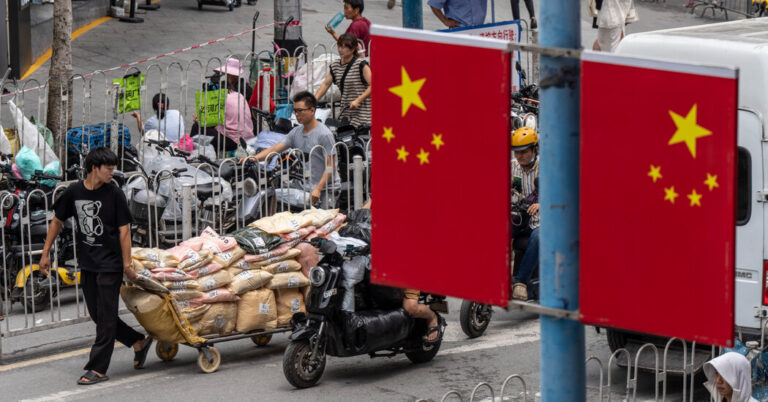
A solid labor market has for months given the Federal Reserve comfort that it could hold off on interest rate cuts until it had more clarity about how President Trump’s policies would impact the economy. New data released on Friday reinforced that patient approach.

Officials at the central bank are widely expected to keep interest rates steady when they announce their next decision on May 7. After lowering interest rates by a percentage point last year, the Fed has since January opted against making additional reductions. That has left interest rates at a range of 4.25 percent to 4.5 percent.

Until this point, officials have felt little urgency to lower interest rates because the economy so far has stayed on solid footing. Mr. Trump’s attempts to reset global trade relations through steep tariffs now risk upending that.

Despite the president’s decision in April to temporarily pause more stringent levies from taking effect on nearly all of the country’s trading partners, businesses have struggled to navigate the uncertainty. Many have shelved big investments and slowed hiring, and some are already raising prices. Surveys suggest that consumers also have turned much more downbeat about the outlook, fueling concern that this pessimism will eventually translate to less spending.

The fear is that consumers will cut back so aggressively that businesses will be forced to lay off workers, worsening the economic slowdown. Jerome H. Powell, the chair of the central bank, has warned that in addition to denting growth, tariffs of the nature Mr. Trump is pursuing also risk stoking inflation.

That combination risks putting the Fed in a bind and further in the cross hairs of Mr. Trump. The president has in recent weeks stepped up his attacks on Mr. Powell, railing on the Fed chair to lower interest rates. On Friday, he again renewed that pressures, writing in a social media post: “NO INFLATION, THE FED SHOULD LOWER ITS RATE!!!”

The central bank is responsible for fostering low, stable inflation as well as a healthy labor market. Officials are now having to game out what they would do if their goals for the economy come into tension with one another.

The latest jobs report, which showed better-than-expected monthly payrolls growth and a steady unemployment rate, is welcome news for officials. It follows inflation data earlier this week that confirmed that in March, price pressures stayed somewhat subdued even as it remained above the Fed’s 2 percent target.

Officials are now debating whether the forthcoming surge in consumer prices will just be a temporary adjustment that fades over time, or if it will lead to persistently higher inflation.

Having just grappled with surging inflation in the aftermath of the pandemic, the Fed has stressed the importance of ensuring that tariff-related price pressures do not mushroom into a bigger problem. Last month, Mr. Powell said that containing inflation was crucial to fostering a healthy labor market.

“Without price stability, we cannot achieve the long periods of strong labor market conditions that benefit all Americans,” he said at an event at the Economic Club of Chicago.

That emphasis suggests there is a high bar for the Fed to restart interest rate cuts. Officials will need to see clear evidence that the economy is weakening before taking action, something that could take time.

Christopher J. Waller, a governor, said in a recent interview that he did not expect tariffs to impact the economy in a significant way before July, suggesting no near-term cuts.

Preston Mui, a senior economist at research and advocacy group Employ America, said he expects the labor market to gradually slow over the next couple of months rather than sharply collapse.

“When it gets sharp is when you have these big spikes in layoffs,” he said. That will depend on what Mr. Trump does with tariffs. If the president reverses course by the self-imposed 90-day deadline in early July, the labor market may avoid a more painful hit. If tariffs remain in place, or the uncertainty around trade policy lingers, the damage could start to mount.

After Friday’s report, traders in federal funds futures markets scaled back their expectations for interest rate cuts from the central bank this year. They see much lower odds of a June reduction but continue to forecast a quarter-point cut in July. Over the course of the year, they see the Fed cutting at least three times.


Source link

Car Prices Expected to Rise as Tariffs on Parts Kick In

0


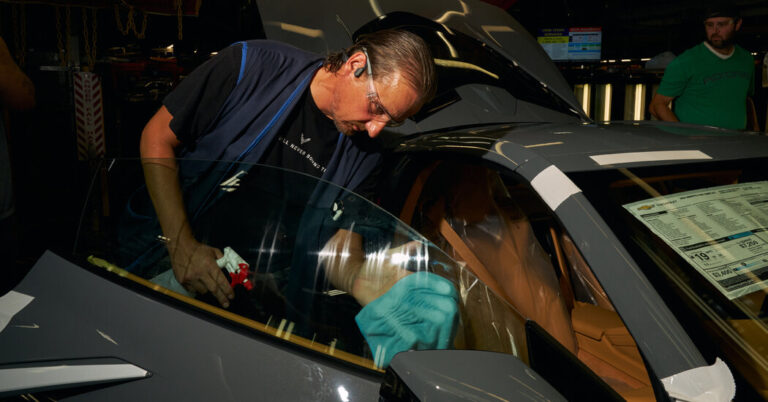
The United States imposed 25 percent tariffs on imported auto parts on Saturday that could sharply raise prices for new and used vehicles as well as for repairs and insurance.

The latest tariffs, which President Trump ordered in March as part of his plan to promote domestic manufacturing, come after the 25 percent levies on imported cars that took effect in early April.

This second round of duties on imported parts will have a broader impact because even cars made in the United States often have engines, transmissions, batteries or other components produced in other countries.

The administration said on Tuesday that the tariffs were intended “to protect national security by incentivizing domestic automobile production and reducing American reliance on imports of foreign automobiles and their parts.”

The tariffs on parts will not apply to components from Canada or Mexico as long as those goods meet the requirements of a North American trade agreement negotiated during Mr. Trump’s first term. Among other things, that deal requires that a minimum percentage of the content of auto parts come from within North America.

The administration also said that imported auto parts would not be subjected to other levies, like the ones on aluminum and steel. And companies that made cars in the United States would be exempted for two years from having to pay a portion of the tariffs for imported parts.

Mr. Trump’s tariffs have already pushed up new car prices as customers flocked to dealerships to buy vehicles before the levies took effect. The tariffs are having a ripple effect on the used car market as more people look for affordable alternatives to new cars, increasing demand and prices.

The tariffs on new auto parts are also expected to increase the cost of repairs and insurance premiums, because replacement parts will become more expensive. Rising car prices will contribute to overall inflation, which Mr. Trump had promised to bring down.

The president has insisted that the tariffs will bring manufacturing back to the United States. But even if that policy succeeds, consumers will still pay more for cars. Many goods, including lots of auto parts, can often be made much more cheaply in China, Mexico or other countries outside the United States.

“A lot of parts, like fasteners, washers, carpet, wiring looms are just not available — we can’t even buy those parts here,” Jim Farley, the chief executive of Ford Motor, told CNN this week.

Automakers and suppliers say it will take years for them to relocate assembly lines. And they are unlikely to commit billions of dollars to domestic manufacturing because of uncertainty about the direction of trade policy.

Mr. Trump has frequently changed his mind about the size of tariffs and how they should be applied. On Tuesday, he modified some of the rules to allow automakers to avoid paying duties on a portion of the components they import for two years. The measures provide the industry some relief, but car prices will still rise by thousands of dollars, analysts said.

There will be unpredictable side effects. The financial stress could drive some suppliers out of business, creating parts shortages.

“Auto suppliers are already at thin margins,” said Lenny LaRocca, U.S. automotive industry leader at the consulting firm KPMG. “They can’t afford the full cost of 25 percent tariffs.”

Mr. Trump’s decision to exempt many parts from Canada and Mexico will, however, ease the burden on some companies.

The auto industry accounts for about 5 percent of Mexico’s gross domestic product and employs around one million people in the country. Vehicles and parts are by far Mexico’s largest exports to the United States.

“Little by little, this haze is clearing up,” Marcelo Ebrard, Mexico’s economy minister, said at an event with business leaders and diplomats on Wednesday. “What we are going to face is a situation that is not as disadvantageous as perhaps many expected it to be.”

In Canada, however, many parts makers supply car factories in that country, said Flavio Volpe, the president of the Automotive Parts Manufacturers’ Association. And the vehicles those plants make will still be hit with tariffs when they are exported to the United States.

“The health of the Canadian auto parts sector is that there is a cluster of manufacturing that we can supply locally,” Mr. Volpe said.

On Friday General Motors said that because of tariffs it was eliminating a third shift at a pickup truck assembly line in Oshawa, Ontario. That plant will now build more trucks for Canadians, the company said. Unifor said the reduction would eliminate about 700 union jobs and was likely to cause parts makers to lay off another 1,200 people.

Prime Minister Mark Carney said that G.M.’s decision was a “terrible manifestation” of the economic crisis Mr. Trump’s tariffs had created for Canada.

The tariffs will hit some carmakers harder than others. Tesla and Ford are somewhat less vulnerable. Tesla manufactures all of the cars it sell in the United States in California and Texas. Ford says that it makes nearly 80 percent of the vehicles it sells in the United States domestically, including F-series pickups, which are the best selling vehicles in the country.

General Motors will suffer more, analysts say, because imported parts often account for more than half the value of Chevrolets or Cadillacs made in the United States. G.M. also imports cars from Canada, Mexico and South Korea.

Volvo Cars, which has a factory in South Carolina but uses many parts from China, will also be hard hit, analysts say.

Even companies that make vehicles in the United States will feel the pain. Rivian builds electric pickups in Illinois, but imports batteries from South Korea and China that will be subject to tariffs.

The tariffs are expected to shrink the supply of less expensive vehicles. Nearly 80 percent of cars priced at less than $30,000 will be subject to 25 percent tariffs, including popular vehicles like the Honda Civic, Toyota Corolla and Chevrolet Trax, according to Cox Automotive.

Car prices will probably not skyrocket immediately, because most carmakers and their dealers have large inventories of cars manufactured before the tariffs took effect. Ford, Hyundai and Volkswagen are among carmakers that have said they will not raise prices for several months. But carmakers are not profitable enough to absorb the increased cost of tariffs indefinitely.

Administration officials continue to discuss tariffs with automakers and the duties could change. But the uncertainty is creating huge headaches for carmakers. G.M. said on Thursday that the tariffs would cost it up to $5 billion this year. Other companies like Stellantis and Mercedes-Benz have told investors they can no longer make reliable predictions about sales and profit for 2025.

Ian Austen and Emiliano Rodríguez Mega contributed reporting.


Source link

Antonelli claims maiden F1 pole for Miami Sprint – as it happened

0


Antonelli claims maiden F1 pole for Miami Sprint – as it happened


Source link

Trump’s Tariff on Cheap Chinese Imports Will Cost Big Tech Billions

0


The expansion of the loophole for tariff-free shipments of goods nearly a decade ago gave rise to Temu, Shein and other low-cost online retailers offering items straight from Chinese factories at unfathomable discounts.

It also unleashed something else — a cascade of billions of dollars of digital advertising that provided a windfall for Meta, Alphabet and other technology industry giants. Temu and Shein, jockeying for the attention of American shoppers, blanketed seemingly every inch of the internet with their ads. In the last two years, only Amazon spent more on online advertising in the United States than Shein or Temu.

Now, the advertising bonanza might be coming to an end after the demise of the shipping loophole that spurred it.

On Friday, President Trump eliminated the exemption that had allowed goods made in mainland China and Hong Kong valued at less than $800 to enter the United States without being subject to import taxes. For Temu and Shein, this means they are now subject to tariffs of as much as 145 percent to bring over Chinese goods. Last week, Temu started adding “import charges” to certain products, which more than doubled the overall price to buy and ship the items.

A Temu spokesperson said on Friday that the company had stopped shipping products from China directly to customers in the United States, and that its U.S. orders would now be shipped from local warehouses in America, as the business “transitions to a local fulfillment model.” Shein did not immediately respond to an email requesting comment.

The new tariffs are expected to deal a punishing blow to companies built on selling goods at rock-bottom prices and attracting customers through aggressive online advertising.

Using the slogan “Shop Like a Billionaire,” Temu bought advertising time during the Super Bowl.

Temu’s parent company, PDD Holdings, used a similar strategy for its Chinese e-commerce app, Pinduoduo, in China, spending lavishly on advertising to grow rapidly in a competitive market.

Sky Canaves, a principal analyst for retail and e-commerce at the research firm eMarketer, said the ads from Temu and Shein were once “inescapable” on search, social media and apps. But that is changing.

“They’ve already pulled back their advertising pretty heavily,” she said.

Over a two-week period starting March 31, Temu spent 31 percent less on U.S. daily advertising on Facebook, Instagram, TikTok, Snap, X and YouTube than its average daily spending on those platforms in the previous 30 days, according to estimates from Sensor Tower, a market intelligence firm. Shein’s daily advertising outlays on its social networks in the United States were down 19 percent over the same two weeks.

Temu and Shein, which had flooded Google in the United States with ads for the goods they sell, started to disappear from the platform in April. On April 5, Temu accounted for 19 percent of all U.S. ads displayed on Google Shopping, but that figure dropped to zero a week later, according to research by Tinuiti, a marketing firm. Shein went from around 20 percent in early April to zero by April 16.

Tinuiti identified the tariffs as the main factor behind the advertising pullback. It said the reduction in spending coincided with the raising of prices by both companies on certain products.

Without the constant advertising presence, Temu’s and Shein’s apps have fallen off the charts of the 10 most downloaded mobile apps in the United States. Temu served about 30 million daily users in the United States, the company disclosed in a lawsuit filed against Shein in 2023.

At Meta, which owns Facebook, Instagram and WhatsApp, some Asian retailers had already reduced their U.S. advertising spending in anticipation of the end of the so-called de minimis exemption, Susan Li, Meta’s chief financial officer, said on a conference call with investors on Wednesday. Some of the spending has been redirected to Meta platforms in other markets, but the spending in April was down from a year earlier, she said. Ms. Li did not name any of the companies.

Investors were closely watching what Meta said because advertisers from China, led by Temu and Shein, had been one of the company’s fastest-growing segments. Last year, advertisers from China generated $18.4 billion in revenue for Meta, accounting for about 11 percent of its total and more than doubling in size since 2022.

Snap, a social media firm, said that “a subset of advertisers” had cut back on spending because of the changes to the shipping loophole. The company declined to provide a forecast for its current quarter, citing the uncertainty caused by the tariffs. Snap’s shares fell 12 percent after the announcement.

Last week, Philipp Schindler, Google’s chief business officer, said changes to the tariff loophole “will obviously cause a slight headwind to our ads business in 2025,” primarily from Asian e-commerce companies. He also did not identify specific companies.


Source link

Sam Altman’s Start-Up Launches Eye-Scanning Crypto Orbs in the U.S.


Spend enough time in San Francisco, peering into the cyberpunk future, and you may find that weird things start seeming normal. Fleets of self-driving cars? Yawn. A start-up trying to resurrect the woolly mammoth? Sure, why not. Summoning a godlike artificial intelligence that could wipe out humanity? Ho-hum.

You may even find yourself, as I did on Wednesday night, standing in a crowded room in the Marina district, gazing into a glowing white sphere known as the Orb, having your eyeballs scanned in exchange for cryptocurrency and something called a World ID.

The event was hosted by World, a San Francisco start-up co-founded by Sam Altman of OpenAI that has come up with one of the more ambitious (or creepy, depending on your view) tech projects in recent memory.

The company’s basic pitch is this: The internet is about to be overrun with swarms of realistic A.I. bots that will make it nearly impossible to tell whether we’re interacting with real humans on social networks, dating sites, gaming platforms and other online spaces.

To solve this problem, World has created a program called World ID — you can think of it as Clear or TSA PreCheck for the internet — that will allow users to verify their humanity online.

To enroll, users stare into an Orb, which collects a scan of their irises. Then they follow a few instructions on a smartphone app and receive a unique biometric identifier that is stored on their device. There are baked-in privacy features, and the company says it doesn’t store the images of users’ irises, only a numerical code that corresponds to them.

In exchange, users receive a cryptocurrency called Worldcoin, which they can spend, send to other World ID holders or trade for other currencies. (As of Wednesday night, the sign-up bonus was worth about $40.)

At the event, Mr. Altman pitched World as a solution to the problem he called “trust in the age of A.G.I.” As artificial general intelligence nears and humanlike A.I. systems come into view, he said, the need for a mechanism that tells bots and humans apart is becoming more urgent.

“We wanted a way to make sure that humans stay special and central in a world where the internet was going to have lots of A.I.-driven content,” Mr. Altman said.

Eventually, Mr. Altman and Alex Blania, the chief executive of World, believe that something like Worldcoin will be needed to distribute the proceeds from powerful A.I. systems to humans, perhaps in the form of a universal basic income. They discussed various ways to create a “real human network” that would combine a proof-of-humanity verification scheme with a financial payments system that would allow verified humans to transact with other verified humans — all without relying on government-issued IDs or the traditional banking system.

“The initial ideas were very crazy,” Mr. Altman said. “Then we came down to one that was just a little bit crazy, which became World.”

The project launched two years ago internationally, and it found much of its early traction in developing countries like Kenya and Indonesia, where users lined up to get their Orb scans in exchange for cryptocurrency rewards. The company has raised roughly $200 million from investors including Andreessen Horowitz and Khosla Ventures.

There have been some hiccups. World’s biometric data collection has faced opposition from privacy advocates and regulators, and the company has been banned or investigated in places including Hong Kong and Spain. There have also been reports of scams and worker exploitation tied to the project’s crypto-based rewards system.

But it appears to be growing quickly. Roughly 26 million people have signed up for World’s app since it launched two years ago, Mr. Blania said, and more than 12 million have received Orb scans to verify themselves as humans.

World stayed out of the United States at first, partly out of concern that regulators would balk at its plans. But the Trump administration’s crypto-friendly policies have given it an opening.

On Wednesday, World announced that it was launching in the United States and opening retail outposts in cities including San Francisco, Los Angeles and Nashville, where new users can scan their eyes and get their World IDs. It plans to have 7,500 Orbs in the country by the end of the year.

The company also revealed a new version of its Orb, the Orb Mini — which is not, in fact, an orb. Instead, it looks like a smartphone with glowing eyes, but serves the same purpose as the larger device. And World announced partnerships with other businesses including Razer, the gaming company, and Match Group, the dating app conglomerate, which will soon allow Tinder users in Japan to verify their humanity using their World IDs.

It’s not clear yet how any of this will make money, or whether privacy-conscious Americans will be as eager to fork over their biometric data for a few crypto tokens as people in developing parts of the world have been.

It’s also not clear whether World can overcome basic skepticism about how strange and sinister the whole thing can feel.

Personally, I’m sympathetic to the idea that we need a way to tell bots and humans apart. But World’s proposed fix — a global biometric registry, backed by a volatile cryptocurrency and overseen by a private company — may sound too much like a “Black Mirror” episode to reach mainstream acceptance. And even on Wednesday, in a room packed with eager early adopters, I met plenty of people who were reluctant to stare into the Orb.

“I don’t give up my personal data easily, and I consider my eyeballs personal data,” one tech worker told me.

World’s connection to Mr. Altman has also drawn scrutiny. During the event, a few skeptics pointed out that by virtue of his position atop OpenAI, he is in some sense fueling the problem — an internet full of hyper-convincing bots — that World is trying to solve.

But it’s also possible that Mr. Altman’s connection could help World scale quickly, if it teams up with OpenAI or integrates with its A.I. products in some way. Maybe the social network that OpenAI is reportedly building will have a “verified humans only” mode, or perhaps users who contribute to OpenAI’s products in valuable ways will someday be paid in Worldcoin.

(The New York Times has sued OpenAI and its partner, Microsoft, claiming copyright infringement of news content related to A.I. systems. OpenAI and Microsoft have denied the claims.)

It’s also entirely possible that privacy norms may shift in World’s favor and that what feels strange and sinister today may be normalized tomorrow. (Remember how weird it felt the first time you saw a Clear kiosk at the airport? Did you promise that you’d never hand over your biometric data, then eventually relent and accept it as the cost of convenience?)

When it was my turn to step up to the Orb, I removed my glasses, opened my World app and followed the instructions it gave me. (Look this way, look that way, step back a bit.) The Orb’s cameras whirred for a minute, capturing my iris’s texture. A ring around the Orb glowed yellow, and it let out a happy chime.

A few minutes later, I was the owner of a World ID and 39.22 Worldcoin tokens. (The tokens are worth $40.77 at today’s prices, and I’ll be donating them to charity, once I figure out how to get them off my phone.)

My Orb scan was quick and painless, but I spent the rest of the night feeling vaguely vulnerable — like I had just agreed to participate in a clinical trial for some risky new drug without reading about the possible side effects. But many in attendance seemed to have no such qualms.

“What am I hiding, anyway?” a social media influencer named Hannah Stocking said, as she stepped up to take her Orb scan. “Who cares? Take it all.”


Source link

Don’t Count the Dollar Out Just Yet

0


In fact, even without the damage inflicted recently by Mr. Trump’s policies, it’s possible that the dollar would be declining anyway, if only because it had reached historically elevated levels. Consider this performance:

  • In 2024, the dollar rose more than 7 percent, measured by the Dollar Index, and 9 percent, using the Nominal Broad U.S. Dollar Index.

  • Taking inflation into account by using the Fed’s Real Broad Trade-Weighted Index, the dollar rose almost 23 percent over the 20 years through March.

  • Late last year, using this broad, inflation-adjusted index, the dollar was stronger than it had been since 1985.

The dollar’s high valuation had become a burden for many U.S. companies earning profits abroad, and it contributed to the U.S. trade deficit, making the dollar’s value a concern of the Trump administration.

What happened in 1985 resonates today.

In those days, Japan, not China, was widely viewed in Washington as the main culprit behind U.S. trade deficits. The strong dollar helped to make U.S. exports expensive — and Japanese goods like Toyotas, Hondas and the Sony Walkman extremely attractive. Labor costs and manufacturing quality had something to do with the growing preference among U.S. consumers for foreign goods, but it was easier for U.S. politicians to deal with the dollar.

So the Reagan administration used diplomacy — and the implicit threat of overwhelming military and political power — to persuade its allies to participate in the devaluation of the dollar. This culminated on Sept. 22, 1985, in an agreement that became known as the Plaza Accord, because it was signed at the grand New York City establishment, the Plaza Hotel.

A publicity-savvy real estate developer named Donald J. Trump bought the Plaza three years later. (Mr. Trump put his first wife, Ivana, in charge of renovating the old building, and he married his second wife, Marla Maples, at the hotel in December 1993, before selling it in 1995.)

Echoes of the Plaza Accord may be heard today. Well before Inauguration Day, with the dollar heading toward 1985 levels, the president-elect’s economic advisers discussed a hypothetical diplomatic agreement, calling this dream the “Mar-a-Lago Accord.” Pulling it off would have required subtlety and statesmanship. Instead Mr. Trump has been applying blunt force and bluster. And he has weakened the dollar.


Source link

2 Planes Abort Landings as Army Helicopter Flies Near D.C. Airport


Federal transportation safety officials were investigating on Friday after two commercial flights aborted landings because an Army helicopter had entered the airspace around Ronald Reagan Washington National Airport, where helicopter traffic has been restricted since a fatal collision in January.

Air traffic controllers instructed Delta Air Lines Flight 1671 and Republic Airways Flight 5825 to abort their landings around 2:30 p.m. Thursday because of the helicopter’s presence, according to the Federal Aviation Administration, which has begun an investigation along with the National Transportation Safety Board.

The helicopter was a Black Hawk headed to the nearby Pentagon, the safety board said.

Both planes later landed safely, but the episode prompted outrage among officials in Washington.

“Our helicopter restrictions around DCA are crystal clear,” Transportation Secretary Sean Duffy said in a social media post, using the airport’s code. He said he would speak to the Defense Department about “why the hell our rules were disregarded.”

The Army said in a brief statement that the helicopter had been “directed by Pentagon air traffic control to conduct a ‘go-around,’ overflying the Pentagon helipad in accordance with approved flight procedures,” as it headed to the Pentagon.

“The incident is currently under investigation,” the Army said. “The United States Army remains committed to aviation safety and conducting flight operations within all approved guidelines and procedures.”

The F.A.A. had restricted nonessential helicopter traffic around the airport, which is just miles from the Capitol and the White House, after a Jan. 29 midair collision between an American Airlines flight and Army Black Hawk helicopter killed 67 people.

The episode on Thursday also renewed concerns by lawmakers, many of whom use the airport.

Senator Ted Cruz, the Texas Republican who leads the Senate’s committee that handles transportation, said the incident underscored continuing risks posed by military flights near the airport and called for legislation to improve civilian air safety.

“Just days after military flights resumed in the National Capital Region, the Army is once again putting the traveling public at risk,” Mr. Cruz said on social media. “Thank God there was a decisive response from air traffic controllers and pilots, or else these two close calls could have resulted in the loss of hundreds of lives.”

Senator Maria Cantwell of Washington, the committee’s top Democrat, criticized the military flight’s proximity to commercial traffic.

She called it “far past time” for Defense Secretary Pete Hegseth and the F.A.A. “to give our airspace the security and safety attention it deserves.”


Source link

Republicans Wrestle With Trump’s Demands for Tax Cuts

0


It was easy to miss, but last weekend President Trump floated a fundamental rewrite of the American tax code. In a social media post, and again in remarks to reporters, Mr. Trump suggested the United States could stop taxing income under $200,000 and instead rely on revenue from his extensive tariffs.

“It’ll take a little while before we do that, but we’re going to be cutting taxes, and it’s possible we’ll do a complete tax cut,” Mr. Trump told reporters on Sunday. “Because I think the tariffs will be enough to cut all of the income tax.”

The idea was news to Republicans on Capitol Hill already in the throes of translating Mr. Trump’s impulses for cutting taxes into law.

Senator Mike Crapo, a Republican from Idaho who leads the Finance Committee, said he had not heard from Mr. Trump or his staff about the proposal. “So I just don’t know what that’s referencing,” he said.

Likewise in the House, where Republicans are preparing to release their first stab at the tax bill in the coming days. “We aren’t having that discussion at all — it’s never come up,” Representative Lloyd Smucker, a Republican from Pennsylvania and a member of the Ways and Means committee, said of not collecting income taxes on earnings under $200,000.

Even if they take a pass on Mr. Trump’s most recent notion, congressional Republicans are straining to incorporate several of his previous tax proposals into the legislation. Those include not taxing tips, overtime pay or Social Security benefits, three of Mr. Trump’s campaign pledges that the White House has continued to push in his second term.

House Republicans are planning to include those ideas in their version of the bill, though their proposals are expected to be narrower than the blanket tax exemptions Mr. Trump has advertised, according to lawmakers, staff and lobbyists after the talks. Mr. Trump’s other ideas from the campaign trail, like allowing Americans to deduct the cost of buying a generator, seem very likely to fall by the way side.

While Republicans acknowledge they’ll now probably have to pass at least a couple of Mr. Trump’s tax proposals, some still grouse about them.

“My beef with what’s being proposed right now, there’s no guiding principle other than, ‘well, this is what President Trump promised on the campaign,’” said Senator Ron Johnson, a Republican from Wisconsin. “I understand the political message there, but let’s keep our tax code simple. I’d much rather lower the rates and keep it simple, rather than do another little special carve-out deal.”

As with all of the tax cuts Republicans are considering, a chief concern about Mr. Trump’s ideas is their cost. Without steps to curb their reach, the cost of the campaign promises could balloon into the trillions, according to estimates from the Committee for a Responsible Federal Budget.

Republicans are trying to limit how much they add to the deficit with the legislation, forcing a parallel and politically treacherous negotiation over cuts to spending on Medicaid and other programs that help low-income Americans. How far Republicans can cut taxes, and what Mr. Trump’s ideas look like in practice, will depend on how much in spending Republicans can ultimately agree to cut.

“I want to make sure that we get tax relief for hardworking Americans, which seems to be the focus of those, but there is a finite amount of money as well,” Senator Roger Marshall, a Republican from Kansas, said of Mr. Trump’s campaign promises. “So I think the big debate is: How much money does the House want to save?”

The leading proposal for not taxing tips — a bill crafted by Senator Ted Cruz, Republican of Texas, and Representative Vern Buchanan, Republican of Florida — would take a number of steps to limit the scope of the tax break.

Under their bill, Americans making more than a threshold that rises annually, set at $160,000 this year, would still have to pay taxes on their tipped income. People making under that limit would avoid income taxes only on the first $25,000 in tips they receive, though they would still owe payroll taxes. To prevent all types of workers from trying to claim the tax break, the bill tasks the Treasury Department with limiting it to people in industries that traditionally receive tips.

It also excludes gig workers from the tax break. Some companies, including the food-delivery service DoorDash, are lobbying for lawmakers to expand the tax break to independent contractors. The company has invited its drivers, who work as independent contractors rather than traditional employees, to write to members of Congress about the issue, with nearly 40,000 of them doing so already.

“This is a matter of basic fairness — tips are tips,” Max Rettig, global head of public policy at DoorDash, said in a statement.

While the details for not taxing tips are up in the air, Republicans expect their bill to ultimately include limitations similar to what Mr. Cruz and Mr. Buchanan had in their bill. Lawmakers said they were also trying to make sure the tax exemption for overtime pay was targeted toward middle-and-low income Americans — and would not create a gold rush in tax dodging for rich Americans. To hold down costs, Republicans may approve the tax breaks only for the duration of Mr. Trump’s term.

Mr. Trump’s wish to not tax Social Security benefits is more complicated. Republicans are using a special procedure called reconciliation to pass the tax legislation without Democratic support. Reconciliation requires lawmakers to follow a series of rules, one of which is that bills considered under the process cannot affect Social Security’s finances.

To work around that prohibition, House Republicans, rather than directly changing how Social Security benefits are taxed, are preparing to offer a more general tax break to older Americans. Americans over 65 are already eligible for a slightly larger standard deduction, and Republicans have considered a further expansion.

“If we can do a deduction that erases the tax burden that our seniors pay on their Social Security income, for people within a certain income threshold, it equates to the same thing,” said Representative Nicole Malliotakis, a New York Republican and member of the Ways and Means Committee. “It’s eliminating their tax burden.”


Source link

Trump’s Order to Cut Funding for NPR and PBS Draws Fiery Pushback

0


President Trump’s executive order to defund NPR and PBS was met with fiery pushback on Friday, as the organizations challenged the legality of the move and said it could jeopardize access to vital information.

The order issued late Thursday instructed the Corporation for Public Broadcasting, which receives and distributes over $500 million in taxpayer money to public TV and radio stations annually, to eliminate millions of dollars in federal funding to the two public media organizations. It amounts to perhaps the most significant threat in a decades-long campaign by Republicans to weaken NPR and PBS.

Patricia Harrison, the chief executive of the Corporation for Public Broadcasting, a private company, said in a statement that the White House had no legal authority over the company. NPR vowed to challenge the order, calling it “an affront to the First Amendment.”

Paula Kerger, the chief executive of PBS, also called Mr. Trump’s executive order illegal. “The president’s blatantly unlawful executive order, issued in the middle of the night, threatens our ability to serve the American public with educational programming, as we have for the past 50-plus years,” Ms. Kerger said.

Mr. Trump and other Republicans have long argued that NPR and PBS have a liberal bias and that taxpayers should not fund their journalism as a result. The executive order echoed those arguments, saying NPR and PBS do not present “a fair, accurate or unbiased portrayal of current events.”

Mr. Trump’s executive order was the fourth effort by Republicans to weaken public media in as many months: A bill is working its way through Congress to defund NPR and PBS; the White House asked Congress on Friday to reduce federal funding for the Corporation for Public Broadcasting; and this week, Mr. Trump sought to fire three directors from the Corporation for Public Broadcasting, a move that was delayed by the courts.

The president’s order on Thursday also instructed federal agencies to cut any funding to NPR and PBS. Some federal agencies, such as the Department of Education, have historically awarded grants to public media outlets.

The change, if it survives a legal challenge, would have significant effects on NPR and PBS, though those organizations could survive without government funding. Roughly 2 percent of NPR’s budget comes from federal grants; for PBS, that number is around 16 percent. Both organizations receive government support indirectly through dues and program licensing fees from their member stations.

But the executive order could fundamentally alter NPR’s and PBS’s relationships with their member stations. For decades, local TV and radio stations across the United States have used federal money to buy popular programming, like “All Things Considered” from NPR and “PBS NewsHour.”

Mr. Trump’s order could forbid local stations to spend their money on those programs, barring indirect federal support of those organizations, even if it does not explicitly eliminate funding for local TV and radio stations scattered across the United States, many of which rely on government support to survive.

It would probably not have immediate effect, since the Corporation for Public Broadcasting has already distributed much of its money for 2025.

Amanda Mountain, the chief executive of Rocky Mountain Public Media in Colorado, urged her members to stay informed, donate and speak up for public broadcasting.

“Make your voice heard,” she wrote in an email obtained by The New York Times. “If you value free, public‐service media, contact your representatives.”

Susan Goldberg, the president and chief executive of GBH, a public broadcaster in Boston, said the loss of federal funding “would be a crippling blow for the millions of people who rely on our services for news and education, especially children.”

Richard H. Pildes, a professor of constitutional law at the New York University School of Law, said the executive order could run afoul of a federal law that prohibited the president from rescinding federal funding without permission from Congress.

“As a general matter, Congress controls the purse strings,” Professor Pildes said. “The president doesn’t have the power to refuse to spend money that Congress has appropriated for specific purposes.”

He also said it was unclear whether Mr. Trump had the authority to order the Corporation for Public Broadcasting to do anything, since it is a private, nongovernmental entity.

A spokeswoman for the White House did not respond to a request for comment.

The specter of defunding has loomed over public media organizations for so long that executives have developed contingency plans. In 2011, NPR put together a secret plan to assess what would happen if all federal funding was eliminated from public media. According to the analysis, NPR could lose between $1 million and $27 million, with as many as 181 local stations shutting down. A contingency plan from this spring called the prospect of total defunding “akin to an asteroid striking without warning.”

Mr. Trump’s order came down just as public radio executives from across the United States met in Washington for NPR’s spring board meeting. Katherine Maher, the chief executive of NPR, addressed the order during the board meeting, saying existing laws prevent any employee of the U.S. government from exercising control over public broadcasting.

“We will strongly defend our work and the editorial independence of our journalists and continue to tell the stories of the country with accuracy, objectivity, and fairness,” Ms. Maher said.


Source link

Miami GP: Charles Leclerc and Lewis Hamilton give damning verdict on Ferrari pace after Sprint Qualifying disappointment | F1 News

0


Charles Leclerc admitted he was feeling “bad” after Ferrari’s “annoying” lack of pace left him and team-mate Lewis Hamilton out of contention for Sprint pole at the Miami Grand Prix.

Leclerc qualified sixth at the Miami International Autodrome as he finished more than three tenths of a second off Mercedes’ Kimi Antonelli, as the Italian teenager stunned McLaren’s Oscar Piastri and Lando Norris to claim his maiden F1 pole.

Leclerc had appeared to be making progress in recent weeks as he backed up successive fourth-place finishes with Ferrari’s first podium of the season at the Saudi Arabian Grand Prix two weeks ago, but the Monegasque was hugely disappointed after Friday’s action.

Asked how he felt about Sprint Qualifying, Leclerc replied: “Bad. The lap was good, but the pace is just not at all there for now, so it’s a bit annoying but it’s the way it is for now.

Please use Chrome browser for a more accessible video player

Sprint Qualifying highlights of the Miami Grand Prix from the Miami International Autodrome.

“I’ll try my best tomorrow to try to do something special with the start, but to be honest, there’s not much room for improvement today. It was just… that’s the pace of the car.

“It’s every corner, really, so it’s not like we are particularly weak in one type of corner. Yes, the slow-speed seems to be a little bit more of our weakness, but it changes from one weekend to the other, so it’s just not great.”

Hamilton: We are just lacking speed

Hamilton has endured a hugely challenging start to his debut campaign with Ferrari following his blockbuster move to the Italian team after 12 years at Mercedes.

The only notable bright moment of the seven-time world champion’s first five rounds of the season came when he took pole and won the opening Sprint of the year in China, but that moment has begun to look like a false dawn.

Please use Chrome browser for a more accessible video player

Lewis Hamilton said he’s working hard to adjust to the Ferrari, and admitted he even found his first six months with Mercedes ‘tough’.

There was hope Hamilton could once more excel in the Sprint format in Miami, but the Brit was once more significantly off the pace of Leclerc, with more than two tenths separating them.

Hamilton said: “It was a better session. P1 was probably a bit better, the car was a bit better, the car was a bit nicer to drive. We are just lacking speed, but we just keep working from there.”

The 40-year-old didn’t appear to feel confident that Ferrari can close the gap to the front-runners over the remainder of the weekend.

Please use Chrome browser for a more accessible video player

Mercedes’ teenage rookie Kimi Antonelli makes F1 history, becoming the youngest pole sitter, taking the Sprint pole at the Miami GP.

Asked whether he can make progress in the Sprint. Hamilton replied: “Not really. I think all the cars ahead are faster. I don’t know what else to say.”

As for making improvements after the Sprint going into Grand Prix Qualifying later on Saturday, Hamilton added:

“There are always ideas. Whether or not they will be right or not…there’s definitely learnings to be taken – set-up changes, how the car behaved, there’s definitely work to do to pick up speed going into the rest of the weekend.”

Sky Sports F1’s Miami GP schedule

Saturday May 3

  • 3.20pm: F1 Academy Qualifying
  • 4pm: MIAMI GP SPRINT (race starts at 5pm)
  • 6.30pm: Ted’s Sprint Notebook
  • 7.50pm: F1 Academy Race 1
  • 8.35pm: Miami GP Qualifying build-up*
  • 9pm: MIAMI GP QUALIFYING*
  • 11pm: Ted’s Qualifying Notebook*

Please use Chrome browser for a more accessible video player

Look back at some of the most dramatic moments to have taken place around the Miami International Autodrome.

Sunday May 4

  • 6pm: F1 Academy Race 2
  • 7.30pm: Grand Prix Sunday: Miami GP build-up*
  • 9pm: The MIAMI GRAND PRIX*
  • 11pm: Chequered Flag: Miami GP reaction*
  • Midnight: Ted’s Notebook

*also live on Sky Sports Main Event

Formula 1 is in Miami for a Sprint weekend, watch it all live on Sky Sports F1. Stream Sky Sports with NOW – no contract, cancel anytime


Source link