Home Blog Page 340

Newark Airport Is Experiencing Major Flight Delays. What’s Causing Them?

0


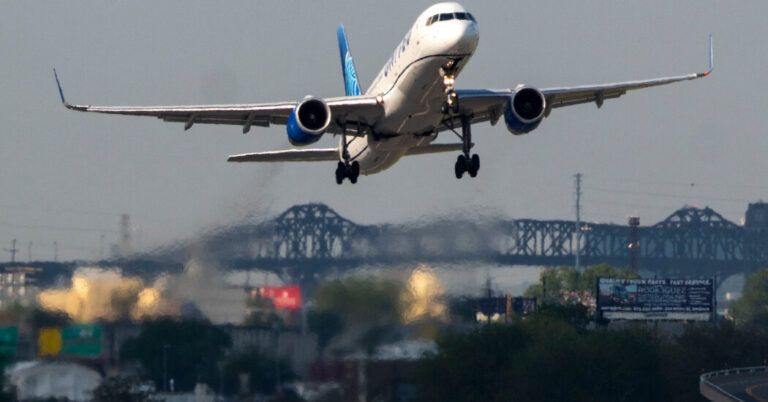
Flying into or out of Newark Liberty International Airport has brought plenty of misery in the last week, with cancellations, delays stretching well past five hours and flight diversions that have stranded travelers far from their destinations.

Passengers are reporting on social media that they have missed flights and spent hours stuck on the tarmac aboard planes. Some are still struggling to make new travel arrangements.

The disruptions, which stretched into Friday with delays averaging over two hours, have highlighted ongoing air traffic control staffing issues. The troubles prompted United Airlines, Newark’s largest carrier, to cut nearly three dozen round-trip flights per day at the hub beginning this weekend, the carrier’s chief executive, Scott Kirby, announced on Friday.

Here’s what anyone heading to Newark Airport needs to know.

Last summer, management of the airspace surrounding Newark shifted from New York to Philadelphia. This move, which involved relocating at least a dozen air traffic controllers, was meant to ease air traffic delays.

The Federal Aviation Administration has attributed this week’s flight disruptions at Newark to equipment failures and unspecified staffing issues at the Philadelphia air traffic control center as well as to construction on one of Newark’s runways.

These ongoing staffing issues are “effectively limiting the capacity of Newark Airport,” said Aidan O’Donnell, the general manager of New Jersey airports at the Port Authority of New York and New Jersey.

The other major New York City airports, Kennedy and LaGuardia, are managed by the New York control center.

One of the airport’s three runways was shut down on April 15 for rehabilitation and repaving, with plans to reopen in mid-June.

This is a “very routine construction project,” said Mr. O’Donnell, and the airport had prepared for it extensively by taking steps such as scheduling fewer flights during this period.

Though the airport has two remaining open runways, the F.A.A. has underutilized one of them during the closure, Mr. O’Donnell said. “When we only have one runway that’s available, we are simultaneously landing and departing on the same runway, which is the least efficient way that traffic can be managed into and out of Newark,” he added.

The airport has more than 1,000 scheduled arrivals and departures each day, the majority of which are operated by United.

The Philadelphia control center experienced telecommunications and equipment issues on Monday, an F.A.A. spokesperson said. That led to hundreds of delays and cancellations and three dozen flight diversions that day, Mr. O’Donnell said. He added that for two hours on Monday afternoon, no flights departed from or landed at Newark.

The disruptions continued through the week as air traffic controller shortages worsened in Philadelphia. Scott Kirby, the chief executive of United Airlines, said in a letter to customers that more than 20 percent of the air traffic controllers responsible for Newark “walked off the job” this week.

Mr. Kirby added that staffing shortages at the Philadelphia control center have been a problem for years.

A spokesman for the National Air Traffic Controllers Association declined to comment.

The next few weeks could be challenging, Mr. O’Donnell warned.

Mass flight delays and cancellations can take days to resolve, as airlines navigate getting passengers, crew and aircraft back on track. Both United and JetBlue Airways have issued flight waivers allowing travelers to rebook without incurring extra fees.

United will cut 35 out of an average of 328 round-trip flights per day from its Newark schedule starting this weekend. The airport, one of the airline’s seven hubs, is a key gateway for flying to Europe, India and the Middle East.

Without enough controllers, “Newark airport cannot handle the number of planes that are scheduled to operate there in the weeks and months ahead,” Mr. Kirby said, adding that the flight reduction was a stopgap measure “since there is no way to resolve the near-term structural F.A.A. staffing issues.”


Follow New York Times Travel on Instagram and sign up for our Travel Dispatch newsletter to get expert tips on traveling smarter and inspiration for your next vacation. Dreaming up a future getaway or just armchair traveling? Check out our 52 Places to Go in 2025.




Source link

Trump Administration Unveils EPA Overhaul With Shift to Approving New Chemicals

0


The Environmental Protection Agency said on Friday that it would disperse scientists from its independent research office to other divisions where they among other things will be tasked with approving the use of new chemicals.

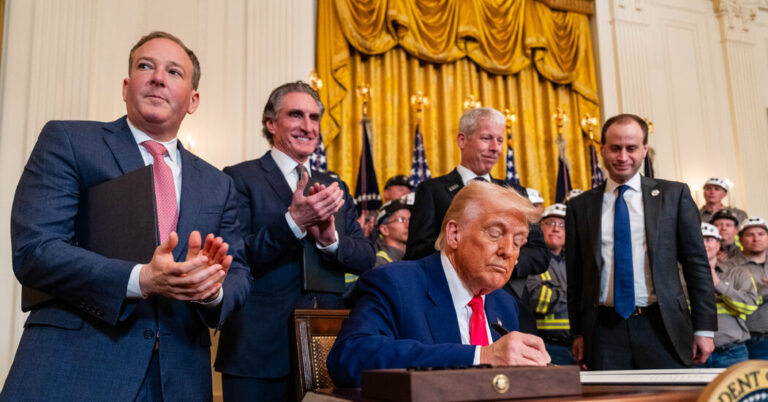
Administrator Lee Zeldin announced the changes to the E.P.A. in a video, saying the agency was “shifting its scientific expertise” to focus on issues he described as “mission essential.”

Most of the immediate changes will affect the Office of Research and Development, the E.P.A.’s main research arm that conducts studies on things like the health and environmental risks of “forever chemicals” in drinking water and the best way to reduce fine particle pollution in the atmosphere.

An internal document previously reviewed by The New York Times outlined the Trump administration’s recommendation to eliminate that office, with plans to fire as many as 1,155 chemists, biologists, toxicologists and other scientists working on health and environmental research.

That didn’t happen on Friday, but the agency’s new priorities were made clear: One hundred and thirty jobs will be moved to an office at the agency tasked with approving new chemicals for use, Mr. Zeldin said. Chemical industry groups have long complained of a backlog in approvals, which they say is stifling innovation.

At an all-hands staff meeting late Friday, Nancy Beck, a former lobbyist at the American Chemistry Council who now heads the E.P.A.’s chemicals office, told stunned scientists that it was “a very exciting time.”

“I encourage everyone throughout the agency to apply for these positions,” she said.

Trump administration officials indicated that more changes were in store for the research office. Scientists who were on the call said they were left with the impression that if they did not move into one of the new areas, their current jobs might be eliminated.

Also on Friday, the E.P.A. extended a deadline for accepting a deferred resignation offer to May 9.

“This feels like the Hunger Games,” said one employee of the research office who spoke on condition of anonymity, for fear of retaliation.

Other scientists will move into the administrator’s office as part of a new Office of Applied Science and Environmental Solutions, which Mr. Zeldin said would “put science at the forefront of the agency’s rule making.”

Democrats and environmental activists warned the move would politicize scientific research.

“This so-called ‘reorganization’ is a thinly veiled attempt to extinguish the agency’s world-renowned scientific expertise by shuffling scientists to process chemical reviews for industry,” Representative Chellie Pingree, Democrat of Maine, said in a statement.

The research office “is intentionally separate from E.P.A.’s policy offices, ensuring it produces unbiased studies,” said Chitra Kumar, the managing director of the climate program at the Union of Concerned Scientists, an advocacy group. Moving the scientists into policy offices “could subject those experts to political influence, particularly in this administration,” she said.

The changes come amid a major deregulatory drive at the agency. The E.P.A. under Mr. Zeldin is revising or repealing more than 30 regulations aimed at protecting the air, water and climate. The administrator also is overseeing an effort to dismantle the legal underpinning for most climate regulations, known as the endangerment finding.


Source link

Trump Says He’s ‘Taking Away’ Harvard’s Tax Exempt Status

0


Harvard University signaled Friday that it would resist President Trump’s renewed threat to revoke the school’s tax-exempt status, a move for which it said there was “no legal basis” as the president escalated his bitter dispute with the nation’s oldest university.

Harvard stopped short of explicitly pledging a legal challenge to a revocation of its tax status, a change that would upend the university’s finances. But a spokesperson for the university said in a statement that there was “no legal basis to rescind Harvard’s tax-exempt status.”

“Such an unprecedented action would endanger our ability to carry out our educational mission,” the statement said. “It would result in diminished financial aid for students, abandonment of critical medical research programs and lost opportunities for innovation. The unlawful use of this instrument more broadly would have grave consequences for the future of higher education in America.”

Mr. Trump declared Friday morning on social media that the government would be “taking away Harvard’s Tax Exempt Status.” Mr. Trump added, “It’s what they deserve.”

Despite Mr. Trump’s assertion online and Harvard’s sharp response, it was not immediately clear Friday whether the I.R.S. was in fact moving forward with revoking Harvard’s tax-exempt status, a change that could typically occur only after a lengthy process. Federal law prohibits the president from directing the I.R.S. to conduct tax investigations, and I.R.S. employees who receive such a command are required to report it to an internal government watchdog.

After Mr. Trump first publicly called for Harvard to lose its tax exemption last month, White House officials said that the I.R.S. would make its own conclusion about whether to do so.

Representatives for the I.R.S. and Treasury Department, which oversees the tax collector, did not respond to a request for comment.

With its tax-exempt status, Harvard not only does not have to pay most taxes, but donors can write off gifts to the school on their own tax returns. Losing the status would not only force Harvard to start paying tax to the federal government on its income but could cause donations to dry up. Philanthropy accounts for about 45 percent of Harvard’s annual operating revenues; most of that sum comes from a payout from the university’s $53 billion endowment.

The intensifying standoff between the Trump administration and Harvard is part of a broad pressure campaign against some of the nation’s most elite universities, which the administration has painted as hotbeds of antisemitism and discrimination that require federal intervention.

In recent weeks, Harvard has taken a decidedly confrontational posture toward the Trump administration. The university rejected a roster of demands from the government, including that it submit reports to Washington, alter its admissions and hiring policies and bring in an outsider to examine “those programs and departments that most fuel antisemitic harassment or reflect ideological capture.”

The university sued after the administration froze more than $2 billion in federal funds in retaliation for Harvard’s defiance.

Even before Mr. Trump first called for Harvard to lose its tax exemption, the Trump administration has sought to transform the typically technocratic I.R.S. into a political tool.

Trump officials pressured the I.R.S. to help Immigration and Customs Enforcement find people it is seeking to deport, a decision that agency officials warned undermined legal protections for taxpayer information. (I.R.S. officials can face prison time if they improperly share taxpayer information, including details about whether an individual or entity is facing an audit.)

The agency has had five different leaders so far this year, with the current acting commissioner, Michael Faulkender, taking over after Treasury Secretary Scott Bessent complained to Mr. Trump that Elon Musk had installed the previous acting leader behind his back. Mr. Faulkender is also the deputy Treasury secretary.

Republicans have long accused the I.R.S. of improperly scrutinizing conservatives, leading a series of investigations under the Obama administration into the agency’s treatment of Tea Party groups. An inspector general later concluded that the agency had improperly targeted both conservative and liberal organizations.

“I think Republicans should be quite cautious about using the I.R.S. against any particular sector or narrow group of organizations,” said Scott Hodge, the former president of the Tax Foundation, a think tank that favors lower taxes. “Weaponizing the I.R.S. in any form is wrong. Policies should always be uniform and neutral and based on tax principles.”

A group of Democratic senators — led by Chuck Schumer of New York, the minority leader — wrote to the Treasury inspector general for tax administration, the I.R.S. watchdog, to request that it investigate Mr. Trump’s targeting of Harvard. They wrote that “it is both illegal and unconstitutional for the I.R.S. to take direction from the president” on assessing tax-exempt groups.

Typically, the I.R.S. will challenge a group’s tax-exempt status after conducting a lengthy audit to determine whether, for example, the entity is engaging in too much political or commercial activity. If the I.R.S. decides to revoke a tax exemption, the group can appeal the decision in court. Given Harvard’s vast research and educational operations, tax experts expect a court would ultimately side with the school.

“Been there, done that,” said Ted Mitchell, the president of the American Council on Education and an under secretary of education during the Obama administration. “The president has been saying this for weeks. Nothing has changed to make it possible for him to take unilateral action on an institution’s nonprofit status.”

Even if the I.R.S. does not ultimately change Harvard’s tax status, Republicans are preparing to substantially increase a tax on university endowments that the party created in 2017.


Source link

Trump Proposes $163 Billion in Cuts Across Government in New Budget

0


President Trump on Friday proposed slashing $163 billion in federal spending next fiscal year, a drastic retrenchment in the role and reach of government that, if enacted, would eliminate a vast set of climate, education, health and housing programs, including some that benefit the poor.

Issuing his first budget proposal since returning to office, Mr. Trump sketched out a dim view of Washington. His blueprint depicted many core government functions as woke, weaponized, wasteful or radical, as the president looked to justify his request that Congress chop domestic spending to its lowest level in the modern era.

Mr. Trump proposed cutting funding for some federal law enforcement, including the F.B.I. He called on lawmakers to slash money meant to police tax evasion at the Internal Revenue Service. He recommended striking billions in funds that help finance clean water projects. And the president reserved some of his deepest cuts for education, health and science, including the National Institutes of Health and the Centers for Disease Control and Prevention, which would see their budgets cut by around half.

Democrats immediately rebuked Mr. Trump for his proposal. Senator Chuck Schumer of New York, the Senate minority leader, called it “heartless” and an “all-out assault on hardworking Americans.” Even some Republicans took issue with Mr. Trump’s budget, although others, like Speaker Mike Johnson, endorsed the blueprint.

Mr. Trump also asked Congress to reduce, if not eliminate, billions of dollars in federal aid to help the poorest Americans. For one, the White House called for reconfiguring federal programs that provide rental assistance to low-income families, cutting aid by more than $26 billion next fiscal year. And the administration proposed the termination of a federal initiative, backed by some Republicans, that aids needy families in paying their monthly heating bills.

In one of the few spending increases included in the budget, Mr. Trump asked lawmakers to bolster spending at the Department of Homeland Security by more than $43 billion, furthering his work to crack down on immigration, conduct deportations and build a wall along the U.S.-Mexican border. The president also requested more than $1 trillion for the military next fiscal year.

But he asked lawmakers to approve that increase essentially on a one-time basis, as part of a broader legislative package — due later this year — meant to advance the president’s tax agenda. The approach angered some Republicans, who signaled they would pursue a larger increase to military spending as part of the yearly process to fund government agencies and programs.

“It is peculiar how much time the president’s advisers spend talking about restoring peace through strength, given how apparently unwilling they’ve been to invest accordingly in the national defense or in other critical instruments of national power,” said Senator Mitch McConnell of Kentucky, the Republicans’ former Senate leader, in a statement that denounced the administration’s “accounting gimmicks.”

For Mr. Trump, the budget served to formalize his conservative vision and his disruptive reorganization of the government, a campaign that has already shuttered entire agencies and dismissed thousands of federal workers without the explicit approval of Congress.

Some of Mr. Trump’s proposed military increases could benefit Elon Musk, the tech billionaire who has advised Mr. Trump on cost-cutting as part of the Department of Government Efficiency

Mr. Trump’s budget supported the creation of a new missile defense shield and a renewed campaign for “U.S. space dominance.” Both are areas in which Mr. Musk and his rocket company, SpaceX, could stand to win major contracts funded by any increase in spending.

In a letter Friday accompanying the spending blueprint, Russell T. Vought, the leader of the White House budget office, said the administration had produced its submission after a “rigorous, line-by-line review of spending.”

Mr. Vought added that the president sought to root out money “contrary to the needs of ordinary working Americans and tilted toward funding niche, nongovernmental organizations and institutions of higher education committed to radical gender and climate ideologies antithetical to the American way of life.”

Sharon Parrott, the president of the left-leaning Center on Budget and Policy Priorities, said many of the budget changes contemplated by Mr. Trump still seemed most likely to fall hardest on low-income Americans, particularly those who rely on government services.

“This is the latest repudiation of some of what he promised on the campaign trail, in terms of being a president who was going to seek to serve people struggling at the margins of the economy,” she said.

Mr. Trump’s proposal is not law. Totaling about $1.7 trillion, after accounting for the full set of spending changes the president seeks, the budget serves only as a formal guide to Congress, where it immediately generated opposition.

“President Trump has made his priorities clear as day: He wants to outright defund programs that help working Americans while he shovels massive tax breaks at billionaires like himself and raises taxes on middle-class Americans with his reckless tariffs,” Senator Patty Murray of Washington, the leading Democrat on the Appropriations Committee, said in a statement.

The criticism was not limited to Democrats, as Republicans also raised alarm about cuts to some programs that serve the neediest Americans. Outlining her “serious objections,” Senator Susan Collins, a Maine Republican who leads the Appropriations Committee, added in a statement: “Ultimately, it is Congress that holds the power of the purse.”

By releasing the budget, Mr. Trump set the stage for what is bound to be a complicated, monthslong process to fund the government and avert a shutdown before an existing spending deal expires on Sept. 30. Entering that fight, many Republicans have echoed Mr. Trump’s desire to slash federal spending, though warring G.O.P. factions have disagreed at times over the exact scope.

Party lawmakers have also raced to identify potentially trillions of dollars in cuts that they can include to finance a related package that would expand a set of expiring tax cuts for families and businesses, one of the president’s signature — and costliest — economic policy priorities.

But Mr. Trump’s proposal carries additional significance. He and his top budget adviser, Mr. Vought, subscribe to the idea that the commander in chief wields expansive authority to halt or cancel spending, even if Congress instructs otherwise. Their view has paved the way for the administration to slow, freeze or cancel billions of dollars in funds, sparking a vast array of lawsuits and prompting more than three dozen ongoing federal investigations into their activities.

On Friday, Mr. Trump’s proposal left unanswered some of the most important questions facing Washington and its finances. It was silent on the nation’s fiscal trajectory, even as the president seeks to cut taxes in a sprawling and costly legislative package that carries substantial implications for the nation’s $36 trillion debt.

“It remains to be seen what the rest of the president’s proposals will hold, and there is still the multitrillion-dollar question of whether the reconciliation bill will blow up the debt,” said Maya MacGuineas, the president of the Committee for a Responsible Federal Budget, a group that advocates deficit reduction.

Nor did the president’s new budget address the future of the federal benefit programs, including Social Security, Medicare and Medicaid, that comprise the largest share of federal spending annually. Some Republicans are particularly interested in rethinking Medicaid, which provides health insurance to poor families, as a source of savings to pay for their tax cuts.

The administration is expected to send those details in a fuller budget to Congress as soon as this month.

Reporting was contributed by Alan Rappeport, Sheryl Gay Stolberg, Catie Edmondson, Eric Lipton, Devlin Barrett, Lisa Friedman, Brad Plumer, Madeleine Ngo and Alicia Parlapiano.


Source link

Miami GP: Kimi Antonelli becomes youngest F1 polesitter to beat Oscar Piastri, Lando Norris in Sprint Qualifying | F1 News

0


Mercedes’ teenage rookie Kimi Antonelli claimed a shock but stunning maiden pole position in Formula 1 for the Miami GP Sprint.

The 18-year-old has replaced Lewis Hamilton at Mercedes this year following the seven-time champion’s move to Ferrari and is competing in just his sixth grand prix weekend.

Debuting on a Miami track he had never driven before Friday, Antonelli uncorked a brilliant single lap in the decisive SQ3 phase of Sprint Qualifying to beat world championship leader Oscar Piastri to the head of Saturday’s 5pm Sprint grid by 0.045s.

The Italian is the youngest-ever driver to claim a pole position for either of F1’s qualifying formats, beating the record held by Sebastian Vettel by more than two years.

Although beaten to pole, Piastri was still ahead of McLaren team-mate Lando Norris, with Max Verstappen fourth for Red Bull on his return to the track after the birth of his first child, daughter Lily.

George Russell was only fifth in the second Mercedes after heading out on the track first in SQ3 but then losing ground to others later on.

Ferrari pair Charles Leclerc and Lewis Hamilton were sixth and seventh respectively.

Please use Chrome browser for a more accessible video player

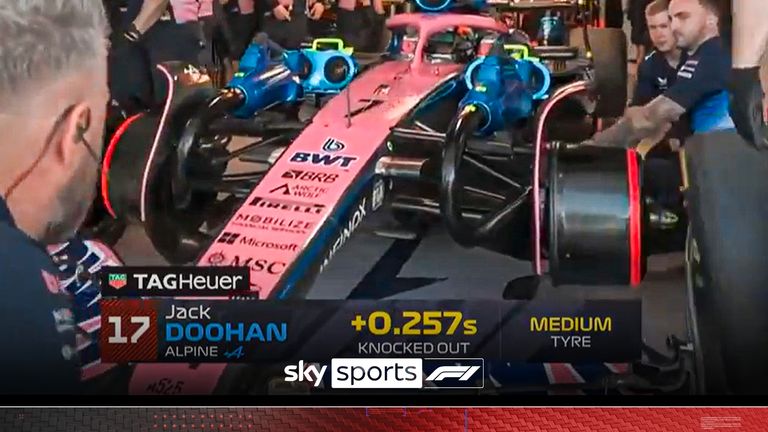
Jack Doohan rants at his Alpine team after being released at the same time as Pierre Gasly, costing him his final run in Sprint Q1 at the Miami GP.

More to follow…

Sky Sports F1’s Miami GP schedule

Saturday May 3

  • 3.20pm: F1 Academy Qualifying
  • 4pm: MIAMI GP SPRINT (race starts at 5pm)
  • 6.30pm: Ted’s Sprint Notebook
  • 7.50pm: F1 Academy Race 1
  • 8.35pm: Miami GP Qualifying build-up*
  • 9pm: MIAMI GP QUALIFYING*
  • 11pm: Ted’s Qualifying Notebook*

Please use Chrome browser for a more accessible video player

Look back at some of the most dramatic moments to have taken place around the Miami International Autodrome.

Sunday May 4

  • 6pm: F1 Academy Race 2
  • 7.30pm: Grand Prix Sunday: Miami GP build-up*
  • 9pm: The MIAMI GRAND PRIX*
  • 11pm: Chequered Flag: Miami GP reaction*
  • Midnight: Ted’s Notebook

*also live on Sky Sports Main Event

Formula 1 is in Miami for a Sprint weekend, watch it all live on Sky Sports F1. Stream Sky Sports with NOW – no contract, cancel anytime


Source link

Pam Bondi Rolls Back Leak Inquiry Constraint Stemming From Fox News Case


Attorney General Pam Bondi has rolled back a constraint on leak inquiries that the Justice Department imposed more than a decade ago, making it easier for investigators to get around a legal bar on search warrants to seize news gathering records.

The safeguard was imposed in 2013 after the revelation that the F.B.I. had portrayed a Fox News reporter as a criminal to bypass restrictions on seizing reporters’ emails.

The change was part of a revised regulation Ms. Bondi issued this week involving leak inquiries. Most of the discussion has focused on how investigators can once again use court orders, subpoenas and search warrants to go after reporters’ information, ending a flat ban on those tactics imposed in 2021 by Attorney General Merrick B. Garland.

Essentially, Ms. Bondi returned to the standard in place before Mr. Garland’s intervention. But a close reading shows that in doing so, she also deleted a key section of the earlier regulation that had emerged from the Fox News incident. The section had limited the ability of investigators to sidestep a 1980 law that generally bars search warrants for newsroom records.

The omission was striking because many conservatives and Republicans were outraged by the events that led the department, under Attorney General Eric H. Holder Jr., to make the reform. The targeted reporter at Fox News, James Rosen, is now the chief White House correspondent for another conservative network, Newsmax.

In a memo last week announcing the end of Mr. Garland’s ban on using compulsory tools to go after reporters’ communications records, notes or testimony, Ms. Bondi declared: “This Justice Department will not tolerate unauthorized disclosures that undermine President Trump’s policies, victimize government agencies, and cause harm to the American people.”

But her memo did not mention any intent to also eliminate the change inspired by the Fox News incident, which remained in place under the first Trump administration. The department press office did not respond to a request for comment.

Gabe Rottman, the vice president of policy for Reporters Committee for Freedom of the Press, warned that the deletion of the safeguard raised the possibility “that you could see a repeat of the James Rosen case” and said it “raises significant First Amendment concerns.” He posted an analysis of the new regulation on the group’s blog.

“Reducing or eliminating protections from journalists and their sensitive news gathering records impairs not just the press but the public,” Mr. Rottman added. “It harms the public’s ability to hold the government accountable.”

The issue centers on the Privacy Protection Act of 1980, which generally bans warrants to search for and seize news gathering materials. But the law contains an exception for cases in which reporters themselves are criminal suspects.

In 2009, Mr. Rosen reported on North Korea’s plans for a nuclear test. The Justice Department opened a leak investigation and eventually prosecuted a State Department contractor, Stephen Jin-Woo Kim. (In 2014, Mr. Kim pleaded guilty to making an unauthorized disclosure of restricted information and was sentenced to 13 months in prison.)

It was vanishingly rare in the 20th century for the Justice Department to bring criminal charges in a leak case. But it started to become common midway through the George W. Bush administration and under Mr. Holder’s watch, the number continued to soar.

Then, in May 2013, it came to light that investigators had seized two months of Associated Press phone records and that they had portrayed Mr. Rosen’s reporting for Fox News as criminal in a search warrant application, raising the prospect of an unprecedented prosecution of a reporter for publishing information.

In seeking a warrant to gain access to Mr. Rosen’s emails at Google, an F.B.I. agent told a judge that “there is probable cause to believe that the reporter has committed or is committing a violation” of the Espionage Act — which criminalizes the unauthorized disclosure of sensitive national security information — “as an aider and abettor and/or co-conspirator” of his source.

Critics across party lines expressed concerns that the Justice Department was going too far in its crackdown on leaks, and some lawmakers also accused Mr. Holder of having misled Congress in earlier testimony in which he said he opposed that idea and had never been involved in or heard discussions about any such potential prosecution.

Justice Department officials countered that they never actually intended to prosecute Mr. Rosen, and had only portrayed him as a criminal suspect to invoke the exemption to the 1980 statute. Critics said the defense essentially amounted to an admission that the department had gamed the law in bad faith.

“That tactic circumvents the clear intent of the Privacy Protection Act,” Mr. Rottman said. “The law is meant to ensure that government can’t seek search warrants for a journalist’s records or unpublished stories unless it has probable cause to believe the journalist has actually done something really wrong.”

In response to the broader furor, President Obama ordered a review of procedures for leak investigations, saying he was “troubled” that investigative reporting could be stifled. Mr. Holder repeatedly met with news media leaders, acknowledging criticism that the Justice Department had tipped too far toward aggressive law enforcement.

He developed new guidelines for leak investigations. Those included forbidding portraying reporters as co-conspirators in criminal leaks simply to circumvent the legal bar on secret search warrants for their reporting materials. His regulation said investigators could only invoke the exemption to the 1980 law if a reporter was officially under investigation.

Those rules stayed in place until early in the Biden administration, when it came to light that under the Trump administration, the Justice Department had seized the communications records of reporters at The New York Times, The Washington Post and CNN.

President Biden ordered prosecutors to stop seizing reporters’ phone and email data. Mr. Garland established a regulation barring the Justice Department from using “compulsory legal process for the purpose of obtaining information from or records of members of the news media acting within the scope of news gathering, except in limited circumstances.”

Last year, the House unanimously passed a bipartisan bill to strengthen the ability of reporters to protect confidential sources. But it died in the Senate after Mr. Trump instructed Republicans to “kill this bill.”


Source link

Former Abercrombie C.E.O. Ruled Unfit to Stand Trial for Sex Trafficking

0


Michael S. Jeffries, the former chief executive of Abercrombie and Fitch who was charged with running an international sex-trafficking ring, on Friday was found unfit to stand trial because of an Alzheimer’s diagnosis.

In a three-page order, Judge Nusrat J. Choudhury of the Eastern District of New York, wrote that Mr. Jeffries was “suffering from a mental disease or defect rendering him mentally incompetent.” Judge Choudhury also ordered that Mr. Jeffries be hospitalized for four months to observe whether his condition improves.

The ruling followed a letter filed last month by Mr. Jeffries’s lawyers, Brian H. Bieber and Alek Ubieta. They wrote that, based on the independent evaluation of three doctors, Mr. Jeffries, 80, had severe dementia and Alzheimer’s, which “ensures continued decline over time.” The condition meant Mr. Jeffries could not understand the charges he was facing, his lawyers wrote.

Mr. Jeffries was indicted last October on charges that, from 2008 to 2015, he coerced dozens of men into sex with him, using his position as the clothing retailer’s chief executive to sexually exploit models who were motivated to advance their careers. He had pleaded not guilty.

Working with his romantic partner, Matthew Smith, and a third person, James Jacobson, Mr. Jeffries lured the men to secret sex parties with the possibility that they’d receive modeling jobs, federal prosecutors said. Mr. Smith and Mr. Jacobson have also been charged with sex trafficking, and, like Mr. Jeffries, have pleaded not guilty.

According to prosecutors, the men that Mr. Jeffries and his co-defendants coerced were not allowed to leave the sex parties. Along with being forced into sex, they were made to consume alcohol, drugs and Viagra. The charges echoed claims made in a class-action lawsuit brought against Abercrombie in 2023 and reported on in a BBC investigation.

The defendants “used their money and influence to prey on vulnerable men for their own sexual gratification,” Breon Peace, the former U.S. attorney for the Eastern District, said in a statement last October.

Though Mr. Jeffries was credited with saving Abercrombie from bankruptcy in the early 1990s, the company faced a variety of crises under his stewardship, well before last year’s criminal indictment.

When Mr. Jeffries left the company in 2014, the company was facing backlash over what many customers saw as its hypersexualized imagery of young models, and it had been enduring sliding sales.

In 2004, Abercrombie agreed to pay $40 million to settle a class-action lawsuit that accused the company of favoring white employees over Black, Hispanic and Asian workers. In 2012, it faced an age-discrimination lawsuit that claimed that employees on Abercrombie’s Gulfstream jet were required to respond to any of Mr. Jeffries’s requests with “no problem.”


Source link

Companies Are Raising Prices as Tariffs Hit

0


More companies are starting to warn that they will have to pass on higher costs to American consumers, raising prices for products like strollers, mattresses, power tools and cast-iron cookware as President Trump’s tariffs take hold.

Some company officials said they had been left with no choice but to raise prices as they pay more to import goods and materials into the United States. Other firms have said they will soon run out of inventory for certain products because they have paused orders from China.

Mr. Trump has upended the global trading system, hitting foreign countries with punishing levies in an attempt to bring manufacturing jobs back to the United States and take aim at what he calls “unfair” trade practices. But economic studies have found that the burden of higher tariffs typically falls on domestic consumers and companies.

Although Mr. Trump has scaled back some tariffs and paused others as he pursues trade deals with foreign nations, the impacts of his policies are already starting to eat into household budgets and frustrate Americans who have noticed higher prices for their goods.

Some major companies have recently warned about impending price increases.

Stanley Black & Decker said on Wednesday that it raised prices on its tools and outdoor products last month and will raise them again later this year. The German sportswear company Adidas said this week that steeper tariffs would eventually lead to higher prices for U.S. customers.

Executives at Procter & Gamble, which makes products like Bounty paper towels and Tide detergent, said last week that the company would most likely increase prices for some products to mitigate the effects of higher tariffs. And officials at Hasbro recently said the toymaker would “have to raise prices,” although it would try to “minimize the burden” on customers.

Some of the most immediate price increases have come in response to the elimination of a loophole that allowed items worth $800 or less from China to enter the United States without import fees. Shein and Temu, popular Chinese e-commerce platforms, began adjusting prices for U.S. customers last week ahead of the end of the tariff exemption on Friday.

Michelle Hall, a 48-year-old secretary in Snohomish, Wash., said she started buying products from Temu late last year and has since spent about $2,300 on furniture, car mats, sweaters, Christmas gifts and other inexpensive goods from the platform. “It’s addicting and fun when you get your packages,” Ms. Hall said.

But over the weekend, she discovered extra “import charges” tacked onto her total. A cart of six items from Temu that would have usually cost her $83.80 would cost an extra $92.08 because of import fees, Ms. Hall said. On Wednesday, she noticed that the platform appeared to take down many products that would have incurred import fees, leaving only products that were shipped from local warehouses.

Ms. Hall said she planned to abandon Temu because she did not want to pay higher prices, and its offerings seemed more limited now.

She said she still hoped that Mr. Trump’s tariffs would have some long-term benefits. She voted for Mr. Trump in November, initially thinking his trade policies could help reduce the deficit, create manufacturing jobs and make the nation less dependent on foreign countries.

But Ms. Hall said she was not sure if those benefits would materialize. “In the meantime, I feel like citizens are suffering,” she said.

Ms. Hall said she never thought her own costs would increase, and she originally hoped that Mr. Trump would quickly bring prices down.

“I wanted to have faith,” she said. “I don’t have that faith anymore.”

Some companies have said they will begin raising prices in the coming weeks because of higher tariffs. Joanna Rosenberg, the chief sales and marketing officer at Zwilling J.A. Henckels, a German company that specializes in cutlery and other kitchen products, said the firm would have to raise prices for some products in early June. Premium knives from Zwilling and cast-iron cookware from Staub, one of the company’s brands known for its Dutch ovens made in France, will see “single-digit” price increases, Ms. Rosenberg said.

She said the company would have to raise prices more substantially for certain knives from its value brand, Henckels. Some of those knives are produced in China, which Mr. Trump has hit with a minimum 145 percent tariff. The president has signaled that the rate could drop, though the White House has insisted it will not do so unless China agrees to pare back its levies too.

“We don’t want to increase prices,” Ms. Rosenberg said. “There’s just no way that we can absorb some of these price increases.”

Some industries are being hit particularly hard because the bulk of their products are made in China. About 90 percent of durable baby and children’s products sold in the United States are manufactured overseas, with the vast majority produced in China, according to the Juvenile Products Manufacturers Association.

Several companies that sell strollers and car seats said they would have to increase prices to offset higher costs from tariffs. UPPAbaby said last month that it would adjust prices across most products. Evenflo increased prices between 10 to 40 percent for most of its products on Thursday. Cybex also increased prices for some products on Thursday, which company officials said was “unavoidable.”

Steven Dunn, the chief executive of Munchkin, which sells products like high chairs, strollers and diaper pails, said the company will likely have to increase prices at a minimum of 20 percent for many products soon. And Mr. Dunn said the company might have to discontinue 30 to 40 percent of its products after its current inventory dwindles within an estimated 10 weeks.

“There are a lot of products that we just will not order anymore at the current rates,” Mr. Dunn said. “You can’t pass on a 145 percent tariff to the consumer and expect them to buy the same product.”

Mr. Dunn said that Munchkin paused its orders from China last month, and officials have tried to move as much manufacturing out of the country as possible. Although Mr. Trump has urged companies to make more products in the United States, producing more baby products domestically is complex. “The tooling, the skills and the automation just doesn’t exist here,” Mr. Dunn said.

Companies that make products in America are not immune to the impacts of higher import fees, either.

Vy Nguyen, the chief executive officer at Avocado Green Mattress, said all of its organic mattresses were made in the Los Angeles area. But many of the “core natural components” that are used to make its mattresses, such as wool and latex, are sourced from countries including India, Thailand and Guatemala. Those materials have risen in price because Mr. Trump has instituted a 10 percent blanket tariff on nearly all trading partners.

Avocado plans to increase mattress prices by about 6 percent and other products by an average of 7.5 percent starting on Tuesday, company officials said.

Some brands have been more vocal about price increases because they are worried about their ability to pass on cost increases to consumers, said Simeon Siegel, a retail analyst at BMO Capital Markets. The companies want to ensure that consumers “don’t feel like they’re having the rug pulled out from under them,” he said.

Réalisation Par, which sells an array of silk dresses, said in an email to customers last month that officials would have to raise prices for U.S. orders starting May 2 because its “silk pieces have always been crafted with care and expertise in the home of silk — China.” In the meantime, customers could take 20 percent off their order until late April, according to the email.

Fatima Ocampo, a 24-year-old data analyst in Sacramento, Calif., said she was already eyeing several dresses from Réalisation Par when she saw the email. Ms. Ocampo said she was planning to wait to make a purchase, closer to when she will leave for her honeymoon in the south of France this fall. But she wanted to take advantage of the lower prices while she could, so she bought three dresses from the brand for about $400 later that day.

“I feel like it’s a clear example of how these tariffs are going to be a burden put onto the consumer,” Ms. Ocampo said.


Source link

Stock Market on Track to Erases Losses From Trump’s ‘Liberation Day’ Tariff Rollout

0


Stocks were on track on Friday to erase their losses from the days after President Trump’s chaotic rollout of tariffs in early April, bolstered in part by a healthy report on the labor market.

The S&P 500 rose 1.6 percent by Friday afternoon, climbing back above where it stood before chaos descended on financial markets after April 2 — Mr. Trump’s so-called “Liberation Day,” which featured his most sweeping tariffs to date.

Friday’s boost to stock prices followed a stronger-than-expected report on hiring in April. But the S&P 500 has been edging higher for days — Friday’s gain would be its ninth consecutive daily increase — as Mr. Trump and members of his administration raised hopes that trade tensions would ease, including by indicating they were willing to engage in talks with China.

Early Friday, China’s commerce ministry in a statement said it too was considering holding talks with the Trump administration, but only if Washington cancels its tariffs on Chinese goods first.

The two countries remain far from any deal that would resolve the trade war between them, but even the prospect of talks has been enough to ease the worst of the anxiety that gripped investors a month ago.

“If the labor market holds up and the Trump administration walks back the most egregious tariffs, the economy could skirt a deep recession,” said Jeffrey Roach, chief economist at LPL Financial.

Still, despite the recent optimism and recovery, the S&P 500 is more than 7 percent below its recent high in mid-February. It has fallen about 5 percent since Mr. Trump’s inauguration in January.

Questions remain about whether Mr. Trump’s tariffs might cause a sharp slowdown in economic growth, which could result if companies start pulling back on hiring, spending and investments amid the uncertainty.

Though Mr. Trump backed off the most extreme tariffs on dozens of countries, many imports into the United States now face new taxes of at least 10 percent, while products from China are being taxed a minimum of 145 percent. On Friday, a provision that had allowed for low-value shipments from China and Hong Kong to evade tariffs altogether closed. And on Saturday, new tariffs of 25 percent on imported auto parts are expected to take effect. That’s in addition to a tax of 25 percent on imported cars that already took effect in April.

Volatility in recent weeks has underscored the degree to which sentiment on Wall Street is still driven by concern about the economic fallout from the Trump administration’s policies. Mr. Trump’s 90-day pause of many of the tariffs that he announced on April 2 will end in July.

“The damage to economic momentum has already been done,” said Mike Sanders, head of fixed income at Madison Investments. “Deals may come, but the real question is how long the data will take to reflect the harm.”


Source link

Miami GP: Oscar Piastri tops sole practice as Oliver Bearman crash creates Sprint Qualifying mystery | F1 News

0


Oscar Piastri topped the sole practice session at the Miami Grand Prix as Oliver Bearman’s crash prevented much of the field from completing their preparations for Sprint Qualifying later on Friday.

With the drivers having just 60 minutes to prepare for the rest of the weekend, the soft-tyre qualifying simulations had been left to the final 10 minutes of the session, during which Bearman spun his Haas into the barriers at Turn 12 to trigger a session-ending red flag.

World championship leader Piastri was among the drivers who did complete a flying lap, which put him three tenths of a second clear of Ferrari’s Charles Leclerc in second, with Max Verstappen a further tenth back in third for Red Bull.

Lando Norris, Piastri’s McLaren team-mate and nearest championship challenger, was only 12th, having been in the final sector of his first attempt at a flying lap when the red flag was thrown.

Please use Chrome browser for a more accessible video player

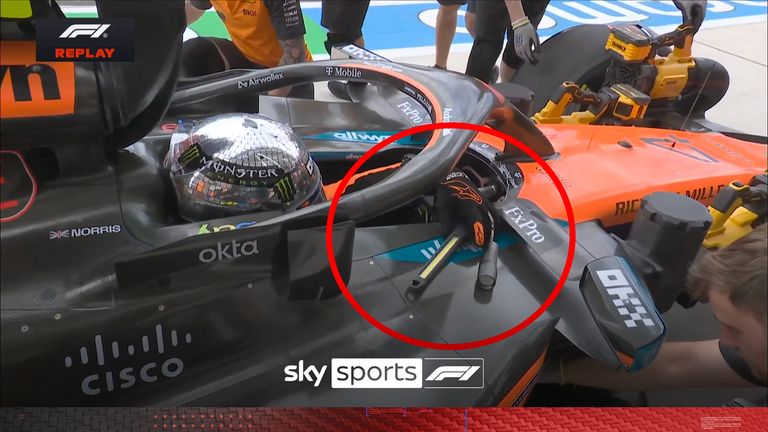
Watch the bizarre moment a mechanic left a torch in Lando Norris’ cockpit after he set off to begin practice one at the Miami Grand Prix.

Norris had trailed by more than three tenths after the first sector but almost halved that deficit in the second sector, leaving uncertainty over what the ultimate margin between the McLarens would have been.

Williams duo Carlos Sainz and Alex Albon were fourth and fifth, respectively, having been one of the first teams to send their cars out on soft tyres.

Lewis Hamilton was another to miss out on the opportunity to complete a flying lap, with the seven-time world champion finishing 13th.

Please use Chrome browser for a more accessible video player

Lando Norris had to dodge around Esteban Ocon in a close call during practice one at the Miami Grand Prix.

Hamilton’s early-season struggles had shown little sign of abating during medium-tyre running earlier in the session, after which he was eighth.

Mercedes’ George Russell had set the fastest time on the medium compound and finished seventh on the timesheet despite not completing a lap on the softs.

Having achieved two career firsts by winning successive races and becoming world championship leader, Piastri arrived at the sixth round of the season with plenty of momentum, along with a 10-point advantage over Norris.

The Australian did experience a minor scare as he brushed the barriers on his worn medium tyres, but once more appeared comfortable when setting the leading time.

Please use Chrome browser for a more accessible video player

Ted Kravitz takes us through the major Red Bull upgrade they’ve brought to Miami.

Reigning world champion Verstappen showed no ill-effects from his late arrival at the Miami International Autodrome having missed Thursday media sessions as he remained at home to attend the birth of his first child.

The Dutchman’s Red Bull team are the only front-runners to have brought significant upgrades to Miami, in the form of an updated floor, but the truncated nature of the practice allowance made it difficult to assess the impact.

Miami GP Practice One Timesheet

Driver Team Time
1) Oscar Piastri McLaren 1:27.128
2) Charles Leclerc Ferrari +0.356
3) Max Verstappen Red Bull +0.430
4) Carlos Sainz Williams +0.550
5) Alex Albon Williams +0.827
6) Isack Hadjar RB +0.840
7) George Russell Mercedes +0.930
8) Yuki Tsunoda Red Bull +1.027
9) Kimi Antonelli Mercedes +1.099
10) Fernando Alonso Aston Martin +1.115
11) Liam Lawson RB +1.246
12) Lando Norris McLaren +1.263
13) Lewis Hamilton Ferrari +1.428
14) Nico Hulkenberg Sauber +1.445
15) Gabriel Bortoleto Sauber +1.643
16) Oliver Bearman Haas +1.868
17) Pierre Gasly Alpine +1.956
18) Esteban Ocon Haas +2.051
19) Jack Doohan Alpine +2.229
20) Lance Stroll Aston Martin +2.234

Sky Sports F1’s Miami GP schedule

Please use Chrome browser for a more accessible video player

Look back at some of the most dramatic moments to have taken place around the Miami International Autodrome.

Friday May 2

  • 7.30pm: Team Bosses’ Press Conference
  • 8.15pm: F1 Academy Practice 2
  • 9.05pm: Miami GP Sprint Qualifying (session starts at 9.30pm)

Saturday May 3

  • 3.20pm: F1 Academy Qualifying
  • 4pm: MIAMI GP SPRINT (race starts at 5pm)
  • 6.30pm: Ted’s Sprint Notebook
  • 7.50pm: F1 Academy Race 1
  • 8.35pm: Miami GP Qualifying build-up*
  • 9pm: MIAMI GP QUALIFYING*
  • 11pm: Ted’s Qualifying Notebook*

Please use Chrome browser for a more accessible video player

The Miami Grand Prix is a unique experience, watch our favourite moments from the last few years!

Sunday May 4

  • 6pm: F1 Academy Race 2
  • 7.30pm: Grand Prix Sunday: Miami GP build-up*
  • 9pm: The MIAMI GRAND PRIX*
  • 11pm: Chequered Flag: Miami GP reaction*
  • Midnight: Ted’s Notebook

*also live on Sky Sports Main Event

Formula 1 is in Miami for a Sprint weekend, watch it all live on Sky Sports F1. Stream Sky Sports with NOW – no contract, cancel anytime


Source link