Home Blog Page 344

Woman Says She Was Sexually Assaulted on American Airlines Flight

0


A woman has filed a lawsuit against American Airlines, saying a man sexually assaulted her during a red-eye flight from San Francisco to Dallas last year.

Barbara Morgan, a California resident, said that shortly after the flight took off and the lights were dimmed, the man sitting next to her in the middle seat started rubbing his arms against her in a deliberate attempt to touch her breasts.

She tried to create some distance from the man, Ms. Morgan said, but he was undeterred. “He placed his hand on the plaintiff’s upper thigh, slid it up toward her vagina and fondled her genitals,” the complaint said, adding that the man put a bag on his lap to conceal an erection.

The lawsuit, filed on April 24 in the U.S. District Court for the Northern District of California, one year after the alleged incident, said that the accused, Cherian Abraham, had been reported to the airline previously, but was allowed to keep flying. In March, Mr. Abraham was arrested and charged by federal investigators with abusive sexual contact linked to three incidents of sexual assault on airplanes, including the one against Ms. Morgan. Mr. Abraham pleaded not guilty to all charges and a trial has been scheduled for Aug. 4. His attorney could not immediately be reached for comment.

Last month, the F.B.I. reported that sexual assault on airplanes is on the rise, with 104 cases investigated by the bureau in 2024, up from 96 in 2023. The agency warned that the number of incidents could be higher as some cases may have gone unreported.

“Sexual assaults typically occur on long commercial flights, and offenders tend to be male, seated directly next to the victim, and under the influence of alcohol or drugs,” the F.B.I. said in a statement published on its website last month. “They may try to conceal their activities, for instance, by using a blanket to cover the victim or taking advantage of a darkened cabin.”

In her legal complaint against American Airlines and Mr. Abraham, Ms. Morgan accused the airline of negligence, stating that flight attendants rarely walked through the cabin and failed to respond to her distress signals when she twice yelled, “Stop.” When she reported the incident at the arrival gate, she said the American Airlines agent engaged in “victim blaming,” asking why she hadn’t taken further action to report the incident during the flight.

In the lawsuit, Ms. Morgan said she “froze” after the incident, fearing that if she made a scene, the man would retaliate or the flight would be rerouted, which would anger other passengers.

“The safety of our customers and team members is our highest priority,” an American Airlines spokesperson said in an emailed statement. “We take this matter very seriously and are working closely with law enforcement on its investigation.”

Mr. Abraham has since been barred from flying with the airline.

“The F.B.I. and American Airlines passengers have repeatedly warned the airline that in-flight sexual assaults are occurring on American Airlines flights — and American Airlines has had every opportunity to take those warnings seriously. Instead, they’ve turned a blind eye, leaving passengers vulnerable at 30,000 feet,” said Patrick J. Driscoll, an attorney for Romanucci & Blandin, the law firm representing Ms. Morgan.

“This isn’t just a failure of policy; it’s a failure of basic responsibility.”


Follow New York Times Travel on Instagram and sign up for our Travel Dispatch newsletter to get expert tips on traveling smarter and inspiration for your next vacation. Dreaming up a future getaway or just armchair traveling? Check out our 52 Places to Go in 2025.


Source link

Apple Tops Wall Street Expectations With $24.78 Billion Profit


Apple built its business by innovating. But lately, it’s been leaning on diplomacy.

Tim Cook, Apple’s chief executive, recently scored exemptions from tariffs on exports of Chinese-made iPhones. The maneuver freed Apple to focus on business, and lately, business has been good.

A new, lower-priced iPhone, which the company introduced in February, and strong sales of apps and services helped the company make $24.78 billion in quarterly profit, a 4.8 percent increase from a year ago, Apple said on Thursday. The company’s sales rose 5 percent to $95.36 billion.

The results exceeded Wall Street analysts’ expectations for $24.37 billion in profit and $94.35 billion in sales. Shares fell more than 2 percent in after-hours trading.

Apple’s steady performance came amid turbulence. In just a few months, the company has had to navigate internal and external obstacles, including the failures of its much anticipated artificial intelligence system and the challenges of the Trump administration’s punishing tariffs on products made abroad.

Last month, shares of Apple plummeted after President Trump imposed tariffs of 145 percent on exports from China, where Apple makes 80 percent of the iPhones it sells, as well as tariffs on other countries that make iPads and Macs like Vietnam. The tariffs erased about $770 billion of the company’s market value in four days.

Wall Street analysts predicted Apple would have to increase iPhone prices to $1,600, from $1,000. Some customers raced to buy iPhones before prices went up, helping lift sales.

But three months after personally donating $1 million to Mr. Trump’s inauguration, Mr. Cook pressed the White House to relax its tariffs and persuaded the Trump administration to temporarily relent.

On Thursday, Apple said sales of iPhones, its most important business, rose 2 percent to $46.84 billion over the quarter. The company increased iPhone sales by more than 10 percent in Japan, India and the Middle East, helping it claim the largest share of smartphone sales in the world over a three-month span, according to Counterpoint Research, a market research firm.

The company continues to struggle in China, where it reported its sixth quarter of sales declines. Total revenue from the region was $16 billion in the quarter, down 2 percent from a year ago.

“Everything is OK for right now because no prices have been raised,” said Ben Bajarin, principal analyst at Creative Strategies, a tech research firm. “The question is: If more tariffs hit, then what happens?”

The company’s services business, which includes sales from apps, Apple Music and Apple Pay, outshined its devices. Apple reported revenue for the business of $26.65 billion, an 11.6 percent increase from last year.

But the future of Apple’s services business is uncertain. In an antitrust case on Wednesday, a federal judge rebuked the company for its business practices and ruled it can’t collect a commission of 27 percent on app sales made outside the App Store. Her order allows apps to cut Apple out of their business, muffling one of the company’s most important sources of revenue.

In a separate antitrust case, Apple could lose $20 billion in services revenue that Google pays to be the automatic search engine on iPhone web browsers. A federal judge ruled last year that Google had broken the law to maintain a search monopoly. This month, he convened a hearing to address its illegal behavior, including remedies that could include restrictions on Google’s payments to Apple.

The company’s device business also faces questions. Last year, Apple revealed a generative A.I. system capable of improving emails, summarizing notifications and upgrading its virtual assistant, Siri. It promoted the system, which it called Apple Intelligence, as a major reason to buy a new iPhone. But in March, the company pulled its advertisements promoting the features and said some would be delayed until this fall.


Source link

Trump Administration Live Updates: President Shuffles Team, Moving Waltz to U.N. and Adding to Rubio’s Titles


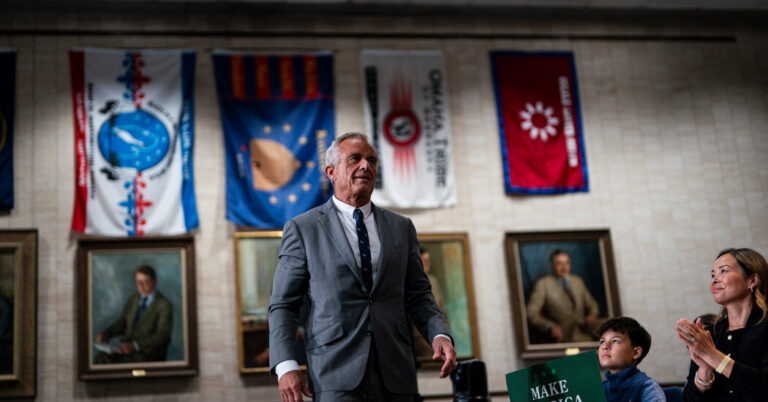
Health Secretary Robert F. Kennedy Jr. on Thursday announced plans to require all new vaccines to be tested against placebos and to develop new vaccines without using mRNA technology, moves that extend his reach deep into vaccine development and raise questions about whether Covid boosters will be available in the fall.

A spokesman for the Department of Health and Human Services called the requirement for placebo testing “a radical departure” from existing standards. But that will depend on how the department defines “new,” because most new vaccines are already tested either against placebos — inert substances — or, in some cases, against vaccines for other diseases.

Mr. Kennedy is one of the nation’s leading vaccine skeptics, and he has been vocal about his disdain for mRNA technology, which was used to develop coronavirus vaccines during the first Trump administration. He once wrote on social media that “mRNA jabs don’t stop infection, don’t block transmission, don’t block mutants, don’t last, don’t work at all.”

Mr. Kennedy’s activism in recent years included petitioning the Food and Drug Administration to pull the Covid vaccine off the market in 2021, during a deadly phase of the pandemic. He also urged the F.D.A. not to authorize Covid shots for children. Mr. Kennedy has also maintained that there could be a link between vaccines and autism, and hired a discredited researcher into his agency whose work aligns with that view.

Since becoming health secretary in February, Mr. Kennedy has made few high-profile pronouncements on vaccine policy, with the exception of his tepid endorsement of the measles shots in response to the outbreak in Texas that has killed two children and one adult. But he and the Trump administration have waded into the issue in other ways, by ordering a study on vaccines and autism and delaying approval of another Covid vaccine.

Mr. Kennedy’s announcements on Thursday represent an extraordinary use of his power as secretary to make decisions ordinarily left to career scientists at the F.D.A. The moves follow his recent instructions that parents of newborns considering vaccination should “do your own research.”

Mr. Kennedy has said he intends to restore trust in the vaccine approval process, but Dr. Jesse Goodman, a former F.D.A. official and an infectious diseases doctor at Georgetown University, said the changes could erode trust.

“Questions never bother me,” Dr. Goodman said, “but it’s really worrisome when it seems like they’re so ubiquitous and so constant that they sow a huge amount of doubt — not just about the one thing, but about everything.”

Most immediately, Mr. Kennedy’s move could affect the next round of Covid booster shots, expected to become available in the fall. Both flu shots and Covid boosters have been authorized without extensive human trials to target new strains of the virus as it has evolved.

Mr. Kennedy says the new policy will not affect flu shots, but the future of Covid boosters is now in doubt. Andrew Nixon, the department spokesman, said that because so many people have been infected and now have immunity to Covid, new studies are required.

“As we’ve said before, trials from four years ago conducted in people without natural immunity no longer suffice,” he said. “A four-year-old trial is also not a blank check for new vaccines each year without clinical trial data, unlike the flu shot, which has been tried and tested for more than 80 years. The public deserves transparency and gold-standard science — especially with evolving products.”

Mr. Kennedy’s plan for the placebo studies, first reported by The Washington Post, also raises ethical questions. It is considered unethical to deprive even a small group of patients of effective vaccines against deadly pathogens. In the case of Covid-19, new clinical studies could hold up authorization for boosters, which would leave the entire U.S. population vulnerable.

Dr. Ofer Levy, a Harvard vaccine researcher and a member of the F.D.A.’s vaccine advisory committee, said that would be “unacceptable,” and that officials must “thread the needle” to be sure the studies are done in a way that do not leave older and immunocompromised people unprotected from Covid.

“Tens of thousands of people can die without protection against Covid,” said Dr. Levy, who co-founded a company working on an opioid vaccine.

The Centers for Disease Control and Prevention reported about 23,000 deaths from Covid since September, with as many as 1,000 a week that month and in January. Still, uptake of the Covid boosters has been low: About 23 percent of adults got the updated Covid shot released in the fall, according to the C.D.C.

One C.D.C. study of the Covid boosters used in 2023 and 2024 found that they averted about 68,000 hospital stays, and were most effective in people who were older than 65 or immunocompromised.

The health secretary’s familiarity with vaccine trials stems at least in part from his reviews of decades-old vaccine approvals, including for the polio vaccine and the measles, mumps and rubella vaccine. Mr. Kennedy has also helped represent plaintiffs in lawsuits against manufacturers.

He and the organization he founded and once led, Children’s Health Defense, have repeatedly complained that vaccines are not tested against placebos in clinical trials when they are being developed. The organization has cited polio, hepatitis and meningitis vaccines as examples, all of which were introduced decades ago.

“Every other medicine is tested against a placebo,” Mr. Kennedy said on a podcast in January 2020, in claiming that vaccines are exempt from that requirement.

That, however, is not entirely correct. Cancer drugs and other medications authorized under the F.D.A.’s accelerated approval program are regularly authorized after trials without a placebo. And new vaccines, including the vaccines for Covid, were tested against placebos — inert substances, such as a saline injection, or in some cases against vaccines for other diseases.

“We’ve required placebo-controlled trials for most vaccines, and sometimes it’s an inert placebo, and sometimes it’s an irrelevant vaccine,” said Dr. Peter Marks, who was the Food and Drug Administration’s top vaccine official until he was forced out in March. “The claim that we have not done randomized trials for pediatric vaccines aside from Covid is not correct.”

Mr. Kennedy has also raised concerns in the past about testing a vaccine against what many scientists consider a reasonable placebo: the same formula, but without the immune-activating agents. Mr. Kennedy has noted that the practice leaves uncertainty about whether ingredients in the formula could cause harm.

In addition to the new placebo requirement, Mr. Kennedy also announced a National Institutes of Health initiative to turbocharge the development of new inoculations for Covid, bird flu and seasonal flu — an effort that appears to be part of a broader assault on mRNA technology, or “platform.”

Since they were developed, Mr. Kennedy issued numerous social media posts about the mRNA shots, including one positing that the F.D.A.’s assessment of the Moderna shot for children in 2022 was “dishonest, and evidence that the public health establishment has abandoned science, logic, reason, rationality, empathy, health and medicine.”

The N.I.H. under the Trump administration has subjected studies related to the mRNA platform to strict scrutiny. Bills restricting the use of mRNA vaccines have popped up in Republican-controlled state legislatures, including in Texas, Idaho and Kentucky.

The F.D.A. is also holding up approvals of a Covid vaccine that is not based on mRNA technology.

The agency was expected to issue a decision on April 1 regarding whether to issue a full approval of the more traditional protein-based Novavax Covid shot, which had been used under emergency authorization. The F.D.A. delayed the decision, though, asking the company to conduct additional research.

“I’m curious if this administration actually intends to just obliterate the Covid vaccine,” said Richard Hughes, a lawyer with the law firm Epstein Becker Green who represents some vaccine makers.

Pfizer and Moderna, makers of the mRNA Covid shots, did not respond to questions about whether updated shots will be available in the fall in the United States.

A spokesman for Moderna said the company has run clinical trials for its booster shots before and after their launch. During an earnings call Thursday, president Stephen Hoge said the company tests its vaccines against placebos. A policy change had not been communicated to the company directly, he said, but “we will absolutely engage constructively and making sure we understand what those needs are and that we fulfill them.”

The new N.I.H. initiative, meanwhile, would develop a “next-generation vaccine platform” that would be “fully government-owned,” the department said. The N.I.H. helped develop the mRNA platform, and the vaccine maker Moderna paid the government hundreds of millions of dollars to license a key patent on the vaccine, though the company and the government later got into a dispute over the patent rights.

The mRNA platform relies on small bits of genetic code, which generated online rumors and conspiracy theories that it was being used to insert microchips into vaccine recipients. The new platform, by contrast, would rely on a more traditional method of vaccine development, which uses inactivated viruses to provoke an immune response.

The department said the new platform would be developed using beta-Propilactone, which is already a component in vaccine development but is considered a hazardous substance by the Environmental Protection Agency when people are exposed to it in large doses.



Source link

Fernandes double gives Man Utd commanding lead over Athletic Club

0


Bruno Fernandes scored twice as Manchester United earned a commanding lead in their Europa League semi-final with a shock 3-0 first-leg victory at 10-player Athletic Club.


Source link

Justice Dept.’s Criminal Inquiry of Columbia Protesters Raised Alarms Internally

0


In an unusual move, Mr. Bove insisted that the prosecutors appeal the ruling to a district court judge, these people said. After weighing the request, Judge John G. Koeltl of Federal District Court of the Southern District of New York instructed the chief magistrate judge, Sarah Netburn, to reconsider the application, the people said.

But the second time, the government lawyers fared even worse. Judge Netburn not only rejected the request for a search warrant, but she also ordered the government to abide by a special condition: Should prosecutors ever try to refile such an application before another federal judge, they had to include a transcript of the sealed discussions in her court, these people said.

Part of the judge’s skepticism, these people said, stemmed from the absence from the case of lawyers with the Manhattan federal prosecutor’s office. But prosecutors in the Southern District of New York were wary of signing onto the effort and had minimal involvement with it, these people said. A spokesman for the U.S. attorney’s office in Manhattan declined to comment.

While civil rights prosecutors conducted the investigation that Mr. Bove had demanded, they often pushed back against specific steps that he wanted taken, these people said, arguing that they were either not justified by the available facts or contrary to law and past practice, or both.

At one point, Mr. Bove instructed F.B.I. agents on the joint terrorism task force in New York to put on their raid jackets, go to Columbia’s campus and stand in a phalanx near any protesters. Within the civil rights division, the instruction was viewed as deeply improper and a blatant attempt to intimidate students, these people said. The F.B.I. agents did not make any such show of force.

By early April, the investigation seemed to have largely died, but nothing prevents Mr. Bove or others from reviving it. In its wake, however, people familiar with the case said it had only exacerbated the ill will and distrust between political appointees at the Justice Department’s headquarters in Washington and the prosecutor’s office in New York, as well as between those political appointees and veterans of the civil rights division.


Source link

Kennedy Issues Demands for Vaccine Approvals that Could Affect Fall Covid Boosters

0


Health Secretary Robert F. Kennedy Jr. announced a plan that would require placebo-controlled studies for all new vaccines, surprising some experts who noted that such testing already routinely takes place.

In a statement, Andrew Nixon, a spokesman for the Department of Health and Human Services, said that “all new vaccines will undergo safety testing in placebo-controlled trials” before approval, and called the move a “radical departure” from existing standards.

Even though modern studies routinely use placebos, one exception has been the Covid booster shots, which have been authorized without human trials to target new strains of the virus as it has evolved. It’s unclear how the announcement will affect availability of Covid vaccines that were expected to be updated for the fall.

Mr. Kennedy also announced an effort Thursday for the National Institutes of Health to turbocharge the development of new inoculations for Covid, bird flu and seasonal flu.

The new vaccine development initiative would involve methods other than the mRNA technology used to develop the dominant Covid vaccines that are already in use, a statement from the Health and Human Services department said. The mRNA shots have been the subject of conspiracy theories, and Mr. Kennedy has intensely criticized them.

Taken together, the moves suggest that Mr. Kennedy will reach far into the details of vaccine development, an effort likely informed by his decades as one of the nation’s most vocal critics of immunization oversight.

Though some scientists say the quest to fully understand the possible unanticipated effects of vaccines is worthwhile, they also warn that doing so in a way that delays approval of lifesaving shots could jeopardize public health.

Mr. Kennedy’s activism in recent years included petitioning the Food and Drug Administration to pull the Covid vaccine off the market in 2021, during a deadly phase of the pandemic. He also urged the F.D.A. not to authorize Covid shots for children.

Asked about how the new testing policy would affect Covid booster shots, Mr. Nixon suggested that new trials could be requested. Though the vaccines authorized by the F.D.A. were initially studied in large trials against placebos, Mr. Kennedy and others have criticized the lack of clinical trials for the boosters.

“As we’ve said before, trials from four years ago conducted in people without natural immunity no longer suffice,” Mr. Nixon said. “A four-year-old trial is also not a blank check for new vaccines each year without clinical trial data, unlike the flu shot which has been tried and tested for more than 80 years. The public deserves transparency and gold-standard science — especially with evolving products.”

Pfizer and Moderna, makers of the mRNA Covid shots, did not respond immediately to requests for comment. The Washington Post first reported the policy shift.

Dr. Ofer Levy, a Harvard vaccine researcher and a member of the F.D.A.’s vaccine advisory committee, said exploring possible unexpected effects from vaccines would be a valuable effort. But he said officials must “thread the needle” to be sure it is done in a way that did not leave older and immunocompromised people unprotected from Covid.

He said that leaving a group taking the placebo vulnerable to Covid posed ethical concerns that would need to be carefully considered. Holding up authorization for updated Covid shots would be “unacceptable,” he said.

“Tens of thousands of people can die without protection against Covid,” said Dr. Levy, who co-founded a company working on an opioid vaccine.

The Centers for Disease Control and Prevention reported about 23,000 deaths from Covid since September, with as many as 1,000 a week that month and in January. Still, uptake of the Covid boosters has been low: About 23 percent of adults got the updated Covid shot released in the fall, according to the C.D.C.

Mr. Kennedy’s familiarity with the issue stems at least in part from his reviews of decades-old vaccine approvals, including for the polio vaccine and the measles, mumps and rubella vaccine. He has also helped represent plaintiffs in lawsuits against manufacturers.

He and the organization he founded and once led, Children’s Health Defense, have repeatedly complained that vaccines are not tested against placebos in clinical trials when they are being developed. The organization has cited polio, hepatitis and meningitis vaccines as examples, all vaccines that were introduced decades ago.

“Every other medicine is tested against a placebo,” Mr. Kennedy said on a podcast in January 2020, in claiming that vaccines are exempt from that requirement.

That, however, is not entirely correct. Cancer drugs and other medications authorized under the F.D.A.’s accelerated approval program are regularly authorized after trials without a placebo. And new vaccines, including the vaccines for Covid, were tested against placebos — inert substances, such as a saline injection, or in some cases against vaccines for other diseases.

But new formulations of already approved vaccines are compared to those in existing vaccines in clinical trials, because it would be considered unethical to withhold effective vaccines from patients, including infants.

“We’ve required placebo-controlled trials for most vaccines, and sometimes it’s an inert placebo, and sometimes it’s an irrelevant vaccine,” said Dr. Peter Marks, who was the Food and Drug Administration’s top vaccine official until he was forced out in March. “The claim that we have not done randomized trials for pediatric vaccines aside from Covid is not correct.”

Mr. Kennedy has also raised concerns in the past about testing a vaccine against what many consider a reasonable placebo: the same formula, but without the immune-activating agents. Mr. Kennedy has noted that the practice leaves uncertainty about whether ingredients in the formula could cause harm.

The announcement that the National Institutes of Health will develop new technology for making flu and coronavirus vaccines to prevent against pandemics appears aimed at displacing the mRNA vaccine technology that has been a target of critics, including the health secretary.

This “next-generation vaccine platform” would be “fully government-owned,” the department said. The N.I.H. helped develop the mRNA platform, and the vaccine maker Moderna paid the government hundreds of millions of dollars to license a key patent on the vaccine, though the company and the government later got into a dispute over the patent rights.

The mRNA platform relies on small bits of genetic code, which generated online rumors and conspiracy theories that it was being used to insert microchips into vaccine recipients. The new platform, by contrast, would rely on a more traditional method of vaccine development, which uses inactivated viruses to provoke an immune response.

The department said the new platform would be developed using beta-Propilactone, which is already a component in vaccine development but is considered a hazardous substance by the Environmental Protection Agency when people are exposed to it in large doses.


Source link

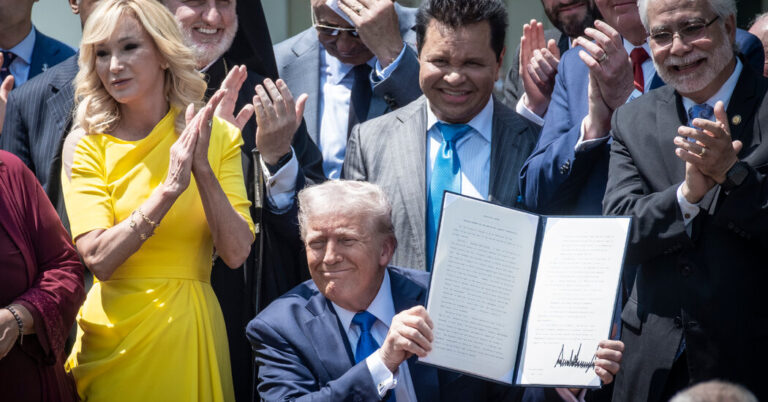
At a Dubai Conference, Trump’s Conflicts Take Center Stage


Sitting in front of a packed auditorium in Dubai, a founder of the Trump family cryptocurrency business made a brief but monumental announcement on Thursday. A fund backed by Abu Dhabi, he said, would be making a $2 billion business deal using the Trump firm’s digital coins.

That transaction would be a major contribution by a foreign government to President Trump’s private venture — one that stands to generate hundreds of millions of dollars for the Trump family. And it is a public and vivid illustration of the ethical conflicts swirling around Mr. Trump’s crypto firm, which has blurred the boundary between business and government.

Zach Witkoff, a founder of the Trump family crypto firm, World Liberty Financial, revealed that a so-called stablecoin developed by the firm, would be used to complete the transaction between the state-backed Emirati investment firm MGX and Binance, the largest crypto exchange in the world.

Virtually every detail of Mr. Witkoff’s announcement, made during a conference panel with Mr. Trump’s second-eldest son, contained a conflict of interest.

MGX’s use of the World Liberty stablecoin, USD1, brings a Trump family company into business with a venture firm backed by a foreign government. The deal creates a formal link between World Liberty and Binance — a company that has been under U.S. government oversight since 2023, when it admitted to violating federal money-laundering laws.

And the splashy announcement served as an advertisement to crypto investors worldwide about the potential for forming a partnership with a company tied to President Trump, who is listed as World Liberty’s chief crypto advocate.

“We thank MGX and Binance for their trust in us,” said Mr. Witkoff, who is the son of the White House envoy to the Middle East, Steve Witkoff. “It’s only the beginning.”

Mr. Witkoff and Eric Trump were speaking on a panel at Token2049, a major crypto conference in the United Arab Emirates, where more than 10,000 digital currency enthusiasts have gathered for a week of networking. It was the latest stop in an international tour by Mr. Witkoff, who visited Pakistan last month with his business partners to meet the prime minister and other government officials. Eric Trump, who runs the family business, has spent the week in Dubai, where he announced plans to back a Trump-branded hotel and tower.

The president himself is set to travel to Saudi Arabia, Qatar and the U.A.E. on a state visit in two weeks.

His son’s panel with Mr. Witkoff was the most anticipated event of the Dubai conference. The auditorium, inside a luxury resort on the shore of the Persian Gulf, was packed with crypto investors from around the world, many of whom had to stand in the aisles or lean on pillows propped against the walls to watch the conversation.

“This is just one incredible country,” Mr. Witkoff said from the stage. “One of the most innovative, if not the most innovative, country on planet Earth today.”

Representatives for Binance, MGX and World Liberty did not respond to requests for comment.

Once a crypto skeptic, President Trump embraced digital currencies on the campaign trail last year as the industry poured tens of millions of dollars into the 2024 election. In September, he and his sons unveiled World Liberty, which they pitched as a new kind of internet bank that would allow people to borrow and lend money using cryptocurrencies.

Since then, World Liberty has sold $550 million worth of a new cryptocurrency called $WLFI, with a large cut of the revenue earmarked for a business entity tied to the Trump family. In March, the company also created a stablecoin — a type of digital currency designed to maintain a price of $1, making it convenient to use for large transactions because its value doesn’t swing like a stock’s.

The company’s dealings have created conflicts of interest with no precedent in modern U.S. history. Some of the investors who bought $WLFI coins are foreign nationals who have been barred from supporting a president via campaign contributions or donations to the inaugural fund. And many of the firm’s corporate partners have clear incentives to curry favor with the federal government as they seek to expand in the American market.

Even the roster of panelists onstage in Dubai highlighted how much the Trump family’s business interests now blur with United States policy and regulation.

Sitting alongside Mr. Witkoff and Eric Trump was one of World Liberty’s top investors, Justin Sun, a Chinese-born billionaire who runs the crypto platform TRON. Mr. Sun bought $75 million in $WLFI coins after the election.

About a year earlier, the Securities and Exchange Commission sued Mr. Sun, accusing him of manipulating the price of a TRON cryptocurrency. When Mr. Trump took office, the S.E.C. asked a federal judge to pause the case while the agency negotiated a settlement, which the judge did.

“I just got to thank you for the support, Justin,” Mr. Witkoff said. “TRON is just an incredible technology, and we’re lucky to be partners with you.”

Soon Mr. Witkoff delivered the panel’s big reveal.

In March, Binance announced that MGX, an investment fund backed by the government of Abu Dhabi, would invest $2 billion in the exchange using stablecoins. But which particular stablecoin it would use to do that had not been disclosed.

The coin chosen for the transaction was World Liberty’s USD1, Mr. Witkoff said.

“Wow,” Mr. Sun responded.

Leaders of MGX and Binance have had high-stakes dealings with U.S. officials.

MGX is led by Sheikh Tahnoon bin Zayed Al Nahyan, an Emirati royal who serves as the nation’s national security adviser. In March, Sheikh Tahnoon visited the United States for meetings with President Trump and some of his cabinet members and advisers.

In 2023, Binance pleaded guilty to charges that it had violated U.S. anti-money-laundering laws and allowed criminals to transact on its platform. As part of a settlement with the Justice Department and other federal agencies, the company was placed under a Treasury Department monitorship to ensure that it would comply with the law.

In recent months, Binance’s founder, Changpeng Zhao, has been seeking a pardon from the Trump administration, after he pleaded guilty to a money laundering violation and spent four months in federal prison.

The role of USD1 in Binance’s deal with MGX provides major financial support to World Liberty.

Stablecoin issuers like World Liberty make money by accepting deposits from investors, giving them stablecoins in return and then investing those deposits to generate a yield that the issuer keeps.

The precise details of World Liberty’s arrangement with MGX and Binance are unclear. But it appears that, with one deal, World Liberty now has $2 billion in deposits to invest. Those funds alone could generate tens of millions of dollars a year in revenue for the Trump family and its partners at World Liberty.

Ultimately, Mr. Witkoff said from the stage in Dubai, he expects the World Liberty stablecoin to grow even bigger, reaching “many billions of market cap.”

Someday, he continued, visitors to the United Arab Emirates might even use the USD1 coin to pay at the Four Seasons in Abu Dhabi.

At that, Eric Trump broke in with a correction.

“You’re not going to be walking into the Four Seasons using USD1,” he said. “You’re going to be walking into the Trump International Hotel and Tower.”


Source link

Israel Scrambles to Extinguish Wildfires on Outskirts of Jerusalem


Firefighters battled wildfires on the outskirts of Jerusalem for a second consecutive day, hoping to extinguish some of the worst blazes in the country in recent years before an expected uptick in winds later on Thursday.

The authorities reopened the main highway between Tel Aviv and Jerusalem and allowed evacuees to return to their homes in Israel and the Israeli-occupied West Bank after the fires interrupted celebrations to mark Independence Day.

But firefighters were racing to take full control of the blazes before winds were forecast to pick up, said Tal Volvovitch, a spokeswoman for Israel’s fire and rescue service.

“We’re doing everything we can to finish in the coming hours because the wind gusts can bring us back to where we started,” she said by telephone.

The exact cause of the fires was unclear, but Prime Minister Benjamin Netanyahu of Israel said that 18 people had been detained on suspicion of arson, including one who he said was caught in the act. But Aryeh Doron, a spokesman for the Israeli police, said only three people had been arrested on suspicion of arson.

On Wednesday, Mr. Netanyahu said strong winds, dryness, and open areas with shrubbery had created a “deadly combination” that fueled the fires. On Thursday, the Israeli police arrested a 19-year-old man from a Palestinian neighborhood in East Jerusalem after they said he wrote on social media in support of the wildfires.

Firefighting planes from Croatia, Italy, and Cyprus were scheduled to arrive on Thursday afternoon to help the Israeli effort, Ms. Volovitch said.

The Palestinian Authority, which administers parts of the Israeli-occupied West Bank, has also offered to help, according to Hussein al-Sheikh, a senior Palestinian official. But Ms. Volovitch suggested they would not be joining the firefighting efforts.

In 2021, Palestinian firefighters joined Israeli efforts to deal with a similar wildfire near Jerusalem. The current Israeli government has frequently criticized the Palestinian Authority, even though they cooperate closely on security in the West Bank.

Israel’s fire and rescue service issued an order banning the lighting of fires in open spaces until May 7, but it said Israelis could hold barbecues in designated areas. Many Israelis flock annually to parks and beaches to hold barbecues on Independence Day, a holiday to commemorate the founding of the country.

Rawan Sheikh Ahmad and Aaron Boxerman contributed reporting to this article.


Source link

Who Decides How Much You Pay for College? Here’s How Tuition Costs Are Set.

0


Last month, four Republicans from the House and Senate sent letters to the presidents of Ivy League schools demanding years of data about how they decide what to charge.

These institutions, the letters said, “establish the industry standard for tuition pricing, creating an umbrella effect for all colleges and universities to justify higher tuition costs than they could otherwise charge in a competitive market.”

In fact, no more than a few dozen other schools can command Ivy League prices from a high percentage of their students and their families. Every other private institution — and most public ones — compete brutally on price up until the May 1 reply date each year (and sometimes afterward). The average tuition discount among private colleges is now over 56 percent for first-time, full-time students.

Those discounts — which often come in the form of merit scholarships — can make a six-figure difference in what families pay over four years. This aid is different and often less predictable than the need-based kind that depends on a family’s income and assets.

The driving force behind college pricing is not some evil genius at Harvard or Penn. Instead, it’s a series of algorithms developed quietly over decades by consulting firms operating just out of sight. The two biggest — EAB and Ruffalo Noel Levitz, or RNL — are owned by private equity firms.

To understand how all this happened — and how things really work today, for families and the financiers hoping to make money off this opaque system — we need to turn the clock back 50 years to when an unlikely character took over the admissions department at Boston College and upended everything.

Jack Maguire attended Boston College as an undergraduate and stuck around for a Ph.D. in physics. Not long after earning the degree, he took up a post as an assistant professor in 1968.

Today, Boston College has a $4.1 billion endowment and rejects 87.5 percent of applicants. But when Mr. Maguire started working there, it was a struggling commuter school running a deficit.

A young physics professor was an unlikely person to turn to when the college was having trouble finding a new dean of admission. Still, the school asked Mr. Maguire, now 85, to take a look. “They couldn’t find anyone else,” he said in a recent interview.

Calling on him made a certain amount of sense. He was on the schools committee in Lexington, Mass., where he lived, so he was plugged into one community feeding students to the college.

When Mr. Maguire examined the college’s data, he smelled opportunity. What if the school gave out precision-guided discounts based on the quality of the applicant even more than it did based on what students could afford? Turns out, when you do that, more of the above-average students say yes to the offer.

As new patterns emerged, Mr. Maguire fed data into computers. The machines had additional suggestions. Experiment and iterate, repeat until solvent.

Word of Mr. Maguire’s results spread quickly in the clubby world of admissions. In 1983, having helped turn Boston College around, he and his wife, Linda Cox Maguire — then the director of admissions at nearby Simmons College, now Simmons University — started their own consulting firm, Maguire Associates.

When Boston University was contemplating what might happen to market demand if it did away with its N.C.A.A. football team, Maguire Associates found that applicants were more likely to have attended an opera than a game. Goodbye, football.

Decades ago, Jack Maguire took over the admissions department at Boston College and was able to increase enrollment after examining the college’s data.Credit…Maguire Associates

Within 10 years of the founding of Maguire Associates, the predecessor firms for Ruffalo Noel Levitz and EAB were getting off the ground. They did what Mr. Maguire had done at Boston College, but they developed other tools, too, and became soup-to-nuts school whisperers.

One or both can help a college buy hundreds of thousands of names of teenagers who have taken the ACT or SAT, market to them across various media, improve retention once they arrive on campus and raise money from alumni more effectively.

For many years, the firms described the Maguire-esque part of their offerings as “financial aid leveraging.” Eventually, worried that the term might evoke images of the firms using money as a crowbar to wedge themselves into teenagers’ brains and parents’ pocketbooks, they rebranded their service as the more benign “financial aid optimization.”

Maguire Associates never grew anywhere near as big as EAB and RNL, and those two juggernauts have not been shy about the zealousness with which they made their industry more like the Wall Street firms that invest in them.

“I actually think of financial aid optimization as a form of arbitrage,” Madeleine Rhyneer, whom EAB refers to as its “dean” of enrollment management, said on a company podcast about how admissions offices “actually” work. “Really, it is. It’s like working in the financial markets.”

EAB provided a more tempered framing of its work in a statement from Ms. Rhyneer. “EAB partners with a variety of schools to help them fulfill their missions and educate broader populations of students,” she said. “In today’s rapidly evolving higher education landscape, that means engagement and scholarship strategies that raise awareness about college options and make college accessible to as many students as possible.”

This work is a relatively small chunk of both firms’ revenues, but it’s the thing that raises parental eyebrows the highest.

Politicians have noticed, too. Those letters last month suggested that “nonpublic algorithms for admissions and financial aid” could indicate that the schools are able to “engage in algorithmic collusion.”

The optimization process begins with the hoovering up of more data about teenagers and their families than one might think possible.

The process starts with demographic, socioeconomic, geographic, academic, curricular and extracurricular information — anything and everything you tell a school when requesting information or applying.

Once a school has a good-sized target list, the pitches begin. Families know this routine; one mother in Ohio sent me a 63-pound box of all the mail her daughter received from collegiate suitors.

If the targeted individuals show interest, then the consultants offer colleges tools to track teenagers’ digital interactions with clients in real time.

Brian Zucker, 68, founder and chief executive of Human Capital Resource Corporation, has been competing with EAB and RNL for years. He and his colleagues refer to this real-time data as footprints in the sand.

“It changes minute by minute,” he said. “It’s texts, visits, clicks, opens, number of seconds on a particular webpage using a particular URL, monitoring forms, of which there are many.”

EAB, in a presentation called “Strategic Use of Grant Aid 101,” discusses up to 200 variables that schools can use when setting an individual admitted student’s price, drawing from data on over 350 clients and 1.5 billion “student interactions.” RNL has over 1,900 clients feeding the tweaking of its various models, from financial aid to fund-raising.

“You have to know how to manage these data and aggregate them, because if they’re presented as individual variables, they just look like vomit,” Mr. Zucker said. “Any individual click doesn’t mean diddly.”

The output from the data gathering often manifests as a matrix, according to Brad Pochard, a former vice president of enrollment management at Furman University who is now an adviser to Moore College Data, which helps colleges sort and view large amounts of information. Imagine two axes — one that measures ability to pay and another that rates academic accomplishment.

There might be 40 or more “cells” in the matrix, with a different price for each one.

So a school makes an opening bid. For lower-income families, it might refer to the discount off the school’s list price as need-based aid. Or for a more affluent family, it could call the discount a “presidential scholarship” — or anything, really, that it thinks will get in a student’s head and sway their decision.

But it is only an opening bid, and each year, more families realize that and delay coming to a decision until days before the deadline, when they ask for a better deal. Often, they get one.

At College of Charleston, a public university in South Carolina, just 12 percent of admitted students to the Class of 2028 said yes to its offers of admission.

Larger public schools in the state, like the University of South Carolina and Clemson, have big rah-rah energy and are fearsome competitors. But they can lack intimacy, and they’re not in one of the most beautiful cities in America.

College of Charleston brought in EAB to help market those advantages. It has paid the firm roughly $500,000 per year for its help (and for all the names on its prospect lists).

At various points each year, new names and the data on those individuals become available from the entities that administer the SAT and ACT.

“We have developed systems and processes (including round the clock shift work) that ensures our partners are consistently first in the inbox and in the mailbox,” the company said in a written pitch to College of Charleston, which I obtained through a public records request.

One of the best ways for a public school to maximize revenue is to attract more students paying out-of-state tuition. The playbook goes something like this:

1) Buy a pile of names of students from appropriately affluent ZIP codes and pitch them relentlessly with a gripping case for going far from home.

2) Upgrade the admissions staff, adding people with corporate sales experience, as the College of Charleston did.

3) Set a high tuition price, creating the perception of value.

4) To make prospects feel especially exalted, offer a fat academic scholarship — but not so much that they aren’t still paying more than in-state students.

“We shifted from awarding top scholars to those who were not receiving merit-based scholarships, and that helped increase our yield quite a bit,” said College of Charleston’s president, Andrew T. Hsu.

That quote comes from a Q&A that appeared on EAB’s website last August, then disappeared around the time I contacted the college to ask about it. A College of Charleston spokesman said that the school requested the removal because the quote made it seem like it was an either-or proposition. The best students still do get merit aid, he said.

So how does the school decide how much to award and to whom?

“There’s a limit to how much I think I can go into detail,” Jimmie Foster Jr., the vice president of enrollment planning at College of Charleston, said when I pressed the question in an interview. Better to keep that sort of thing out of the hands of competitors, after all. EAB hasn’t helped the school with financial aid optimization, so it couldn’t say either.

Whatever the pricing strategy, the financial results have been impressive. For out-of-state students in one recent year, the school offered three times the discount off the list price per student compared with what South Carolina students received while still extracting double the net price from those out-of-state students.

In the space of five years, the school has gone from having three outside states each send it 75 or more first-year students to nine outside states doing so.

According to the school’s 2024-25 common data set, the statistic-stuffed form that colleges and universities send to U.S. News & World Report and other such entities, 1,127 of the 1,249 students in the first-year class who could afford to pay the full price (including both in-state and out-of-state students), received grants. The average annual amount was $12,572.

In other words, College of Charleston has good reason to believe that the vast majority of its most affluent students wouldn’t come without a hefty discount.

College of Charleston is not alone in giving scholarships to people who don’t need them.

It is, after all, the model Mr. Maguire helped pioneer at Boston College, a Jesuit university. Nobody looked over his shoulder back then questioning the ethics of big discounts for people who could afford full price, he told me last month.

He has never been silent about inequities in the system, though. In a 2003 interview in an industry journal, he suggested that Princeton, and the like, should hand over $100 million from its multibillion-dollar endowments to a college that has nothing and help it educate more struggling students.

That hasn’t happened. But he’s not alone in considering the fate of the applicants who have the least money.

Eileen K. O’Leary spent 34 years in the financial aid trenches at Stonehill College, outside of Boston, before retiring in 2017. There, she purchased consulting services from Mr. Zucker.

Over time, she felt a growing amount of pressure to offer bigger discounts to more people who didn’t need them. After all, there were usually competitors down the road with a different consultant whispering in their ears, urging them to cut the price further. Then, more families realized they could play schools against one another.

“I was old school, and I thought financial aid was for improving access, but it no longer was,” she said. “It was a business model.”

If you’re a private equity firm, all of this looks a lot like a reason to invest in the consultancies.

After all, most colleges can’t afford to hire their own algorithm-twirling data scientists, and one quick way to draw scrutiny from your boss or your board is if enrollment and revenue decline. American University’s first-year class last fall came up 350 people short of the school’s goal of 2,250 students, contributing to a revenue gap that was over $20 million.

The fact that American is a reasonably selective school is a reminder of just how hard it is to win over students if you’re not one of the Ivy League schools that elected representatives seem so obsessed with. Hiring a name-brand enrollment consulting firm and keeping it on retainer to manage the data flow now feels more like defense than offense.

The private equity firms that own EAB and RNL will make money, or not, based on several factors, including what they paid initially to buy the companies and what they received in dividends (if anything) along the way.

But the big score comes when they eventually sell the companies.

As the college enrollment industry becomes ever more data-driven, you can watch EAB and RNL in real time billing themselves more like tech operators than some kind of direct-mail sweatshop. They possess “enrollment intelligence assets” that they deploy on “immense data sets” using “new capabilities to perform advanced analysis.”

Software companies come with larger valuations than consulting firms, after all.

In 2023, EAB introduced Appily, a consumer-facing college portal with a sunny vibe. At its heart, it’s matchmaking software. “Think about it as a dating app,” Tisleen Singh, an EAB director, said on a company podcast.

Students set up a profile or conduct a search, and schools can respond right away or invite people to virtual tours. They can also instantly offer admission — and a discount — without a formal application.

Swipe right and get a $50,000 merit aid award in no time flat! Appily does not actually match you with romantic prospects in your entering class though — at least not yet.

It’s a game effort, and EAB already claims three million Appily users. But neither EAB’s private equity owners nor RNL’s overlords have been able to sell their stakes, even though they have all been investors for several years. Some of them wouldn’t comment, and others didn’t reply to requests for comment.

You can understand why. With many universities under fire from the Trump administration, EAB and RNL salespeople have to work even harder to get schools to part with their money. One thing that may help: If international students are afraid to come to the United States — or are not allowed to — the colleges will need more firepower and data savvy to fight for any applicants who still want to pursue higher education.

None of this is Jack Maguire’s problem anymore. By 2022, he and his wife were ready to plan for retirement. They sold their company to Carnegie, a marketing-focused consultancy backed by New Heritage Capital, a private equity firm.

Mr. Maguire, a longtime American Legion baseball coach who has had five former players signed to professional contracts, still gets out and throws batting practice. The couple recently returned from a trip through all the British Isles.

And by last year, New Heritage was done with being an enrollment whisperer, too. Another investment firm, Shamrock Capital, is now the money behind the ongoing efforts to extract one more dollar from one last family each and every spring.

Dylan Freedman contributed reporting.


Source link

How Google’s Antitrust Case Could Upend the A.I. Race


A federal judge issued a landmark ruling last year, saying that Google had become a monopolist in internet search. But in a hearing that began last week to figure out how to fix the problem, the emphasis has frequently landed on a different technology, artificial intelligence.

In U.S. District Court in Washington last week, a Justice Department lawyer argued that Google could use its search monopoly to become the dominant player in A.I. Google executives disclosed internal discussions about expanding the reach of Gemini, the company’s A.I. chatbot. And executives at rival A.I. companies said that Google’s power was an obstacle to their success.

On Wednesday, the first substantial question posed to Google’s chief executive, Sundar Pichai, after he took the stand was also about A.I. Throughout his 90-minute testimony, the subject came up more than two dozen times.

“I think it’s one of the most dynamic moments in the industry,” said Mr. Pichai. “I’ve seen users’ home screens with, like, seven to nine applications of chatbots which they are trying and playing and training with.”

An antitrust lawsuit about the past has effectively turned into a fight about the future, as the government and Google face off over proposed changes to the tech giant’s business that could shift the course of the A.I. race.

For more than 20 years, Google’s search engine dominated the way people got answers online. Now the federal court is in essence grappling with whether the Silicon Valley giant will dominate the next era of how people get information on the internet, as consumers turn to a new crop of A.I. chatbots to answer questions, find solutions to their problems and learn about the world.

At the hearing, government lawyers have argued that Google’s monopolistic tactics in search could be applied to make its Gemini chatbot a ubiquitous A.I. product. That cannot be allowed to happen in the emerging field of A.I., the government has said, to ensure that consumers have choices of products for use well into the future.

Google has argued that the court does not need to intervene because the rapid growth of OpenAI — the A.I. start-up that helps power Apple’s A.I. product on the iPhone — and other rivals shows that the market is rife with competition already.

How much Judge Amit P. Mehta, who will determine the fixes in the search case, buys into these A.I. arguments could reshape the fierce contest to lead the technology. Google is already a leading A.I. player, with Gemini attracting more than 350 million monthly active users, according to data at the trial. Any measures to hinder its efforts or help its competitors would have big implications for that race.

The government has asked the court to force Google to sell its Chrome browser and share data with rivals, including its search results and ads, among other measures.

Government requests for fixing monopolies are forward-looking by nature, attempting to undo years of damaged competition and opening markets to new rivals. From the government’s perspective, “you do not want to have spent five years and a whole bunch of agency resources bringing a case that doesn’t really do anything,” said John Newman, the deputy director of the Federal Trade Commission’s Bureau of Competition during the Biden administration.

A Google spokesman pointed to the opening statement by the company’s lead lawyer, John Schmidtlein, who said the market for artificial intelligence was “performing extraordinarily competitively.” The Justice Department declined to comment.

The hearing this year follows Judge Mehta’s 2024 ruling that Google had illegally protected its monopoly by paying companies like Apple, Mozilla and Samsung for its search engine to come up automatically in web browsers and on smartphones.

From the hearing’s start, government lawyers put A.I. front and center.

The first witness, University of Texas associate professor of computer science, Gregory Durrett, gave Judge Mehta a crash course on A.I. In response, Judge Mehta asked questions about how chatbots work and how they were incorporated in Google’s products.

The government presented documents showing that Google last year had considered an arrangement with wireless carriers and smartphone manufacturers that would have given Gemini prime placement on devices alongside its search engine. It was reminiscent of the deals that Google had signed to get prime placement for its search engine.

Google decided not to move forward with the Gemini plan with wireless carriers and smartphone makers after the judge’s search ruling last year. It ultimately reached a separate deal with Samsung to put Gemini on Samsung’s smartphones, the documents showed.

A Google executive testified that the agreement with Samsung gave the smartphone maker the ability to work with other A.I. services. Mr. Pichai testified that the company had focused on signing deals that aligned with its own proposal for remedies, which says smartphone makers should have more freedom to decide what Google apps to install.

Executives from rival A.I. companies, such as OpenAI, also testified that the government’s proposed changes to Google’s business would make it easier for them to build products and reach consumers.

Nicholas Turley, the head of product for OpenAI’s ChatGPT, said on the stand that his company had rolled out a prototype search tool called SearchGPT in July and asked Google for a deal to access its data. But Google turned down OpenAI because “it would involve too many complexities,” according to an email from an OpenAI executive.

“I was aware that Google might not be incentivized to offer us good terms given the competitive nature of some of our offerings,” Mr. Turley said. If Judge Mehta required Google to share more data with OpenAI, the company would be able to “build a better product faster,” he added.

OpenAI would also be interested in buying Google’s Chrome browser if it were for sale, Mr. Turley added.

(The New York Times has sued OpenAI and its partner, Microsoft, for copyright infringement of news content related to A.I. systems. They have denied wrongdoing.)

Dmitry Shevelenko, the chief business officer of the A.I. search start-up Perplexity, testified that his firm had tried to reach deals with phone companies to offer its chatbot automatically — but one of them already had an arrangement with Google.

That company “really likes our assistant, thinks it is great for their users, but they can’t get out of their Google obligations, and so they’re unable to change the default assistant on the device,” he said.

Google’s lawyers countered that the company was not locking smartphone makers into overly restrictive deals to offer Gemini. They repeatedly said many A.I. companies were thriving and referred to data that showed ChatGPT was used more widely than any other chatbot.

“I think ChatGPT is doing just fine without any of the remedies in this case,” said Mr. Schmidtlein in his opening statement. “These companies are competing just fine without plaintiffs’ remedies.”


Source link