Home Blog Page 346

Andoni Iraola exclusive interview: Bournemouth boss using lessons of Athletic Club and planning future | Football News

0


This week’s Europa League tie between Manchester United and Athletic Club is an opportunity for Andoni Iraola to cast his mind back to their last meeting, when he captained his former side to a famous quarter-final victory under Marcelo Bielsa in 2012.

“We were very, very good,” he tells Sky Sports with a smile. Typically, he is understating it. “It was a United team that came from winning the Premier League and losing the Champions League final against Barca,” he adds. “They were at their top level with top players…”

And yet they were dismantled over the course of two legs as Athletic Club, with their policy of only using Basque players, showed their remarkable capacity to punch above their weight. Thirteen years on, it is a quality which has come to define Iraola’s current side too.

Iraola, the head coach, guided Bournemouth to a club-record points total in his first season in charge and has already beaten it with four games of his second left to play. Achieving European qualification for the first time in the club’s history remains a possibility.


Saturday 3rd May 5:00pm


Kick off 5:30pm


For now, though, he will see how his old side fare over the two legs of their latest assignment on that stage. Iraola spent most of his playing career at Athletic Club. He still describes himself as a supporter. “I have great, great memories of the Manchester United tie and I hope this tie goes the same way for them,” he grins.

His time at Athletic Club provides valuable learnings as well as cherished memories. “My understanding of football comes from there,” he says. “The way they used to play, even with different managers, was quite clear and it is how I am most comfortable.

“Obviously, you have to adapt from team to team. What we are doing in Bournemouth is not the same as what we were doing in Spain. But the main idea comes from there.”

Athletic Club, like Iraola’s Bournemouth, are typified by a direct approach and an emphasis on physicality. “They always say Athletic Club is the most English of the LaLiga teams,” he says. “I think there is a connection there that fits very well with Bournemouth.”
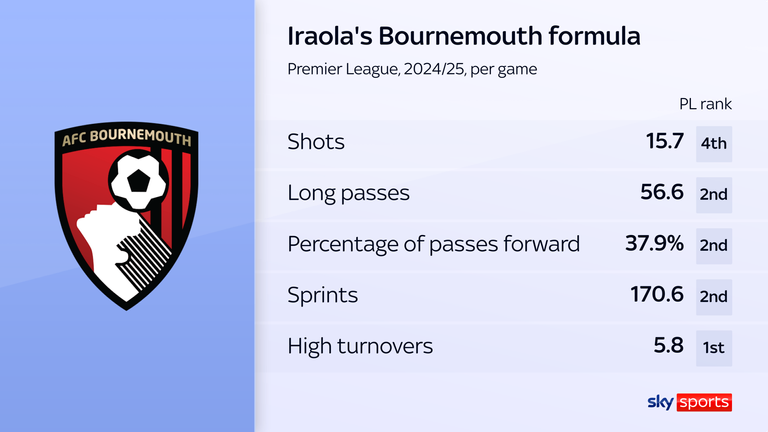
Bournemouth are direct in possession and intense and aggressive off the ball
Image:
Bournemouth are direct in possession and intense and aggressive off the ball

That connection continues to bear fruit.

Bournemouth conceded a painful late equaliser to Manchester United after Evanilson’s wrongly awarded red card on Sunday, but they face Arsenal, Aston Villa and Manchester City next having taken points off all three this season, thanks in large part to the fearless, attack-minded approach implemented by their head coach.

“The fixture schedule is not so important for us. Our approach against all the teams is very similar,” he says.

“It’s true that we would probably like to have easier games because we are playing away to Arsenal and Manchester City in games where we need to take the points. But I think we can still be competitive. We can make them play in a way that is not as easy for them. But we need to give our best and be at our best level.”

The challenge of finding ways to bridge the gap to the elite is familiar to Iraola, thanks again to the time spent at his boyhood club. “Most of the players come from the academy at Athletic Club,” he explains.

Andoni Iraola (right) and his Bournemouth assistant coach Tommy Elphick (left)
Image:
Andoni Iraola and Bournemouth assistant coach Tommy Elphick

“You have to grow quickly and learn to face the big clubs, even without the experience. With everyone’s help, you have to make it work, even against the top teams.

“I try to take those learnings to my teams. Respect the top teams, because they are better than you, but don’t respect them too much.

“Okay, you can have respect, but no fear. It’s like, ‘We know you are better, but let’s try to make it level, let’s try to give our best and see if we can make up the difference’.”

Iraola ‘happy’ at evolving Bournemouth

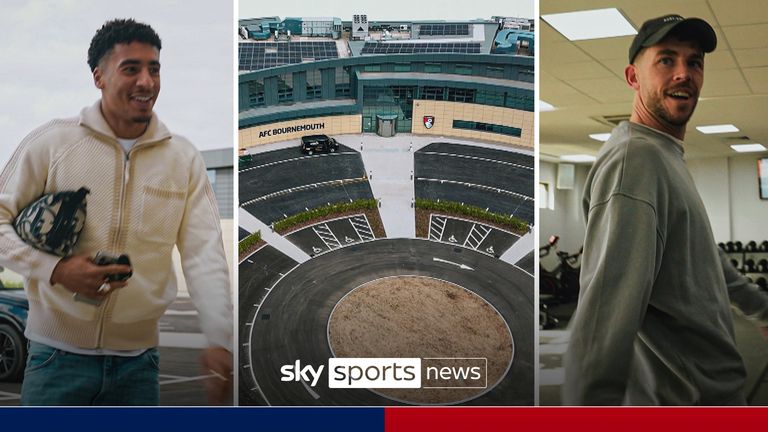
Iraola is speaking on a terrace at Bournemouth’s new training centre. It is a stunning facility and its opening was followed by news that the club have also bought back the Vitality Stadium, with plans to expand it. These are exciting times, on and off the pitch.
Please use Chrome browser for a more accessible video player

Bournemouth players have a first look at their new, state-of-the-art training facility (Credit: AFC Bournemouth)

“I think we are lucky to be here in this moment for the club,” says Iraola. “I think the club is taking steps forward, but also knowing the challenges of the competition.

“Every club in the Premier League is very powerful and probably bigger than us. We have to try to reduce this gap. With the new training ground and the improvements to the stadium, I think we are getting closer to the other teams. I always tell the players, the club are giving us everything, so now it’s our moment to perform.”

The state-of-the-art surroundings are a reminder of how far Iraola has come. “I am not used to this level of facilities,” he smiles as he recalls his coaching beginnings with AEK Larnaca in Cyprus and Mirandes and Rayo Vallecano in Spain’s second tier.

These days, the 42-year-old is one of the most talked-about managers in the game, a reported target for Spurs and even Real Madrid. Not that he is allowing the noise to affect him. The mention of it is treated with characteristic modesty.

Antoine Semenyo fired Bournemouth ahead
Image:
Antoine Semenyo has gone from strength to strength under Iraola

“For me, it’s a big challenge to compete here in the Premier League,” he says. “Most, if not all of the coaches that I am playing against have achieved more things than me.

“I have not been coaching for a lot of years. I’m really happy with how my career has gone because I have been taking steps forward, but still, in most of the teams I’ve been at, I’ve been fighting to avoid relegation a lot of times and just trying to finish in a good position.

“For me, it’s good that, together with the team here, we had a very good season last season. This season, we have improved on that and continued with this evolution of the club.”

I am very happy working here. The communication is really close and I feel we have a good connection

Andoni Iraola

Will Iraola be there to oversee it beyond this summer? He has a year left on his contract and Bournemouth are said to be relaxed over his future. He does not sound like somebody in a hurry to move on.

“I am very happy,” he says. “I have always said it. I am very happy working here with everyone in the club. I am still finishing my second season, so we are talking about probably my fourth season here.

“I have a good relationship with everyone here. If everything goes well, we will have time to talk about these things. The communication with the club is really close and I feel we have a good connection.”

No panic over Huijsen, Kerkez

Iraola is not the only one attracting interest, of course.

It is a testament to his coaching ability that players previously overlooked by bigger clubs, such as Dean Huijsen, Milos Kerkez and Antoine Semenyo, now have long queues of suitors.
Please use Chrome browser for a more accessible video player

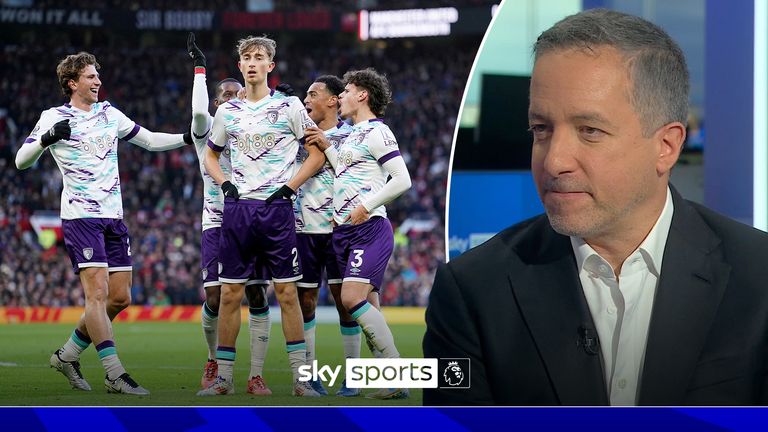
Sky Sports chief reporter Kaveh Solhekol says clubs are ‘queuing up’ to sign Dean Huijsen

Iraola gives off no hint of panic around possible departures.

“I don’t think it’s any different from previous years, especially when the team has done a good job,” he says. “It happened to us last season. We didn’t know what was going to happen with some players. We lost Lloyd Kelly and after that Dom Solanke.

“We don’t really know what is going to happen in the summer, we are still focused on other things, but right now all the players are ours and, if nothing happens, they will continue to be ours next season also. So I don’t think it’s going to be different from other summers.

“We will focus on trying to improve the team, and add new players if we can, and if some player leaves because someone comes with what the club considers to be a good offer, we have to be ready for those situations, but not with fear.

“It is something that all the clubs, especially the ones who are not at the highest level like the top, top teams, have to get used to.”

The key, Iraola says, is to bring in the right replacements where necessary. Bournemouth’s transfer dealings this summer will be spearheaded by sporting directors Simon Francis and Tiago Pinto. Iraola has faith the club will deliver and highlights the strength of the foundations already in place.

“I think recruitment is key but I’m not too involved in it. I try to help them if I can, especially in the summer when the window is open.

“We also have to use the advantage of knowing each other better.

“When you are in the second or third year in a team, you can progress a lot because you already know the basics, you have experience with the same players in the good moments and the bad moments, and I think we have to take that advantage to get into more detail and become more solid as a team.”

Marcus Tavenier celebrates after giving Bournemouth the lead at Spurs
Image:
Marcus Tavenier celebrates after scoring against Spurs earlier this season

Any new arrivals have to fit into that collective ethos but what does Iraola look for in potential signings? “Like all the managers, I want good players. Obviously, they speak English, they come with a lovely mentality, they are coachable… You can ask for everything from every player but everyone has different aspects.

“The most important things are that they are good players and also that they want to come here, they want to show their level here with us and they understand what we are trying to do here.

“I think that is something that the recruitment team is very, very clear about and they are doing very well.”

It helps, of course, that Bournemouth have now established themselves in the Premier League. But they also have a growing number of success stories to hold up to potential targets. Under Iraola, the club has become a destination where young, high-potential players such as Huijsen and Kerkez can flourish.

Bournemouth delivered one of their most complete performances of the season
Image:
Milos Kerkez celebrates with Justin Kluivert during Bournemouth’s win at Newcastle

“I think it is an advantage compared to where we were two seasons ago, when we were just recently promoted and probably there were more doubts,” says Iraola.

“Now, I think the players know us, they know how we want to play, what we want to do. And if they want to come here, for us, perfect.

“For sure, sometimes we cannot compete, especially against other Premier League clubs. But I think now the player that comes to Bournemouth has a clear path of what we are going to ask him to do, and the expectations he will have. I think it’s a great place to come.”

A great place to come and, supporters will hope, a great place to stay too. Iraola, the coach shaped at Athletic Club and thriving in the Premier League, has put Bournemouth on an exciting path.

Watch Arsenal vs Bournemouth live on Sky Sports Premier League and Main Event from 5pm on Saturday; kick-off 5.30pm


Source link

European Anti-Tourism Groups Plan June 15 Disruptions

0


Travelers to Europe, mark your calendars (and bring your raincoats). On June 15, activist groups across southern Europe are planning to stage protests against tourism. Although the precise form of those demonstrations has not been decided, it’s a pretty safe bet that water guns will be involved.

At workshops held in Barcelona last weekend that brought together about 120 activists from Venice; Lisbon; Palermo, Italy; and a dozen other cities, leaders of the Southern Europe Network Against Touristification, called for a coordinated day of actions to raise awareness about what they called “the urgent need to limit the growth of tourism.” The tactics discussed included marches, picketing at airports, obstructing tourists’ entry to historic sites and blockading tour buses.

Driven by rising rents, housing shortages, pollution and overcrowded public transportation, the call signals a continuation — and possibly an escalation — of the demonstrations that erupted across Europe in 2024.

At a protest along Barcelona’s famed Las Ramblas boulevard last July, a handful of participants pulled out water guns and began squirting tourists. The tactic attracted global media attention, which is why, this time around, the activists have adopted the toys as an effective symbol of their resistance.

In Barcelona, where the municipal government has taken measures to reduce the impact of overtourism (the city received 15.5 million tourists in 2024), such as curbing new hotel construction and banning Airbnb after 2028, tourism officials greeted the news of the planned June 15 protests with dismay.

“It’s unfortunate that global anti-tourism movements chose to announce their proposals in Barcelona, when Barcelona is the city that is doing the most for sustainable urban tourism,” said Mateu Hernández, director general of Barcelona Tourism.

With international travel expected to increase this year, the summer of 2025 looks likely to see other protests proliferate. Already, in the Canary Islands, a demonstration against tourism is scheduled for May 18, with organizers suggesting they will move beyond the kind of marches that brought 60,000 to the streets last year to also include occupying what they called “symbolic” tourist sites.

Participants in the Barcelona workshops capped their gathering with their own symbolic protest. On Sunday morning, the activists met outside the Sagrada Família church (the city’s most popular tourist attraction), surrounded a tour bus filled with passengers, hung a banner announcing the June 15 demonstrations from its windshield, and squirted it with water guns.

“We don’t want to hurt anyone,” said Elena Boschi, an English-language teacher and activist from Genoa, Italy. “We just want them to be mindful of the impact that their presence is having on these places and the people who live in them.”


Follow New York Times Travel on Instagram and sign up for our Travel Dispatch newsletter to get expert tips on traveling smarter and inspiration for your next vacation. Dreaming up a future getaway or just armchair traveling? Check out our 52 Places to Go in 2025.


Source link

Jeju Air Disaster Prompts a Reckoning Over Runway Safety

0


Jeju Air Flight 2216 did not have to end in such a catastrophe.

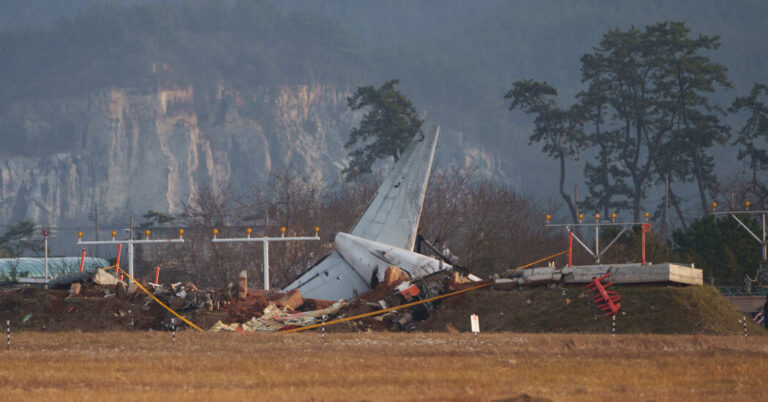
Early on Dec. 29, a clear Sunday morning, the Boeing 737-800 made an emergency landing on its belly at South Korea’s Muan International Airport. The aircraft skidded past the end of the runway, smashed into a concrete structure and burst into flames. Of the 181 passengers and crew members aboard, 179 were killed.

Runway excursions — when an aircraft overruns or veers off the runway during landing or takeoff — have for years been among the most common type of aviation accident. But in the vast majority of cases, the planes come safely to a stop, saved in part by zones around runways that are supposed to contain only structures that are frangible, meaning designed to break easily upon impact.

The New York Times analyzed information on more than 500 runway excursions and found that 41 resulted in deaths. In 2010, 158 people died when a flight in India overran the runway and fell into a gorge. But no other runway excursion has come close to the death toll at Muan airport, according to the data, which was compiled by the nonprofit Flight Safety Foundation.

Accidents in which planes hit breakable structures at the end of runways have tended not to be deadly:

The story behind why a steel-reinforced concrete structure stood so close to a runway illustrates a longstanding vulnerability in global air transport. A United Nations aviation safety agency issues recommendations to keep the area near airport runways clear of obstacles. But it is up to national regulators and private companies that manage airports to interpret, implement and oversee compliance of those standards.

Inquiries by The Times to airport regulators in more than two dozen countries revealed inconsistencies in how they interpret the standards issued by the U.N. agency, the International Civil Aviation Organization.

Since the Jeju Air crash, international aviation groups have urged airport operators to examine the areas surrounding runways, and a number of countries have conducted inspections.

In South Korea, authorities found safety violations at seven of the country’s 14 airports, with structures that could damage planes that overshoot or veer off a runway.

Safety analysts say such accidents don’t have to result in disaster.

“Runway overruns do happen, and happen often,” said Hassan Shahidi, the president of the Flight Safety Foundation, based in Alexandria, Va. “That’s why the safety of the area around the runway is so crucial, and why the presence of concrete barriers in these areas must be carefully investigated.”

On Wednesday, the South Korean government said it would replace concrete and other hard structures housing navigation equipment with “easy-to-break lightweight steel,” completing the work at Muan airport by the end of August and at other airports by the end of the year.

More than four months since the crash, authorities continue to investigate what caused the Jeju Air flight’s emergency landing. Preliminary findings suggest that a bird strike as the plane approached the airport caused the pilots to lose control. It remains unclear why the plane’s landing gear failed to deploy, or why its wing flaps didn’t appear to engage — limiting the pilots’ ability to slow the plane down.

But experts interviewed by The Times widely agreed that the concrete structure near the end of the runway played a catastrophic role in the accident’s deadly outcome.

The International Civil Aviation Organization, or I.C.A.O., recommends that airports have “runway end safety areas.” In those zones, all structures, such as the one at issue in the South Korean crash, should be designed to break easily upon impact.

At Muan, a relatively small airport in the southwest part of the country, the structure was a mount for an antenna array that provides radio guidance to aircraft coming in for a landing. These arrays, known as localizers, are commonly installed near airport runways.

In 2020, ​renovation work on Muan’s localizer mount was authorized by the Korea Airports Corporation, a state-owned entity that oversees the country’s airports, and was completed in early 2024. The work ​included adding a thick concrete slab running along the mount, atop an earthen berm. The berm covered concrete pillars supporting the antenna.

Air safety regulators outside South Korea said the localizer might have been placed atop the berm to ensure a strong signal. The concrete base may have been designed to protect the localizer from harsh weather, such as snow or typhoons. But several of them said they were shocked that local authorities would have approved the construction of such a structure.

In January, the former president of the airports corporation, who was in office during the renovations at Muan International Airport, died in what the local police called an apparent suicide.

Local experts said in interviews that the country’s regulations, based on I.C.A.O. standards on runway safety areas, were highly ambiguous.

In South Korea, a law known as the Airport Facilities Act provides the framework for airport safety standards. It was drawn in part from recommendations by the I.C.A.O. but lacks specificity on issues like how to build barriers near runways that break upon impact, said Hyoseok Chang, an assistant professor at Hanseo University’s department of air transportation and logistics.

“It is difficult to find specific details on the required strength levels or exact structural specifications” for localizer mounts, Mr. Chang said. “There is no regulation in Korea explicitly stating that concrete cannot be used,” he added.

In the immediate aftermath of the Jeju Air crash, South Korean officials stated that the antenna mount at Muan airport, about 866 feet from the runway’s end, complied with safety regulations. But in the days that followed, they acknowledged that they needed to review the barrier’s placement and design.

The Korea Airports Corporation announced in early April that it had officially commenced improvement work at the seven airports where navigation aids were not installed according to safety standards, with plans to give the improvements at Muan first priority.

Disastrous runway overrun accidents like the one at Muan airport have, in the past, spurred regulatory changes.

In the United States, the Federal Aviation Administration strengthened safety standards for areas surrounding runways after an American Airlines plane landing in Arkansas in 1999 ran into a stanchion just off the runway that tore through the plane, killing 11 people.

For most large airports in the United States, the F.A.A. recommends that any structures within 1,000 feet of the runway’s end be frangible. The United Nations’ I.C.A.O. recommends a minimum safety area of either 295 or 787 feet based on factors including the length of the runway.

The Flight Safety Foundation’s database, which has complete information on accidents that caused injuries, deaths or significant damage to aircraft over the last 15 years, includes hundreds of examples illustrating how runway overruns can produce far less catastrophic outcomes.

In October 2022, Korean Air Flight 631 overran the runway at Mactan-Cebu International Airport in the Philippines. Amid heavy rain, the Airbus A330-322 skidded off the runway and struck a localizer mount. The plane continued through the structure before coming to a stop more than 700 feet from the runway’s end. All 173 passengers and crew members survived, and the metal structure on which the localizer was mounted was found wrapped around the plane’s wings.

The severity of any aviation accident is determined by its own set of often complex circumstances, and potential airport hazards, such as steep drop-offs at the end of runways, make it difficult to precisely compare accidents.

After the Jeju Air disaster, some countries have investigated the safety of localizer structures at airports. Japanese officials confirmed that localizer structures near runways were sufficiently frangible. In Taiwan, the airport regulator said it would soon implement similar checks across its airports.

Other groups are waiting to see the results from an ongoing investigation into the Jeju Air crash.

Regulators including the Civil Aviation Authority in Britain said they would closely examine the crash investigation for any lessons they should follow at their airports. The I.C.A.O. said in a statement that while carrying out its standards was solely up to sovereign authorities, the results of investigations like the one in South Korea informed ongoing reviews of its technical standards.

In South Korea, government officials have said they would spend about $178 million over the next three years fixing issues including the problematic localizer structures at the country’s airports. The authorities said on Wednesday that all airports would now be required to meet the I.C.A.O. standards for a safety area extending at least 787 feet. Airports with limited space must install materials called Engineered Material Arresting Systems, which can slow or stop planes that careen off the runway, they said.

Sangdo Kim, a former South Korean deputy minister for civil aviation who served as ambassador to the I.C.A.O., urged international regulators to learn from the Jeju Air crash.

“Many lives were lost in the Muan crisis,” Mr. Kim said. “To prevent similar accidents, all countries should voluntarily inspect their localizer-housing structures.”

In an ideal world, regulators would enforce consistent safety standards at airports worldwide, Mr. Kim said. But in reality, larger international airports often receive priority for safety checks over smaller, less visited ones like Muan, he said.


Source link

Christina Leitzel’s ‘Fun’ Prosthetic Eyes are Designed to Stand Out

0


As a maker of prosthetic eyes, Christina Leitzel was told as an apprentice to treat her craft much as an expert art forger would: create a perfect match of one of nature’s most intricate canvases.

But just as there are many ways to lose an eye — to cancer or to a fall; to a broom that strikes the wrong part of the brow — Leitzel wants to show there are many ways to gain one.

On a damp afternoon in Portland, Ore., a man in his 30s who had recently lost his eye to a BB gun stepped out of her office with a grin. His eyes matched his forest green beanie. But in his left, a shimmering gold vortex swirled within the pupil.

Leitzel, also known as “Christina Oculara” on TikTok and Instagram, creates what she calls “fun eyes.” Her designs include pupils painted in the shape of a sunflower and the diamond slit of a beloved cat. She has fulfilled requests as strange as they are touching: A man who arrived with a box of ashes, wishing for his late wife to “see everything that he did.” A woman adorned in piercings who thought, Why not a pierced iris, too?

That one, Leitzel said, turned out to be her favorite. The resulting TikTok was so popular that eye doctors felt compelled to post warnings against piercing actual eyeballs.

Social media has helped turn Leitzel’s practice into a mecca for the one-eyed community. Perhaps, she suggests, blending in is often for the comfort of the fully sighted, rather than those who are not. Some prefer to have their difference visible — and start a conversation.

“I just want my patients to be happy,” Leitzel said. “At the end of the day, they have to feel comfortable with themselves.”

It hasn’t always been so straightforward. Her profession, ocularistry, requires at least five years of training in how to properly design, fabricate and maintain prosthetics. Leitzel hears from colleagues who worry that her “fun” eyes confuse medical devices with props or costumes. A few years ago, her professional association chastised her for one of her designs, which it said “lowered the esteem of the profession.” (It involved a cartoon penis.)

In case of any regrets, Leitzel requires new patients to first receive a standard prosthetic, which costs about $5,000 before insurance. Then, if they wish, she’ll create a fun one for $500. She and Rachel Yee, a friend and patient, raise money to cover the expense through a nonprofit called the Fun Eye Fund.

Leitzel was unaware of ocularistry until a classmate at her Philadelphia art school popped out her eye and handed it to her. She was surprised that it was not a glass orb, like in the movies, and that it was immaculately hand-painted. The classmate sent Leitzel around the corner to her ocularist, who took her on as an apprentice.

There, she learned the art of making eyes: How to cast a mold with an organic putty called alginate. How to create the illusion of dilation by carefully layering light and dark pigment.

Strands of red thread embedded in the resin give the appearance of veins. To arrive at a true-to-life level of irritation in the eye, Leitzel asks questions: Had the patient slept well the night before? Any recreational substances? (“It’s Portland, after all,” she said.)

She also listens to stories of accidents and operations. For some patients, she turns away the mirrors during fittings, knowing the sight of their raw socket is too much to bear.

In 2021, Leitzel met Yee, who had lost her eye to cancer as a toddler, for a fitting. Yee was 31 and had always wanted an eye with a pupil that was gold and glittering. But ocularists turned her down, telling her it wasn’t what they did. Leitzel didn’t.

It was the first time, Yee recalled, that she was happy with a new prosthetic. But she wore it only among friends at first, unsure if she could handle the attention. She kept wearing her realistic prosthetic instead.

It wasn’t until she later saw hateful comments on TikTok about her eye that she realized there was no point in hiding. “It’s human nature to spot differences in people’s faces,” Yee said. “If they’re going to look, I wanted to give them something to look at.”

Today, she has dozens of fun designs by Leitzel and reserves her realistic eye for rare occasions, like renewing her driver’s license. “It depends on my mood — and my outfit,” Yee said. Jet black for the gym. Pearly white, with Swarovski crystals and gold under the protective acrylic layer, for her wedding.

Not all of Leitzel’s experiments pan out. Attempts to embed insects — a bee, a scorpion — have resulted in crushed blobs, though the latter surprised her when it glowed under a black light.

Leitzel’s latest pursuit was a snow-globe effect, involving glitter that would dance in diluted glycerin. It wasn’t working as she hoped. “Liquid is not a thing,” she said, scrutinizing the translucent plastic between her fingers. “At least, not until I figure it out.”


Source link

Chelsea latest: 'Money does not win titles' – Maresca

0


Chelsea latest: 'Money does not win titles' – Maresca


Source link

Trump’s Tariffs Lead Japan to Slash Its Economic Growth Forecast

0


The growing list of major economies warning of weaker growth because of U.S. tariffs has a new member.

The Bank of Japan said on Thursday that it expects the Japanese economy to grow 0.5 percent in the fiscal year that started on April 1. That is a sharp downgrade from the 1.1 percent the central bank had forecast in January.

Explaining the change, the Bank of Japan cited “trade and other policies” leading to a slowdown in overseas economies and a decline in domestic corporate profits. The outlook was released alongside an announcement that the central bank would keep interest rates unchanged at 0.5 percent.

President Trump’s tariff threats are weighing on economic prospects around the world. In April, the International Monetary Fund lowered its 2025 outlook for all Group of 7 nations, including Germany and Japan, the world’s third- and fourth-largest economies, due largely to U.S. tariffs.

In Japan, Mr. Trump’s new taxes on imports — including a 25 percent tariff on imported cars — are already weighing heavily on the economy. The country is also bracing for potentially higher across-the-board levies of 24 percent, which the prime minister has said would cause a national crisis if they were not negotiated lower.

While Japan has shifted much of its manufacturing base overseas in recent decades, it still exports a substantial number of products, such as cars, to the United States. Items produced by Japanese companies outside Japan and then shipped to the United States also face the threat of higher tariffs.

Japanese companies — many of which are set to report full fiscal-year earnings later this month — are already warning of deteriorating earnings.

Last month, the Japanese operator of Uniqlo cut its profit forecast for the second half of the year through August by about $70 million, anticipating that tariffs will hurt its U.S. businesses. Uniqlo manufactures many of its products in countries including China, Vietnam, Indonesia and India that also face higher tariffs.

On Wednesday, the U.S. government said the American economy had shrunk in the first three months of the year. And a report on manufacturing activity in China showed that Chinese factories had experienced their sharpest monthly slowdown in over a year.

In Japan, the tariff disruption is exacerbating pressures on an already fragile economy.

With inflation slamming household staples and outpacing wage increases for most of the past three years, Japanese consumers have been reluctant to spend. Weak consumption caused Japan’s inflation-adjusted growth rate to slow to 0.1 percent in 2024, down from 1.5 percent the prior year.

U.S. tariffs are also complicating the Bank of Japan’s efforts to revert to more conventional monetary policies, as was underscored by Thursday’s decision to keep interest rates steady.

For decades, the central bank maintained interest rates at or below zero to nudge Japan’s economy out of a persistent cycle of weak growth and deflationary pressure. The aim of those rock-bottom rates was to encourage spending and generate moderate levels of inflation.

The Bank of Japan got part of its wish with a burst of inflation spurred by Covid-19 pandemic supply chain snags and geopolitical shocks. These higher prices enabled the central bank to raise interest rates for the first time in 17 years in March 2024. It raised rates again in July and January and had signaled an intention to continue the trend.

Now, Mr. Trump’s tariffs threaten the assumptions of sustained economic recovery and inflation upon which the central bank had said it would base its decisions to keep increasing rates.

Some economists expect that a tariff-induced economic slowdown could trigger a similar decline in prices. On Thursday, the Bank of Japan projected that Japan’s core prices, not counting fresh food, would rise by around 2.2 percent this fiscal year, compared with its previous forecast of 2.4 percent.


Source link

How Spain’s Success in Renewable Energy May Have Left Its Power Grid Vulnerable

0


Spain’s power company, Red Eléctrica, proudly declared on April 16 that enough renewable energy had been generated to cover demand. “The ecological transition is moving forward,” it said.

Less than two weeks later, Spain and Portugal experienced an 18-hour blackout that disrupted daily life, shutting down businesses and schools and crippling trains and mobile networks.

Officials have given few details on the cause of the outage. But the incident exposed how Spain and Portugal, promoted as success stories in Europe’s renewable energy transition, are also uniquely vulnerable to outages, given their relative isolation from the rest of the continent’s energy supply.

“This disruption serves as a clear warning,” wrote Pratheeksha Ramdas, an analyst at Rystad Energy, a consulting firm. “Future grid failures could have even more severe consequences,” she added.

The widespread outage raises questions about the resilience of the power infrastructure in Spain and Portugal — and to an extent, Europe. The two countries have invested heavily in building renewable energy sources like wind turbines and solar farms.

More than half of Spain’s electricity came from renewable energy as of last year, up from about a quarter 15 years ago. That rapid increase has put Spain at the forefront of Europe’s transition to renewable energy and led to much lower electricity prices and less reliance on fossil fuels.

This shift, though, may also have made the grid more prone to the sort of disruption that occurred on Monday. “When you have more renewables on the grid,” Ms. Ramdas said, “then your grid is more sensitive for these kind of disturbances.”

Old-line generation sources like gas turbines and nuclear plants have a spinning momentum known as inertia, which helps buffer the fluctuations that are more common with intermittent sources like wind and solar power.

When the Spanish grid became unstable about midday on Monday, it might have been easier to keep the system functioning if conventional power sources like natural gas or nuclear turbines had a larger presence, analysts say.

“This stored rotating energy can help maintain grid frequency until sufficient backup capacity is brought online,” said Henning Gloystein, director for energy at Eurasia Group, a research firm.

The blackout could bolster the argument for retaining conventional generation sources, Mr. Gloystein said. He noted that Germany plans to build gas-fired power plants as backups for renewable energy.

As renewable energy expands across Europe, the need for grid upgrades and storage has become critical. But over the last 15 years, investment in grids has lagged behind investment in alternative energy, which has doubled in that period, according to the International Energy Agency.

Spain requires more investments in grid infrastructure and additional storage facilities, like batteries to provide backup power, said Federico Santi, a senior analyst at Eurasia Group.

“So they’re almost a victim of their own success,” he said.

There are also calls for more investment in critical energy infrastructure beyond renewable energy. Another major power outage occurred in March at London’s Heathrow Airport, when a fire shut down the airport, one of the world’s busiest, for a full day, disrupting more than 1,000 flights. The incident raised questions about whether there had been enough investment in key infrastructure.

Spain and Portugal are often said to be on an energy island. Spain is connected to France by power cables, but the volumes of electricity that can flow through these conduits is a fraction of what can move between Germany and its neighbors. As for Portugal, it is completely dependent on Spain.

These conduits, known as interconnectors, help balance power systems on a daily basis and, during crises, serve as emergency sources of energy. During the blackout, France cut them off to prevent the disruption from spreading to Central Europe, according to Rystad. That worsened Spain’s power deficit and further squeezed Portugal.

As the situation stabilized, France resumed electricity exports to Spain, which helped the country restart its grid. Had the Iberian Peninsula been better connected to the rest of the continent, it might have been able to compensate more quickly for the power loss.

Several projects to improve connectivity are likely to gain momentum after the outage, Mr. Santi said, adding that pressure may increase to delay or cancel the phaseout of nuclear power stations in Spain, which was on track to be done by 2035.

European countries are realizing that the push for more renewable energy and electrification of economies will be jeopardized unless they spend more on grids and other related infrastructure like batteries and other sources of energy that can be quickly tapped.

More thought and money will need to go into managing renewable energy because the power produced by these sources waxes and wanes with the wind and sun.

“Pursuing net zero does not have to lead to power outages,” Georg Zachmann, a senior fellow at Bruegel, a research organization, said, referring to cutting emissions.


Source link

New Data Provide a Pre-Tariff Snapshot of a Stable but Slowing Labor Market

0


The labor market remained sound in March, with job openings declining but layoffs remaining near record lows, while rates of new hiring were slow but steady, according to data released by the Bureau of Labor Statistics on Tuesday.

The numbers from last month are a snapshot of the state of the U.S. economy and labor market before the start of the global trade volatility brought on by President Trump’s tariff campaign.

“It reflects a labor market that ‘could have been,’ given the damage tariffs will do,” argued Guy Berger, the director of economic research at the Burning Glass Institute, which studies the labor market. “We have the foundations of a labor market stabilization,” he added, “but trade policy has other ideas.”

The prevailing environment before April of subdued hiring and few firings was not an easy one for active job seekers, especially in certain sectors like tech and manufacturing. But the stability of the overall job market was undeniable — so much so that some labor economists started to worry that the conditions bordered on stagnant.

Now, the economy is facing a radically different set of challenges.

Consumer sentiment has plunged since January, when the import taxes were announced by the White House, as fears of both job loss and higher inflation have surged among households and top business leaders.

The effects of the tariffs on shipping have not yet been fully felt. But experts in global freight logistics, such as Craig Fuller, the founder of FreightWaves, expect that to change in the coming days and weeks as companies face tariffs ranging from 10 percent to well over 120 percent on many Chinese goods.

Federal job openings declined by 36,000 in March, a result of the Trump administration’s steep cutbacks to the federal civil service. And in the overall labor market, job openings fell by 288,000. Some financial analysts are focused on a broader, monthslong pre-tariff slowdown.

“The main story is that job openings are down,” said Neil Dutta, the head of economics at the research firm Renaissance Macro. “We are at the point where opening declines push up unemployment.”

The jobs report for April will help fill out some of the economic picture. Economists expect unemployment to have been largely unchanged and for moderate job growth to have continued. But forecasters are bracing for surprises because of the uncertainty surrounding the tariffs.

The employment picture and consumer spending remain bright for now — a point that Treasury Secretary Scott Bessent has emphasized in his public remarks.

But many analysts, including Daniel Altman, the chief economist at Instawork, a job search and recruitment site, are in wait-and-see mode.

“I think the jobs report will be more revealing,” Mr. Altman said.


Source link

Blackpool 0-2 Birmingham City

0


Highlights of the Sky Bet League One match between Blackpool and Birmingham City.


Source link

Adidas Warns Sneakers Will Cost More in the U.S. as Trump’s Tariffs Take Effect

0


The German sportswear company Adidas said on Tuesday that the increase in tariffs would lead to higher prices for its sneakers and sportswear for U.S. customers.

“Since we currently cannot produce almost any of our products in the U.S., these higher tariffs will eventually cause higher costs for all our products for the U.S. market,” Bjorn Gulden, the company’s chief executive, said Tuesday on a call with analysts.

Mr. Gulden said Adidas had sent extra inventory to the United States to clear customs before tariffs took effect, but he added that the company would eventually feel President Trump’s 10 percent base-line duty increase for all imports.

“Cost increases due to higher tariffs will eventually cause price increases,” he said. “But it is currently impossible to quantify these or to conclude what impact this could have on the consumer demand for our products.”

Adidas also rerouted some products that were made in China and destined for the United States to other markets, which are expected to become more important for the company in the wake of the growing trade war between the global superpowers.

U.S. sales in the first three months of the year increased just 3 percent, because of the phasing out of the last sneakers in the popular Yeezy line, which were developed with the rapper Ye, formerly known as Kanye West, as part of a collaboration that ended in 2022.

In Europe, sales increased 14 percent in the first three months of the year, while sales in China grew 13 percent.

The company, which is based in Herzogenaurach in southern Germany, said it was refraining from issuing a profit outlook for the full year, citing the unpredictability that tariffs have caused. They affect many countries, including Indonesia and Vietnam, where Adidas produces many of its shoes and sportswear.

“In a ‘normal world,’” Mr. Gulden said, the company’s first-quarter results would have led it to raise the outlook for revenue and operating profit for 2025, but “the uncertainty regarding the U.S. tariffs has currently put a stop to this.”


Source link