Home Blog Page 347

Thrive Capital Creating Vehicle for Serial M&A

0


Thrive Capital has bet big on artificial intelligence, including emerging giants of the field like OpenAI and Databricks.

Now the venture capital firm is taking a different approach: creating and buying companies that it believes can benefit from A.I. — including in industries that seem far more humdrum, such as accounting — and holding on to them for a long time.

Thrive Capital is raising money for a company it has created called Thrive Holdings, which is meant to develop and buy start-ups, according to four people with knowledge of the matter. The idea is to help operate the businesses, and use the cash flow to both invest in the companies and buy up others.

The firm is in the late stages of closing about $1 billion for Thrive Holdings’ initial round of funding, according to one of the people with knowledge of the matter. The first investors include Thrive Capital’s existing group of backers, including pension funds and endowments.

But because Thrive Holdings is essentially being set up as a permanent capital vehicle, it can keep raising money over the years, these people said.

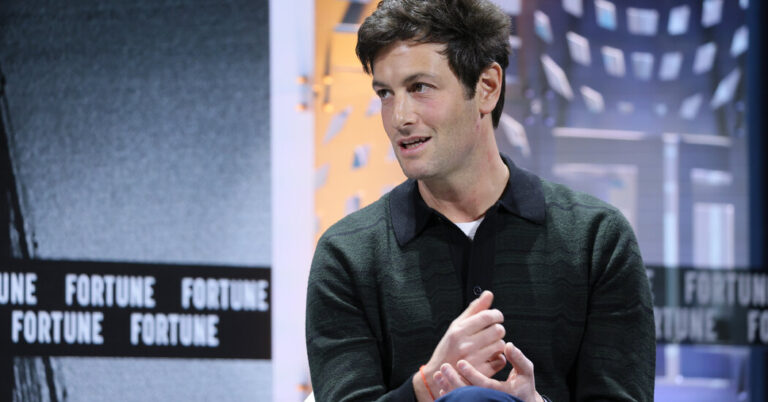
In many ways, it’s an unusual bet by Thrive Capital. The firm, which was founded in 2010 by Joshua Kushner, made its name betting on fast-growing and soon-to-be-prominent start-ups, including Instagram, the payment processor Stripe and Kim Kardashian’s Skims.

More recently, it has concentrated on A.I. businesses, having led an OpenAI funding round in October that valued the ChatGPT maker at $157 billion, as well as investments in Anysphere, an A.I. coding tool, and Isomorphic Labs, an A.I. drug researcher owned by Google.

Thrive Holdings appears to be particularly interested in everyday industries. Thrive Capital has already backed two companies that fit this mold: Crete, an accounting company, and Long Lake, which has focused on buying managers of homeowner associations. Thrive Holdings has already started investing in complementary areas, such as I.T. service providers, these people said.

Other venture capital firms have publicly committed to a serial acquisition strategy, known in the finance world as a roll-up. General Catalyst, for example, explicitly promoted its plan to support “A.I.-enabled roll-ups” when it led a fund-raising round for Eudia, an A.I.-enabled legal services company. (It has also invested in Long Lake.) Others betting on a similar strategy include the firm 8VC.

The idea is these businesses can be made vastly more efficient by incorporating A.I.; Long Lake, for example, uses such software to automate the operations of homeowner associations.

But unlike roll-ups done by Wall Street mainstays like private equity firms, the venture firms are targeting younger companies. Thrive Holdings also plans to focus heavily on the operations of the businesses it buys, in part by using a team of software engineers and Thrive’s ties to A.I. companies like OpenAI, these people said.

Thrive Holdings also differs from other venture firms via its setup as a so-called holding company that can own stakes in companies for a long time, even “forever,” one of the people with knowledge of the company said.

Over its 15-year existence, Thrive Capital and its executives, including Mr. Kushner, have incubated more than a dozen companies. At least five have valuations exceeding $1 billion. Among them is Oscar Health, the health insurer driven by its use of technology, though its current market value of $3 billion is roughly a third of where it stood when it went public in 2021.

Other businesses that Thrive Capital has incubated include the health care billing company Cedar, the health benefits app Rightway Healthcare, the virtual patient care management start-up Cadence and the online pharmacy Capsule.


Source link

Senate Rejects Bipartisan Measure to Undo Trump’s Tariffs

0


The Senate on Wednesday rejected an effort to undo President Trump’s sweeping tariffs on most U.S. trading partners, even as a small group of Republicans joined Democrats in delivering a rebuke to a trade policy that many lawmakers fear is causing economic harm.

The vote deadlocked at 49 to 49, meaning it failed despite three Republicans joining Democrats in favor of a measure that sought to terminate the national emergency declaration Mr. Trump used this month to impose 10 percent reciprocal tariffs.

Senator Rand Paul, Republican of Kentucky and a cosponsor of the resolution, crossed party lines to support it, as well as Senators Susan Collins of Maine and Lisa Murkowski of Alaska. But the defections were not enough to make up for the absences of two supporters: Senators Sheldon Whitehouse, Democrat of Rhode Island, and Mitch McConnell, Republican of Kentucky, who backed a similar measure this month.

“It’s still a debate worth having,” Mr. Paul said of the failed resolution. He noted that many of his Republican colleagues are privately expressing consternation over Mr. Trump’s trade war but have carefully calibrated their public responses to defer to the president.

Even if the resolution had passed the Senate, it had no path to enactment. The White House has threatened a veto, and House Republican leaders moved pre-emptively to prevent any such measure from being forced to the floor until the fall at the earliest. The maneuver was aimed at shielding their members from politically tricky votes on the matter.

The attempted intervention by a bipartisan coalition of senators followed weeks of rising frustration on Capitol Hill, where lawmakers have continued to fret about the tariffs even after Mr. Trump announced a 90-day pause on some of them. The president’s whipsawing moves on trade have prompted even some Republicans to begin pressing for Congress to claw back its constitutional power over the issue.

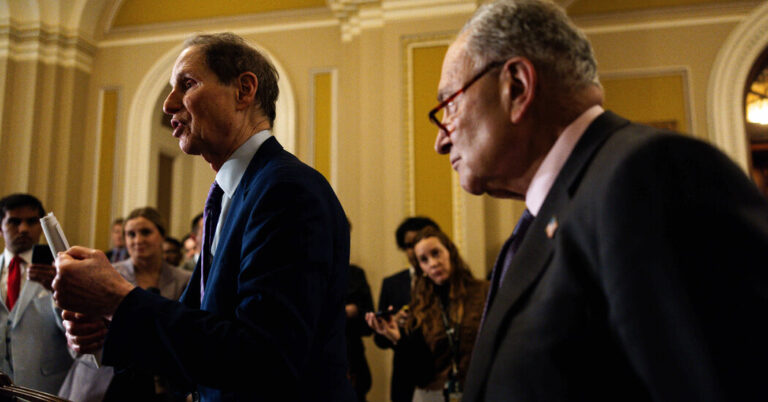
“The United States Senate cannot be an idle spectator in the tariff madness,” Senator Ron Wyden, Democrat of Oregon and one of the resolution’s co-sponsors, said ahead of the vote.

He pleaded with Republicans to vote for terminating the tariffs by repeatedly pointing to an economic report from the Commerce Department released on Wednesday that showed that the U.S. economy slowed in the first three months of the year.

“A major culprit is unquestionably Donald Trump and his senseless global tariffs,” Mr. Wyden declared.

Weeks earlier the Senate approved a similar resolution to block 25 percent tariffs imposed on Canadian imports under the same emergency powers. That measure has stalled in the House as a result of the maneuvering by Republican leaders to block the consideration of such resolutions.

Ahead of Wednesday’s vote in the Senate, Republican leaders in that chamber had sought to dissuade their members from backing the resolution. During a weekly party lunch, Senators John Thune of South Dakota, the majority leader, and John Barrasso of Wyoming, his No. 2, privately urged their colleagues to give Mr. Trump time to see through his economic agenda without challenge from Republicans in Congress, according to an attendee.

“Many of us in this chamber have heard from constituents concerned about the economic impact of the tariffs,” Senator Mike Crapo, Republican of Idaho, said. But he praised Mr. Trump’s decision to pause the reciprocal tariffs on most countries, excluding China, and urged senators not to disrupt ongoing negotiations by voting to rescind the paused tariffs altogether.

“We should not undermine these negotiations by the president at this critical juncture,” Mr. Crapo said.

Speaker Mike Johnson said Wednesday morning that any president, no matter their party, had a “broad degree of latitude” to deal with trade matters, as Mr. Trump is doing. Speaking at an event reflecting on the administration’s first 100 days hosted by Axios, he added that he did not “think it is appropriate for Congress to jump in the middle of that and try to legislate.”

The speaker said he might be open to asserting congressional authority over tariffs if he saw an “imbalance” between the powers of the executive and legislative branches on the topic. But he did not elaborate on what might prompt such action.


Source link

David Horowitz, Leftist Turned Trump Defender, Is Dead at 86

0


David Horowitz, a radical leftist of the 1960s who did a political about-face to become an outspoken conservative author and activist, writing that Barack Obama had “betrayed” America, and an ardent cheerleader for Donald J. Trump, died on Tuesday. He was 86.

The David Horowitz Freedom Center, a think tank he founded in Southern California, said the cause was cancer. His wife, April Horowitz, said he died at his home in Colorado.

Once a self-described Marxist, Mr. Horowitz executed a dizzying transit from the extreme left to the extreme right. He argued that the Black Lives Matter movement had fueled racial hatred; he opposed Palestinian rights; he denounced the news media and universities as tools of the left; and he falsely claimed that Mr. Trump had won the 2020 election, which Mr. Horowitz called “the greatest political crime” in American history.

A prolific author since his early 20s, Mr. Horowitz published several pro-Trump books, including “Big Agenda: President Trump’s Plan to Save America” (2017) and “The Enemy Within: How a Totalitarian Movement Is Destroying America” (2021). The enemies he accused of totalitarian impulses were the mainstream Democrats Nancy Pelosi, then the House speaker, and Kamala Harris, then the vice president.

Mr. Horowitz was a mentor to Stephen Miller, Mr. Trump’s top domestic policy adviser, whom he met when Mr. Miller was a California high school student fervidly critical of multiculturalism.

At Duke University, Mr. Miller started a chapter of Students for Academic Freedom, a grass-roots advocacy group founded by Mr. Horowitz. Mr. Horowitz asked him to help coordinate an “Islamo-Fascism Awareness Week” on college campuses, according to Jean Guerrero, a biographer of Mr. Miller, writing in Politico in 2020.

Mr. Horowitz helped Mr. Miller land a job as press secretary to Senator Jeff Sessions, Republican of Alabama, who participated in a retreat sponsored by the David Horowitz Freedom Center. The center describes itself on its website as opposing “efforts of the radical left and its Islamist allies to destroy American values and disarm this country.”

Mr. Miller joined Mr. Trump’s first presidential campaign in 2016, and Mr. Sessions served as attorney general under Mr. Trump from 2017 to 2018.

Before his turn to the far right, Mr. Horowitz was a mainstream conservative who in 1984 cast his first Republican ballot, to re-elect President Ronald Reagan.

He and a fellow convert, Peter Collier, writing in The Washington Post Magazine in 1985, described their transformation as a response in part to what they considered the left’s naïve views of communist movements, and in part to Reagan’s blunt assessment of the Soviet Union as an enemy of freedom.

“We agree with his vision of the world as a place increasingly inhospitable to democracy and increasingly dangerous for America,” they wrote.

In a 1997 autobiography, “Radical Son,” Mr. Horowitz identified a more wrenching moment when he broke from the left: the death of a friend, Betty Van Patter, whom he had recruited for a bookkeeping job at a foundation associated with the Black Panther Party.

Mr. Horowitz believed that Ms. Van Patter was murdered by the Panthers, though the case was never officially solved. The New Left movement, he concluded, was too wrapped up in fantasies of revolution to see the Panthers as thugs.

Reviewing “Radical Son” in The New York Times Book Review and speaking of Mr. Horowitz, the historian Richard Gid Powers called it “a courageous book, full of self-revelation and with a willingness to expose his own frailties.” However, he continued, Mr. Horowitz “is nothing if not contentious, and some of his contentions will rub readers the wrong way.”

Identified in the 1980s as a neoconservative, Mr. Horowitz began moving farther right with the emergence of culture wars. He co-founded Heterodoxy magazine in 1992 to critique political correctness on American campuses. In 1988, he and Mr. Collier founded the Center for the Study of Popular Culture, which changed its name in 2006 to the David Horowitz Freedom Center.

Mr. Horowitz pressed universities and state lawmakers to adopt an “academic bill of rights,” which he argued would expose students to broader viewpoints. Critics said it was an effort to purge liberal professors and create quotas for hiring conservatives.

In years of public speaking, often on college campuses at the invitation of Republican students, Mr. Horowitz was known for a pugilistic style. He advised conservatives to “begin every confrontation by punching progressives in the mouth.”

“If you’re nuanced and you speak in what I would call an intellectual manner, you get eaten alive,” he told The Times in 2017.

In speaking engagements that sometimes required security details and drew explosive responses from students, Mr. Horowitz often criticized Islamic radicals and the Palestinian cause, which he equated with a desire to wipe Israel from the map.

“There is a movement for a second Holocaust of the Jews that is being supported on this campus by the Muslim Student Association,” Mr. Horowitz said at the University of California, Santa Barbara, in 2008. The student group’s faculty adviser rebuked him.

In 2013, in an article in National Review titled “How Obama Betrayed America,” Mr. Horowitz attacked President Barack Obama for “minimizing” the threat of Islamic terrorism.

The Southern Poverty Law Center in 2014 called Mr. Horowitz “the godfather of the modern anti-Muslim movement.”

Two longtime former colleagues of Mr. Horowitz’s, Ronald Radosh and Sol Stern — who also turned their backs on the New Left — wrote about their friend’s more extreme political arc in The New Republic in 2021, lamenting that he had metamorphosed from “a thoughtful conservative” into a “Trump propagandist.”

“When the full history of the Trump intellectuals’ betrayal of decent conservatism is written, David Horowitz will have special pride of place, a chapter all to himself,” they wrote.

David Joel Horowitz was born on Jan. 10, 1939, in New York City, in Queens. His parents, Phil and Blanche Horowitz, were schoolteachers and members of the American Communist Party. They quit the party in 1956 when the Soviet leader Nikita Khrushchev denounced the crimes of Joseph Stalin.

David grew up “a sheltered child in a Marxist bubble,” he later wrote, attending a May Day parade at age 9.

He earned a bachelor’s degree in English from Columbia University in 1959 and a master’s degree in English from the University of California, Berkeley, in 1961. He helped found Root and Branch, a campus-based New Left magazine.

While living in London in the mid-1960s, he wrote a leftist critique of the Cold War, “The Free World Colossus,” which excoriated the United States as imperialist.

Returning to California in 1968, Mr. Horowitz became co-editor of the influential New Left magazine Ramparts, which ultimately reached a paid circulation of nearly 250,000. In its pages, he celebrated the Black Panther Party, and he became friends with one of its leaders, Huey Newton.

Beginning in 1976, after he fell out with the left but before he embraced the right, Mr. Horowitz and Mr. Collier wrote best-selling biographies of the Rockefeller, Kennedy and Ford families.

Mr. Horowitz’s marriages to Elissa Krauthamer, Sam Moorman and Shay Marlowe ended in divorce. In 1998, he married April Mullvain.

Besides his wife, he is survived by a sister, Ruth Horowitz; three children from his first marriage, Anne, Jonathan and Ben Horowitz, who is a co-founder of the Silicon Valley venture capital firm Andreessen Horowitz; a stepson, John Kibbie; and seven grandchildren. A daughter from his first marriage, Sarah, died in 2008; Mr. Horowitz wrote about that loss in his book “A Cracking of the Heart” (2009).

His other books include “Dark Agenda: The War to Destroy Christian America” (2018) and “I Can’t Breathe: How a Racial Hoax Is Killing America” (2021).


Source link

Federal Watchdog Reveals Dozens of Inquiries Into Trump’s Withholding of Funds

0


An independent federal watchdog has opened more than three dozen investigations into the Trump administration to determine if it has illegally withheld billions of dollars in congressionally approved funds, raising the odds of a high-stakes constitutional clash over the power of the government’s purse.

The acknowledgment by the Government Accountability Office came on Tuesday, as House and Senate Democrats estimated for the first time that President Trump might have blocked the delivery of at least $430 billion during his first 100 days in office. That imperiled money enacted for foreign aid, green energy, health and transportation-related programs, potentially in violation of the law.

The dispute originates in Mr. Trump’s vast, chaotic and continued reconfiguration of the federal government. Since the first days of Mr. Trump’s term, he and his top advisers — including the tech billionaire Elon Musk — have shuttered programs while blocking or slowing a wide array of funds seen as wasteful, unnecessary or incompatible with the president’s broader political agenda.

Many Democrats and legal scholars contend that Mr. Trump’s budget maneuvers violate the Constitution, which vest the powers to tax and spend with Congress, not the executive branch. The spending interruptions have also prompted a wave of court challenges as state officials, nonprofits and other federal aid recipients say the White House has acted illegally.

On Tuesday, Gene L. Dodaro, the comptroller general of the Government Accountability Office, revealed at a congressional hearing that his office had opened “39 different investigations” into the administration. He suggested some of the focus was on cuts or changes to spending at the Education Department, the Environmental Protection Agency and other major federal offices.

Under a 1970s law, the Government Accountability Office has the power to investigate whether an administration has improperly withheld authorized funding in defiance of Congress. The watchdog has the power to sue if it finds the administration illegally impounds funds.

Mr. Dodaro did not signal how his office might proceed. He told lawmakers that some federal agencies had not been “responsive” to his requests for information, while the White House’s budget office had largely ignored his entreaties.

“We’re trying to get information from the agencies about what their legal position is for not expending the money,” Mr. Dodaro said.

He acknowledged the inquiries after questioning from Senator Patty Murray, Democrat of Washington, who leads her party on the chamber’s top appropriations panel. Earlier on Tuesday, Ms. Murray and her counterpart in the House, Representative Rosa DeLauro, Democrat of Connecticut, issued the estimate that more than $400 billion in congressionally-appropriated funds had been slowed or blocked under Mr. Trump.

At the hearing, Ms. Murray faulted Mr. Trump for having “unilaterally frozen” funds in ways that “wreaked havoc for our families and communities across the country.”

A spokeswoman for the White House budget office did not immediately respond to a request for comment. The Government Accountability Office declined to comment further.

The inquiries seemed to raise the likelihood of a legal showdown between Mr. Trump, congressional Democrats and the Government Accountability Office, a powerful yet little-known independent watchdog. The office has largely remained unscathed even as the president has taken aim at other areas of oversight, including firing ethics officials such as the nation’s inspectors general.

At the heart of the battle is the president’s ability to invoke a power known as impoundment, which would allow Mr. Trump to stem the flow of federal dollars even if Congress instructs otherwise. Mr. Trump and his top budget adviser, Russell T. Vought, argue that a decades-old law restricting impoundment is unconstitutional, maintaining instead that the president should possess expansive authorities to reconfigure federal spending.

“The president ran on the notion that the Impoundment Control Act is unconstitutional,” Mr. Vought told lawmakers at a confirmation hearing this year, referring to the 1970s law that specifies controls over the president’s spending powers. “I agree with that.”

Mr. Vought similarly encouraged Mr. Trump to impound federal funds during his first term. In a legal memo issued at the end of the administration, Mr. Vought wrote at the time that existing law “limits the executive branch’s ability to spend appropriations effectively.”

But the matter most notably came to a head in 2020, during Mr. Trump’s impeachment trial, when the Government Accountability Office found that the administration had violated the law by withholding roughly $400 million in aid to Ukraine in defiance of Congress. Mr. Vought defended his office’s actions at the time. In January, he told lawmakers that the administration had “engaged in a policy process” and ultimately released the funds “by the end of the fiscal year.”

The dozens of new investigations are set to proceed as Mr. Trump prepares to issue his budget for the 2026 fiscal year, which is expected to propose deep cuts to many domestic programs, including child care, education, health and housing initiatives targeting the poor.

The president is expected to couple that blueprint with a formal, legal request to Congress to cancel spending previously authorized for the current fiscal year, predominately targeting billions of dollars in foreign aid and money for public broadcasting.


Source link

Meta Says It Anticipates Continued Growth Despite Tariffs

0


Meta said on Wednesday that it expected to see strong revenue growth in its advertising business in the coming months, even as President Trump’s tariffs threaten to batter the global economy.

The Silicon Valley company, which owns Facebook, Instagram and WhatsApp, also reported rising revenue and profit for the first quarter, buoyed by Instagram and Facebook ads. But it added that it would monitor the “active regulatory landscape,” which includes legal challenges in the European Union and the United States that could “significantly impact” its core business.

Revenue for the first quarter was $42.3 billion, up 16 percent from a year earlier and above Wall Street estimates of $41.3 billion, according to data compiled by FactSet, a market analysis firm. Profit was $16.6 billion, up 35 percent from $12.4 billion a year earlier and surpassing estimates of $13.6 billion.

For the current quarter, Meta said it expects revenue of $42.5 billion to $45.5 billion, with the high end of that range above Wall Street expectations of $43.8 billion. The company’s shares rose more than 5 percent in after-hours trading.

“We’ve had a strong start to an important year, our community continues to grow and our business is performing very well,” said Mark Zuckerberg, the chief executive of Meta.

Meta’s business has been robust in recent years as the company has invested in artificial intelligence to suggest different posts, videos and ads to users. Mr. Zuckerberg has said the investments have kept people coming back to Meta’s apps more regularly and clicking more relevant ads.

But the company faces new challenges in the Trump era. President Trump’s tariffs may affect some of Meta’s largest initiatives, including spending billions on infrastructure projects like data centers, which use raw materials that have been hammered by Mr. Trump’s import taxes.

Meta expects to spend even more on those infrastructure investments. On Wednesday, it raised its capital expenditure forecast for this year to $64 billion to $72 billion, up from $60 billion to $65 billion.

Meta has faced questions about its main revenue source: selling digital ads to brands and retailers, both large and small. The more that small businesses are hit with tariffs, the less they can afford to spend on Facebook and Instagram ads.

Mr. Trump set the highest tariffs on imports from China, and Chinese e-commerce powerhouses like Shein and Temu are especially important to Meta’s business. In 2023, Chinese companies accounted for 10 percent of Meta’s revenue.

Meta is also undergoing an antitrust trial in Washington over whether it illegally quashed competition in social networking by buying Instagram and WhatsApp when they were young start-ups. The outcome of the multiweek trial, which is the first major tech case prosecuted by the current Trump administration, could reshape the U.S. antitrust landscape and the Silicon Valley ecosystem.

Last week, the European Union said it was fining Meta 200 million euros ($230 million) for breaking the Digital Markets Act, a 2022 law intended to increase competition in the digital economy.

Wednesday’s earnings did not show an advertising pullback, as Mr. Trump’s tariffs were announced in April and the earnings period ended in March. The company’s financial guidance suggested that brands might continue spending on advertising on Facebook and Instagram, which have billions of users worldwide.

Instead, advertisers may cut ad spending on smaller platforms like Reddit, Snapchat and Pinterest, said Minda Smiley, a senior social media analyst at eMarketer. The impact won’t be seen until future earnings, she added.

“It’s sort of business as usual” right now, Ms. Smiley said. “But there’s uncertainty in terms of how they’re going to be impacted in the next quarter.”


Source link

Chelsea secure sixth successive WSL title with win at Man Utd!

0


Highlights of the Women’s Super League match between Manchester United and Chelsea.


Source link

Penske Shakes Up Leadership of South by Southwest

0


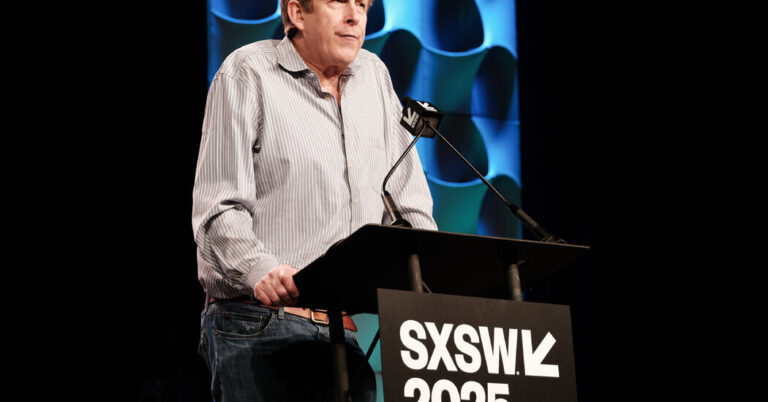
SXSW, which began as a music festival in Austin, Texas, in 1987, has expanded to a two-week event that now features three tracks of programming: music, film and interactive. Penske, which owns publications like Rolling Stone and The Hollywood Reporter and events like the Golden Globes, first invested in the festival in 2021. At the time, it bought 50 percent of the company with a partner, MRC. The two partners took control of the festival two years ago by buying another 1 percent.

Many of the people laid off in the past week had been with the festival for decades, including Lillian Park, the company’s head of communication, who had been employed by SXSW since 1988. “Farewell SX,” Ms. Park wrote on her LinkedIn profile. “I’m moving to Scotland to hang out with the sheepies.”

Mr. Forrest joined SXSW in 1989, just two years after it began, as the festival’s first paid employee. He ran SXSW Interactive from 1994 to 2017. He took on the co-president role in 2022. In 2024, he was named the sole president. Mr. Forrest was widely admired inside the organization. He worked without a salary during the pandemic to help keep others employed. Last year, he took a pay cut to save additional jobs.

As part of the reorganization, Greg Rosenbaum, the co-founder and vice president of SXSW EDU, an event focused on education, has been elevated to head of programming for the entire festival; Peter Lewis, chief partnerships officer, has been promoted to lead partnerships and strategy; and Brian Hobbs, a SXSW director, is now vice president of the music festival.

Like many other festivals, SXSW has not been able to return its profit margins to prepandemic levels, said Nick Barbaro, a co-founder of the festival and a board member. He added that new events in London this summer and Sydney, Australia, which started two years ago, had improved the bottom line for the organization.


Source link

Microsoft Profit Increases 18% While It Slows A.I. Spending

0


Since the release of the ChatGPT chatbot in 2022, Microsoft has plowed more and more money into building data centers in what one industry analyst called “the largest infrastructure build-out that humanity has ever seen.”

But after 10 consecutive quarters of increased spending for artificial intelligence, the company has put on the brakes, according to financial results released Wednesday.

In the first three months of 2025, Microsoft spent $21.4 billion on capital expenses, down more than $1 billion from the previous quarter.

The company is still on track to spend more than $80 billion on capital expenses in the current fiscal year, which ends in June. But the pullback, though slight, is an indication that the tech industry’s appetite for spending on A.I. is not limitless.

Overall, Microsoft’s results showed unexpected strength in its business. Sales surpassed $70 billion, up 13 percent from the same period a year earlier. Profit rose to $25.8 billion, up 18 percent. The results far surpassed Wall Street’s expectations.

“Cloud and A.I. are the essential inputs for every business to expand output, reduce costs, and accelerate growth,” Satya Nadella, Microsoft’s chief executive, said in a statement.

Microsoft’s stock price increased more than 5 percent in after-hours trading after the results were announced.

The company had been frantically building, and in recent quarters, Microsoft had said it would have seen even higher sales if it had more data centers up and running to fully supply the cloud computing and artificial intelligence services its customers wanted.

Sales of Microsoft’s flagship cloud computing service, Azure, grew 33 percent in the quarter, well over Wall Street’s expectations. Almost half of that growth came from artificial intelligence services.

Investors have been bracing for a change in infrastructure spending since analysts at the investment bank TD Securities reported in late February that Microsoft had been pulling out of some contracts for data centers. The analysts said much of that appeared tied to projects Microsoft had intended to build for its partner, OpenAI, to develop advanced A.I. systems. OpenAI is now expected to work with the software maker Oracle through their Stargate project.

Microsoft has acknowledged slowing down projects in Ohio and Wisconsin, and said it had paused some early-stage projects as part of a “refinement” process.

(The New York Times has sued OpenAI and Microsoft, claiming copyright infringement of news content related to A.I. systems. The two companies have denied the suit’s claims.)

Analysts at the investment firm Raymond James wrote last week that they had not yet detected major reductions in spending by Microsoft’s enterprise cloud customers. But they are concerned that tariffs and the uncertain economy might lead customers “to reduce spending on growth initiatives, shifting their focus to ‘keeping the lights on.’”

Microsoft’s personal computing business grew 6 percent to $13.4 billion. Commercial sales for its online productivity tools for businesses, including Excel, Teams and Word, grew 15 percent.

Microsoft’s results would have been even stronger were it not for the weakened U.S. dollar, which reduced revenue by more than $1 billion and profit by almost $400 million.


Source link

How Trump May Unintentionally Cut Carbon Emissions

0


President Trump has expressed little interest in fighting climate change. One of his key cabinet officials has even sought to evaluate whether humanity benefits from a warming climate, in a bid to undermine environmental rules.

Yet even as he works to accelerate oil and gas production, Mr. Trump’s economic approach may inadvertently reduce greenhouse gas emissions, as consumption slows in response to a global trade war.

Any reprieve for the planet, however, would be brief. Over the longer term, tanking the economy with tit-for-tat tariffs is likely to impede progress, because of how much clean energy deployment depends on overseas supply chains and because voters are less likely to support climate policy when they’re financially stressed.

Carbon emissions, largely a byproduct of going places and making things, have always been tethered to economic growth. Forecasters increasingly anticipate that Mr. Trump’s aggressive use of tariffs could tip the economy into recession as companies and consumers cut spending in the face of higher prices for imported goods.

“If we’re talking about a traditional recession, people fly less, they buy less stuff, there’s less investment in capital goods,” said Alex Heil, a senior economist at the Conference Board, who focuses on energy and climate. “And just a slowdown in economic activity is likely to slow down carbon emissions.”

That is what happened in the last two recessions. Global carbon emissions dipped slightly, before resuming their upward march. (Emissions in the United States continued to decline after 2008 as cheap natural gas displaced coal, and it’s possible that a similar peak is nearing for the rest of the world.)

There are already signs of this happening: Airlines are forecasting lower traffic, and fewer homes are being built. After the pre-tariff panic buying is done, consumer-oriented companies are expecting lower sales as customers pare their shopping lists. The end of the de minimis exemption, which allowed shipments worth up to $800 to enter the country tariff-free, may result in many fewer flimsy but trendy clothing items flown across the ocean.

There’s a certain irony here: U.S. environmentalists have long sought to impose some kind of tax on carbon, in order to discourage dirty products and encourage cleaner ones. Tariffs discourage people from buying foreign products, and plenty of those are also carbon intensive. So although a carbon tax would lower emissions more directly — Europe is even planning a new tariff system targeted at carbon intensive goods — broad tariffs are better than nothing, from a climate perspective.

It’s also true that globalization fueled the explosion of climate-warming gases by making it possible for the citizens of wealthier countries to fill their large houses with toys, furniture and cars at a low cost. As environmental regulations tightened in Europe and the United States, more polluting factories moved to developing countries with looser rules.

But it’s not clear that a trade war will run that process in reverse, because of the thicket of countervailing effects it creates. For one thing, even as the United States imposes tariffs, shipments of goods may simply be redirected, rather than falling overall.

“The question is, are we really looking at substantially reduced cross-border trade, or are we just looking at different cross-border trade?” said Ethan Zindler, chief policy analyst at BloombergNEF. “If you take trade route A versus trade route B, it might have higher emissions. So it’s very hard to know.”

Even if international shipping declined, and tariffs redirected consumption toward domestic goods, that wouldn’t necessarily help. Most emissions associated with global freight actually come in the last-mile delivery via truck from ports of entry to warehouses and retailers.

Moreover, if the world did return to an age in which countries bought more within their own borders — and that’s a big “if” — building new factories that may not operate as efficiently as China’s enormous industrial zones could end up increasing the carbon required to produce a sofa or a pair of shoes.

The bigger factor for emissions in the medium term would be how trade restrictions and an economic downturn affected new sources of electricity.

Recessions always bring down gas prices; concerns about the Trump administration’s economic policy have already done so. Tariffs on steel and aluminum are also making it more expensive to get oil rigs up and running, which has slowed down drilling.

But tariffs cut both ways for energy, and renewable sources may suffer even more. Solar arrays, wind farms and electric vehicles are currently built with goods produced in other countries, including batteries and turbines, most of which are now subjected to tariffs of at least 10 percent. (For solar panels, the duties are far higher.) Retaliatory measures, such as China’s export controls on rare earth minerals needed in clean energy technologies, will magnify the effect.

The Biden administration worked to build up domestic sources of solar panels, batteries and other parts needed to build renewable energy, supported with billions of dollars in subsidies. It also used tariffs to protect some of those industries, and planned for more when they were up and running. But they’re currently not producing nearly enough to supply domestic demand.

“Where we are in the process now is we’re building the factories, now we need the equipment to put in the factories, and that takes a lot of steel,” said Eric Van Nostrand, who ran economic policy at the Treasury Department under President Joseph R. Biden Jr. Tariffs on steel make that harder, and investment is already wilting in the face of high interest rates and the possibility that Congress will curtail the clean energy tax credits in the Inflation Reduction Act.

Trade barriers also make it more difficult to adapt when climate-related disasters hit. When a drought wipes out a wheat or soybean crop, shifting to imports without having to pay exorbitant taxes can cushion the blow. And rebuilding after a hurricane or a wildfire is much more costly without imported lumber, cement and appliances.

And economic downturns are hard on average consumers, who lose jobs and have their hours cut. Even if they might do fewer loads of laundry to save on their energy bills, investing in an electric vehicle or a heat pump for their house becomes more difficult (and will be even more so if Congress repeals Biden-era subsidies for those items).

“Recessions are not times when people decide to spend a lot of money to upgrade their washing machines to a more energy-efficient one,” said Brian Prest, a fellow at Resources for the Future, an energy-focused think tank. Holding back the upgrade cycle can keep emissions from falling as much as they might have in a healthy economy.

But the more important implications of a trade war and ensuing recession would kick in over the longer term, and none of them are good for the climate.

First, the path of decarbonization depends a lot on how quickly technology progresses. As trade barriers rise, exporting to other countries becomes more difficult. That shrinks the market available for entrepreneurs, reducing the incentive to take risks and invest.

Second, even if Americans elect a more climate-friendly president and Congress in the coming years, recessions typically don’t lend themselves to ambitious environmental policy. Relieving immediate financial pain tends to take priority, said Jonas Meckling, a climate fellow at Harvard Business School.

“If this results in a contraction of economic growth, then we know that climate won’t be a top agenda item for voters, and everything will focus much more on just stimulating the economy,” Dr. Meckling said. It’s already happening up north: Faced with rising joblessness and high costs, Canada has backed off on its own consumer carbon tax.

That’s also true on an international level. Economic insecurity focuses nations inward, when dealing with climate change requires international cooperation. Festering global conflicts are also pushing leaders to focus their resources on building up their militaries, leaving less money to support a transition to low-carbon energy, industrial processes and agriculture.

That’s why climate economists take little solace in even the carbon silver lining of any impending recession.

“Emissions may drop a bit because of a bit less economic activity,” said Brian Copeland, an economics professor at the University of British Columbia. “But I think it just makes the long-run transition to a less carbon intensive society harder.”


Source link

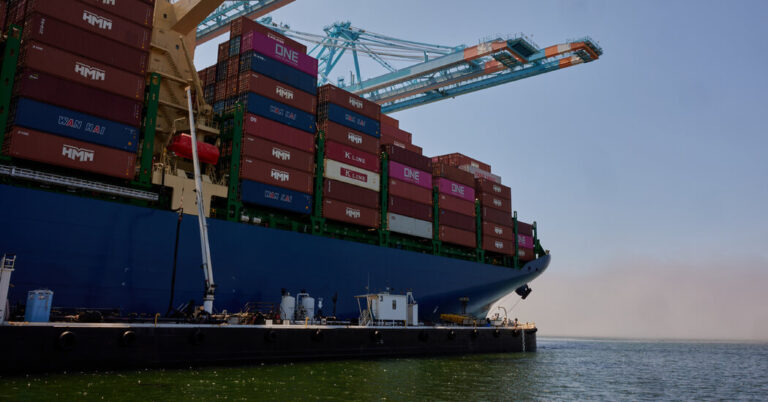
West Coast Ports Brace for China Tariffs to Dent Import Volume Within Days

0


Census Bureau data released on Tuesday showed a surge in U.S. imports starting last fall, from $268 billion at the end of October to $343 billion at the end of March, reflecting a push by major American companies to buy goods ahead of anticipated tariffs. The U.S. trade deficit for goods widened in March to a record high.

Finished consumer goods that wholesalers and retailers import directly from China make up the bulk of the items expected to be most affected at the Los Angeles and Long Beach ports, said Jason Miller, a professor of supply chain management at Michigan State University.

“This is just a pure demand destruction scenario at the moment, where there’s just not as much stuff coming in,” Dr. Miller said.

The Port of Los Angeles, for example, handles a large volume of furniture imports, which are likely to decline sharply. Imports of plastic products from China, such as scooters and toys, are set to fall drastically at the Port of Long Beach. East Coast ports are likely to see a similar drop in shipping volume a couple weeks after the decline hits the West Coast, Dr. Miller said.

If the downturn in imports is sustained, the effects on employment and economic growth are likely to extend far beyond the ports themselves. Moving fewer containers means not just less work for dockworkers, but also subdued demand for trucking and warehouse jobs.

“That, of course, has ripple effects for the broader economic community,” Dr. Miller said.

Data compiled by Torsten Slok, chief economist at Apollo Global Management, an investment firm, showed a steep decline in the number of containers heading to the United States from China, starting this month. In a research note last week, Mr. Slok said a drop in shipments from China could lead to “significant layoffs” in the trucking, logistics and retail sectors in May.


Source link