Home Blog Page 352

4 Killed When a Car Crashes Through an Illinois After-School Center

0


Four people, all of them children or teenagers, were killed and several others were injured on Monday when a car crashed through an after-school center in Chatham, Ill., a village just south of Springfield, the State Police said.

The victims are believed to be 18 years and younger, the Illinois State Police Department said in news release.

The car struck three of the victims outside the building and the other inside it, the police said. Several others were taken to the hospital, and at least one person was airlifted, the authorities said.

There was no additional information on the injuries on Monday evening or the ages of those injured, said Melaney Arnold, a spokeswoman for the Illinois State Police.

The driver, who has not been identified, was not injured and was undergoing an evaluation at the hospital Monday evening, the State Police said. No one else was in the vehicle, the police said.

Officers with the Chatham Police Department, Chatham Fire Department and other agencies responded to a call Monday afternoon of a vehicle driving into Y.N.O.T. After School Camp, the State Police said

According to the police, the driver drove into the east side of the building, striking multiple people outside and then continued driving through the building, hitting more people inside before exiting through the building on the west side.

The Illinois State Police and the Chatham Police Department are investigating the crash. It was not immediately known what caused the crash.

Gov. JB Pritzker of Illinois expressed his condolences for the victims and their families in a statement on Monday evening, and said that his administration was monitoring the situation.

“Our community lost a group of bright and innocent young people with their whole lives ahead of them,” Mr. Pritzker said. “Parents said goodbye to their kids this morning not knowing it would be the last time. My heart is heavy for these families and the unimaginable grief they’re experiencing.”

This is a developing story.

Neil Vigdor and Julie Bosman reporting.


Source link

House Passes Bill to Ban Sharing of Revenge Porn, Sending It to Trump

0


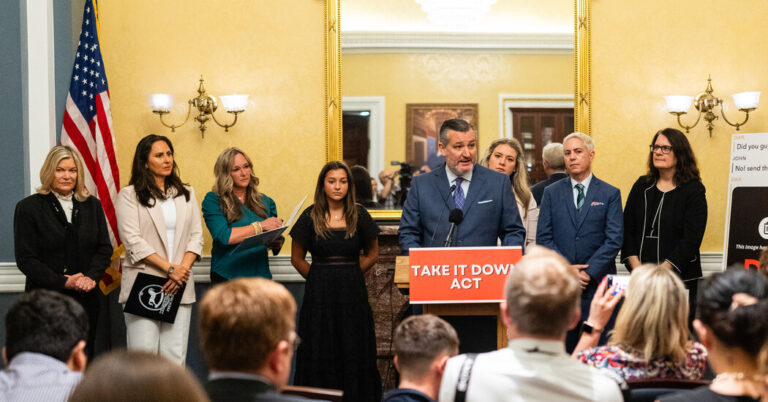
The House on Monday overwhelmingly passed bipartisan legislation to criminalize the nonconsensual sharing of sexually explicit photos and videos of others — including A.I.-generated images known as “deepfakes” — and to mandate that platforms quickly remove them.

The vote of 409 to 2 cleared the measure for President Trump, who was expected to quickly sign it.

The legislation, known as the Take It Down Act, aims to crack down on the sharing of material known as “revenge porn,” requiring that social media companies and online platforms remove such images within two days of being notified of them.

The measure, which brought together an unlikely coalition of conservatives and liberals in both parties, passed the Senate unanimously in February. The support of Mr. Trump, who mentioned it during his joint address to Congress last month, appears to have smoothed its path through Congress.

The legislation, introduced by Senators Ted Cruz, Republican of Texas, and Amy Klobuchar, Democrat of Minnesota, is the first internet content law to clear Congress since 2018, when lawmakers approved legislation to fight online sex trafficking. And though it focuses on revenge porn and deepfakes, the bill is seen as an important step toward regulating internet companies that have for decades escaped government scrutiny.

The Take It Down Act’s overwhelming support highlights mounting anger among lawmakers toward social media platforms like Facebook, Instagram and X for hosting disinformation and harmful content, particularly images that hurt children and teenagers.

Though revenge porn and deepfakes affect adults and minors alike, both have been particularly potent for teenage girls as the spread of widely available “nudification” apps has spurred boys to surreptitiously concoct sexually explicit images of their female classmates and then circulate them.

Representative María Elvira Salazar, a Florida Republican who introduced a companion bill in the House, said on Monday that the bill would stop the abuse and harassment of young girls that was “spreading like wildfire” online.

“It is outrageously sick to use images — the face, the voice, the likeness — of a young, vulnerable female, to manipulate them, to extort them and to humiliate them publicly just for fun, just for revenge,” Ms. Salazar said.

The bill’s passage also echoes similar efforts in statehouses across the country. Every state except South Carolina has a law criminalizing revenge porn. And at least 20 states have laws that address sexually explicit deepfakes.

The measure that passed on Monday is part of a yearslong bipartisan effort by lawmakers to address deepfake pornography. Mr. Cruz and Ms. Klobuchar first introduced the bill last year, when it passed the Senate but died in the Republican-led House. It was reintroduced this year and appeared to gain momentum after it drew the support from the first lady, Melania Trump.

Representative Alexandria Ocasio-Cortez, a millennial Democrat from New York, also introduced legislation last year that would have allowed those depicted in sexually explicit deepfakes to sue the people who created and shared them. That bill has not been reintroduced this year.

Lawmakers have in recent years rallied around several bills aimed at protecting children online from sexual exploitation, bullying and addictive algorithms. In January 2024, chief executives of Meta, TikTok and other tech firms testified before angry lawmakers, defending their platforms.

In the hearing, Mark Zuckerberg, the chief executive of Meta, was forced to apologize to parents who had lost their children from online harms.

Some speech advocates have warned that the measure could chill free expression, saying such a law could force the removal of legitimate images along with nonconsensual sexual imagery.

“The best of intentions can’t make up for the bill’s dangerous implications for constitutional speech and privacy online,” said Becca Branum, the deputy director of the Free Expression Project for the Center for Democracy and Technology, a research group.

Ms. Branum added that the Take It Down Act was “a recipe for weaponized enforcement that risks durable progress in the fight against image-based sexual abuse.”


Source link

Micah hilariously storms pitch to troll opponents with DANCE celebration!

0


Micah Richards does PK Humble’s dance after Yanited’s dramatic loss to Trebol FC.


Source link

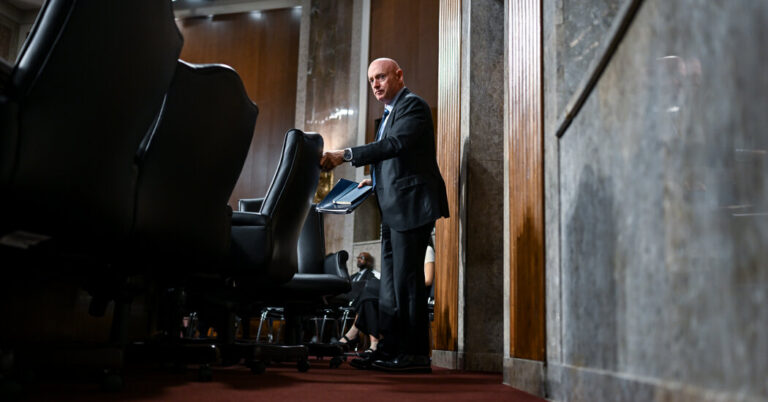
Senator Denounces Musk’s Cuts: ‘Not What Anybody Signed Up For’

0


Senator Mark Kelly knows Elon Musk better than most Americans do.

Kelly, an Arizona Democrat, is a former NASA astronaut and Navy combat pilot. He used to consult for SpaceX about crew safety, he told me, and sat in on meetings there with Musk. He drove a Tesla for a while, before very publicly returning it this year.

In a way, Kelly embodies the whiplash many Democrats feel when it comes to Musk, and he has emerged as one of the billionaire’s most vocal critics in Washington. With the Trump administration approaching its 100th day tomorrow, I called Kelly to ask him what it’s like to tangle with Musk on X — and what power Democrats really have to unwind the changes Musk has already set into motion.

JB: You are one of many Democrats who have decided to return their Teslas. Do you miss it?

MK: No, no. There’s things I liked about it, which was the performance. The thing is pretty incredible from an acceleration standpoint. It’s the closest thing I can think of to a catapult-shot off the front of the aircraft carrier. Though I was back on the U.S.S. Lincoln about a year ago, in the back of an F-18, and I realized it still is not that close.

It’s fun to drive. What I didn’t like about it is, I was driving less than 200 miles a month, but I was having to charge it every week, constantly thinking, OK, when am I going to plug this car in next time?

Did you replace it with something?

Yeah, I got a Tahoe.

Elon Musk became central to certain aspects of Democrats’ messaging over the past several months. But for you, it’s been a little more personal, because Musk insulted you during an X dispute involving your brother, the astronaut Scott Kelly, about the astronauts at the Space Station — and then he called you a “traitor” after you visited Ukraine.

He called me a traitor for doing my job, essentially, and supporting our ally. It’s almost comical, because if I’m the traitor, well, that means you must be on the side of Russia.

He’s the one who made this personal. I don’t really care what he says about me.

What happens when the richest man in the world calls you a traitor? Do you get more threats?

I do feel like it kind of ticked up a little bit. And it’s not only me, it’s Gabby [Giffords, his wife and a former congresswoman] too. Even though she’s been shot, nearly assassinated, people threaten to kill her as well.

My family especially knows that this is a full-contact sport. If you’re going to decide to serve the country in this way, you subject yourself to a bit of risk.

This juvenile stuff Elon does, that stuff doesn’t really matter. What matters is the damage he’s doing to our country, to the federal government, to these agencies that help people, not only within our borders but around the world, and the help we provide to other nations through things like USAID.

I’m not against the whole idea that we’ve got to figure out a way to reduce the size of the federal budget. But this ain’t it. Sending one dude and a bunch of his minions in here to just slash and burn without any analysis or a plan, and then giving them access to the personal information of 350 million citizens of our country, is not what anybody signed up for when they went to vote for Donald Trump.

You hit on something that I think is important, which is that cutting government spending is pretty popular.

And it should be.

Spending on foreign aid is not terribly popular. Does opposing DOGE’s cuts pose any political risk to Democrats?

Sometimes you’ve got to take risks to do the right thing, and try to nudge us back in the right direction. I am not going to get behind Elon or anybody else’s cuts to food assistance. I was talking to Cindy McCain [the executive director of the World Food Program] about this the other day. Her budget’s been just axed, and now she’s got to decide who starves to death and who doesn’t because of Elon Musk and Donald Trump. These decisions have consequences.

I get it that when you’re going about your life here, it might seem like a hard pill to swallow, to be spending any money overseas trying to help somebody else. But hey, we are the leaders of the free world, and the world is a much more dangerous place without the United States of America leading our allies.

You can spend a little bit of money on trying to solve these problems, like famine in places like Sudan or Afghanistan or other countries, or you can buy more bullets.

There’s somebody that might be complaining about foreign aid today, and tomorrow, or five years from now, they’re sending their kid overseas to fight in a war that wouldn’t have otherwise happened if people like Elon Musk didn’t go through and jam through these changes.

What can Democrats actually do to curtail DOGE or stop what Musk is doing?

I’m on the phone with my Arizona attorney general regularly about this and talking about the lawsuits that they can file.

We try to encourage our Republican colleagues to have hearings, or try to persuade them that these cuts that they’re making are not a good idea and get them to get off the sidelines.

Is that working?

It’s a slow process. But I think it does work. You say, ‘Hey, how do you feel about the cuts to your university’s funding for all this research?’ They start thinking about it. It’s a slow, slow process, like turning around the aircraft carrier.

Is there any lesson that you think Democrats have learned over the past 100 days — any way that you want to kind of calibrate or adjust the approach to Musk and DOGE going forward?

According to the White House, he’s not going to be there much longer. Now, we’ve also heard Donald Trump change his mind on things almost daily. But he may be gone soon. Then, the question is, who replaces him in that role? Maybe he elevates one of his 20-something-year-old DOGE bros.

Just because somebody’s good at one thing, like, really good at one thing — and I’ll give Elon credit, he’s good at building a rocket — he is not good at this.

I think Donald Trump thinks he’s the smartest guy in the world because he’s the richest guy in the world. It does not work like that.

This conversation was condensed and edited for clarity.


MEANWHILE on X

Musk is using his X account as a megaphone. My colleague Steven Lee Myers, who covers misinformation and disinformation, checked in on where Musk seems to be focusing.

Elon Musk’s retreat from his cost-cutting role in the federal government has become increasingly evident as his attention turns more and more to his businesses. He seized on the widespread power outages in Spain, Portugal and France on Monday to promote two of his companies, Tesla and Starlink.

The impetus was a post on X by a Spanish-American supporter of President Trump and the MAGA movement. Ada Lluch, who describes herself on X as “just a girl with common sense” and has more than 300,000 followers, complained that the blackout had disrupted her grandfather’s dental surgery in Spain.

“My grandpa was in the middle of a surgery and I can’t contact them,” she said, in one of a series of posts that attacked Spain’s government.

“Tesla Powerwall plus Starlink should still work,” Musk replied, referring to the car company’s rechargeable home battery and to his satellite communications link.

Steven Lee Myers

you shouldn’t miss

The Trump administration has cut $1 billion in federal aid to anti-hunger groups, according to the advocacy group Feeding America. This month, my colleague David Fahrenthold went to a charity in Charleston, W.Va., to see how those cuts were playing out in the kitchen.

He met Sara Busse, who was feeding 40 needy seniors vegetable soup, dried cranberries and crackers. Food pantries across the state are trying to do more with much less since the Agriculture Department sharply curtailed its deliveries of free food. And that has left Busse feeling like she’s on a grim reality show about turning a dwindling food supply into 600 meals a week.

She used $35 of the church’s money to buy ground beef and chicken stock, fortifying the government’s wan soup. She found someone to donate three spinach salads, to which she added the cranberries. The crackers were her starch.

Read more here.


Source link

Amazon to Launch First Project Kuiper Internet Satellites: What to Know

0


The battle of billionaires in space between Jeff Bezos and Elon Musk is ready to enter a new arena: satellite internet.

Amazon, the company that Mr. Bezos started as an online bookseller three decades ago, is now a merchandising behemoth, the owner of the James Bond franchise, a seller of electronic gadgets like Echo smart speakers and one of the most powerful providers of cloud computing.

So perhaps it is not a surprise that Amazon is now launching the first few of thousands of satellites known as Project Kuiper to provide another option for remaining connected in the modern world. The market for beaming high-speed internet to the ground from orbit is currently dominated by Elon Musk’s SpaceX rocket company, which operates a similar service, Starlink. Starlink, with thousands of satellites in orbit and more launching nearly every week, already serves several million customers around the world.

The first attempt to send the satellites to orbit, on April 9, was postponed because of poor weather at the launch site. On Monday, the company is ready to try again.

The first 27 Project Kuiper satellites are scheduled to lift off on Monday between 7 and 9 p.m. Eastern time from Cape Canaveral Space Force Station in Florida. They will fly on an Atlas V, a rocket made by United Launch Alliance, a joint venture between Boeing and Lockheed Martin.

U.L.A. plans to provide live coverage beginning at 6:35 p.m. The company says that weather conditions are currently 70 percent favorable for an on-time launch.

The spacecraft will deploy the Kuiper satellites in a circular orbit at 280 miles above the surface. The satellites’ propulsion system will then gradually raise that orbit to an altitude of 393 miles.

Project Kuiper will be a constellation of internet satellites intended to provide high-speed data connections to almost every point on Earth. Doing this successfully will require thousands of satellites, and Amazon’s goal is to operate more than 3,200 in the years to come.

The company will compete with SpaceX’s Starlink, a service that was originally marketed primarily to residential customers.

While Kuiper also aims for that market, particularly in remote areas, it will also be integrated with Amazon Web Services, the company’s cloud computing offering, which is popular with large corporations and governments around the world. That might make it more attractive to businesses that involve satellite imagery or weather forecasting that not only need to move large amounts of data across the internet, but also to perform calculations on the data.

Ground stations will connect the Kuiper satellites to the web services infrastructure in a manner that could also allow companies to communicate with their own remote equipment. For example, Amazon has suggested that energy companies could use Kuiper to monitor and control remote wind farms or offshore drilling platforms.

In October 2023, two prototype Kuiper satellites were launched to test the technology. Amazon said that the tests were successful. Those prototypes were never meant to serve in the operational constellation, and after seven months they were nudged back into the atmosphere, where they burned up. The company said it has since updated the designs of “every system and subsystem on board.”

“There’s a big difference between launching two satellites and launching 3,000 satellites,” said Rajeev Badyal, an Amazon executive in charge of Kuiper, in a promotional video ahead of the launch.

Amazon told the Federal Communications Commission in 2020 that service would begin after it had deployed its first 578 satellites. The company has said that it expects to connect customers to the internet later this year.

While a fully functional constellation needs thousands of satellites, the company can offer service in specific regions with far fewer in orbit before expanding to more global coverage later on.

The F.C.C.’s approval of the constellation came with a requirement that at least half the satellites needed to be deployed by July 30, 2026. Industry analysts say the company could get an extension if it has demonstrated substantial progress by then.

Getting the satellites into orbit also depends on rocket launches occurring on schedule, which can be a problem if enough rockets are not available. Amazon also needs to build hundreds of ground stations, to relay their signals to users.


Source link

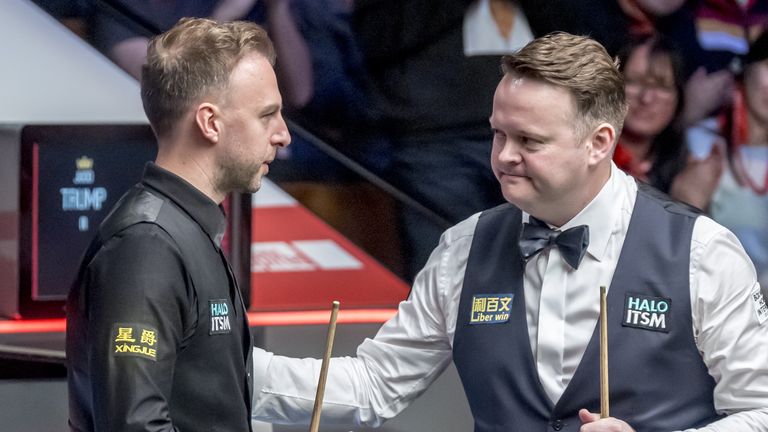
World Snooker Championship: Ronnie O’Sullivan and Luca Brecel breeze into Crucible quarter-finals | Snooker News

0


Ronnie O’Sullivan and Luca Brecel through to World Snooker Championship quarter-finals; single frames needed for progression sealed inside half an hour in truncated Monday evening session at the Crucible; pair join Judd Trump in last eight after he weathered Shaun Murphy fightback

Last Updated: 28/04/25 8:48pm

Si Jiahui awaits Ronnie O'Sullivan in the quarter-finals at the World Snooker Championship

Si Jiahui awaits Ronnie O’Sullivan in the quarter-finals at the World Snooker Championship

Ronnie O’Sullivan and Luca Brecel wrapped up one of the quickest Crucible sessions in history as they took just over a quarter of an hour to seal their respective places in the World Snooker Championship quarter-finals.

The two former winners returned on Monday evening, each requiring a single frame to complete wins over Pang Junxu and Ding Junhui respectively.

Brecel won the sprint to the dressing room as he summoned a break of 71 to see off the 2016 finalist 13-4, and he was swiftly followed by O’Sullivan, who rifled in a break of 95 to complete his victory over Pang by the same score.

Having barely been challenged to get out of second gear by his outclassed opponent, O’Sullivan, who came to Sheffield having not played a competitive match since January, remained predictably downbeat about his performance.

Rating his form as “probably two out of 10”, O’Sullivan, who will face another Chinese opponent, Si Jiahui, in the last eight, added: “I wasn’t bothered about getting it over quickly – I need all the table time I can get.

“I think I’ve dragged them [my opponents] down to a poorer level. I think they expected me to play better and were maybe shocked that I didn’t, but I don’t think Si will fall into that trap, and that’s what makes him dangerous.”

O'Sullivan beat Pang Junxu to reach a record-extending 23rd Crucible quarter-final

O’Sullivan beat Pang Junxu to reach a record-extending 23rd Crucible quarter-final

Si, a shock semi-finalist on his Crucible debut two years ago, survived a late scare to see off Ben Woollaston 13-10 and confirm his place in the last eight.

O’Sullivan had done the damage in the second session of their match on Sunday when he reeled off six frames to move to the brink of victory.

Despite often looking far from happy with his form, he still managed to dredge up back-to-back centuries, enough to outclass the hapless Pang and serve a warning to his rivals that he still has what it takes to claim a record eighth Crucible crown.

Luca Brecel wrapped up his second-round tie against Ding Junhui  with minimal fuss

Luca Brecel wrapped up his second-round tie against Ding Junhui with minimal fuss

Brecel’s own victory was shaped by a stunning first session on Saturday, for which he had jetted in on a private jet from Belgium with four hours to spare, and proceeded to compile two centuries and three more breaks over 50 as he racked up a virtually unassailable 7-1 lead.

Brecel, who will face Judd Trump in the last eight, arrived at the Championships in negligible form but believes he stands a chance of repeating his stunning run to the title in 2023.

“I’m not sure if I’m playing as good as then but I’m definitely not so worried about winning the title,” he added. “Two years ago it felt like a golden chance, and now I feel like I can get back there and do it again, so it’s not that much pressure.”

Trump withstands Murphy fightback to reach quarters

Judd Trump held off a Shaun Murphy revival as a 13-10 victory booked his place in the quarter-finals

Judd Trump held off a Shaun Murphy revival as a 13-10 victory booked his place in the quarter-finals

Trump held off a spirited fightback from Shaun Murphy to set up his quarter-final against Brecel.

The 35-yera-old Englishman began the final session of the second-round clash of former champions with a 10-6 lead and moved to within one frame of victory with the aid of breaks of 63 and 86.

Murphy dug deep to win the next two frames with breaks of 88 and 72 to at least reach the mid-session interval and carried on where he had left off when play resumed, breaks of 112 and 99 reducing his deficit to 12-10.

The Masters champion also got in with a superb long red in frame 23 but, after also potting the blue, missed a red to the corner and Trump stepped in with a break of 58 which effectively secured a hard-fought 13-10 win.

World No 1 and 2019 champion Trump is through to the last eight in Sheffield

World No 1 and 2019 champion Trump is through to the last eight in Sheffield

World Snooker Championship: Quarter-finals

  • John Higgins vs Mark Williams
  • Zhao Xintong vs Chris Wakelin
  • Luca Brecel vs Judd Trump
  • Ronnie O’Sullivan vs Si Jiahui


Source link

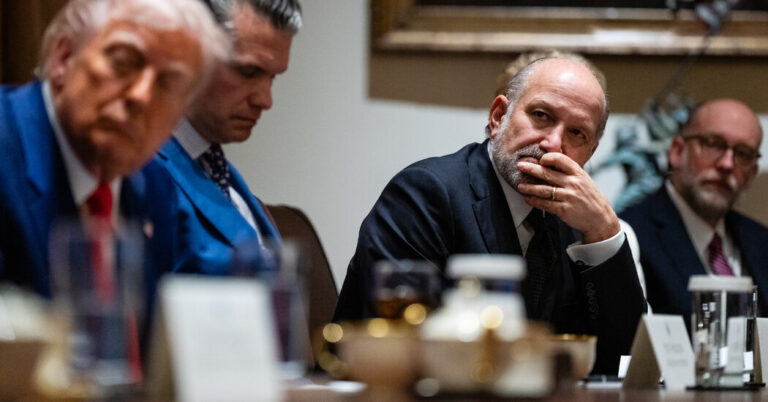
Howard Lutnick, Trump’s ‘Buoyant’ Trade Warrior, Flexes His Power Over Global Business

0


Since Howard Lutnick was tapped to serve as President Trump’s commerce secretary, executives from some of the world’s largest companies have been trying to win him over.

Leaders of Nvidia, Facebook, Taiwan Semiconductor Manufacturing Company and Alphabet have visited his newly purchased $25 million property in Washington — a 16,250-square-foot mansion that Mr. Lutnick, a billionaire, recently quipped would be “big enough for my ego” — to persuade him to adopt a business-friendly agenda.

As Mr. Trump ratcheted up tariffs to levels not seen in a century, Ford, General Motors and other companies that have built their businesses around international trade reached out to Mr. Lutnick in the hope that he could persuade the president to take a less aggressive approach. Some chief executives have put in calls to the commerce secretary at midnight.

Mr. Lutnick, 63, heads a department that both promotes and regulates industry and he has been put in charge of overseeing trade. As a result, he has found himself in a position of incredible influence, as the go-between for a president imposing sweeping tariffs and the industries being crushed by them.

A former bond trader who amassed billions on Wall Street, Mr. Lutnick has become one of the loudest salesmen for tariffs in an administration generally unified on their benefits. He has publicly echoed the president’s message that big tariffs are needed to revive American industry, and that if companies don’t like them, they should build factories in the United States.

But in internal conversations in the administration, he has often been a voice for moderation. He argued in favor of Mr. Trump pausing his global tariffs for 90 days after they sent convulsions through the stock and bond markets. And he has made the case to the president to grant relief to certain favored industries, helping them to win exemptions from billions of dollars of levies.

After the country’s biggest car companies argued to Mr. Lutnick that tariffs on Canada and Mexico would hurt the competitiveness of U.S. auto factories, Mr. Lutnick lobbied the president to secure a major exemption in March.

In April, Mr. Lutnick helped to push through exceptions that saved electronics companies from severe China tariffs, after he and other officials received calls from executives like Tim Cook of Apple and Michael Dell of Dell Technologies.

Mr. Trump appears to regret granting such exclusions. He has groused to associates that he did not want to do them in the first place, and wrote on Truth Social in April that “NOBODY is getting ‘off the hook,’” saying that electronics would be subject to other tariffs in the future.

Companies have been left deeply confused about the direction of trade policy but more determined than ever to lobby for lucrative exemptions.

Mr. Lutnick did not respond to a request for an interview. A spokesman for the Commerce Department declined to comment. The New York Times spoke with more than three dozen corporate executives and current and former employees of the Commerce Department, the White House, Mr. Lutnick’s former Wall Street firm, Cantor Fitzgerald, and others.

Mr. Lutnick is not always on the side of helping industry. Often he has employed the threat of tariffs or other aggressive tactics against businesses to encourage them to invest more in the United States.

For example, Mr. Lutnick has paused disbursements to companies from the CHIPS program, a bipartisan, multibillion-dollar effort to rebuild America’s semiconductor industry. Mr. Lutnick put pressure on some executives to increase their U.S. investments if they want to receive their funds, even though companies have already signed contracts for those payments, according to three people familiar with the conversations.

He has also given companies the impression that they may get tariff relief by investing more in the United States, and discussed holding tariffs paid by companies in escrow, returning it if they make U.S. investments. Companies including Apple, TSMC and Nvidia have announced investments since Mr. Trump began threatening tariffs.

As a former investment banker, Mr. Lutnick seems particularly interested in novel ways to shore up government finances. He has backed Mr. Trump’s plan of selling citizenship to wealthy foreigners with a “gold card,” and talked about the government taking a cut from patents and innovations.

Mr. Lutnick has floated renaming the Department of the Interior “the Department of American Assets” and using tariff revenue to finance a new sovereign wealth fund. He has also spoken passionately about establishing a new “investment accelerator” that aims to cut red tape for investors.

Mr. Lutnick’s supporters say he brings fresh thinking that is badly needed in Washington. But executives and foreign officials have described some of his proposals as zany or harmful, and come away from conversations deeply unsettled, half a dozen people familiar with the exchanges say.

And despite overseeing a sprawling government agency, Mr. Lutnick is working to further expand his reach.

He has been moving to take control of the customs service in order to make Mr. Trump’s “External Revenue Service” — which would collect import taxes — a reality. Mr. Lutnick has also expressed interest in gaining authority over the U.S. Postal Service. After Mr. Trump gave him “a whole 24 hours,” in Mr. Lutnick’s words, to figure out how to fix the post office’s finances, Mr. Lutnick suggested merging it into the Commerce Department and using mail carriers to do the national census.

As a go-to adviser for the president, Mr. Lutnick has helped fan Mr. Trump’s impulses and instincts. After Mr. Trump expressed concerns about the United States losing influence over the Panama Canal, Mr. Lutnick had a friend set up two iPhones to record video of ship traffic through the canal, he told an audience at a conference in Washington in March. Mr. Lutnick shared the videos with Mr. Trump, and they lamented how much Chinese writing was on the side of the boats and shipping containers. “The Panamanians had sold out,” he said.

Few of the ideas that Mr. Lutnick appears most enthusiastic about fall within the traditional purview of the Commerce Department, an agency with roughly 50,000 employees that oversees business, weather monitoring, fisheries, artificial intelligence and commercial space activity.

Within the department, employees say morale has plummeted, as the administration has piled on work and slashed hundreds of jobs. Technologists and scientists who have devoted their careers to making the United States more globally competitive — one of the Trump administration’s stated goals — say they have been left rudderless.

Some Commerce employees said that Mr. Lutnick, unlike past secretaries, did not send a welcome email or give a welcome address, and that they did not know his email or see him in person for a month after his confirmation. Mr. Lutnick has told others that he planned to spend a majority of his time at the White House.

Many employees believe Mr. Lutnick is focused on an audience of one: the man he refers to as “DJT.” Mr. Lutnick often speaks of the president’s intuition, wisdom and prescience, has boasted of having regular Friday night dinners with Mr. Trump and describes any day that he speaks to the president as a “good day.”

Robert F. Kennedy Jr., the secretary of health and human services, said Mr. Lutnick had a “unique chemistry” with the president and “an instinct for finding hidden levers of power to implement policy.” He described Mr. Lutnick as “garrulous, funny and irrepressibly buoyant.”

“I think if you cut his head off, he’d still be smiling,” Mr. Kennedy said.

Jamieson Greer, the U.S. trade representative, described Mr. Lutnick as “relentless” and said they were “very close partners” in developing and executing trade policy. “The country is extremely fortunate to have him in public service,” he said.

At a dinner in the Australian embassy in February where he gave the keynote speech, Mr. Lutnick said he had first brushed with Mr. Trump decades ago at New York charity dinners, after which they would go out and “chase the same girls.” The line was met with awkward silence, a person in attendance said.

Mr. Lutnick told the group of foreign dignitaries and investors that the U.S. economy was greatest at the turn of the 20th century, when it had high tariffs on foreign products. He said Mr. Trump planned to construct “a tariff wall” around the United States and urged foreign countries to be on the right side of it.

Some foreign governments that have negotiated with Mr. Lutnick have described him as brash and aggressive. Canadian officials say he issued a series of devastating threats in a February phone call, warning that Mr. Trump could eject Canada from the intelligence sharing group the Five Eyes and review the defense system that shields both countries from foreign missiles.

Mexican officials, in contrast, described Mr. Lutnick as tough but engaging, and said he was receptive to their arguments that automotive supply chains that run between the countries can be beneficial for U.S. factories.

“With us, he was constructive,” said Luis Rosendo Gutiérrez Romano, the Mexican deputy secretary for trade.

Mr. Lutnick seems to be relishing his role in Mr. Trump’s orbit. He threw himself a lavish confirmation party in February at his Washington home. Mr. Lutnick and his wife, Allison, mingled with senators, Wall Street traders and executives like Meta’s Mark Zuckerberg.

He has also embraced the media spotlight. Some of his near-daily TV appearances have set off alarm among Trump officials and allies, as well as charges from Democrats that Mr. Trump’s billionaire cabinet is out of touch.

In late March, Mr. Lutnick said in an interview that only a “fraudster” would complain about missing a Social Security check, and that his 94-year-old mother-in-law “wouldn’t call and complain.”

In April, Mr. Lutnick said in a TV interview that “the army of millions and millions of human beings screwing in little, little screws to make iPhones — that kind of thing is going to come to America.”

While new to Washington, Mr. Lutnick served for more than 30 years as the chief executive of Cantor Fitzgerald, the New York brokerage firm, and carved out a substantial fortune in a brutally competitive industry. He also led BGC Group, a broker dealer, and was a top executive at Newmark, a commercial property firm.

Mr. Lutnick’s life was tinged with tragedy that made him more protective over friends and family and encouraged him to build an empire of wealth around them. He lost both his parents suddenly as a young man. And Cantor Fitzgerald lost hundreds of employees, including Mr. Lutnick’s brother and best friend, during the Sept. 11 attack on the World Trade Center, where its offices were located.

Some former employees said Mr. Lutnick had treated them like family, taking them to Six Flags and the circus and buying them popcorn and cotton candy. Others recalled that Mr. Lutnick would leave the office to eat dinner with his family, then come back for meetings at 10 p.m., which he expected employees to attend.

Jimmy Dunne, the vice chairman of Piper Sandler, an investment bank that has worked with Cantor, described Mr. Lutnick as “very intense and very tough.”

“You go to battle with him or against him, you better be pretty secure because he’s going to test you,” Mr. Dunne said. “He doesn’t shy away from a fight.”

Mr. Lutnick described himself as a fiscal conservative and social liberal, and he has a history of supporting both Republicans and Democrats. But his strong support for Israel and conservative economics helped sway him toward Mr. Trump.

Employees who had known Mr. Lutnick for a long time were surprised in 2020 to hear him question the results of the presidential election. In 2024, Mr. Lutnick was a major donor to Mr. Trump and then co-chair of his transition team. Mr. Lutnick vied to become Treasury secretary, but lost out to the hedge fund manager Scott Bessent. The hostility between the two men has not abated, despite both working together to persuade Mr. Trump to pause some of his tariffs.

Lauren Hirsch, Maggie Haberman, Jonathan Swan, Maureen Farrell, Tripp Mickle and Matina Stevis-Gridneff contributed reporting. Kitty Bennett contributed research.


Source link

Why Trump’s Economic Disruption Will Be Hard to Reverse

0


President Trump has made clear his intent to smash the reigning global economic order. And in 100 days, he has made remarkable progress in accomplishing that goal.

Mr. Trump has provoked a trade war, scrapped treaties and suggested that Washington might not defend Europe. He is also dismantling the governmental infrastructure that has provided the know-how and experience.

The changes have been deep. But the world is still churning. Midterm elections in two years could erode the Republican majority in Congress. And Mr. Trump’s reign is constitutionally mandated to end in four years. Could the next president come in and undo what the Trump administration has done?

As Cardinal Michael Czerny, a close aide to Pope Francis, said of the Catholic Church: “There is nothing that we have done over 2,000 years that couldn’t be rolled back.”

The same could be said of global geopolitics. Yet even at this early stage, historians and political scientists agree that on some crucial counts, the changes wrought by Mr. Trump may be hard to reverse.

Like the erosion of trust in the United States, a resource that took generations to build.

“The MAGA base and JD Vance will still be around long after Trump’s gone,” said Ian Goldin, professor of globalization and development at the University of Oxford. No matter who next occupies the White House, the conditions that propelled the “Make America Great Again” movement — widening inequality and economic insecurity — remain. For the rest of the world, there is still a worry, he said, that there could be “another Trump in the future.”

As a result, allies are working to strike trade partnerships and build security alliances that exclude the United States. The European Union and South American countries recently created one of the world’s largest trade zones.

The Canadian prime minister, Mark Carney, recently proposed building new transportation networks to ease access to global markets outside the United States. Canada is also negotiating to join Europe’s military buildup to reduce its reliance on the United States, while Britain and the European Union are working to finalize a defense pact.

“The world moves on,” Mr. Goldin said. Supply chains will be rearranged, new partnerships will be struck, and foreign students, researchers and tech talent will find other places to migrate. “The U.S. is not going to quickly restore its economic position,” he said.

“And it’s not just the United States that is so different now,” he added. Mr. Trump is emboldening autocratic leaders around the world, which further chips away the rules-based system.

Second, Mr. Trump’s disdain for international institutions only strengthens the influence of China, the principal target of his attempts to use economic pressure.

The administration is creating “immense moments of opportunity for Xi Jinping and China,” said Orville Schell, director of the Center on U.S.-China Relations at the Asia Society in New York.

China’s top leader, Xi Jinping, is seeking to exploit Mr. Trump’s protectionist turn and chaotic policy reversals to better position Beijing as the defender of free trade and the new leader of the global trading system.

Mr. Xi’s argument particularly resonates among many emerging economies in Latin America, Asia and Africa.

Africa is a prime example. Mr. Trump has gutted the U.S. Agency for International Development, which delivered food and health care to the world’s poorest. And the reorganization plan for the State Department has proposed eliminating nearly all diplomatic missions across the continent.

By comparison, China has already invested deeply in Africa as part of its Belt and Road Initiative, and its push to control more of the continent’s critical minerals. Washington’s withdrawal creates a power vacuum that allows China to solidify its position and gain greater control over mining rights, analysts said.

Mr. Trump’s hostility to allies could also undercut government efforts in recent years to keep advanced technology out of China’s hands. Those previously close relations were crucial in persuading the Netherlands and Japan to halt exports of advanced semiconductor equipment to China.

Antony Hopkins, a history professor at Cambridge University, added that Mr. Trump is forgetting the important role China plays as an international investor and buyer of U.S. debt. If China’s ability to access America’s large consumer market is severely curtailed, “you are courting the possibility of damaging China’s ability to invest in U.S. Treasury bonds, and if you do that, you’re shooting yourself in the foot.”

Another region caught between the United States and China is Southeast Asia. But as Mr. Trump threatened, and then paused until early July, potentially ruinous tariffs on the export-oriented economies of countries like Vietnam, Bangladesh and Indonesia, China has gained an opportunity to strengthen ties.

Finally, the evisceration of the federal government’s research and data collection capabilities risks undermining America’s scientific excellence and competitive edge. According to the National Center for Science and Engineering Statistics, the federal government finances roughly 40 percent of the long-term basic research that undergirds the country’s technological and scientific breakthroughs.

The administration is cutting billions of dollars in grants to universities, scientists and researchers, undermining work on topics like environmental hazards, disease control, climate and clean energy programs, computer processing, agriculture, defense, and artificial intelligence. It has slashed funding for the cybersecurity work that protects the power grid, pipelines and telecommunications. Thousands of veteran and up-and-coming experts have been fired.

Institutions are worried about a brain drain as American and foreign researchers turn elsewhere for grants, jobs and academic freedom.

Nor would it be easy to quickly reconstitute the networks of people, assistance, information and logistical know-how contained in agencies that have been disbanded or emptied.

“This is a revolution dedicated to destroying not only policies but institutions,” Mr. Schell at the Asia Society said. Even if the Democrats were to regain power, it’s not clear “there will be a structure to revive or whether it will have to be arduously rebuilt.”

Sometimes a signature event like the fall of the Berlin Wall in 1989 serves as an endpoint to an era. But it is not necessarily always clear in real time if stress on a system is so extreme that it won’t be able to snap back.

Many people thought the “Nixon shock” represented such a break, David Ekbladh, a history professor at Tufts University, said. In 1971 President Richard M. Nixon terminated the system of fixed exchange rates and severed the value of the U.S. dollar from gold.

The author William Greider called it the “precise date on which America’s singular dominance” of the global economy ended. Chaos enveloped global markets and America’s allies worried that the president’s unilateral decision undermined the postwar cooperative system. Still, the larger economic order held.

“The game changed, but it wasn’t a revolution,” said Mr. Ekbladh. Negotiations to open markets continued, the America’s alliances remained intact and the Group of 10 negotiated a new arrangement. Respect internationally for the rule of law prevailed and the United States was still universally seen as the leader of the free world.

The question for the United States now is how deep support is for the system that was, Mr. Ekbladh said. These currents of deep discontent with the global economy and have been bubbling up for a long time, and many people voted for Mr. Trump because of his promise to upend the system. “Do the American people want this to go away?”


Source link

Pakistan’s Detention of Indian Border Guard Adds to Tensions

0


The detention of an Indian border guard by Pakistani forces has injected another element of tension into the already volatile confrontation between the two countries after last week’s deadly terrorist attack in Kashmir.

The family of the Indian border guard, Purnam Kumar Shaw, who is part of the paramilitary Border Security Force, has expressed concern about his fate.

He was accompanying farmers looking after their crops along the border in the Indian state of Punjab when he strayed across the line demarcating Indian and Pakistani territory and was detained, according to the Indian news media.

He was detained on Wednesday, a day after the terrorist attack in the Indian part of Kashmir, which killed 26 civilians and has pushed the nuclear-armed neighbors to the verge of military confrontation.

India has accused Pakistan of having a hand in the attack and has indicated it is preparing a military strike, in addition to other punishing measures it has already laid out. Pakistan has denied the accusations and reciprocated with its own retaliatory measures.

Mr. Shaw’s detention could give the Pakistani government a bargaining chip and affect India’s options for striking Pakistan.

Indian security officials have remained tight-lipped about the case. A senior Pakistani military official confirmed that the Pakistan Rangers, a paramilitary force, had detained the Indian guard. An Indian official said the government was seeking Mr. Shaw’s return according to established protocols.

“We are worried about his safety,” Rahul Shaw, his nephew, said. “The B.S.F. has told us that they will bring him back safely,” he added, referring to the Border Security Force.

The guard has an 8-year-old son, and his wife is pregnant with their second child, his nephew said.

Kalyan Banerjee, a member of the Indian Parliament for the state of West Bengal, said senior Indian security officials had assured him that Mr. Shaw was in good health and that the government was making “every possible effort” to get him back to India.

The exact details of how Mr. Shaw, a guard with nearly two decades of service, ended up detained are not clear.

The security arrangements along some parts of the border can be complicated. Farms on the Indian side often abut a middle ground between Indian and Pakistani territory known as the zero point.

In many villages, India’s Border Security Force oversees villagers’ access to their farms, issuing them identification cards and keeping a close watch on their activities, including when they tend their fields during designated hours. Accidental border crossings occasionally take place.

Mr. Shaw’s detention in some ways recalls the last major face-off between India and Pakistan over Kashmir, which came in 2019 after a deadly terrorist attack on Indian security forces.

After India conducted airstrikes, the Pakistani side shot down an Indian jet and arrested its pilot. His fate became part of the process that led to de-escalation between the two adversaries.

K.J. Singh, a retired Indian general who led the country’s Western Command, said the fact that border soldiers often accidentally stray across the demarcation line makes it less of an equivalent with the detention of the pilot.

Mr. Singh said he was hopeful that the bargaining over the border guard might rise little higher than the usual levels in such cases.

Zia ur-Rehman contributed reporting from Lahore, Pakistan.


Source link