Home Blog Page 354

‘60 Minutes’ Rebukes Paramount On-Air Over Executive Producer’s Exit

0


In an extraordinary on-air rebuke, one of the top journalists at “60 Minutes” directly criticized the program’s parent company in the final moments of its Sunday night CBS telecast, its first episode since the program’s executive producer, Bill Owens, announced his intention to resign.

“Paramount began to supervise our content in new ways,” the correspondent, Scott Pelley, told viewers. “None of our stories has been blocked, but Bill felt he lost the independence that honest journalism requires.”

A spokesman for Paramount had no immediate comment, and has previously declined to comment on Mr. Owens’s departure.

Mr. Owens stunned the show’s staff on Tuesday when he said he would leave the highest-rated program in television news over disagreements with Paramount, CBS’s corporate parent, saying, “It’s clear the company is done with me.”

Mr. Owens’s comments were widely reported in the press last week. The show’s decision to repeat those grievances on-air may have exposed viewers to the serious tensions between “60 Minutes” and its corporate overseers for the first time.

Shari Redstone, the controlling shareholder of Paramount, has been intent on securing approval from the Trump administration for a multibillion-dollar sale of her media company to a studio run by the son of Larry Ellison, the tech billionaire.

President Trump sued CBS last year, claiming $10 billion in damages, in a case stemming from a “60 Minutes” interview with the 2024 Democratic presidential nominee, Kamala Harris, that Mr. Trump said was deceptively edited. Ms. Redstone has expressed her desire to settle Mr. Trump’s lawsuit, although legal experts have called the case far-fetched.

In his remarks on Sunday night’s telecast, Mr. Pelley presented Mr. Owens’s decision to resign as an effort to protect “60 Minutes” from further interference.

“He did it for us and you,” Mr. Pelley told viewers of the show, which began airing in 1968. “Stories we pursued for 57 years are often controversial — lately, the Israel-Gaza War and the Trump administration. Bill made sure they were accurate and fair. He was tough that way. But our parent company, Paramount, is trying to complete a merger. The Trump administration must approve it.”

After “60 Minutes” ran a segment in January about the war between Israel and Hamas, Ms. Redstone complained to CBS executives about what she considered the segment’s unfair slant. A day later, CBS appointed a veteran producer to a new role involving journalistic standards. She reviewed certain “60 Minutes” segments that were deemed sensitive.

Representatives for Mr. Trump and for Paramount are involved in settlement talks, and mediation is expected to start this week.

Mr. Pelley’s on-air monologue on Sunday night evoked a previous moment of public discord between “60 Minutes” and its corporate overseers.

In 1995, also in a closing note to viewers, the correspondent Mike Wallace said on air that the program had chosen not to broadcast an interview with a former tobacco industry executive because managers at CBS News had given in to legal pressure. “60 Minutes” ultimately aired the interview, and the episode was later dramatized in “The Insider,” a 1999 movie starring Al Pacino as Lowell Bergman, a “60 Minutes” producer.

Sunday’s “60 Minutes” episode also featured a segment that examined the Trump administration’s decision to reduce funding to the National Institutes of Health, including an interview with a former director who expressed his concerns about adverse effects on Americans’ health.

Lauren Hirsch contributed reporting.



Source link

U.S. Dollar’s Weakness Creates an Opportunity for the Euro. Can It Last?

0


President Trump’s shake-up of the global trade system has sent tremors through the long-held view that the United States is the source of the world’s safest financial assets. That’s created an opportunity for Europe.

The market tumult in which investors simultaneously sold off the U.S. dollar, American stocks and U.S. Treasury bonds eased last week as Mr. Trump backed off his threats to fire the Federal Reserve chair, Jerome H. Powell, and Treasury Secretary Scott Bessent tried to reassure foreign officials that trade deals would be struck.

But many European officials attending the spring meetings of the International Monetary Fund and World Bank in Washington last week were skeptical that the uncertainty over Mr. Trump’s trade policy would dissipate any time soon. They said the unpredictable nature of the Trump administration’s approach to setting policy would not easily be forgotten. Instead, they saw the potential to attract investors to European assets, from the euro to the bond market.

“We see that our stability, predictability and respect for the rule of law is already proving a strength,” Valdis Dombrovskis, the European commissioner responsible for the trade bloc’s economy, said on Wednesday in a discussion on the sidelines of the I.M.F. meetings. “We already have stronger investor interest in euro-denominated assets.”

The most comprehensive indication that funds are flowing to Europe: Since the beginning of April, the euro has gained 5.4 percent against the dollar, rising above $1.13, the highest level since late 2021.

The question among policymakers and investors is whether the recent jump in the euro and other euro-denominated assets is simply a short-term rebalancing of portfolios that heavily favored the dollar or the beginning of a long-term trend in which the euro firmly encroaches on the dollar’s role as the world’s dominant currency.

“There’s a lot of enthusiasm about Europe,” Kristin J. Forbes, an economist at the Massachusetts Institute of Technology, said in an interview.

She said the excitement about the euro reminded her of the currency’s founding in 1999, when some economists and policymakers raised the prospect of it replacing the dollar. In its early years, the euro’s international use exceeded the combined use of the currencies it replaced.

But then the euro was hit by crises. Despite having a monetary union of a dozen members, including Germany, Europe’s largest economy, the region remained politically fragmented, sapping confidence in the currency. The sovereign debt crisis in 2012, followed by a decade of ultra low interest rates, meant the region’s bonds offered low returns.

The euro is now used by 20 member countries and represents about 20 percent of the world’s central banks foreign exchange reserves, a figure that has barely budged in the past two decades. Thirty percent of global exports are invoiced in euros, whereas more than half are in dollars.

Speculation about new dominant currencies should be taken “cautiously,” Ms. Forbes said, but there is more momentum behind the euro.

“This feels like it does have more legs because it is a combination of a stronger, more unified Europe,” she said. “At the same time, there are more problems emerging with U.S. dollar assets.”

Improvements have been made on some of the issues that previously deterred foreign investors. Today, European bonds are providing better returns, and investors trust that the European Central Bank will be the lender of last resort, minimizing the risk that one country’s economic troubles could affect all euro assets.

For investors, the most promising new development is the prospect of Germany issuing about 1 trillion euros in additional government debt, known as bunds and considered the safest euro-denominated assets.

For years, Germany’s strict fiscal conservatism has restrained the supply of bunds. But last month, Parliament altered the borrowing limits anchored in its constitution, the so-called debt brake, to allow the government to borrow hundreds of millions of euros to invest in the military and infrastructure.

“There are cheers in Europe” because of Germany’s fiscal stimulus, said Kristalina Georgieva, the I.M.F. managing director. “And it adds something that is not tangible, but it is important — confidence.”

The demand for German debt has preceded any additional issuance. During the recent market turmoil, bund prices rose, pushing down the yields, a clear sign of investor interest. At the same time, yields on U.S. government bonds have moved in the other direction. By the end of last week, the yield on 10-year bunds was 2.47 percent, reversing nearly all the increase that followed the stimulus announcement.

Investors are also anticipating an increase in debt issued jointly by European governments, an idea that has been proposed to finance more military spending across the bloc. Economists have pointed out that this happened before: The European Union issued more than 600 billion euros in bonds to finance post-pandemic recovery programs. But that borrowing faced fierce opposition, and future issuance would also struggle to win the backing of all the member states.

Although there has been confusion and frustration with the Mr. Trump’s trade policies, many European officials, including central bankers, emphasized the need for Europe to seize this moment.

“This will be a time of creativity and pragmatism, getting things moving,” Olli Rehn, the governor of the Finnish central bank, said in a speech. “I am very much looking forward to this period as a positive challenge because we are very serious about reinforcing common defense in Europe. Which will, by the way, need safe assets.”

Optimism is growing about the role of the euro. Klaas Knot, the governor of the Dutch central bank, said he had gone from being agnostic about the international use of the euro to a “cautious believer.”

But he added that “the external strength” of the euro “is a reflection of internal strength” in Europe, and governments need to go further to increase that strength, he said in a speech on the sidelines of the meetings in Washington.

Officials must continue to deepen the single market that connects the bloc’s more than 448 million people and enable them to trade and do businesses freely, Mr. Knot said. Lawmakers, he said, also needed to build a single capital market that would make it easier for money to cross European borders. “We still have quite some work to do in Europe.”

Alfred Kramer, the director of the I.M.F.’s European department, warned against “over-interpreting” the recent shift toward the euro. A “move to European exceptionalism,” he said, is “still a long and hard road away.”

The region, he said, needed many more structural changes that would enable a more dynamic business sector in which companies could reach larger markets and pools of capital.

Many officials said it was more likely that the euro would be one of several assets that become more prominent as investors reduce their holdings in dollars. In recent weeks, for example, the price of gold has soared, exceeding $3,300 per troy ounce, and the Swiss franc has also surged, gaining nearly 7 percent against the dollar this month.

“I don’t see everyone massively getting out of dollars and suddenly shifting to the euro; I think it’s more a healthy diversification,” Ms. Forbes said. But private investors abroad who have built up a lot of holdings in U.S. debt and are now watching the dollar decline want alternatives.

“Europe,” she added, “is a natural place to diversify.”

Melissa Eddy contributed reporting from Berlin.


Source link

One Person Killed as Boat Collides With Ferry in Florida

0


At least one person was killed and other people were injured on Sunday night when a boat struck a ferry with dozens of passengers aboard near the Memorial Causeway Bridge in Clearwater, Fla., the authorities said.

The driver of the boat that hit the Clearwater Ferry, which was carrying 45 people, fled after the crash, the Clearwater Police Department said on social media. At least two people were taken to local hospitals by helicopter, the police said.

It was unclear what had led to the crash, and the police did not say how many people had been injured. There were six people on the boat that ran into the ferry, the U.S. Coast Guard said.

The Florida Fish and Wildlife Conservation Commission is leading an investigation into the incident.


Source link

Hull FC 12-36 Wigan Warriors

0


Highlights of the Super League clash between Hull FC and Wigan Warriors.


Source link

A Budget Traveler Tries Out Luggage-Shipping Services

0


Literally and metaphorically, luggage is the freight of air travel.

It’s not just fees that deter fliers from checking bags; it’s the time and hassle involved in reclaiming them as well as the risk they’ll be lost, damaged or delayed. Nearly seven in 1,000 airline passengers globally experience mishandled bags, according to SITA, an airline technology provider.

Promising to reduce travel friction, luggage-shipping services have flourished in recent years, offering unburdened transit and the delight of finding your bags waiting for you in your destination.

The convenience often comes at a cost above a checked-bag fee. So, we wondered, is it worth it?

Shippable luggage ranges from carry-on bags to large items like golf clubs, skis, bikes, trunks and cardboard boxes.

Travelers begin the process by scheduling a shipment online with details about the size and weight of the bag, and pickup and delivery dates, which will influence the price. The bigger the bag and the faster the shipment, the higher the cost. (Most companies advise scheduling a shipment to arrive one business day before you do.)

Shipping distance and how you initiate the transit may also affect the price. Services such as Lugless and Ship&Play allow you to drop off your items at a shipment center like FedEx or UPS to save a little money, though pickup is also available.

More premium offerings like Luggage Forward and Luggage Free specialize in door-to-door service, collecting bags from private addresses. Delivery destinations can include homes, hotels and offices. Most shipping services recommend that travelers let their hotels know about the shipment and its expected arrival date.

Prices vary widely. On Luggage Free, I priced a carry-on-size bag shipped from a New York hotel to a San Francisco hotel at $94.99; a full-size suitcase would have cost $114.99. Standard golf clubs were $109.99, skis $139.99 and a bike $209.99.

By comparison, airline fees for a checked bag start around $35 and often include standard sports equipment like skis and golf clubs.

The same carry-on and full-size bags shipped with another luggage specialist, ShipGo, were about $70 and $80. On the same route, ShipGo priced a golf bag from about $80, skis from $95 and a bike from $180.

Lugless came in cheapest, with the smallest suitcase starting at $38, if given a week to make the delivery.

Travelers who use shipping services generally praise their convenience.

Sally Brooks, an actress based in New York and Los Angeles, has been using Lugless to ship bags since 2011. She said she usually pays less than $40 for a small case, making the service competitive with an airline.

“The less distraction and stress at the airport, the better for me,” Ms. Brooks said.

Stephanie Fisher, an agent in Key Largo, Fla., for Brickell Travel, has sent clients’ bags with Luggage Free, particularly on complicated trips. In one case, a client traveled to Paris and then on to a fishing trip in Spain that required different wardrobes.

“If they have varied itineraries, it can be easier to ship bags and switch out gear,” Ms. Fisher said.

Planning ahead is key. Shipping companies require travelers to have their bags ready well in advance of travel to get the best rates.

Jeremy Abelson, who works in finance, regularly uses Ship&Play for work trips. “You can save half an hour to 45 minutes on the way out of the airport because you don’t have to go to baggage claim,” he said.

But packing in advance has made it harder for the Denver father of four to use it as regularly on family trips.

Price is also a deterrent. But when multiple bags are involved — many airlines charge $150 for a third bag — shipping may be the cheaper way to go.

I tried on numerous occasions over several months to ship a bag and found that I usually wasn’t organized enough to get it out in time.

But for an April trip from Chicago to Aspen, Colo., I sent my ski bag ahead with Ship&Play. It was easy enough to stuff ski clothes, which I wouldn’t need until I arrived, around my skis, poles and helmet in a soft-sided case five days before its scheduled arrival (and six days before mine) to get the cheapest price. I would dedicate a carry-on to ski boots and other clothes.

The ski bag weighed under the specified limit of 50 pounds for the lowest rate, $84.99. With taxes and fees, the total came to $98.97 and included up to $2,000 in insurance with delivery to my lodgings (in this case, my sister’s house).

I opted to drop the bag at a local FedEx store. Normally, leaving a bag with an airline doesn’t induce anxiety. But somehow abandoning such a conspicuous object behind a retail counter did.

Nonetheless, the bag arrived safely three days later, ahead of schedule, without damage.

I appreciated the convenience of not having to haul the unwieldy bag to and from the airport on the way out. But on the return, I checked it with my airline, which was free to me as a holder of the airline’s branded credit card but otherwise would have cost $40, according to an airline employee at the airport.

Paying an extra $60 to $100 for shipping seemed indulgent. But when I factored in a $50 cab ride, which I needed to help me manage the ski bag, a wheeled carry-on and backpack, compared with a $5 train fare, the equation evened out a bit.

Still, the shipping payoff depends on how much you value convenience. I might ship ahead again, especially with multiple bags or an awkward item like skis.


Source link

Chevron Championship: Ariya Jutanugarn duffs chip at final regulation hole before Mao Saigo wins chaotic five-way play-off | Golf News

0


Ariya Jutanugarn dramatically fluffed a chip at the final regulation hole before losing in a five-way play-off as Mao Saigo won The Chevron Championship after a remarkable finish in Texas.

Jutanugarn attempted to dink onto the 18th green from the adjacent rough but the ball only moved a matter of inches.

She went on to suffer a bogey six to lose her one-shot lead, drop to seven under and slip into an overtime shootout with Saigo, Hyo-Joo Kim, Ruoning Yin and Lindy Duncan at the first major of the season.

Yin, Duncan and Saigo all nailed birdie putts on the final green to reach the play-off but Kim missed one of her own that would ultimately have seen her victorious in regulation time after Jutanugarn’s bizarre moment at the last.

Ariya Jutanugarn, Chevron Championship, LPGA Tour golf (Associated Press)
Image:
Ariya Jutanugarn was made to pay for a huge error on the 18th hole in Texas

The sole play-off hole required was also laced with action as Yin failed to convert an eagle effort that would have seen her take the trophy and then saw the subsequent birdie look lip out.

After Jutanugarn and Kim squandered their birdie shouts, too, Saigo – who held the co-lead heading into the final round but then shot a two-over 74 – drained hers to ensure her maiden victory on the LPGA Tour, after six on the LPGA of Japan Tour, was a major.

Jutanugarn misses out on third major title

Jutanugarn was within touching distance of a third major and first in seven years, after the 2016 Women’s Open and 2018 US Women’s Open, only for her late mistake – when nerves perhaps settled in for a player who has not won an event since 2021 – to cost her.


Live LPGA Tour Golf


Thursday 1st May 11:00pm


The 29-year-old had made two birdies and an eagle across her first eight holes to open up a two-shot lead before bogeys at nine and 13 set her back, although a number of clutch par saves around that kept her in control while many of her rivals, including Saigo and Yin, stuttered.

Duncan registered successive birdies at 13 and 14 to earn a share of the lead at eight under, only to then record consecutive bogeys at 15 and 16 as her hopes of a maiden major appeared to have evaporated.

Jutanugarn’s woe at 18 let Duncan back in, though, and the American had an eagle putt from off the green to win the title, only for that to skid on past the hole and leave a tricky birdie putt to force her way into the play-off.

Duncan made bogey in overtime.

Nelly Korda, The Chevron Championship 2025 (Associated Press)
Image:
Defending champion Nelly Korda’s hopes of back-to-back titles were largely wrecked by a five-over opening round

Korda left to rue opening 77 and third-round double bogeys

Defending champion and world No 1 Nelly Korda ended up in a tie for 14th on two under with her hopes of going back to-back largely wrecked on the opening day when she shot a five-over 77 but also dented by successive double bogeys on the back nine during her third round.

Korda – yet to win an event this season after seven victories in 2024 – carded a two-under 70 on the final day.

Lexi Thompson’s bid for a second major title – and first since entering semi-retirement – faded as she shot a four-over 76 after beginning on six under par and three strokes adrift of 54-hole leaders Saigo and Hae-Ran Ryu.

Lexi Thompson, The Chevron Championship, LPGA Tour Golf (Associated Press)
Image:
Lexi Thompson’s charge faded on the final day at The Woodlands

Thompson, who won this event in 2014, has stepped back from full-time golf and is only playing in selected events.

The top European was ninth-placed Carlota Ciganda on four under with the best Brit England’s Georgia Hall, who ended up in joint 28th on one over.

Watch the LPGA Tour’s Black Desert Championship live on Sky Sports+ from 11pm on Thursday and then from midnight on Sky Sports Golf. Stream golf and more sport with NOW – no contract.


Source link

2 U.S. Citizen Children Were Deported to Honduras With Their Mother, Lawyer Says

0


A 4-year-old and a 7-year-old with U.S. citizenship were deported alongside their mother to Honduras last week, the family’s lawyer said, adding to the recent string of American citizens caught in the cross hairs of the Trump administration’s immigration crackdown.

The children and their mother were put on a flight to Honduras on Friday, the same day another child with U.S. citizenship, a 2-year-old girl, was sent to that country with her undocumented mother.

Lawyers for both families said the mothers were not given an option to leave their children in the United States before they were deported. In the case of the 2-year-old, whose 11-year-old sibling was also sent to Honduras, a federal judge in Louisiana expressed concern that the administration had deported the American child against the wishes of her father, who remained in the country.

But President Trump’s border czar, Tom Homan, denied that any American child was deported. Speaking about the 2-year-old’s case on CBS’s “Face the Nation” on Sunday, Mr. Homan said that federal immigration agents gave her mother a choice of whether to be deported with or without her child, and that she had left the country with her daughter at her discretion.

The children are from two different families who were living in Louisiana. The mother of the 2-year-old is pregnant, and the 4-year-old, a boy, has a rare form of late-stage cancer, the families’ lawyers said. They said the boy had no access to his medications or his doctors while he was in custody with his 7-year-old sister and mother.

The moves come as the Trump administration has ramped up its immigration enforcement and mass deportation efforts. In Florida last week, nearly 800 immigrants were arrested in an operation involving U.S. Immigration and Customs Enforcement officers and state law enforcement officials.

Immigration advocates and the American Civil Liberties Union have condemned the administration’s actions, raising concerns of due process.

Gracie Willis, a lawyer with the National Immigration Project who is involved in the 2-year-old’s case, said, “What we saw from ICE over the last several days is horrifying and baffling,” referring to Immigration and Customs Enforcement.

But the administration has stood firm. “Having a U.S. citizen child after you enter this country illegally is not a get-out-of-jail free card,” Mr. Homan said.

A spokeswoman for the Department of Homeland Security, Tricia McLaughlin, said on Sunday that it was common for parents who face deportation to want to be removed with their children, noting that the mother of the 2-year-old had made that choice.

“We take our responsibility to protect children seriously and will continue to work with federal law enforcement to ensure that children are safe and protected,” Ms. McLaughlin said.

Both families were detained earlier last week during routine check-ins with ICE. They were in the Intensive Supervision Appearance Program, a probationary program that allows people undergoing immigration proceedings to stay in the country.

The 2-year-old and her mother, along with an 11-year-old sibling who is not an American citizen, were detained April 22. The family with the 4-year-old and 7-year-old was detained Thursday morning, said Erin Hebert, their lawyer.

When they were detained, the families were taken hours away from New Orleans, the site of their appointments, their lawyers said, adding that they were prohibited from communicating with other family members or their lawyers. Lawyers for both families said that they were not able to reach the mothers until after they had arrived in Honduras.

Ms. Hebert said she had attended the appointment with the family she is representing, but the family was quickly taken into custody before she could speak with them. She said that she and her team plan to challenge the family’s deportation but are still evaluating their next steps.

In a brief order issued on Friday from Federal District Court in the Western District of Louisiana, Judge Terry A. Doughty asked why the administration had sent the 2-year-old — identified in court records only as V.M.L. — to Honduras with her mother even though her father had sought, through an emergency petition on Thursday, to stop her from being sent abroad.

Judge Doughty, a Trump appointee, said that he had a “strong suspicion that the government just deported a U.S. citizen with no meaningful process,” and set a hearing for May 16 to explore the issue.

“I’ve never seen anything like it,” Ms. Hebert said. “There is just no good-faith interpretation for what happened to these children.”

Alan Feuer, Minho Kim, Hamed Aleaziz and Brandon K. Thorp contributed reporting.


Source link

New Details Emerge on Trump Officials’ Sprint to Gut Consumer Bureau Staff

0


Two weeks ago, a three-judge panel from the federal appeals court in Washington lifted a freeze on firing employees at the Consumer Financial Protection Bureau, with some conditions. The judges, ruling on a Friday night, said that workers could be fired if agency leaders determined, after a careful assessment, that they were not needed to carry out the bureau’s legally required responsibilities.

Within hours, Trump administration officials — working closely with Elon Musk’s associates at the Department of Government Efficiency — scurried to fire nearly all the agency’s employees. By the following Thursday afternoon, bureau leaders sent termination notices to nearly 1,500 employees, retaining barely 200 people, and ordered that the fired workers’ access to agency systems be shut down the next day.

A judge has again stopped the cuts for now. But the details of what happened at the agency, which oversees banks and lenders and enforces consumer protection laws, will be vital to determining if the firings can proceed. Hundreds of pages of newly released agency records, supplemented by narrative accounts filed in court by more than 20 agency employees, were submitted ahead of a hearing this week before Judge Amy Berman Jackson of the Federal District Court in Washington.

Judge Jackson halted the planned firings less than a day after the notices went out, saying that they went far beyond what the appeals court had allowed. Starting Tuesday, she will hold a two-day hearing to take witness testimony and decide whether to extend her order blocking the firings.

The consumer bureau has been on life support since February, when Trump officials arrived at the agency and began dismantling it. A series of federal court rulings prohibited the agency’s destruction. Congress created the agency in 2011 to add safeguards around mortgages and other consumer financial products, and only Congress has the power to abolish it.

Mark Paoletta, the agency’s chief legal officer and the mastermind behind the termination plan, defended the firings, saying in a legal filing that they would “right-size” an agency filled with “vast waste.” Russell Vought, the White House budget office director who also serves as the bureau’s acting director, has called the bureau a “woke and weaponized” agency.

But firing so many workers at once, with no transition period, would destroy the bureau’s ability to operate, employees warned their bosses in emails, chat messages and verbal conversations, according to court records. Within days, critical technical systems would fail, enforcement lawyers would miss court deadlines and agency data that federal courts had ordered be preserved would be lost, they said.

“I don’t think we can keep operating even for 60 days without keeping many of these folks,” Christopher Chilbert, the bureau’s chief information officer, wrote in an email the day the terminations were announced.

Adam Martinez, the agency’s chief operating office, responded: “Understood and I do not disagree. We will really need to spend the next week figuring out a path forward.”

Judge Jackson has asked for the testimony of Gavin Kliger, a 25-year-old associate of Mr. Musk’s who carried out the terminations.

Mr. Kliger, a former Twitter summer intern who had no experience in government work before this year, joined the Office of Personnel Management in January as a senior adviser. He has carried out assignments for Mr. Musk’s Department of Government Efficiency, or DOGE, in at least nine agencies, including the Internal Revenue Service, where he is said to have been recently ousted from.

Emails sent in the hours after the appeals court ruled that staff cuts could move forward show Mr. Musk’s officials scrambling to fire people as quickly as possible — at times moving so fast they appeared to forget which agency they were focused on.

Jeremy Lewin, a 28-year-old lawyer who leads DOGE’s State Department foreign aid actions, sent an email on Saturday from his U.S. Agency for International Development email address laying the groundwork for the reduction in force, the government’s version of a layoff. In a nod to specific language in the appellate court’s order, Mr. Lewin wrote, “Director Vought’s team and I will conduct an individualized assessment to, consistent with the DC Circuit’s stay, ensure that only nonstatutory positions are affected.”

Mr. Paoletta said in court filings that he worked with two other lawyers to conduct a unit-by-unit evaluation of the consumer bureau and determined that the bureau could function without 90 percent of its current staff.

“An approximately 200-person agency allows the bureau to fulfill its statutory duties and better aligns with the new leadership’s priorities and management philosophy,” he said.

But emails and other agency records show that up until nearly the moment the termination notices were sent, bureau officials were still debating the numbers. On the Tuesday before the notices went out, some workers trying to prepare materials believed 485 workers would remain.

Trump officials wanted those slated for termination to be cut off from the agency’s systems less than 24 hours after receiving their layoff notice. One human resources worker involved in the planning asked a manager how people who were traveling and unable to check their email before losing access would be notified of their firing.

“Many people have asked that question. No one making decisions really cares,” the manager responded. “It makes me sad.”

In legal declarations totaling more than 100 pages, department heads — who said they were not consulted by the Trump officials before the firings — and other workers depicted the terminations as reckless and riddled with errors.

The one person Mr. Paoletta left in the Office of Servicemember Affairs, a legally required unit that aids military workers, had already accepted the government’s deferred resignation offer and would be retiring in September. He had turned in his work equipment and lost access to agency systems, workers said — meaning the office would be unstaffed if the firings proceeded.

The head of another legally required department said that he and all of his workers had received termination notices, despite Mr. Paoletta’s testimony that one worker had been retained.

“If there is such a person, that person has not reached out to me or, to my knowledge, to anyone else in my office to understand how we fulfill our statutory mandate,” the department head said.


Source link

Titanic Survivor’s Letter, Written Aboard the Ship, Sells for Nearly $400,000

0


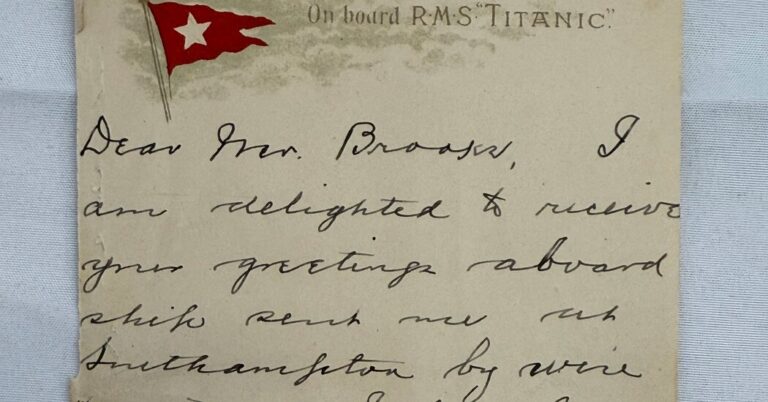
Days before the Titanic struck an iceberg, a first-class passenger, Col. Archibald Gracie, described the vessel in a letter written while on board: “It is a fine ship but I shall await my journey’s end before I pass judgment on her.”

Colonel Gracie’s journey on the Titanic had a catastrophic end, but he fared better than most.

He was on the top deck of the ship, gripping a railing, as it plunged into the sea. He said he was “swirled” under water before he got to a raft, where he spent hours floating on icy waters before being rescued.

The letter he wrote was sold on Saturday at an auction for $399,000 (or 300,000 pounds), according to Henry Aldridge and Son, an auction house in Wiltshire, England.

The auction house said the letter, written in neat, cursive handwriting, was addressed to an unidentified European ambassador, the great-uncle of the seller. The letterhead shows a triangular red flag with a white star and is printed with the words “On board R.M.S. Titanic.”

The letter was dated April 10, 1912, the day the ship set sail from Southampton, England. On April 12, it was postmarked in London, where it was received at the Waldorf Hotel. The Titanic struck an iceberg just before midnight on April 14 and sank the next day.

The buyer of the letter was based in the United States, according to Andrew Aldridge, the managing director of Henry Aldridge and Son. The auction house did not publicly identify the buyer or the seller.

Mr. Aldridge said in an email that the stories of the ship’s passengers “are told through the memorabilia” and that “their memories are kept alive through those items.”

The auction house had initially expected the letter to sell for up to 60,000 pounds, or nearly $80,000.

Colonel Gracie, a graduate of the United States Military Academy at West Point, was a high-profile survivor of the Titanic disaster, in which about 1,500 people perished.

He died eight months later, in December 1912, of complications from diseases, but his doctors and his family said that the real cause was that he had never recovered from the shock of the Titanic disaster, according to The New York Times.

After Colonel Gracie was rescued, he began work on “The Truth About the Titanic,” a book about his experience that was published posthumously. The New York Times review of the book said “there is something effective in the very lack of directness and coherency in the narrative.”

Colonel Gracie said in an interview with The New York Tribune that he had been on the top deck of the ship when it was hit by a wave that sent other people overboard. He managed to stay on and grabbed a brass railing.

“When the ship plunged down, I was forced to let go, and I was swirled around and around for what seemed an interminable time,” he said. “Eventually I came to the surface to find the sea a mass of tangled wreckage.”

He said he grabbed a wooden grating and then saw a canvas-and-cork raft. He made it onto the raft and began trying to rescue others. They eventually reached a rescue ship, R.M.S. Carpathia.

“The hours that elapsed before we were picked up by the Carpathia were the longest and most terrible that I ever spent,” Colonel Gracie said, according to The Tribune. “Practically without any sensation of feeling because of the icy water, we were almost dropping from fatigue.”

Colonel Gracie was an established figure in New York and Washington society.

His father had been an officer in the Confederate Army during the Civil War. Colonel Gracie was also a descendant of Archibald Gracie, who built the New York City mayor’s official residence, Gracie Mansion, in 1799.

After news of the Titanic’s sinking reached the United States, and it was not known whether Colonel Gracie had survived, his wife, Constance Schack Gracie, was reported missing for unrelated reasons.

Mrs. Gracie had not been on the ship, but had left town to avoid being subpoenaed in the lunacy trial of another society woman, Mary E. Gage, according to The New York Times.

In the days after the Titanic disaster, the Gracies’ daughter, Edith Gracie, was asked about the whereabouts of her mother, which she said she did not know, and about the fate of her father, The Times reported.

She said Colonel Gracie had been in Europe recuperating from an operation and had said in a letter that he would return home with a much stronger constitution.

“It is too terrible to think of,” she said, “but I am hoping against hope that he has come through the perils of the accident without harm.”


Source link

Five goals, one title | Liverpool THRASH Spurs to win the league

0


Highlights from the Premier League match between Liverpool and Tottenham Hotspur.


Source link