Home Blog Page 355

Alexis Herman, First Black Secretary of Labor, Dies at 77

0


Alexis Herman, a Democratic Party insider who grew up under segregation in Alabama and went on to become the first Black secretary of labor, a position in which she helped settle a crippling strike by United Parcel Service workers, died on Friday in Washington. She was 77.

Her death, after a brief illness, was announced by her family. The announcement did not say where in Washington she died.

President Bill Clinton was familiar with Ms. Herman when he nominated her as labor secretary in his second term. She had been the chief executive of the 1992 Democratic National Convention; deputy director of Mr. Clinton’s transition team after he won the 1992 presidential election; and the White House’s public liaison director during his first term.

When he nominated her for labor secretary, President Clinton referred to her work at the Office of Public Liaison, a grass-roots organizer of support for administration policies. “She has been my eyes and ears,” he said, “working to connect the American people, business and labor, individuals and communities with their government.”

Ms. Herman was only three months into running the Labor Department when 185,000 unionized U.P.S. workers went on strike in early August 1997, hobbling package deliveries nationwide.

Ms. Herman spent five days going room to room at a Washington hotel to persuade leaders of the U.P.S. and the teamsters’ union to focus on the issues.

“I wasn’t trying to be subtle,” she told the “Today” show after the 15-day strike ended. “I was trying to be very direct. I moved in with them.”

Joseph McCartin, a labor historian at Georgetown University, said that Ms. Herman’s role in settling the strike helped ameliorate tensions between the Clinton administration and the labor movement over issues like the impact of the North American Free Trade Agreement.

Ms. Herman also played a role in efforts to curtail sweatshops by creating a code of conduct and a monitoring system for American companies that make apparel overseas. She supported two increases in the minimum wage and helped gain passage of the Workforce Investment Act of 1998, an overhaul of job training programs.

During her tenure, unemployment dropped to a 30-year low.

Robert Reich, Ms. Herman’s predecessor as labor secretary, said in a statement, “I saw Alexis champion efforts to increase diversity in government and the workplace, and encourage young people to get involved in politics.”

Alexis Margaret Herman was born on July 16, 1947, in Mobile, Ala. Her mother, Gloria Broadus Caponis, was a schoolteacher. Her father, Alex Herman, owned an insurance company. He also owned the Chattanooga White Sox, a Negro minor league team, and signed the future Hall of Fame pitcher Satchel Paige to his first professional contract.

Mr. Herman was also a civil rights activist, a Democratic politician and a ward leader in Mobile.

After Ms. Herman and her father visited a minister on Christmas Eve when she was 5, their car was driven off a dirt road by one driven by members of the Ku Klux Klan. She recalled that her father handed her the small silver pistol that he brought for protection as he traveled to community meetings.

“He told me, ‘If anybody opens this door, I want you to pull this trigger,’” she told The Chicago Tribune in 1997.

He locked the door behind him and confronted the Klansmen, who beat him.

A year or so later, Ms. Herman was walking to her home with her mother, who was so tired that she decided that they would take a bus the rest of the way. When they boarded, her mother collapsed from exhaustion in the front seat. The bus driver told her to move to the back of the bus.

But she could not — or would not — and the driver wrested her from the seat, opened the door and pushed her onto the street.

“With tears in her eyes, torn stockings, and struggling to get off her knees, she held her head high and said to me, ‘Come on, Alexis, we’ll just keep walking,’” Ms. Herman wrote in an essay included in “My Mother’s Daughter” (2024), an anthology edited by Paulette Norvel Lewis.

Ms. Herman was educated in parochial schools to avoid having to attend segregated ones.

After graduating from Xavier College of Louisiana in 1969 with a bachelor’s degree in sociology, Ms. Herman was hired as a social worker at Catholic Charities in Mobile. In that job, she persuaded the city shipyard in nearby Pascagoula, Miss., to give apprenticeships to young Black laborers.

She moved to Atlanta to direct a program for the Southern Regional Council that lobbied corporations to hire Black women for white-collar jobs.

The program drew the attention of the new Carter administration; in 1977, she was named director of the Labor Department’s Women’s Bureau, which represents the needs of working women.

After President Jimmy Carter lost his bid for re-election in 1980, Ms. Herman formed a consulting firm with Ernest Green — one of the nine Black students who desegregated Little Rock High School in 1957 — that advised businesses on marketing and minority hiring issues. She soon began meeting influential Black political figures, including Andrew Young, the civil rights leader and former mayor of Atlanta; the Rev. Jesse Jackson, whose 1984 and 1988 presidential campaigns she joined; and Ronald H. Brown, who in 1989 became chairman of the Democratic National Committee. Ms. Herman became his deputy.

When Ms. Herman was nominated for labor secretary, her confirmation was held up for months, partly by a Senate investigation into whether she had used the Office of Public Liaison to help influential Democratic donors obtain access to President Clinton to plead for special interests. Some Republicans also brought up past claims that she had guided federal contracts and grants to cronies near the end of President Carter’s term.

She was cleared and confirmed by the Senate, 85 to 13.

In 2000, after a nearly two-year investigation, an independent prosecutor cleared her of accusations by a former business partner that she had accepted kickbacks in the awarding of federal contracts when she was running the Office of Public Liaison.

President Clinton insisted in a statement at the time that Ms. Herman had done nothing wrong and that he was “proud to call her my friend.”

Her marriage to Charles Franklin ended with his death in 2014. She is survived by her stepchildren, Charles Franklin Jr., Michele Franklin and Sherry Smith, and a cousin, Bernard Broadus.

After serving in the Clinton administration, Ms. Herman formed a consulting company, New Ventures, and served on the boards of Coca-Cola, Entergy and other companies. She was also a co-chair of the Bush-Clinton Katrina Fund in 2006 after Hurricane Katrina, and she joined the board of the Clinton-Bush Haiti Fund after the 2010 earthquake in Haiti.

She was president of the Dorothy I. Height Education Fund, named for the civil and women’s rights activist who was her mentor.

In a statement, Marc Morial, the president of the National Urban League, praised Ms. Herman, who was the senior vice chair of the organization’s board. Her “commitment to empowering underserved individuals and marginalized communities,” he said, “was fierce, genuine and unwavering.”




Source link

Inside The Mad Dash to Turn Division I Athletes Into Influencers

0


On a February afternoon at the University of North Carolina, a group of seven students on the diving team sat barefoot on the floor of the college’s muggy natatorium. They were staring expectantly at a petite blond woman in a black sweater perched on a concrete block.

Vickie Segar was there, with the blessing of the university’s athletic department, to pitch them on turning their TikTok and Instagram accounts into cash cows.

“Let’s talk about the money in the creator economy,” said Ms. Segar, after explaining that she was a graduate of the university who had run a top influencer marketing agency for a dozen years. “Does anybody follow Alix Earle?”

The students said yes, amid several chuckles, because asking a college student that question in 2025 is like asking if a millennial has ever heard of Beyoncé.

How much money, she continued, did they think that Ms. Earle, a TikTok megastar who rose to fame with confessional-style videos about beauty and college life, makes for promoting a brand across several posts on Instagram Stories? “$100,000?” one student guessed. “$70,000,” another tossed out.

Ms. Segar, whose firm has worked with Ms. Earle on brand deals, paused. She drew out her response: “$450,000 per Instagram Story.”

For a moment, there was just the hum of the pool and a single exclamation from one student: “Oh. My. God.”

Ms. Segar smiled and explained, “Our job is to help you guys bring in some of that money.”

U.N.C. doesn’t have a formal contract with Ms. Segar or her firm, Article 41. But the school has encouraged students and coaches to work with them. Later this year, the firm’s pitch will also be a part of orientation for freshman athletes at the school.

Welcome to the budding business of turning college athletes into social media stars. The world of intercollegiate sports has been upended in recent years by the National Collegiate Athletic Association’s rules that allow student-athletes to make money from their name, image and likeness — known as N.I.L. For the most part, it was viewed as a change that would reward stars in college basketball and football.

Now, Chapel Hill is at the forefront of the next stage of the N.I.L. era. The school is supporting Ms. Segar in her effort, which began last fall, to turn all 850 of its student-athletes into influencers.

The school doesn’t get a cut of their earnings. But “they want every athlete at the school to make as much money as possible because it will get better athletes,” Ms. Segar said.

This hoped-for, large-scale conversion of college athletes to influencers shows how N.I.L. deals “have grown exponentially in ways that nobody could have imagined or predicted,” said Michael H. LeRoy, a law professor at the University of Illinois. “This is another milestone in how this is evolving.”

And while many students are eager to make some extra cash, the efforts are alarming to some. “This saddens me,” Mr. LeRoy said. “Their bodies are being monetized on TikTok for the benefit of the school.”

The new N.I.L. rules have already minted a few unexpected stars in the last few years. There’s Olivia Dunne, the 22-year-old Louisiana State gymnast, who can now command hundreds of thousands of dollars for an advertorial TikTok post. And Haley and Hanna Cavinder, 24-year-old twins, who made N.I.L. deals valued at more than $1.5 million, according to Forbes, while playing basketball at the University of Miami.

Ms. Segar, 42, who graduated from North Carolina in 2005 and lives in Chapel Hill, believes those players are just the start. Uber, Athleta and State Farm are among companies that have already paid for posts that feature student-athletes showing off their game-day looks or routines. Only a few students will hit big numbers, but Ms. Segar reasons that many could eventually make at least a few thousand dollars per branded TikTok or Instagram post.

Article 41, which Ms. Segar founded in 2024 with her husband, Ben Gildin, a lawyer and former lacrosse player at Kenyon College, will take a 20 percent cut of the deals, which is typical among influencer management firms.

Other companies, including traditional Hollywood agencies and boutique firms, have been pouncing on N.I.L. influencer opportunities, too. Those efforts have largely been focused on top talent in basketball and football who might one day play professionally. Creative Artists Agency, one of Hollywood’s powerhouse firms, says it has worked with nearly 100 athletes on N.I.L. deals since 2021.

ESM, a sports management firm that historically worked with N.F.L. players, now represents a roster of current and former student-athletes, including the Cavinder twins, and is helping Clemson start an in-house agency.

But Ms. Segar’s firm is unique, so far, in its belief that every athlete — benchwarmer or not — can have a following.

Bubba Cunningham, the U.N.C. athletic director, works out of an office next door to the Dean E. Smith Center, where its famed men’s basketball team plays. From there, he oversees 28 varsity teams, many of them elite, like women’s soccer and field hockey.

Mr. Cunningham, whose given name is Lawrence, has been the college’s athletic director for more than a decade, which means he has watched the full-scale erosion of the long-held bargain between athletes and their universities: a free education in exchange for their on-field prowess. That meant, officially at least, no advertisements, gifts or cuts of merchandise sold by schools, even jerseys with their name on the back.

That model has all but imploded in recent years amid a series of antitrust cases. Based on the preliminary terms of a landmark settlement, schools like U.N.C. will offer student-athletes two potential forms of compensation beyond scholarships in the 2025-26 school year. The school is likely to have $20.5 million — calculated by taking 22 percent of the most recent annual revenue from four major college sports divisions generated from media and sponsorship rights and ticket sales — to pay athletes directly, through a revenue-sharing agreement. The settlement would resolve several antitrust lawsuits filed against the N.C.A.A. and the biggest conferences by former college athletes.

At U.N.C., that $20.5 million will go to men’s and women’s basketball, football and baseball, according to Mr. Cunningham. Many other schools are doing similar splits.

“Since this is about the commercial value of the sport, we’re going to attribute the money to the sport that earned it,” he said.

Making an arrangement with a firm like Ms. Segar’s offers him a solution for everyone else — especially female athletes.

“The most popular player on the most popular team is what I’ve always said will get the lion’s share of the money,” Mr. Cunningham said. “But the most entrepreneurial student that understands social media and understands how to create a social media presence can become an influencer.”

Bella Miller, a 22-year-old gymnast at U.N.C. with more than 27,000 followers on TikTok, said she wasn’t sure sports like hers would ever benefit from N.I.L., with so few athletes eventually competing professionally. Despite the success of someone like Ms. Dunne, most brands and agents “don’t want to focus their time and energy on sports like gymnastics, volleyball, swimming because they didn’t really see that potential,” she added.

Article 41’s pitch about becoming an influencer — complete with a 50-page training guide with tips like “no, you don’t have to dance” and “treat each TikTok as a bite-sized lesson” — is aimed at members of a cohort who have, in some cases, been using social media since before they were teenagers.

For many, the notion of becoming a creator is appealing. In a 2023 Morning Consult survey, three in five members of Generation Z said they would become influencers if given the opportunity. (And many of them might have the opportunity. There are 27 million paid creators in the United States, and 44 percent of them are doing it full time, according to a 2023 survey from the Keller Advisory Group, a consultancy.)

Alyssa Ustby, 23, a star player on the women’s basketball team, who is bespectacled and earnest off the court, is among the highest-paid U.N.C. student-athletes when it comes to N.I.L. deals.

She said she had around 1,000 Instagram followers before college: She’d post photos of friends, or senior prom. But when she entered U.N.C. in 2020, TikTok was ubiquitous.

“I was like, ‘OK, what’s the worst that could happen — that I stay where I am?’” Ms. Ustby said. She quickly became a hit with a TikTok series that showed her training with other U.N.C. athletes, poking fun at her form as she tried to do laps with the swim team and trying to catch a ball with the women’s lacrosse team.

Now, she has 132,000 followers on TikTok and 54,000 on Instagram and commands between $10,000 and $15,000 for branded posts. Sponsors have included Papa John’s (“Where’s the best place to eat an epic stuffed crust pizza?” she asks, eating one as a study snack and in the gym in a TikTok ad) and American Eagle Outfitters.

Ms. Ustby, who majored in advertising and public relations (and just signed a free-agent contract with the W.N.B.A.’s Los Angeles Sparks), said she saw her experience building a TikTok audience as akin to an internship. She earned more than $100,000 through brand deals last year and tracked them on a spreadsheet that is also monitored by her father, a wealth manager.

Jake Dailey, a 19-year-old freshman wrestler from Scranton, Pa., with moppy hair and a big smile, said that he was probably 10 years old when he started using social media. He started posting silly jokes and wrestling videos to TikTok as a high school freshman in 2021, which his mother encouraged, even though it earned some derision from his peers.

“I would say, yeah, it’s cringe-y,” but “it’s definitely going to pay off in the long run for me,” he said. Mr. Dailey said he had scored free products and a recent paid deal with an apparel company called the Mutt Dog.

Many of Mr. Dailey’s posts depict him shirtless, pointing his phone camera at himself in the mirror or flexing. In his view, physique is part of why student-athletes play well on social media. “Young, fit, attractive people definitely come from athletics,” he said.

Mr. Dailey, who has 90,000 TikTok followers and 32,000 on Instagram, said he would be thrilled to become a full-time influencer. Otherwise, he plans to become a dentist.

Bodies are, inevitably, part of what’s on display. When Ms. Segar and Mr. Gildin spoke to U.N.C.’s divers, they urged them to highlight their physical abilities. “I put diving at the top with gymnastics” with tricks that regular people can’t do, Ms. Segar told the group, using an expletive for emphasis. (She said she intentionally peppers her talks with curse words to put the students at ease.)

Women are often the audience that brands are trying to reach on TikTok and Instagram, and they’re more likely to post as creators on the platforms, Ms. Segar said. The success of athletes like Ms. Dunne and the Cavinder twins sometimes attracts a line of criticism about how much their looks matter.

Ms. Segar admitted that athlete-influencers in the very top tier are more likely to be conventionally attractive, but pushed back on the idea that the student-athletes she is pitching need to adopt what she called Mr. Dailey’s “thirst trap strategy.”

A breakout star probably has “something really special about them — they are either a top athlete or they are really beautiful or they are incredibly funny,” she said. “But we don’t need people to get eight million followers. We need them to get to 5,000, 10,000, 20,000 followers — that is where we start seeing revenue.”

Ms. Segar acknowledged that race can play a role in determining which athletes gain bigger social media followings, outside of sports like basketball and football. But she said she believed that was changing with the younger generation. And, she added, “there is more money going to diverse creators in the N.I.L. space than there is in the traditional influencer space that I’ve worked in for over a decade.”

Mr. LeRoy, the Illinois law professor, said he was concerned about the mental health ramifications as more athletes pushed to have big presences on social media.

Ms. Ustby, the basketball player, said a friend on the team who started building up her TikTok presence at the same time as her didn’t enjoy the same success.

“She was constantly putting in all this effort, making videos, and they would just never go viral,” she said. “She said it literally just felt like a popularity contest she was losing, and it sucks, and that was a really strenuous thing on our friendship because my stuff was kind of taking off.”

Mr. LeRoy said that it was worth remembering that “these are undergrads, many of whom are teenagers.”

“If part of your N.I.L. strategy as a school is to increase your student-athlete exposure to the social media ecosystem that is filled with irrationality and hate, you’re not helping the mental health of the athletes,” Mr. LeRoy said. “This is not a good atmosphere for them to be competing at a high level and then also competing in the social media sphere.”

Mark Gangloff, U.N.C.’s head coach of swimming and diving, said he was keeping an eye on how influencing fit into athletes’ “very full plates.”

“That is my only caution — how much is too many things for any one person to try and take on at one time?” he said.

(Article 41 and U.N.C.’s coaches have emphasized that the effort is entirely voluntary and that many student-athletes have opted to keep their social media profiles private.)

Ms. Segar and Mr. Gildin are self-funding Article 41, which has 13 full-time employees and 24 paid interns. (She sold her influencer agency, Village Marketing, to the ad giant WPP in 2022.) The couple are prepared to invest several million dollars into the firm, which they say has helped launch social profiles for more than 70 students and coaches who have signed agreements with the firm.

Article 41 is fielding requests for similar work from other colleges like the University of Michigan. It plans to seek compensation for its services from other institutions, though it is not asking for money from U.N.C., where Ms. Segar and Mr. Gildin are donors and Ms. Segar sits on a board for its athletic booster club.

The firm is intervening when brands send free products to athletes and insisting that they are paid for posting about them. It’s also trying to sweeten existing equipment deals between brands and teams by adding promises of social media posts to their deals to help teams earn revenue.

Athleta is among the brands that have already struck paid deals with Ryleigh Heck, a field hockey player, and Ms. Miller, the gymnast, but it does not officially outfit U.N.C. athletes otherwise. Michelle Goad, Athleta’s chief digital officer, said it was testing ads with the students in part to help “build a bridge to our next generation of consumers,” and to see if the exposure could eventually exceed that of traditional college sponsorships.

Anna Frey, a 17-year-old tennis star from Farmington, Utah, will be one of the biggest athlete-influencers on campus when she starts her freshman year at U.N.C. this fall, with 2.1 million TikTok followers who watch posts of her serving tennis balls, performing dances to popular TikTok sounds and going to school dances.

Her father, Tanner Frey, said there were some serious cons to that sort of presence.

“I feel like 90 percent of people are so nice in the comments and 5 percent are mean and 5 percent are perverts,” he said in an interview.

Mr. Frey said he had made a block list of “about probably 30 words” that Instagram and TikTok could use to censor offensive comments on his daughter’s posts. He said the “meanest, nastiest” comments came from gamblers who would berate his daughter in the comments if she lost a match.

Still, he said it was “the best time ever in the history of the world to be a female athlete,” in part because of the opportunities tied to brand deals and the new N.C.A.A. rules for payments.

“Four years ago, none of this was even possible,” he said. “If Anna wanted to go play college tennis, she’d have to make a really hard decision between that and accepting half a million dollars a year from these brands and going pro.”

He added, “It’s nice they can go and do both now.”

Audio produced by Sarah Diamond.


Source link

Iran Port Explosion’s Death Toll Rises

0


The death toll from a massive explosion at an Iranian port rose to 40 on Sunday with more than 800 people injured, according to the state media. Several people remain missing.

The blast Saturday evening at Iran’s largest and most important shipping port resulted in a major fire, which spread and caused destruction in the surrounding areas. Iran’s health ministry, citing airborne toxic pollutants, declared a state of emergency in the province and instructed people to stay indoors.

The port, Shahid Rajaee, is strategically located in Bandar Abbas, in southern Iran, along the Strait of Hormuz.

Officials declared three days of public mourning in the province.

By Sunday morning most of the fire had been contained and firefighters were battling to extinguish the remaining 20 percent, according to the state-run Islamic Republic News Agency.

Last year the Shahid Rajaee port handled 85 percent of Iran’s shipping container traffic, as well as a large portion of its oil, according to the Port and Maritime Organization.

An Iranian official told state media on Saturday that the explosion was likely set off by containers of chemicals and the authorities have not suggested that the blast was caused by sabotage or a deliberate attack.

Five years ago, Israel launched a cyberattack that hampered operations at the Shahid Rajaee port as part of its long-running shadow war with Iran. Israeli officials did not respond to a request for comment on Saturday’s explosion.

Masoud Pezeshkian, the Iranian president, said the country’s interior minister was heading to the region to oversee an investigation into the cause of the explosion.

Mr. Pezeshkian also instructed the minister to speed up the reconstruction and reopening of the port.

State media reported that the country’s first vice president, Mohammad Reza Aref, has stressed the need to bolster safety protocols across all ports and industrial facilities in the area to prevent similar accidents in the future.


Source link

Chelsea Women 1 – 4 Barcelona Women

0


Chelsea’s Women’s Champions League bid was shattered by a brilliant Barcelona, who won 4-1 in the second leg to advance to the Champions League final via an 8-2 aggregate win.

Trailing 4-1 from the game in Spain, Sonia Bompastor’s Blues needed a miracle of epic proportions to reach the Lisbon final – but found themselves a further 3-0 down at half-time against unarguably the best team in the world.

Chelsea did start strongly and could have reduced the deficit but Sandy Baltimore and Sjoeke Nusken missed two big chances in quick succession – but Barcelona stunned Stamford Bridge with three brilliant goals.

First, Aitana Bonmati scored a stunning solo goal, bursting past Niamh Charles down the Barcelona right and finishing high past Hannah Hampton. The second goal came down the same wing, as great work from Caroline Graham Hansen saw her cross for Ewa Pajor, who couldn’t miss from a few yards out.

Just as Chelsea were catching their breath, Barcelona struck once again with the best goal of the lot. Claudia Pina, who scored twice in the first leg, got another in superb fashion by finding the top corner from the edge of the box.

Chelsea's tough task looked considerably more daunting after Aitana Bonmati's opener
Image:
Chelsea’s tough task was over after three first half goals

Hampton was stranded, Chelsea bewildered. The Women’s Super League’s shining light was given a footballing lesson by Barcelona – and it continued after half-time. It should have been an even bigger triumph.

Fridolina Rolfo blazed a good chance over, while Hampton made stunning saves to deny Pajor and Salma Parulello on two occasions, while Lucy Bronze denied another Barcelona chance with a last-ditch clearance off the line.

Chelsea had chances to make the scoreline somewhat respectable but Barcelona’s defence would not let up even at 7-1 up. Catarina Macario flashed a good chance wide inside the box, while Catalan goalkeeper Cata Coll denied Johanna Rytting Kaneryd and Lucy Bronze with superb close-range saves.

Instead, Parulello would get her reward as an awful mix-up between Hampton and Niamh Charles allowed her to poke home. Wieke Kaptein pulled one back but it would then be followed by as boos from the home crowd at full-time.

It was the joint-second worst defeat of Bompastor’s career – only in the 5-1 home loss to Arsenal as Lyon manager in October 2022 has been worse. For the Chelsea boss, she is still odds-on to claim a domestic double this term – but the gap to Europe’s best is vast.

More to follow.

Chelsea’s sorrow in photos

Chelsea could not keep Barcelona off the scoresheet
Image:
Chelsea could not keep Barcelona off the scoresheet

Chelsea's Erin Cuthbert and Keira Walsh, the latter formerly of Barcelona, could not believe their eyes
Image:
Chelsea’s Erin Cuthbert and Keira Walsh, the latter formerly of Barcelona, could not believe their eyes

Chelsea coach Sonia Bompastor suffered a heavy defeat
Image:
Chelsea coach Sonia Bompastor suffered a heavy defeat

Chelsea's Mayra Ramirez looks bewildered - the Blues forward was taken off at half-time
Image:
Chelsea’s Mayra Ramirez looks bewildered – the Blues forward was taken off at half-time

Barcelona coach Pere Romeu celebrates with his staff after a brutal first half
Image:
Barcelona coach Pere Romeu celebrates with his staff after a brutal first half

What’s up next in WSL?


Source link

Tesla and Volkswagen May Have a Leg Up As Tariffs Raise EV Prices

0


President Trump’s tariffs on imported cars and auto parts could stall the growth of electric vehicles, setting back a technology critical to addressing climate change.

But the tariffs could also work in favor of some electric models made in the United States, like the Tesla Model Y or Volkswagen ID.4, that are among the cars with the fewest imported parts and, thus, the least vulnerable to tariffs.

The tariffs could lead to steep increases in the cost of batteries and other components. By hurting electric vehicle manufacturing in the United States, the tariffs could also cede more ground to Chinese automakers that have a substantial lead.

One thing is clear: The tariffs will raise prices for all vehicles — gasoline, electric or hybrid — and could lead to severe parts shortages if some suppliers go out of business. There will be ripple effects that no one can predict. But vehicles that are subjected to lower tariffs could gain a competitive advantage.

Electric vehicles have far fewer parts than cars that run on gasoline or diesel. In theory, it should be easier for carmakers to source parts from the United States, avoiding tariffs.

Efforts to create a domestic supply chain for electric vehicles are well underway, in part because of Biden administration policies that provided loans and subsidies to battery factories and other projects.

LG Energy Solution, a South Korean battery maker, runs three battery factories in the United States that supply General Motors and other customers. Three more LG plants will begin producing batteries next year, and a seventh is planned.

“The capacity is there, and now we’re just managing the ramp-up to meet the market size,” Robert Lee, the president for North America at LG Energy Solution, said in a recent interview.

The problem is that many battery raw materials come from China and may face stiff tariffs. For example, China dominates the supply of refined graphite, an essential ingredient in most electric vehicle batteries.

American companies are working on producing battery-grade graphite, lithium and other key materials. But it will be several years before these operations can replace Chinese suppliers.

All the cars that Tesla sells in the United States are made in California or Texas. Last year, Tesla’s Model Y sport utility vehicle topped Cars.com’s annual American-made index, which uses data that automakers submit to the federal government and other sources to rank vehicles according to how much of their content and labor originates in the United States.

Tesla uses some parts from Mexico and China that will be subject to tariffs, but less so than other automakers. That gives the Model Y, Tesla’s most popular vehicle, a cost advantage that could narrow the price gap with conventional cars. On average, sale prices for electric vehicles are $12,000 more than comparable vehicles with internal combustion engines, according to Cox Automotive.

“We do have localized supply chains in both America, Europe and China,” Elon Musk, the chief executive of Tesla, said last week on a conference call with analysts and investors. “So that puts us in a stronger position than our competitors.”

Another vehicle relatively insulated from tariffs is the Volkswagen ID.4, an electric sport utility vehicle made in Tennessee with a battery from Georgia.

“That’s not a bad thought,” Kjell Gruner, the president of Volkswagen Group of America, said last week when a reporter asked whether the ID.4 might gain a competitive advantage.

But he added that figuring out the ultimate impact of tariffs was extremely difficult because many variables were at play and because Mr. Trump’s trade policies changed frequently. Mr. Gruner said he started each day with a meeting with other executives to discuss the latest developments.

“You need to look at your entire value chain, from logistics to manufacturing, procurement, sales and marketing,” Mr. Gruner said. “You need to get into the weeds.”

Mr. Musk has warned that tariffs will also be bad for Tesla and said he had failed to talk the president out of them.

Except for Tesla, most carmakers don’t make much or any money on electric vehicles. Carmakers may decide to curtail production of those cars and focus on gasoline pickups and sport utility vehicles that usually are very profitable.

The risk is that, by delaying rollouts of electric vehicles, U.S. carmakers will lose their ability to compete with Chinese, South Korean and European carmakers that are expanding their electric lineups. There is near unanimity in the industry that sooner or later electric vehicles will become more popular than cars with internal combustion engines.

“It’s hard to figure out how you net out the massive costs potentially associated with tariffs with the need to continue to invest in the future,” said John Bozzella, president of the Alliance for Automotive Innovation, an industry association.

Electric vehicles usually have more semiconductors than cars with internal combustion engines and would be hit harder by tariffs on chips that Mr. Trump has signaled may be coming.

Some tariffs may also apply to charging equipment, which could slow the recent rapid growth of stations where people can plug in vehicles. Fear of not being able to find a charger has kept many people from buying electric vehicles.

The motors in most electric vehicles use magnets that contain rare earth minerals, which will be in short supply because of restrictions that China recently imposed in retaliation to U.S. tariffs.

The rare earths crunch will probably come in the second half of the year, said Neha Mukherjee, lead rare earths analyst at Benchmark Mineral Intelligence.

“There are stockpiles already in the market which can suffice for now,” Ms. Mukherjee said. If the restrictions continue, she said, “we’ll see prices ticking higher.”


Source link

Trump’s Tariffs Squeeze an Already Struggling British Car Industry

0


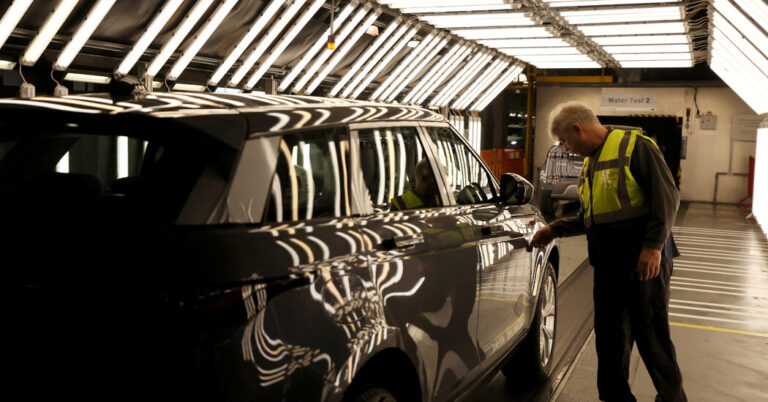
The 25 percent tariffs imposed by President Trump on imported cars have added to the pressures on vehicle manufacturers around the world, but the pain could be particularly acute in Britain’s venerable but flagging auto industry.

Britain exports more than 70 percent of the cars that it makes. In 2024, it sent about 101,000 of those vehicles — about 17 percent of car exports, worth 7.6 billion pounds (about $10.1 billion) — to the United States, according to the Society of Motor Manufacturers and Traders, an industry group. Tariffs now threaten to close what had been one of Britain’s largest markets.

Over the decades, Britain has built a reputation for producing innovative and iconic vehicles like the Land Rover Defender and the Morris Minor, which helped make car ownership affordable as the country emerged from World War II.

In recent years, though, the auto industry has struggled to keep pace as it navigates obstacles including the global shift to electric vehicles and Britain’s exit from its main export market, the European Union.

The annual number of cars made in Britain has fallen nearly 50 percent since the end of the last decade to about 770,000. It now imports far more cars than it makes.

Given the Trump administration’s rapid policy swings, it is impossible for auto industry executives to know what level of tariffs will stick. But Washington’s moves are already bad news for some of Britain’s carmakers, which view the United States as a crucial growth market.

“This is about a very unsettling move for U.K. manufacturing,” said Peter Wells, a car expert at Cardiff University in Wales.

Mr. Wells said companies would most likely be forced to alter their plans, like production runs and shipping. “So already it’s costing money to try and deal with the volatility,” he said.

JLR, the maker of Jaguar and Land Rover vehicles, said it would suspend shipments to the United States for April. The company, which is owned by India’s Tata Motors, is one of the largest vehicle manufacturers in Britain, but 28 percent of its sales over the last year were in North America, where it does not make cars.

Any long-term changes in the United States are likely to have large implications for Britain’s automakers. The United States last year shipped only 18,000 vehicles to Britain, which imposes a 10 percent tariff on U.S. imports.

Some European models from American automakers do well in Britain. The Ford Puma, which is made in Romania in a joint venture, has recently been the top-selling model in Britain.

British car manufacturing is now dominated by a small group of international companies including Nissan, which operates a large plant at Sunderland; BMW, which makes the Mini; and Toyota.

To keep attracting investment, especially in new electric models, these plants need to be able to compete with rivals around the planet. Executives and analysts say the industry faces a raft of challenges, including high energy costs and stress on the network of suppliers of parts and services after Brexit.

“Ultimately, the U.K. is not a competitive place to be building cars today,” Alan Johnson, Nissan’s senior vice president for manufacturing in the region, told a parliamentary hearing last week.

Stuart Bradley, principal engineer at Warwick Manufacturing Group, a part of the University of Warwick, said he thought that high-priced brands from carmakers like JLR or Rolls-Royce Motor Cars might have a brighter future in Britain than what he called “commodity” producers.

“I think the high-value market is going to carry on to be quite strong,” he said.

The unions that represent the estimated 200,000 workers in auto manufacturing in Britain worry that the tariffs are just the latest in a series of blows that could lead to job losses or even plant closings.

Some manufacturers have closed British plants in recent years. In 2021, for instance, Honda shut down a plant at Swindon that employed 3,500 people.

Unite, a trade union that represents around 70,000 autoworkers, estimates that the British car industry is operating at just over half capacity, probably sapping the profitability that comes from spreading costs over large volumes.

“It’s not sustainable,” said Des Quinn, Unite’s national officer for automotive. “The whole sector is in crisis.”

Much depends on the difficult transition to electric vehicles. The industry says it is being squeezed by the British government’s requirement to phase out sales of the bulk of gasoline- and diesel-powered cars by 2030.

Britain had made rapid advances in increasing its electric car fleet. Britain led Europe, for instance, in sales of electric cars in 2024, according to the British government.

Critics, though, say strict government-imposed quotas for electric vehicle sales have encouraged imports of electric vehicles like Teslas, which are made in Germany or China, at the expense of the domestic industry. Chinese automakers like BYD are also making inroads.

The question is whether the British-based makers can catch up in the coming years — especially in the production of smaller, cheaper electric cars for ordinary consumers.

“I’m not entirely confident that all of the industry will come through unscathed,” Mr. Wells said.


Source link

The Missteps That Led to a Fatal Plane Crash at Reagan National Airport

0


As they flew south along the Potomac River on the gusty night of Jan. 29, the crew aboard an Army Black Hawk helicopter attempted to execute a common aviation practice. It would play a role in ending their lives.

Shortly after the Black Hawk passed over Washington’s most famous array of cherry trees, an air traffic controller at nearby Ronald Reagan National Airport alerted the crew to a regional passenger jet in its vicinity. The crew acknowledged seeing traffic nearby.

One of the pilots then asked for permission to employ a practice called “visual separation.” That allows a pilot to take control of navigating around other aircraft, rather than relying on the controller for guidance.

“Visual separation approved,” the controller replied.

The request to fly under those rules is granted routinely in airspace overseen by controllers. Most of the time, visual separation is executed without note. But when mishandled, it can also create a deadly risk — one that aviation experts have warned about for years.

On Jan. 29, the Black Hawk crew did not execute visual separation effectively. The pilots either did not detect the specific passenger jet the controller had flagged, or could not pivot to a safer position. Instead, one second before 8:48 p.m., the helicopter slammed into American Airlines Flight 5342, which was carrying 64 people to Washington from Wichita, Kan., killing everyone aboard both aircraft in a fiery explosion that lit the night sky over the river.

One error did not cause the worst domestic crash in the United States in nearly a quarter-century. Modern aviation is designed to have redundancies and safeguards that prevent a misstep, or even several missteps, from being catastrophic. On Jan. 29, that system collapsed.

“Multiple layers of safety precautions failed that night,” said Katie Thomson, the Federal Aviation Administration’s deputy administrator under President Joseph R. Biden Jr.

The New York Times examined public records and interviewed more than 50 aviation experts and officials, including some with extensive knowledge of the events, to piece together the most complete understanding yet of factors that contributed to the crash.

Up to now attention has focused on the Black Hawk’s altitude, which was too high and placed the helicopter directly in the jet’s landing path at National Airport. But The Times found new details that show that the failures were far more complex than previously known.

The helicopter crew appeared to have made more than one mistake. Not only was the Black Hawk flying too high, but in the final seconds before the crash, its pilot failed to heed a directive from her co-pilot, an Army flight instructor, to change course.

Radio communications, the tried-and-true means of interaction between controllers and pilots, also broke down. Some of the controller’s instructions were “stepped on” — meaning that they cut out when the helicopter crew pressed a microphone to speak — and important information likely went unheard.

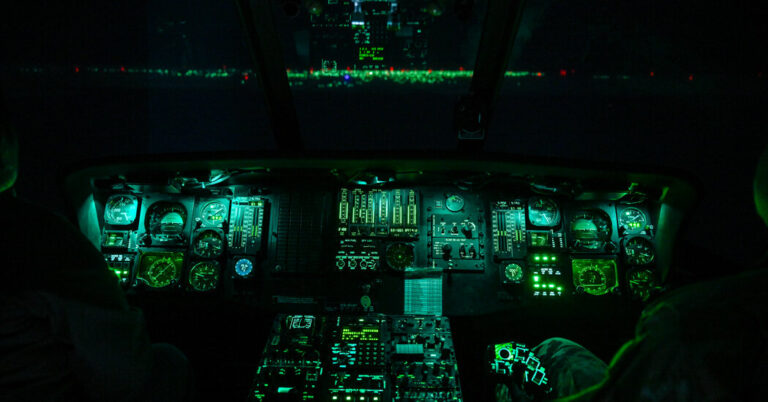
Technology on the Black Hawk that would have allowed controllers to better track the helicopter was turned off. Doing so was Army protocol, meant to allow the pilots to practice secretly whisking away a senior government official in an emergency. But at least some experts believe that turning off the system deprived everyone involved of another safeguard.

The controller also could have done more.

Though he had delegated the prime responsibility for evading other air traffic to the Black Hawk crew under visual separation, he continued to monitor the helicopter, as his job required. Yet he did not issue clear, urgent instructions to the Black Hawk to avert the crash, aviation experts say.

These lapses happened against the backdrop of systemic deficiencies in U.S. aviation. The F.A.A. has struggled for years with low staffing among controllers, and the National Airport tower has been no exception. At the time of the crash, for reasons that remain murky, a single controller was working both helicopter traffic and commercial runway traffic — jobs that would typically be done by two controllers.

The F.A.A. said in a statement that it could not discuss “any aspect” of a continuing investigation led by the National Transportation Safety Board.

Brig. Gen. Matthew Braman, the Army’s director of aviation, said, “I think what we’ll find in the end is there were multiple things that, had any one of them changed, it could have well changed the outcome of that evening.” He, too, deferred detailed questions about the investigation to the N.T.S.B., adding that the Army was conducting its own reviews of the accident.

Investigators from the N.T.S.B. will issue their final report on the causes of the crash by early 2026.

In the meantime, data recently analyzed by the board revealed that National Airport was the site of at least one near collision between an airplane and a helicopter each month from 2011 to 2024. Two-thirds of the incidents occurred at night, and more than half may have involved helicopters flying above their maximum designated altitude.

Given those findings, the F.A.A. recently banned most helicopter flights along a portion of the route the Black Hawk used.

And, critically, the F.A.A. has also vastly limited the use of visual separation.

The maneuver is primarily used by pilots flying helicopters and smaller aircraft, and is used less frequently for commercial jets. When using visual separation, pilots take responsibility for noticing and steering clear of neighboring air traffic if certain conditions, like good visibility, are met. It has long been viewed in the industry as essential to keeping traffic moving.

But the occasional difficulty for pilots to see and avoid nearby air traffic has also been implicated in at least 40 fatal collisions since 2010, according to the N.T.S.B. It has led to stern safety warnings to pilots from both the F.A.A. and the N.T.S.B.

Human error, blind spots not evident from a cockpit and environmental conditions “leave even the most diligent pilot vulnerable to the threat of a midair collision with an unseen aircraft” under this maneuver, the N.T.S.B. wrote in a safety bulletin published in 2016.

The practice of allowing pilots to navigate around traffic on their own “has long been seen as a flawed concept but a necessary one,” said Jeff Guzzetti, a former accident investigator for both the F.A.A. and the N.T.S.B. “But it has been linked to a number of deadly midair incidents throughout the years.”

At 6:39 p.m. Eastern Standard Time, a CRJ700 regional jet departed Wichita under cool, dry conditions with 60 passengers, two pilots and two flight attendants on board. It was operated by American Airlines’s subsidiary carrier, PSA Airlines, and the direct route to National Airport had started the previous January.

Capt. Jonathan J. Campos, a 34-year-old raised in Brooklyn who had wanted to fly since an early age, was the pilot. Sam Lilley, a 28-year-old former marketer whose father had been an Army Black Hawk pilot, was the first officer.

National Airport is one of only five airports in the United States that the F.A.A. designates as complex because of high density.

It is one of 57 airports in the United States that has a special-qualification designation from the F.A.A., according to an agency document reviewed by The Times. Nearly all of the remaining airports, such as those in Durango, Colo., or Missoula, Mont., are included because of hazardous mountainous terrain that pilots must navigate during takeoffs and landings, or because they are smaller airports without radar or a control tower.

“You have to have an aggressive defensive posture coming into DCA,” said Dennis Tajer, a spokesman for the Allied Pilots Association who is also an American Airlines pilot, using the call sign for National Airport. “You have to take your A-game and add a plus to it.”

Six minutes after Flight 5342 departed, the Black Hawk took off from Davison Army Airfield, at Fort Belvoir, Va., about 20 miles southwest of Washington.

The crew was ordered to fly about 40 miles north of the base to a suburb near Gaithersburg, Md., where it would turn around and head back to Virginia.

The crew’s mission was to conduct an annual evaluation of Capt. Rebecca M. Lobach, who joined the Army in 2019, to ensure that her helicopter piloting skills were up to par.

That night, her assignment was to navigate the conditions of a scenario in which members of Congress or other senior government officials might need to be carried out of the nation’s capital during an attack.

Captain Lobach was the highest-ranking soldier on the helicopter, but Chief Warrant Officer 2 Andrew Loyd Eaves, who was acting as her instructor, had flown more than twice as many hours over time.

A third crew member, Staff Sgt. Ryan Austin O’Hara, whose job was to help with equipment and other technical issues, sat in the back.

Captain Lobach, who was sitting in the front left seat, was initially handling the radio communications. To her right working the controls was Warrant Officer Eaves, a former Navy petty officer who joined the Army, according to his brother Forrest Eaves, because it would train him and permit him to fly helicopters.

Investigators believe Captain Lobach and Warrant Officer Eaves were wearing night-vision goggles, which were required attire for this type of evaluation. Goggles allow exponentially enhanced visibility of nearby people and objects, which is helpful at night in complex surroundings. But urban lights can also become cripplingly bright, according to military pilots.

Despite differences in rank and the delineation of duties, all three Black Hawk crew members bore responsibility for searching the sky for other aircraft and helping to stay clear of them.

Sitting in the control hub of the National Airport tower that night, an air traffic controller watched the lighted dots on the radar scope in front of him.

His colleagues’ air-traffic instructions punctuated the ambient noise as he directed aircraft by radio. A little after 8:30 p.m., an Army helicopter, known in the tower as a “P.A.T.” for priority air transport, made contact with him.

The controller had worked for the F.A.A. for about a decade in two smaller air-traffic control centers, but had been stationed at National Airport for about two years, according to government employee filings. The controller, whom The Times is not identifying because his name has not been publicly revealed as part of the investigation, did not respond to requests for comment.

Like his colleagues in the tower, he typically worked one control duty at a time, such as directing just helicopters, or only handling airplanes on taxiways. He worked about seven hours that day, according to a government document reviewed by The Times. The F.A.A. says all controllers get required breaks.

But after a co-worker left the control hub at 3:40 p.m., some controllers began to assume combined duties. The controller who ended up directing the Black Hawk took over combined duties at roughly 7 p.m., according to the government document. An N.T.S.B. spokesman declined to confirm how long the controller operated in both roles.

Such a combination was not unusual, and was approved that evening by a tower supervisor, according to a person briefed on the staffing. But the roles were not typically combined until traffic slowed many hours later, around 9:30 p.m.

Though the reasons why the supervisor combined the duties so early are still not clear, the F.A.A. would later say in an internal report that staffing was “not normal” that evening.

By the time both the Army Black Hawk and Flight 5342 were in radio contact with the controller — starting about 8:43 p.m. — five controllers were working different duties in the control hub of the tower.

In addition to doing two jobs at once, the controller faced another complicating factor that night: He could not watch the helicopter’s movements in real time.

Doing so would have required the use of an aviation broadcasting system called Automatic Dependent Surveillance-Broadcast Out, or ADS-B Out, which reports an aircraft’s position, altitude and speed roughly every second.

But the Black Hawk did not operate with the technology because of the confidentiality of the mission for which the crew was practicing. That is because ADS-B Out positions can be obtained by anyone with an internet connection, making the system a potential risk to national security.

As a result, the controller relied on pings from the helicopter’s transponder to show its changing location, which can take between five and 12 seconds to refresh, according to F.A.A. documents.

Aviation experts said that during that gap, the aircraft could change course or elevation, making for a concerning level of uncertainty.

In a busy airspace, that lapse, said Michael McCormick, a former vice president of the F.A.A. Air Traffic Organization, is “a very long time.”

General Braman said the fact that ADS-B Out was turned off “played no role in this accident” because the transponder meant that the Black Hawk could be seen on the radar and “was never invisible.”

Some federal lawmakers have strongly disagreed.

During a contentious Senate hearing on March 27, Chris Rocheleau, the F.A.A.’s acting administrator, announced that the technology would be required on all flights near National Airport — though with some as-yet-undefined exceptions.

Near the end of his shift, the controller handling both helicopters and commercial jets tried to pull off a complicated, and potentially risky, maneuver called a squeeze play.

This is an attempt to keep operations moving efficiently, according to veteran National Airport controllers, by tightly sequencing runway traffic with minimal time between takeoffs or landings.

In this case, the plan was to let one airplane depart from Runway 1 at about 8:47 and let another land on the same runway about a minute later.

Shortly thereafter, the controller needed to bring Flight 5342 in for a landing.

But to fit in the Wichita flight without interrupting the flow of other traffic, the controller made a request that was permissible but atypical, according to the N.T.S.B. He asked to divert its landing to one of the airport’s ancillary runways, a spot normally used by smaller aircraft because of its shorter length.

“Can you take Runway three-three?” the controller asked the pilots.

His request would require Mr. Campos and Mr. Lilley to adjust their route during the final stage of their flight, introducing a wrinkle at the end of a two-hour journey. But commercial pilots train for such maneuvers, and having just passed over Mount Vernon in Virginia, about 10 miles from National Airport, they still had time to make the shift.

After a beat, one of the pilots replied. “Yeah, we can do, uh, three-three,” he said.

The pilots began the process of rerouting the flight to the new runway, which intersected Runway 1 at an acute angle in the middle.

Runway 33 had an additional quirk: a particularly narrow vertical space between the landing slope for a jet and the maximum altitude at which helicopters using a certain route, called Route 4, could fly.

At its highest, near the Potomac’s east bank, the vertical distance between a helicopter and an aircraft en route to landing on Runway 33 would be 75 feet, N.T.S.B. investigators said. But if a helicopter were flying farther from the river’s east bank toward the airport, that distance would be even less.

That is one reason why, after the crash, the N.T.S.B. recommended banning helicopter flights on Route 4 when Runway 33 at National Airport is in use.

Jennifer Homendy, the N.T.S.B. chairwoman, said in a March 11 press briefing that those distances “are insufficient and pose an intolerable risk to aviation safety by increasing the chances of a midair collision at DCA.”

With so little margin for error — 75 feet or even less — it would be crucial that the Black Hawk fly below the maximum altitude for the route.

Aboard the Black Hawk that night a curious exchange occurred between the two pilots.

Captain Lobach, who by that point had assumed the controls, announced an altitude of 300 feet, according to cockpit voice recordings. Warrant Officer Eaves then read out an altitude of 400 feet.

The exact time that passed between the statements has not been detailed in N.T.S.B. reports, but records suggest that it was no longer than 39 seconds. And experienced helicopter pilots say that given the ease of mobility in a Black Hawk, the altitude could have changed in fractions of seconds.

But the discrepancy, which neither pilot commented on at the time, was potentially significant.

The F.A.A. mandated an altitude of no higher than 300 feet for that part of the route, meaning that an altitude of 400 feet would have been unacceptable and could have positioned the Black Hawk uncomfortably close to departing or landing airplanes.

By about 8:44 p.m., it seemed to be in a more appropriate spot.

As the helicopter approached the Key Bridge, from which it would fly south along the river, Warrant Officer Eaves stated that it was at 300 feet and descending to 200 feet — necessary because the maximum height for its route closer to the airport had dropped to 200 feet.

But even as it reached that juncture, Warrant Officer Eaves evidently felt obligated to repeat his instruction: The Black Hawk was at 300 feet, he said, and needed to descend.

Captain Lobach said she would. But two and a half minutes later, the Black Hawk still was above 200 feet — a dangerously high level.

Seconds after the Black Hawk crossed over the Tidal Basin, a shallow lake near the Washington Monument ringed by cherry trees, the controller informed the Army crew that a regional jet — Flight 5342 — was “circling” to Runway 33.

Aviation experts said that development may have blindsided Captain Lobach.

Though she had flown four or five similar practice rides there over the years, she might have never confronted a landing on Runway 33, because it is used only 4 to 5 percent of the time.

In any case, investigators now believe that the word “circling” was not heard by the Black Hawk crew because one of them was pressing the microphone key to speak when the word came through their radios. If the key is depressed, the pilot can speak but not hear incoming communications.

Around 8:46 p.m., Warrant Officer Eaves responded to whatever he did hear of the circle-landing notification, using the call sign for his own flight: “PAT two-five has traffic in sight. Request visual separation.”

The controller gave his approval.

Visual separation is at the crux of an aviation concept known as see and avoid, which works exactly as it sounds. A pilot is meant to see neighboring air traffic, often without assistance from the controller, and avoid it by either hovering in place until the traffic passes or by flying around it in prescribed ways.

See-and-avoid flying is commonplace in aviation. At many tiny airports, with no controllers, there is no alternative. In busy airspaces, such as parts of National Airport’s, the helicopter’s altitude limits are too low for controllers to easily assist it in maneuvering around obstacles such as ships or tall buildings, while also keeping it clear of air traffic.

The F.A.A. said in its statement that “pilots are responsible for keeping themselves safely separated from other aircraft.”

Nonetheless, even when a helicopter is operating under see-and-avoid rules, if the controller notices it is converging into another aircraft’s path, he or she should — under F.A.A. rules — call out the existence of the nearby traffic and ask the helicopter to affirm that it has the aircraft in sight.

At that point, the helicopter crew should acknowledge that it sees the traffic and can request visual separation — asking permission to stay clear of the nearby aircraft — which the controller can grant or refuse. Or, if the crew says that it does not see the traffic, the controller will likely direct the helicopter to a safer position.

One benefit of the see-and-avoid system is that it can lighten the controller’s workload during busy periods. But see and avoid has proved problematic, even fatal, in recent decades.

In 2019, two airplanes collided above Ketchikan, Alaska, killing six people and injuring 10 others. Three years later, two helicopters collided above San Diego, but there were no casualties. The N.T.S.B. cited failed see-and-avoid efforts in both cases.

One risk is that the pilots will miscalculate which way the other aircraft is moving; another is identifying the wrong aircraft.

John Goglia, a former N.T.S.B. board member, put it plainly: See and avoid assumes that every pilot has sharp vision and can pick out the right aircraft in the direction they have been told to look. But instructions are not always clear, he said. And tools like night-vision goggles can sometimes cloud vision more than clarify it.

Put two planes in roughly the same patch of sky, and even the most attentive pilot might track the wrong one, Mr. Goglia said.

During a recent press briefing on the crash, Sean Duffy, the transportation secretary, criticized the practice of allowing helicopters to use visual separation in confined airspaces like the one near National Airport.

“Having helicopters fly under landing aircraft, and allowing helicopter pilots to say, ‘I’ll maintain visual separation’ — that is not going to happen anymore,” he said. “That is too risky. You’re threading the needle. And it’s going to stop.”

In the 90 seconds after the air traffic controller granted visual separation to the Black Hawk, the attempted squeeze play started to unfold. At 8:46:48 p.m. the tower cleared a jet for immediate departure off Runway 1.

Then, the Black Hawk, still southbound, passed Hains Point, a park area along the east side of the Potomac, moving it closer to the airport on the opposite bank.

At the same time, Flight 5342 began a leftward turn toward Runway 33. It was flying at about 500 feet and the equivalent of around 153 miles per hour.

At 8:47:39 p.m., the controller contacted the helicopter.

“PAT two-five, do you have the CRJ in sight?” he asked, using the abbreviation for the model of Flight 5342’s aircraft.

As he spoke, a conflict alert — which controllers described as a distinctive beeping sound — was audible in the tower behind him, according to the N.T.S.B. report. A warning light, controllers said, would also have been flashing on the radar scope.

Conflict alerts are not rare. Controllers say they can go off numerous times over a long shift, to the point that they risk losing their urgency.

The controller received no response. The helicopter and Flight 5342 were by then about one mile apart.

The controller then issued an instruction to the helicopter crew: Pass behind the airplane.

Cockpit voice recordings indicate that the essence of the controller’s command — to “pass behind” — might not have been heard by the Black Hawk crew, perhaps because of a second bleep-out.

Some former military pilots said that by issuing a proactive command to pass behind the jet, the controller was going above and beyond his obligations, especially under see-and-avoid conditions, and that an experienced Black Hawk crew should have known what to do without help.

Still, some regulators and controllers said that the controller in this case could have done more.

He could have told the Black Hawk crew where Flight 5342 was positioned and which way it was bound. (The F.A.A. manual instructions direct controllers to use the hours of a clock in describing locations.) He could have provided the jet’s distance from the helicopter in nautical miles or feet.

But one thing is critical. When two aircraft are on a collision course, the controller’s top priority must be to warn both sets of pilots.

“Advise the pilots if the targets appear likely to merge,” F.A.A. regulations state.

That did not happen.

Direct, immediate intervention was needed that night. Instead of seeing and avoiding Flight 5342, Captain Lobach continued flying straight at it.

Investigators might never know why. There is no indication that she was suffering from health issues at the time or that a medical event affected her during those final moments aboard the Black Hawk, according to friends and people familiar with the crash investigation, which included autopsies and performance log reviews.

Two seconds after the controller’s cut out instruction about passing behind the jet, Warrant Officer Eaves replied, affirming for the second time that the Black Hawk saw the traffic.

“PAT two-five has the aircraft in sight. Request visual separation,” he said.

“Vis sep approved,” the controller replied.

It was their last communication.

The Black Hawk was 15 seconds away from crossing paths with the jet. Warrant Officer Eaves then turned his attention to Captain Lobach.

He told her he believed that air traffic control wanted them to turn left, toward the east river bank.

Turning left would have opened up more space between the helicopter and Flight 5342, which was heading for Runway 33 at an altitude of roughly 300 feet.

Kitty Bennett contributed research.


Source link

London Marathon: Sabastian Sawe records biggest career victory while Tigst Assefa shatters women’s-only world record | Athletics News

0


Kenyan Sebastian Sawe made a brilliant tactical decision to demolish a stacked men’s field en route to victory while Ethiopia’s Tigst Assefa shatters women’s-only world record in winning the 45th London Marathon on Sunday

Last Updated: 27/04/25 12:28pm

Sabastian Sawe of Team Kenya celebrates winning the London Marathon

Sabastian Sawe of Team Kenya celebrates winning the London Marathon

Sabastian Sawe of Kenya won the London Marathon for his biggest career victory while Tigst Assefa shattered the women’s-only world record.

Sawe pulled away from a leading group of nine runners about 90 minutes into the race and finished in two hours, two minutes and 27 seconds.

The 29-year-old made his move when his rivals slowed down at a drinks station – opting not to take any water despite warm temperatures.

Jacob Kiplimo, the half marathon world record holder who was making his full marathon debut, was the only runner able to give chase but could never get close to erasing the gap. The Ugandan finished about 70 seconds back in second place.

In the women’s race, Assefa of Ethiopia secured her first London Marathon title after pulling away from Joyciline Jepkosgei.

Assefa finished in a time of two hours, 15 minutes and 50 seconds, the fastest ever in a women’s-only marathon – but 25 seconds slower than the course record set by Paula Radcliffe in 2003 when it was a mixed race.

Assefa finished second both in London and at the Paris Olympics last year but adds this title to two Berlin Marathon wins.

Unlike in Paris, she made sure there would be no sprint finish this time as she left Jepkosgei behind with a few kilometres left and ran alone along the River Thames and through central London to the finish in front of Buckingham Palace.

Jepkosgei, the 2021 London winner, was almost three minutes back while Olympic champion Sifan Hassan was third.

Eilish McColgan, the 10,000m gold medallist at the 2022 Commonwealth Games, was eighth in her belated debut marathon in a Scottish record time of two hours, 24 minutes and 25 seconds.

And she was not the only British woman in the top 10, which also included ninth-placed Rose Harvey, but her compatriot Charlotte Purdue could not finish after pulling up with a calf issue.

It was a Swiss double in the wheelchair events, with Marcel Hug racing to his sixth London marathon title in one hour, 25 minutes and 25 seconds and Catherine Debrunner winning her third women’s title in four years in one hour, 34 minutes and 18 seconds, missing her own world record by two seconds.

A world record 56,000 runners were expected to participate in the 42.195-kilometre race that started at Greenwich Park, snaked along the River Thames before finishing on The Mall.


Source link

Trump’s Tariffs Prompt Wave of Lawsuits

0


Somewhere along a roughly 7,500-mile journey that begins in Shenzhen, China, there are 19 shipments bound for Rick Woldenberg, the chief executive of Learning Resources, an educational toy company in Vernon Hills, Ill.

Eventually, the containers of puzzle cards, child binoculars and other products will reach a port in the United States, and Mr. Woldenberg will face a difficult and expensive decision. He can pay the sky-high tariffs that President Trump has imposed on most foreign goods, or forgo at least some of the much-needed inventory, perhaps imperiling his bottom line.

Mr. Woldenberg expects to do a bit of both. But he has also opted for a more aggressive course of action, joining a growing roster of opponents now legally challenging Mr. Trump’s ability to issue some of the tariffs in the first place.

Nearly four weeks into a costly global trade war with no end in sight, Mr. Trump is facing a barrage of lawsuits from state officials, small businesses and even once-allied political groups, all contending that the president cannot sidestep Congress and tax virtually any import at levels to his liking.

The lawsuits carry great significance, not just because the tariffs have roiled financial markets and threatened to plunge the United States into a recession. The legal challenges also stand to test Mr. Trump’s claims of expansive presidential power, while illustrating the difficult calculation that his opponents face in deciding whether to fight back and risk retribution.

None of the lawsuits filed this month are supported by major business lobbying groups, even though many organizations — including the U.S. Chamber of Commerce and the Business Roundtable — have been sharply critical of the president’s tariffs and lobbied to lessen their impact. The chamber privately debated bringing a lawsuit, but ultimately decided it was “not the best course of action at this time,” said Neil Bradley, the executive vice president of the group.

“Engaging the administration in order to achieve a quick and immediate reduction in tariffs has the best chance of aiding businesses,” he said.

Instead, the battle has been left to a scattered yet growing roster of litigants, including Mr. Woldenberg, whose lawyers sued on Tuesday. In an interview, he said the tariffs had become so costly that he had “nothing to lose” by taking legal action.

“I’m going to do everything in my power to keep our company healthy, but we’re hobbled,” he said.

Last week, a dozen Democratic attorneys general from states including Colorado, New York and Oregon also asked a federal judge to block many of Mr. Trump’s tariffs on grounds that they had “upended the constitutional order and brought chaos to the American economy. California sued earlier this month, claiming the president’s policies harmed its economy and budget.

The White House did not respond to a request for comment. The Business Roundtable also did not respond to a request for comment.

At the heart of the legal wrangling is a 1970s law, the International Emergency Economic Powers Act, which enables the president to order trade embargoes, set sanctions and limit foreign investment to ward off adversaries abroad.

Mr. Trump invoked that law to impose his initial duties on Chinese exports, in what he described as an effort to stop the flow of fentanyl into the United States. He also used those powers to establish a 10 percent tax on exports from nearly every other country and to justify what he calls “reciprocal” tariffs, which will charge even steeper duties on countries including U.S. allies. For evidence of an emergency, Mr. Trump primarily pointed to the trade deficit — the difference between what the United States exports to other nations and what it imports.

No president before Mr. Trump had ever imposed such import taxes under the emergency law, which does not once mention the word “tariff.” That omission has set the stage for a series of pivotal legal clashes, hinging in part on whether the law truly empowers the president “without actually, explicitly saying tariffs,” said Ted Murphy, a co-leader of the global arbitration, trade and advocacy practice at the law firm Sidley Austin.

The latest lawsuit arrived Thursday from the Pacific Legal Foundation, a group with reported ties to the conservative donor Charles Koch. On behalf of a clothing company, a board game designer and other small businesses, the group faulted Mr. Trump for imposing an “unlawful and unconstitutional” 145 percent tariff on Chinese goods, resulting in higher prices for American businesses.

Jamey Stegmaier, a co-founder of Stonemaier Games and a plaintiff in the case, said his company had more than 250,000 board games and other products on order that it could not easily import from China, unless it was willing to pay a “total tariff tax of around $1.5 million.”

The decision to sue was the “right thing” but still a difficult choice, Mr. Stegmaier said, citing a fear of retribution from Mr. Trump. “It’s kind of a scary proposition to oppose the administration right now,” he said.

Another legal group with ties to Mr. Koch and the conservative financier Leonard A. Leo sued early this month on behalf of a Florida company facing high costs from the president’s tariffs on China. Mr. Leo is a co-chairman of the Federalist Society, which has advised Mr. Trump on judicial appointments.

The organization behind the lawsuit, the New Civil Liberties Alliance, does not disclose its full range of donors, nor do any of its like-minded peers, making it difficult to determine the exact driving financial force behind each of the new tariff cases.

In a separate lawsuit, two members of one of the largest tribes in the United States claimed that Mr. Trump’s tariffs on Canada violated treaty rights, and they asked a judge to halt taxes on imports arriving at key points of entry.

Rob Bonta, the Democratic attorney general of California, said his state’s tariff lawsuit was similar to its other legal battles with Mr. Trump and came down to the “core issue of executive authority.”

“Our position has been clear, time and time again, that we will not allow this president to exert authority he does not have,” Mr. Bonta said.

Mr. Trump has said he is moving forward with tariffs in order to raise billions of dollars in revenue, encourage more domestic manufacturing and force America’s trading partners to make concessions, including dropping tariffs on U.S. goods. Without the economic emergency law, the president could have been forced to use much slower and narrower paths to tariffs, as he did with sector-specific levies including those on the auto industry.

Greta Peisch, a former trade official who is a partner at the law firm Wiley Rein, said those tariffs were a more “established practice,” arising from federal investigations into those industries, so challenging them would be an “uphill battle.”

In enacting the economic emergency law in 1977, Congress sought to curtail presidential powers after past commanders in chief had overused emergency declarations. President Richard M. Nixon had even tapped a precursor trade statute to impose his own 10 percent duty on imports, which similarly drew a court challenge, though the president prevailed.

Decades later, lawyers for Mr. Trump have cited that legislative history to argue that they can impose tariffs in response to economic emergencies — primarily because Congress never explicitly said they could not. That position has put the administration at odds with constitutional scholars who take the view that the executive branch cannot claim powers that are not expressly granted to it.

“The president doesn’t have authority outside of authorities delegated to him by Congress to issue tariffs,” said Jeffrey Schwab, a senior counsel at the Liberty Justice Center, a nonprofit with past ties to Richard Uihlein, an Illinois industrialist and a Republican megadonor.

This month, the group sued the Trump administration on behalf of small businesses that say the recent tariffs have harmed them. That included Victor Schwartz, the founder of VOS Selections, a New York City company that imports specialty wine, spirits and sake.

For the moment, Mr. Schwartz said, his company has been mostly unscathed, securing its latest shipments before the highest tariffs take effect. Soon, though, he may have to delay orders, cancel them or make other cuts, he predicted.

Faulting “billionaires sitting around doing nothing,” Mr. Schwartz added of his choice to join the legal battle: “I just felt like, ‘Put up or shut up.’”


Source link

How Labubus Turned Into a Global Sensation

0


Online and in person, people are clamoring to get their hands on Labubus, which are dolls that are “well-intentioned” but somewhat mischievous.


Source link