Home Blog Page 356

Rachel Reeves Says U.K. Will Not Alter Standards for U.S. Trade Deal

0


Britain will not rush into a trade deal with the United States or change its food or car safety standards, Rachel Reeves, the British chancellor of the Exchequer, said in Washington on Wednesday.

When asked about reports that the Trump administration wanted Britain to lower its tariffs on cars to 2.5 percent from 10 percent, Ms. Reeves said only that she wanted to reduce trade barriers between Britain and other countries.

The British government has been pursuing a U.S. trade deal as it hopes to soften the economic blow that British businesses are facing from higher tariffs imposed by President Trump on goods imported into the United States. Dozens of countries have lined up to negotiate with the Trump administration, but Ms. Reeves did not give any timeline for when an agreement would be brokered.

Speaking with reporters before her first in-person meeting with Scott Bessent, the U.S. Treasury secretary, Ms. Reeves said there were firm lines the government would not cross in its negotiations, such as changing food standards that would allow hormone-treated beef to be imported into Britain or compromising on car safety rules that protect pedestrians and cyclists. For U.S. officials, increasing exports of agricultural products and American cars has long been a sticking point in trade negotiations.

“These are discussions around tariffs and trade barriers, but we are not going to be changing our standards based on asks from foreign governments,” Ms. Reeves said. “Decisions around food standards, around digital services, around auto standards are decisions for the U.K. government to make.”

Discussions with Mr. Bessent would instead be about building a partnership focused on technology.

Ms. Reeves said the Trump administration was right, in some respects, to call out the need for “fair” trade practices.

“I believe in free trade, but it also has to be fair trade,” she said. “And that’s where the U.S. does have an important point around some of the global imbalances that have built up in the global economy.”

On Wednesday, Ms. Reeves said the British government would take action to avoid the dumping of cheap goods into the country, a concern shared by European officials. The British government will review the customs rule that allows goods valued at up to 135 pounds ($180) to be imported without having to pay a duty. The move is intended to support retailers that say they are being undercut by fast-fashion businesses, like the Chinese company Shein, that send cheaper packages directly to customers.

It mirrors an executive order Mr. Trump had issued to end the so-called de minimis exemption, a loophole that allowed retailers to send clothes and other goods valued at $800 or less from China directly to American shoppers without having to pay tariffs.




Source link

What We Know About Wisconsin Judge Hannah Dugan’s Arrest

0


F.B.I. agents arrested on Friday a Milwaukee judge accused of obstructing justice by directing an undocumented immigrant out of her courtroom through a side door while federal immigration agents waited in a hallway to arrest him.

The arrest of the judge, Hannah C. Dugan, quickly drew condemnation from Democratic leaders and prompted protests in the Wisconsin city.

But the U.S. attorney general, Pam Bondi, defended the move, saying Judge Dugan’s arrest sent a “strong message” to judges that the Trump administration will prosecute them if they obstruct justice by “escorting a criminal defendant out a back door.”

And after the arrest, the F.B.I. director, Kash Patel, posted a photo of her in handcuffs on X, adding, “No one is above the law.”

The arrest has raised several questions — many of which remain unanswered. Here’s what we know so far.

On April 18, six federal officers arrived at the Milwaukee County Courthouse to arrest Eduardo Flores-Ruiz, a Mexican national who was there for a hearing on battery charges.

Before the hearing, a lawyer told Judge Dugan that agents from Immigration and Customs Enforcement were outside her courtroom, according to the criminal complaint against her. She called the situation “absurd” and left the bench.

Judge Dugan then spoke with the federal agents, telling them that they needed a judicial warrant and to speak with the chief judge of Milwaukee County.

One of the officers talked to the chief judge, Carl Ashley, who told the officer that there was a policy in the works about where in the courthouse ICE agents could arrest people. But he “emphasized that such actions should not take place in courtrooms or other private locations,” the complaint said. Chief Judge Ashley told the agent that hallways were areas where an arrest could be made.

As Mr. Flores-Ruiz and his lawyer left the courtroom, Judge Dugan told them, “Wait, come with me,” according to a courtroom deputy who overheard the interaction. The deputy saw her usher them through a door that leads to a “nonpublic” area of the courthouse, court records show.

Agents then saw Mr. Flores-Ruiz and his lawyer in a public hallway, and one agent entered an elevator with them and watched them leave the building, but did not immediately make the arrest, the complaint said. Other agents then arrested him on the street after a foot chase.

A week later, F.B.I. agents arrested Judge Dugan at the courthouse. She was charged with obstructing immigration officers and concealing someone to prevent an arrest.

Craig Mastantuono, a lawyer who represented Judge Dugan at her brief court appearance as a defendant on Friday, called her arrest “highly unusual,” noting that federal law enforcement officers could have first contacted her for questioning or asked her to turn herself in.

Judge Dugan, 65, spent much of her career providing legal services for poor people, specializing in housing and public benefits.

In 1995, she represented people who panhandled on downtown sidewalks, arguing that barring them from doing so was unconstitutional. She was elected judge in 2016 and ran unopposed for re-election in 2022. Her current term ends in 2028.

Ann Jacobs, a Milwaukee lawyer who has appeared before the judge in court, described Judge Dugan as a “very by-the-book sort of judge.”

After her court appearance on Friday, Judge Dugan was released on her own recognizance. Her legal team vowed to contest the charges. A preliminary hearing in her case is scheduled for May 15.

Mr. Flores-Ruiz, a Mexican national in his early 30s, was at the courthouse on April 18 for a hearing on his three misdemeanor battery charges stemming from an episode in March, according to a criminal complaint against him.

Records show that Mr. Flores-Ruiz got into a fight with his roommate, who had asked him to turn down the music he was playing. The roommate said Mr. Flores-Ruiz struck him about 30 times and also hit the roommate’s girlfriend and her cousin.

But federal officials were looking to arrest Mr. Flores-Ruiz for another reason: He also faces a federal illegal re-entry charge.

Mr. Flores-Ruiz was deported from the United States in January 2013 under an order of expedited removal, which is generally issued to those who cross the border without proper documentation and are quickly detained. Martin Pruhs, his lawyer on his federal charge, said in an interview that Mr. Flores-Ruiz returned to the country soon after he was deported and has been living in Milwaukee and working as a cook for about 12 years.

Mr. Pruhs said he had no criminal record before the misdemeanor charges.

Six federal officers from four agencies — the F.B.I., ICE, Customs and Border Protection, and the Drug Enforcement Administration — were involved in his arrest last week. The complaint against Judge Dugan said the agents were in street clothes and planned to arrest Mr. Flores-Ruiz in a “low-key” and safe manner. It also explained that it is common for law enforcement officials to arrest people at a courthouse because they know the person they are seeking would be unarmed.

The number of agents who were present has raised questions, with some people wondering if there were too many to arrest one migrant. But others have said the number may not be highly unusual, especially if the agents were planning on making multiple arrests that day.

Mr. Flores-Ruiz is currently being held in the Ozaukee County jail in Port Washington, Wis.

The arrests of Judge Dugan and Mr. Flores-Ruiz have experts wondering how other immigration cases and the court system at large could be affected.

Since federal agents sought to arrest Mr. Flores-Ruiz at a courthouse, Ms. Jacobs, the Milwaukee lawyer, is concerned that undocumented people will be afraid to participate in future cases where their testimonies would be helpful.

Ms. Jacobs, who is also the chair of the Wisconsin Elections Commission, said Judge Dugan’s arrest was so “profound and unheard-of” that it was difficult to foresee how it might affect judges’ behavior. She added that it appeared designed to make judges afraid to take any position out of step with the Trump administration.

Some are worried about what this case could mean for America’s democracy and future. Ann Rohrer, a health care worker from Wauwatosa, Wis., said she thought “our democracy, our country is under attack.”

Ms. Rohrer, 62, was one of hundreds of people protesting Judge Dugan’s arrest on Saturday outside an F.B.I. building in St. Francis, Wis.

“All the things that make America great are being attacked,” she said.

Devlin Barrett, Julie Bosman and Robert Chiarito contributed reporting.


Source link

The White House Correspondents’ Dinner: Red Carpet Arrivals

0


The White House Correspondents’ Association dinner in Washington had fewer big-name celebrity guests than it did during the Biden presidency, when Scarlett Johansson, Jon Hamm and Sean Penn mixed with journalists and politicians. But on Saturday a red carpet was rolled out nonetheless.

President Trump, who skipped the annual black tie dinner during his first term, made no plan to attend the gathering before leaving Washington to attend the funeral of Pope Francis in Rome.

An appearance by the comedian Amber Ruffin, who had been booked as the host, was scrapped last month “to ensure the focus is not on the politics of division,” as the association’s president, Eugene Daniels, put it in a letter to members.

Here’s how the people who attended the event — known as “nerd prom” in the capital — looked when they arrived at the Washington Hilton Hotel.


Source link

Europe’s Pharma Industry Braces for Pain as Trump Tariff Threat Looms

0


Insulin, heart treatments and antibiotics have flowed freely across many borders for decades, exempt from tariffs in a bid to make medicine affordable. But that could soon change.

For months, President Trump has been promising to impose higher tariffs on pharmaceuticals as part of his plan to reorder the global trading system and bring key manufacturing industries back to the United States. This month, he said pharmaceutical tariffs could come in the “not too distant future.”

If they do, the move would have serious — and wildly uncertain — consequences for drugs made in the European Union.

Pharmaceutical products and chemicals are the bloc’s No. 1 export to America. Among them are the weight-loss blockbuster Ozempic, cancer treatments, cardiovascular drugs and flu vaccines. Most are name-brand drugs that yield a large profit in the American market, with its high prices and vast numbers of consumers.

“These are critical things that keep people alive,” said Léa Auffret, who heads international affairs for BEUC, the European Consumer Organization. “Putting them in the middle of a trade war is highly concerning.”

European companies could react to Mr. Trump’s tariffs in a range of ways. Some pharmaceutical companies trying to dodge the tariffs have already announced plans to increase production in the United States, which Mr. Trump wants. Others could decide to move production there later.

Other companies appear to be staying put, but could raise their prices to cover the tariffs, pushing up costs for patients. And higher prices could affect not only American consumers, but also patients in Europe. Some companies have begun to argue that Europe should create more favorable conditions for their businesses by dismantling some of the rules that keep drug prices down.

Or some middle ground could play out: Companies might shift their financial profits to the United States for accounting purposes to avoid import charges, even as they leave their physical factories overseas to avoid the expenses of moving and challenges of having to set up new supply chains.

Ms. Auffret’s group has already warned European officials that they must not hit back at an attack on the important industry by tariffing American drugs in return: Tit for tat would come at too serious of a cost to European consumers.

But the pharmaceutical sector is complicated. Agreements with insurance companies and government agencies can make it difficult to rapidly adjust prices for branded drugs, while government regulations can make moving both a challenge and a long-term commitment. The upshot is that no one can confidently predict the outcome.

“We haven’t tariffed pharmaceuticals in a very long time,” said Brad W. Setser, an economist at the Council on Foreign Relations who has closely studied the tax rules that incentivize overseas production.

Even as Mr. Trump has paused his so-called “reciprocal” tariffs in favor of an across-the-board rate of 10 percent during the hiatus, he has left in place some industry-specific tariffs and made clear that computer chips and pharmaceutical products would be next. The United States recently kicked off investigations into both sectors, a first step toward hitting them with tariffs.

Many industry experts expect that the new tariffs could be 25 percent, in line with those on steel, aluminum and cars.

For the countries at the center of Europe’s drug industry, the possible tariffs are particularly worrisome. That is especially true for Ireland, where pharmaceuticals make up 80 percent of all exports to the United States.

Many drug companies originally moved to Ireland because it offers very low corporate tax rates. But it has also worked to develop its pharmaceutical industry and offers access to a highly skilled work force.

In recent years, the sector has grown rapidly. More than 90 pharmaceutical companies are now based there, according to Ireland’s Foreign Direct Investment Agency, and many of the biggest American drugmakers have operations in the nation. Last year, Ireland’s pharma industry exported 58 billion euros, or about $66 billion, in pharmaceutical and chemical products to the United States.

“The Irish are smart, yes, smart people,” Mr. Trump said in March, while Prime Minister Micheál Martin of Ireland was visiting the White House. “You took our pharmaceutical companies and other companies,” he said. “This beautiful island of five million people has got the entire U.S. pharmaceutical industry in its grasps.”

Now, tariffs could chip away at the benefits of manufacturing there — which is Mr. Trump’s goal.

“In the U.S., we don’t make our own drugs anymore,” Mr. Trump said last week from the Oval Office, adding that “the drug companies are in Ireland.”

Firms are already bracing. Companies have been rushing to export their pharmaceuticals from Ireland and into the U.S. market before the gauntlet falls, statistics suggest.

Nor is Ireland the only country affected. Germany, Belgium, Denmark and Slovenia are also major exporters.

“It’s an enormous issue for Europe,” said Penny Naas, who leads a competitiveness program for the think tank the German Marshall Fund and has long worked in European public policy and corporate affairs.

European leaders have been reaching out to both American officials and the industry. In addition to the Irish prime minister’s recent visit to the Oval Office, the Irish foreign affairs minister traveled to Washington to meet with the commerce secretary.

Ursula Von der Leyen, the president of the European Commission, the European Union’s executive arm, has met in Brussels with the European Federation of Pharmaceutical Industries and Associations, the lobby group representing Europe’s biggest drugmakers.

The industry is leveraging the moment to push for wish-list items, like less red tape.

The European drug lobby group told Ms. von der Leyen that companies could shift production or investment toward the United States to limit their exposure to Mr. Trump’s tariffs, especially when faster approvals and easier access to capital are making America more attractive.

At least 18 members of the group, which includes Bayer, Pfizer and Merck, have planned nearly €165 billion in investments in the European Union over the next five years. As much as half of that could shift to the United States, the federation said. Nor is it alone in that prediction.

“Pharma needs more attractive conditions to produce in Europe,” said Dorothee Brakmann, the director of Pharma Deutschland, Germany’s largest association of pharmaceutical companies.

Such warnings seem to have teeth. Some companies have begun to lay out plans to spend more in the United States; the firm Roche last week announced a $50 billion American investment plan, the latest in a string of such announcements.

In commentary published last week, the chief executives of Novartis and Sanofi suggested that less regulation was not enough to stem the bleeding. They argued that “European price controls and austerity measures reduce the attractiveness of its markets,” and that the bloc should pave the way for higher prices.

Industry executives have also warned that tariffs on the sector could disrupt supply lines, impair patient access and dampen research and development.

“There’s a reason” that tariffs on medicines are set to zero, Joaquin Duato, the chief executive of the drugmaker Johnson & Johnson, said on a recent earnings call. “It’s because tariffs can create disruptions in the supply chain, leading to shortages.”

Ms. von der Leyen has emphasized similar concerns, warning that tariffs on the pharmaceutical sector risk “implications for globally interconnected supply chains and availability of medicines for European and U.S. patients alike.”

Pharmaceutical tariffs also hold another danger for the European Union.

The bloc has been trying to build up its ability to manufacture generic drugs, which are medically essential but much less profitable than the name-brand products, and are frequently made in Asia.

But if U.S. tariffs mean that generic drug manufacturers in China and India are suddenly looking for customers outside of America, it could send a flood of cheaper-than-usual pills toward Europe.

That could make it even more difficult for the European Union to establish a domestic manufacturing base for generics, even as tariffs lure name-brand drug production toward the United States.

“We do think that it’s likely that this is going to cause increased investment in the U.S.,” said Diederik Stadig, a sectoral economist at ING. “The European Commission needs to be on the ball.”


Source link

Washington’s Besieged Journalists Raise a Glass, Darkly

0


Usually, the White House Correspondents’ Association dinner features Hollywood stars, a zinger-filled comedy set and a public display of comity between the White House and the press corps that covers it.

On Saturday, the dinner had no comedian and no president. Among the smattering of celebrities on hand was Michael Chiklis, whose best-known television role, in “The Shield,” concluded in 2008.

“It’s just us,” Eugene Daniels, the association’s president and an MSNBC host, told his fellow journalists at the start of the night.

The reporters who spoke from the dais emphasized the importance of the First Amendment, garnering repeated ovations from the black-tie crowd. Levity came in the form of clips from past years, when presidents still turned up and cracked wise about the press and themselves.

Hand-wringing about the dinner, once the apex of the capital’s social calendar, is as much a Washington tradition as the corporate-sponsored parties that surround it. But as media institutions grapple with an onslaught from President Trump — who has sued and threatened television networks, barred The Associated Press from presidential events and upended the day-to-day workings of the White House press corps — the notion of a booze-soaked celebration felt particularly jarring.

“The mood and reality sucks,” said Jim VandeHei, the journalist and news executive who helped create Politico and then Axios, two stalwarts of the Beltway media.

No president attending, no comedian to make fun of all of us, TV networks buckling under government pressure, a top producer quitting over corporate interference and the public sour on the media and government,” Mr. VandeHei said. “Enjoy the weekend!”

It is true that, in the last several days alone, the head of “60 Minutes” resigned as CBS’s owner considered a multimillion-dollar payment to settle a lawsuit brought by President Trump, and the Committee to Protect Journalists, a nonprofit that aids reporters living under autocrats, issued a safety advisory for journalists planning to visit the United States. And on Friday afternoon, hours before the first wave of weekend parties, the Justice Department announced that it would subpoena reporters’ phone records and compel their testimony in leak investigations.

Maybe journalists could use a moment or two to relax.

“Our clients work so hard covering today’s nonstop news cycle, and once a year we throw a big weekend of parties to honor them for their work,” said Rachel Adler, the head of news at Creative Artists Agency, who represents television journalists like Andrea Mitchell and Audie Cornish and was the co-host of a jampacked soiree on Friday at a private Georgetown club. “Why would this year be any different?”

Tammy Haddad, a Washington impresario whose annual Saturday garden party went ahead unabated and well-attended, said that for all the tensions over press access and independence, the weekend was still a chance for community. “Some chose to stay away, but there are opportunities to make new connections and find some common ground,” she said. (Her guests included the editor Tina Brown, the chef Bobby Flay and Dr. Mehmet Oz, the celebrity doctor recently sworn in to lead Medicare and Medicaid.)

Still, the correspondents’ dinner itself carried a more serious tenor than in years past. Some of the loudest applause came for journalists at The A.P., which has been embroiled in a legal fight with the administration after Mr. Trump sought to restrict access to its reporters for using the term “Gulf of Mexico” in its coverage.

Mr. Daniels pledged support to The A.P. and also to Voice of America, another outlet that has been the target of Mr. Trump’s scorn. With no entertainer for the evening, Mr. Daniels served as the keynote speaker, calling for journalistic solidarity.

“What we are not is the opposition,” he said. “What we are not is the enemy of the people. And what we are not is the enemy of the state.” He called journalists “competitive and pushy,” but also “human,” noting the effort that reporters make to ensure accurate information reaches the public.

In interviews, top journalists at multiple news outlets said that it had been nearly impossible to convince celebrities and lawmakers to attend as guests. One reporter said that the list of people who had rejected invitations to join the publication’s table was in the “dozens.”

This is a dinner that once attracted the likes of George Clooney and Steven Spielberg. On Saturday, it seemed as if the most au courant actor in town was Jason Isaacs, the Englishman who played the dad on the latest edition of “The White Lotus,” and whose character spent the season fantasizing about a murder-suicide.

Mark Leibovich, a correspondent for The Atlantic, said he found it refreshing to have an evening more focused on the act of reporting than a comedian’s speech.

Still, he added, “I wish we could have used the time we gained from that to all leave an hour earlier.”

The correspondents’ association represents hundreds of journalists who regularly cover the workings of the White House. Its autonomy has been undermined repeatedly by the Trump administration, which broke precedent by handpicking which outlets are granted access to the “pool” that covers smaller presidential events and has signaled plans to shake up the seating chart in the James S. Brady Press Briefing Room. (For decades, the correspondents’ association has overseen the pool and the seating chart.)

In February, the group announced that a comedian, Amber Ruffin, the actress and talk-show host, would be the dinner’s featured entertainer. Last month, Ms. Ruffin’s appearance was canceled. She had appeared on a podcast where she referred to the Trump administration as “kind of a bunch of murderers.”

Mr. Daniels said he wanted “to ensure the focus is not on the politics of division.”

Ms. Ruffin has since mocked the group for canceling her set, quipping: “We have a free press so that we can be nice to Republicans at fancy dinners — that’s what it says in the First Amendment.”

In previous years — including in 2018, during Mr. Trump’s first term — the White House press secretary attended the dinner and sat on the dais. Karoline Leavitt, Mr. Trump’s current press secretary, said she had turned down an invitation.

On Friday, during an interview with the Axios reporter Mike Allen, Ms. Leavitt was asked to describe the news media in one word.

“Exhausted,” she said, with a smile.


Source link

Fight Highlights | Billam-Smith settles grudge by beating Glanton!

0


Chris Billam-Smith won a tough points decision over Brandon Glanton following a fight week filled with bad blood.


Source link

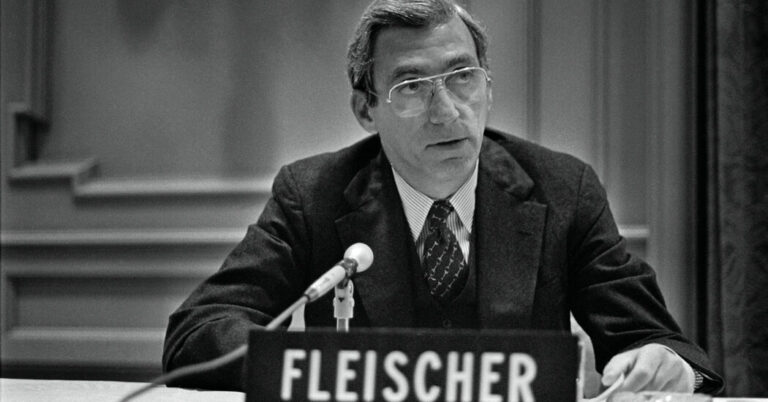
Arthur Fleischer Jr., Veteran Corporate Takeover Lawyer, Dies at 92

0


Arthur Fleischer Jr., an art-loving lawyer who for decades was one of the leading deal makers in corporate mergers, died on March 21 at his home in Manhattan. He was 92.

The death was confirmed by his wife, Susan.

Over a 65-year career at the firm that became known as Fried, Frank, Harris, Shriver & Jacobson, where he eventually served as co-chairman, Mr. Fleischer became one of the top practitioners of the business of mergers and acquisitions, playing a role in a number of major transactions.

Perhaps his highest-profile assignment was advising what was then Philip Morris in its unsolicited takeover bid of Kraft, which led to a $13.1 billion deal in 1988. At the time, it was one of the biggest mergers ever announced.

His line of work, he admitted, could be demanding. “These transactions do not provide opportunity for on-the-job training,” he told The New York Times in 1988. “They require people who can move quickly and can think strategically and are familiar with the kinds of problems that are common to these types of deals.”

Mr. Fleischer also provided legal counsel to BellSouth in its $86 billion sale to AT&T in 2007; to Chevron in its $36 billion takeover of Texaco in 2001; to Bestfoods in its $24 billion sale to Unilever in 2000; and to Dow Jones & Company in its $5.3 billion sale to Rupert Murdoch’s News Corporation.

The Philip Morris battle involved many of the best-known deal makers of the era, with Mr. Fleischer working alongside the star banker Bruce Wasserstein and facing off against Willard Overlock Jr., of Goldman Sachs, and Martin Lipton, a rival lawyer at Wachtell, Lipton, Rosen & Katz.

Mr. Fleischer was often mentioned in the same breath as Mr. Lipton, the creator of the famed poison-pill takeover defense, and Joseph H. Flom, of Skadden, Arps, Slate, Meagher & Flom.

“Art is one of the three creators of modern takeover law,” Roberta Romano, the co-director of the Yale Law School Center for the Study of Corporate Law, said in 2009 when she presented Mr. Fleischer with an award. “He has been a pioneer in the art of engaging in hostile takeovers and defending against them, from the days when such transactions were novel and not being undertaken by many law firms.”

Arthur Fleischer Jr. was born on Jan. 27, 1933, in Hartford, Conn., the second son of Arthur and Clare (Katzenstein) Fleischer. He grew up in Hartford and Salt Lake City, in a family of scientists: His father was a chemist who worked on battery technology, and his brothers, Allan and Everly, earned doctorates in physics and chemistry.

He assumed he would follow suit. But soon after he took up chemistry during his freshman year at Yale University, the school his father and brothers had attended, he discovered that his talents lay elsewhere.

After he broke his school-issued set of laboratory glassware, a teacher told him, “You’d be a great theoretical scientist, but this is a lab science,” his wife said in an interview.

He decided to major in history, graduating in 1953, and then joined the Army for two years, serving as a typist and working at the Pentagon. He went on to attend Yale Law School and graduated in 1958.

Mr. Fleischer began his career as a tax lawyer at a firm then known as Strasser Spiegelberg. But when his former law school professor William L. Cary became chairman of the Securities and Exchange Commission during the Kennedy administration, Mr. Fleischer left to serve as Mr. Cary’s executive assistant in Washington.

It was during his time at the S.E.C. that Mr. Fleischer became interested in practicing securities law, which led to his work on deals. “You were always operating where the law was changing,” he told The Times in 1988. “And it’s an area where the lawyers are very much at the center of the transaction. So it was more satisfying.”

Mr. Fleischer played a significant role in the 1980s merger boom, the era of “Barbarians at the Gate.” In addition to the Kraft Foods takeover battle, he was involved in attempted takeovers of the Hospital Corporation of America, now known as HCA, and the grocery chain Kroger.

Mr. Fleischer recounted his experiences in two books, “Takeover Defense: Mergers and Acquisitions” (originally written with Alexander R. Sussman and currently in its ninth edition), which Ms. Romano described as “the leading treatise on takeover defenses,” and “Board Games: The Changing Shape of Corporate Power” (1988, written with Geoffrey C. Hazard Jr. and Miriam Z. Klipper).

But the law was not his only focus. Mr. Fleischer was one of the most avid art collectors in the world of corporate law, acquiring works by prominent and emerging artists, many of them displayed in Fried Frank’s offices. (In a 2006 interview with The Wall Street Journal, he highlighted works by the photographers Lise Sarfati and Collier Schorr in the firm’s collection.)

He also served on the boards of the Whitney Museum of American Art and the Kitchen, a nonprofit experimental art institution, and donated works to the Solomon R. Guggenheim Museum and Yale.

In addition to his wife, Mr. Fleischer is survived by two daughters, Elizabeth and Katie Fleischer; two grandsons; and his brother Everly.


Source link

Whiskey Fraud Strikes Britain and Ireland

0


There are some 48,000 barrels of Scotch whisky quietly aging in Martin Armstrong’s warehouses in southwestern Scotland. Last year, 17 of them became a problem.

Mr. Armstrong normally deals with companies that buy hundreds of barrels at a time from distilleries, then pay him to store them as they age. In July, he started getting desperate calls from people who had bought just one or two barrels from an investment outfit called Cask Whisky Limited. They had been told that some of those barrels were stored in Mr. Armstrong’s warehouse.

Cask Whisky had promised those investors sky-high returns. But when the company collapsed last year, it left them scrambling to find their barrels.

“We were inundated by questions,” Mr. Armstrong said.

He couldn’t help most of them. He had never even done business with Cask Whisky. Still, Mr. Armstrong knew exactly what he was dealing with: yet another in a growing number of Scotch whisky-investment scams.

There are dozens of companies like Cask Whisky, often located in London but selling barrels stored in remote corners of Scotland and Ireland, making it hard for clients to see their investments in person. Some are semi-legitimate operations that sell barrels at prices so inflated they will take decades to turn a profit; others are practicing outright fraud.

“There’s a whole range of different types of cask scams, from the mild to the just evil,” said Isabel Graham-Yooll, a whisky consultant in London. “It’s a murky old world.”

The City of London Police said it received 89 reports of alcohol investment fraud in 2023, the most recent data available, amounting to nearly $4 million in lost money. Those numbers are set to grow, experts warn, as the global economy teeters and people become more aware of the risks involved in barrel investing and try to get out. Many are about to realize that what they took to be a sound investment is anything but.

“I personally think that we’re at the beginning of what’s going to be a major industry crisis,” said Felipe Schrieberg, a journalist and a founder of the consumer-awareness website Protect Your Cask. “Bloodbath has been the word that I’ve been using.”

As a rule, whisky barrels gain in value the longer they age: The taste of the liquid improves, while slow evaporation means there is less of it each year. As a result, barrels have long been a favored commodity among fraudsters, who promise big returns to unsuspecting investors. But for several reasons, the scams have picked up in earnest over the last five years.

For one thing, near-zero interest rates pushed investors to seek out better returns than banks could offer. Government-issued stimulus checks during the Covid pandemic gave British taxpayers money to play with. And sophisticated marketing tools allowed companies to pinpoint promising demographics — often retirees with a nest egg and a poor grasp of the risks involved.

All this happened at a time when the valuations for top-rated single-malt Scotch were skyrocketing. In a 2023 report on so-called passion assets by the Knight Frank Luxury Investment Index, rare whisky grew 428 percent in value over the previous 10 years, far more than products like wine and watches.

Investment companies took such numbers and blasted them across Facebook and Google Ads, reeling in thousands of hapless clients.

“The biggest problem is that people are so desperate to make an investment that the fear of missing out means that they bypass all logical safety checks,” Mr. Armstrong said.

To insiders like Mr. Armstrong, the red flags are obvious. A new barrel of whisky should cost less than $1,000 before a reasonable markup, but these companies often sell them for as much as six times that amount.

They tout access to highly regarded distilleries like Linkwood and Deanston, without explaining that the barrels frequently come with trademark protections that forbid using the distilleries’ names, which significantly reduces their value.

And the investment companies often issue ownership documents that leave out key details, like the date of distillation, making it hard for buyers to track down their barrels among the estimated 22 million stored around Scotland.

“I think part of it is that romance of whisky, the romance of having your own cask in a warehouse, that makes people let their guards down,” said Mr. Schrieberg, the journalist.

Even the promise of steady, elevated returns is largely a myth. Value growth in whisky is not linear; a four-year-old barrel is not worth much more than a three-year-old one, and barrels reach premium status only at around 18 years old.

And only a vanishingly small number of barrels produce whisky with the right aroma and taste to fetch the sort of five-figure prices that investment companies often promise. There is simply no way of knowing whether a particular barrel, on the day it is filled, will ever reach that height.

“It’s like saying this specific blue paint was used by Picasso, this particular Picasso painting made with that blue paint went up 1,000 percent, ergo, if you buy this tub of blue paint, it is going to go up that same percent,” said Blair Bowman, a whisky broker who has been critical of the barrel-investment business.

Making the hard sell for bad investments isn’t necessarily illegal. But several companies are clearly committing fraud.

Mr. Armstrong requires barrel owners to tell him when they sell to third parties, but neither the original owners, nor Cask Whisky, informed him about their sales. As he tried to piece together what had happened, he realized that the company had likely sold the same barrels to multiple people, or sold barrels that didn’t exist in the first place.

In March, the BBC produced an exposé about the barrel-investment industry, including interviews with investors who had put hundreds of thousands of pounds into schemes that turned sour. The BBC also reported that the London police were investigating Cask Whisky Limited and two similar operations, Cask Spirits Global Limited and Whisky Scotland, for fraud.

But enforcement is rare. In Britain, the financial authorities don’t regulate barrels as investments, offering little protection for buyers. And the line between high-pressure salesmanship and fraud is a blurry one, though in some cases the country’s Advertising Standards Authority has gone after companies for misleading marketing.

Investors have slim chances of recovering their money. In March, Britain’s Insolvency Office, the government agency that is shutting down Cask Whisky, sent out a memo telling investors that it couldn’t help them recover their barrels; all it could offer was a list of email addresses for warehouses where those barrels might sit.

“There’s this kind of superhero complex, where we’re just all waiting for someone to come in and fix things,” Ms. Graham-Yooll said.

The problem is largely specific to Scotland and Ireland, where the buying and selling of barrels among businesses is a longstanding practice. It is less of an issue in the United States, where it’s harder for individual buyers to purchase barrels and where the Securities and Exchange Commission often regulates the sale of barrels as investments.

To be fair, some barrel-investment companies are legitimate, and may even offer a realistic way to turn a long-term profit. But the industry is so complex and scams so plentiful that experts advise staying away.

“In theory, there is a world in which buying casks by the general public could work,” Mr. Schrieberg said. “But if you’re a Joe Public, I’d recommend don’t get involved. It’s just too high-risk and there’s too much ugly stuff going on.”

Follow New York Times Cooking on Instagram, Facebook, YouTube, TikTok and Pinterest. Get regular updates from New York Times Cooking, with recipe suggestions, cooking tips and shopping advice.


Source link

ICE Arrests Nearly 800 in Florida in Operation With Local Officers

0


U.S. Immigration and Customs Enforcement officers, along with state law enforcement officials, arrested about 780 immigrants in Florida in an operation this week, according to ICE data obtained by The New York Times.

The operation began on Monday and targeted undocumented immigrants with final deportation orders, according to an ICE official, who spoke on the condition of anonymity to discuss the operation. The officers picked up more than 275 migrants with final removal orders, the data showed.

ABC News and Fox News earlier reported news of the arrests, which took place over four days.

It was the latest move by the Trump administration to seek to accelerate deportations of undocumented immigrants, which have so far been well below the administration’s goals.

Since President Trump took office, ICE officials have worked with various federal agencies to conduct raids across the United States. The effort this week in Florida was the first to be conducted as part of a formal arrangement with state law enforcement known as a 287(g) agreement, according to the official.

The Trump administration has sought to recruit local authorities to help in immigration operations in an effort to speed deportations. The administration has resumed collateral arrests during such operations, which allows officers to pick up migrants who were not initially targeted but were around an individual who was sought by ICE.

Generally, people must have received an order of removal from an immigration judge before they are deported, a process that can take weeks or stretch into years. But since the start of 2024, 70 percent of these removal orders were issued to someone who did not attend their hearing before a judge, according to a Times analysis of court records.

“It’s going to break up families,” said Tessa Petit, the executive director of the Florida Immigrant Coalition, said of the arrests this week. “And that is not the welcoming state that Florida has been for immigrants for decades.”

Given the scale of the operation, Ms. Petit said, there is a chance that many of those arrested were in the country on some sort of legal status and did not possess criminal records.

The raids represented the biggest escalation of immigration enforcement in Florida since Mr. Trump took office, Ms. Petit said, adding that they were much more reflective of the president’s mass deportation promises.

ICE operations in communities take an extensive amount of research and surveillance. They also require many officers, which is why the Trump administration has pulled in several other law enforcement agencies.

Trump administration officials have increasingly turned to warning undocumented immigrants to leave the country.

“President Trump and I have a clear message to those in our country illegally: LEAVE NOW,” said Kristi Noem, the homeland security secretary, in a statement on Monday. “If you do not self-deport, we will hunt you down, arrest you and deport you.”

Orlando Mayorquín, Albert Sun and Miriam Jordan contributed reporting.


Source link

Chris Eubank Jr inspired by father in gruelling 12-round victory over Conor Benn at Tottenham Hotspur Stadium | Boxing News

0


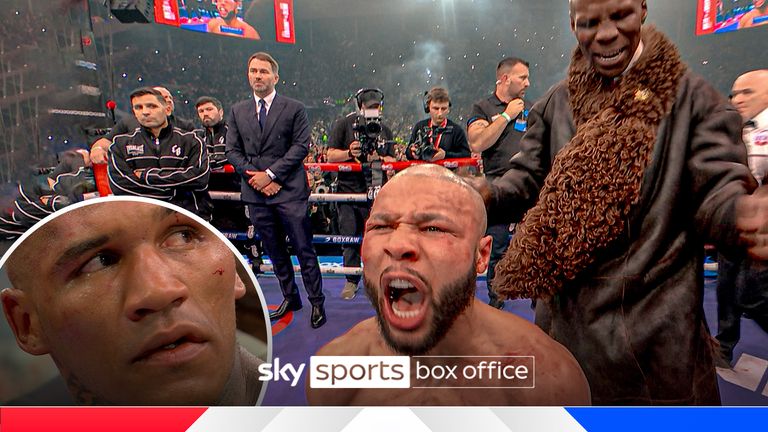
Chris Eubank Jr said his gruelling 12-round victory over Conor Benn was inspired by his father, who made a stunning surprise appearance just hours before the fight.

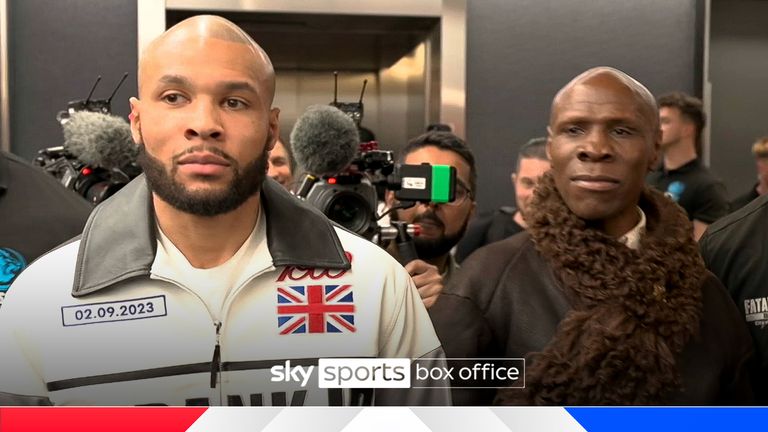
The Eubanks have have been estranged, and have scarcely spoken to each other in recent years, but 35 years after Eubank Sr famously battled Nigel Benn, he arrived with his son at the Tottenahm Hotspur Stadium and they made an emotional ringwalk together.

The appearance, which came without warning, was loudly cheered by the 65,000 fans in London who were treated to a new chapter in the Eubank vs Benn family rivalry, with Eubank Jr ultimately emerging as the victor via unanimous decision.

Eubank Jr won the fight 116-112 on all of the judges’ scorecards and said his success drew on his dad’s legacy.

Please use Chrome browser for a more accessible video player

Chris Eubank Jr claimed a dramatic points victory over Conor Benn in a fight which saw both men hurt over a hugely entertaining twelve rounds.

“The fact our fathers did it all those years ago brings out a different spirit into you and that’s what we showed here tonight,” he said.

“I’m happy to have this man [Eubank Sr] back with me. He needed to be here. All this is because of what he did.

“We upheld the family name. Onwards and upwards.”

Please use Chrome browser for a more accessible video player

Watch the moment Chris Eubank Jr was declared the winner by unanimous decision over Conor Benn.

Eubank Jr, who is seven years older than his opponent, was taken to hospital for precautionary checks following the fight and was badly cut in the ninth round.

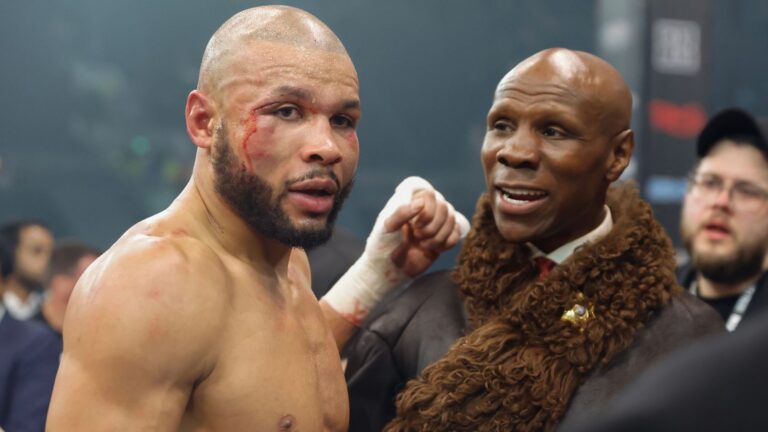
His father celebrated with him in the ring after the fight and described his performance as “legendary”.

Please use Chrome browser for a more accessible video player

Chris Eubank Jr and his father made an epic ring walk at Tottenham Hotspur Stadium complete with an orchestra!

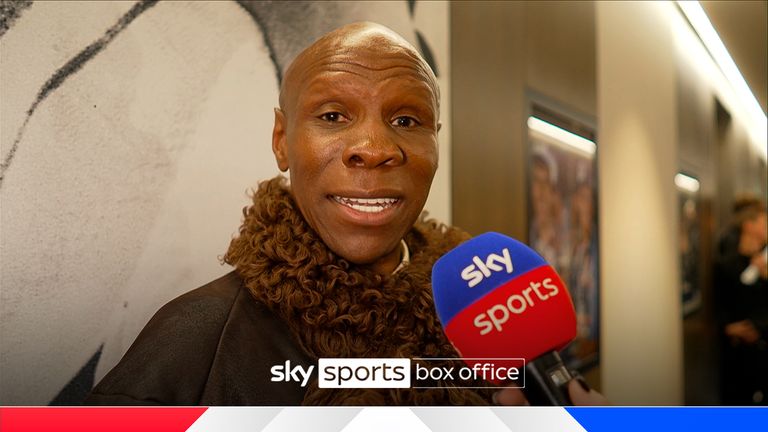
“He couldn’t move around the ring and so he had to stand toe-to-toe. That is legendary behaviour in the ring. Legendary.

“Conor Benn is an extraordinary fighter. He’s gone pear-shaped somewhere, but an extraordinary fighter.

Please use Chrome browser for a more accessible video player

Chris Eubank Sr was keen to point out that he never stopped loving his son despite disagreeing with some of his decisions.

“I thought he would blow out in four of five rounds he was going strong right the way through the fight.

“I am so proud. That’s my son. I was always going to be here.”

Benn hopes for reconciliation of Eubanks

Please use Chrome browser for a more accessible video player

Chris Eubank Jr entered the Tottenham Hotspur Stadium alongside his father after both had publicly fallen out in the build-up to his fight against Conor Benn.

Conor Benn embraced Eubank Sr in the ring following the final bell and insisted the surprise appearance was a positive for the event.

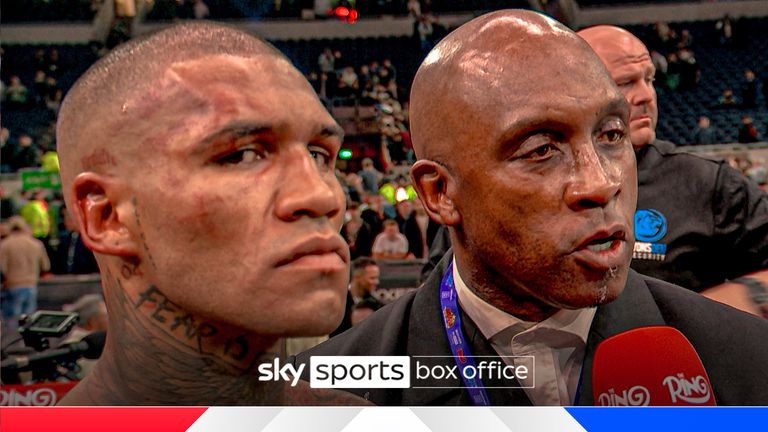
An emotional Benn, who was consoled by his own father in the ring after the decision was announced, now hopes the duo can reconcile.

“I looked at Chris Senior, grabbed him by the neck and said ‘mate, I’m so happy that you’re here, I’m so happy you turned up’, he said.

Please use Chrome browser for a more accessible video player

Conor Benn says he would ‘love a rematch’ after losing to Chris Eubank Jr unanimously.

“Outside of everything else, all the noise and the promotion and the fight, the relationship with your dad never goes.

“That’s always there. That’s longstanding. I’d pick the relationship with my dad over boxing any day of the week.

“If this has brought them two together, that’s worth its weight in gold.”

Book Chris Eubank Jr vs Conor Benn repeats at 8am and 5pm on Sunday on Sky Sports Box Office. Book now!


Source link