Home Blog Page 358

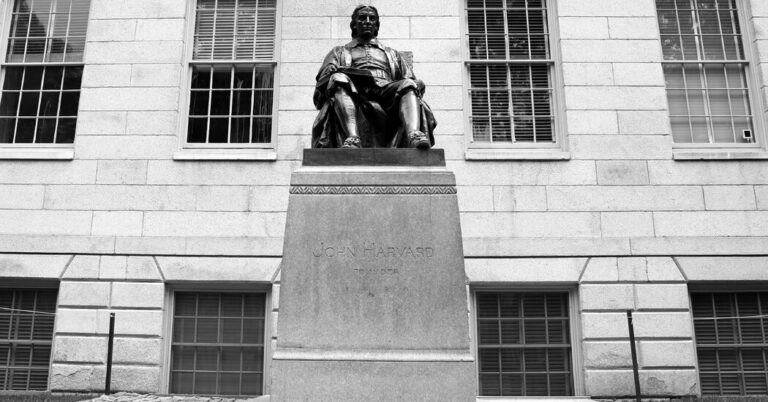
Harvard’s War With Trump Forces Question of How Endowments Should Be Spent

0


There are proposals from Republicans in Congress to increase the tax on large endowments, potentially to 14 percent, much higher than the 1.4 percent put in place eight years ago. Assuming a 10 percent return, that would leave Harvard with a tax bill of about $742,000,000, roughly equal to what it spent on financial aid last year. But you can go around and round. If Harvard raised its endowment draw, however sacrilegiously, to 7 percent, it would add about $1.3 billion to its budget.

Undoubtedly the prospect of higher taxes and the realities of a chaotic stock market have made the notion of tapping endowment income more robustly seem even less attractive to trustees. But those who consider endowments essentially inviolate dismiss some of the workarounds. It is true that as endowments have become more heavily invested in hedge funds and private equity, they have become less liquid. But there are secondary markets for selling positions in some of these funds if a need for cash is urgent. There are reports that Harvard is now considering this option.

One of the great luxuries of having a lot of money is the ability to borrow against it, often cheaply. Princeton University’s president, Christopher Eisgruber, has become one of the most prominent critics of the Trump administration’s antagonisms toward the academy. In response to the federal government’s freezing of several dozen grants, the university, rather than hike up its draw, has issued bonds as a means of raising cash.

Some observers of the recent campus upheaval have noted that Columbia, the largest landowner in New York City, rather than acquiesce to the government’s demands to preserve $400 million in grant money, might have borrowed against its real estate, the value of which stands apart from its $14 billion endowment. Harvard, with its triple-A rating, has issued more than $1 billion in bonds since March. “For a bondholder, the only question is: ‘Will I be paid?’” said Larry Ladd, a former budget director at the university who is now a consultant. “If Harvard were liquidated, they would get paid,” he added.

And while many restrictions are imposed by donors, others are imposed by the university itself, Mr. Schapiro of Williams and Northwestern explained to me recently, “so they can be unrestricted.” Although it is difficult to pull off, and Mr. Schapiro does not recommend it as protocol, he once approached the grandson of a donor who had died long ago to ask if he could use the money for something other than what was intended. The grandson said yes.


Source link

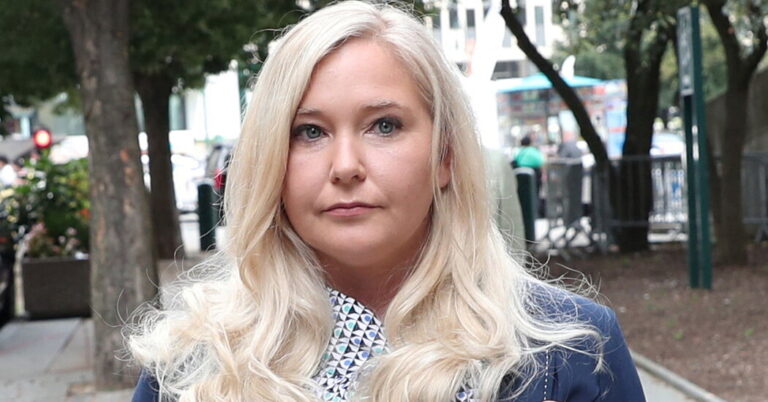
Virginia Giuffre, Voice in Epstein Sex-Trafficking Scandal, Dies at 41

0


Virginia Giuffre, a former victim of Jeffrey Epstein’s sex-trafficking ring who said she was “passed around like a platter of fruit” as a teenager to rich and powerful predators, including Prince Andrew of Britain, died on Friday at her farm in Western Australia. She was 41.

Ms. Giuffre (pronounced JIFF-ree) died by suicide, according to a statement by the family. She wrote in an Instagram post in March that she was days away from dying of renal failure after being injured in an automobile crash with a school bus that she said was traveling at nearly 70 miles per hour.

In the statement, her family called her “a fierce warrior in the fight against sexual abuse and sex trafficking” and “the light that lifted so many survivors.”

In 2019, Mr. Epstein was arrested and charged by federal prosecutors in the Southern District of New York with sex-trafficking and conspiracy, accused of soliciting teenage girls to perform massages that became increasingly sexual in nature.

Barely a month after he was apprehended, and a day after documents were released from Ms. Giuffre’s successful defamation suit against him, Mr. Epstein was found hanged in his cell in the Metropolitan Correctional Center in Lower Manhattan. His death, at 66, was ruled a suicide.

In 2009, Ms. Giuffre, identified then only as Jane Doe 102, sued Mr. Epstein, accusing him and Ghislaine Maxwell, his co-conspirator and the daughter of the disgraced British media magnate Robert Maxwell, of recruiting her to join his sex-trafficking ring when she was a minor under the guise of becoming a professional masseuse.

In 2015, she was the first of Mr. Epstein’s victims to give up her anonymity and go public, selling her story to the British tabloid The Mail on Sunday.

“Basically, I was training to be a prostitute for him and his friends who shared his interest in young girls,” Ms. Giuffre was quoted as saying in Nigel Cawthorne’s 2022 book, “Virginia Giuffre: The Extraordinary Life Story of the Masseuse Who Pursued and Ended the Sex Crimes of Millionaires Ghislaine Maxwell and Jeffrey Epstein.”

“Ghislaine told me that I have to do for Andrew what I do for Jeffrey,” she said.

Ms. Giuffre accused Mr. Epstein, a multimillionaire financier, and Ms. Maxwell, a British socialite, of forcing her to have sex with Prince Andrew, also known as the Duke of York. He flatly denied the accusations, but he relinquished his royal duties in 2019.

In 2021, she sued the prince, who is the younger brother of King Charles III of England, contending that he had sexually assaulted her at Ms. Maxwell’s home in London and at Mr. Epstein’s homes in Manhattan and Little St. James, in the Virgin Islands.

A widely published photograph showed Prince Andrew with his hand around her waist. He said he had no memory of the occasion.

After Prince Andrew agreed to settle the suit by Ms. Giuffre in 2022, he praised her in a statement for speaking out and pledged to “demonstrate his regret” for his association with Mr. Epstein “by supporting the fight against the evils of sex trafficking, and by supporting its victims.”

The settlement included an undisclosed sum to be paid to her and to her charity, now called Speak Out, Act, Reclaim.

In interviews and depositions, Ms. Giuffre said she was recruited to the sex ring in 2000 while working as a locker room attendant at Mar-a-Lago, President Trump’s resort in Palm Beach, Fla. By her account, she was reading a massage therapy manual when she was approached by Ms. Maxwell and invited to become Mr. Epstein’s traveling masseuse. She said the two of them then groomed her to perform sexual services for wealthy men.

Ms. Giuffre sued Ms. Maxwell for defamation in 2015 for calling her a liar; they settled for an undisclosed sum in 2017. Ms. Maxwell was convicted in 2021 of sex trafficking and other counts. The verdict was viewed as the legal reckoning that Mr. Epstein had denied the judicial system, and his victims, by hanging himself. Ms. Maxwell was sentenced to 20 years in prison.

Virginia Louise Roberts was born on Aug. 9, 1983, in Sacramento to Sky and Lynn Roberts. When she was 4, the family moved to Palm Beach County, where her father was a maintenance manager at Mar-a-Lago.

She said she ran away from home after having been molested by a close family friend since she was 7. She was placed in foster homes; boarded with an aunt in California; fled to the Haight-Ashbury neighborhood of San Francisco, the former hippie haven; lived on the streets when she was 14; and spent six months with a 65-year-old sex trafficker, who abused her.

Compared with living on the streets and earning $9 an hour for her summer job at Mar-a-Lago, Mr. Epstein’s offer to make $200 a massage several times a day was, Mr. Cawthorne wrote, one that “Virginia had determined for herself she could not refuse.”

But her mandate went well beyond those duties, she told the BBC in 2019: She said that she was “passed around like a platter of fruit” to Mr. Epstein’s friends and ferried around the world on private jets.

In 2002, when she was 19, Ms. Giuffre enrolled in the International Training Massage School in Thailand to become a professional masseuse. There she met Robert Giuffre, an Australian martial arts instructor, and they married.

The couple had three children, Christian, Noah and Emily, and lived in Australia, Florida and Colorado before settling in Perth in 2020. They have since separated. Complete information on survivors was not immediately available.

Ms. Giuffre told The Miami Herald in 2019 that the birth of her daughter in 2010 prompted her to speak publicly about her victimization. She explained why she had originally agreed to let Mr. Epstein and Ms. Maxwell groom her as a masseuse and to provide sexual services.

“They seemed like nice people,” she said, “so I trusted them, and I told them I’d had a really hard time in my life up until then — I’d been a runaway, I’d been sexually abused, physically abused. That was the worst thing I could have told them, because now they knew how vulnerable I was.”

If you are having thoughts of suicide, call or text 988 to reach the 988 Suicide and Crisis Lifeline. Or go to SpeakingOfSuicide.com/resources for a list of additional resources.

Hank Sanders contributed reporting.


Source link

How Tariffs Could Make Americans’ Hobbies More Expensive

0


Hobby forums, normally places for trading tips about knitting patterns and sharing photos of new projects, are now hosting in-depth analyses of tariff news and heated political debates. Ben Schinkel, 42, an avid gamer who voted for Mr. Trump, said that the news cycle had inspired him to do some research into tariffs; he concluded that “tariffs are good if we can get a better deal for things from China and other countries.” But he said the tariffs will most likely make him more selective about which video games he buys, and he would draw the line at $90 for a new game — unless it was a new Mario or Zelda game. (Many new games now cost close to $70, and Mr. Schinkel pays around $20 a month for an Xbox Game Pass subscription.)

Other gamers seem more unsettled. “Even some very staunch Trump supporters I know, some friends of mine, are getting radio silent on their love for the gentleman,” said Ryan Hughes, who owns a video game store in Albany. Mr. Hughes, who also runs a payment software company used by other game stores, is frequently in touch with other store owners and said that, in general, the industry is in “panic mode.” Much of the gear needed to play games — GameCube and PlayStation controllers, memory cards, wires and consoles — is imported from China and may be tariffed steeply. (Such parts are largely not included in the electronics exemption the Trump administration announced this month.)

People have maintained hobbies through hard times before — underemployed Americans with extra free time tinkered through the Great Depression, wove through the 1970s economic downturn, gardened through the 2008 financial crisis and weathered the sourdough-scented Covid recession.

But an idea that has become widespread in the world of contemporary hobbies is that the “the more you spend on it, the realer it is,” said Anne Helen Petersen, the writer of the Culture Study newsletter, who often writes about hobbies (and is herself an enthusiastic dahlia gardener). Ms. Petersen suggested that tighter budgets might lead some people to lean into the community aspect of hobbies. Maybe it will be hard to buy the brand-new version of everything. But does a neighbor have a tool you can borrow?

Such a communal approach is the hope for Luis Garcia, 25, in Guadalupe, Calif., who recently started playing the Manga card game One Piece in a game shop at a local mall. Mr. Garcia, who does not currently have a job, has spent about $500 on a few sets of cards, which are imported from Japan, since picking up the game in December. If prices rise, he said, he hopes his gaming group could strike some kind of agreement not to play with the new editions of card sets. If a box went up to more than $145, he said, he would not buy it.


Source link

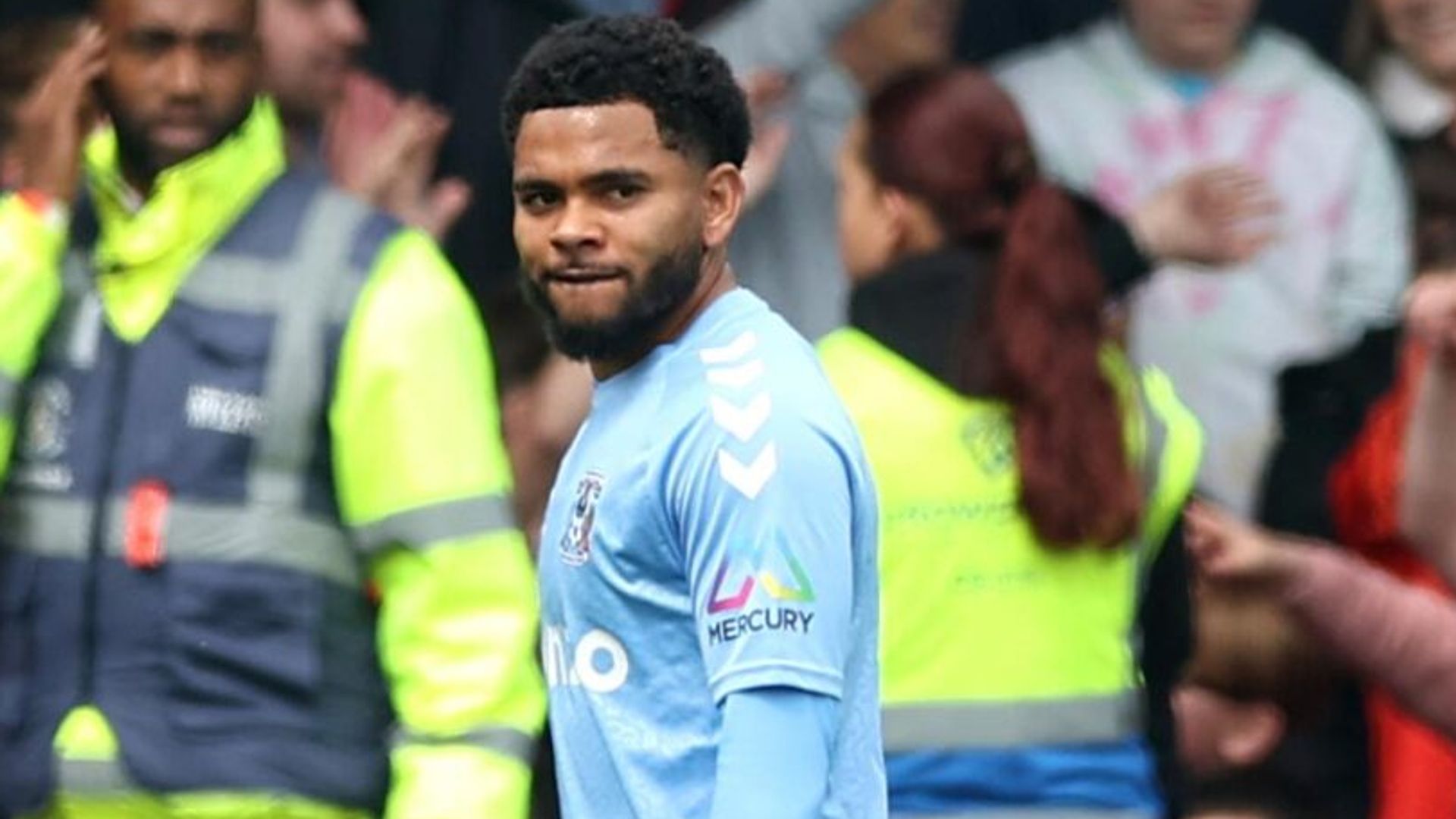
Luton vs Coventry – Live match updates

0


Full Time
After Extra Time
This is a live match.
Extra Time
Half Time

Luton Town
vs Coventry City. Sky Bet Championship.

Kenilworth Road.


Source link

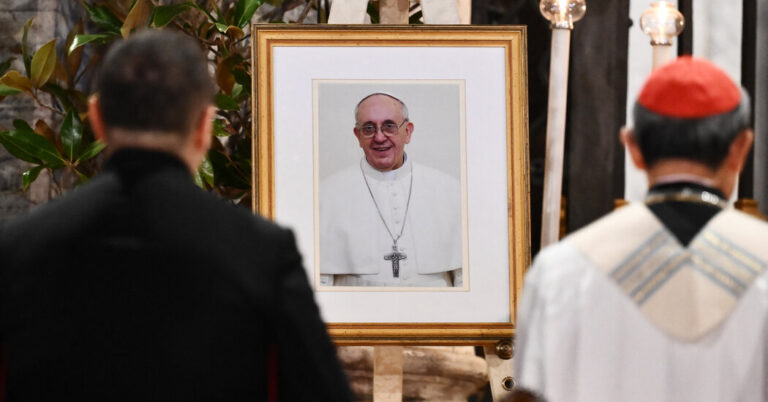
How Francis Wooed Donors – The New York Times

0


Founded by Conrad Hilton, the hotel magnate, the Hilton Foundation is one of the biggest financial backers of Catholic sisters’ work around the world, and has given roughly $28.5 million to Vatican-led initiatives, including Vatican departments, since 2020.

Francis saw donors as vital partners. He looked to them not only to fund the causes dear to him but also to plug the Vatican’s creaky finances. In February, while the pope was recovering from a near-death bout of double pneumonia, he created the Commissio de Donationibus pro Sancta Sede, a committee to fund-raise directly for the curia, or the Vatican’s governing hierarchy, and to shore up its many budget shortfalls. Francis’ initiative was bold: He was essentially betting that donors would be happy to openly fund church bureaucracy as well as the Roman Catholic Church’s far-flung missions around the world.

Such an ask would have been an extremely tough sell when the Francis papacy began.

Back then, the church’s financial reputation was in tatters. Accounting intrigue and scandal at the Vatican Bank loomed over the last conclave. In 2013, just before Francis was elected pope, Italian banking authorities had shut off most of the A.T.M.s in the Vatican and blocked credit card transactions at the Vatican Museum, until the microstate could prove it was meeting international anti- money-laundering standards. Decades of mismanagement and corruption scandals had taken their toll.

The church seemed to need a great business mind as much as it needed a towering theologian.

To donors’ relief, Francis modernized the Vatican’s financial oversight. A year into his papacy, he created an auditor general and beefed up internal anti-corruption controls. He also introduced some financial transparency (though it’s far from business-world standards) and brought in outside auditors, such as KPMG and EY, to help keep a lid on costs and make the Holy See’s curia run more professionally.

He also worked more closely with the church’s major donors, and their influence on the church grew.

At the same time, the Vatican hosted a series of impact-investing summits to bring more Wall Street money to causes close to Francis, many of the same ones that donors often focus on. The pope became a featured speaker at major international events, addressing in 2023 the Clinton Global Initiative.


Source link

How Trump Plays Into Putin’s Hands, From Ukraine to Slashing U.S. Institutions

0


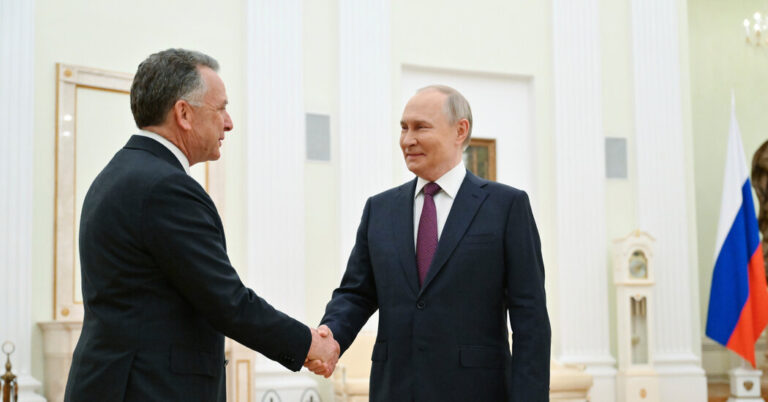
If President Vladimir V. Putin of Russia drafted a shopping list of what he wanted from Washington, it would be hard to beat what he was offered in the first 100 days of President Trump’s new term.

Pressure on Ukraine to surrender territory to Russia? Check.

The promise of sanctions relief? Check.

Absolution from invading Ukraine? Check.

Indeed, as Mr. Trump’s envoy Steve Witkoff visited Moscow on Friday for more negotiations, the president’s vision for peace appeared notably one-sided, letting Russia keep the regions it had taken by force in violation of international law while forbidding Ukraine from ever joining NATO.

But that is not all that Mr. Putin has gotten out of Mr. Trump’s return to power. Intentionally or not, many of the president’s actions on other fronts also suit Moscow’s interests, including the rifts he has opened with America’s traditional allies and the changes he has made to the U.S. government itself.

Mr. Trump has been tearing down American institutions that have long aggravated Moscow, such as Voice of America and the National Endowment for Democracy. He has been disarming the nation in its netherworld battle against Russia by halting cyber offensive operations and curbing programs to combat Russian disinformation, election interference, sanctions violations and war crimes.

He spared Russia from the tariffs that he is imposing on imports from nearly every other nation, arguing that it was already under sanctions. Yet he still applied the tariff on Ukraine, the other party he is negotiating with. And in a reversal from his first term, Politico reported that Mr. Trump’s team is reportedly discussing whether to lift sanctions on Russia’s Nord Stream 2 gas pipeline to Europe, a project he has repeatedly condemned.

“Trump has played right into Putin’s hands,” said Ivo Daalder, the chief executive of the Chicago Council on Global Affairs and a former ambassador to NATO under President Barack Obama. “It’s hard to see how Trump would have acted any differently if he were a Russian asset than how he has acted in the first 100 days of his second term.”

Karoline Leavitt, the White House press secretary, rejected the notion that Mr. Trump’s actions have been to Russia’s advantage. “The president only acts in the interest of the United States,” she said in an interview.

She added that there was no connection between Russia and the cuts to various organizations that have been orchestrated by Elon Musk’s Department of Government Efficiency, or DOGE, or similar efforts to pare back government.

“DOGE has nothing to do with the efforts by our national security team to end the war,” she said. “Those are not conscious decisions the president is making to appease Russia in any way. When it comes to Russia and Ukraine, he’s trying to appease the world by ending the war and bringing it to a peaceful resolution.”

Mr. Trump has long rejected criticism that he is soft on Russia, even as he has expressed admiration for Mr. Putin. He issued a rare rebuke of Mr. Putin this week after a missile strike on Kyiv killed at least a dozen people, demanding on social media, “Vladimir, STOP!”

Speaking with reporters later, Mr. Trump denied that he was pressuring just Ukraine for concessions. “We’re putting a lot of pressure on Russia, and Russia knows that,” he said.

Asked what Moscow would have to give up as part of a peace deal, Mr. Trump said only that Russia would not get to take over all of Ukraine — something it had not actually been able to do militarily in the three years since its full-scale invasion. “Stopping the war, stopping taking the whole country, pretty big concession,” he said.

But what has been so striking about Mr. Trump’s return to office is how many of his other actions over the past three months have been seen as benefiting Russia, either directly or indirectly — so much so that Russian officials in Moscow have cheered the American president on and publicly celebrated some of his moves.

After he moved to dismantle Voice of America and Radio Free Europe/Radio Liberty, two U.S.-funded news organizations that have transmitted independent reporting to the Soviet Union and later Russia, Margarita Simonyan, the head of the Russian state broadcaster RT, called it “an awesome decision by Trump.” She added, “We couldn’t shut them down, unfortunately, but America did so itself.”

Those are just a couple of the U.S. government organizations that Mr. Trump and Mr. Musk have targeted to the delight of Russia. Moscow has long resented the U.S. Agency for International Development, the National Endowment for Democracy, the International Republican Institute and the National Democratic Institute, all of which fund democracy promotion programs that the Kremlin considers part of a campaign of regime change, and all of which now face the ax.

Secretary of State Marco Rubio’s new department restructuring plan likewise takes aim at offices that have aggravated Russia over the years, including the democracy and human rights bureau, which would be folded into an office for foreign assistance. Mr. Rubio said the bureau had become a “platform for left-wing activists to wage vendettas” against conservative foreign leaders in places like Poland, Hungary and Brazil.

“The ultimate outcome is this is going to benefit Russia under Putin in the long term,” said Alina Polyakova, president of the Center for European Policy Analysis. “These kinds of democracy promotion programs under multiple administrations we saw as a way to win allies and improve America’s standing in the world. By pulling back, we’re undermining that, and Russia is stepping in.”

Samuel Charap, an analyst at the RAND Corporation, said that many of the actions Mr. Trump had taken were not necessarily aimed at pleasing Moscow. “I’m not sure the Russians thought of those things as things that they would want to put on the table, even in a negotiation with the U.S.,” he said, like dismantling Voice of America. “But they’re certainly happy to see it go away.”

At the same time, Mr. Charap said that the Ukraine peace plan offered by Mr. Trump, even though tilted in Moscow’s direction, did not actually address important points that Russia insisted on including in any settlement, like barring the presence of any foreign military forces in Ukraine.

“It doesn’t touch on a bunch of issues that they’ve identified as their top priorities in the negotiation about the Ukraine war,” he said, “and the concessions that are made, in some cases, might not have been their top priorities.”

Some of the targets of the Trump administration’s cuts have been resisting, and it is not clear how many of the cuts will ultimately go into effect. A federal judge this week blocked Mr. Trump from dismantling Voice of America, pending further litigation. The Trump administration appeal on Friday. The National Endowment for Democracy, aid groups and other institutions are suing as well.

But there is no such recourse for other government initiatives. Mr. Rubio earlier this month shut down an office that tracked foreign disinformation from Russia and other adversaries, asserting that the Biden administration had tried to “censor the voices of Americans.”

Just this week, the White House included in the press pool Tim Pool, a right-wing commentator who was paid $100,000 for each video that he posted to a social media site as part of what the Justice Department called a Russian influence operation. Mr. Pool has said that he did not know the money came from Russia, and he has not been accused of a crime.

Some of the Trump administration’s positions abandon longstanding Republican orthodoxy, and even in some cases stances held by Mr. Trump’s team itself. The National Endowment for Democracy was created under President Ronald Reagan. The now-vacated position on Russian atrocities was mandated by legislation co-sponsored by Representative Michael Waltz, Republican of Florida, who is now Mr. Trump’s national security adviser.

The notion that Russia would get to keep the territory it has taken as part of a balanced peace deal is broadly acknowledged as inevitable. But Mr. Trump is taking it further by offering official U.S. recognition of Russia’s control of Crimea, the peninsula it seized from Ukraine in 2014 in violation of international law, an extra step of legitimacy that stunned many in Ukraine as well as its friends in Washington and Europe.

Such a move would reverse the policy of the first Trump administration. In 2018, Mr. Trump’s State Department issued a Crimea Declaration affirming its “refusal to recognize the Kremlin’s claims of sovereignty over territory seized by force,” likening it to the U.S. refusal to recognize Soviet control of the Baltic States for five decades.

In 2022, Mr. Rubio, then a Republican senator from Florida, co-sponsored legislation barring U.S. recognition of Russian sovereignty over any captured Ukrainian territory. “The United States cannot recognize Putin’s claims, or we risk establishing a dangerous precedent for other authoritarian regimes, like the Chinese Communist Party, to imitate,” Mr. Rubio said at the time.

By contrast, Mr. Trump made clear in a new interview with Time magazine that the United States could indeed recognize Mr. Putin’s claim. In fact, he went ahead and effectively did so without even waiting for a deal to be sealed.

“Crimea will stay with Russia,” he said in the interview, which was released on Friday. He again blamed Ukraine for Russia’s decision to invade it, saying that “what caused the war to start was when they started talking about joining NATO.”

The net effect of Mr. Trump’s tilt toward Russia and dismantlement of U.S. institutions that have irritated Moscow is to undercut America’s position against a major adversary, argued David Shimer, a former Russia adviser to President Joseph R. Biden Jr. Just last month, Mr. Shimer noted, the intelligence community declared that Russia remains an “enduring potential threat to U.S. power, presence and global interests.”

“The current approach,” Mr. Shimer said, “favors Russia across the board — making concession after concession on Ukraine, dismantling our key soft power tools and weakening our alliance network across Europe, which historically has helped the United States deal with Russian aggression from a position of strength.”


Source link

Dollar Doubts Dominate Gathering of Global Economic Leaders

0


On the sidelines of the spring meetings of the International Monetary Fund and World Bank this week, Treasury Secretary Scott Bessent tried to convey an important message about the United States dollar.

Speaking to a crowd of global policymakers, regulators and investors, Mr. Bessent sought to allay fears that had ballooned in recent weeks about the dollar’s global standing and the country’s role as the safest haven during times of stress. He reiterated that the administration would continue to have a “strong-dollar policy” and affirmed that it would remain the currency that the rest of the world wanted to hold, even though it had weakened against most major currencies.

For participants at the event, Mr. Bessent’s comments were a needed salve after a bruising couple of weeks in financial markets as a result of President Trump’s trade war. Violent swings in stocks, coinciding with the weakening of the dollar as investors fled U.S. government bonds, had incited panic.

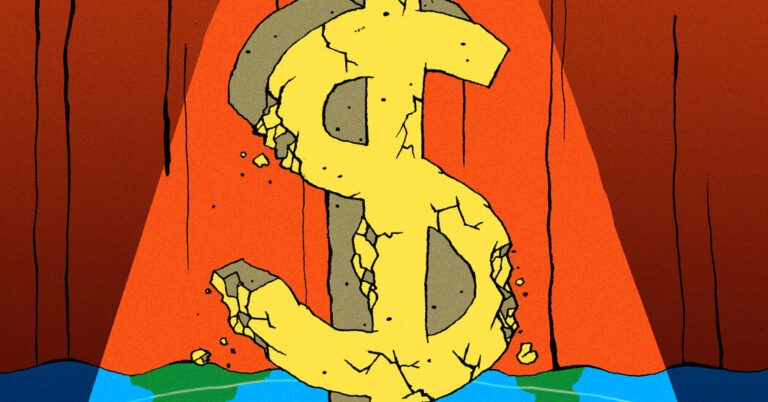
The fact that Mr. Bessent found it necessary to emphasize that message in front of such a big crowd underscored how precarious the situation had become since Mr. Trump returned to the White House less than 100 days ago. What now looms large are uncomfortable questions about what happens if the international community starts to lose faith in the dollar and other U.S. assets, something that economists warn would be costly for Americans.

“People are playing through scenarios that previously had been judged unthinkable, and they’re playing them through in a very serious kind of way in the spirit of contingency planning,” said Nathan Sheets, the chief economist at Citigroup and a Treasury official in the Obama administration.

“If the United States is going to pursue aggressive economic policies, it’s natural for the rest of the world to step back and say, ‘Well, do we want to buy U.S. assets as we have in the past?’”

At a similar gathering hosted by the I.M.F. and World Bank six months ago, attendees were preparing for an entirely different economic backdrop. Convening less than two weeks before the presidential election, they still had in their sights a rare soft landing in which the major central banks finished their fight against high inflation while managing to avoid a recession.

The tariffs Mr. Trump had been talking about on the campaign trail were top of mind, but for the most part, they were viewed as a negotiating tactic. Any turn toward protectionism was widely expected to push up the value of the dollar compared with other currencies. The rationale was that tariffs would lower demand for imported goods, since they would make them more expensive for American consumers, and over time result in fewer dollars being exchanged for foreign currencies.

But since Inauguration Day, the opposite has occurred. An index that tracks the dollar against a basket of major trading partners has fallen nearly 10 percent in the last three months. It now hovers near a three-year low. The sharpest slide came after Mr. Trump announced large tariffs on nearly all imports in April. While he temporarily reversed course, the dollar has yet to recoup its losses.

There are reasons not to read too much into its recent weakening. The U.S. economic outlook has fundamentally changed. Businesses are “frozen” by tariffs, Christopher J. Waller, a governor at the Federal Reserve, said this week as he warned about layoffs stemming from the uncertainty.

Economists have sharply scaled back their estimates for growth while raising their estimates for inflation, a combination that carries a whiff of stagflation. In that environment, it is not surprising that the dollar and other U.S. assets appear less appealing.

Dollar depreciation — even if extreme — also does not necessarily translate to a loss of stature in the global financial system. There have been previous big drops in the value of the dollar that have not incited a wholesale shift away from the currency’s primacy, said Jonas Goltermann, the deputy chief markets economist at Capital Economics.

But at this year’s spring meetings, there was a palpable sense that something more ominous could be taking place. Joyce Chang, JPMorgan’s chair of global research, noted a disconnect between domestic and international participants at the conference that the Wall Street bank hosted during the week of the meetings.

U.S.-based investors appeared less concerned about a structural shift away from the country’s assets and more focused on the ways in which Mr. Trump could course-correct on his economic policies. International investors were consumed by the prospects of a “regime change” in the financial system and a “new world order,” Ms. Chang said.

Mr. Trump had recently escalated his attacks on Jerome H. Powell, the Fed chair, fanning fears about how much the administration would encroach on the central bank’s independence. That longstanding separation from the White House is broadly seen as essential to the smooth functioning of the financial system.

“The dollar’s role in the system was not ordained from above,” said Mark Sobel, a former Treasury official who is the U.S. chairman of the Official Monetary and Financial Institutions Forum. “It’s a reflection of the properties of the United States.”

Those include a large economy that transacts with the world; the financial system’s deepest, most liquid capital markets; a credible central bank; and the rule of law.

“I do believe that Trump is doing permanent damage,” Mr. Sobel said.

It is hard to overstate the dominance of the dollar globally, meaning there are real limitations to how significantly private and public investors can diversify away from it, even if they want to.

Most trade is invoiced in dollars. It is the leading currency for international borrowing. Central banks also prefer to hold dollar assets more than anything else, and by a wide margin.

“Anybody who’s looking for diversification has to be realistic,” said Isabelle Mateos y Lago, the chief economist at BNP Paribas. “Reserve assets, by definition, have to be liquid.”

Alternatives do exist, but they are hobbled by their own weaknesses. China lacks open, deep and liquid capital markets, and its currency does not float freely, tarnishing its appeal globally. Top European leaders — including Christine Lagarde, the president of the European Central Bank — have talked more readily about bolstering the prominence of the euro, something that is considered more plausible now that countries like Germany are stepping up their spending. But the amount of available euro-denominated safe assets pales in comparison with that of U.S. capital markets.

Still, in the recent period of volatility, investors have found a number of places to take cover. The euro, Swiss franc and Japanese yen have been clear beneficiaries. Gold has rallied sharply, too.

“You don’t need to have the role of the dollar as a reserve asset go to zero,” said Ms. Mateos y Lago. “A multipolar system can totally work.”

When asked at Wednesday’s event, which was hosted by the Institute for International Finance, whether the dollar’s reserve currency status was a burden or a privilege, Mr. Bessent said: “I actually am not sure that anyone else wants it.”

But economists warn that Americans would be losing clear benefits if the government was too cavalier about the dollar’s shedding its special status.

The country’s exporters would reap rewards, as a weaker dollar would make their products more competitive. However, that advantage could come at the expense of reduced spending power for Americans abroad and higher borrowing costs at a time when the government has huge financing needs.

Despite the pain that Americans may have to bear, the global financial system would be far more “resilient” if other currencies shared the dollar’s global role over time, said Barry Eichengreen, an economist at the University of California, Berkeley. During times of stress, that would mean multiple sources of liquidity.

However, three months into Mr. Trump’s second term, Mr. Eichengreen warned that a “dire scenario is now on the table” — a sharp sell-off of dollar-denominated assets into cash.

“A chaotic rush out of the dollar would be a crisis,” he said. “All of a sudden, the world would not have the international liquidity that 21st-century globalization depends on.”


Source link

Ange Postecoglou exclusive: Under-fire Tottenham boss insists storm will pass amid poor Premier League season | Football News

0


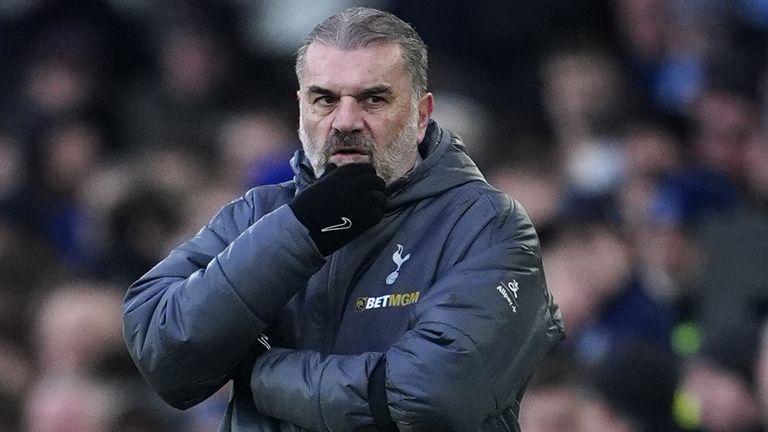
Listening to Ange Postecoglou describe the noise around Tottenham Hotspur’s season can feel like living in a world of extremes.

The highs of Frankfurt and the lows of any number of recent Premier League games are just the part on the football pitch. The Spurs head coach used the word “hysteria” at one point, when describing the external voices passing comment on his side.

“Within the football department we’ve tried to maintain a discipline about how we behave and keep the noise on the outside away from us,” he reveals.


Sunday 27th April 4:00pm


Kick off 4:30pm


“We came back from Frankfurt on a high and everyone was buzzing, then it was another disappointing game in the week [a 2-1 home defeat to Nottingham Forest] and that flips 180 degrees. From our perspective it’s really important we cocoon ourselves from it.”

Easier said than done, surely? “It’s not easy because as much as I can say to the players ‘block out the noise’, we all live in the outside world. If I could keep them locked up in here for the next month I’d be OK. What you look at is the behaviour of the players; the way they are training, the way they are talking. For the most part they are handling it pretty well.”

Please use Chrome browser for a more accessible video player
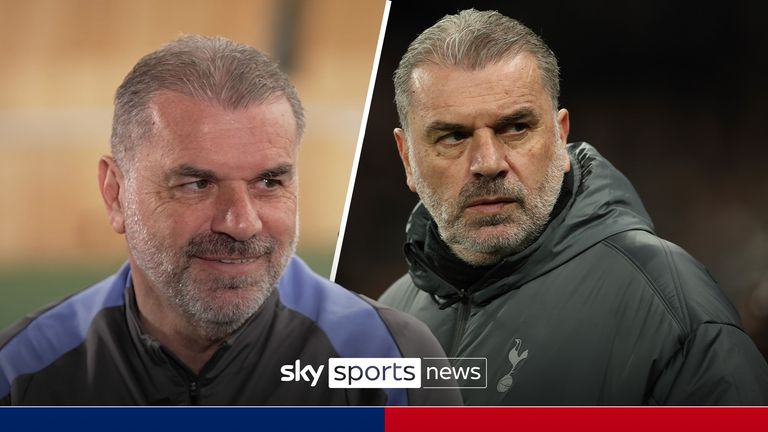
Ange Postecoglou believes his future is bright despite the growing pressure from critics on his Spurs tenure

What does irk Postecoglou is the idea that Spurs have reached this point where they could achieve European success, without meticulously building and preparing over the course of many weeks and months. He talks to the players about ‘The Stonecutter’s Credo’. It is an allegory from the Danish writer and photographer Jacob Riis:

When nothing seems to help, I go and look at a stonecutter hammering away at his rock, perhaps a hundred times without as much as a crack showing in it. Yet at the hundred and first blow it will split in two, and I know it was not that last blow that did it, but all that had gone before.

“Sometimes people look at success and look at the tail end of it and don’t realise what’s gone into it,” Postecoglou explains.

Ange Postecoglou during the Premier League match at Goodison Park

“A lot of it is work that is unseen or seems like you are not really progressing. For us, as difficult as the season has been, a lot of it has been good for us in terms of building resilience and staying united.

“I know that for us to break through and bring a trophy we are going to need bundles of that. We just need to keep banging away at the rock and hopefully on the 101st blow we will crack it.”

That final blow represents a possible Europa League Final triumph. It could either be a hugely exciting or frustrating outcome depending on whether or not the stone cracks.

Please use Chrome browser for a more accessible video player

FREE TO WATCH: Highlights from Wolverhampton Wanderers’ match against Tottenham Hotspur in the Premier League

“It just depends on how it pans out,” Postecoglou continues. “That’s the reality of football. Sometimes you don’t get what you deserve. I always found that’s short-term. Over the long course you will succeed. It’s about getting back at the rock and doing the right things all the time, I really believe in that.

“All the success I’ve had in my career, none of it has been instant, none of it has been because of one thing or one answer to everything. It’s about consistently – over and over again – trying to do the right things. Eventually success comes and sometimes it comes at unexpected times, it doesn’t come when you think it should.”

Postecoglou is in his 60th year and retains a sense of perspective that comes with the wisdom he has gained over time. He was just half that age when starting out in management at South Melbourne and admits that his younger self would not have coped with the pressures he is under today.

Please use Chrome browser for a more accessible video player
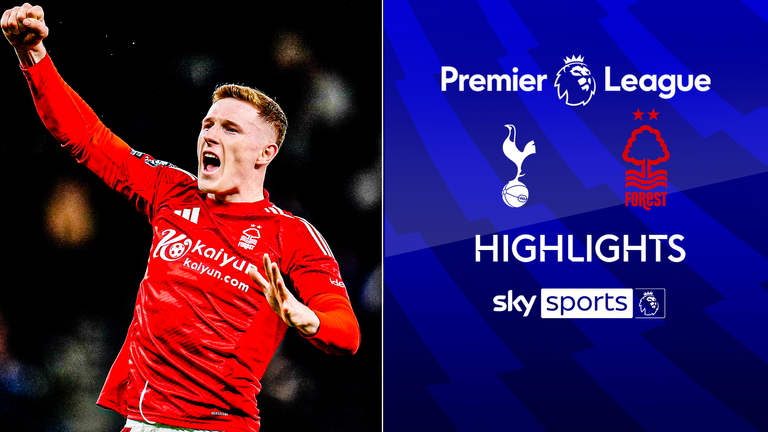
Highlights from the Premier League match between Tottenham Hotspur and Nottingham Forest

“No probably not, that’s the reality of it. Invariably when you are younger you take things a lot more personally, you think things are very definite in terms of the outcomes. Over the course of time you realise none of that is true, everything is just a moment in time and the moments all pass.

“It’s not that I never had pressure when I was younger, you always do. For all young managers the first job is really important because if you don’t succeed you might not get another opportunity. The pressure is always there, it’s just the noise now and the way the world has changed as well. There are so many more platforms.

“When I first started, the media used to be journalists and that was it. Now every platform you can think of has an opinion and they all have the ability to voice that opinion and it can feel really overwhelming, and the younger me would have struggled to cope with that.”

If Spurs can prevail in Europe then Postecoglou’s mission will arguably have been completed. He was tasked with reducing the age profile of the squad, changing the direction on the pitch and bringing success. It has been a hugely challenging campaign but one that can end with each of those boxes being ticked.

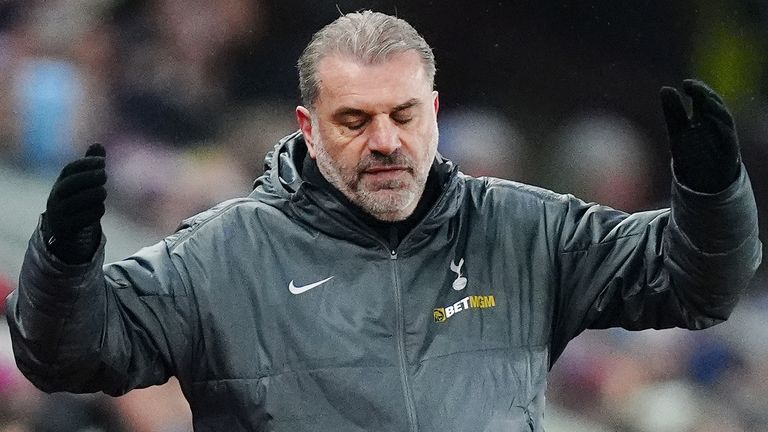
Ange Postecoglou shows his frustration after Spurs concede an opening minute goal at Villa Park

“Yes, that was the brief, that was why I came,” he adds. “To change the way the club played its football, to regenerate a squad because it was coming to the end of a cycle, and to win trophies.

“I still feel like that’s the motivation and they were the objectives for me coming here and that’s what I’m determined to see out. I haven’t tried to change the initial mission which was to play football that excites the fans, to bring some exciting young talent to the club, and hopefully succeed.”

And as the noise builds ahead of Sunday’s trip to Liverpool and that Europa League semi-final first leg against Bodo/Glimt on Thursday, Postecoglou will not let any of it affect his preparations for the biggest test of his Spurs career.

“Provided you stay true to yourself, your head hits the pillow at night and you’re fine. In those moments if you change what you believe in, or your values, or who you are as a person, that’s where you do have those sleepless nights.

“That’s happened at times in my career but as you get older you realise that it’s like every other storm, they all pass.”

Watch Liverpool vs Tottenham on Sunday from 4pm, live on Sky Sports; Kick-off 4.30pm



Source link

How Sarah Paiji Yoo, the Co-Founder of Blueland, Spends Her Sundays

0


Sarah Paiji Yoo started her career in finance and then founded several start-ups, mostly in the fashion and beauty worlds. But during parental leave after the birth of her first child, she realized how many microplastics her family was inadvertently consuming.

“I started to have mixed feelings around pushing people to buy more things, when I didn’t feel like they needed it,” Ms. Yoo, 40, said. “On the other side of becoming a mother, I realized I still loved working, and I still loved early-stage company building, but I just needed more meaning in the work that I was doing.”

So in 2019 she co-founded Blueland, reimagining household cleaning products to eliminate single-use plastic packaging. She appeared on “Shark Tank” (and scored a deal) that same year.

Her company sells tablets that can be mixed with water in reusable bottles to make things like hand soap and cleaning sprays, or dropped directly into a dishwasher, washing machine or toilet. The tablets come in compostable paper packaging.

Ms. Yoo is originally from Cerritos, Calif., and moved to New York City 19 years ago. She met her husband, Kenneth Yoo, at a bar; nine months after their first date, the two were engaged. They had their son Noah in 2017. Colin followed in 2020. The foursome moved into a five-bedroom co-op on the Upper West Side the next year.

MORNING SNUGGLES I don’t need an alarm clock on the weekends — I can definitely rely on my kids to wake me up. These days it’s around 6:30, maybe 6:40 if we’re lucky. They run into our room and we usually bring them into bed, not only because it’s a nice moment, but Ken and I are trying to squeeze in an extra few minutes in bed.

RUNNING SOLO A new thing that started this year is I go for a quick solo run. I turned 40 last year, and I think it’s just hitting me that exercise is important: being strong, not falling when I get older, and just being able to be around as long as I can. We live right by Riverside Park and it’s always a good reminder that, wow, Manhattan is an island! I feel so grateful to live less than a five-minute walk from the water.

COFFEE AND CROISSANTS I’ll run for 20 minutes and then I’ll swing back to pick up my reusable mugs to bring with me to the coffee shop. There’s a new French bakery that opened up nearby called La Farine Patisserie et Café. I love that it replaced a gigantic Starbucks.

For the kids, it’s a chocolate croissant and a plain croissant, one for each. I will do a baguette with butter and jam. One of the best parts of the weekend is I allow myself to buy coffee. It just tastes better when somebody else makes it.

PLAY BALL We are a baseball family through and through. My husband played Division I; he was a pitcher in college. So, many Sundays for our family in the spring are occupied by a good amount of baseball. Noah plays Little League, and Colin plays T-ball. Noah’s games are usually in Central Park or Randall’s Island on Sundays.

ECO-FRIENDLY ERRANDS On Sundays, we have this loop that we do. First, there’s the farmer’s market by the American Museum of Natural History. There are a few stands that we always hit up for our fresh produce and flowers; Wood Thrush Farm is my absolute fave. We used to bring our compost to the market, but now that the city rolled out the smart compost bins, we stop at one on the way. And if we have any textiles that we wouldn’t donate, we hit up the textile drop-off at the farmer’s market.

Ken and I both wear contact lenses and they aren’t recyclable by the city. What can be recycled with the city is anything that’s hard and firm, but anything that’s soft has to go through a different recycling stream that’s not available curbside. There’s an optometrist near our house where we can drop off any used contact lenses. And then we also drop off plastic film, bags and bubble wrap at the Fairway in our neighborhood.

There’s still a lot of plastic that, unfortunately, is not recyclable, even with flexible plastic recycling. For example, the kids want animal-shaped Cheddar crackers that come in a chip bag with that inside plastic lining. I think these are things that, in my heart of hearts, I would love for Blueland to also tackle — but probably not in the next, realistically, 10 years.

GARDENING If the kids don’t have a birthday party or play date, we might stop by the West Side Community Garden. I’m a member, even though we don’t have our own plot yet. It’s a requirement as a member to volunteer four hours a month. I’m on the flower committee and composting committee.

I SCREAM, YOU SCREAM Ken and I are firm believers: Weekends are for eating ice cream. Noah loves gelato; he loves Amorino. I love Salt & Straw, and that they encourage sampling. It’s also nice because they do the metal spoons for the sampling. I would not feel comfortable if they were like, “Oh, here’s another single-use, disposable spoon.” Colin and Ken love Gelateria Gentile. If we have time, the kids will scooter and we’ll just hit up all three.

SOAP TEST When we can, Ken and I try to do a date night on Sundays. Typically, his parents come in from Queens. When we get home, I’ll do some cleaning — as much as they’re family, it’s still my mother-in-law! During that period, if there’s anything I’m testing, I bring in my sons to help. It’s kind of fun, because my older son is old enough to be interested. We might be dissolving new hand soap scents or trying out new laundry tablets.

DATE NIGHT We love doing date night at, like, 5 p.m. The world is your oyster at 5 p.m. because you can get a lot of reservations. Our ideal date night is omakase and a foot massage. We’ll typically go to a local walk-in massage place — one of the ones where you just kind of sit in a chair in the open — and get a foot massage. And then we’ll be home for bedtime.

EARLY TO BED I like to go to bed on Sundays very early, with the kids. I’m admittedly really bad about getting enough sleep during the week. I’m trying to embrace that we’re still in the moment of time where the kids still want to snuggle in bed and still want me in their beds. It just feels so warm and it helps put me to sleep in a way that I think I struggle with during the week.


Source link

With Khloud, Khloe Kardashian Will Release a Protein-Packed Popcorn

0


Cereal. Ice cream. Flavored sparkling water. A Snickers bar. Donuts and brownies. Candy.

What sounds like the treats table at a child’s birthday party is, in fact, a list of snacks that can now be found crammed with protein.

Next week, Khloé Kardashian, the reality TV star and entrepreneur, will add her Khloud Protein Popcorn to the list. Her popcorn will come in three different flavors: white Cheddar, olive oil and sea salt, and sweet and salty. It will contain 7 grams of protein per serving, derived from the popcorn’s “Khloud Dust,” which is a blend of milk proteins and seasoning, according to a statement from Ms. Kardashian’s company, Khloud Foods.

“I’ve always been a snacker and constantly on the lookout for options that are convenient, healthy, and actually taste good,” Ms. Kardashian said in an emailed statement. With Khloud, Ms. Kardashian added, she wanted to create a snack that ticked those boxes and was “something I’d feel good sharing with family and friends.”

The introduction of Khloud Popcorn, which Ms. Kardashian announced on social media this week, fits with a broader food trend. Experts call it the “proteinification” of snacks, or desserts, or basically “everything,” said Jonathan Deutsch, a professor of culinary arts and science at Drexel University and a trend spotter for the Specialty Food Association, a national organization of food and beverage businesses. The brands hope to cash in on growing consumer demand for protein, which is driven largely by social media.

A trend report by Cargill, a company that sources and processes ingredients for food manufacturers, showed that 61 percent of surveyed consumers noted that they were hoping to increase their protein intake in 2024, up from 48 percent who said so in 2019. Sixty-three percent of consumers reported that they were looking for protein in their snacks in 2024.

The trend also stems from increased use of GLP-1 weight-loss drugs, like Ozempic and Mounjaro, said Dr. Lisa Young, a nutrition consultant and adjunct professor of nutrition at New York University. Those who use the weight-loss drugs report not only a loss in appetite but also a loss of muscle mass, which means that they are likely to try to pack as much protein as possible into the little that they do eat.

But, Dr. Young added, even people using GLP-1 drugs need only a fraction more protein than the recommended amount for an adult, which is 0.8 grams of protein per kilogram of body weight per day. People on the weight-loss drugs, and those who do intense workouts, like weight training, are advised to shoot for 1.2 to 1.5 grams of protein per kilogram of body weight.

Protein-enriched snacks, she added, can also fall under the category of ultra-processed foods, the consumption of which, she cautioned, can add to gut problems.

From a marketing perspective, Mr. Deutsch said, there are only three macronutrients that the food industry can try to target in its new product lines: fat, carbs and protein.

“They’re not going to have a ‘fat popcorn’ and they’re not going to have an ‘extra-carb popcorn,’” he said. “That leaves one macronutrient, right?”

According to Mr. Deutsch, an apple or popcorn “as God made it,” or even just a glass of water, could be seen as the ideal snacks for most people because, “when you walk around civil society, you’re not stumbling over people with protein deficiencies.”


Source link