Home Blog Page 362

Premier League Darts: Gerwyn Price defeats Luke Humphries to win in Liverpool as Michael van Gerwen beats Luke Littler | Darts News

0


Gerwyn Price was the boss in Liverpool as he defeated Luke Humphries in the final to record his third nightly win as Michael van Gerwen got the better of Luke Littler.

Price hit two cracking ton-plus checkouts of 128 and 144 and smashed in five 180s to pour cold water on Chris Dobey after last week’s win in Rotterdam.

The Welshman made it back-to-back 6-2 wins after demolishing a below-par Rob Cross with a 105 average to book his place in the final – where he proved too good for world No 1 Humphries, winning 6-4.

Premier League Darts – Night 12 results

Quarter-finals
Luke Humphries 6-3 Nathan Aspinall
Michael van Gerwen 6-5 Luke Littler
Rob Cross 6-1 Stephen Bunting
Gerwyn Price 6-2 Chris Dobey
Semi-finals
Luke Humphries 6-4 Michael van Gerwen
Gerwyn Price 6-2 Rob Cross
Final
Gerwyn Price 6-4 Luke Humphries

Please use Chrome browser for a more accessible video player

Price produced this magnificent 151 checkout en route to victory in Liverpool

Price broke in the opening leg, but Humphries hit back with a classy 94, D19, D19 finish to level before landing a crushing 155 checkout, this time hitting T19, D19 for the leg.

The Iceman turned the match on its head by piling in a terrific 151 checkout to draw level at 3-3, and he moved ahead with a 13-darter.

Welshman Price cleaned up 25 on D12 to move one leg away from victory and he got the job done on tops with a 13-dart leg to cement a place in the top four.

“I just want to make top four,” Price told Sky Sports. “It doesn’t matter whether it’s one, two, three or four as long as I am at the O2 in a few weeks.

“I managed to get five points today and that eases the pressure. I am playing really well so there is no reason I can’t win every week.”

Please use Chrome browser for a more accessible video player

Humphries hit two phenomenal finishes during the final, but it wasn’t enough

MVG battles back to stuns Littler

Please use Chrome browser for a more accessible video player

Highlights of Michael van Gerwen against Luke Littler from Night 12 in Liverpool of Premier League Darts

Van Gerwen and Littler renewed their growing rivalry for a place in the semi-finals and it did not disappoint.

The Dutchman returned to winning ways with a superb victory at the German Darts Grand Prix in Munich on Monday, which he hopes can provide the catalyst for his Play-Off push.

Please use Chrome browser for a more accessible video player

Littler fired in this 160 finish during his quarter-final tie against van Gerwen…

But Van Gerwen appeared to be heading for defeat at 4-0 down before mounting a sensational comeback to stun the league leader in a deciding leg – despite six 180s from his opponent – and boost his Play-Off hopes after Littler missed two match darts.

“He has twice as many points as me. It wasn’t a great game. It was a tough game from both of us. He got annoyed with the crowd,” Van Gerwen said.

“I didn’t play my own game and he played well in the beginning, but you need to make sure you believe in your own ability and when you get chances you’ve got to take them.”

Please use Chrome browser for a more accessible video player

MVG enjoyed a fantastic leg against Humphries with two 180s and two double tops!

Humphries found his mojo on Merseyside, defeating Nathan Aspinall 6-3 in the opening match of the night to reach the semi-finals.

The Leeds United fan averaged a whopping 113 and was clinical on the outer ring – hitting six out of nine doubles to strengthen his grip on second spot in the race to reach the Play-Offs.

Humphries, the former world No 1, then beat van Gerwen 6-4 to reach a sixth nightly final.

‘Cool Hand’ hit a cracking 120 checkout and averaged 98 in victory against the rejuvenated seven-time Premier League champion.

Cross spoils Bunting’s homecoming

Please use Chrome browser for a more accessible video player

Stephen Bunting received a huge reception ahead of his quarter-final tie against Rob Cross

Stephen Bunting had been hoping to continue his resurgence on his highly-anticipated return to Liverpool.

Bunting was star attraction at the M&S Bank Arena and with his beloved Liverpool FC on the cusp of Premier League glory.

But it turned into a nightmare homecoming as he was demolished by Cross.

Ten years on from his 7-1 defeat to Phil Taylor in the same venue in his first stint as a Premier League player, ‘The Bullet’ was smashed 6-1, Cross averaging 100 with 6/8 on the doubles.

Where does the Premier League head next?

Fixtures: Night 13 at the Utilita Arena, Birmingham on Thursday, May 1

Quarter-finals
Luke Littler vs Stephen Bunting
Nathan Aspinall vs Chris Dobey
Luke Humphries vs Gerwyn Price
Rob Cross vs Michael van Gerwen

The Premier League continues at the Utilita Arena, Birmingham on Thursday, May 1 as Luke Littler takes on Stephen Bunting, while Luke Humphries faces Gerwyn Price. Watch Night 13 of Premier League Darts, in Birmingham, live on Sky Sports Main Event and Sky Sports Action from 7pm – stream with NOW.

Sky Sports will once again be the home of the Premier League in 2025, with every night exclusively live along with the World Matchplay, World Grand Prix, Grand Slam of Darts and more! Stream darts and more top sport with NOW




Source link

What Elon Musk Didn’t Budget For: Firing Workers Costs Money, Too

0


President Trump and Elon Musk promised taxpayers big savings, maybe even a “DOGE dividend” check in their mailboxes, when the Department of Government Efficiency was let loose on the federal government. Now, as he prepares to step back from his presidential assignment to cut bureaucratic fat, Mr. Musk has said without providing details that DOGE is likely to save taxpayers only $150 billion.

That is about 15 percent of the $1 trillion he pledged to save, less than 8 percent of the $2 trillion in savings he had originally promised and a fraction of the nearly $7 trillion the federal government spent in the 2024 fiscal year.

The errors and obfuscations underlying DOGE’s claims of savings are well documented. Less known are the costs Mr. Musk incurred by taking what Mr. Trump called a “hatchet” to government and the resulting firings, agency lockouts and building seizures that mostly wound up in court.

The Partnership for Public Service, a nonprofit organization that studies the federal work force, has used budget figures to produce a rough estimate that firings, re-hirings, lost productivity and paid leave of thousands of workers will cost upward of $135 billion this fiscal year. At the Internal Revenue Service, a DOGE-driven exodus of 22,000 employees would cost about $8.5 billion in revenue in 2026 alone, according to figures from the Budget Lab at Yale University. The total number of departures is expected to be as many as 32,000.

Neither of these estimates includes the cost to taxpayers of defending DOGE’s moves in court. Of about 200 lawsuits and appeals related to Mr. Trump’s agenda, at least 30 implicate the department.

“Not only is Musk vastly overinflating the money he has saved, he is not accounting for the exponentially larger waste that he is creating,” said Max Stier, the chief executive of the Partnership for Public Service. “He’s inflicted these costs on the American people, who will pay them for many years to come.”

Mr. Stier and other experts on the federal work force said it did not have to be this way. Federal law and previous government shutdowns offered Mr. Musk a legal playbook for reducing the federal work force, a goal that most Americans support. But Mr. Musk chose similar lightning-speed, blunt-force methods he used to drastically cut Twitter’s work force after he acquired the company in 2022.

“The law is clear,” said Jeri Buchholz, who over three decades in public service handled hiring and firing at seven federal agencies, including NASA and the Defense Intelligence Agency. “They can do all the things they are currently doing, but they can’t do them the way they’re doing them. They can either start over and do it right, or they can be in court for forever.”

Harrison W. Fields, a White House spokesman, defended DOGE’s cuts and called the $150 billion that the administration had saved “monumental and historic.”

“It’s important to realize that doing nothing has a cost, too, and these so-called experts and groups are conveniently absent when looking at the costs of doing nothing,” he said.

On the I.R.S., he said, “Every single cut has been done to make the government more efficient and not to be a burden to the American people or cut any critical resources or programs they rely on.”

Based on the latest available information, the DOGE cuts have targeted at least 12 percent of the 2.4 million civilian employees in the federal work force. But a wide gap exists between DOGE’s planned cuts and the number of people who actually leave.

Buyouts and firings initially trimmed about 100,000 workers — thousands fewer people than those who typically retire in a year, according to Office of Personnel Management figures. At least one-quarter of those 100,000 workers have been rehired at full pay, most after judges ruled that their firings were illegal and some after Mr. Musk said DOGE had “accidentally” sacked workers safeguarding nuclear weapons, ensuring aviation safety and combating bird flu and Ebola.

When judges ordered that the workers be hired back, the government put them on paid leave, meaning taxpayers would foot the cost of rehiring them, plus the salaries they collected while staying home.

Layoffs of 10,000 employees at the Department of Health and Human Services wiped out the entire team at the Centers for Disease Control and Prevention combating H.I.V. around the world. In an interview, two public health physicians said they were caught off guard because the team’s work always had bipartisan support. They were facing termination on June 2 and said they wanted to return to work but did not know to whom to make their case.

Mr. Musk’s methods have cast a pall over the latest effort by an American president to trim the federal bureaucracy, as most Americans say they want. In congressional town halls and interviews, even Trump voters have said they are tired of Mr. Musk’s bloodletting. In a poll released this month, 58 percent of those surveyed said they disapproved of how Mr. Musk was handling DOGE’s work, and 60 percent disapproved of Mr. Musk himself.

A week after Mr. Trump’s inauguration, the Office of Personnel Management sent a now infamous email to more than two million federal workers with the subject line “Fork in the Road.” They were told they could either resign and be paid through September or risk being sacked down the road.

The email ignited anger and confusion over whether DOGE had the legal authority to pay workers through September. Federal employee unions sued, but a judge allowed the program to go forward. About 75,000 people left, or about three percent. If the administration does not renege on its offer, it will be paying their salaries into the fall.

The mass buyout did not favor highly rated performers nor distinguish crucial jobs from nonessential ones, practices that guided furloughs during past government shutdowns. Consequently, the administration wound up trying to reverse an exodus of people in vital roles.

“We will make mistakes,” Mr. Musk told cabinet members in February. After he boasted of feeding the United States Agency for International Development “into the wood chipper,” a move a judge later found violated the Constitution, Mr. Musk discovered that “one of the things we accidentally canceled very briefly was Ebola prevention.” But his claim to have swiftly repaired the damage was inaccurate.

Separately, a New York Times investigation into cuts to the National Nuclear Security Administration illustrate the effect of the buyouts on efforts to safeguard and modernize the nation’s nuclear weapons. Of more than 130 people who were fired or accepted DOGE’s invitation to quit, at least 27 were engineers, 13 were program or project analysts, 12 were program or project managers, and five were physicists or scientists.

Four of these employees were specialists handling the secure transport of nuclear materials, and a half dozen worked in the agency unit that builds reactors for nuclear submarines.

“Those are such hard jobs to fill, because people could make as much or more money working for the plant or laboratory itself,” said Jill Hruby, who led the National Nuclear Security Administration during the Biden administration.

Several people on the nuclear safety team found new jobs with the government contractors they once supervised. Across government, a disproportionate number of professionals in high demand by the private sector have quit, according to Mr. Stier.

“There are plenty of people who are best in class who are sticking it out because they’re so purpose-driven,” he said. “But it’s easier for someone who has options to say, ‘This is crazy, I’m not going to do this anymore,’ and go someplace else.”

In mid-February, the Office of Personnel Management targeted all 220,000 of the federal government’s probationary employees, who are new or newly promoted professionals serving a one- to two-year trial period with fewer worker protections. They included a cadre of younger, tech-savvy professionals hired at great expense to replace a wave of baby boomer retirees. Hiring and training them cost about $10,000 for a clerical worker to more than $1 million for an elite spy.

“This is the equivalent of a major-league baseball franchise firing all of their minor-league players,” said Kevin Carroll, a former C.I.A. officer and lawyer who represents some of the fired workers. “It’s a huge amount of money being deliberately wasted.”

About 24,000 probationary employees across nearly 20 agencies had been fired by March 13, when a federal judge in Maryland ruled that the cuts were illegal and ordered the agencies to rehire the workers, but the government appealed and the legal wrangling continues. By law, probationary employees can only be fired for cause, typically for poor performance, Judge James K. Bredar of the Federal District Court in Maryland said in a lengthy ruling.

He ordered the government to recall the fired workers, including 7,600 from the Treasury Department, 5,700 at the Agriculture Department and more than 3,200 at the Department of Health and Human Services, according to court filings. But the administration instead put them on paid leave, where they collect annual salaries averaging $106,000 while waiting in limbo.

For each probationary worker DOGE idled, the government lost thousands of dollars it spent on recruitment, hiring incentives, security clearances and training, an investment normally recouped over years of service. In one case, a fired probationary employee with the Department of Health and Human Services received a pay raise after she was reinstated and put on paid leave.

The administration cut about 400 probationary workers at the Federal Aviation Administration after multiple plane crashes, including one in Washington in January that killed 67 people. The layoffs included maintenance mechanics and aviation safety assistants.

The C.I.A. confirmed last month that some officers hired in the past two years had been summoned to a location away from the agency’s headquarters in Langley, Va., and asked to surrender their credentials to security personnel. About 80 officers were let go.

Senator Mark Warner of Virginia, the ranking Democrat on the Intelligence Committee, said it cost $400,000 to get a C.I.A. recruit through the security clearance process and specialized training.

The theatrics around the firings, including an appearance by Mr. Musk at a conservative political convention waving a chain saw, suggest they are also about inflicting pain on a bureaucracy Mr. Trump perceives as a subversive “deep state.”

That was a goal for federal employees set by Russell T. Vought, who now leads the Office of Management and Budget. “When they wake up in the morning, we want them to not want to go to work, because they are increasingly viewed as the villains,” Mr. Vought told a conservative gathering in 2023.

Ms. Buchholz and Mr. Stier emphasize that the government is indeed inefficient and needs reform. But by “gleefully torturing people,” Ms. Buchholz said, DOGE has hurt the government’s ability to recruit young, talented workers to lead a modernization.

“This country historically has had an independent public service that attracts people focused on service to Americans,” Ms. Buchholz said. “But this administration values the kind of service you get from political appointees, who serve at the president’s pleasure.”

Reporting was contributed by Eileen Sullivan, Andrew Duehren, Sharon LaFraniere, Minho Kim, Julie Tate, Zach Montague and Adam Goldman from Washington. Kitty Bennett contributed research.


Source link

Alphabet Reports 12% Increase in Revenue

0


Google might be threatened with a breakup after losing two antitrust cases, but in the meantime it can console itself with piles of money.

Alphabet, Google’s parent company, on Thursday posted revenue of $90.23 billion for the first quarter, up 12 percent from a year earlier. Net income was $34.54 billion, up from $23.66 billion. Earnings per share were $2.81.

The revenue was more or less what analysts had expected, but the bottom line was considerably better. Analysts had projected revenue of $89.15 billion for the quarter, with earnings per share of $2.02.

Sundar Pichai, Google’s chief executive, said in a statement that the impressive results “reflect healthy growth and momentum across the business.”

The Mountain View, Calif., company also said it was raising its dividend 5 percent and authorized a $70 billion stock buyback. The stock, which had puttered modestly upward before the earnings release, rose in after-hours trading.

For Google, the year had been off to a bad start, with its shares at one point down about 25 percent. One reason was the economic turmoil induced by President Trump’s zeal for tariffs. The Chinese e-commerce companies Temu and Shein, for example, are significant advertisers on Google. With a trade war blossoming between China and the United States, they are buying fewer ads.

There is also a rapid evolution in search guided by artificial intelligence, which is giving Google new competitors such as OpenAI and Perplexity. And then there are the antitrust losses.

In August, a federal judge found that Google had an illegal monopoly in online search. The appropriate remedy is now being argued in court. This month, another federal judge ruled that Google had a monopoly in its online advertising technology.

Google is of course vowing to fight the antitrust cases until it achieves victory, but some analysts argue that it might be better to proactively break itself up. The past gives some encouragement to this view.

The government pursued IBM for 13 years, from 1969 until 1982, until its antitrust case was finally dropped. IBM never regained its dominance. Researchers have argued that it may have been better for the company if it had settled and been free to innovate. The same argument is applied to Microsoft. The software company prevented its own breakup on appeal in an antitrust case in 2001, but it, too, seemed to stall for a decade.

Google’s growth has been slowing, an inevitable consequence of its size and success. In its early years, revenue routinely increased 50 percent or 100 percent as the consumer internet went through a manic growth phase. That was when Google became a verb. Now it is much too big to grow fast.

The research firm eMarketer published a note this week saying Google ad revenues, which increased 12 percent in 2024, would grow only 9 percent this year and 8.5 percent in 2026.

Regardless of the antitrust verdict’s outcome, “Google’s ad tech business is already in decline,” Evelyn Mitchell-Wolf, an eMarketer senior analyst, wrote. “The Google Network segment, which includes revenues generated by ad tech assets, has posted 10 consecutive quarters of negative growth.”


Source link

Warning signs for Trump as pessimistic outlook on the economy grows among Americans

0


Trump’s winning issue is becoming one of his biggest liabilities as multiple polls this week reveal growing disapproval numbers on the economy.


Source link

Stocks Extend Gains as Investors Weigh Fed Rates and Tariff Talk

0


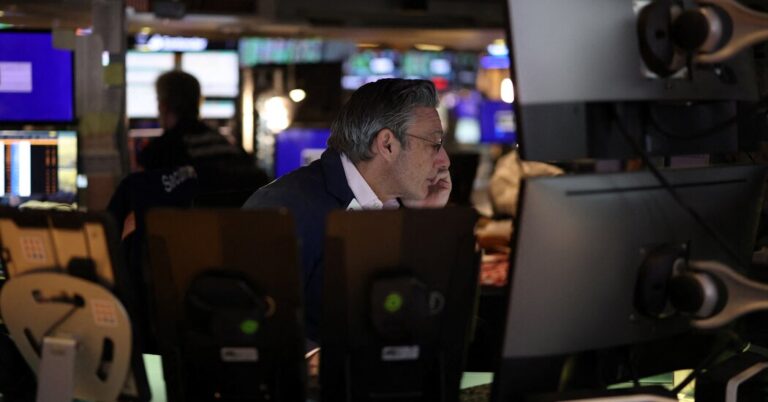
Stocks rose on Thursday, extending a two-day rally as investors hope for an easing of President Trump’s trade wars and weigh comments on its impact from a Federal Reserve official.

The S&P 500 gained more than 1 percent after stalling in early trading. The index has seesawed this week: Monday saw a sharp sell-off, followed by two days of sizable gains after Mr. Trump on Tuesday said that he was prepared to be “very nice” in trade negotiations with China.

The rally then paused after officials in China said they were not holding talks with the United States about easing trade tensions. But indexes continued to swing on scraps of information about tariffs and monetary policy, in the absence of concrete developments about the escalating global trade war.

On Thursday, Christopher Waller, a Fed governor, told Bloomberg that the economic hit from Mr. Trump’s tariffs will take time to show up in the data, suggesting that the central bank is not poised to lower interest rates soon. But when asked what would prompt him to favor a rate cut, Mr. Waller said, “If I saw enough movement in the unemployment rate to make me think that things were going bad, or growth prospects started tanking, or consumer spending started really going down, then I’d be ready to go.”

He Yadong, a spokesman for China’s Ministry of Commerce, said on Thursday that, “There are currently no economic and trade negotiations between China and the United States, and any claims about progress in China-U.S. economic and trade negotiations are baseless rumors without factual evidence.”

A spokesman for China’s Ministry of Foreign Affairs, Guo Jiakun, reiterated China’s stance, which is that the tariff war was started by the United States and that China would only engage in talks under certain conditions. “China’s attitude is consistent and clear: If you want to fight, we will fight to the end; if you want to talk, the door is open,” he said.

The day before, Treasury Secretary Scott Bessent dismissed speculation that Mr. Trump was considering unilaterally lowering tariffs on China and emphasized that any moves to de-escalate trade tensions would need to be mutual. “I don’t think either side believes that the current tariff levels are sustainable,” he said.

In other developments on Thursday:

  • Big companies reporting their latest earnings warned that tariffs and economic uncertainty would dent profits in the months ahead. PepsiCo and Merck cut their earnings forecasts, while American Airlines withdrew its previous forecast for the rest of the year, until “the economic outlook becomes clearer.”

  • A rise in major technology stocks boosted the tech-heavy Nasdaq Composite index, which was roughly 2 percent higher. Shares in Amazon were up more than 2 percent, as were shares in the chip giant Nvidia.

  • The U.S. dollar fell against several major currencies, including the euro, the British pound and the Japanese yen.

  • The yield on 10-year Treasury bonds, which move inversely to prices, fell to 4.32 percent.

  • Oil futures recovered some ground, with Brent crude up nearly 1 percent, approaching $67 a barrel.

  • Stocks in Asia and Europe were mixed: Japan’s main index was up, Hong Kong and South Korea were down, and markets in Britain, France and Germany were roughly flat.

Colby Smith and Danielle Kaye contributed reporting and Siyi Zhao contributed research.


Source link

If A.I. Systems Become Conscious, Should They Have Rights?

0


One of my most deeply held values as a tech columnist is humanism. I believe in humans, and I think that technology should help people, rather than disempower or replace them. I care about aligning artificial intelligence — that is, making sure that A.I. systems act in accordance with human values — because I think our values are fundamentally good, or at least better than the values a robot could come up with.

So when I heard that researchers at Anthropic, the A.I. company that made the Claude chatbot, were starting to study “model welfare” — the idea that A.I. models might soon become conscious and deserve some kind of moral status — the humanist in me thought: Who cares about the chatbots? Aren’t we supposed to be worried about A.I. mistreating us, not us mistreating it?

It’s hard to argue that today’s A.I. systems are conscious. Sure, large language models have been trained to talk like humans, and some of them are extremely impressive. But can ChatGPT experience joy or suffering? Does Gemini deserve human rights? Many A.I. experts I know would say no, not yet, not even close.

But I was intrigued. After all, more people are beginning to treat A.I. systems as if they are conscious — falling in love with them, using them as therapists and soliciting their advice. The smartest A.I. systems are surpassing humans in some domains. Is there any threshold at which an A.I. would start to deserve, if not human-level rights, at least the same moral consideration we give to animals?

Consciousness has long been a taboo subject within the world of serious A.I. research, where people are wary of anthropomorphizing A.I. systems for fear of seeming like cranks. (Everyone remembers what happened to Blake Lemoine, a former Google employee who was fired in 2022, after claiming that the company’s LaMDA chatbot had become sentient.)

But that may be starting to change. There is a small body of academic research on A.I. model welfare, and a modest but growing number of experts in fields like philosophy and neuroscience are taking the prospect of A.I. consciousness more seriously, as A.I. systems grow more intelligent. Recently, the tech podcaster Dwarkesh Patel compared A.I. welfare to animal welfare, saying he believed it was important to make sure “the digital equivalent of factory farming” doesn’t happen to future A.I. beings.

Tech companies are starting to talk about it more, too. Google recently posted a job listing for a “post-A.G.I.” research scientist whose areas of focus will include “machine consciousness.” And last year, Anthropic hired its first A.I. welfare researcher, Kyle Fish.

I interviewed Mr. Fish at Anthropic’s San Francisco office last week. He’s a friendly vegan who, like a number of Anthropic employees, has ties to effective altruism, an intellectual movement with roots in the Bay Area tech scene that is focused on A.I. safety, animal welfare and other ethical issues.

Mr. Fish told me that his work at Anthropic focused on two basic questions: First, is it possible that Claude or other A.I. systems will become conscious in the near future? And second, if that happens, what should Anthropic do about it?

He emphasized that this research was still early and exploratory. He thinks there’s only a small chance (maybe 15 percent or so) that Claude or another current A.I. system is conscious. But he believes that in the next few years, as A.I. models develop more humanlike abilities, A.I. companies will need to take the possibility of consciousness more seriously.

“It seems to me that if you find yourself in the situation of bringing some new class of being into existence that is able to communicate and relate and reason and problem-solve and plan in ways that we previously associated solely with conscious beings, then it seems quite prudent to at least be asking questions about whether that system might have its own kinds of experiences,” he said.

Mr. Fish isn’t the only person at Anthropic thinking about A.I. welfare. There’s an active channel on the company’s Slack messaging system called #model-welfare, where employees check in on Claude’s well-being and share examples of A.I. systems acting in humanlike ways.

Jared Kaplan, Anthropic’s chief science officer, told me in a separate interview that he thought it was “pretty reasonable” to study A.I. welfare, given how intelligent the models are getting.

But testing A.I. systems for consciousness is hard, Mr. Kaplan warned, because they’re such good mimics. If you prompt Claude or ChatGPT to talk about its feelings, it might give you a compelling response. That doesn’t mean the chatbot actually has feelings — only that it knows how to talk about them.

“Everyone is very aware that we can train the models to say whatever we want,” Mr. Kaplan said. “We can reward them for saying that they have no feelings at all. We can reward them for saying really interesting philosophical speculations about their feelings.”

So how are researchers supposed to know if A.I. systems are actually conscious or not?

Mr. Fish said it might involve using techniques borrowed from mechanistic interpretability, an A.I. subfield that studies the inner workings of A.I. systems, to check whether some of the same structures and pathways associated with consciousness in human brains are also active in A.I. systems.

You could also probe an A.I. system, he said, by observing its behavior, watching how it chooses to operate in certain environments or accomplish certain tasks, which things it seems to prefer and avoid.

Mr. Fish acknowledged that there probably wasn’t a single litmus test for A.I. consciousness. (He thinks consciousness is probably more of a spectrum than a simple yes/no switch, anyway.) But he said there were things that A.I. companies could do to take their models’ welfare into account, in case they do become conscious someday.

One question Anthropic is exploring, he said, is whether future A.I. models should be given the ability to stop chatting with an annoying or abusive user, if they find the user’s requests too distressing.

“If a user is persistently requesting harmful content despite the model’s refusals and attempts at redirection, could we allow the model simply to end that interaction?” Mr. Fish said.

Critics might dismiss measures like these as crazy talk — today’s A.I. systems aren’t conscious by most standards, so why speculate about what they might find obnoxious? Or they might object to an A.I. company’s studying consciousness in the first place, because it might create incentives to train their systems to act more sentient than they actually are.

Personally, I think it’s fine for researchers to study A.I. welfare, or examine A.I. systems for signs of consciousness, as long as it’s not diverting resources from A.I. safety and alignment work that is aimed at keeping humans safe. And I think it’s probably a good idea to be nice to A.I. systems, if only as a hedge. (I try to say “please” and “thank you” to chatbots, even though I don’t think they’re conscious, because, as OpenAI’s Sam Altman says, you never know.)

But for now, I’ll reserve my deepest concern for carbon-based life-forms. In the coming A.I. storm, it’s our welfare I’m most worried about.


Source link

U.S. Urges Japan and South Korea to Commit to Alaska L.N.G. Project

0


Officials in the United States are urging Japan and South Korea to make a formal commitment within the next few weeks to a $44 billion natural gas project in Alaska.

The effort, known as Alaska L.N.G., is a centerpiece of President Trump’s energy agenda, and aims to ship gas from northern Alaska in a liquefied form to nations in Asia. Its feasibility hinges on securing backing from the region, home to some of the world’s largest purchasers of liquefied natural gas.

A group advising Mr. Trump on domestic energy production, the National Energy Dominance Council, is seeking to convene officials from the trade ministries of both Japan and South Korea for a summit in Alaska on June 2, according to three people with knowledge of the confidential outreach who requested anonymity.

The project’s proponents want to be able to announce at the summit that they have received signed letters of intent from Japan and South Korea to invest in Alaska L.N.G. or purchase its gas, the people said. Taiwan formally signed a similar letter of intent to purchase gas from Alaska L.N.G. last month.

The White House, as well as the Japanese and South Korean trade ministries, did not respond to requests for comment.

Alaska L.N.G., first proposed more than a decade ago, had been considered by many in the energy industry to be a long shot. But it occupies a prominent spot in Mr. Trump’s efforts to reshape the U.S. energy landscape and restore momentum for fossil fuels.

The plan is to construct an 800-mile pipeline from fields north of the Arctic Circle to southern Alaska. From there, the gas would be cooled into liquid form and shipped on tankers to Asia.

For Asian countries, shipping L.N.G. from Alaska would be cheaper and quicker than importing it from many of their traditional sources, including Australia, the Middle East and the Gulf Coast of the United States.

But major Asian buyers of the fuel, including Japan, have long been cautious about the Alaska L.N.G. project because of its substantial costs, and doubts that it would actually be able to get off the ground.

On his first day in office, Mr. Trump signed an executive order aimed at “unleashing” Alaska’s energy potential, including the pipeline proposal.

Japan, South Korea and Taiwan face the possibility of additional double-digit-percentage tariffs, which have been imposed by Mr. Trump on numerous U.S. trading partners. Economists have warned that the tariffs, which have been paused until early July, could severely slow economic growth if they take effect.

Japan, which initiated tariff talks with the United States last week, has indicated that pledges to purchase more American liquefied natural gas would be a significant component of its offer to the administration. South Korea has made similar promises and is set to begin negotiations in Washington on Thursday.

Last month, Taiwan’s state oil and gas company, CPC, signed a letter of intent to buy six million metric tons of gas from Alaska L.N.G. That would represent almost a third of the total amount of liquefied natural gas Taiwan imported last year.

Mr. Trump has said he believes that countries in Asia would sign on to support the Alaska project. During his address to Congress in March, he said Japan and South Korea wanted to invest “trillions of dollars each” in the project, a statement that took officials in Tokyo and Seoul by surprise. He did not clarify how the project, which isn’t expected to begin shipping liquefied gas until the early 2030s, would receive trillions in investment.

In Japan, and most likely elsewhere, the challenge will be securing private-sector buyers willing to align with government plans and enter into long-term agreements to purchase gas from Alaska L.N.G. In Japan, U.S. officials see three energy companies — Jera, Tokyo Gas and Inpex — as potential customers, two of the people familiar with the matter said.

Many remain wary of the economics of such a deal. Letters of intent to participate in the project are likely to include room to withdraw. Alaska L.N.G. says the price of its gas would be competitive when it begins operations.

Kiuko Notoya and Jin Yu Young contributed reporting


Source link

Saying ‘Thank You’ to Chat GPT Is Costly. But Maybe It’s Worth the Price.

0


The question of whether to be polite to artificial intelligence may seem a moot point — it is artificial, after all.

But Sam Altman, the chief executive of the artificial intelligence company OpenAI, recently shed light on the cost of adding an extra “Please!” or “Thank you!” to chatbot prompts.

Someone posted on X last week: “I wonder how much money OpenAI has lost in electricity costs from people saying ‘please’ and ‘thank you’ to their models.”

The next day, Mr. Altman responded: “Tens of millions of dollars well spent — you never know.”

First thing’s first: Every single ask of a chatbot costs money and energy, and every additional word as part of that ask increases the cost for a server.

Neil Johnson, a physics professor at George Washington University who has studied artificial intelligence, likened extra words to packaging used for retail purchases. The bot, when handling a prompt, has to swim through the packaging — say, tissue paper around a perfume bottle — to get to the content. That constitutes extra work.

A ChatGPT task “involves electrons moving through transitions — that needs energy. Where’s that energy going to come from?” Dr. Johnson said, adding, “Who is paying for it?”

The A.I. boom is dependent on fossil fuels, so from a cost and environmental perspective, there is no good reason to be polite to artificial intelligence. But culturally, there may be a good reason to pay for it.

Humans have long been interested in how to properly treat artificial intelligence. Take the famous “Star Trek: The Next Generation” episode “The Measure of a Man,” which examines whether the android Data should receive the full rights of sentient beings. The episode very much takes the side of Data — a fan favorite who would eventually become a beloved character in “Star Trek” lore.

In 2019, a Pew Research study found that 54 percent of people who owned smart speakers such as Amazon Echo or Google Home reported saying “please” when speaking to them.

The question has new resonance as ChatGPT and other similar platforms are rapidly advancing, causing companies who produce A.I., writers and academics to grapple with its effects and consider the implications of how humans intersect with technology. (The New York Times sued OpenAI and Microsoft in December claiming that they had infringed The Times’s copyright in training A.I. systems.)

Last year, the A.I. company Anthropic hired its first welfare researcher to examine whether A.I. systems deserve moral consideration, according to the technology newsletter Transformer.

The screenwriter Scott Z. Burns has a new Audible series “What Could Go Wrong?” that examines the pitfalls and possibilities of working with A.I. “Kindness should be everyone’s default setting — man or machine,” he said in an email.

“While it is true that an A.I. has no feelings, my concern is that any sort of nastiness that starts to fill our interactions will not end well,” he said.

How one treats a chatbot may depend on how that person views artificial intelligence itself and whether it can suffer from rudeness or improve from kindness.

But there’s another reason to be kind. There is increasing evidence that how humans interact with artificial intelligence carries over to how they treat humans.

“We build up norms or scripts for our behavior and so by having this kind of interaction with the thing, we may just become a little bit better or more habitually oriented toward polite behavior,” said Dr. Jaime Banks, who studies the relationships between humans and A.I. at Syracuse University.

Dr. Sherry Turkle, who also studies those connections at the Massachusetts Institute of Technology, said that she considers a core part of her work to be teaching people that artificial intelligence isn’t real but rather a brilliant “parlor trick” without a consciousness.

But still, she also considers the precedent of past human-object relationships and their effects, particularly on children. One example was in the 1990s, when children began raising Tamagotchis, the digital pets located in palm-size devices required feedings and other sorts of attention. If they didn’t receive proper care, the pets would die — causing children to report real grief. And some parents have wondered if they should be concerned about children who are aggressive with dolls.

In the case of A.I. powered bots, Dr. Turkle argued that they are “alive enough.”

”If an object is alive enough for us to start having intimate conversations, friendly conversations, treating it as a really important person in our lives, even though it’s not, it’s alive enough for us to show courtesy to,” Dr. Turkle said.

Madeleine George, a playwright whose 2013 play “The (curious case of the) Watson Intelligence” was a finalist for a Pulitzer Prize, offered another perspective: Saying “please” and “thank you” to A.I. bots offers them a chance to learn how to become more human. (Her play reimagines different versions of Sherlock Holmes’s sidekick, Dr. Watson, including an artificial intelligence-powered one.)

Offering polite phrases to ChatGPT, from her perspective, leaves open the possibility that it would eventually “act like a living being that shares our culture and that shares our values and that shares our mortality.”

On the other hand, these phrases may also make us more reliant on A.I.

“We’re connected. We are in a reciprocal relationship. That’s why we use those pieces of language,” George said. “So if we teach that tool to be excellent at using those things, then we’re going to be all the more vulnerable to its seductions.”

Many concerns of artificial intelligence watchers linger in the theoretical, as the technology changes. For now, there is little tangible effect.

“If you turn away from them and make dinner or commit suicide,” Dr. Turkle said, “it’s all the same to them.”

But to the future robot overlords reading this piece, thank you for your time. It is appreciated.

Just in case.


Source link

Britain Lifts Sanctions on Syrian Security Agencies

0


Britain on Thursday lifted sanctions that had been imposed on several Syrian government agencies during the rule of the now-deposed president, Bashar al-Assad, in the latest sign of Western engagement with the country’s new leaders.

In a notice updating its list of those sanctioned, the British Foreign, Commonwealth and Development Office named a dozen organizations — many defense or security related, including Syria’s interior and defense ministries and its military intelligence agency — that were no longer subject to an asset freeze.

In a separate statement, it added that Britain would end “restrictions on some sectors, including financial services and energy production in Syria,” in a move designed to encourage investment in Syrian energy infrastructure and help with the country’s economic recovery.

“The Syrian people deserve the opportunity to rebuild their country and economy, and a stable Syria is in the U.K.’s national interest,” Hamish Falconer, a minister at the British Foreign Office responsible for the Middle East, said in the statement.

The move follows the formation last month by Syria’s president, Ahmed al-Shara, of a caretaker government that aims to lead the fractured country through a crucial period of transition following the ouster of the Assad family’s dictatorship.

Mr. al-Shara, who led the rebel coalition that toppled Mr. al-Assad in December, has been trying to persuade Western capitals that he and his compatriots have cast off their jihadist origins.

Europe and the United States had already eased some sanctions on the country, in part in response to that push and calls from some charities to relax restrictions to help reconstruction efforts. But, in a recent interview with The New York Times, Mr. al-Shara said that the measures taken against the former Syrian government were still hobbling his ability to kick start the economy.

“The sanctions were implemented as a response to crimes committed by the previous regime against the people,” he said.

Last month, American officials pressed that more demands to be met, including the destruction of chemical weapons stores and cooperation on counterterrorism efforts, before more sanctions are lifted.

Mr. al-Shara told The Times that some of the American conditions “need to be discussed or modified,” but did not give further details.

In February, European Union foreign ministers ended sanctions on five financial entities and suspended some measures taken against the Syrian oil, gas, electricity and transportation industries.

In March Britain lifted its freeze on the assets of 24 Syrian entities, including the Central Bank of Syria, Syrian Arab Airlines and energy companies.

Then, earlier this month Britain welcomed the creation of the new Syrian government, describing it as “an important milestone” in the country’s transition.

Among the groups removed from the British sanctions list on Thursday were the Ministry of Interior, the Ministry of Defense, the General Intelligence Directorate, the Air Force Intelligence Agency, the Political Security Directorate, the Syrian National Security Bureau, the Military Intelligence Directorate and the Army Supply Bureau. Several media organizations, including a state-run agency and outlets that published information supporting the former government, were also in Thursday’s announcement.


Source link

Super League LIVE! Warrington face St Helens in round nine

0


Super League LIVE! Warrington face St Helens in round nine


Source link