Home Blog Page 37

Remembering civil rights icon Joanne Bland : NPR

0


AYESHA RASCOE, HOST:

Before I met Joanne Bland back in 2022, I was told to expect a bossy grandmother who is totally awesome.

(SOUNDBITE OF ARCHIVED NPR CONTENT)

RASCOE: Should I call you Miss Bland?

JOANNE BLAND: Most people call me Miss Bland…

RASCOE: Miss Bland.

BLAND: …If they’re younger than me.

RASCOE: (Laughter) Well, I’m going to call you Miss Bland.

Miss Bland drove me around Selma, Alabama, wearing a T-shirt that said kindness. She spent more than 30 years guiding visitors through the city where she was born, and she had a story for every block.

(SOUNDBITE OF ARCHIVED NPR CONTENT)

BLAND: We are now turning on to Water Avenue, one of the first streets in Selma when Selma became a city. At one period in our history, this was as far inland as you could come from the Gulf of Mexico into the state of Alabama, so it made Selma a major trade mecca. You see this red building on the right?

RASCOE: Yeah.

BLAND: This was a slave holding pen. The slaves were brought up from the river and housed on the second floor.

RASCOE: Journeys for the soul – that’s what Joanne Bland called her tours. Bland was just 11 years old on March 7, 1965, the day now known as Bloody Sunday. She had come with her older sister to join a march from Selma to the state capital in Montgomery. Before they’d even left Selma, the activists, led by Hosea Williams of the Southern Christian Leadership Conference and John Lewis of the Student Nonviolent Coordinating Committee, or SNCC, were met by armed state troopers and local police, some on horseback, and viciously beaten on the Edmund Pettus Bridge. Film captured that day brought the brutality used to suppress the rights of Black Americans into homes across the U.S. Living that history drove Bland to dedicate her life to sharing it, trying to safeguard the lessons from that time.

(SOUNDBITE OF ARCHIVED NPR CONTENT)

BLAND: This is urgent, that we start to capture our own histories, that I’m one of the youngest people who participated – one of, not the youngest. But we’re leaving here every day. And when we leave, those stories are gone. Who will tell the story?

RASCOE: Selma native and lifelong civil rights activist Joanne Bland died last week at the age of 72. Her family announced her death in a statement saying, Miss Bland departed this life surrounded by love, leaving behind a legacy of strength, grace and unwavering dedication to her family and community. For this remembrance, we wanted to revisit our 2022 tour and let Joanne Bland – Miss Bland to me – tell her story one more time.

(SOUNDBITE OF ARCHIVED NPR CONTENT)

BLAND: Now, listen, let me tell you all this, OK? And don’t ask me a question.

RASCOE: (Laughter) I won’t.

BLAND: The area you’re in is George Washington Carver home. This is where I grew up at, but this area became the center of the voting rights struggle.

RASCOE: Joanne Bland was raised in this public housing by her dad and grandma. It was a haven for local and out-of-town activists.

BLAND: My grandmother and most of the mothers in the community would say when it would start to get dark in the evening, to go find a white person because we would always find them sitting on those steps, the steps of Brown Chapel, with a backpack on their back leaning against the wall and perfectly happy to sleep there because they couldn’t stay at hotels. It was dangerous for them because they were outside agitators.

RASCOE: We get out of the car at Brown Chapel AME Church, one of the most famous sites in civil rights history.

Now, did you listen to Martin Luther King here?

BLAND: Of course.

RASCOE: Of course.

BLAND: The one thing I remember – he was always eager to talk to us, young people. And when the elders would try to keep us away, he’d say, no, let them come, let them come. And he would ask you about your day, and you wanted to tell him every detail. And at 9 o’clock, I went to the restroom, you know, stuff like that.

RASCOE: (Laughter) Yeah.

BLAND: Just to stay in his presence. And he always had a peppermint, a Starlight peppermint, and he would always give you that peppermint. And to this day, I love peppermints.

RASCOE: Yeah.

Bland marches us to the edge of a small, kind of rundown playground, surrounded by a chain link fence and old, chipped pavement.

BLAND: I want you to stand on this cement. I need you to find a rock. Hurry up, little girl, dear. We ain’t got all day. It’s cold out here. You see that rock?

RASCOE: I see this rock.

BLAND: You know who stood on that rock.

RASCOE: Who?

BLAND: Child, John Lewis stood on that rock.

RASCOE: Oh, wow.

BLAND: You see, you’re standing on the last piece of the original cement, where we gathered on what is now known as Bloody Sunday. I followed John Lewis and Hosea Williams up to that bridge to be beaten by law enforcement officers. You’re standing on sacred ground.

RASCOE: With that, we get back in the car and make our way along what’s now Martin Luther King Street.

BLAND: This is First Baptist. First Baptist was SNCC headquarters. This is where they tried to teach me the principles of nonviolence. I flunked.

RASCOE: (Laughter).

We’re probably about a mile from where the marchers were attacked on Bloody Sunday.

BLAND: This is also where I came back to. My sister and I, Linda, ran back here. We ran past our house, thinking we didn’t have time to unlock the door because those same men were chasing the marchers back. And we were terrified. And we kept running, and we ran up those steps and went inside the church thinking we were safe. We were not. They came into the church and started beating people all over again.

RASCOE: My goodness.

BLAND: Yeah, I saw them pick up a young man about 16 years old and just hoist him above their heads and throw him into the baptismal pool. What happened at that bridge didn’t stop at that bridge. It happened out here all night long.

RASCOE: She never stops teaching. Here’s the dividing line between Black and white Selma. Here is the house where Dr. King stayed. She stops the van in front of a large house that looks like a plantation.

BLAND: I’ve come a long, long way with this civil rights history because it’s been like therapy talking about it. It was like a cleansing. But I’m not nearly in that same place with this slavery history. Our history had to be the worst of all mankind.

RASCOE: We don’t get out of the car here. Bland has only been inside the house, now a museum, once.

BLAND: When I opened that door, I was overwhelmed with the beauty of this house. It has been completely restored to the way it was in the 1800s. It has a stairway that drew me to it like a magnet. And I stood there marveling over this wonderful craftsmanship and wondering, did some of my ancestors do this incredible work?

RASCOE: Our next stop shows just how tied up that civil war history remains with the progress of the civil rights era.

BLAND: This cemetery – I have a love-hate relationship with it. The trees are magnificent.

RASCOE: They are beautiful.

BLAND: I mean, huge, huge magnolias and oaks. Oh, my goodness, it’s just amazing. And then all this evil is inside of it.

RASCOE: Bland drives through the dirt roads of Live Oak Cemetery. It predates the Civil War and includes a monument to Nathan Bedford Forrest, a Confederate General and KKK grand wizard. You would think the monument is old, like the cemetery, but it actually was put up after Selma elected its first Black mayor in 2000.

BLAND: When I look at it, it says to me, you may have a Negro mayor, but I’m still here. We got to find a way to change hearts. And the people who think like that are still here, and they’re still fighting this war, you know?

RASCOE: ‘Cause there are Confederate flags up.

BLAND: I use this as a teaching tool to let young people know it wasn’t that long ago, that this is still here.

RASCOE: What do you say to those people who will say they’re concerned about teaching this sort of history to young white children because they worry that they will feel bad about themselves?

BLAND: Well, one, you can’t let a child leave thinking you’re blaming them. You’re not even blaming their parents. Hopefully, I’m inspiring that white child with the stories of the past to make sure this never, ever happens to another people.

RASCOE: Is this where you end the tour?

BLAND: Yeah, kind of, sort of. There are a couple more things I want to show you.

RASCOE: Bland drives us back toward downtown, stopping just short of the bridge where her life – and America, really – changed back in 1965. It’s still named for another Confederate general and KKK leader, and Bland wouldn’t change that.

BLAND: When you change names, you change history. I walked across the Edmund Pettus Bridge. All those bad things he did – every time you walk across that bridge, I bet he’s rolling in his grave. That’s what grandma would say.

RASCOE: (Laughter).

BLAND: I think what we did was changed the whole meaning of this bridge.

RASCOE: On March 25, 1965, on their third try, marchers joined by Martin Luther King Jr. arrived in Montgomery, Alabama. Joanne Bland was among them. The Voting Rights Act passed that August.

BLAND: Selma gave so much. This history is so rich. It’s sort of like Mecca. I had so many people to tell me they didn’t realize the bridge was that small. That’s because the history is so huge, so huge.

(SOUNDBITE OF MUSIC)

RASCOE: That was civil rights activist Joanne Bland in 2022. She died last week. She was 72 years old.

(SOUNDBITE OF MUSIC)

Copyright © 2026 NPR. All rights reserved. Visit our website terms of use and permissions pages at www.npr.org for further information.

Accuracy and availability of NPR transcripts may vary. Transcript text may be revised to correct errors or match updates to audio. Audio on npr.org may be edited after its original broadcast or publication. The authoritative record of NPR’s programming is the audio record.



Source link

China’s brain-computer interface industry is racing ahead

0


While Elon Musk’s Neuralink likes to say it’s “pioneering” brain-computer interfaces (BCIs), China’s BCI industry is already quietly moving from research to scale.

A new wave of startups is racing to commercialize both implantable and noninvasive BCIs, backed by stronger policy support, expanding clinical trials, and growing investor interest. So says Phoenix Peng, who has founded not one, but two BCI startups. He’s a co-founder of NeuroXess, maker of BCI implants, as well as founder and CEO of noninvasive ultrasound BCI startup Gestala.

His belief in the potential of this market is founded on concrete action: Provinces such as Sichuan, Hubei, and Zhejiang have already set medical service pricing for BCI, speeding its inclusion in the national medical insurance system.

Over time, he foresees the technology extending beyond medicine “treating disease” to “human augmentation,” he said.

“I have always maintained that neuroscience and AI are two sides of the same coin. They are destined for deep integration, realizing direct high-bandwidth connections between the human brain and AI. BCI will serve as the ultimate bridge between carbon-based and silicon-based intelligence. While this may sound distant, it represents an unimaginably vast market in the future,” Peng said.

Four factors driving BCI in China

But over the next three to five years, BCI use is likely to stay concentrated in healthcare, with the market reaching multibillion-dollar scale as insurance coverage expands, Peng told TechCrunch. 

In August 2025, China’s industry ministry and six other agencies released a national roadmap to further speed development of BCIs. The plan targets major technical milestones by 2027, common industry standards, and a full supply chain by 2030, with the goal of building globally competitive BCI companies and supporting smaller specialized firms.

Techcrunch event

Boston, MA
|
June 9, 2026

Asked what’s driving China’s rapid progress in BCI, Peng told TechCrunch it comes down to four factors. The first one is strong policy support, with cross-department collaboration that aligns technical standards and medical reimbursement. In December, at the 2025 Shenzhen BCI & Human-Computer Interaction Expo, China announced an 11.6 billion yuan ($165 million) brain science fund to support BCI companies from research through commercialization.

The second factor is vast clinical resources, including large patient pools and lower research costs that accelerate trials. China’s national health insurance means quicker commercialization once the state approves a device. This compares to the U.S. where even after the FDA approves a device, private insurers, as the main payers, must each individually do so. Europe is known for applying the strictest approval standards in healthcare tech, with an emphasis on regulation of data privacy.

Researchers have completed the country’s first fully implanted, wireless BCI trial — only the second globally — allowing a paralyzed patient to control devices without external hardware, per CGTN. Neuralink is the startup that completed the first such trial.

“In traditional electrical BCIs, Chinese firms have achieved clinical progress in motor and language decoding, spinal cord reconstruction, and stroke rehabilitation, with over 50 flexible implantable BCI clinical trials completed by mid-2025,” Peng said, adding that next-generation efforts are now moving toward whole-brain neural decoding and encoding, including ultrasound-based approaches such as Gestala’s.

The third factor is China’s mature industrial manufacturing, Peng points out, spanning semiconductors, AI, and medical hardware, which supports fast R&D and prototyping. Finally, there is strategic investment in the market, with both state-led funds and private capital surging under national initiatives.

Some recent key deals include Shanghai-based BCI startup StairMed Technology raising $48 million (350 million yuan) in Series B funding in February 2025. BrainCo, a neurotech company developing its noninvasive BCIs and bionic limbs, has also quietly filed for a Hong Kong IPO, according to reports, after raising $287 million (2 billion yuan) earlier this year. Peng’s company Gestala, which launched in January, is in talks with investors to close an angel round soon, he tells us. 

All told, China’s BCI startups are ramping up to challenge U.S. leaders like Neuralink, Synchron, and Paradromics. Among the most active players in China are NeuroXess, Neuracle, NeuralMatrix, BrainCo, Bo Rui Kang Tech, Aoyi Tech, Brainland Tech, and Zhiran Medical. They span approaches from implantable flexible interfaces to noninvasive brain-computer technologies.

This means that China’s BCI market was expected to grow to more than $530 million (3.8 billion yuan) in 2025, up from 3.2 billion yuan in 2024, according to media reports, with projections putting the market at over 120 billion yuan by 2040.

BCI types

BCIs are taking two paths. The first is invasive electrophysiological BCIs like NeuroXess and Neuralink that implant electrodes in people’s brains for precise neuron-level signals. But this type comes with surgery risks. The second type is noninvasive systems like NeuroSky and BrainCo that trade some precision for safety and ease of use.

The field is now broadening further, with emerging approaches — including ultrasound, magnetoencephalography imaging, transcranial magnetic stimulation, optical methods, and hybrid BCIs — giving researchers new tools to read and influence brain activity. 

Startup founders also hope that noninvasive technology could help overcome adoption barriers. Not everyone is willing to undergo brain surgery to have a device implanted in their heads.

Ultrasound BCIs from companies like OpenAI-backed Merge Labs and Gestala are targeting high-prevalence conditions such as chronic pain, stroke, and depression. As noninvasive solutions, these technologies are more readily accepted by patients and offer significantly greater commercial scalability.

Gestala, for instance, expects to roll out its first-generation product by Q3, its founder said. Early clinical trials have shown promising results: A single session reduced pain scores by 50%, with effects lasting one to two weeks, Peng noted.

HongShan Capital, formerly Sequoia China, has invested in Zhiran Medical, a startup founded in 2022 focused on improving long-term implant performance. The company uses flexible, high-throughput electrodes to reduce inflammation and signal loss associated with rigid implants.

“Some technologies may look cutting-edge but far from practical application,” Yang Yunxia, a partner at HongShan Capital, wrote in a blog post. While others appear commercially viable, they face “high costs” or significant technical barriers, Yunxia contends. Ultimately, investment decisions come down to whether the investor believes a product can be developed into a sustainable business, the partner noted.

The years ahead 

Over the next five years, industry insiders expect China’s BCI regulations to align more closely with international standards, with a particular focus on regulatory approval and data sovereignty. Global frameworks developed by organizations such as the IEC and ISO, along with guidance from the U.S. Food and Drug Administration (FDA), are expected to serve as key reference points. 

Chinese regulators are also expected to tighten oversight of invasive devices, as well as the data that all BCI devices generate, while easing approval for noninvasive technologies.

As for the ethics that confront brain-implanted or manipulating devices, China plans to strengthen informed-consent requirements, broaden ethics review beyond medicine, and move toward unified technical standards for clinical evaluation.


Source link

How to send a message via satellite on iPhone

0


Apple’s satellite features were originally designed for emergencies, allowing iPhone users to contact emergency services when cellular and Wi-Fi coverage is unavailable. With recent versions of iOS, Apple has expanded those capabilities to include sending and receiving messages via satellite. This makes it possible to stay in touch with friends and family from remote locations where traditional networks do not reach, such as hiking trails, rural areas or offshore locations.

Messaging via satellite is built directly into the iPhone and works automatically when no cellular or Wi-Fi signal is available. While it is not intended to replace regular messaging, it can be a useful backup when coverage drops.

How to send a message via satellite

Before you can get started, you’ll need to turn on iMessage before you’re off the grid. It’s also important to set up an emergency contact as well as members of your Family Sharing group prior to your departure. This will enable them to message you via SMS without the need to message them first.     To send a message via satellite, open the Messages app when no cellular or Wi-Fi signal is available. If the feature is supported in the current location, the app will display a prompt indicating that satellite messaging is available.

Selecting the option to connect via satellite launches a guided connection screen. Your iPhone will provide real-time instructions to help maintain alignment with the satellite. Once connected, a text message can be typed and sent, although delivery may take longer than usual.

The iPhone will notify you when the message has been sent successfully. Replies from the recipient will also be delivered via satellite, as long as the connection remains active.

What you need before you can send satellite messages

Sending messages via satellite requires a compatible iPhone model and the correct software version. The feature is supported on iPhone models with satellite hardware, beginning with iPhone 14 and later. The device must be running a version of iOS (iOS 18 or higher) that supports satellite messaging, which Apple has continued to refine through recent iOS updates.

The feature also depends on location and availability. Satellite messaging is currently supported in select regions, including the United States and parts of Canada, with expanded support rolling out gradually. The iPhone must be outdoors with a clear view of the sky, as trees, buildings and terrain can interfere with the satellite connection.

Satellite messaging is not designed for continuous conversations. Messages are compressed and sent at a slower pace than standard texts, and delivery times can vary depending on conditions and satellite positioning.

How satellite messaging works on iPhone

When an iPhone loses access to cellular and Wi-Fi networks, the system automatically detects that only satellite connectivity is available. Instead of failing to send, the Messages app prompts the user to connect to a satellite.

On-screen instructions guide the user to position the phone correctly. This typically involves holding the device up and following directional prompts to align it with an overhead satellite. The phone uses built-in sensors to help maintain the connection while the message is being sent.

Messages sent via satellite are text-only and use a reduced data format to ensure they can be transmitted reliably. Images, videos, audio messages and large attachments are not supported.

Who can receive satellite messages?

Satellite messages can be sent to contacts using iMessage or standard SMS, depending on the recipient’s device and settings. If the recipient is using an Apple device with iMessage enabled, the message will be delivered through Apple’s messaging system. If not, the message will be sent as a standard text.

Recipients do not need a satellite-capable device to receive messages. From their perspective, the message appears similar to a regular text, though delivery times may be longer.

Tips for getting a reliable connection

A clear view of the sky is essential for satellite messaging to work properly. Open areas with minimal obstructions offer the best results. Movement, heavy foliage and nearby structures can interrupt the connection.

Because satellite bandwidth is limited, keeping messages short improves reliability and delivery speed. The iPhone may prompt the user to edit longer messages to fit within satellite constraints.

Battery life is also a consideration. Maintaining a satellite connection uses more power than standard messaging, so it helps to conserve battery when relying on satellite features for extended periods.

Limitations to keep in mind

Satellite messaging is designed for occasional use when other networks are unavailable. It does not support group messages, media attachments or read receipts in the same way as standard messaging.

Delivery times can range from under a minute to several minutes, depending on environmental conditions and satellite availability. The feature should not be relied upon for time-sensitive communication unless no other option is available.

Apple has also noted that satellite features may be offered free for a limited period, with potential pricing or subscription requirements introduced in the future depending on region and carrier arrangements.

When satellite messaging can be useful

Messaging via satellite can be helpful for travelers, hikers and anyone spending time in remote areas where coverage is unreliable. It offers a way to check in, share basic updates or request non-emergency assistance when traditional networks are unavailable.

While it is not a replacement for emergency services, it complements Apple’s existing emergency satellite features by providing an additional communication option when users are off the grid.

As Apple continues to expand satellite support, messaging via satellite is likely to become a more familiar part of the iPhone experience, particularly for users who regularly venture beyond the reach of cellular networks.


Source link

Galaxy S26 to feature ‘Hey Plex’ Perplexity hotword

0


Samsung has confirmed that the upcoming Galaxy S26 series will support a new Perplexity hotword – “Hey Plex” – as part of an “open and inclusive integrated AI ecosystem” that also includes Google and Bixby, which have their own hotwords.

“Hey Google” has been around on Android devices for years now, but it lives right alongside an optional “Hey Bixby” hotword on Samsung Galaxy devices. Now, Perplexity is being thrown into the mix.

Samsung says in a press release that “Hey Plex” will activate Perplexity on “upcoming flagship Galaxy devices,” aka the Galaxy S26 series. It’s a “system-level” integration that points to Perplexity being pre-installed as well, as was previously reported. Perplexity also appears to be used in the Bixby reboot.

This is a part of Samsung’s “vision for a rich, open and integrated multi-agent ecosystem” in Galaxy AI as “nearly 8 in 10 users now rely on more than two types of AI agents,” the company says.

Advertisement – scroll for more content

Samsung explains:

As part of this multi-agent expansion, Samsung will introduce Perplexity as an additional AI agent on upcoming flagship Galaxy devices. Users will be able to access Perplexity through a dedicated voice wake phrase, “Hey Plex,” or via quick-access controls such as pressing and holding the side button, making contextual assistance easy to reach when needed. Deeply embedded across select Samsung apps — including Samsung Notes, Clock, Gallery, Reminder and Calendar, as well as select third-party apps — Perplexity’s AI agent enables smoother, multi-step workflows, allowing users to move seamlessly between tasks without manually managing individual apps. This system-level approach offers Galaxy users a richer and more flexible AI experience across the device.

It’s unclear is this will be exclusive to Galaxy S26, but Samsung hints it could be on other devices with details on “supported devices” to be announced “soon.” So it sounds like we’ll hear more next week alongside the Galaxy S26 announcement.

More on Samsung:

Follow Ben: Twitter/XThreads, Bluesky, and Instagram

FTC: We use income earning auto affiliate links. More.


Source link

Mass. weather: Blizzard to hit Sunday with up to 2 feet of snow across parts of state

0


A massive storm is gearing up to hit southern New England on Sunday and forecasters expect it will bring 18 to 24 inches of snow across parts of southeastern and coastal regions of the state.

This powerful winter storm will bring significant impacts to much of the region Sunday afternoon into Monday, with heavy snowfall, strong winds and blizzard conditions for Rhode Island and much of the eastern part of Massachusetts, according to the National Weather Service.

Strong winds combined with heavy, wet snow will create a significant risk of power outages across Rhode Island and eastern Massachusetts.

Forecasters are also warning about serious concerns of coastal flooding, with a surge of 2 to 3 feet coinciding with high tide between 2 a.m. and 5 a.m. on Monday.

The weather service issued a Blizzard Warning for southeastern and coastal areas of Massachusetts. Residents should expect travel to become nearly impossible into Monday.

Snowfall rates of 2 to 4 inches per hour will be possible at times and widespread wind gusts of 40 to 50 mph are expected, including well inland areas such as Springfield and central Massachusetts corridors.

Snow flurries will turn into accumulating snow in the late afternoon, with the heaviest snowfall expected from late Sunday night through Monday afternoon, according to forecasters.

Eastern and coastal regions of the state are expected to see snowfall totals of 18 to 24 inches.

Farther west, including Springfield and central Massachusetts, the National Weather Service is predicting 12 to 18 inches of snow.

A Winter Storm Warning is in effect for those areas beginning at 4 p.m. Sunday through 7 a.m. Tuesday.

Forecasters are also warning about potentially damaging winds during the storm, with gusts close to 60 mph in the coastal regions. Cape Cod and islands could see wind gusts as strong as 70 mph, according to the National Weather Service.

Local forecasts for Sunday:

  • Boston, MA: High 37 degrees, Low 28 degrees, Mostly Cloudy
  • Hyannis, MA: High 36 degrees, Low 28 degrees, Mostly Cloudy
  • Pittsfield, MA: High 32 degrees, Low 22 degrees, Chance Light Snow
  • Springfield, MA: High 37 degrees, Low 25 degrees, Slight Chance Snow then Cloudy
  • Worcester, MA: High 34 degrees, Low 23 degrees, Cloudy


Source link

Sam Altman would like remind you that humans use a lot of energy, too

0


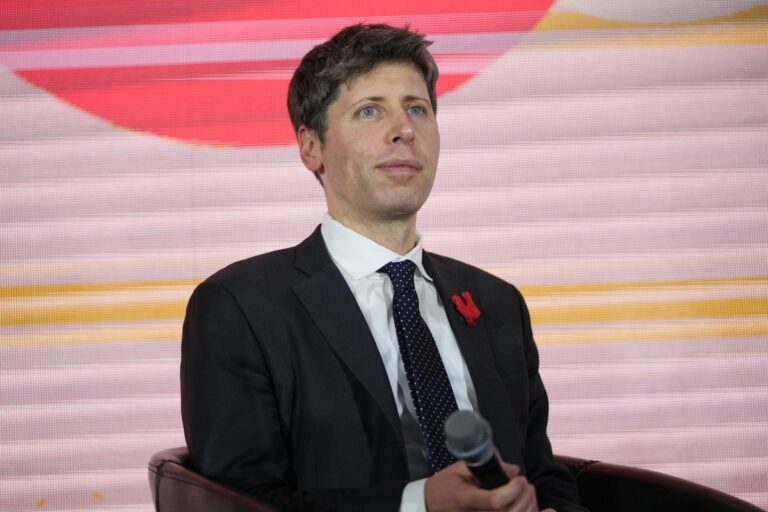
OpenAI CEO Sam Altman addressed concerns about AI’s environmental impact this week while speaking at an event hosted by The Indian Express.

For one thing, Altman — who was in India for a major AI summit — said concerns about AI’s water usage are “totally fake,” though he acknowledged it was a real issue when “we used to do evaporative cooling in data centers.”

“Now that we don’t do that, you see these things on the internet where, ‘Don’t use ChatGPT, it’s 17 gallons of water for each query’ or whatever,” Altman said. “This is completely untrue, totally insane, no connection to reality.”

He added that it’s “fair” to be concerned about “the energy consumption — not per query, but in total, because the world is now using so much AI.” In his view, this means the world needs to “move towards nuclear or wind and solar very quickly.”

There’s no legal requirement for tech companies to disclose how much energy and water they use, so scientists have been trying to study it independently. Data centers have also been connected to rising electricity prices.

Citing a previous conversation with Bill Gates, the interviewer asked whether it’s accurate to say a single ChatGPT query currently uses the equivalent of 1.5 iPhone battery charges, to which Altman replied, “There’s no way it’s anything close to that much.”

Altman also complained that many discussions about ChatGPT’s energy usage are “unfair,” especially when they focus on “how much energy it takes to train an AI model, relative to how much it costs a human to do one inference query.”

Techcrunch event

Boston, MA
|
June 9, 2026

“But it also takes a lot of energy to train a human,” Altman said. “It takes like 20 years of life and all of the food you eat during that time before you get smart. And not only that, it took the very widespread evolution of the 100 billion people that have ever lived and learned not to get eaten by predators and learned how to figure out science and whatever, to produce you.”

So in his view, the fair comparison is, “If you ask ChatGPT a question, how much energy does it take once its model is trained to answer that question versus a human? And probably, AI has already caught up on an energy efficiency basis, measured that way.”

You can watch the full interview below. The conversation about water and energy usage begins at around 26:35.


Source link

The Stop Killing Games campaign will set up NGOs in the EU and US

0


The Stop Killing Games campaign is evolving into more than just a movement. In a YouTube video, the campaign’s creator, Ross Scott, explained that organizers are planning to establish two non-governmental organizations, one for the European Union and another for the US. According to Scott, these NGOs would allow for “long-term counter lobbying” when publishers end support for certain video games.

“Let me start off by saying I think we’re going to win this, namely the problem of publishers destroying video games that you’ve already paid for,” Scott said in the video. According to Scott, the NGOs will work on getting the original Stop Killing Games petition codified into EU law, while also pursuing more watchdog actions, like setting up a system to report publishers for revoking access to purchased video games.

The Stop Killing Games campaign started as a reaction to Ubisoft’s delisting of The Crew from players’ libraries. The controversial decision stirred up concerns about how publishers have the ultimate say on delisting video games. After crossing a million signatures last year, the movement’s leadership has been busy exploring the next steps.

According to Scott, the campaign leadership will meet with the European Commission soon, but is also working on a 500-page legal paper that reveals some of the industry’s current controversial practices. In the meantime, the ongoing efforts have led to a change of heart from Ubisoft since the publisher updated The Crew 2 with an offline mode.


Source link

Major Galaxy S26 leak shows Privacy Display, faster charging

0


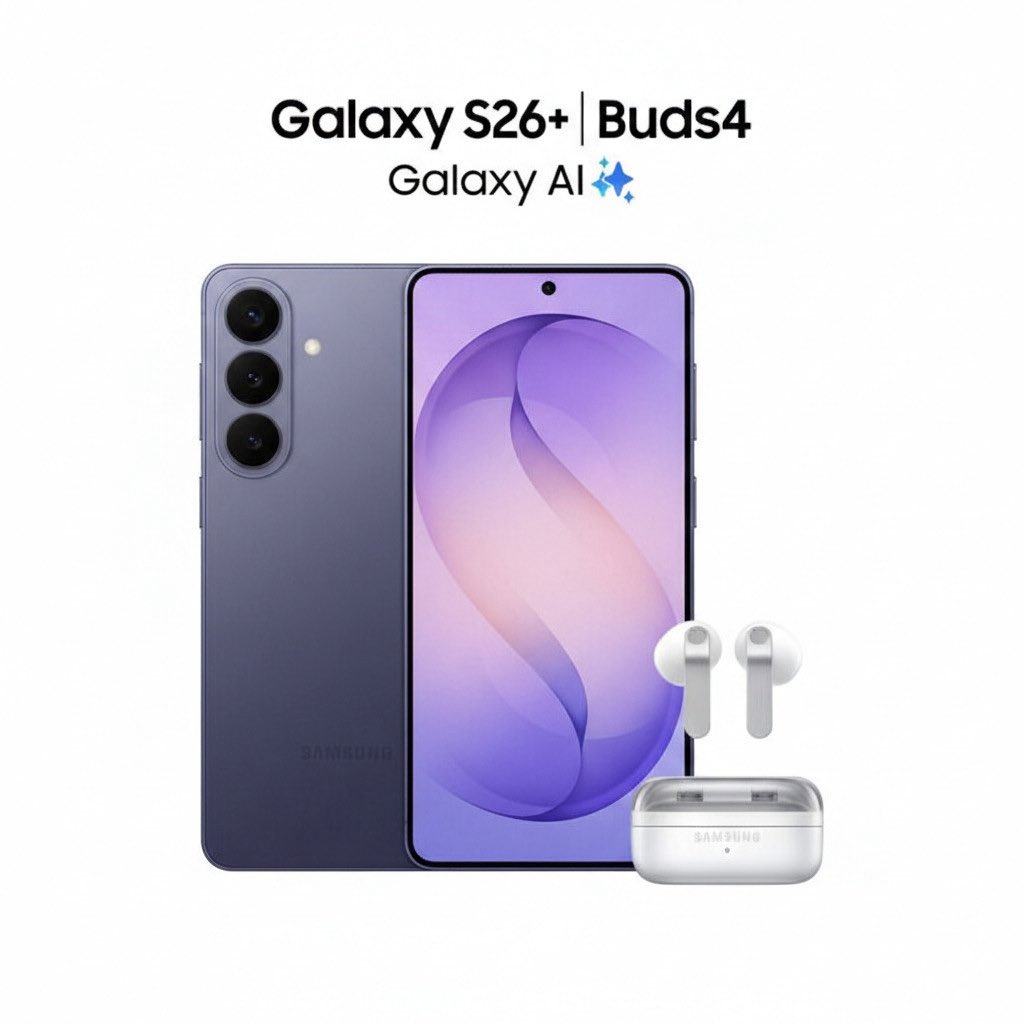
In the lead-up to Samsung’s Unpacked event next week, a major leak of promo materials confirms a few key details such as faster charging, while also showing the Privacy Display in better detail than we’ve seen.

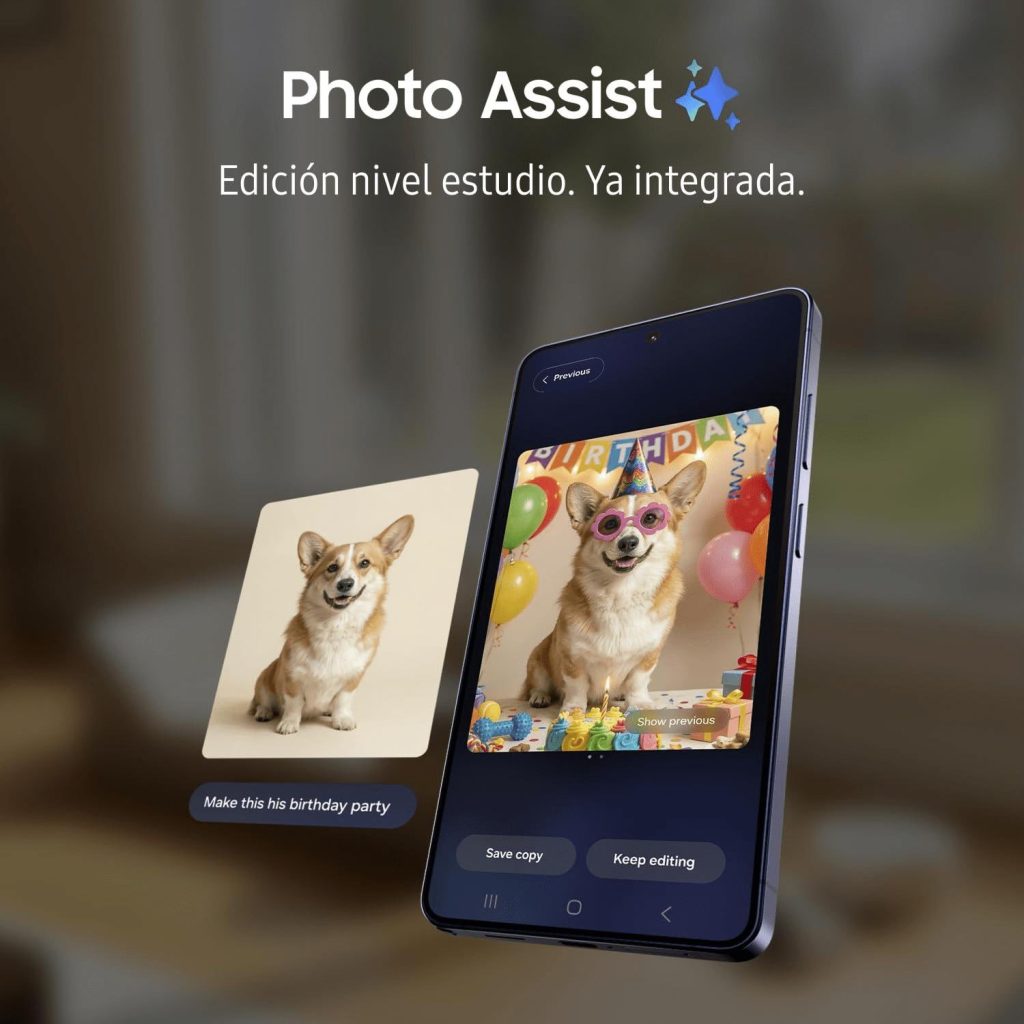
Official-looking Samsung promo materials posted on Twitter/X by @ya_sking12767 show off Samsung’s new phones – Galaxy S26, S26+, and Galaxy S26 Ultra, alongside the Galaxy Buds 4 series. There’s prominent Galaxy AI branding, of course, as well as a quick look at Samsung’s Photo Assist feature showing some prompt-based image editing. Samsung previously teased that edits would be more integrated with the rest of the camera experience this year.

The leaked images then go into some more specs and details.

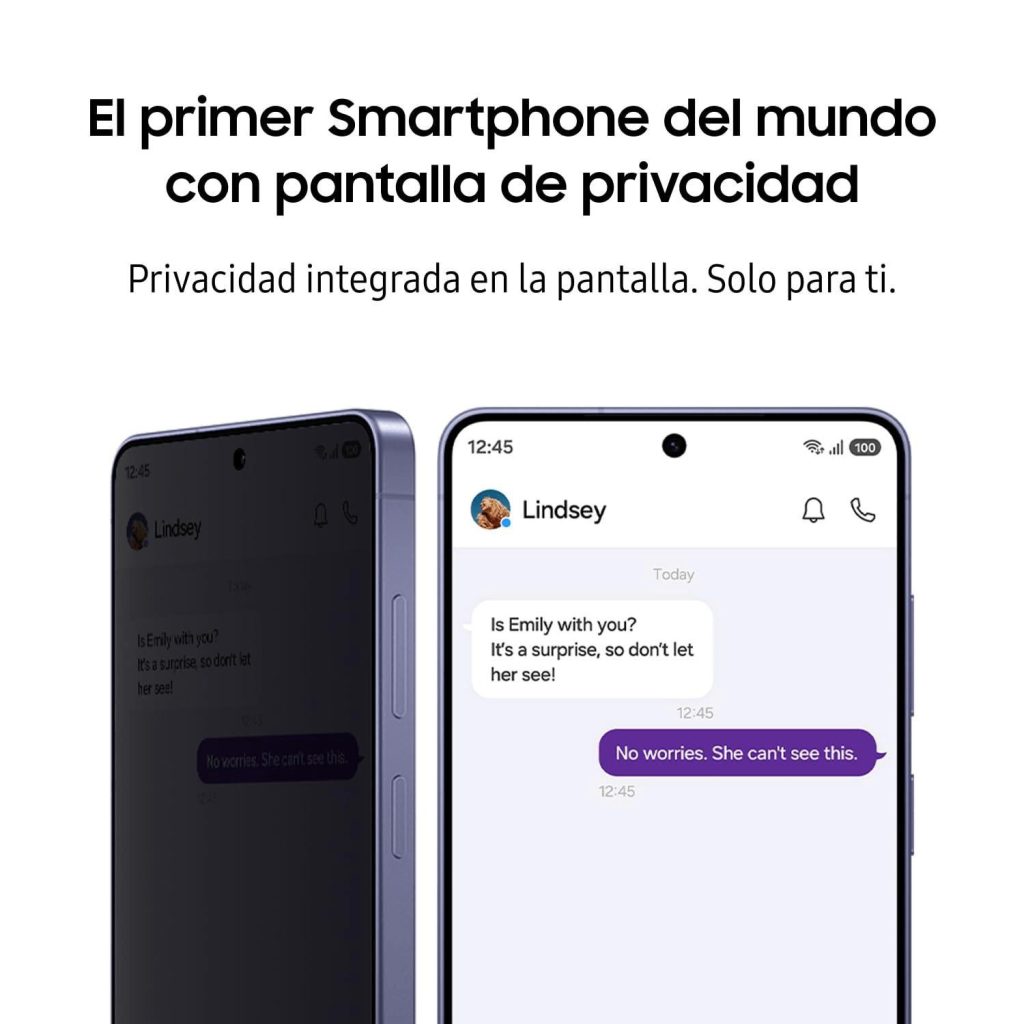
One image shows the Privacy Display, with the entire screen darkened at an off-angle. It’s still unclear whether or not the Privacy Display on Galaxy S26 Ultra is an all-or-nothing feature, as prior leaks showed the settings with some granular options. Teasers have also hinted it might be able to apply to only certain portions of the display such as notifications, but this teaser shows that it also works on the whole screen.

Advertisement – scroll for more content

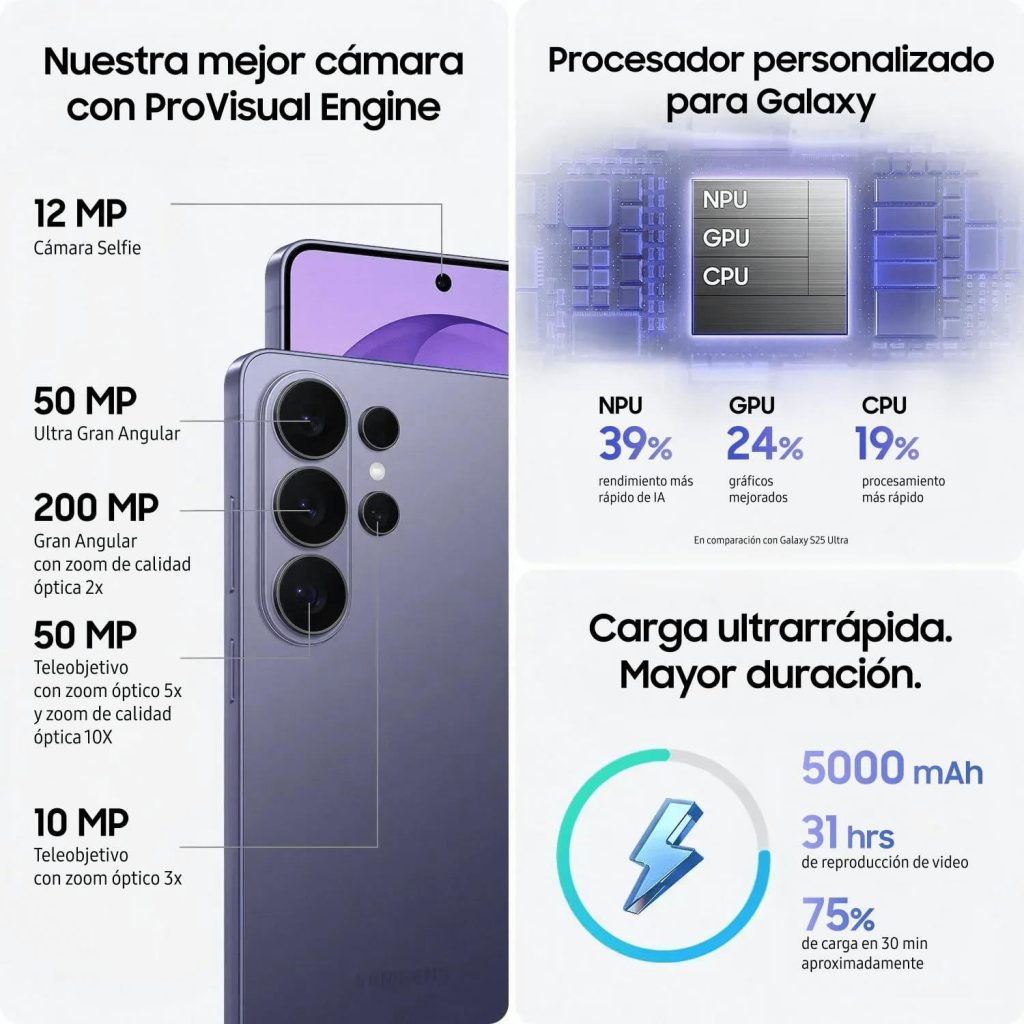
There’s also a spec breakdown, showcasing the unchanged camera layout on the Galaxy S26 Ultra – 200MP + 50MP 5x telephoto + 50MP ultrawide + 10MP 3x telephoto + 12MP selfie – and the upgraded performance of the latest Snapdragon chip.

Most notable here is the battery and charging info. The battery size on Galaxy S26 Ultra is unchanged at 5,000 mAh with Samsung saying battery life should be around 31 hours, unchanged from last year., Samsung’s leaked promo also says that the Galaxy S26 Ultra charges 75% in 30 minutes – also seemingly unchanged from last year. There are rumors of 60W charging, but it seemingly doesn’t make a huge difference from the looks of it.

Samsung has confirmed that the Galaxy S26 series will launch on February 25, so we don’t have long to wait to see the whole package!

More on Samsung:

Follow Ben: Twitter/XThreads, Bluesky, and Instagram

FTC: We use income earning auto affiliate links. More.


Source link

Dunkin’ 48 oz bucket drinks: What to know about the Massachusetts test

0


Dunkin’ is testing 48 oz buckets of coffee and other drinks at only a few locations — and Massachusetts is among them.

The drinks come in 48 oz containers with a unique lid and straw. Signs advertise a refresher option for $9.49 and two coffee options. The coffee options start at $8.89.

The formerly largest size offered at Dunkin’, an extra large, is 24 oz.

But the bucket drinks aren’t sold at all locations.

MassLive confirmed the drinks are being sold at 175 University Dr. in Amherst. Social media posts have stated the drinks are also being sold at other locations, including in Falmouth, New Bedford and Lee, N.H.

The viral TikTok trend of drinking coffee out of buckets had Massachusetts residents lining up at local coffee shops over the summer.

Massachusetts is a natural testing ground for Dunkin’ — the company has been experimenting in the commonwealth for years.

Dunkin’ has previously tested new products, such as blueberry cobbler coffee flavor and “ElectroBrew,” in Massachusetts. The company also tested Popping Bubble Iced Tea, Sparkling Dunkin’ Refreshers, Summer Shandies and Bubble Iced Coffee in 2020.


Source link

Willie Colón, salsa pioneer, has died at 75 : NPR

0


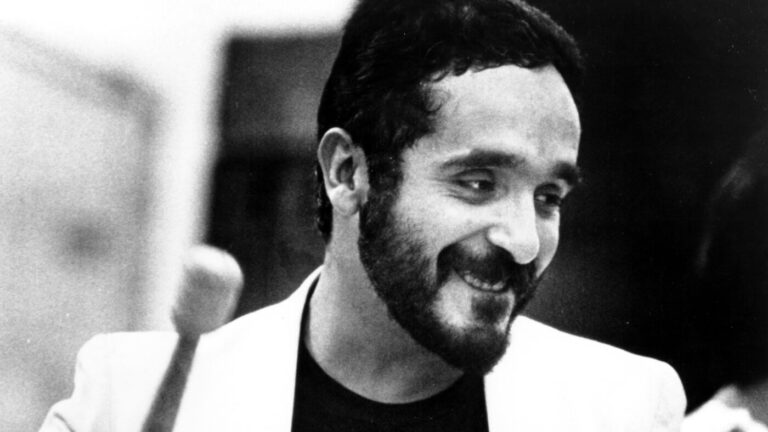
Willie Colon

Willie Colon in an undated photograph.

Michael Ochs Archives/Michael Ochs Archives


hide caption

toggle caption

Michael Ochs Archives/Michael Ochs Archives

Willie Colón, the salsa legend who took the genre to new heights while recording more than two dozen albums for Fania Records, died Saturday. He was 75 years old.

Colón’s family shared the news in a post on the musician’s Facebook page. No cause of death was provided.

“While we grieve his absence, we also rejoice in the timeless gift of his music and the cherished memories he created that will live on forever,” read the statement.

The New York City trombonist and bandleader was a key part of Latin music’s evolution during the 1970s. He was born in the Bronx in 1950 but had direct ties to Puerto Rico, thanks to grandparents who still lived on the island. As a young teenager Colón was soaking up popular music of the 1960s: R&B, rock, jazz … and Puerto Rican folk music, which he heard while visiting his extended family during the summer.

He started playing trumpet at age 12 then switched to trombone. By age 15, he was recording with a new upstart indie record label called Fania Records. At age 17 he released his first album, a record that was so raw and unorthodox that critics and older musicians panned it. No matter — it became popular with young Nuyoricans who were looking for something to hang their identity on.

The album featured Puerto Rican vocalist Hector Lavoe, who went on to become one of salsa’s first major stars as a solo act — but only after he recorded several very popular albums with Colón between 1967 and 1975.

Two years later Colón recruited vocalist Ruben Blades to join his band, and this time his music addressed some of the social issues the two musicians were seeing in the Latino community. That led up to the duo’s Siembra, released in 1978 and still considered one of the high watermarks of salsa.

Musically, Colón’s trombone-based brass section set his band apart from other popular Fania bands. He was also busy as a producer and arranger for many Fania albums, which led to him teaming up with Cuban vocalist Celia Cruz for an album called Only They Could Have Made This Album.

Willie Colón’s later years were a mix of music and politics. In 1994, he ran as a Democrat in the primary for New York’s 17th congressional district, and later for the office of New York City Advocate. He served for more than a decade as an advisor to former New York mayor Michael Bloomberg.

In the 2010s, Colón took a slight detour from music by enrolling in the Westchester County Police Academy. He was sworn in as a police officer in 2014 at age 64 and stayed with the department for eight years part time while still performing. He resigned in 2022 as a deputy lieutenant.

Ultimately it’s the music that Colón will be remembered for. His was the sound of the Puerto Rican community in New York finding its voice.


Source link