Home Blog Page 370

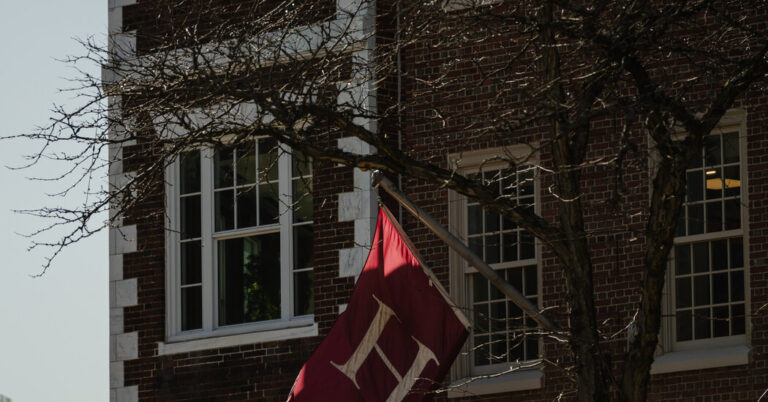
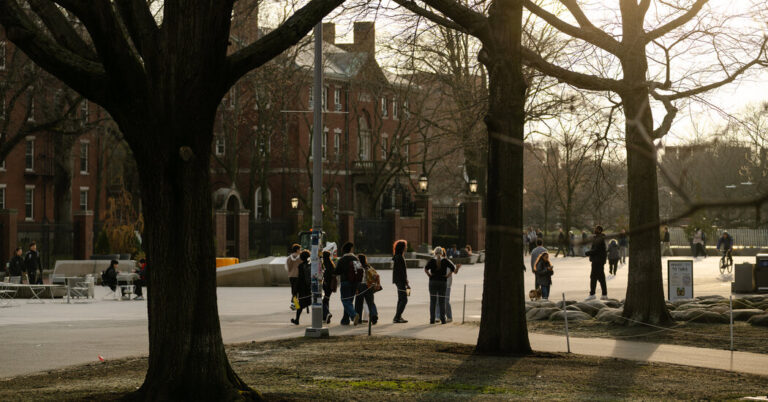
Why Harvard Decided to Fight Trump

0


Late last week, officials at Harvard University were trying to decipher what the Trump administration wanted the school to do to combat antisemitism.

The government had made some straightforward demands, like requiring the school to ban masks, which are often favored by protesters.

But other demands seemed vague.

Then, late on Friday night, the federal government sent Harvard a five-page fusillade of new demands that would reshape the school’s operations, admissions, hiring, faculty and student life.

It took less than 72 hours for Harvard to say no.

The decision is the most overt defiance by a university since President Trump began pressuring higher education to conform to his political priorities.

It came after leaders at Harvard, during intense discussions over the weekend, determined that what the government was proposing represented a profound threat to the 388-year-old university’s independence and mission.

Harvard has extraordinary financial and political firepower for a clash with Washington. And the university’s leaders watched Columbia University reel, as the Trump administration made more demands, even after the school capitulated.

Harvard would fight. The alternative seemed far worse.

“No government — regardless of which party is in power — should dictate what private universities can teach, whom they can admit and hire, and which areas of study and inquiry they can pursue,” Harvard’s president, Alan M. Garber, wrote in an open letter on Monday.

This account is based on correspondence between Harvard and the government, public statements, and interviews with Trump administration officials, people at Harvard and close observers of the university. Harvard declined to make Dr. Garber available for an interview.

In response to his announcement, the government swiftly retaliated with a freeze of more than $2.2 billion in federal funding. Nearly $7 billion more remains imperiled, including money that goes to Harvard’s affiliated hospitals. And on Tuesday, Mr. Trump — who has picked out elite universities, long accused by conservatives of leaning left, as a special target — threatened Harvard’s tax-exempt status.

Even for the world’s richest university, which has an endowment of about $53 billion, a lasting freeze would cut deeply into labs, departments and even classrooms. But officials at Harvard elected to prize its reputation, independence and legacy, wagering that the institution could outlast Mr. Trump’s crusade.

“This is what Joe McCarthy was trying to do magnified ten- or 100-fold,” said Lawrence H. Summers, a former Harvard president, adding that “it runs directly against the university’s role in a free society.”

The first sentences of the Trump administration’s letter on Friday were civil but frustrated. Three federal officials wrote that Harvard had “failed to live up to both the intellectual and civil rights conditions that justify federal investment.”

The officials — one from the Department of Education, one from the Department of Health and Human Services and one from the General Services Administration — told Dr. Garber that they would “welcome” his “collaboration in restoring the university to its promise.” If Harvard agreed to their terms, the officials wrote, they could begin work on a “more thorough, binding settlement agreement.”

The letter arrived after Harvard sought clarification over the comparably anodyne list of proposals that the government had shared eight days earlier. What landed in Cambridge on Friday night went well beyond an explanation.

The polite opening paragraphs gave way to a range of demands so broad and intrusive that they stunned Harvard leaders, who had until recently been open to hammering out some kind of accord with the government.

The government said it wanted the Harvard faculty’s power reduced, and demanded that Harvard embrace “merit-based” admissions and hiring policies. The Trump administration wanted to audit university data, and sought changes to the “recruitment, screening, and admissions of international students.”

The administration also insisted that Harvard conduct a review for “viewpoint diversity.” The government wanted Harvard to “immediately shutter” any programs related to diversity, equity and inclusion and to bring in an outsider to examine “those programs and departments that most fuel antisemitic harassment or reflect ideological capture.” And the government wanted reports “at least until the end of 2028” — around the time Mr. Trump is to leave the White House — on Harvard’s compliance with the administration’s demands.

The ultimatums seemed only tangentially connected to the Trump administration’s stated ambition of erasing antisemitism on campus. Kenneth L. Marcus, the Education Department’s civil rights chief during Mr. Trump’s first term, said the government’s proposals went “far beyond antisemitism and reflect a far wider cultural concern within the conservative movement about what is rotten in higher education.”

Mr. Marcus, who is the chairman and chief executive of the Louis D. Brandeis Center for Human Rights Under Law, said the demands were an attack on “the left-wing tilt that Harvard is thought to exemplify.”

Dr. Garber did not frame Harvard’s response as a matter of left or right. In his letter rebuffing the administration, he used 12 words to summarize Harvard’s stance: “The university will not surrender its independence or relinquish its constitutional rights.”

His announcement plunged Harvard into one of the gravest confrontations in its history.

Steven Pinker, a psychology professor and a co-president of the Council on Academic Freedom at Harvard, said that it was “almost inconceivable that a university president could have acceded to that list of demands, because they actually stipulate the content of beliefs of faculty and admitted students.” But he still marveled over the speed of Harvard’s response.

Dr. Summers, a former Treasury secretary who is more a veteran of political combat than most in academia, said he figured “the extremity of the demand letter made this an easier decision than it might otherwise have been.”

If government officials were spoiling for a fight, their tactic appears to have worked. But because the Trump administration itself did not publicly release the bombshell letter, Harvard had time to fine-tune a counterattack, including a glossy website outlining its contributions to society. It was a rare example of a university upstaging the Trump administration’s campaign, which has often hinged on unpredictability.

Harvard’s burst of defiance unleashed surprise across higher education, partially because there had been little sense it would be bold in the face of Mr. Trump’s attacks. When dozens of university leaders participated in a conference call on Sunday, according to two people familiar with the private discussion, there was no mention of the government’s new demands to Harvard, or of the school’s coming response.

In recent months, Harvard had adopted a conspicuously low and accommodating profile — so much so that many on campus had openly fretted that the university was pursuing a Columbia-style path of appeasement.

In March, Columbia acceded to a roster of Trump administration demands in a quest to restore $400 million in federal grants and contracts. But the money had not begun to flow again. Instead, the government is now weighing the possibility of a consent decree with the school, which would empower a federal judge to monitor an agreement with the university and give the White House leverage, potentially, for years.

In the run-up to Mr. Trump’s inauguration, Harvard hired a powerhouse lobbying firm with close ties to the White House and the Justice Department. The university also adopted a stricter definition of antisemitism that upset many free speech advocates. As the federal government then dialed up the pressure on Columbia and its elite peers, Harvard moved to oust two leaders of its Center for Middle Eastern Studies, paused a partnership with a Palestinian university, then agreed to start one with an Israeli school.

Harvard was also not among the top universities listed as plaintiffs in court challenges to the Trump administration’s proposed changes to research-funding formulas.

Still, the university had been making subtle preparations for a clash with the White House, some of them long before the announcement by the government on March 31 that it would review roughly $9 billion in Harvard’s funding.

The university imposed a hiring freeze in March and has sought to raise $1.2 billion in the bond market. Harvard also weighed adjustments to the $53 billion endowment’s payouts, just as it had done during the pandemic.

The financial stakes for Harvard are enormous. They also have implications for the rest of the country, as the Trump administration appears determined to retreat from the government-university relationship that has flourished across the United States since around World War II

The actual details also remain hazy.

The Trump administration has not explained to Harvard how it came up with the $2.2 billion that it intended to freeze. But officials believe the number could be the entirety of the roughly $650 million the federal government provides the university’s researchers annually and the life span of any multiyear contracts.

Harvard was already feeling the fallout by Tuesday morning. The university’s T.H. Chan School of Public Health confirmed that Sarah Fortune, an infectious disease specialist, had received a stop-work order. Dr. Fortune’s tuberculosis research was supported through a $60 million National Institutes of Health contract involving Harvard and other universities across the country.

Federal officials didn’t immediately respond to messages asking about their communications with the university and researchers.

Harvard’s endowment may help it weather some of the financial fallout. But university leaders are often stringently averse to tapping into these funds, worried about drawing down funds they will need in the future. At Harvard, roughly 80 percent of its endowment funds are limited to specific purposes.

Still, in its most recent financial report, Harvard said that there were billions of dollars that it could tap “in the event of an unexpected disruption.”

Columbia’s experience in recent weeks made it clear that any path the university chose seemed just as likely to lead to ongoing turmoil, and the Trump administration’s continuing treatment of the Ivy League university unnerved officials at Harvard, who feared the White House would renege on any agreement.

Lee C. Bollinger, who was Columbia’s president for 21 years, said on Tuesday that a strategy of “negotiation and conciliation seems to have no acceptable ending point.”

Dr. Pinker had a similar feeling. He said he believed that Harvard might have tried to negotiate just as Columbia did, “if it had assurance that the administration was negotiating in good faith.”

The Trump administration and some of its allies on Capitol Hill have bashed Harvard for its defiance. The administration task force that is handling the dispute with Harvard, for instance, said in a statement Monday night that the university’s response reflected “the troubling entitlement mind-set that is endemic in our nation’s most prestigious universities and colleges — that federal investment does not come with the responsibility to uphold civil rights laws.”

But in many quarters, especially on campuses, Harvard’s new gumption has brought relief. Many fear how billions in lost research funding could threaten jobs, laboratories and longstanding projects. They argue, though, that it was imperative for a university as muscular as Harvard to defend its principles.

Steven Levitsky, a Harvard political scientist who had been urging the university to take a tougher stand against Mr. Trump, read Dr. Garber’s letter before a class about authoritarianism and democracy.

“It looks like Harvard has decided it’s time to fight,” he said when he began.

The room of about 100 students, he said, erupted into applause.

Lulu Garcia-Navarro and Miles J. Herszenhorn contributed reporting.



Source link

Stocks Tumble in Asia as Tech Investors Pull Back

0


Share prices of big technology companies declined in Asia on Wednesday, dragging broader markets lower, after Nvidia, the American chip giant, revealed that the U.S. government would restrict sales of some of its chips to China.

They are the first major limits that President Trump’s administration has put on semiconductor sales abroad. Nvidia dominates the market for chips used in building artificial intelligence systems and will now require a license sell A.I. chips to China. It raises the possibility that the company’s sales to China will evaporate in the coming months, bringing an end to a business that has contracted as the United States has curbed chip exports to its geopolitical rival.

In a regulatory filing on Tuesday, Nvidia said it will take a $5.5 billion hit because of piles of chips it will not be able to sell or orders it won’t be able to fill.

Nvidia’s stock was down about 6 percent in after-hours trading.

Stock market benchmarks in Japan and China fell about 1 percent on Wednesday. Share prices were down 2.5 percent in Hong Kong and nearly 2 percent in Taiwan, a hub of global chip manufacturing. The maker of most of the world’s advanced chips, Taiwan Semiconductor Manufacturing Company, which gets a lot of business from Nvidia, dropped 2.5 percent.

In the United States, S&P 500 futures, which let investors bet on how the index might perform when trading begins in New York, were down 1 percent.

On Tuesday, the S&P 500 dipped 0.2 percent, and the technology-heavy Nasdaq also posted a slight loss. Positive quarterly results in the banking sector and signs that the United States was making progress on a trade deal with Britain helped stabilize stocks on Tuesday.

President Trump’s whipsawing tariff policies are still driving sentiment in global markets, especially in sectors facing the threat of more levies or potential reprieves.

A survey by Bank of America showed that global investors have cut their U.S. stock holdings by a record amount in the past two months, and that the potential for a recession spurred by Mr. Trump’s trade war poses a major risk to markets.

Tripp Mickle contributed reporting.


Source link

Wednesday Briefing: A Trump-Harvard Showdown

0


After freezing $2.2 billion in funding to Harvard University, President Trump turned up the pressure yesterday and threatened to revoke its tax-exempt status.

The fight between the Trump administration and the nation’s oldest and most elite university was headed for a showdown that could affect other U.S. institutions.

Harvard has rejected the administration’s demands that it make changes to the university’s policies and programs related to diversity hiring and the tolerance of anti-Israel protests.

Details: With an endowment of $50 billion, Harvard is uniquely positioned to withstand the funding freeze. The university’s strong refusal of Trump’s demands has injected energy into other universities fearful of the president’s wrath.

Ripple effects: Columbia University, which has faced criticism for not striking a more defiant stand, showed signs of adopting a tougher tone yesterday. The new acting president pledged that the university would not allow the government to “require us to relinquish our independence and autonomy.”

For more: Critics say that the Trump administration’s demands are an attack on academic freedom. Here’s what to know about Trump’s targeting of universities.


Two of our reporters and a photographer traveled to Sumy, a city in northern Ukraine, a day after Russian airstrikes hit a central neighborhood on Palm Sunday, killing 34 people. They witnessed another Russian attack on Monday.

The Palm Sunday attack has become an argument that peace talks between Moscow and Kyiv are failing. In Sumy, the attack has set off preparation for a possible new Russian ground assault in the region.

The feeling in Sumy “is of fear, ceaseless tension and frayed nerves,” our reporters wrote. For residents, there are no signs of a cease-fire.


The paramedics and rescue workers killed in an Israeli shooting in Gaza last month died mainly from gunshots to the head or chest, according to autopsy reports obtained by The Times.

The autopsy reports said that 11 of the men had gunshot wounds and that most had been shot multiple times. Three others had shrapnel wounds. Israel’s military said it was investigating.

Related: An Israeli strike killed a security guard and wounded 10 patients at a field hospital in southern Gaza, the hospital’s director said.

The small Finnish city of Rovaniemi has branded itself as “the Official Hometown of Santa Claus,” with a tourist season that runs from October to March. Local residents are anything but jolly, with many complaining of out-of-control development.

Our reporter traveled to the city, where tourism brings in more than 400 million euros a year. “The people who benefit are happy,” a man in a red suit and a long white beard told him. “Those who don’t — they’re jealous.”

Lives lived: Elsa Honig Fine, an art historian who published textbooks on Black and female artists, died at 94.

Auvers-sur-Oise, a village near Paris, is where Vincent Van Gogh spent his final days. There, art experts in 2020 identified some gnarled tree roots on a hillside as those depicted in his final painting “Tree Roots.” There has been strife in the village ever since.

The owners of a property near the roots have been locked in a fight with the municipality, which has claimed part of their land for a historic site. The knotty dispute has unsettled residents just as the new tourism season heats up.


Source link

Schumer Moves to Block Trump Picks for Two Key Prosecutor Positions

0


Democrats have so far failed to derail any of President Trump’s nominees, lacking the numbers in the Senate to block them. But they are about to test their ability to use an arcane Senate tradition to stop Mr. Trump from installing one lesser-known but critical category of nominee: federal prosecutors.

For decades, heads of the Senate Judiciary Committee of both parties have sought the approval of home-state senators before moving ahead with the nominations of U.S. attorneys, waiting to proceed until they receive what is known as a “blue slip” indicating the senators’ approval.

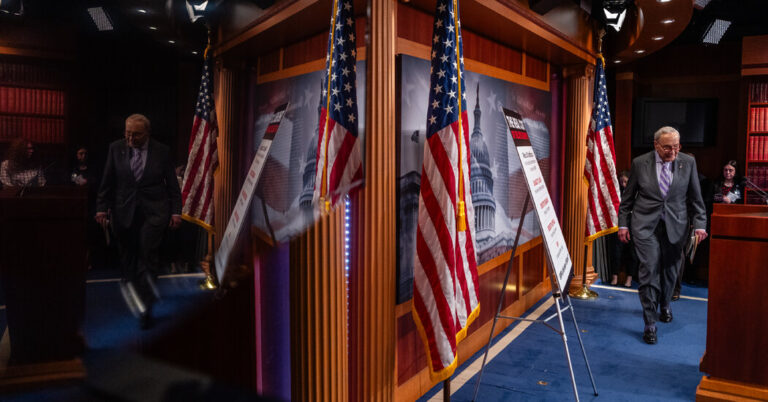
Senator Chuck Schumer, the New York Democrat and minority leader, will be the first to challenge Mr. Trump on his selections, by refusing to return blue slips consenting to consider the nominees for two top posts in New York: Jay Clayton to be the U.S. attorney for the Southern District and Joseph Nocella Jr. to be the lead prosecutor in the Eastern District.

“Donald Trump has made clear he has no fidelity to the law and intends to use the Justice Department, the U.S. attorney offices and law enforcement as weapons to go after his perceived enemies,” Mr. Schumer said in a statement to The New York Times confirming his intent to withhold the blue slips. “Such blatant and depraved political motivations are deeply corrosive to the rule of law and leaves me deeply skeptical of Donald Trump’s intentions for these important positions.”

His position is likely to anger the White House. But in a recent interview, Senator Charles E. Grassley, the Iowa Republican who leads the Judiciary Committee, said that he intended to respect the blue slip tradition. Given Mr. Schumer’s stance, that means the two high-priority nominations of Mr. Trump are on track to die in the committee without receiving a vote.

“The answer is yes,” Mr. Grassley said when asked whether he would honor the blue slip position of senators. “If they are from the state the nomination comes from.”

Mr. Clayton served as chairman of the Securities and Exchange Commission in the first Trump administration after being confirmed on a bipartisan Senate vote in May 2017. Within days of his election victory last November, Mr. Trump said that he intended to put Mr. Clayton up for the prestigious prosecutorial post. He officially nominated him on his first day in office.

Mr. Clayton was considered an unusual selection for the high-profile position because he lacked prosecutorial experience. But Mr. Trump has shown that he puts a premium on placing people he trusts in critical law enforcement positions. Mr. Clayton made it clear after the election that he would join the administration if the president requested it.

Mr. Nocella, a Nassau County district court judge since 2022, has deep ties to Republican politics in the region. He also once served as a prosecutor in the office he was nominated to oversee. In nominating Mr. Nocella, Mr. Trump credited him with a tough crime-fighting record.

Blue slip privileges are better known for giving senators veto power over judicial nominees. But they have also long been extended in considering the nominations of federal prosecutors and U.S. marshals confirmed by the Judiciary Committee.

The blue slip tradition is neither a law nor a rule. But like many things in the Senate, it has taken hold over time and is now considered sacrosanct. The practice dates to the early 1900s, when the powerful posts were considered patronage positions — plum jobs to distribute to supporters and prominent constituents. Southern senators eventually used blue slips to prevent the confirmation of judicial nominees who might have been more aggressive enforcing civil rights laws.

Urged on by Senator Mitch McConnell, the Kentucky Republican and majority leader at the time, Mr. Grassley in 2018 weakened the power of the blue slip for federal appeals court judges. He and Mr. McConnell argued that their jurisdictions typically cover multiple states and nominees, and therefore should not be subject to the whims of single lawmakers.

Democrats followed the same policy when they won back the majority.

But Democrats and Republicans have stuck with the blue slip power for trial-level district court judges, U.S. attorneys and federal marshals. Most see it as a valuable mechanism to wield power in the Senate.

Senators want to retain influence over judges and prosecutors in their states and want to force presidents to negotiate with them over who fills those jobs. When Mr. Trump moved quickly after the election to say that he would nominate Mr. Clayton, it was clear that he had not consulted with the New York senators.

Some Republicans on the committee said that they supported adhering to the blue slip policy for district court judges and prosecutors even if it could lead to Democrats blocking nominees.

“It serves a useful purpose even when in Democratic hands,” said Senator John Cornyn, Republican of Texas and a longtime member of the Judiciary Committee. “Obviously we value the ability to, appropriately, stop some nominees.”

“I definitely want to honor blue slips, 100 percent,” said Senator Lindsey Graham, Republican of South Carolina, who has led the committee in the past.

Mr. Schumer’s action does not mean that Democrats intend to reflexively block the Trump administration’s picks for prosecutorial jobs in their states. One Democrat said privately that if Mr. Trump nominated someone acceptable and experienced, that person would be preferable to an unacceptable acting nominee.

One nominee Democrats have made clear they do not support is Ed Martin, the interim U.S. attorney in Washington who has come under fierce criticism for some of his actions. His interim status expires next month. But with no elected senator, the District of Columbia has no one in position to try to veto him by denying a blue slip.

Senator Adam Schiff, Democrat of California, put a hold on Mr. Martin’s nomination. But unlike with a blue slip, the majority can override a hold with a vote on the Senate floor.

The Judiciary Committee has historically not held confirmation hearings for the 93 U.S. attorney positions, and most are typically confirmed with no roll call vote.

When he was a Republican senator from Ohio, Vice President JD Vance put holds on multiple U.S. attorneys, citing the Justice Department’s targeting of Mr. Trump. The tactic stalled their confirmations because Democrats in the majority did not want to use scarce floor time to try to move through the prosecutors.


Source link

Trump Has Mixed Emotions Toward Japan

0


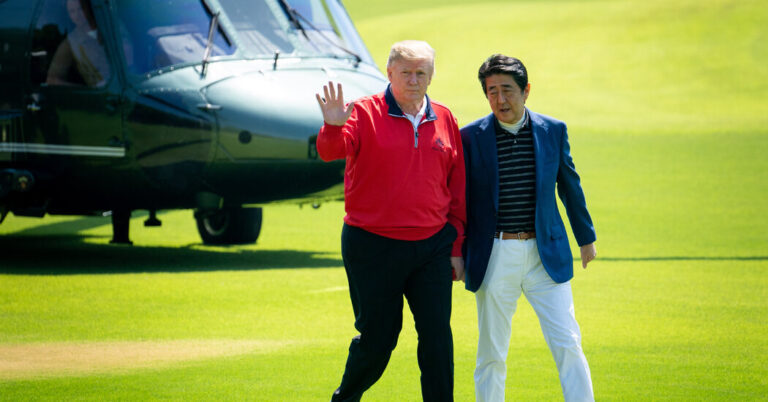
This month in the White House’s Rose Garden, as he held up a placard showing the global wave of tariffs he wanted to impose, President Trump paused to fondly recall a fallen friend.

“The prime minister of Japan, Shinzo, was — Shinzo Abe — he was a fantastic man,” Mr. Trump said during the tariff announcement on April 2. “He was, unfortunately, taken from us, assassination.”

The words of praise for Mr. Abe, who was gunned down three years ago during a campaign speech, did not stop Mr. Trump from slapping a 24 percent tariff on products imported from Japan. But they were unusual, nonetheless, coming from a president who has had few nice things to say these days about other allies, particularly Canada and Europe.

Now, Japan will be one of the first countries allowed to bargain for a possible reprieve from Mr. Trump’s sweeping tariffs, many of which he has put on hold for 90 days. On Thursday, a negotiator handpicked by Japan’s current prime minister is scheduled to begin talks in Washington with Treasury Secretary Scott Bessent and others.

Japan’s place at the front of the line reflects the different approach that Mr. Trump has taken toward the nation. While the president still accuses it of unfair trade policies and an unequal security relationship, he also praises it in the same breath as a close ally, an ancient culture and a savvy negotiator.

“I love Japan,” Mr. Trump told reporters last month. “But we have an interesting deal with Japan where we have to protect them but they don’t have to protect us,” referring to the security treaty that bases 50,000 U.S. military personnel in Japan.

Japan holds a special, if not always fond, place in Mr. Trump’s thinking. Its meteoric economic rise in the 1980s shaped his current views of global trade, including his passion for tariffs. Some observers say the president has maintained a love-hate relationship with Japan that leads him to criticize the country while also admiring it — and reveling in the flattery from its recent leaders.

“Trump’s behavior toward Japan looks quite contradictory, but it’s actually very consistent,” said Glen S. Fukushima, a former U.S. trade official who has watched U.S.-Japan relations for more than four decades. “He has a lot of admiration and respect for Japan, which he thinks has been really shrewd in hoodwinking the Americans.”

While the president on Wednesday suspended the broadest tariffs after financial markets went into free fall, Japan still faces a new 10 percent base tariff that Mr. Trump has imposed on most imports to America. Late Friday, the White House amended its terms again by sparing smartphones, computers, semiconductors and other electronics from tariffs. Yet there also remain higher levies on steel and aluminum and a 25 percent tariff on autos, which could hit Japan’s economy hard.

Japan has reacted with feelings of betrayal and bewilderment to the tariffs, which targeted America’s friends and foes alike. After failed diplomatic efforts to win Japan an exemption, Shigeru Ishiba, the current prime minister, declared the tariffs a “national crisis.”

But at the same time, Mr. Trump has given Japan more privileged treatment. When Mr. Ishiba wanted to discuss a possible deal to reduce tariffs, Mr. Trump took the call.

“Spoke to the Japanese Prime Minister this morning. He is sending a top team to negotiate!” Mr. Trump wrote Monday on his social media platform. True to form, the president then immediately shifted into a complaint that Japan has “treated the U.S. very poorly on Trade.”

“They don’t take our cars, but we take MILLIONS of theirs,” he wrote.

While flip-flopping is not unusual for Mr. Trump’s off-the-cuff style, his split view of Japan goes much deeper, extending back to his early days as a Manhattan real estate developer. Even then, he spoke of Japan as both a valued customer for his buildings and a source of financing for new deals, while also railing against the unequal balance of trade.

“America is being ripped off,” Mr. Trump said in an interview in 1988. “We’re a debtor nation, and we have to tax, we have to tariff, we have to protect this country.”

In 2016, those attitudes helped carry him to victory among voters disillusioned with globalization. But before Mr. Trump’s inauguration, Mr. Abe was the first world leader to visit the president-elect in Trump Tower, where he applauded Mr. Trump’s election win and presented him with a gold-plated golf club. Mr. Trump, who was still being viewed warily by other world leaders, never forgot the gesture, said Shinsuke J. Sugiyama, who was Japan’s ambassador to the United States during the first Trump administration.

“Abe took a risk by being the first world leader to visit him,” Mr. Sugiyama said. “This gave Trump a whole different image of Japan.”

Japan’s current prime minister has tried to use that same playbook during the second Trump administration, but with mixed results. Mr. Abe’s widow, Akie Abe, had dinner with Mr. Trump and Melania Trump in January at the president’s Mar-a-Lago resort in Florida.

A month later, Mr. Ishiba became one of the first heads of state to visit Mr. Trump at the White House, playing up Japan’s huge investments in American business and industry. He also mentioned the July 2024 assassination attempt on Mr. Trump, telling the U.S. president, “You were one chosen by God.”

Mr. Ishiba earned priority access to Mr. Trump for his negotiator, a close political ally named Ryosei Akazawa, who will most likely pledge to buy more American food, weapons and energy. Mr. Ishiba hopes he can offer enough to win an exemption from Mr. Trump’s tariffs.

“By being first to bend a knee, Abe allowed Trump to say, ‘Look, Japan was laughing at us, but now that I’m in power, they come to see me,’” said Jennifer M. Miller, a historian of U.S.-Japan relations at Dartmouth College. “Ishiba is hoping the old playbook will still work.”


Source link

Wednesday Briefing: A Trump-Harvard Showdown

0


After freezing $2.2 billion in funding to Harvard University, President Trump turned up the pressure yesterday and threatened to revoke its tax-exempt status.

The fight between the Trump administration and the nation’s oldest and most elite university was headed for a showdown that could affect other American institutions.

Harvard has rejected the administration’s demands that it make changes to its policies and programs related to diversity hiring and the tolerance of anti-Israel protests.

Details: With an endowment of $50 billion, Harvard is uniquely positioned to withstand the funding freeze. Its strong refusal of Trump’s demands has injected energy into other universities fearful of the president’s wrath.

Ripple effects: Columbia University, which has faced criticism for not striking a more defiant stand, showed signs of adopting a tougher tone yesterday. The acting president pledged that the university would not allow the government to “require us to relinquish our independence and autonomy.”

For more: Critics say the administration’s demands are an attack on academic freedom. Here’s what to know about Trump’s targeting of universities.


Two of our reporters and a photographer traveled to Sumy, a city in eastern Ukraine, a day after Russian airstrikes hit a central neighborhood on Palm Sunday, killing 34 people. They witnessed another Russian attack on Monday.

The Palm Sunday attack has become an argument that peace talks between Moscow and Kyiv are failing. In Sumy, it has set off preparation for a possible new Russian ground assault in the region.

The feeling in Sumy “is of fear, ceaseless tension and frayed nerves,” our reporters wrote. For residents, there are no signs of a cease-fire.


The paramedics and rescue workers killed in an Israeli shooting in Gaza last month died mainly from gunshots to the head or chest, according to autopsy reports obtained by The Times.

The autopsy reports said 11 of the men had gunshot wounds and that most had been shot multiple times. Three others had shrapnel wounds. Israel’s military said it was investigating.

Related: An Israeli strike killed a security guard and wounded 10 patients at a field hospital, the hospital’s director said.


The small Finnish city of Rovaniemi has branded itself as “the Official Hometown of Santa Claus,” with a tourist season that runs from October to March. Local residents are anything but jolly, with many complaining of out-of-control development.

Our reporter traveled to the city, where tourism brings in more than 400 million euros a year. “The people who benefit are happy,” a man in a red suit and a long white beard told him. “Those who don’t — they’re jealous.”

Lives lived: Elsa Honig Fine, an art historian who published textbooks on Black and female artists, died at 94.

Auvers-sur-Oise, a village near Paris, is where Vincent Van Gogh spent his final days. There, art experts in 2020 identified some gnarled tree roots on a hillside as those depicted in his final painting “Tree Roots.” There has been strife in the village ever since.

The owners of a property near the roots have been locked in a fight with the municipality, which has claimed part of their land for a historic site. The knotty dispute has unsettled residents just as the new tourism season heats up.


Source link

2 U.S. Soldiers Killed in Vehicle Accident Near Mexico Border

0


Two U.S. soldiers involved in operations near the border between the United States and Mexico were killed in a vehicle accident on Tuesday morning, and another was seriously injured, the military said.

The cause of the accident near Santa Teresa, N.M., is under investigation, the military’s Northern Command said in a statement on social media. Santa Teresa is on the outskirts of El Paso, Tex.

The military said the three soldiers had been deployed to support Joint Task Force Southern Border, which last month assumed leadership of military operations at that border as part of the Trump administration’s efforts to curtail illegal crossings.

The military did not release the names of the soldiers who were killed. The three soldiers were Marines, according to a U.S. military official who spoke on condition of anonymity to discuss operational matters.

Thousands of troops have been sent to the southwestern border in recent months, following President Trump’s order to increase the military’s role in stemming the flow of migrants into the United States.

Mr. Trump declared an emergency at the border on the first day of his second term and promised to send U.S. military forces to confront migrants, drug cartels and smugglers. About 1,600 Marines and Army soldiers were later sent to secure the border, joining 2,500 Army reservists already there.

Another wave of troops was sent in February and March, bringing the total number of active-duty troops on the border to about 9,000, according to Defense Department officials.

Vehicle accidents are a common cause of death in the U.S. military. From 2010 to 2019, at least 123 service members were killed as a result of 3,753 accidents involving tactical vehicles in noncombat situations, according to the Government Accountability Office, an independent watchdog agency for the federal government.


Source link

Aston Villa 3-2 PSG: Unai Emery ‘proud’ of Champions League performance and insists his side ‘deserve’ to play at the level | Football News

0


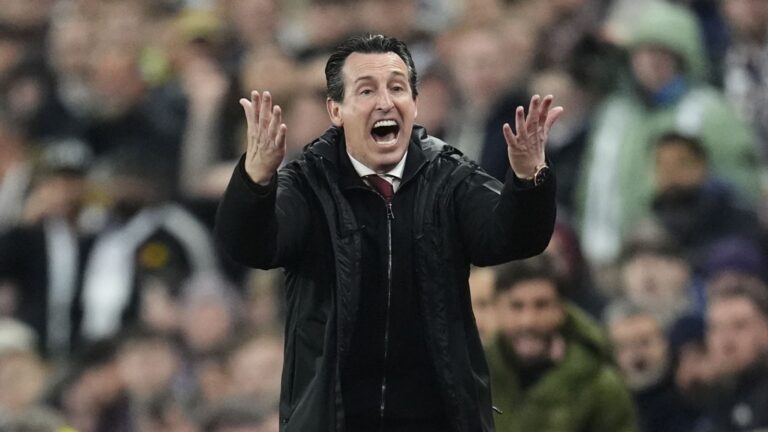
Aston Villa boss Unai Emery has outlined how “proud” he was of his team following their performance against Paris Saint-Germain but insisted his team deserve to play in the Champions League again.

Villa headed into the fixture facing a 3-1 deficit on aggregate following the defeat at the Parc des Princes last week, before conceding two early goals to Achraf Hakimi and Nuno Mendes in the opening 30 minutes of the second leg at Villa Park.

Youri Tielemans’ deflected effort pulled one back before half-time, with captain John McGinn and Ezri Konsa striking within the space of two minutes after the restart to tee up a tantalising finish with the scoreline finely poised at 5-4 in the tie.

Villa had chances to draw level through Marco Asensio, playing against his parent club, and Konsa but ultimately fell short before bowing out of the competition with their heads held high.

“I am very proud of everything we did,” Emery told Amazon Prime.

“To get to this level is the best step forward to get to where I want to be at with Aston Villa.

Please use Chrome browser for a more accessible video player

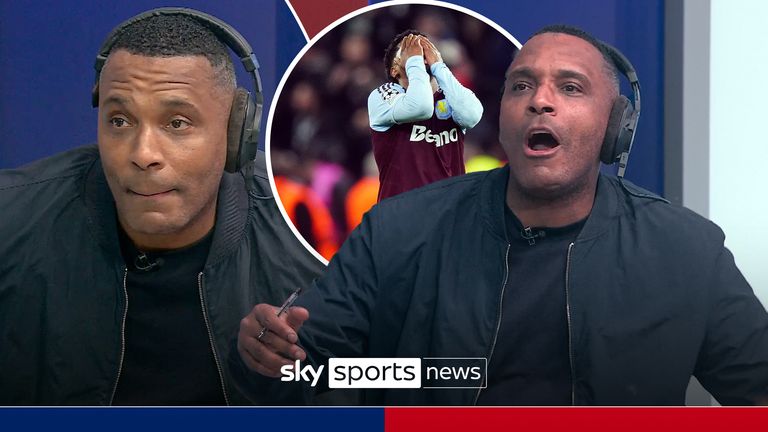
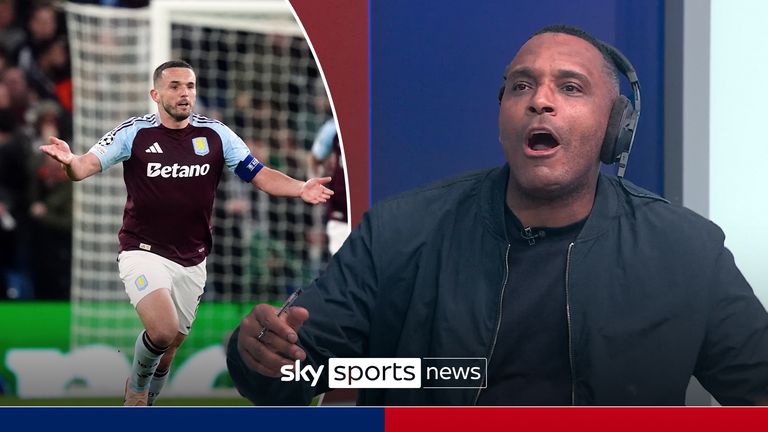
The best of Clinton Morrison as he goes through all emotions watching Aston Villa fall short of an all-time Champions League comeback

“We competed well in the first leg, but not enough. We were even better today and close to coming back. The last step forward is still [missing], and this is the only [aspect] I want to [work on] for our process.”

Villa have are now facing a short turnaround before another crucial clash, as they host fellow Champions League chasers Newcastle, live on Sky Sports, this Saturday. The Magpies currently sit in fourth place, two points ahead of Villa in seventh, with a game in hand.


Saturday 19th April 5:00pm


Kick off 5:30pm


Emery continued in his press conference: “The players showed capacity. We beat Bayern Munich and we won tonight, the players showed their capacity at this level, they are here because they deserve to be here and facing matches like today.

“I want a club with same the challenges as I have – adding more quality players if we need it – so proud of these players, confident we will get our objectives until the last match we’ll face.”

McGinn: We have come a long way

Will Villa qualify for Champions League football?

Aston Villa currently sit in seventh place within the Premier League table, with the top five set to secure Champions League football.

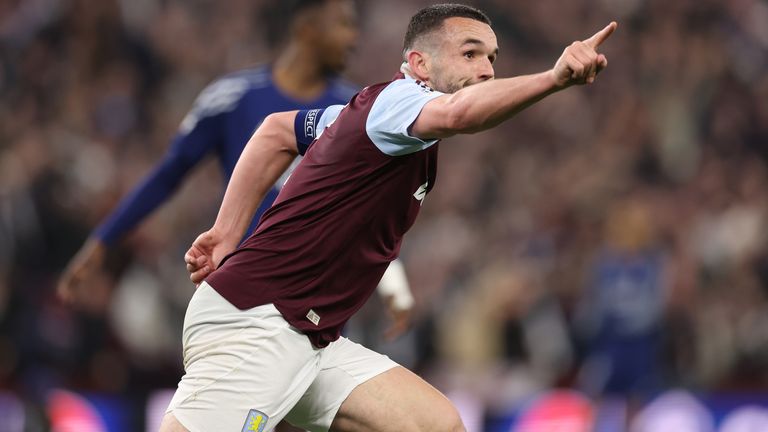
The Villa captain kickstarted the second-half resurgence after driving deep into the PSG half and firing into the top corner. He insists, despite exiting the competition, the team can be proud of their efforts and the journey they have been on.

McGinn signed for Villa from Hibernian in 2018 and played a major role in their rise from the second tier of English football to competing with Europe’s elite.

“Obvious disappointment but I am proud of my team-mates, proud of the club,” he told Amazon Prime. “We have come a long way. We were so, so close tonight. We just fell a little bit short.

John McGinn celebrates after scoring Aston Villa's second goal of the night against PSG
Image:
John McGinn celebrates after scoring Aston Villa’s second goal of the night against PSG

“We had chances to take the game to extra-time but we’ve got to be proud about the way we came back against one of the best teams in the world, to fight to the end.

“We want more. We want to be back here next season and we will try our best to do that.”

Please use Chrome browser for a more accessible video player

Morrison cannot believe what he is watching as Aston Villa score two goals in three minutes to make it 5-4 on aggregate against PSG

When asked about what Emery said at half-time, when his side were still staring down the barrel of a 5-2 deficit on aggregate, McGinn added: “He said, ‘I’m proud of the performance, keep going, you just never know’.

“We never gave up. It was chaos, but we gave absolutely everything and I think every Aston Villa supporter will leave with a huge sense of pride.”

Konsa: We will be back!

Konsa echoed the claims made by his manager and captain, while also referencing the chance he missed when Marcus Rashford’s cross flashed across the face of goal but the defender failed to make the necessary connection from point-blank range.

Please use Chrome browser for a more accessible video player

Morrison is critical of Aston Villa’s tactics as Unai Emery’s side find themselves 5-1 down to PSG on aggregate

“I’m proud of the boys,” Konsa said. “The two goals at the start killed us but we showed great belief and character to get back into it. We won the second leg but it wasn’t enough.

“At half-time we felt we had nothing to lose. We wanted to go out there and prove a point. We had chances, I think I scored the hardest one. I don’t think we could have done any more. I missed the ball [for the headed chance], it happens.

“Donnarumma made some excellent saves. We showed tonight we can compete at the highest level and we want to do it again next season.”

‘Villa have to use PSG victory going forward’

Sky Sports’ Jamie Carragher on CBS:

“It’s one of those nights that as a fan, you’re disappointed, but you’ve loved it as well.

“You were going to Villa Park not expecting too much but that is a night they’ll remember for a long time.

“Hopefully, from Villa’s point of view, they’ll get in the Champions league again next season. I think they will through league position.

“But that is a night they couldn’t have dreamt of four or five years ago.

“Yes, they will be disappointed, but they’ll be a real buzz around Aston Villa now going forward because they can use that performance.

“If they’d have ended up losing 2-0 or 3-0, that affects your league form or the FA Cup semi-final they’ve got coming up.

“They can use the fact that, in the captain John McGinn’s eyes, they’ve beaten the best team in Europe, and beaten them well or even by more.

“They have got to take that going forward now.”

Enrique: PSG have not been dominated in this way before

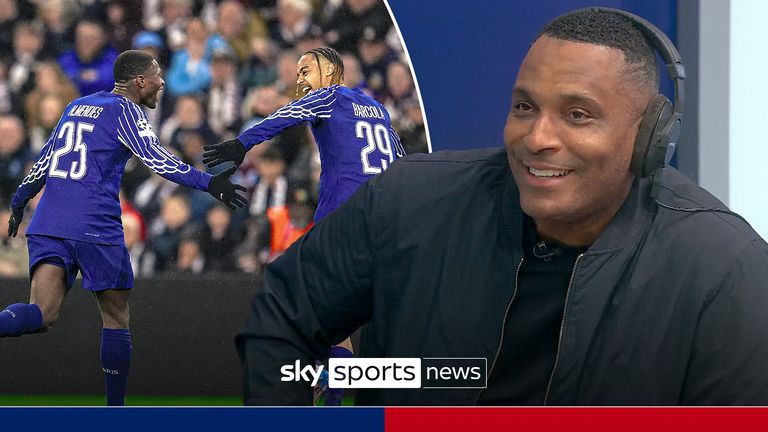
Paris Saint-Germain's Nuno Mendes (centre) celebrates scoring their side's second goal
Image:
Paris Saint-Germain’s Nuno Mendes (centre) celebrates scoring their side’s second goal

PSG boss Luis Enrique acknowledged the spirited performance from Villa and even claimed he had not seen a team “dominate” his side in that manner before travelling to the west Midlands.

“I do not think this team has been dominated by a team in this way but the opponent had to take risks because they were going out of the competition.

“They attacked with real intensity and in front of a great crowd as well. We will improve with this experience.

“I was not happy at the end of the first half. We were playing at a level that was not befitting of the Champions League. Then in the second half, we were really suffering and Villa had chances to equalise.”


Source link

Trump Gives Conflicting Signals and Mixed Messages on Iran Nuclear Talks

0


Just a few weeks ago, President Trump’s national security adviser, Michael Waltz, a longtime hawk on Iran, cast the administration’s goal in negotiations over Tehran’s nuclear program in crystal clear terms.

“Full dismantlement,” he said. He went on to list what that meant: Iran had to give up facilities for enriching nuclear fuel, for “weaponization” and even its long-range missiles.

But what sounded like a simple, tough-sounding goal on a Sunday talk show has started to unravel. In the past 24 hours, officials have left a contradictory and confusing set of messages, suggesting the administration might settle for caps on Iran’s activities — much as President Barack Obama did a decade ago — before backtracking on Tuesday.

Some of this may simply reflect inexperience in dealing with nuclear weapons programs. Mr. Trump’s chief negotiator is Steve Witkoff, a friend of the president’s who, as a New York developer like him, has spent a lifetime dealing with skyscrapers but only began delving into Iran’s underground nuclear centrifuges and suspected weapons labs a few weeks ago.

But the inconsistency also appears rooted in the splits inside Mr. Trump’s national security team as it grapples anew with one of the longest-lasting and most vexing problems in American foreign policy: How to stop Iran’s nuclear program without going to war over it. So far, the result is a blitz of mixed messages, conflicting signals and blustering threats, not unlike the way Mr. Trump and his aides talk about their ever-evolving tariff strategy.

The issue came to the fore on Monday night when Mr. Witkoff began talking about his first encounter with Iran’s foreign minister last Saturday in Oman. The meeting went well, he said, plunging into the complex world of Iran’s nuclear program, which has taken it to the very threshold of building a weapon.

Mr. Witkoff emerged from that meeting envisioning a very different kind of deal with Iran than the one Mr. Waltz described.

In a friendly interview with Fox News, he spoke about building a system of “verification” for the production of enriched uranium, “and ultimately verification on weaponization, that includes missiles, type of missiles that they have stockpiled there, and it includes the trigger for a bomb.” He suggested Iran might still be able to produce uranium at low levels — those needed to produce nuclear power — and he never mentioned the world “dismantlement.”

He was describing, in short, a revised, presumably more Trumpian version of the agreement the Obama administration struck with Iran a decade ago. “In principle the original nuclear deal can be improved,” he said. Mr. Trump has regularly derided that deal as a “disaster” and pulled out of it in 2018, calling it “a horrible one-sided deal that should have never, ever been made.”

A few years later, Iran declared that if the United States would not abide by the old agreement, it would not either. It began enriching uranium to near-bomb-grade, putting it just days or weeks from having the fuel to make six or more weapons. U.S. intelligence agencies concluded that Iranian researchers were working on a “faster and cruder” means of turning that fuel into a weapon.

Mr. Witkoff’s statement didn’t survive for very long. On Tuesday morning, Mr. Trump and his top national security officials, including Mr. Witkoff, were in the Situation Room, debating Iran policy, in a meeting first reported by Axios. By midmorning, Mr. Witkoff posted a message on social media declaring that “Iran must stop and eliminate its nuclear enrichment and weaponization program,” a characterization he never used the previous night.

“A deal with Iran will only be completed if it is a Trump deal,” he said. At a news briefing a few hours later the White House press secretary, Karoline Leavitt, said that Mr. Trump had told the Omani hosts of the Iran talks about “the need for Iran to end its nuclear program through negotiations.” The negotiations resume Saturday.

In fact, Mr. Witkoff and Vice President JD Vance have argued internally that it would doom the negotiations to insist on full dismantlement, according to officials familiar with the ongoing debate, who requested anonymity to discuss private discussions. The Iranians have already declared that they will not give up all of their nuclear program — and thus their option to race for a bomb. Instead, the two have argued the administration should strive for a strict verification system — perhaps run by the United States, rather than the International Atomic Energy Agency — to assure compliance.

But that sounds reminiscent of an Obama-era compromise.

Mr. Waltz and Secretary of State Marco Rubio, officials say, have stuck with their long-held hawkish view that Iran cannot be left with the capability to enrich nuclear fuel. Otherwise, it will be poised to do what it did in recent years: ramp up enrichment to near-bomb-grade levels.

“I think eliminating Iran’s capability is unattainable,” said Gary Samore, who dealt at length with the Iran issue as the top White House nuclear official in the Clinton and Obama administrations. “I don’t think Iran will agree to eliminate the whole program even under the threat of military force.”

The Iranians are hedging their bets. Speaking on Tuesday in Iran, Ayatollah Ali Khamenei, the country’s supreme leader, told senior government officials that an agreement “may or may not come to fruition; we are neither too optimistic nor too pessimistic.”

He continued: “Of course, we are very pessimistic about the other side.”

Mr. Samore, who now is director of the Crown Center for Middle East Studies at Brandeis University, said he was in favor of any accord that “reset the nuclear clock.”

“All the techniques people have used so far — sabotage, sanctions, diplomacy — have all been about buying time. I don’t think that Trump wants to go to war,” he said, “and the Iranians don’t want to go to war. That suggests there could be room for agreement.”

Farnaz Fassihi contributed reporting from New York.


Source link

Santa Lives in Rovaniemi, Finland. Some of His Neighbors Are Not Thrilled.

0


“Do these have cheese in them?” he asked.

She saw more tourists in snowmobile suits lingering by the cashier. Before they could make eye contact, she got out of there.

“I was thinking: Here we go again,” she said.

These were small impositions, but enough was enough. If you’re blond and therefore identifiable as a likely native of Rovaniemi, you can barely move around a supermarket during tourist season — and it’s all Santa’s fault.

A simple marketing idea, playing off a cherished childhood fantasy, has made a small city on the edge of the Arctic Circle almost unlivable for many people who live there. And it’s not just the needy tourists in the dairy or cracker aisle. It’s also the noisy Airbnbs, the escalating housing crunch, the sidewalks so crowded you can’t walk down them without bumping into people, and the car doors slamming in the middle of the night.

And it all started when the Nazis came to town.

Early in World War II, Finland allied with the Nazis, who built a big base in Rovaniemi, a Lapland railway hub. But by October 1944, the Nazis were losing and the Soviet Red Army was marching into Eastern Europe. As a little memento for the Finns and the Russians, the retreating German soldiers burned Rovaniemi to the ground.

That left a blank canvas. So after the war, Finland asked Alvar Aalto, the celebrated Finnish architect, to redesign the city. Aalto, known for his bold churches, concert halls and kitchen stools, came up with an idea: Why not remake the ruined town in the shape of a reindeer head, with the peripheral roads shooting out like antlers, to honor the area’s connection to reindeer herding?


Source link