Home Blog Page 373

Canada Conditionally Waives Retaliatory Tariffs on U.S.-Made Cars and Trucks

0


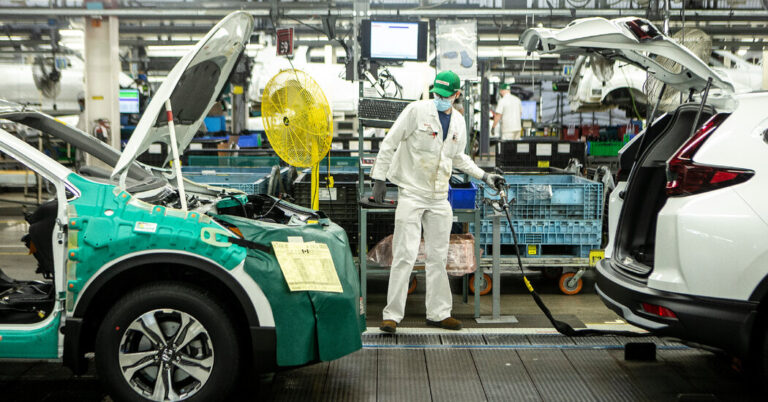
In a partial roll back of its retaliation against U.S. tariffs, Canada’s finance minister said on Tuesday that the government would let automakers import vehicles assembled in the United States duty-free provided that they continued to build cars in Canada and continued with previously announced expansions.

Last week, Canada began charging 25 percent tariffs on vehicles imported from the United States in response to President Trump’s levies of the same amount on cars.

The great majority of Canadian-made cars and trucks end up in the United States. Mr. Trump has repeatedly said that he wants carmakers to move all of their manufacturing to the United States, a move widely seen in Canada as a direct assault on the country’s largest export aside from oil and gas.

Auto trade between the United States and Canada has become tightly integrated since the two countries signed a trade deal 60 years ago that eased the flow of vehicles and related goods across the border. The resulting trade has been generally balanced between the two nations, though there have been occasional, slight surpluses in the United States’ favor.

François-Philippe Champagne, Canada’s finance minister, did not specify in his statement exactly how many U.S.-made cars and trucks each of the five major automakers would be allowed to import without tariffs.

But his statement suggested that those numbers would be linked to Canadian manufacturing: “The number of tariff-free vehicles a company is permitted to import will be reduced if there are reductions in Canadian production or investment.”

A spokeswoman for Canada’s Department of Finance was unable to immediately provide further details. Stellantis, one of the major automakers, declined to comment on the announcement. Ken Chiu, a spokesman for Honda, said the company’s factories in Alliston, Ontario, would continue to produce as many vehicles as it could. The other three companies did not respond to questions.

Only Toyota and Honda, which account for about two-thirds of Canadian auto production, are currently operating at or near full capacity in Canada.

Stellantis recently stopped renovating a factory in the Toronto suburb of Brampton that would have made gasoline and electric Jeeps, in what the company described as a pause. Its larger plant, in Windsor, Ontario, is in the middle of a two-week shutdown that was induced by the U.S. tariffs.

Ford’s factory in Oakville, Ontario, was closed for a now-abandoned plan to convert it for electric vehicles. It is now retooling to make large pickups. And General Motors announced that it would largely shut down production of a poor-selling electric van made in Ingersoll, Ontario, until October.



Source link

What to Know About Who Pays the Higher Costs of Trump’s Tariffs

0


President Trump’s latest tariffs are about to become an unavoidable and expensive reality for American businesses and for people who rely on foreign goods.

Shoppers buying clothes from retailers in China may soon pay more than twice as much, now that a special exemption for lower-value imports is disappearing. And companies involved in international trade must now make even more complicated calculations to decide how much they owe in tariffs.

“Maybe 3 percent of the people are well prepared,” said Jeremy Page, a founding partner of Page Fura, an international trade law firm, whose clients include large companies. “And that might even be charitable.”

Imports from China have been hit with tariffs of 145 percent. That means for every $100 worth of goods a business buys from that country, it has to pay $145 to the federal government. Goods from most other countries have a new 10 percent tax, though that could rise if the countries do not reach trade agreements with the United States by July. And there are separate tariffs on cars, steel and aluminum. Mr. Trump has also said he wants to impose new tariffs on pharmaceuticals and computer chips.

Mr. Trump contends that the tariffs will encourage businesses to produce goods in the United States. The tariffs on Chinese goods will almost certainly reduce imports from the country. But American businesses will not be able to quickly get goods from elsewhere — U.S. imports from China totaled $439 billion last year — and they will end up owing huge amounts in tariffs.

Mr. Trump has said tariffs are a tax on other countries, but, overwhelmingly, American businesses importing the goods pay the tariffs to the Customs and Border Protection when goods enter the United States. Importers may pass some or all of the cost of the tariff to consumers through higher prices.

“In the short term, prices are definitely going to increase,” said Daniel J. Barabino, chief operating officer at Top Banana, a fruit distributor based at the Hunts Point Produce Market in the Bronx, which imports bananas and other produce from Central America.

Importers may also try to negotiate lower prices with foreign suppliers, which would reduce the tariff.

Most importers employ customs brokers who calculate the tariffs owed based on the goods’ value and where they were exported from. Other factors — like whether a product has components from China — can complicate the tariff calculation.

Payments are made electronically, from the bank accounts of either importers or the brokers, who later recoup the money from their clients. As Mr. Trump has piled on tariffs, some brokers are becoming more cautious and demanding customers pay up quickly.

“With changing tariffs and increased risk, many brokers are tightening their credit policies — asking for upfront payments or requiring funds to be held on account,” said Adam Lewis, a co-founder and president of Clearit, a customs broker.

The tariffs end up at the Treasury Department, which also receives taxes and other government fees, and spends the money on things like salaries, weapons and equipment.

Calculating tariffs can be difficult, especially when tariff rates change a lot in a matter of days, as they have recently.

Trade rules allow for some leeway, said Mr. Page, the lawyer. Importers who realize they have made a mistake and inform Customs and Border Protection are usually allowed to pay what they owe, plus interest.

But, Mr. Page said, Mr. Trump’s recent executive orders on metals tariffs were stricter than that. The order said Customs and Border Protection could impose much higher monetary penalties if importers misclassified goods, an approach that, in Mr. Page’s view, defies the law.

“That mandate says, ‘We’re going to hammer you no matter what,’” he said.

Customs and Border Protection’s systems are already showing signs of strain.

On Friday, the agency said importers had not been able to submit tariffs owed on certain goods. The glitch appeared to be preventing importers from applying a lower tariff rate on goods that were in transit to the United States before some of Mr. Trump’s new levies took effect.

Customs and Border Protection said it was releasing the goods affected by this problem and allowing importers to submit their customs duties later.

Late Friday, a spokeswoman for the agency said: “There was a brief technical issue that was quickly identified and resolved. It had no impact on cargo flow, and all applicable tariffs were collected during that time.”

“This won’t be the last time that something like this happens,” Mr. Lewis said, adding that there may be backlogs when customs officials do more checks to see if the tariffs on Chinese goods are being paid correctly.

Countries that don’t strike trade deals with the United States by July may face higher tariffs, and Mr. Trump may suddenly decide to introduce new tariffs. Fears of such levies could extend a monthslong rush to get goods into the United States before the new tariffs take effect.

Supply chains have so far handled the higher volumes without major snags.

Trucking activity around Laredo, Texas, one of the busiest border crossings in the United States, was 46 percent higher than it was a year earlier, according to Motive, which gets its data from cameras fitted inside vehicles used by supply chain companies. Local truckers said their networks had not been strained.

At the Port of Long Beach and Port of Los Angeles, trucks took 71 minutes on average to pick up cargo from terminals in the first three months of this year, according to data from the Harbor Trucking Association, a trade group. That was slightly up from 68 minutes in the first three months of last year. In the first quarter of 2022, when the pandemic trade boom caused backlogs at the ports, pickups took an hour and a half.

Danielle Kaye contributed reporting.


Source link

At Trial, Mark Zuckerberg Avoids Explaining Takeovers of Instagram and WhatsApp

0


In his second day on the stand of a landmark antitrust trial, Mark Zuckerberg, the chief executive of Meta, said he bought Instagram and WhatsApp because it was hard to build new apps and dodged questions about whether he was trying to snuff out competitive threats to his company.

“Building a new app is hard,” he said Tuesday when asked why, in one 2012 email that was presented, he had seemed intent on buying Instagram. “We’ve probably tried building dozens of apps over the history of the company, and the majority of them don’t go anywhere.”

“We could have built an app,” he added. “Whether it succeeded or not is a matter of speculation.”

Mr. Zuckerberg’s testimony is central to the antitrust trial, being held in the U.S. District Court for the District of Columbia. The chief executive spent several hours on Monday answering questions from lawyers as they tried to make the case that Mr. Zuckerberg saw the other apps as rivals that he needed to take out. During the questioning, which at times became contentious, Mr. Zuckerberg frequently said he didn’t remember his thought process for certain emails.

The case, Federal Trade Commission v. Meta Platforms, poses a consequential threat to Mr. Zuckerberg’s business, which he co-founded as Facebook in his Harvard dorm room in 2004. The F.T.C. is asking Judge James E. Boasberg, who is presiding over the case, to find the company guilty of using a “buy-or-bury” strategy to kill off competition by acquiring nascent rivals like Instagram and WhatsApp. Meta bought Instagram in 2012 for $1 billion and WhatsApp in 2014 for $19 billion.

If successful, the government is likely to ask the judge to break up Meta through selling the two apps.

Still, legal experts cautioned, the F.T.C. faces an uphill climb to win. The government is asking a judge to look back more than a decade and prove that Meta stayed powerful by quashing competitors through its acquisitions. Regulators approved the Instagram and WhatsApp deals at the time, raising questions about why, experts said.

The suit against Meta is part of a broader push by U.S. regulators to rein in the power of the largest tech companies. The F.T.C. has also sued Amazon, accusing it of protecting a monopoly by squeezing sellers on its vast marketplace and favoring its own services.

The Department of Justice won a suit last year accusing Google of maintaining a monopoly in search, and a proceeding is set for next week to determine remedies for the violations. The D.O.J. has also sued Google over its dominance in ad technology. Apple was also a target of a suit by the government, which accused it of making it difficult for iPhone and iPad users to leave its ecosystem.

During opening statements in the Meta trial on Monday, the F.T.C. said the company’s purchases of Instagram and WhatsApp cemented its power, depriving consumers of other social-networking options and edging out competition.

Meta’s lawyers denied the allegations in opening statements, countering that the company faces plenty of competition from TikTok and other social media platforms. Trying to unwind the mergers after they had been approved a decade ago would set a dangerous precedent, the lawyers added.

On Tuesday, lawyers for the F.T.C. pressed Mr. Zuckerberg to explain internal communications that preceded the purchases of Instagram and WhatsApp, both of which the company later bought. Mr. Zuckerberg’s notes, some of which date back 15 years, detailed fears about how Facebook could compete on mobile devices.

Daniel Matheson, lead litigator for the F.T.C., pointed to 2012 emails among Mr. Zuckerberg and his top executives, in which they traded candid thoughts on employee performance, potential and past acquisitions, and the threat of upstart competitors.

In one email to Sheryl Sandberg, Meta’s former chief operating officer, Mr. Zuckerberg told her he could teach her to play Settlers of Catan, a popular board game. He went on to criticize some lieutenants, saying that their lagging performance was one reason they needed to buy Instagram for $1 billion.

“A billion dollars is very expensive,” Mr. Zuckerberg said on the stand.

In another email, from 2013, Mr. Zuckerberg told executives to block foreign competitors from advertising on Facebook, including popular Asian messaging apps like Kakao and WeChat.

“Those companies are trying to build social networks and replace us,” he wrote. “The revenue is immaterial to us compared to any risk.”

Mr. Zuckerberg is expected to testify a total of seven hours. Ms. Sandberg and Kevin Systrom, a co-founder of Instagram, will testify this week, the F.T.C. said.


Source link

Some Online Scam Victims Can Now Seek Tax Relief on Firmer Ground

0


Victims of sophisticated online scams are often dealt a double whammy. Not only is their money forever gone, but these stolen sums often generate giant tax bills when the funds are emptied from taxable retirement accounts.

Many of these victims are often left wondering what sort of recourse they might have. Tax regulators recently provided some answers, clearing the way for more victims to seek a tax break on more solid footing.

In a memorandum released on March 14, the Internal Revenue Service’s Office of Chief Counsel described which types of scams might qualify for tax relief, which included many investment schemes and some types of impersonation fraud. But it still excludes victims of other widespread digital crimes, including kidnapping schemes, for example, and romance-related fraud that did not involve investing.

“We are aware that taxpayers have suffered losses from various scams perpetrated by unknown individuals operating domestically and internationally,” the memo said. “However, the actual scam may vary, and the application of this advice is dependent on the taxpayer’s specific facts.”

There used to be a more equitable way for people with the largest fraud losses to deduct them from their income, using a tax deduction for victims of personal casualties, disasters and theft. But that and many other individual breaks were eliminated or narrowed as part of the Republican-led tax overhaul known as the Tax Cuts and Jobs Act of 2017, which helped to pay for broader tax cuts, including a reduced corporate tax rate.

The current structure of the deduction, effective from 2018 through 2025, treats victims unevenly. It can be used only in certain situations, even though many of these fraudsters are operating out of the same playbook.

The tax deduction, in its pared down form, says that personal casualty and theft losses can be claimed only in situations like federally declared disasters or “transactions entered into for profit.”

That means deductibility is an option only if the victims had a goal of profiting when they entered into transactions with scammers — but that definition wasn’t etched into the law. The new guidance provides taxpayers with parameters by laying out several different situations that qualify and a couple that don’t.

This includes taxpayers deceived by impersonators who claim to be fraud specialists at the victim’s financial institution, who then urge them to move their money to safer accounts because their existing ones have been compromised.

Since the victim intended to safeguard and later reinvest the money, the I.R.S. deems this “a transaction entered into for profit.” In other words, the guidance recognizes that the preservation of the assets qualifies as a profit motive (and is eligible for tax deduction).

“That opens the door a bit for more taxpayers to take theft loss deductions,” said James Creech, a director at the tax advocacy and controversy practice at Baker Tilly, a large accounting and advisory firm in San Francisco. “Practically what this means is that if you are audited you can take the memo, show it to the auditor, and most likely that will resolve the question of if the transaction was entered into for profit.”

Other qualifying situations include so-called pig butchering investment schemes, where unsuspecting people are directed to seemingly legitimate mobile apps or websites where they can buy cryptocurrencies and have the opportunity to earn large profits. As their account value increases, they invest more money — but when they try to cash out, the money vanishes. This, too, is deemed a profit-driven transaction by the I.R.S.

In another situation, the taxpayer gets a phishing email from an impersonator, urging them to call a fraud analyst to ensure their money is safeguarded; the impersonator instructs the victim to click on a link in an email, which gives them control over their computer, and eventually enables them to empty the victim’s investment account without their permission.

In all three cases, the taxpayer had contacted their financial institutions and law enforcement and were informed they had little to no chance of recovering the money.

The memo also outlines scenarios that would not qualify, in large part because there is no profit motive. So if an individual was deceived into paying medical bills for a scammer posing as a romantic interest, that would not be eligible for the tax deduction. The same goes for victims who sent ransom money to criminals who had claimed to have kidnapped their grandchild using artificial intelligence to clone the child’s voice.

The guidance also clarifies that none of these situations would be eligible for the tax breaks provided to victims of Ponzi schemes, which can be used when an investment fraud meets certain conditions.

Regardless of your specific situation, it helps to document everything as soon as you realize you’ve been victimized. File a police report with local officials and federal ones, including the Federal Bureau of Investigation’s Internet Crime Complaint Center. Take screenshots of any online platforms or apps that you used to communicate with the criminals, including online conversations, photos or anything related. Create a timeline or narrative of the events.

The casualty and theft loss deduction is set to revert to its original form at the end of this year if the sweeping 2017 tax law expires. But Republicans are trying to extend that package.

The original federal casualty loss deduction was limited in different ways. It could be claimed only by taxpayers who itemized deductions on their returns, which means the total amount of those deductions had to exceed the standard deduction for it to be worth it. And the deduction applied only to losses that exceeded 10 percent of their adjusted gross income.

Lawmakers, including Representative Jamie Raskin, Democrat of Maryland, have drafted legislation to offer more comprehensive and retroactive relief, dating back to 2018 when the deduction was curtailed. But that hasn’t been passed into law.

“This I.R.S. guidance provides a good deal of clarity and relief to a lot of scam victims, including a constituent of mine who would have owed hundreds of thousands of dollars in taxes,” Mr. Raskin said in a statement. “But we still have important bipartisan work to do in Congress to make the tax code fairer for all scam victims.”

The way the states treat these situations can amplify victims’ federal losses too, tax experts said, generating significant tax liabilities of their own. But some states are trying to address that.

Joseph Vogel, a Democratic state legislator in Maryland, said he recently introduced a bill with bipartisan support that would make these losses generally deductible at the state level.

“The scams are getting better and better,” he said. “These people need some relief.”


Source link

American Airlines Will Offer Free Wi-Fi on Most Flights Next Year

0


Beginning next year, if you catch an American Airlines flight, you won’t have to pay to watch shows or movies, keep up with the latest news or endlessly scroll your social media feeds to pass the time.

American Airlines will provide free high-speed Wi-Fi for its regular costumers on most flights, the company announced on Tuesday. In doing so, the airline will be among the last of the major domestic carriers to offer free internet connectivity.

The airline said that beginning in January 2026, members of its free AAdvantage loyalty program will have access to the wireless service, which will be available on 90 percent of the carrier’s fleet. The company said in a statement that it will be offering the perk on “more planes than any other domestic carrier.”

“Our customers greatly value staying connected while in the air, whether communicating with friends, getting work done, checking in on social media or streaming their favorite subscription services,” Heather Garboden, chief customer officer at American Airlines, said in the statement.

The airline will partner with AT&T to provide the service at no cost, it said. The connection will be powered by the satellite service providers Viasat and Intelsat, it added.

To connect, passengers will be required to enroll in the AAdvantage loyalty program, which accumulates loyalty points for travel with the carrier. Wi-Fi service, which is available on most of American’s routes, currently begins at $9.

The airline said that it is on pace to outfit more than 500 regional aircraft with high-speed wireless by the end of this year.

Other carriers already provide free Wi-Fi.

In 2023, Delta Air Lines introduced free Wi-Fi for most domestic flights through the airline’s SkyMiles program.

Last month, United Airlines announced that its free internet would be powered by Starlink, the satellite internet service founded by Elon Musk, and that some of its fleet will be equipped by the end of this year before rolling it out to every plane.


Source link

Senators Investigate Private Equity Role in Soaring Fire-Truck Costs

0


As fire departments around the country rep ort soaring prices and waiting times for new fire engines, two United States Senators are investigating the effect on public safety and the role that private equity investment has played in disrupting the firefighting equipment industry.

The senators — Elizabeth Warren, Democrat of Massachusetts, and Jim Banks, Republican of Indiana — reported on Tuesday that they had heard from dozens of fire departments about delayed deliveries, defective parts and escalating prices. In a letter to the International Association of Fire Fighters, they said they were concerned that “private equity is padding shareholders’ wallets at the expense of public safety” and that they were seeking to learn more about the situation.

Over the past two decades, the private equity firm American Industrial Partners has acquired a number of specialty vehicle companies, including fire truck manufacturers, and has combined them into a single company called Rev Group. Company executives told analysts that they would substantially raise profit margins and that other companies were doing the same. Rev Group closed two manufacturing plants to streamline its operations.

The New York Times reported earlier this year that prices for fire trucks have soared in recent years and that manufacturers are taking longer to deliver vehicles. Rev Group has said it has a backlog of $4 billion in orders.

Industry leaders have said that the delays and rising prices stemmed from disruptions brought on by the coronavirus pandemic, but some fire officials have blamed the problems at least partly on the industry’s consolidation.

Sue Finkam, the mayor of Carmel, Ind., said she raised the issue with Mr. Banks after she saw how quickly prices for new trucks were rising and how long they would take to be delivered. The estimated price of a new pumper vehicle rose about 10 percent in 2024 from the previous year, she said, while the wait time for a new tiller apparatus is now more than four years.

Ms. Finkam said her city was growing and needed to add more fire stations. But as matters stand now, she said, the city expects to be able to acquire land, design a fire station, construct the building, hire firefighters and train them, while still waiting for the station’s fire engines to be delivered. With the brunt of the pandemic now a few years in the past, she said, she hopes the senators will get answers about the soaring prices and delays.

“The taxpayers are going to be the ones shouldering the burden,” she said.

In Los Angeles, even before the wildfires that consumed whole neighborhoods earlier this year, the city fire department was struggling to maintain its aging fleet, and dozens of vehicles were out of service. Union officials said that rising prices for replacement vehicles had forced the department to order fewer new rigs than it had planned.

Ms. Warren said that the senators’ letter to the International Association of Fire Fighters was the first step in their investigation. She wants to encourage a broader congressional inquiry, and hopes that the Trump administration will get involved.

“Ultimately, when we don’t take care of our firefighters, we make it harder for our firefighters to take care of their communities,” Ms. Warren said in an interview.

Basel Musharbash, an antitrust lawyer who has done his own examination of fire truck manufacturing, said the consolidation in the industry had implications for public safety. But he said that similar private-equity roll-ups are reshaping many other sectors of the economy as well.

“What happened here is alarming and should hopefully attract a lot of attention, not just to the plight of fire departments but to the plight of lots of different industries that are dealing with private-equity-led consolidation,” Mr. Musharbash said.


Source link

The U.S. Wants to Break Up Google and Meta. That Could Be Hard.

0


The last time the courts seriously weighed the wisdom of breaking up a giant technology company was a quarter-century ago, after Microsoft was found to have illegally stifled competition in personal computer software.

A Federal District Court judge said yes to forcing Microsoft to split in two, separating its monopoly Windows operating system from its Office productivity products and other software. But an appeals court threw out the order, calling the breakup option “a remedy that is imposed only with great caution, in part because its long-term efficacy is rarely certain.”

In a pair of landmark proceedings this month in two Washington courtrooms, the issue of possibly breaking up a big tech company will be on the judicial table again.

In an antitrust trial that began on Monday, the Federal Trade Commission argued that Meta maintained an illegal monopoly in social media through its acquisitions of Instagram and WhatsApp. The agency seeks to force Meta to divest both. Next week at a separate trial, a federal judge will hear arguments from the Justice Department about why the court should break up Google in order to remedy the company’s monopoly in internet search.

“Divestiture can be an entirely acceptable remedy, depending on the severity of the harm,” said William Kovacic, a law professor at George Washington University and a former chairman of the F.T.C. “But it can be risky surgery.”

For generations, the courts have faced the quandary of what action to take in major antitrust cases once a dominant company has been found to have engaged in anticompetitive behavior. In a 1947 Supreme Court ruling, Justice Robert H. Jackson memorably wrote that if a court’s solution did not open the market to competition, the government would have “won a lawsuit and lost a cause.”

But while a court’s ruling is based on examining facts in the past, its remedy looks to the future. The goal is to free up markets rather than hobble them — and create a competitive environment that results in more new ideas, new companies, more innovation and lower prices.

The challenge is taking on new significance as regulators make a major push to rein in the tech giants in a string of antitrust cases objecting to the power they have over communications, commerce and information.

In a different lawsuit against Google, the Justice Department is awaiting a judge’s decision on the company’s dominance in advertising technology. The department has also sued Apple over its tactics to protect its lucrative iPhone franchise. The F.T.C. has sued Amazon, saying the company illegally shielded its monopoly in online retailing from competition.

This wave of antitrust litigation, including appeals, is likely to last for years. And if the government wins any of its cases, a judge could order a breakup — the worst-case outcome for the companies.

History shows that these orders can be effective, antitrust experts said. But the results in improving competition has been mixed.

Standard Oil, an energy giant founded by John D. Rockefeller in 1870, was the defining case of the progressive, trustbusting era of the late 19th and early 20th centuries. The company was broken up by the Supreme Court in 1911, split into 34 entities that had made up the original Standard Oil Trust, which controlled the oil industry’s production, refining, distribution and pricing. While that initially helped competition, over time the trust’s descendants became oil giants of their own, including Exxon Mobil, Chevron and ConocoPhillips.

The breakup of AT&T, in a settlement in 1982, followed a lengthy antitrust suit by the Justice Department, which accused the company of illegally monopolizing the telecommunications market in America. The local phone business was split into seven regional “Baby Bell” companies, and the order opened up the long-distance phone and telephone equipment markets, increasing competition and driving down prices.

In antitrust jargon, a “structural” solution like this generally means a breakup. But there are steps short of a forced sell-off that can shape markets and stimulate competition, antitrust experts said.

In 1969, under pressure from a government antitrust suit accusing it of monopolizing the computer market of its day, IBM unbundled its hardware from software — treating them as separate businesses, sold and priced independently. Software would no longer be “free,” included in the price of a computer. That helped ignite the rise of the commercial software industry, with Microsoft as the biggest winner.

Microsoft avoided a breakup, but its eventual settlement in 2001 contained a prohibition against contracts that had essentially used its Windows monopoly as a club by restricting personal computer makers from distributing the software of upstart rivals. That restraint kept the door open to new competition in browser software and search. Google was the leading beneficiary.

“Those were strong remedies without a breakup that created more competition,” said Fiona Scott Morton, an economics professor at the Yale University School of Management.

The next powerful tech companies to face courtroom scrutiny are Meta and Google.

On Monday, the F.T.C. and Meta, formerly Facebook, presented their opening statements in the U.S. District Court for the District of Columbia. Mark Zuckerberg, the company’s chief executive, then took the stand. The essence of the government’s case is that Facebook vastly overpaid more than a decade ago for Instagram and WhatsApp, to kill them off to protect a lucrative monopoly in social networking.

Meta replied that Instagram and WhatsApp had grown and flourished under its ownership. And, the company argued, there is plenty of competition in the social networking market, including the meteoric rise of TikTok.

Should the government win the Meta case, the likely remedial step, antitrust experts said, would be a court order to sell off Instagram and WhatsApp.

Next week in the same Washington court, Google faces the remedies stage in the lawsuit by the Justice Department and a group of states over its internet search monopoly. In August, Judge Amit P. Mehta found that Google illegally maintained a search monopoly.

To restore competition, the government asked the court to order Google to sell Chrome, its popular web browser, and either spin off Android, its smartphone operating system, or be barred from making its services mandatory on Android phones. Chrome and Android are powerful distribution channels for Google search.

Google has described the government’s list as a “wildly overboard proposal” that “goes miles beyond the court’s decision” and that would harm consumers by offering them inferior products. The company has also said it will appeal.

Tim Wu, a law professor at Columbia University who was a White House adviser on technology and competition policy in the Biden administration, supports breakups in the Google and Meta cases.

“If you want to stir the pot, structural solutions are clean and essentially self-executing — you break it up and walk away,” he said. (Mr. Wu writes for The New York Times’s opinion section.)

But any breakup order would be appealed, and the higher courts today seem to echo the skepticism of the Microsoft era.

In a rare unanimous decision in 2021, the Supreme Court ruled that the National Collegiate Athletic Association could not use its market power to stop payments to student-athletes. It was essentially a wage price-fixing case, decided entirely for the plaintiffs.

Yet Justice Neil M. Gorsuch, writing for the court, digressed to make a broader point about judicial restraint in antitrust matters.

“In short,” he wrote, “judges make for poor ‘central planners’ and should never aspire to the role.”


Source link

Assad Defaced: Syrians Destroy a Dictator’s Icons

0


As the rebels swept across Syria, symbols that had once seemed omnipresent collapsed.

In Aleppo, a statue of one of Mr. al-Assad’s brothers, Bassel al-Assad, on a horse was toppled. The horse remained. 

In a village north of Damascus, the capital, a giant statue of the ousted leader’s father, former President Hafez al-Assad, was felled.

The statues were carried away, possibly for scrap metal. 


Source link

Trump Threatens Harvard’s Tax Status After Freezing Funds

0


President Trump threatened Harvard University’s tax-exempt status on Tuesday after the school rebuffed the administration’s demands aimed at purging “woke” ideology from America’s college campuses.

The move escalated the feud between the Trump administration and Harvard, the nation’s richest as well as oldest university.

“Perhaps Harvard should lose its Tax Exempt Status and be Taxed as a Political Entity if it keeps pushing political, ideological, and terrorist inspired/supporting “Sickness?” Remember, Tax Exempt Status is totally contingent on acting in the PUBLIC INTEREST!”

It’s the latest turn in a fight between Mr. Trump and academia more broadly, in which the Trump administration has been threatening to withhold billions of dollars in federal funding from various colleges and universities over diversity hiring practices and the tolerance of anti-Israel protests on campuses that sometimes included antisemitic behavior.

Last week, Harvard was sent a letter by the Trump administration demanding reforms and routine progress reports on how they were being implemented, in order to continue to “maintain” the financial relationship with the government. Harvard rejected the demand, and the Trump administration instituted a funding freeze of more than $2 billion.

Harvard is uniquely positioned to withstand such a change, with an endowment totaling more than $50 billion. By contrast, Columbia University, which has a far smaller endowment, settled with the administration when it was pressed to make changes to its policies and programs.


Source link

Stocks Edge Higher as Investors Assess Tariff Scenarios

0


Stocks inched higher in early trading on Tuesday, as the Trump administration’s chaotic tariff rollout continues to spur volatility in the markets.

The S&P 500 opened up 0.5 percent, and the technology-heavy Nasdaq also gained slightly. President Trump’s whipsawing tariff policies are still driving sentiment on Wall Street, especially in sectors facing the threat of more levies or potential reprieves.

Here’s what else to know:

  • Bank stocks rose on Tuesday, as major U.S. lenders reported their latest earnings. Bank of America surpassed Wall Street’s profit and revenue expectations, and its shares rose about 5 percent Tuesday morning. Citigroup’s profits also beat estimates, sending its stock more than 2 percent higher.

  • Tariff threats are taking center stage in the pharmaceutical and technology sectors, after the Trump administration on Monday took steps that appeared likely to result in new tariffs on pharma products and semiconductors. Shares in drugmaker Eli Lilly were up slightly on Tuesday morning, while Novartis stock was trading roughly flat. Shares in chip giant Nvidia were nearly 2 percent higher, after the company on Monday said it would invest in artificial intelligence infrastructure in the United States.

  • Shares in Boeing, the aviation giant, fell about 1.5 percent on Tuesday following a report from Bloomberg News that China had instructed its airlines to halt deliveries of Boeing planes after the Trump administration imposed steep tariffs on Chinese goods.

  • In the auto industry, shares in General Motors, Ford Motor and Stellantis — which jumped on Monday after Mr. Trump signaled that he might offer car companies some relief from tariffs — were mixed on Tuesday morning. Shares in General Motors and Ford both fell more than 1 percent, while Stellantis rose about a half percent. The sector, which is grappling with a 25 percent tariff on imported vehicles, is bracing for new levies on imported car parts.

  • The U.S. dollar, long a haven in global financial markets, has been falling against other major currencies. But an index that tracks the currency against a basket of major trading partners stabilized early Tuesday, ending a five-day slide.


Source link