Home Blog Page 376

Another Lawsuit, This Time in Colorado, Over Trump’s Use of the Alien Enemies Act

0


A federal judge temporarily blocked the Trump administration on Monday night from using a powerful wartime statute to deport to El Salvador Venezuelan immigrants in Colorado who have been accused of being violent gang members.

The lawsuit, brought in Federal District Court in Colorado by the American Civil Liberties Union, was the third of its kind filed in recent days, joining similar challenges filed last week in Texas and New York.

Lawyers for the A.C.L.U. brought the suit on behalf of two men — known in court papers only by the their initials, D.B.U. and R.M.M. The men claim they have been wrongly accused by the administration of being members of the Venezuelan gang, Tren de Aragua.

In a later filing, the A.C.L.U. appeared to suggest that the administration might be preparing to deport additional migrants in Colorado, also accused of being affiliated with Tren de Aragua.

Court papers say that D.B.U., 32, was arrested on Jan. 26 at a gathering that federal drug and immigration agents have repeatedly described as a Tren de Aragua party. After his arrest, the papers say, he denied being a member of the gang and has not been charged with any crime.

Federal agents arrested R.M.M., 25, last month after they saw him standing with three other Hispanic men near their vehicles outside a residence in Colorado that was under surveillance as part of an investigation into Tren de Aragua, court papers said.

R.M.M. has claimed that he had nothing to do with the gang and had gone to the location with friends “to meet a prospective buyer for his vehicle at a public meeting,” the papers said.

Mr. Trump’s efforts to use the Alien Enemies Act to deport scores of Venezuelan immigrants have set off one of the most contentious legal battles of his second term. It began last month, after the president invoked the act, which has been used only three times since it was passed in 1798, to authorize the deportation of people he claimed were members of Tren de Aragua.

The A.C.L.U. immediately began fighting Mr. Trump’s use of the act, which the administration has already employed to deport more than 100 Venezuelan immigrants to the CECOT megaprison in El Salvador, known for its human rights violations.

The initial challenge by the A.C.L.U. was brought in Washington, where a federal judge, James E. Boasberg, issued an order to temporarily stop the deportation flights to El Salvador. Judge Boasberg expressed concern that the immigrants who fell subject to Mr. Trump’s proclamation had no way to contest whether they were gang members in the first place.

A federal appeals court in Washington subsequently agreed with him, finding that, at this early stage, it appeared unlikely that the Alien Enemies Act could be applied as Mr. Trump was trying to use it.

Then last week, the Supreme Court weighed in, ruling that immigrants subject to deportation under the act needed to be given notice before being removed from the country so that they could challenge the process in court. But those challenges, the justices said, were required to be made in the places where the immigrants were being held.

That prompted the A.C.L.U. to scramble to locate any Venezuelans who might be subject to Mr. Trump’s proclamation. They have so far located immigrants in Texas, New York and Colorado and the lawsuits filed on their behalf were temporary measures meant to keep them in the country until the underlying legal questions involving the administration’s use of the Alien Enemies Act were resolved.



Source link

As Trump Upends Global Trade, Europe Sees an Opportunity

0


President Trump has big ambitions for the global trading system and is using tariffs to try to rip it down and rebuild it. But the European Union is taking action after action to make sure the continent is at the center of whatever world comes next.

As one of the globe’s biggest and most open economies, the E.U. has a lot on the line as the rules of trade undergo a once-in-a-generation upheaval. Its companies benefit from sending their cars, pharmaceuticals and machinery overseas. Its consumers benefit from American search engines and foreign fuels.

Those high stakes aren’t lost on Europe.

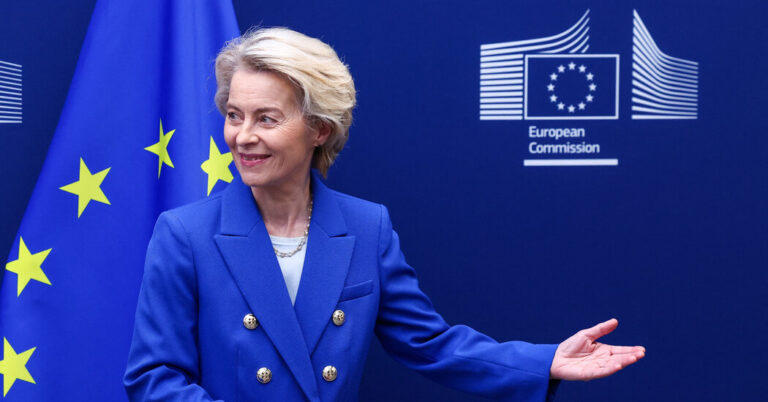
Ursula von der Leyen, the president of the European Commission, the E.U.’s executive arm, has spent the past several weeks on calls and in meetings with global leaders. She and her colleagues are wheeling and dealing to deepen existing trade agreements and strike new ones. They are discussing how they can reduce barriers between individual European countries.

And they are talking tough on China, trying to make sure that it does not dump cheap metals and chemicals onto the European market as it loses access to American customers because of high Trump tariffs.

It’s an explicit strategy, meant to leave the economic superpower stronger and less dependent on an increasingly fickle America. As Ms. von der Leyen and her colleagues regularly point out, the U.S. consumer market is big — but not the be-all-end-all.

“The U.S. makes up 13 percent of global goods trade,” Maros Sefcovic, the E.U.’s trade commissioner, said in a recent speech. The goal “is to protect the remaining 87 percent and make sure that the global trade system prevails for the rest of us.”

Success is far from guaranteed. America is still the world’s biggest economy and a critical supplier of military technology and leadership for Europe. There is no real hope of replacing it in those roles overnight. Mr. Trump’s pivot is unlikely to be painless.

But not changing is not an option, as Ms. von der Leyen acknowledged in an interview with The Financial Times this week.

“I mean, never waste a good crisis,” she said.

Europe has made it clear that it is eager to negotiate with the United States. Mr. Sefcovic has traveled to Washington repeatedly and plans to return to the United States on Monday. The goal is to work toward “win-win outcomes,” Olof Gill, a spokesman for the European Commission, said on Friday.

The bloc is dangling carrots like cutting tariffs on cars and other industrial products, and ramping up purchases of American liquefied natural gas. It is also threatening retaliation if negotiations fail.

But striving for a deal is just Part 1 of the strategy. Part 2? Making new friends.

Europe has spent the time since Mr. Trump’s re-election working to strike or improve trade ties with various partners. Officials have been in talks with Mexico, India, South Korea, South Africa and Central Asia, to name a few. The E.U. announced just Thursday that it would begin free trade discussions with the United Arab Emirates.

Ms. von der Leyen also spoke this week to Mark Carney, the new Canadian prime minister.

“She reaffirmed the E.U.’s strong commitment to open and predictable trade, and expressed her determination to work closely with Canada on reforming the global trading system,” the bloc said in a statement.

The E.U. and the U.S. agree that the existing trading system has failed to prevent China from subsidizing production, allowing it to dump inexpensive products into other markets in a way that puts domestic producers out of business.

And Ms. von der Leyen has been clear that changes to the trade rules are now inevitable.

She told The F.T. that when it came to the World Trade Organization — the beating heart of the rules-based order that Europe holds dear — the goal was to “modernise, reform and stabilise.”

Ms. von der Leyen has underscored that Europe will be on watch as the U.S. and China become further embroiled in an all-out trade battle. China on Friday said it was raising its tariffs on American goods to 125 percent from 84 percent, retaliating for the third time in the escalating trade war between the two superpowers.

European officials are worried that Chinese companies will send their metals, chemicals and other products rushing toward the continent, with American customers out of reach. The E.U. has set up an “import surveillance task force” to make sure it can detect — and respond to — potential dumping.

When Ms. von der Leyen spoke to the Chinese premier earlier this week, she urged Beijing to negotiate with the United States and emphasized that China needs to work on longer-term structural solutions to rebalance its trading relationships, the E.U. said.

Some European leaders — including Prime Minister Pedro Sánchez of Spain — have even been pushing to enhance China and E.U. relations in a world of upheaval. Experts have said it is equally, if not more likely, that trade tensions between the two will intensify under all of the pressure.

Still, Europe’s basic strategy is clear: It’s pushing for a deal with the U.S., but it’s also recognizing that the world is on the cusp of change and hoping to ride that shift to success.

One question is whether all of its new alliances will trigger Mr. Trump. The American president has already vented on social media about Europe’s deal-making.

“If the European Union works with Canada in order to do economic harm to the USA, large scale Tariffs, far larger than currently planned, will be placed on them both,” he wrote on Truth Social in late March.

So far, that threat seems to have done little to deter conversations.

There is always the reality that Europe relies on American cooperation for more than just trade, though. Even if it can replace American customers and raw materials with other markets, U.S. military support is still critical in both the war in Ukraine and for the North Atlantic Treaty Organization.

But for now, the E.U. seems to accept that the rules are about to be rewritten. Given that, its leaders seem to be doing what they can to make sure that when it happens, they are holding the pen.


Source link

Rosie O’Donnell on Ireland, Trump and Her New Hulu Documentary

0


“It’s not my cello,” Rosie O’Donnell said over a video call, sitting on a gray love seat in a gray hoodie and a pair of chic brown glasses.

In New York, it was a Thursday morning. In Dublin, where the actress, comedian and former talk show host has been staying since mid-January, afternoon light streamed through a nearby window. The cello came with the rental.

Lots of celebrities talked during the 2016, 2020 and 2024 elections about moving abroad if Donald J. Trump won — among them, Barbra Streisand, Cher, and Amy Schumer.

Ms. O’Donnell actually went through with it.

“I never thought he would win again,” she said of President Trump, bringing up the television clips she watched last year of Kamala Harris, then the vice president, appearing at packed arenas in Pennsylvania and Michigan. “But I said, ‘If he does, I’m going to move,’ and my therapist said, ‘Well, let’s make a real plan.’”

It so happens that Ms. O’Donnell had reservations about discussing all this with a reporter.

Her application for Irish citizenship has not yet been approved and she is worried about doing anything to jeopardize that. Technically, she and her youngest child, Clay, who is autistic and nonbinary, are still just visiting the country.

That being said, Ms. O’Donnell has a documentary she wants to promote — “Unleashing Hope: The Power of Service Dogs for Children With Autism,” the story of a program in which incarcerated people train service dogs in prison, after which the dogs are placed with families like hers.

Ms. O’Donnell did appear on “The Late Late Show,” Ireland’s equivalent of “The Tonight Show,” a few weeks back. On it, she talked about her new life in the country, hurled some insults at Mr. Trump and gave every indication that she would be remaining over there for the foreseeable future.

But much of her focus at the moment is on the documentary, which was inspired partly by, of all things, her unlikely relationship with Lyle Menendez, the convicted murderer.

Ms. O’Donnell, of course, has been feuding with Mr. Trump since 2006, when she joined “The View,” a chatfest created by the anchorwoman Barbara Walters.

On the show, in response to what she felt was Mr. Trump’s receiving overly positive coverage for his treatment of a controversy involving a Miss USA contestant, Ms. O’Donnell mocked Mr. Trump, flipping her hair over her face and delivering a withering impersonation while questioning his role as a moral arbiter and a successful businessman.

Mr. Trump threatened to sue “The View” and Ms. Walters personally. Ms. Walters got on the phone with him to smooth things over. Soon enough, Mr. Trump was appearing all over cable news calling Ms. O’Donnell “wacko” and “fat,” and he said Ms. Walters personally told him that she regretted hiring Ms. O’Donnell.

The year after, despite soaring ratings, Ms. O’Donnell left the show. But her feud with Mr. Trump never ended. She became a fixture and a punchline in the supermarket tabloids, which she always suspected, but was unable to prove, was the work of Mr. Trump and Michael Cohen, his former lawyer and fixer who went to prison after pleading guilty to campaign-finance violations, tax fraud and bank fraud.

While incarcerated at the federal correctional facility in Otisville, N.Y., Mr. Cohen received what he said in a phone interview on Friday was a letter from Ms. O’Donnell. “It was so heartwarming and compassionate I actually thought I was being punked,” he said. She then visited Mr. Cohen in prison and was in touch with him in the days before Mr. Trump was convicted on 34 counts of falsifying business records.

It may seem like a case of politics making strange bedfellows, but it was pretty typical behavior for Ms. O’Donnell, who has a habit of finding the good in controversial people.

Friends of hers include Lynndie England, the former United States Army Reserve soldier who was prosecuted for mistreating detainees at the Abu Ghraib prison in Baghdad. Ms. O’Donnell reached out to Ms. England during her 2005 trial, believing that she was being turned into a scapegoat for the injustices of the Iraq war.

And there is Reality Winner, the former military contractor who pleaded guilty to felony transmission of national defense information after leaking classified documents about Russian interference in the 2016 election to The Intercept, a nonprofit news site. During the trial, Ms. O’Donnell got in touch with Ms. Winner’s mother, Billie Winner-Davis, and later had Ms. Winner on her podcast.

But no friendship of Ms. O’Donnell’s is more surprising than the one she has with Lyle Menendez, who along with his brother, Erik, was convicted of first degree murder and sentenced to life without parole for the 1989 slaying of their parents, Jose and Kitty Menendez.

While the brothers were on trial in 1996, Ms. O’Donnell gave an interview on “Larry King Live” in which she said that she believed the brothers had been molested as children and that the murders were, in some way, an act of self-defense.

Soon after, she received a letter from Lyle Menendez.

In it, he thanked her for her support and stated his belief that she “knew” from a personal place that what he was saying was true. Ms. O’Donnell did: She said she and her siblings had been molested by their father.

But she did not reach out to him then.

“At that point, I had not ventured anywhere near this in my family or in my therapy,” she said last week.

In 2022, after watching a documentary about the Menendez brothers, Ms. O’Donnell discussed their case on TikTok, reiterating her belief that they were sexual abuse survivors who killed their parents out of a sense of trauma and desperation.

Soon after, she said, Lyle Menendez’s wife, Rebecca Sneed, reached out to her to see if she was interested in speaking with him.

Their first conversation lasted two or three hours, Ms. O’Donnell said.

“Then he started calling me on a regular basis from the tablet phone thing they have,” she said. “He would tell me about his life, what he’s been doing in prison and, for the first time in my life, I felt safe enough to trust and be vulnerable and love a straight man.”

Some of her friends expressed concern. “They were like, ‘Ro, he’s a murderer,’” she said.

She shrugged, then went to visit him in prison, where she saw scores of inmates with Labrador retrievers stationed silently at their feet.

Ms. O’Donnell asked Mr. Menendez how this could possibly be legal and he told her about a program they had to train and place dogs with the blind, disabled veterans and autistic children, which is run by the program Guide Dogs of America. He suggested Ms. O’Donnell get a dog for Clay through the program.

Ms. O’Donnell said she felt uneasy at first. Clay is a highly verbal child and Ms. O’Donnell, aware of her celebrity status, did not want to jump in front of someone who could not function without a highly trained service dog. But Mr. Menendez told her not to worry: The dogs were distributed according to need.

A year later, she was approved for a dog.

Ms. O’Donnell spent two weeks commuting daily to the prison, where she was matched with Kuma, a black Labrador mix who had been trained for a year by Carlos Aguirre, an inmate doing time for armed robbery. (Although the dog winds up working principally with the autistic child, the intensive training takes place between the dog and an adult.)

Kuma bonded instantly with Clay when she came home. “I noticed the difference in Clay immediately,” she said. “I was shocked to find out that all the stories I heard from other mothers of autistic children were true.”

So Ms. O’Donnell decided to film a short documentary about the program. The result of that, which was produced by Hilary Estey McLoughlin and Terence Noonan — veterans of her late-1990s talk show — will be released on Hulu on April 22.

While the documentary was filming, Ms. O’Donnell read Project 2025, a document created by the Heritage Foundation that laid out a right-wing agenda for a potential second Trump term. She believed Mr. Trump when he said he would be a dictator on Day 1, and she did not believe him when he said Project 2025 reflected anything other than a specific plan for what he would do as president.

“World tragic events have always wiped me out emotionally,” she said. “I believe it stemmed from watching the Vietnam War on television as a little kid during dinner and seeing unbearably graphic horror on the news.”

The first Trump term was debilitating for her.

“I was unbelievably heavy, I was drinking too much,” she said. “But there were guardrails.”

In the campaign’s final weeks, she made preparations. Just in case.

“I got my passport renewed, I got Clay’s passport renewed,” she said. “My brother has his passport. All my cousins have their passports. But I was never a traveler.”

So moving to Ireland felt strange, though she has been pleasantly surprised by how much she likes it.

“I see reflections of myself in this country everywhere I look, and reflections of my family and my very Irish childhood,” she said. “We’re 100 percent Irish. Being Irish Catholic was a very big part of my identity, and coming back here does feel like coming home in a way that’s hard to explain or understand, even for me.”

The people, she said, are unusually friendly. When they approach her in public, they do so in a way that feels “1,000 percent different than in the United States.”

There was an uncomfortable moment, however, when she watched Micheál Martin, the prime minister of Ireland, meet with Mr. Trump at the Oval Office during a televised appearance.

There, Brian Glenn, a reporter from the right-wing news outlet Real America’s Voice and the boyfriend of Representative Marjorie Taylor Greene, Republican of Georgia, asked Mr. Martin why he was allowing Ms. O’Donnell to move there when all she could do was “bring unhappiness” to the country.

Mr. Martin seemed to wince in his chair. But he was able to avoid the question because Mr. Trump jumped in to say what a good question that was and went about insulting Ms. O’Donnell himself.

Afterward, Ms. O’Donnell sent Mr. Martin a letter saying how embarrassed she was to have become a topic of conversation during what should have been a serious meeting. He has not responded.

It was yet another chapter in a feud with Mr. Trump that has been going for nearly 20 years. But given Ms. O’Donnell’s seeming ability to forge relationships with various castaways, criminals and other notorious people, it seemed fair to ask: Could she see any good residing in him?

“None,” she said.


Source link

Harvard’s Decision to Resist Trump is ‘of Momentous Significance’

0


Harvard University is 140 years older than the United States, has an endowment greater than the G.D.P. of nearly 100 countries and has educated eight American presidents. So if an institution was going to stand up to the Trump administration’s war on academia, Harvard would be at the top of the list.

Harvard did that forcefully on Monday in a way that injected energy into other universities across the country fearful of the president’s wrath, rejecting the Trump administration’s demands on hiring, admissions and curriculum. Some commentators went so far as to say that Harvard’s decision would empower law firms, the courts, the media and other targets of the White House to push back as well.

“This is of momentous, momentous significance,” said J. Michael Luttig, a prominent former federal appeals court judge revered by many conservatives. “This should be the turning point in the president’s rampage against American institutions.”

Michael S. Roth, who is the president of Wesleyan University and a rare critic of the White House among university administrators, welcomed Harvard’s decision. “What happens when institutions overreach is that they change course when they meet resistance,” he said. “It’s like when a bully is stopped in his tracks.”

Within hours of Harvard’s decision, federal officials said they would freeze $2.2 billion in multiyear grants to the university, along with a $60 million contract.

That is a fraction of the $9 billion in federal funding that Harvard receives, with $7 billion going to the university’s 11 affiliated hospitals in Boston and Cambridge, Mass., including Massachusetts General, Boston Children’s Hospital and the Dana-Farber Cancer Institute. The remaining $2 billion goes to research grants directly for Harvard, including for space exploration, diabetes, cancer, Alzheimer’s disease and tuberculosis.

It was not immediately clear what programs the funding freeze would affect.

Harvard, the nation’s richest as well as oldest university, is the most prominent object of the administration’s campaign to purge “woke” ideology from America’s college campuses. The administration’s demands include sharing its hiring data with the government and bringing in an outside party to ensure that each academic department is “viewpoint diverse.”

Columbia University, which faced a loss of $400 million in federal funding, last month agreed to major concessions the government demanded, including that it install new oversight of its Middle Eastern, South Asian and African Studies Department.

In a letter on Monday, Harvard’s president, Alan M. Garber, refused to stand down. “Neither Harvard nor any other private university can allow itself to be taken over by the federal government,” he wrote.

The administration’s fight with Harvard, which had an endowment of $53.2 billion in 2024, is one that President Trump and Stephen Miller, a powerful White House aide, want to have. In the administration’s effort to break what it sees as liberalism’s hold on higher education, Harvard is big game. A high-profile court battle would give the White House a platform to continue arguing that the left has become synonymous with antisemitism, elitism and suppression of free speech.

Steven Pinker, a prominent Harvard psychologist who is also a president of the Council on Academic Freedom at Harvard, said on Monday that it was “truly Orwellian” and self-contradictory to have the government force viewpoint diversity on the university. He said it would also lead to absurdities.

“Will this government force the economics department to hire Marxists or the psychology department to hire Jungians or, for that matter, for the medical school to hire homeopaths or Native American healers?” he said.

Harvard has not escaped the problems that roiled campuses nationwide after the Hamas-led attacks in Israel on Oct. 7, 2023. In his letter, Dr. Garber said the university had taken steps to address antisemitism, support diverse viewpoints and protect free speech and dissent.

Those same points were made in a letter to the administration from two lawyers representing Harvard, William A. Burck and Robert K. Hur.

Mr. Burck is also an outside ethics adviser to the Trump Organization and represented the law firm Paul, Weiss, Rifkind, Wharton & Garrison LLP in the deal it recently reached with the Trump administration.

Mr. Hur, who worked in the Justice Department in Mr. Trump’s first term, was the special counsel who investigated President Joseph R. Biden Jr.’s handling of classified documents and termed him “an elderly man with a poor memory,” enraging Mr. Biden.

Both lawyers understand the legal workings of the current administration, an expertise of benefit to Harvard.

“Harvard remains open to dialogue about what the university has done, and is planning to do, to improve the experience of every member of its community,” Mr. Burck and Mr. Hur wrote in the letter, addressed to the acting general counsels of the Departments of Education and Health and Human Services and to a commissioner within the General Services Administration. “But Harvard is not prepared to agree to demands that go beyond the lawful authority of this or any administration.”

Representative Elise Stefanik, the New York Republican who held hearings last year investigating antisemitism on college campuses, including at Harvard, was withering in a social media post.

“Harvard University has rightfully earned its place as the epitome of the moral and academic rot in higher education,” Ms. Stefanik, a Harvard graduate, wrote. She added that “it is time to totally cut off U.S. taxpayer funding to this institution that has failed to live up to its founding motto Veritas. Defund Harvard.”

It is unclear what other measure the Trump administration could take against Harvard for its resistance, although potential actions could include an investigation of its nonprofit status and further cancellations of the visas of international students.

The president of the American Council of Education, Ted Mitchell, said that Harvard’s action was essential.

“If Harvard had not taken this stand,” he said, “it would have been nearly impossible for other institutions to do so.”


Source link

Five More Big Law Firms Reach Deals With Trump

0


Five more prominent law firms facing potential punitive action by President Trump reached deals on Friday with the White House to provide a total of $600 million in free legal services to causes supported by the president.

Four of the firms — Kirkland & Ellis, Latham & Watkins, A&O Shearman and Simpson Thacher & Bartlett — each agreed to provide $125 million in pro bono or free legal work, according to Mr. Trump. A fifth firm, Cadwalader, Wickersham & Taft, agreed to provide at least $100 million in pro bono work.

With the latest round of deals, some of the biggest firms in the legal profession have agreed over the past month to provide a combined $940 million in free legal services to causes favored by the Trump administration, including ones with “conservative ideals.”

Mr. Trump announced the agreements between his administration and the law firms on Friday on Truth Social, the platform owned by his social media company, Trump Media & Technology Group.

Top lawyers from each firm provided a statement to the White House, which was included in the social media posts. Earlier this week, The New York Times reported on negotiations with four of the firms.

The deals were announced during a week in which Mr. Trump talked openly in the Oval Office about using the firms he has struck deals with to help negotiate trade agreements with other countries and even work on coal leasing deals.

Mr. Trump did not specifically mention potential work on trade deals or coal leasing agreements in his social media posts. Rather, the posts said the firms would devote free legal work to things like fighting antisemitism, helping Gold Star families, assisting law enforcement and “ensuring fairness in our justice system.”

The terms are similar to ones Mr. Trump previously announced with Paul, Weiss, Rifkind, Wharton & Garrison; Skadden, Arps, Slate, Meagher & Flom; Willkie Farr & Gallagher; and Milbank.

Law firms are settling with the Trump administration to head off executive orders that would make it difficult for them to represent clients with federal contracts or seek government regulatory approvals.But a few firms are fighting Mr. Trump’s executive orders in federal court, claiming the orders are unconstitutional and a form of retaliation for taking positions he doesn’t like. Judges have temporarily stayed the orders against Perkins Coie, WilmerHale and Jenner & Block from going into effect.

A fourth firm, Susman Godfrey, was hit with an executive order this week and became the latest firm to take on the Trump administration. Late Friday the firm filed a lawsuit in federal court in Washington seeking to block the order from taking effect.

Lawyers from Munger, Tolles & Olson are representing Susman in the litigation. Munger is the same firm that helped organize an amicus brief filed by more than 500 law firms in support of Perkins Coie. But only a few large law firms signed on that legal filing.

Susman represented Dominion Voting Systems, a voting machine manufacturer, in a major defamation case against Fox News. The conservative cable news channel agreed to pay $787.5 million to Dominion to resolve the lawsuit. Dominion filed the lawsuit over misinformation the cable network spread about its role in the 2020 election, which Mr. Trump has repeatedly said was stolen from him.

“If President Trump’s Executive Orders are allowed to stand, future presidents will face no constraint when they seek to retaliate against a different set of perceived foes,” Susman’s 66-page complaint begins. “What for two centuries has been beyond the pale will become the new normal. Put simply, this could be any of us.”

Mr. Trump is going after law firms that have hired attorneys he perceives as his political enemies, represented causes he has opposed or refused to represent people because of their conservative and right-wing political beliefs. Some firms are also being targeted for their hiring practices that advance the principle of having a diverse work force.

The president has said repeatedly that diversity, equity and inclusion policies in hiring are illegal and discriminatory and that he intends to get rid of them. The federal Equal Employment Opportunity Commission, in what has been seen as a related move, sent letters to 20 law firms last month requesting information about their D.E.I. practices.

Four of the firms that reached deals with Mr. Trump — Kirkland, Latham, Shearman and Simpson Thacher — had each received one of those letters. In settling, Mr. Trump said the E.E.O.C. had agreed not to pursue claims against those four firms. Later in the day, the E.E.O.C. announced a separate settlement with the four firms.

Law professors and others in the legal industry have praised the firms that are fighting the administration while criticizing those that have settled. The critics say the law firms that settle have succumbed to pressure tactics by the administration. And each new settlement only encourages Mr. Trump to become even more emboldened in his demands for free legal work.

The Trump administration seems to believe it is “developing a war chest of legal enlistees or conscripts” to do work for it, said Harold Hongju Koh, a professor of international law at Yale Law School, who was an author on a recently published paper that called the executive orders unconstitutional retaliatory measures.

“Every kid learns, on the schoolyard, if you cave to a bully they will come back to bully you some more,” said Mr. Koh.


Source link

Brice Oligui Nguema Is Favored to Win Gabon Election

0


Voters in Gabon are set to pick their next president on Saturday, and on paper they have plenty of options: anti-French firebrands, a general who staged a coup, a tax inspector and a female candidate in this oil-rich Central African country.

But most candidates and experts agree that the election might be a done deal. They say the race has been rigged in favor of Brice Oligui Nguema, the general who staged a coup in 2023 and has ignored his early promises to hand power over to a civilian.

“It is not a level playing field to begin with,” said Joseph Siegle, director of research at the Africa Center for Strategic Studies, a Washington-based organization that is part of the U.S. Department of Defense.

Gabon is a resource-rich country of 2.5 million that was long ruled by one family. Although wealthier than other countries in sub-Saharan Africa, unemployment is widespread and poverty is high, making those key issues for voters.

Here is what to know about the presidential contest.

A 50-year-old general who swapped his uniform for jeans, Jordan sneakers and Michael Jackson’s dance moves on the campaign trail, Mr. Nguema is widely tipped to win.

Mr. Nguema served as an aide-de-camp to Gabon’s long-ruling autocrat, Omar Bongo, and was head of the Republican Guard under his son, Ali Bongo Ondimba, who was deposed in 2023.

With that coup, Mr. Nguema ended the run of one of Africa’s longest-ruling families. Omar Bongo held power for 41 years, and his son held office for 14.

The coup was the latest of eight military takeovers that have shaken West and Central Africa since 2020.

But Mr. Nguema has rebranded himself as a conventional candidate in the election, with the campaign slogan “It’s good,” or “C’BON” in French, a play on his initials. He has promised to build large infrastructure projects, including a new airport, calling himself “Brice the Builder.”

He has also vowed to preserve ties with France, the former colonial power, which has recently been ordered to withdraw troops from several African countries. Some 350 French troops are in Gabon, but Mr. Nguema has said, “I’m not chasing anyone out.”

Paul Modoss, a 35-year-old entrepreneur, said on Friday that he would vote for Mr. Nguema because he had united the country and embodied renewal. “You can’t call President Brice Oligui Nguema a dictator,” he said. “A dictator doesn’t return power to the people through the ballot box.”

His most serious opponent is Alain-Claude Bilie-By-Nze, who was Mr. Bongo’s prime minister.

Mr. Bilie-By-Nze, 57, has vowed to break with Gabon’s pre-coup political system, dismantle its network and reduce French influence, even though he long operated within that system.

He has also called Mr. Nguema’s potential election a threat to democracy and said he wants to diversify Gabon’s economy and reduce its dependence on oil revenues.

Lauréa Mamboundou, a 26-year-old law student, said she would vote for Mr. Bilie-By-Nze for his political experience.

“He is the most competent candidate today, but also the one who would be the easiest to sanction with our votes should he ever betray the people’s trust,” she said. “This is a guarantee against the drift we all fear.”

Gabon is rich in mineral resources. It holds a quarter of the world’s reserves of manganese, a mineral used to produce steel. But its economy remains overly dependent on oil, which accounts for 38 percent of Gabon’s gross domestic product.

The country is among the world’s most corrupt countries, according to the watchdog Transparency International. Over 40 percent of young people in Gabon are unemployed. And a third of its 2.5 million people live on less than $5.50 a day, according to the World Bank.

Under Mr. Nguema’s leadership, the interim authorities adopted a new Constitution that allows members of the military to run for office. It also limits a president to two seven-year terms.

Mr. Siegel said the general had borrowed from the playbook of another Central African country, Chad, whose leader seized power when his father was killed in 2021, and who was later declared winner in an election.

Mr. Bilie-By-Nze said Mr. Nguema had flouted electoral rules by using state funds to finance his campaign, while other candidate received no such state support. “The junta’s leader has tailored a Constitution and an electoral law to his own needs to confiscate power,” Mr. Bilie-By-Nze said in a statement.

A spokesman for Mr. Nguema declined to comment.

Several Central African countries are ruled by authoritarian leaders, including Africa’s top three longest-serving presidents. Two are Gabon’s neighbors: the president of Cameroon has been in power for 42 years and the president of the Republic of Congo has held office for 38 years.

In Gabon, the two leading candidates have a long history with the Bongo family but have tried to distance themselves from it. Each has accused the other of being the candidate of the old regime.

About 860,000 people are expected to go to the polls on Saturday. The results are expected to be announced before April 16.

Yann Leyimangoye contributed reporting from Libreville, Gabon.


Source link

Trump Administration Memo Proposes Cutting State Department Funding by Nearly Half

0


The Trump administration could cut nearly 50 percent of the State Department’s funding next fiscal year, according to an internal memo laying out a downsizing plan being given serious consideration by department leaders, said two U.S. officials. The plan was drawn up as the White House pressures agencies to make significant budget cuts.

The memo, a copy of which was obtained by The New York Times, proposes eliminating almost all funding for international organizations like the United Nations and NATO, ending the budget for supporting international peacekeeping operations and curtailing all of the department’s educational and cultural exchanges, like the Fulbright Program.

It also proposes cutting funding for humanitarian assistance and global health programs by more than 50 percent despite Secretary of State Marco Rubio’s pledges that lifesaving assistance would be preserved.

It was not clear if Mr. Rubio had endorsed the cuts outlined in the memo, which was dated April 10. Pete Marocco, who oversaw the gutting of government foreign aid programs before abruptly leaving the department, and Douglas Pitkin, who is in charge of the department’s budget planning, prepared the document. It was also not clear how seriously the proposed cuts would be entertained in Congress, which appropriates federal dollars.

But, according to a U.S. official familiar with the department’s review, it is likely that the White House will send Congress a budget proposal this spring that is substantially similar to what the memo outlines in an effort to press lawmakers to formalize downsizing efforts that are already underway.

Agencies are facing a deadline this week to submit detailed reorganization plans to the White House explaining what cuts they will make to help further shrink the federal government. While many departments have already announced or begun carrying out their planned cuts, the State Department has yet to publicly detail complete plans for downsizing. The memo is part of a process involving the White House budget office and the State Department trading proposals and suggestions.

Reports of steep cuts already had Democrats on Capitol Hill reeling.

Senator Jeanne Shaheen of New Hampshire, the top Democrat on the Foreign Relations Committee, said in a statement on Monday that the cuts “would leave our country alone and exposed and allow China and Russia to fill the vacuum made vacant by this administration.”

“Why in the world would we cut funding for NATO at a moment when war is raging in Europe and security threats on the continent grow?” she added.

Senator Brian Schatz of Hawaii, a Democrat on the appropriations committee, said: “While ultimately Congress controls the purse strings, recent reports about the administration’s plan to gut State Department personnel, U.S. presence overseas and foreign assistance are deeply troubling. These cuts don’t make America safer, they risk our security.”

“I want to hear from Secretary Rubio directly,” he added.

A budget copy of the memo began circulating in Washington in recent days. The Washington Post reported details of the memo earlier on Monday.

The State Department had no immediate comment.

The memo states that the State Department will request a $28.4 billion budget in fiscal year 2026, which begins Oct. 1. That figure is $26 billion less than what was on the books for fiscal year 2025, according to the document.

The administration intends to claw back some funds for the current fiscal year as well, according to the memo. Mr. Marocco and Mr. Pitkin wrote that the Trump administration would seek to reclaim approximately $20 billion in unspent funds from fiscal year 2025 to return to the Treasury.

Among other cuts, the memo proposes keeping a pay and hiring freeze through fiscal 2026, with the exception of any hires needed to take over foreign aid programs inherited from the U.S. Agency for International Development, which is being disbanded. Overall, the memo seeks to cut foreign aid spending by more than half of current budget levels for the State Department and U.S.A.I.D.

Though Mr. Rubio promised last month that the State Department would continue administering a number of lifesaving assistance programs, the Trump administration has quietly canceled some of those initiatives in recent weeks.

The only funding for global health programs that the State Department envisions preserving is $2.9 billion for H.I.V. treatments provided through the President’s Emergency Plan for AIDS Relief; $687 million for interventions for diseases like tuberculosis and malaria; $200 million for global health security; and $800 million for the Global Fund, distributed at a rate of $1 for every $4 other donors provide. The Global Fund is an international organization that finances disease treatment and prevention.

All other programs — including those to tackle neglected tropical diseases, provide vaccines to children in poor countries and preserve maternal and child health — would be cut.

The memo offers fewer details about the cuts to humanitarian aid. It outlines $2.5 billion for a new Bureau for Humanitarian Assistance at the State Department, and $1.5 billion in emergency migration and refugee assistance that President Trump can use “to address humanitarian emergencies.”

The memo also proposes a one-year freeze for a key narcotics control program, rationalizing the suspension of funds by noting that the program has an unspent $1.4 billion on hand that should cover that period.

Additionally, it envisions creating a roughly $2 billion America First Opportunities Fund at the Treasury, which would give the Trump administration latitude to “provide targeted support for economic and development assistance for enduring and emerging Trump administration priorities.”

Stephanie Nolen contributed reporting.


Source link

White House to Ask Congress to Rescind $1.1 Billion From NPR and PBS

0


The White House is planning to ask Congress to claw back more than $1 billion slated for public broadcasting in the United States, according to two people briefed on the plan, a move that could ultimately eliminate almost all federal support for NPR and PBS.

The plan is to request that Congress rescind $1.1 billion in federal funding for the Corporation for Public Broadcasting, the taxpayer-backed company that funds public media organizations across the United States, one of the people said. If Congress agrees, that will amount to about two years of the organization’s funding, nearly all of which goes to public broadcasters including NPR, PBS and their local member stations. The Trump administration isn’t planning to ask Congress to claw back about $100 million allocated for emergency communications.

Government money accounts for a small part of the budgets at NPR and PBS, which also generate revenue through sponsorships and donations. Most of the government funding goes to local stations, which rely on it to finance their newsrooms and pay for programming.

The proposal would be part of a broader rescission package, a formal request to Congress to rescind previously approved funds, that would also eliminate billions allocated to foreign aid, the two people said. The process is established under law, which gives the House and Senate 45 days to vote to approve the request after it is submitted. The White House plans to submit this rescission request in the coming weeks, the people said. If Congress does not approve the rescission request, the money must be spent as originally intended.

The Trump administration’s proposal to defund public broadcasting comes amid sustained pressure on NPR and PBS from Republicans in Congress, who have intensified long-running attacks on the broadcasters. The chief executives of both organizations testified before Congress last month in a fiery hearing that played out along mostly partisan lines: Republicans assailed the executives for what they saw as liberal bias, and Democrats argued that the proceeding was a waste of time.

The ask would also be the latest move by the Trump administration to exert pressure on media organizations. The administration is waging a legal battle with The Associated Press over its decision to exclude the wire service from the presidential press pool, breaking decades of precedent. Mr. Trump is also personally suing CBS News and The Des Moines Register, and the Federal Communications Commission has launched investigations into Comcast, PBS and NPR.

Spokespeople for the Corporation for Public Broadcasting, PBS and NPR declined to comment.

The Corporation for Public Broadcasting is “forward-funded” two years to insulate it from political maneuvering, and a sizable chunk of the money for 2025 has already been paid out to public broadcasters in the United States, according to a person familiar with the matter.

Public media executives have been planning for the possibility of having public funding clawed back for months. According to a document prepared by station directors this past fall, the immediate elimination of funding, while unlikely, would be “akin to an asteroid striking without warning.”

“It is the highest risk scenario especially in a time in which the media ecosystem is rapidly changing,” the document said.

Public media defenders say rural audiences would be hit the hardest if funding was cut from NPR and PBS stations. In very remote areas without broadband access, public radio and TV are among the few sources of news and entertainment.

But those in favor of defunding say advances in technology have made those services obsolete. In an interview last month, Representative Marjorie Taylor Greene, Republican of Georgia, said residents in rural parts of her district had enough access to cellphone and internet services to keep them informed.

“The bottom line here: NPR and PBS only have themselves to blame,” said Mike Gonzalez, a fellow at the Heritage Foundation who has argued publicly for defunding public media. “For the last 50 years, every Republican president has tried to defund them or reform them.”

In 2011, NPR executives produced a secret report that explored what would happen if government funding was eliminated. According to the report, up to 18 percent of roughly 1,000 member stations across the United States would close, and $240 million would vanish from public radio. Stations in the Midwest, the South and the West would be most affected, and roughly 30 percent of listeners would lose access to NPR programming.

One potential upside, according to the document: Cutting off federal funding would galvanize public radio supporters, leading to a sudden surge in donations to stations across the United States.

Maggie Haberman contributed reporting.


Source link

In Canada’s Fight With Trump, Danielle Smith Is Playing Good Cop

0


As Canada barrels through one of the stormiest periods in its history toward an April 28 federal election, there’s a name that’s not on the ballot but is on people’s minds: Danielle Smith.

Ms. Smith, the premier of Alberta, the Western province often called the Texas of Canada because of its oil, ranches and conservative politics, is referred to as “divisive” by supporters and critics alike: People love her, people hate her, people love to hate her.

An unapologetic MAGA-aligned conservative, she has riled Canadians across the country by speaking admiringly of President Trump and focusing on her province’s fortunes, particularly its oil exports, even as the U.S. administration menaces Canada.

Ms. Smith, 54, has been premier for the past two and a half years, having spent the past two decades dipping in and out of politics.

“I keep getting fired,” she chuckled in an interview with The New York Times in Calgary, Alberta, in February.

She has also worked as an economist, a lobbyist and a radio host of a popular call-in show in which she honed her folksy, affable but sharply ideological raconteur style.

She’s the closest thing Canada’s conservative movement has to a MAGA ally — and has the Mar-a-Lago photograph with Mr. Trump to prove it.

As Mr. Trump started to say he wanted to make Canada the 51st state, before being inaugurated, Ms. Smith visited him in Florida.

Even before Mr. Trump’s re-election, Ms. Smith had been key in shaping the evolution of Canada’s broader conservative movement. Critics say she has courted ideological minorities, including fervent anti-vaccine organizations, advocates for Albertan secessionism and hard-line anti-trans activists, to secure her election.

She has been careful to make those groups feel included in her agenda while not fully endorsing their rhetoric.

That ability, along with the political freedom afforded by her lack of interest in national office, has put her at the vanguard of Canada’s changing right.

In recent months, Ms. Smith has defended her pro-Trump overtures as a diplomatic approach that complements the more aggressive stance taken by the federal government.

Simply put, she said of her Trump ties, “I’m happy to be good cop.”

Ms. Smith’s approach is underpinned by more than admiration for Mr. Trump and his politics.

It is also driven by her province’s unusual relationship with the United States, and the rest of Canada.

“Americans helped us build our two biggest industries, our cattle industry and our oil and gas industry,” she added, sitting in her office in Calgary.

Ms. Smith has qualified her support for Mr. Trump by saying she does not support his tariffs on Canada.

“I think it’s going to hurt them — it’s going to hurt us — but I think we can probably work our way through that,” she said.

She’s had to respond to criticism and calibrate her enthusiasm in the context of Mr. Trump’s calling for the annexation of Canada — “It’s not going to happen,” she said — and his ire over Canadian goods, including Alberta’s oil, which almost entirely heads to the United States and is subject to a 10 percent tariff (although a loophole to avoid the levy was subsequently introduced).

But she was generally effusive about Mr. Trump, recalling her January visit to his Mar-a-Lago club in Florida, where she saw him D.J. on an iPad and hold court after a game of golf.

And, she added, much like Mr. Trump, she has her own comeback story.

More than a decade ago, Ms. Smith was leading a small right-wing party in Alberta when she decided to join the larger provincial conservative party, a move that outraged her former colleagues but that she defended as an effort to unify the province’s conservatives.

The high-risk move backfired. Ms. Smith was not selected by the party to be a candidate for her electoral district and left politics for years.

In 2022, she came roaring back, winning her bid to lead Alberta’s United Conservative Party and then a provincial election to become premier.

To win, she took the opposite approach to the one she had tried a decade ago: Instead of tacking to the center, she led the party’s expansion to the right. She secured the support of libertarian grass-roots organizations, including a prominent citizens’ group that had organized around anti-vaccine mandates, as well as a movement seeking Albertan independence from the rest of Canada.

Albertan independence, in fact, would become a pressing question.

Ms. Smith has sought to use the question of Alberta’s relationship with the rest of Canada to her political advantage.

Many Albertans — not just the ones supporting independence — say that their province’s energy riches are being exploited by a federal government that takes revenues from them to bankroll poorer parts of the country.

And they rail against Ottawa for introducing climate policies that limit the province’s ability to extract and sell energy products.

Asked explicitly if she supported Alberta’s splitting away, Ms. Smith said, “We should go back to what the Constitution says,” referring to Canada’s federal system, in which provinces have power to manage several important policy areas. “The Constitution gives us areas of exclusive jurisdiction that the federal government keeps invading and trying to undermine.”

Secessionism advocates see, in Ms. Smith, an ally. Her chief of staff is a co-author of a crucial document, the Free Alberta Strategy, which lays out the reasoning for independence.

Another author, Barry Cooper, who teaches political science at the University of Calgary, said she was making the right noises. “I think she can advance our place within the federation,” he said.

Historically, separatism “has been an abstract concept related to Alberta going it alone,” said Jared Wesley, a professor at the University of Alberta who researches the topic. It remains a minority view, though a recent poll from the Angus Reid Institute indicated support could grow if the Liberal Party won the upcoming federal election.

Ms. Smith has pledged to explore the idea of holding an independence referendum after that election and has threatened a rupture with the federal government to gain concessions.

Last month, after meeting Prime Minister Mark Carney, the Liberal leader in the elections, she said that she had “provided a specific list of demands the next prime minister, regardless of who that is, must address within the first six months of their term to avoid an unprecedented national unity crisis.”

The demands included several policies to bolster the province’s energy sector.

Ms. Smith is playing a key role in mobilizing support for the federal Conservative leader, Pierre Poilievre, who is vying to become the country’s next prime minister and was also born in Alberta.

Together, Ms. Smith and Mr. Poilievre are defining a brand of Canadian conservatism focused on culture issues, limiting the government’s role in public and private life, and an anti-elite, anti-federal approach to running Canada. If Mr. Poilievre loses the election, that vision could be in jeopardy.

Both politicians supported the so-called Freedom Convoy, a movement with strong appeal in Alberta that began as a protest against Covid vaccine mandates for truck drivers, drew in other groups, turned violent in places and paralyzed the nation’s capital for weeks.

But Ms. Smith’s embrace can be a double-edged sword, as Mr. Poilievre is discovering.

In a Breitbart interview last month, she said that Mr. Poilievre was “in sync” with Mr. Trump and that she had asked the White House to “put things on pause” — a reference to the hostile climate between the two countries — until the election.

Critics said her remarks were an invitation to Washington to interfere with Canada’s elections in favor of Mr. Poilievre, whose combative style bears similarities to Mr. Trump’s. Mr. Poilievre has seen his once-large lead over the Liberals evaporate in the run-up to the vote, partly because many Canadians now consider Mr. Trump a major threat.

But Ms. Smith was, again, unapologetic, insisting that she was trying to do what was best for Canada, not just for Mr. Poilievre.

With Mr. Trump in the Oval Office, Ms. Smith seems to feel that, finally, her ideological side is winning.

She delights at Mr. Trump’s assault on what she calls “wokeism.”

But the policy area where her alignment with Mr. Trump’s movement is most pronounced is probably health. In fact, Ms. Smith says that Alberta has been leading the way.

“We were at the front end on protecting the choice of kids through the trans policy changes that we’ve made,” she added, referring to Alberta’s passing legislation limiting access to gender-affirming medical interventions for minors and other policies targeting transgender children.

Ms. Smith has opposed any mandatory vaccination, despite measles outbreaks in Canada and in the United States.

“Parents are pretty discerning,’’ she said. “They’re able to know which vaccines are best for their kids.”

While Ms. Smith has been at the forefront of the country’s hottest political debates, she still seems most comfortable on Alberta’s radio waves.

She takes questions from Albertans on a regular call-in program called “Your Province. Your Premier.”

She listens attentively and offers a smiling reply, no matter the topic, that unfailingly makes the caller feel as if they are making a really good point, however unreasonable it may be.

She credits her years as a call-in radio host for learning to listen to everyone, a quality that makes her likable, as even some of her harshest critics concede.

“I just would rather hear people out; it’s just the nice, polite thing to do,” she said, adding a rare reference to Canada rather than Alberta: “Maybe it’s just a Canadian thing.”


Source link

5 Migrants Assumed Dead After Boat Capsizes Off Florida Coast

0


Five migrants are feared dead after their boat capsized on the way to Florida from the Bahamas in “a suspected failed smuggling venture,” officials said on Monday.

The U.S. Coast Guard said on Monday that it had suspended its search after covering 1,240 square miles over seven hours. Four people were rescued from a 25-foot vessel about 30 miles off Florida’s Atlantic Coast, near St. Lucie, on Sunday morning, according to the Coast Guard.

Martin County Fire Rescue said in a statement that four survivors and one deceased victim were pulled from the water just before 10 a.m. Sunday. The Martin County Sheriff’s Department and the Coast Guard counted nine total passengers, but did not report the deceased victim reported by fire rescue officials. When asked, the sheriff, John Budensiek, was not aware of the death.

One of the survivors was seriously injured and the others had injuries that were not life-threatening, fire rescue officials said.

Sheriff Budensiek said at a news conference on Monday that the four people rescued were of Dominican and Haitian descent. According to interviews with survivors, the boat quickly capsized in the early hours of Friday when it left the island of Bimini, Sheriff Budensiek said. The Coast Guard said the boat capsized early Saturday morning.

Many of the migrants were initially able to cling onto the boat but “lost their grip and one by one drifted out into the ocean,” he said.

Only four were still alive — one woman and three men, including a 17-year-old — once the sheriff’s office was called around 8 a.m. on Sunday to assist the Coast Guard and U.S. Customs and Border Protection with the rescue operation, Sheriff Budensiek said.

A fisherman who was out with his family on Sunday spotted the flipped vessel and was able to get close enough to give the migrants water, food and life jackets, the sheriff said. Because of rough sea conditions, his team needed over an hour to reach the boat. All four people who survived were transported to a hospital, where they were treated for water exposure and “serious sunburns,” Sheriff Budensiek said.

The chance of recovering the remaining missing people “is probably pretty dismal at this point,” he said. “We believe they’re in the Gulf Stream, so they’re moving rapidly to the north.”

“The decision to suspend a search is always difficult and never taken lightly,” Chief Warrant Officer Edgardo Insignares said in a Coast Guard statement. Smugglers “routinely exploit” vulnerable migrants for profit, he said, “while putting their lives at risk aboard overloaded and unseaworthy vessels.”


Source link