


Bournemouth latest: 'Win comes at perfect moment,' says Iraola
Source link
Bournemouth latest: 'Win comes at perfect moment,' says Iraola

Tariff-Induced Inflation Surge May Be Temporary, Fed Official Says
Tariffs of the magnitude that President Trump has enacted are poised to raise inflation in the United States. Whether it will be a temporary surge or one that spirals into a more serious problem is not yet clear, echoing a similar debate that bedeviled officials at the Federal Reserve during the coronavirus pandemic.
Back then, the Fed initially billed the rise in inflation stemming from business shutdowns and supply chain snarls as “transitory,” an approach that led the central bank to be late in raising interest rates when it became clear that price pressures were persistent.
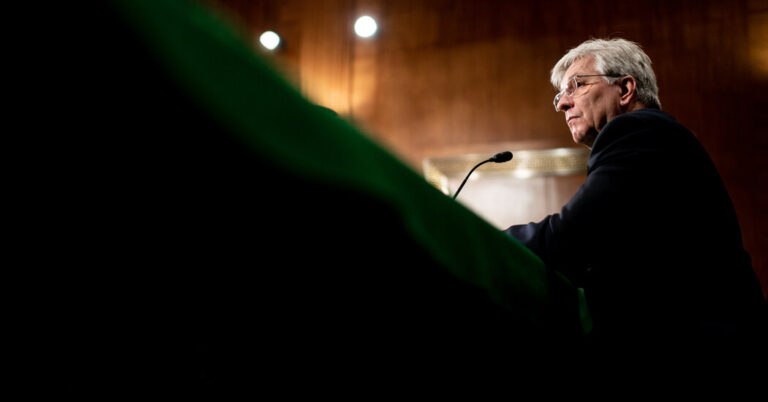
One influential official at the Fed is reviving that view. In a speech on Monday, Christopher J. Waller laid out two scenarios that may play out for Mr. Trump’s tariffs, which the Fed governor described as “one of the biggest shocks to affect the U.S. economy in many decades.” How these levies impact both inflation and growth will impact how soon the Fed can again lower interest rates.
If a recession appears to be taking shape, Mr. Waller said he would support the Fed cutting interest rates “sooner and to a greater extent” than initially expected.
The first scenario Mr. Waller laid out assumes that the average tariff imposed on U.S. imports remains around its current level of 25 percent for an extended period. The second assumes a more modest 10 percent universal tariff, as other levies are removed over time.
In both cases, Mr. Waller argued, the effects on inflation would not persist so long as expectations about future price pressures remained under control.
“I can hear the howls already that this must be a mistake given what happened in 2021 and 2022,” he said in a speech at an event in St. Louis. “But just because it didn’t work out once does not mean you should never think that way again.”
Mr. Waller argued that if Mr. Trump maintains a more aggressive package of tariffs, economic growth is “likely to slow to a crawl and significantly raise the unemployment rate.” Inflation could rise to around 4 percent this year before fading back toward the Fed’s 2 percent target. He also warned that the unemployment rate could approach 5 percent, substantially higher than the current 4.2 percent level.
“While I expect the inflationary effects of higher tariffs to be temporary, their effects on output and employment could be longer-lasting,” he said.
“I expect the risk of recession would outweigh the risk of escalating inflation, especially if the effects of tariffs in raising inflation are expected to be short lived,” Mr. Waller added.
After lowering interest rates by a percentage point last year, the Fed has paused as it awaits more clarity about Mr. Trump’s plans for the economy. Already, officials appear increasingly worried about the potential fallout, striking a much more hawkish tone in recent days than Mr. Waller’s about the risks to inflation.
Expectations about future inflation have started to shift but remain more or less stable over a five-year period, a gauge that holds more weight for officials than the shorter-term measures.
On Monday, new data from the New York Fed showed that consumers were bracing for higher inflation in the year ahead as well as higher unemployment. In five years’ time, they expect inflation to stay stuck around 3 percent.
In the event that Mr. Trump scales back his tariffs, Mr. Waller said, the impact on the economy would be more muted and, in turn, would give the Fed more flexibility to be patient about rate cuts. That could mean the central bank waits until the latter half of this year to lower rates again, he said.
Trump Moves to Put New Tariffs on Computer Chips and Drugs

The Trump administration took steps on Monday that appear likely to result in new tariffs on semiconductors and pharmaceutical products, adding to the levies President Trump has put on imports globally.
Federal notices put online Monday afternoon said the administration had initiated national security investigations into imports of chips and pharmaceuticals. Mr. Trump has suggested that those investigations could result in tariffs.
The investigations will also cover the machinery used to make semiconductors, products that contain chips and pharmaceutical ingredients.
In a statement confirming the move, Kush Desai, a White House spokesman, said the president “has long been clear about the importance of reshoring manufacturing that is critical to our country’s national and economic security.”
The new semiconductor and pharmaceutical tariffs would be issued under Section 232 of the Trade Expansion Act of 1962, which allows the president to impose tariffs to protect U.S. national security.
Earlier in the day, Mr. Trump hinted that he would soon impose new tariffs on semiconductors and pharmaceuticals, as he looked to shore up more domestic production.
“The higher the tariff, the faster they come in,” Mr. Trump told reporters at a White House appearance, citing import taxes he has imposed on steel, aluminum and cars.
Semiconductors are used to power electronics, cars, toys and other goods. The United States is heavily dependent on chips imported from Taiwan and elsewhere in Asia, a reliance that Democrats and Republicans alike have described as a major risk to national security.
As for pharmaceuticals, Mr. Trump argued that too many vital medicines were imported. “We don’t make our own drugs anymore,” he said.
Some drugs are produced at least in part in the United States, though China, Ireland and India are significant sources of some types of pharmaceuticals.
Mr. Trump also signaled Monday that he could offer certain companies relief from his tariffs, as he did for electronics imports in recent days — a break from his past insistence that he would not spare entire industries.
The president said he was “looking at something to help some of the car companies, where they’re switching to parts that were made in Canada, Mexico and other places.” He added, “And they need a little bit of time because they’ve got to make them here.” Shares of General Motors, Ford Motor and Stellantis jumped after his comments.
“I’m a very flexible person. I don’t change my mind, but I’m flexible,” Mr. Trump said on Monday when asked about possible exemptions. He added that he had spoken to Apple’s chief executive, Tim Cook, and “helped” him recently.
The president has announced significant changes over the last week to his trade agenda, which has roiled markets and spooked the businesses that he is trying to persuade to invest in the United States.
Mr. Trump announced a program of global, “reciprocal” tariffs on April 2, including high levies on countries that make many electronics, like Vietnam. But after turmoil in the bond market, he paused those global tariffs for 90 days so his government could carry out trade negotiations with other countries.
Those import taxes came in addition to other tariffs Mr. Trump has put on a variety of sectors and countries, including a 10 percent tariff on all U.S. imports; a 25 percent tariff on steel, aluminum and cars; and a 25 percent tariff on many goods from Canada and Mexico. Altogether, the moves have increased U.S. tariffs to levels not seen in over a century.
Amid a spat with China, Mr. Trump raised tariffs on Chinese imports last week to an eye-watering minimum of 145 percent, before exempting smartphones, laptops, TVs and other electronics on Friday. Those goods make up about a quarter of U.S. imports from China.
The administration argued that the move was simply a “clarification,” saying those electronics would be included within the scope of the national security investigation on chips.
But industry executives and analysts have questioned whether the administration’s real motivation might have been to avoid a backlash tied to a sharp increase in prices for many consumer electronics — or to help tech companies, like Apple, that have reached out to the White House in recent days to argue that the tariffs would harm them.
Mr. Trump has already used the legal authority under Section 232 to issue tariffs on imported steel, aluminum and automobiles. The administration is also using the authority to carry out investigations into imports of lumber and copper.
The notices on Monday said the administration had begun its investigations into imports of pharmaceuticals and semiconductors on April 1. Neither the White House nor the president previously said the process had officially begun.
Kevin Hassett, the director of the White House National Economic Council, told reporters on Monday that the chip tariffs were needed for national security.
“The example I like to use is, if you have a cannon but you’re getting the cannonballs from an adversary, then if there were to be some kind of action, then you might run out of cannonballs,” he said. “And so you can put a tariff on the cannonballs.”
Mr. Trump has argued that tariffs on chips will force companies to relocate their factories to the United States.
Some tech companies have been responsive to the president’s requests to build more in the United States. Taiwan Semiconductor Manufacturing Company, the world’s largest chip manufacturer, announced at the White House in March that it would spend $100 billion in the United States over the next four years to expand its production capacity.
Apple has announced that it will spend $500 billion in the United States over the next four years to expand facilities around the country.
On Monday, Nvidia, the chipmaker, announced that it would produce supercomputers for artificial intelligence made entirely in the United States. In the next four years, the company said, it will produce up to $500 billion of A.I. infrastructure in the United States in partnership with TSMC and other companies.
“The engines of the world’s A.I. infrastructure are being built in the United States for the first time,” Jensen Huang, Nvidia’s chief executive, said in a statement.
The White House blasted out the news in an announcement that credited the president.
“It’s the Trump Effect in action,” the statement said, adding, “Onshoring these industries is good for the American worker, good for the American economy and good for American national security — and the best is yet to come.”
But some critics have questioned how much tariffs will really help to bolster the U.S. industry, given that the Trump administration is also threatening to pull back on grants given to chip factories by the Biden administration. And foreign governments like China, Japan, South Korea and Taiwan all subsidize semiconductor manufacturing heavily with tools like grants and tax breaks.
Globally, 105 new chip factories, or fabs, are set to come online through 2028, according to data compiled by SEMI, an association of global semiconductor suppliers. Fifteen of those are planned for the United States, while the bulk are in Asia.
Mr. Trump has criticized the CHIPS Act, a $50 billion program established under the Biden administration and aimed at offering incentives for chip manufacturing in the United States. He has called the grants a waste of money and insisted that tariffs alone are enough to encourage domestic chip production.
Jimmy Goodrich, a senior adviser to the RAND Corporation for technology analysis, said tariffs could be effective “if used smartly, as part of a broader strategy to revitalize American chip making that includes domestic manufacturing and chip purchase preferential tax credits, along with clever ways to limit the coming tsunami of Chinese chip oversupply.”
“However,” he added, “the United States on its own only accounts for about a quarter of all global demand for goods with chips in them, so working with allied nations is critical.”
Administration officials have suggested that chip tariffs could be applied to semiconductors that come into the United States within other devices. Most chips are not directly imported — rather, they are assembled into electronics, toys and auto parts in Asia or Mexico before being shipped into the United States.
The United States has no system to apply tariffs to chips encased within other products, but the Office of the United States Trade Representative began looking into this question during the Biden administration. Chip industry executives say such a system would be difficult to establish, but possible.
Rebecca Robbins contributed reporting from Seattle.
Tuesday Briefing: El Salvador Won’t Return Deportee
El Salvador refused to return a U.S. deportee
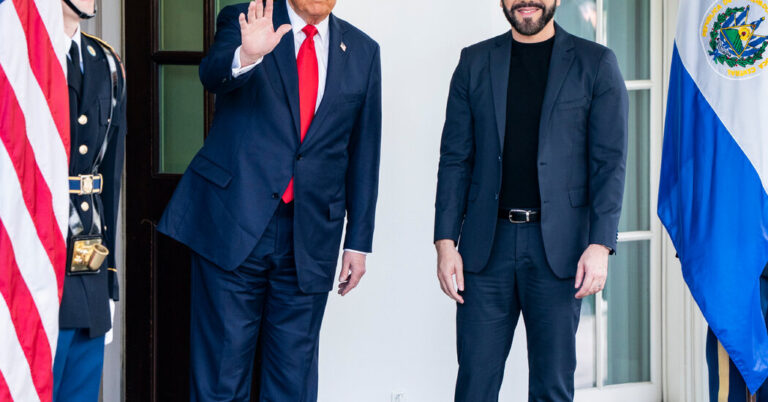
At a White House meeting with President Trump, El Salvador’s president, Nayib Bukele, said yesterday that he would not return a man who was wrongly deported from the U.S. and sent to a notorious prison in El Salvador.
“Of course I’m not going to do it,” Bukele said when reporters asked if he was willing to help return the man, Kilmar Armando Abrego Garcia. The deportation case is at the heart of a legal battle that has gone to the Supreme Court. Here’s what else to know.
Bukele said returning Abrego Garcia would be like smuggling “a terrorist into the United States.” As the Salvadoran president spoke in the Oval Office, Trump smiled in approval.
Background: The Trump administration has said that the deportation was an “administrative error,” and has been ordered by the Supreme Court to “facilitate” Abrego Garcia’s return. But Trump has defied the order.
Quotable: “This meeting is one of the starkest examples of a foreign leader fawning over and placating Trump during a visit to the Oval Office,” said Zolan Kanno-Youngs, a White House reporter for The Times.
More on Trump
Zuckerberg took the stand in landmark Meta antitrust trial
Mark Zuckerberg, the chief executive of Meta, took the witness stand yesterday on the first day of a landmark antitrust trial that could dismantle his company.
The U.S. government has accused Meta of illegally creating a monopoly by acquiring Instagram and WhatsApp when they were tiny start-ups. The trial poses the most consequential threat yet to Zuckerberg’s business empire.
In a packed courthouse in Washington, Zuckerberg responded by describing the social media market as much larger than how the government was defining it. Meta, he said, is involved in “the general idea of entertainment and learning about the world and discovering what’s going on.”
What’s next: During the eight-week trial, the government and Meta are expected to tell competing versions of Meta’s 20-year growth story. If the judge rules against Meta, Zuckerberg may be forced to sell Instagram and WhatsApp. This could alter a long pattern in Silicon Valley of Big Tech companies snapping up younger rivals.
In an essay published just before his arrival, Xi called on other countries to join China in defending stability, free trade and “an open and cooperative international environment.”
While the Chinese leader will be welcomed during his tour, Vietnam and its neighbors are also trying to appease Trump to get tariffs lowered, which may make them resistant to making bold pro-China pronouncements.
MORE TOP NEWS
Jeff Bezos’ Blue Origin rocket yesterday launched the singer Katy Perry and five other women into space. Blue Origin pitched the space tourism flight as a way to encourage more women to pursue careers in science.
Amanda Hess, one of our critics at large, writes that the effort may have fallen short. “If the flight proves anything, it is that women are now free to enjoy capitalism’s most decadent spoils alongside the world’s wealthiest men,” she wrote.
CONVERSATION STARTERS
Remembering Mario Vargas Llosa
The Peruvian author Mario Vargas Llosa, who died on Sunday at 89, was the last surviving member of the Boom movement of socially conscious Latin American writers that included Gabriel García Márquez and Carlos Fuentes, among others.
He was the world’s savviest and most accomplished political novelist, our book critic Dwight Garner writes. His political novels are morally complex and meticulously observed, but life’s absurdity sneaks into them. Read Dwight’s appreciation here.
RECOMMENDATIONS
Marjorie Taylor Greene Bought Market Dip Before Trump Paused Tariffs, Profiting From the Rally
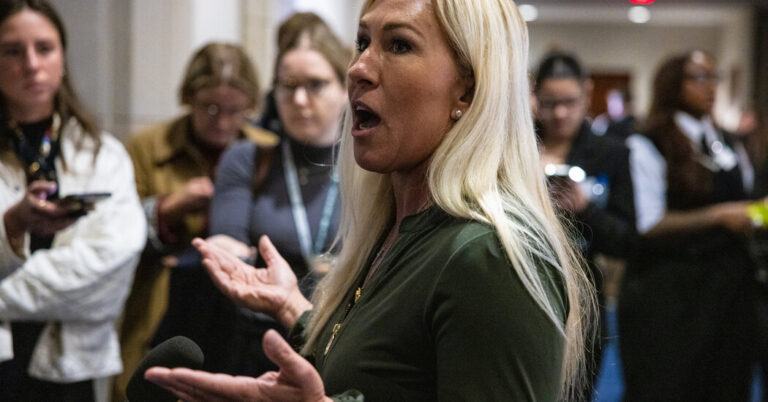
Representative Marjorie Taylor Greene, Republican of Georgia, disclosed on Monday that she had purchased between tens and hundreds of thousands of dollars worth of stock on April 8 and 9, the day before and the day of President Trump’s announcement that he was pausing a sweeping set of global tariffs, a pivot that sent the stock market soaring out of a sizable slump.
Ms. Greene bought between about $21,000 and $315,000 in stocks on those days. The day before Mr. Trump’s move, she also dumped between $50,000 and $100,0000 in Treasury bills, according to required public disclosures made to the House.
The report came as Democrats in Congress have demanded investigations of whether the president’s whipsawing moves on trade might have been aimed at manipulating the market and giving his allies a lucrative opportunity for insider trading.
Members of Congress are required to report their stock trades within 30 days of making them, though they only have to mark down broad ranges rather than specific dollar amounts. Ms. Greene’s April 8 and 9 trades — 21 each in the range of $1,001 to $15,000 — are some of the first among members of Congress that will be reported over the coming month as lawmakers detail their financial moves around the time the president encouraged people to buy the dip ahead of his pause on tariffs.
“THIS IS A GREAT TIME TO BUY!!!” Mr. Trump wrote on social media the morning of April 9. About four hours later, he said he was pausing most tariffs on every country except China, an announcement that resulted in massive one-day gains in stocks.
Ms. Greene, one of Mr. Trump’s most loyal allies in the House and an active stock trader, appeared to heed the advice, making an unusually large volume of stock purchases. That day, she bought stock in several companies, including Apple, which has since gone up in value by about 5 percent. She also bought stock in other technology companies, as well as energy firms such as Devon Energy Corporation and the pharmaceutical giant Merck & Company, according to her public disclosures.
The day before, she purchased stock in Palantir, whose value has since gone up 19 percent, and in Advanced Micro Devices, Inc., whose stock has since risen 21 percent. She also sold the Treasury bills as government bond yields were rising amid the tariff chaos, (Ms. Greene had previously purchased up to $500,000 in Treasuries before April 2, when Mr. Trump announced his most expansive tariffs to date.)
Ms. Greene, who is the chairwoman of the DOGE subcommittee of the House Oversight Committee, did not respond to a request for comment. When her stock trades were examined in the past, she told The Atlanta-Journal Constitution that she relies on a financial adviser to trade on her behalf and does not have input on which companies are being traded, or when.
Lawmakers in both parties have long championed legislation to ban individual stock trading by members of Congress as a way to appeal to growing populist sentiment among constituents.
The tumult in the stock market caused by Mr. Trump’s erratic moves on tariffs has led Democrats to question who is gaining financially because of it. Ms. Greene is not alone in appearing to have capitalized on the market volatility.
Representative Rob Bresnahan, a Pennsylvania Republican who has emerged as one of the most active stock traders in the freshman class despite saying during his campaign that he wanted to ban congressional stock trading, also appears to have profited from Mr. Trump’s tariffs.
Mr. Bresnahan sold up to $50,000 in Alibaba stock on March 4, the same day Mr. Trump doubled the tariff on Chinese imports to 20 percent. Alibaba is an e-commerce giant with close ties to the Chinese Communist Party. The stock price rose by about 30 percent between Mr. Bresnahan’s initial purchase and his final sale.
A spokeswoman for Mr. Bresnahan said that he relies on a financial adviser to trade stocks for him, and never knows about the trades before they happen or when they occur. The Alibaba trade, she said, was part of a larger strategic stock package. When it was reported in his disclosure, Mr. Bresnahan’s team put in guardrails so that he would not be able to trade that stock again.
While there has been no evidence of insider trading, Democrats have zeroed in on the potential for malfeasance as a way to attack Mr. Trump’s tariff moves and suggest that he and his friends are exploiting decisions that have hurt ordinary people.
“It is unconscionable that as American families are concerned about their financial security during this economic crisis entirely manufactured by the president, insiders may have actively profited from the market volatility and potentially perpetrated financial fraud on the American public,” a group of Democrats led by Senators Adam Schiff of California and Ruben Gallego of Arizona wrote in a letter last week to Paul Atkins, the chairman of the Securities and Exchange Commission.
In the letter, they demanded that Mr. Atkins open an investigation to determine whether Mr. Trump or any “insiders” had engaged in insider trading or other securities law violations.
Separately, Representative Alexandria Ocasio-Cortez, Democrat of New York, wrote in a fund-raising appeal on April 11 that “any member of Congress who purchased stocks in the last 48 hours should probably disclose that now,” after Nasdaq call volume spiked ahead of Mr. Trump’s announcement. Ms. Ocasio-Cortez has been a longtime proponent of legislation to ban stock trading for members of Congress.
US Dollar Keeps Falling as Trump’s Tariffs Rattle Investors
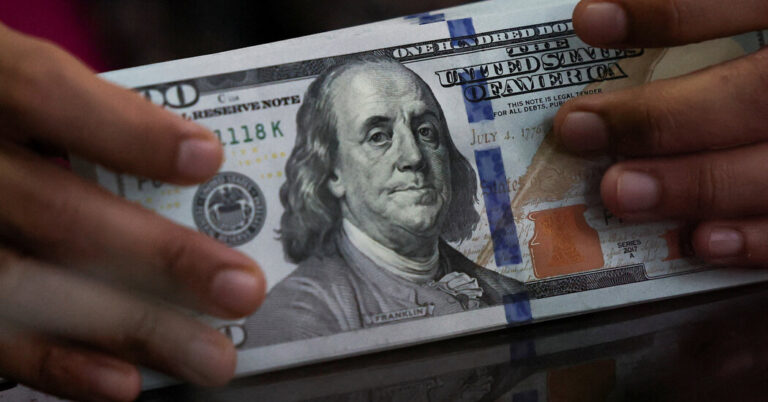
The U.S. dollar extended its slide against other major currencies on Monday, the latest sign that investors may be starting to shun what has long been the safest haven in global financial markets.
An index that tracks the dollar against a basket of major trading partners fell for a fifth straight day, even as U.S. stocks and bonds rallied. The dollar has fallen by roughly 8 percent this year, trading near a three-year low.
There has been a particularly steep decline since President Trump announced tariffs on nearly every country’s imports a few weeks ago. The dollar has lost value against the euro, the yen, the pound and a host of other currencies, making imports from those countries more expensive for Americans, even before tariffs are applied.
Investors and many of Mr. Trump’s advisers had expected the dollar to strengthen as tariffs were put in place, given the conventional wisdom that the levies would discourage Americans from purchasing imported goods and in turn reduce the demand for foreign currency. Scott Bessent, the Treasury secretary, argued that the dollar’s appreciation would be significant enough to offset a rise in inflation.
But the magnitude of the tariffs that Mr. Trump has announced has been more substantial than many expected, unleashing turbulence acute enough to raise questions about whether U.S. assets have lost their luster. On multiple days in recent weeks, when the dollar was selling off, so too were U.S. stocks and government bonds, a combination that Krishna Guha, vice chairman at Evercore ISI, described as “rare, ugly and worrying.”
In part, the turmoil reflects the confusion about Mr. Trump’s plans for tariffs. Mixed messages about exemptions and pauses, and which products and countries might be hit with new tariffs, have rattled investors who have long seen dollar-denominated assets like U.S. Treasury bonds as the surest thing in finance.
“Both institutional investors and central banks are having to begin to think about what would happen should the dollar and the Treasury market no longer be the safe haven,” said Joe Brusuelas, chief economist at the consulting firm RSM.
Sharp moves in the value of the dollar can have a destabilizing effect on the global economy, because it serves as a central pillar of the financial system. The dollar is on one side of nearly 90 percent of all foreign-exchange trades, according to the Bank for International Settlements, from Americans abroad using their credit cards to large corporations making billion-dollar takeovers. Essential commodities, like oil, are also typically priced in dollars, regardless of who is buying or selling.
Brad Setser, a senior fellow at the Council on Foreign Relations who previously worked at the Treasury Department, said there were reasons not to read too much into the dollar’s sell-off.
For nearly a decade, U.S. assets have been among the best performers in the world — consider the “Magnificent Seven” tech stocks that propelled the S&P 500 and Nasdaq to a series of record highs.
“A lot of the money coming into the U.S. hasn’t been coming to the U.S. seeking safety. It’s been coming to the U.S. seeking yield and chasing the run up in U.S. equities,” he said. “In that context, when there’s a general move to reduce risk — because the world certainly seems a lot riskier after Trump’s tariff announcement — some of that money that was betting on U.S. outperformance and the U.S. continuing to offer outsized returns is being unwound.”
Economists now see much higher odds of a recession in the United States because of escalating trade tensions. That may mean the Fed will be compelled at some point to start lowering interest rates to protect the labor market. Lower rates make holding dollar-denominated assets less appealing, which could put more pressure on the currency. While the bar for future cuts appears high given that inflation is poised to rise as growth slows, signs that the economy is hurtling toward a recession could change the central bank’s approach.
If that transpired, Christopher J. Waller, an influential Fed governor, on Monday said he would support cutting rates “sooner and to a greater extent” than initially expected. In a speech, he also acknowledged the turbulence caused by Mr. Trump’s tariffs, saying it was an “understatement to say that financial markets did not respond well” to them.
Even Mr. Setser acknowledged that there may be something more fundamentally worrying to the dollar’s slide than simply a shift in expectations about the economic outlook.
“It is not crazy to think that after a period of exceptional policy volatility in the United States and with real risk of recession, that some foreign investors might wonder whether they should continue to put an ever increasing amount of money into the United States,” he said.
Pope Places Antoni Gaudí, ‘God’s Architect,’ on Path to Sainthood

Pope Francis on Monday placed Antoni Gaudí, the Catalan modernist once called “God’s architect” for his work on the Sagrada Familia, Barcelona’s world-famous basilica, on the path to sainthood.
Francis recognized his “heroic virtues” and authorized a decree declaring him “venerable,” a move toward sainthood, the Vatican said in a statement. For the next step, beatification, a miracle attributed to him would have to be verified. After that, a confirmation of yet another miracle would be required for Gaudí to be declared a saint in the Roman Catholic Church. The process can take years, even centuries.
The basilica marked the pope’s decision by noting on its website that after Gaudí died at 73, a leading prelate at the time called him God’s architect, and that the Sagrada Familia “opens hearts to beauty with its beauty.”
Antoni Gaudí i Cornet was born on June 25, 1852, most likely in Reus, Spain. He moved years later to Barcelona, where he studied architecture, earning his degree in 1878. After working on some small projects, according to the basilica’s website, “he soon became one of the most sought-after architects and began taking on larger commissions.”
The Gaudi Foundation notes that his association with the architect Joan Martorell i Montells brought Gaudí into contact with the rich industrialist and prominent Barcelona figure Eusebio Güell, which “helped to engender many of the imperishable works” still admired today.
Construction of the Sagrada Familia began in 1882, and Gaudí took over the project a year later, when he was 31. He worked on the basilica for more than four decades, the last 12 years of his life exclusively. It remains unfinished.
Gaudí was hit by a tram in Barcelona on June 7, 1926, and taken to the city’s hospital for the poor because he was not recognized. He died three days later.
In 2010, the basilica was consecrated by Pope Benedict XVI, who described Gaudí, as “a creative architect and a practising Christian who kept the torch of his faith alight to the end of his life, a life lived in dignity and absolute austerity.”
“Gaudí, by opening his spirit to God, was capable of creating in this city a space of beauty, faith and hope, which leads man to an encounter with him who is truth and beauty itself,” Benedict said in 2010.
In announcing the decree, the Vatican’s Dicastery for the Causes of Saints, which oversees the canonization process, described Gaudí as a faithful layman who, “moved by the yearning for union with the Lord,” led a “good spiritual and moral life above the ordinary.”
It added that Gaudí “offered to God the fruits of his own labor understood as a mission to make the people know and draw them closer to God, and made art a hymn of praise to the Lord.”
Cardinal Juan José Omella, the archbishop of Barcelona, said in a video statement on Monday that “it was a joy to receive the news” that Gaudí had been declared “venerable.” It was a recognition, he said, “not only of his architectural work, but of something more important than his holiness, that he is a man who was good.”
An association to promote Gaudí’s beatification was established in 1992, with the aim of achieving that goal “through the organization of lectures, exhibitions and publications; and to collect testimonies of favors granted by his intercession,” according to a book published by the association.
In 2023, the cause was submitted to the Vatican, and the Archdiocese of Barcelona became officially involved.
Not many artists have achieved saintly status. Some are prelates who also wrote poetry. One is an abbess who wrote musical compositions.
Fra Angelico, the Renaissance artist and Dominican friar who was beatified by Pope John Paul II in 1982, may be the best known. A major Fra Angelico exhibition opens in Florence, Italy, on Sept. 26 and looks set to be one of the major European art shows of the fall.
As Gaudí inches toward sainthood, so, too, is the Sagrada Familia creeping toward completion. Two towers were finished in 2023, and the Sagrada Familia Foundation has said it hopes that the central, and tallest, tower will be finished by 2026 — the centennial of Gaudí’s death.
“He was a visionary, and a Christian visionary, so the cause for beatification is more than merited,” said the Italian historian Giovanni Maria Vian, who called the Sagrada Familia “the last great church” in the long history of ecclesiastical architecture in Europe.
Gaudí had conceived the basilica “as a religious monument to give praise and praise God,” he said, much like the craftsmen who worked on the great cathedrals of the Middle Ages.
Arson Attack on Shapiro Raises New Fears About Threats to U.S. Politicians

A charred piano. A singed light fixture dangling by a cord in a fire-scarred room. Plates strewn with ash, not far from a dinner table just cleared from a Passover Seder.
The scorched rooms inside the official residence of Gov. Josh Shapiro of Pennsylvania were the work of an arsonist who the authorities say admitted “harboring hatred” for Mr. Shapiro. Officials say the suspect revealed that if he found the governor, he planned to beat him with a hammer.
The attack on Mr. Shapiro and his family was only the latest prominent attempt on the life of an American elected official. A string of violent outbursts in recent years has raised alarms about the threats lawmakers are confronting and the country’s often poisonous political environment.
President Trump faced two assassination attempts last year, a bullet grazing his ear at a rally in Pennsylvania. A group of extremists planned to kidnap Gov. Gretchen Whitmer of Michigan. A man broke into Representative Nancy Pelosi’s home and assaulted her husband with a hammer. A gunman attacked Republican members of Congress as they practiced for a baseball game, wounding Representative Steve Scalise of Louisiana.
Yet while the attacks on top officials have rattled Americans in both parties, research shows that political violence overall is not necessarily on the rise. Large-scale eruptions — with the notable exception of the Trump-inspired riot at the Capitol on Jan. 6, 2021 — have not become more frequent. Support among Americans for acts of political violence like murder or arson remains exceedingly low, according to a weekly study conducted by the Polarization Research Lab at Dartmouth College.
“The high-profile nature of the attacks definitely makes it so that the public perceives political violence as a threat to the country that is disproportionate to the actual nature of the problem,” said Sean J. Westwood, a professor at Dartmouth College and the director of the Polarization Research Lab.
But the relative rarity of political violence has done little to settle an American public increasingly on edge, and threats continue to flood the inboxes of elected officials, election workers and journalists.
Before the 2024 election, more than 70 percent of voters said they were “very worried” about political violence, according to a poll by the Leadership Conference on Civil and Human Rights.
On Sunday, Mr. Shapiro stood outside his residence, where broken and blackened windows sat behind yellow caution tape, and vowed to work harder as governor in the face of threats.
“This kind of violence is becoming far too common in our society, and I don’t give a damn if it’s coming from one particular side or the other, directed at one particular party or another, or one particular person or another,” Mr. Shapiro said, his voice rising with anger. “It is not OK, and it has to stop. We have to be better than this.”
Condemnation of the attack was swift and bipartisan.
“Thanks be to God that Governor Shapiro and his family were unharmed in this attack,” Vice President JD Vance wrote on social media. “Really disgusting violence, and I hope whoever did it is brought swiftly to justice.”
“Acts of violence have no place in our politics,” Senator Cory Booker, a Democrat from neighboring New Jersey, said in a statement. “Those responsible should be held accountable.”
Mr. Trump, who twice survived attempts on his life — and who has pointed to the specter of domestic terrorism as justification for his aggressive immigration agenda — did not issue a statement on Sunday or on Monday morning. Asked on Monday in the Oval Office about the attack, he said the assailant was “probably just a wack job.”
“Certainly a thing like that cannot be allowed to happen,” Mr. Trump said.
The authorities have yet to reveal more information on the suspect’s political leanings, but several Democrats and Jewish groups noted that the attack against Mr. Shapiro, who is Jewish, came on the first night of Passover. Law enforcement authorities have not commented on whether the arson is being investigated as a hate crime.
“Political violence of any kind is never acceptable, and it is especially unconscionable to attack a Jewish family during the first night of Passover,” Representative Hakeem Jeffries, the Democratic minority leader, said in a statement. “Everyone responsible must be prosecuted to the full extent of the law.”
Federal and state officials have taken steps to address threats of political violence. In 2021, Attorney General Merrick B. Garland created an elections threat task force based in the Justice Department’s public integrity unit. Last year, numerous election offices were fortified with bulletproof glass and an increased security presence.
Such steps have helped to ferret out and prevent attacks before they happen. Jena Griswold, the Democratic secretary of state in Colorado, received more than 1,800 death threats and violent threats last year. Law enforcement officials arrested and charged multiple people said to be responsible.
But the threats still prompted many local election officials and workers to resign or back away from working in the next election. In Colorado, county clerks had roughly 40 percent turnover, Ms. Griswold said in an interview, as “we have seen people step down because they are not willing to continue to work in this type of atmosphere.”
“It is very hard to live under that threat environment,” she said, adding how relieved she was that Mr. Shapiro and his family were safe. “It definitely takes a toll on just how you live your daily life, and it absolutely has affected elections here in Colorado and across the nation.”
The Colorful Cult of Le Creuset

April Hershberger is not the only collector of Le Creuset cookware who owns so many pieces that she can’t count them. But she may be the only one who built an entire house around one: the deep-red, nine-quart oval Dutch oven she received as a gift for her 2006 wedding.
It sparked an obsession.
She had her kitchen stove, the centerpiece of her home in a restored barn in southeastern Pennsylvania, custom-made to match her collection of Le Creuset cherry-red pots, baking dishes, pitchers, plates and more. Ms. Hershberger, 42, also has pieces in mustard yellow and sunflower yellow, Mediterranean blue and Caribbean blue, forest green and lime green, which she frequently arranges and rearranges into stripes, swirls and rainbows, documenting it all on Instagram.
“I could never commit to one color,” she said.
Like Hermès and Chanel, Le Creuset (luh cruh-SAY, according to the official video, meaning French for crucible) is a Gallic legacy brand that has flourished in the modern global marketplace by becoming collectible while also remaining functional. And collectors have turned what was once a niche brand into a near-cult, perpetually entranced by new lines, colors and shapes.
Some stick to a color family, like pastels; others focus on a single item across the spectrum, like trivets or pie birds.
“As an Aries, fire and flames speak to me,” said Arlene Robillard, a purist who has one of the world’s largest collections of the company’s original color: Volcanique, an orange-red ombré sold in the United States as Flame.
Last week, to celebrate its 100th anniversary, Le Creuset released its latest color, Flamme Dorée (golden flame). It’s close to the original hue, with a gold shimmer added, like expensive makeup or a shot of Goldschläger. Months ago, a sighting of the new hue at an unspecified Williams Sonoma store sent the Le Creuset Lovers group on Facebook, which has 97,000 members, into a frenzy of speculation.
“I have a good relationship with the staff and one showed me a DO in the new sparkle flame!” an anonymous member posted. (DO is the collectors’ shorthand for Dutch oven.)
Before Le Creuset, most cookware came in shades of gray, black and brown. But in 1925, two Belgian entrepreneurs — one an expert in cast iron, the other in vitreous enamel, made of heat-fired glass — built a foundry in the industrial northeastern corner of France to deploy their new technology: coating cast iron with colorful enamel. (The enameled cast-iron pots are all still made in the foundry, but other cookware and tableware are produced in Portugal, Thailand, China and elsewhere.)
Their Le Creuset pots quickly caught on in Europe thanks to their bright colors, durability and kitchen performance. The cookware began trickling into the United States in the 1950s, but sales swelled in this century as new items were introduced, making it clear that fans can be tempted into buying far more cookware than they actually need.
By expanding the company’s color palette from basics into pastels, neons and neutrals, and expanding the line from cookware into tableware, utensils and storage, Le Creuset has become a kitchen marketing powerhouse, with 90 stores in North America. (In 1988, five years after the first U.S. store opened, the company was bought from French owners by Paul van Zuydam, a South African entrepreneur who pushed for the new strategy. Since the company is privately held, its revenues are not made public.)
The company has produced collaborations with artists like Sheila Bridges, using her black Harlem Toile de Jouy pattern, and with brands like “Star Wars,” “Harry Potter” and Hello Kitty. (The United States is its largest market, and Japan is not far behind.) It has also staged strategic drops of limited-run items like a black heart-shaped Dutch oven that sells out as soon as it reappears, then shows up on resale sites like Etsy and eBay.
After the baker Jim Lahey’s recipe for no-knead bread baked in a Dutch oven went viral in the early 2000s (and re-emerged during the pandemic), Le Creuset produced a dedicated bread oven in 2022 that has become its most popular new piece in decades, said Sara Whitaker, a director of U.S. marketing for the company.
Pop-up factory sales, like a three-day event held last week in San Jose, Calif., generate huge lines and feverish social media posts, especially among buyers of V.I.P. tickets that come with the opportunity to buy a $50 “mystery box” that can be opened only after exiting the sale. Each box contains at least $350 (but sometimes up to $1,000) worth of overstocked and discontinued merchandise, and fans film suspenseful unboxing videos in the parking lots to post on TikTok.
Outside the factory sales and outlet stores, the pots can be very expensive: retail prices go up to $750 for the biggest, a Dutch oven called the “goose pot,” large enough to roast a 15-pound bird.
Last month, when Netflix debuted a new lifestyle show starring Meghan, the Duchess of Sussex, among the many reasons some viewers called her “unrelatable” were the white Le Creuset pots she used. Her cookware was singled out as being too expensive and too pristine, a criticism that some Black women said was based in racist and dated assumptions. Many of them, like Sharzaè Cameron of Atlanta, made a point of showing off their collections on social media.
“We have had these for years now — this isn’t new,” said Ms. Cameron, 42, citing wedding registries, outlet stores and holiday gifts as opportunities to build a collection. (In an interview at her home last month, Meghan told me it was absurd that anyone would think that modern Black women use only traditional cast-iron skillets.)
Starting in the 1960s, two aspirational domestic empires were built on a sturdy platform of Le Creuset: Williams-Sonoma on the West Coast and Pottery Barn on the East. In 1965, my parents (Hanna, 82, and Jeffrey Moskin, 83) bought the pots they still use every day.
When they married that year, both were looking to escape from their families’ culinary claustrophobia: my mother from a strictly kosher home in Brooklyn (jellied calves’ feet, margarine) and my father from a suburban one on Long Island (orange soda, frozen vegetables). His father was in the restaurant-supply business, so my parents had a good start when they wed: a giant black Garland restaurant stove and thick aluminum skillets.
But they didn’t feel they were on their way until they had Le Creuset pots, the flame-colored Dutch ovens and heavy-lidded saucepans that helped them master recipes by Julia Child, Richard Olney and Elizabeth David. (At the time, everyone in their circle wanted to be a French home cook, preferably one who lived in the countryside.)
Contraptions like a Salton yogurt maker and a Romertopf terra-cotta casserole have passed through their kitchen, but no other pots have been added to their rack, 60 years later. That’s why I didn’t know there was such a thing as a nonstick skillet until I was out of college.
The culinary historian, cooking teacher and retired podcast host Lynne Rossetto Kasper, 82, said she started using the pots as soon as they arrived in the United States, because their weight made it possible to deeply brown ingredients without scorching, and to cook at a low simmer.
“Finding something that you could braise in or build a slow sauté and get the right kind of fond wasn’t easy,” she said, because even top American-made cookware, like Farberware, was mostly lightweight aluminum. Two of her well-used Le Creuset Dutch ovens will be up for sale next week in an auction of her culinary collection but, she said, “they are only a few of the many that have passed through my life.”
Hailey Sipe, a product director for a tech company who lives in Orange County, Calif., called me from the road Thursday with a report from the San Jose pop-up sale. She and two friends from the M.B.A. program at U.C.L.A. had made the 300-mile drive north after work on Wednesday, then got up early to scope out the line and parking.
Ms. Sipe, 34, already owns some colorful pots handed down from her mother and sister, but since her marriage last year, has been building a collection in neutrals, including Oyster gray, Sea Salt pale blue and Brioche beige.
The grail item for her 90-minute shopping slot was a bread oven. (The slots are staggered in 120-minute intervals, to give the staff a chance to make order from the chaos.) “There’s a mad dash at the beginning, because the strategy is to grab everything you might want and figure it out later,” Ms. Sipe said.
To open their mystery boxes, the three friends met up with other attendees at a nearby parking lot where collectors came prepared to barter, bringing folding tables and sometimes pieces from home they’re ready to part with. The process was an emotional roller coaster, she said: The first box held a perfect set of white Dutch ovens, but it wasn’t hers. The next held mostly Chiffon pale pink, a color that none of the women particularly like for cookware. Her own box was filled with Flame pieces. “Orange is not in my color palette,” she said emphatically.
Still, for about $1,400, Ms. Sipe went home with a black braiser, a Rhone (wine-colored) pot and 10 other pieces that she’ll use, trade or give as gifts.
And the bread oven? The entire spectrum was sold out by the time she got inside, with the exception of Flame. (Ms. Whitaker of Le Creuset said Flame is declining in popularity and the company is “de-emphasizing” its production.)
Ms. Robillard, the Flame collector, has well over 1,000 pieces in the original color, including rarities like a 1955 Tostador, a kind of George Foreman Grill prototype by Raymond Loewy, the French American industrial designer who also created the original Coca-Cola can, the Barcalounger and the Shell logo.
Ms. Robillard, 73, has a contact in the Netherlands who scours flea markets for her, and a dedicated room in her home in Apopka, Fla., for the collection, stored on industrial shelving that has to be bolted to the walls to support its weight.
Factory sales and new pieces hold no interest; her current fixation is a vintage sangria pitcher that she once spotted on a resale site in South America. “The hunt is always fun.”
Follow New York Times Cooking on Instagram, Facebook, YouTube, TikTok and Pinterest. Get regular updates from New York Times Cooking, with recipe suggestions, cooking tips and shopping advice.
How to Evade Taxes in Ancient Rome? A 1,900-Year-Old Papyrus Offers a Guide.
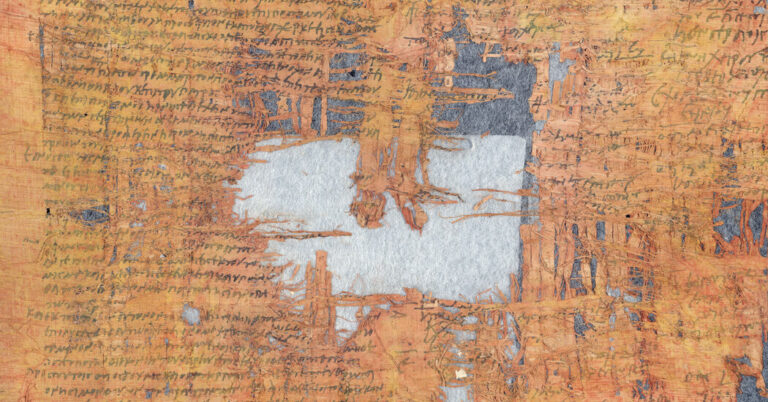
It may not have been the tax-evasion trial of the century — the second century, that is — but it was of such gravity that the defendants faced charges of forgery, fiscal fraud and the sham sale of slaves. Tax dodging is as old as taxation itself, but these particular offenses were considered so serious under Roman law that penalties ranged from heavy fines and permanent exile to hard labor in the salt mines and, in the worst case, damnatio ad bestias, a public execution in which the condemned were devoured by wild animals.
The allegations are laid out in a papyrus that was discovered decades ago in the Judean desert but only recently analyzed; it contains the prosecutor’s prep sheet and the hastily drafted minutes from a judicial hearing. According to the ancient notes, the tax-evasion scheme involved the falsification of documents and the illicit sale and manumission, or freeing, of slaves — all to avoid paying duties in the far-flung Roman provinces of Judea and Arabia, a region roughly corresponding to present-day Israel and Jordan.
Both tax dodgers were men. One, named Gadalias, was the impoverished son of a notary with ties to the local administrative elite. Besides convictions for extortion and counterfeiting, his catalog of misdeeds included banditry, sedition and, on four occasions, failing to show up for jury duty at the court of the Roman governor. Gadalias’s partner in crime was a certain Saulos, his “friend and collaborator” and the supposed mastermind of the caper. Although the ethnicity of the accused is not explicitly stated, their Jewish identities are assumed, based on their biblical names, Gedaliah and Saul.
This ancient legal drama unfolded during the reign of Hadrian, after the emperor’s tour of the area around A.D. 130 and presumably before A.D. 132. That year, Simon bar Kochba, a messianic guerrilla chief, led a popular uprising — the third and final war between the Jewish people and the empire. The revolt was violently suppressed, with hundreds of thousands killed and most of the surviving Jewish population expelled from Judea, which Hadrian renamed Syria Palestina.
“The papyrus reflects the suspicion with which the Roman authorities viewed their Jewish subjects,” said Anna Dolganov, a historian of the Roman Empire with the Austrian Archaeological Institute, who deciphered the scroll. She noted that there is archaeological evidence for coordinated planning of the Bar Kochba revolt. “It is possible that tax evaders like Gadalias and Saulos, who were inclined to disrespect the Roman order, were involved in the preparations,” Dr. Dolganov said.
In the current issue of Tyche, a journal of antiquity published by the University of Vienna, Dr. Dolganov and three Austrian and Israeli colleagues present the court proceedings as a case study. Their paper brings to light how Roman institutions and imperial law could influence the administration of justice in a provincial setting where relatively few people were Roman citizens.
“The document provides rare and highly interesting evidence for the slave trade in this part of the empire,” said Dennis P. Kehoe, a classicist at Tulane University, who was not involved in the study, “as well as the circumstances under which Jews might have slaves.”
Following the papyrus trail
No one is certain when or by whom the papyrus was unearthed, but Dr. Dolganov said that it was probably found in the 1950s by Bedouin antiquity dealers. She suspects that the discovery site was Nahal Hever, a steep-walled canyon west of the deep cleft of the Dead Sea where some Bar Kochba rebels, fleeing the Romans, took refuge in natural fault line caves in the limestone cliffs. In 1960, archaeologists found documents from the era in one of the Jewish hide-outs; others have been discovered since.
Initially misclassified, the ragged 133-line scroll lay unnoticed in the archives of the Israel Antiquities Authority until 2014, when Hannah Cotton Paltiel, a classicist at the Hebrew University of Jerusalem, realized that it was written in ancient Greek. In light of the document’s complexity and extraordinary length, a team of scholars was assembled to conduct a detailed physical examination and cross-reference names and locations with other historical sources.
Deciphering the papyrus and reconstructing its intricate narrative posed major challenges to Dr. Dolganov. “The letters are tiny and densely packed, and the Greek is highly rhetorical and full of technical legal terms,” she said. Unlike in documents such as contracts, there were no formulaic expressions that made the translation easier. “It certainly does not help that we only have the second half, or less, of the original,” Dr. Dolganov said.
The researchers deduced that the tax scheme was designed to escape notice, which meant careful detective work was required to piece together what happened. “I had to adopt the perspective of the Roman fiscal administration to understand what the text is talking about,” she said. Dr. Dolganov also had to imagine the dodge from the standpoint of the accused: To commit tax fraud with the slave trade in the most remote corner of the Roman world, what would you have to do, and what would have made the effort profitable?
The ancient scheme has resonated deeply with modern tax lawyers. A German lawyer told Dr. Dolganov that the shenanigans of Gadalias and Saulos were not all that different from today’s most common forms of tax fraud — shifting assets, phony transactions. And the Roman interrogation methods were largely in line with Untersuchungshaft — investigative custody — for financial crimes, which involves intimidation and often brutal questioning.
“Dr. Dolganov has performed wonderful feats of scholarship in unraveling the meaning of the contents and their significance for the history of the region and the empire,” said Brent Shaw, a classicist at Princeton University with no connection to the project.
Rebels with a cause
The case against Gadalias and Saulos was bolstered by information provided by an informant who tipped off the Roman authorities — and the text even suggests that the informant was none other than Saulos, who denounced his accomplice Chaereas to protect himself in a looming financial investigation. The most likely scenario, Dr. Dolganov said, was that Saulos, a resident of Judea, arranged the bogus sale of several slaves to Chaereas, who lived in the neighboring province of Arabia.
By being sold across the provincial border, the slaves would have vanished in print from Saulos’s assets in Judea. But because they physically stayed with Saulos, the alleged buyer, Chaereas, could opt not to declare them in Arabia. “Thus, on paper, the slaves disappeared in Judea but never arrived in Arabia, thereby becoming invisible to Roman administrators,” Dr. Dolganov said. “Henceforth, all taxes on these slaves could be avoided.”
The empire had sophisticated systems for tracking slave ownership and collecting various taxes, which amounted to 4 percent on slave sales and 5 percent on manumissions. “To free a slave in the empire, you had to present documentary evidence of the slave’s current and previous ownership, which had to be officially registered,” Dr. Dolganov said. “If any documents were missing or looked suspicious, Roman administrators would investigate.”
To hide Saulos’s double-dealing, Gadalias, the notary’s son, evidently forged the bills of sale and other legal agreements. When the authorities became aware of the matter, the defendants allegedly made payments to a local city council for protection. At the trial, Gadalias blamed his late father for the forgeries, and Saulos pinned the manumission on Chaereas. The papyrus offers no insight into their motive. “Why the men took the risk of freeing a slave without valid papers remains a mystery,” Dr. Dolganov said.
One possibility is that, by faking the sale of slaves and then releasing them, Gadalias and Saulos were observing a Jewish biblical duty to free enslaved people. Or maybe there was profit to be made in capturing people — perhaps even willing participants — from beyond the border, bringing them into the Empire and then releasing them from their “slavery” to become free Romans. Or maybe Gadalias and Saulos were human traffickers, plain and simple — Dr. Dolganov emphasized that the alternate story lines were entirely speculative, as nothing in the text supported them.
What surprised her most about the trial, she said, was the professionalism of the prosecutors. They employed deft rhetorical strategies worthy of Cicero and Quintilian and displayed an excellent command of Roman legal terms and concepts in Greek. “This is the edge of the Roman Empire, and boom, we see legal practitioners of high caliber who are competent in Roman law,” Dr. Dolganov said.
The papyrus does not reveal the final verdict. “If the Roman judge was convinced these were hardened criminals and execution was in order, Gadalias as a member of his local civic elite may have received a more merciful death by decapitation,” Dr. Dolganov said. “At any rate, almost anything is better than being eaten by leopards.”