Home Blog Page 378

Harvard Will Not Comply With a List of Trump Administration Demands

0


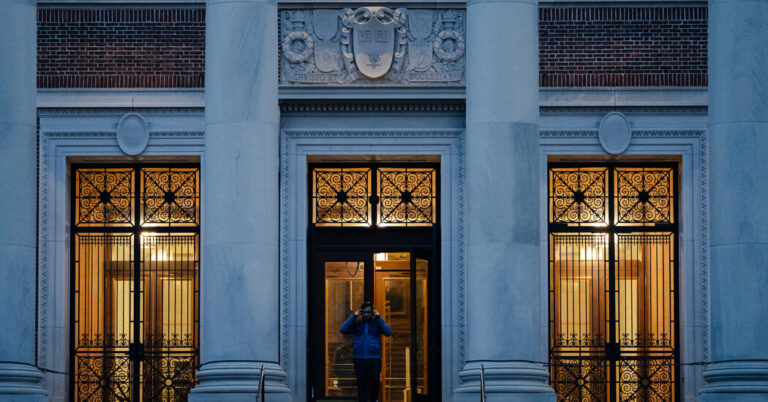
Harvard University said on Monday that it had rejected policy changes requested by the Trump administration that would have placed “unprecedented” demands on the institution, setting up a showdown between the administration and the nation’s wealthiest university.

A letter to Harvard from the Trump administration on Friday demanded that the university reduce the power of students and faculty members over the university’s affairs; report foreign students who commit conduct violations immediately to federal authorities; and bring in an outside party to ensure that each academic department is “viewpoint diverse,” among other steps.

“No government — regardless of which party is in power — should dictate what private universities can teach, whom they can admit and hire, and which areas of study and inquiry they can pursue,” said Alan Garber, Harvard’s president, in a statement to the university on Monday.

Lawyers for Harvard said in response to the administration’s letter that the university “is not prepared to agree to demands that go beyond the lawful authority of this or any administration.”

The Trump administration said in March that it was examining about $256 million in federal contracts for Harvard, and an additional $8.7 billion in what it described as “multiyear grant commitments.” The announcement went on to suggest that Harvard had not done enough to curb antisemitism on campus. It was vague about what the university could do to satisfy the Trump administration.

This is a developing story. Please check back for updates.


Source link

Good Luck Getting Goldman Sachs to Even Say the Word ‘Tariff’

0


Goldman Sachs on Monday revealed its latest financial results and outlook for the future, and in a deft feat of linguistics, its executives managed not to utter the word “tariff” once.

Instead, in an hourlong call with analysts, David M. Solomon, the bank’s chief executive, unfurled a bouquet of euphemisms, saying that there had been “landscape changes,” “uncertainty about how certain things that are close will proceed forward” and a change in “constructs” that impacted how international businesses “interact to the U.S. and global economic system.”

Asked directly about how the investment bank’s trading business was faring this month, Mr. Solomon stated that, “On April 2, a handful of things happened that shifted perspective, but I would say there were things going on before April 2 that shifted perspective,” as well.

That was the day that President Trump unveiled a wide swath of global tariffs, sending stock markets crashing and creating angst across the international economy.

As one of the world’s largest elite investment banks, Goldman finds itself very much in the middle of the market and economic turmoil that Mr. Trump’s tariff policies have unleashed. Those realities did emerge on Monday when Mr. Solomon, reading from prepared remarks, acknowledged that the chance of a recession was increasing and that “uncertainty around the path forward and fears over the potentially escalating effects of a trade war have created material risks to the U.S. and global economy.”

But based on their comments on Monday, the leadership at Goldman Sachs is not only avoiding the appearance of criticizing Mr. Trump, they are steering clear of mentioning him and the specifics of his policies all together.

The reticence from Goldman was particularly jarring given that last week several major Wall Street chieftains, including Jamie Dimon, head of JPMorgan Chase, and BlackRock’s Larry Fink, were more direct in their assessment of the turmoil. Other Wall Street titans have publicly blamed Mr. Trump’s tariff roll out for pushing the economy to the brink of a recession.

Big banks began to report their latest earnings last week, a quarterly ritual that has taken on new importance during the market turmoil that has accompanied the escalating trade war between the United States and its trading partners. Banks have historically been considered a barometer for the economy overall.

Goldman has long enjoyed close ties to Washington, a status quo that once gave it the nickname “Government Sachs.” And there is understandable reason for the bank’s executives not to want to touch the stove. The New York bank reported higher-than-expected revenue and profit for the quarter that ended March 31, with a profit of $4.6 billion, up 17 percent from the same period last year. Its shares were up roughly 2 percent on Monday, in line with the rise for stocks overall.

Shares are down 12 percent this year overall, as international lenders have been pinched by the threat of a recession that would discourage consumers and companies from borrowing from and working with banks such as Goldman.

Goldman’s business arranging and facilitating stock trades grew strongly: U.S. stock markets peaked during the quarter, before tumbling after Mr. Trump announced broad-based tariffs in early April. That helped offset a decline in investment banking fees, as deal making has slowed amid the uncertainty caused by Mr. Trump’s on-again-off-again tariff policy.

Mr. Solomon said on Monday that Goldman was experiencing “enormous” volume in currency trading, which was no surprise given that Mr. Trump’s tariffs have caused the price of the U.S. dollar to sink precipitously.

In his prepared remarks, Mr. Solomon said, “The administration’s focus on trade barriers and strengthening the U.S.’s competitive position is commendable.”

Shortly before the earnings were released, one Goldman executive briefed a group of reporters under the agreement that he not be named. As the interview began, a spokeswoman cut in to discourage questions about the trade war.


Source link

2025 NFL Draft matchmaker: Best fits for Cam Ward, Jaxson Dart, other top QBs

0


Read Dane Brugler’s 2025 ‘The Beast’ NFL Draft guide.

At least beyond Cam Ward, there is no consensus on where each of this year’s crop of quarterbacks may get drafted. After Ward presumably becomes a Tennessee Titan, the rest of the group is a complete mystery. It’s just as likely Ward is the only quarterback we see on Thursday night as it is that four quarterbacks go in the first round.

Lucky for us, we’re going to cut through all that uncertainty and play quarterback matchmaker, placing all of this year’s top quarterback prospects on the teams that make the most sense. In some cases, that has more to do with what type of quarterback the team needs; in others, it’s about finding the right environment for getting the most out of a particular skill set.

Let’s get to the lovely new couples.

Cam Ward: Tennessee Titans

All signs point to Ward being the Titans’ starting quarterback next year. It’s not even worth entertaining different possibilities for either QB or team at this point. Ward is both a good fit for the core of Brian Callahan’s offense and would bring elements that Titans’ quarterbacks last season did not.

The Titans’ 2024 offense was all about maximizing play-action opportunities and attacking down the field. Ward has the arm talent and fearlessness as a thrower to excel in that environment. However, Ward also massively improved his quick-game operation in college, and he’s much more comfortable playing from spread and empty formations than Will Levis has ever been. Ward is leaps and bounds ahead of Levis (or Mason Rudolph) as a creator outside of the pocket, too.

There are going to be growing pains with Ward’s overzealous play style early on, but they will be worth it in the long run. Ward has both a floor and ceiling worthy of being the No. 1 pick in this class.

Shedeur Sanders: New Orleans Saints

Finding Sanders’ best fit was trickier than I anticipated. Kevin Stefanski’s downfield play-action offense in Cleveland is not ideal; Brian Daboll’s quicker passing attack in New York might make sense, but that offensive line is a sieve and Sanders is not athletic enough to tap into some of the best parts of Daboll’s playbook.

The idea of Sanders being Kellen Moore’s first crack at a quarterback is intriguing, though. Sanders is at his best operating spread passing concepts, especially in the underneath area. He’s a reliable short-area passer who uses the intermediate and deeper areas of the field to keep defenses honest, rather than making those his preferred areas of attack. That’s perfectly fine for a West Coast-inspired offense.

Of course, falling to ninth overall is no guarantee. The Browns or the Giants may feel the itch of desperation and draft Sanders in the top three. If Sanders does slide a little bit, however, it wouldn’t be a shock to see the Saints stop that fall.

Jaxson Dart: Seattle Seahawks

It would be stunning if the Seahawks left the first two days of the draft without a quarterback. The deal Sam Darnold signed in March is effectively a one-year contract with team options from then on out — if that doesn’t scream “a developmental quarterback is coming,” I don’t know what does.

Seattle could go in a few directions, but Dart makes sense for their new offense under Klint Kubiak, and vice versa.

Dart reminds me a lot of Jimmy Garoppolo as a passer. The two are quite similar in build, arm talent and ability on throws over the middle of the field. A majority of Dart’s best throws on film are slants, short posts and crossers. The same was true of Garoppolo at his best in San Francisco. Neither Dart nor Garoppolo is a quarterback you want reading out a full progression very often.

In theory, Kubiak’s offense plays into all of that. It’s built off the run game, which is then parlayed into a strong play-action attack. Not only does that simplify reads for the quarterback, it also demands the QB often makes tight throws over the middle of the field, which is where Dart shines.

With a year on the bench to learn the pace of the league, maybe Dart can make it work with the Seahawks.

Tyler Shough: Cleveland Browns

The Browns’ best path to a quarterback is to take the Day 2 player most ready to start immediately. For my money, that is Shough.

Outside of Ward, Shough is the most talented thrower in the class. He has a flexible yet explosive release that works well from all platforms, in and out of the pocket. Though he’s more of a straight-line thrower than someone with fantastic touch, he still gets the job done from an accuracy perspective.

Shough is a quality processor, as well. Similar to Ryan Tannehill, he can be a hair slow coming off of reads early in the down but generally doesn’t make bizarre mistakes, and he protects the ball well.

In terms of pro readiness and arm talent, Shough just makes the most sense for Kevin Stefanski’s offense right now.

Jalen Milroe: Los Angeles Rams

If Sean McVay wants to keep the offense roughly the same in an eventual post-Matthew Stafford world, Milroe is not the answer — he’s actually the furthest thing from Stafford in this draft class (aside from the two or three bizarre misfires each QB has every game).

McVay has long flirted with the idea of a mobile quarterback, though. He was eager to give John Wolford a chance at the end of the Jared Goff saga, then held onto him as the team’s backup through the 2022 season. McVay also gave Bryce Perkins a start in 2022, a game in which Perkins carried the ball 19 times for 90 yards.

Milroe will walk into the league as one of the best athletes at the position. As a passer, he’ll need at least a year to fix his footwork and adapt to the speed of coverage at the NFL level, but that’s okay. There would be no pressure on Milroe to compete with Stafford for the job.

This would be a long play. Regardless of it being a good or realistic idea, I just so badly want to see the world in which McVay gets to re-unlock the boot-action game and dabble in a quarterback-centric rushing attack.

Riley Leonard: New York Giants

Brian Daboll’s best work over the years — outside of his time with Josh Allen — was at Alabama in 2017, with Jalen Hurts, and in 2022, with Daniel Jones.

Though different quality players, Hurts and Jones can both generally be described as sturdy, athletic quarterbacks with the arm talent to push the ball down the field a little bit. Both players added something to the offense via their mobility, and Daboll took advantage.

Aside from maybe Milroe, Leonard is Daboll’s best swing at that kind of athlete. Leonard is 6-foot-4, 218 pounds with serious wheels. He’s fairly explosive in short areas and excels when he really gets to stride out, similar to Jones. He’s clearly a weapon in the designed-run game and the red zone.

Leonard still has a lot to prove as a passer, but his athletic ability and toughness gives him a floor to work with while he figures it out.

Kyle McCord: Dallas Cowboys

It’s hard to find and hold onto good backup quarterbacks — the Cowboys were lucky to draft and retain Cooper Rush for as long as that they did. Boring as he is to watch, Rush was a perfectly competent quarterback when it came to running the offense and not playing outside of his means.

With Rush now in Baltimore, the Cowboys are in search of the next guy to fill that role. McCord is their best bet.

McCord is not an overwhelming talent. His arm is just okay, and he’s not going to scare anyone on the move. Like any good NFL backup, however, McCord can run an offense efficiently and consistently. He really learned to play within himself at Syracuse, displaying good rhythm and decision-making as a thrower.

It’s unlikely he ever ascends to anything above a very good backup, but that’s quite alright for a Cowboys team shopping for that exact kind of player.

Will Howard: Pittsburgh Steelers

They have to draft somebody, right? Even under the assumption Aaron Rodgers finally drops the charade and signs, the Steelers need to make some sort of effort to secure a young quarterback.

Howard, if nothing else, fits Arthur Smith’s offense. He is not someone who should be a high-volume passer, which already leans into Smith’s run-first approach. Additionally, Howard’s best traits are his size and arm talent, which allows him to comfortably throw down the field, as well as ample athletic ability for a player his size. Smith’s entire play-action and boot menu would be open with Howard at quarterback.

It’s hard to imagine Howard developing the down-to-down accuracy and play speed to really thrive as an NFL starter, but Smith’s offense in Pittsburgh at least would give Howard a chance to hide his weaknesses and lean into his strengths.

Dillon Gabriel: Miami Dolphins

Putting the short lefty quarterback prospect as a backup to the short lefty NFL quarterback feels like a bit, but it’s not. It makes sense when you consider each player’s strengths and the dynamics of being a left-handed vs. right-handed thrower.

Firstly, pass-catchers often talk about the flight and spin of the ball being different from lefty quarterbacks — the ball rotates in the opposite direction of 99 percent of quarterbacks, so it looks different coming into a receiver’s vision.

Gabriel, like Tua Tagovailoa, also thrives with RPOs and throws over the middle. He has a flexible and explosive release, making him perfectly equipped to manage those RPOs at a high level. And he thrives on in-breaking throws, even offering more velocity than Tagovailoa does.

The Dolphins desperately need to invest in a backup quarterback somehow. Gabriel fits.

Quinn Ewers: Buffalo Bills

Not every player or team gets their ideal match in an exercise like this. Sometimes, teams have to settle for whoever is left on the dance floor.

From the Bills’ perspective, a young backup quarterback should be on the table, because Mitchell Trubisky has just one year left on his deal. It makes some sense for the Bills to get ahead of things early and get a developmental player in the pipeline.

Ewers would bring functional athleticism and arm talent for Joe Brady. He still struggles with pocket presence and touch accuracy, especially down the field, but there’s enough talent there to mold a functional backup.

(Top photo of Jaxson Dart:  Justin Ford / Getty Images)



Source link

To Fight Federal Job Cuts, Energy Experts and States Try a New Argument

0


President Trump’s “energy dominance” agenda will be undermined by steep cuts to federal agencies that are said to be planned by the Trump administration, scientists, lawmakers and energy executives warned on Monday.

Pleas from numerous quarters have streamed into the inboxes of cabinet secretaries, asking them to salvage various divisions of government agencies. Federal officials face a deadline today to present their plans for another round of mass firings, and agencies that address energy and the environment are expected to be hard hit.

Experts said cuts to the Environmental Protection Agency, Department of the Interior and the Department of Energy would most severely hurt efforts to tackle climate change. However, there is little expectation that those concerns would be heeded by Trump administration officials, who either deny or downplay the threat of global warming.

Instead, opponents of the job cuts are making arguments more in line with the Trump administration’s priorities by saying the cuts threaten nuclear energy, mineral production and expanding energy access.

At the Department of Energy, for example, some of the biggest losses are expected in places like the Office of Clean Energy Demonstrations, which oversees several large projects, including a plan to build seven hydrogen hubs around the country. Another expected target is the Loan Program Office, which provides federal financing for clean energy.

A coalition of energy producers and trade groups representing nuclear power, data centers, and wind and solar energy — as well as direct-air-capture technology, a method of pulling planet-warming carbon dioxide out of that atmosphere — said in a letter to Chris Wright, the Energy secretary, that the cuts “would critically undermine American energy and industrial strategy.”

They noted the loan office has supported the only new nuclear construction in the country. It has also supported a major lithium mining project in Nevada (lithium is a key battery component) as well as grid upgrades in Arizona and across the Midwest to support rapidly growing electricity demand from manufacturing.

Meanwhile two dozen former commissioners, secretaries and directors of state environmental agencies issued a letter expressing “deep concern” about reports that the E.P.A. will eliminate its scientific research arm, the Office of Research and Development.

Lee Zeldin, the E.P.A. administrator, has separately said he intends to cut the agency’s budget and work force by about 65 percent.

The letter makes no mention of climate change or the department’s role in providing the scientific foundation for regulations. Instead, state officials wrote to Mr. Zeldin that the cuts will hurt the ability of state agencies to do their work.

“States do not have the capacity to conduct research” at the same level as the E.P.A., state officials said. The E.P.A.’s science arm has led the way for states on everything from how to remove PFAS (a class of chemicals tied to numerous health risks) from drinking water to developing new techniques to clean up heavy metals from toxic cleanup sites.

Democrats on the House Energy and Commerce Committee also issued letters Monday to Mr. Wright and Mr. Zeldin about the effects of what lawmakers described as “mass firings” at the agencies. “Your persistent assault on career civil servants threatens public health and will make it impossible for E.P.A. to fulfill its mission ‘to protect human health and the environment,’” Representative Frank Pallone of New Jersey and the top Democrat on the committee and other lawmakers wrote to Mr. Zeldin.

Thousands of workers across the government have already resigned in recent days, including more than 1,100 people at the National Park Service, according to a person familiar with the details. Another 1,100 have resigned from the Bureau of Land Management, which oversee 245 million acres of national public land, according to another person.

Both requested anonymity to discuss details of the resignations that the administration has not yet made public.


Source link

Hungary Changes Constitution to Mandate Two Genders

0


Emboldened by President Trump, Prime Minister Viktor Orban of Hungary on Monday escalated his culture war against what he calls “gender madness,” after his governing party voted to amend the Constitution to mandate that all Hungarians are either male or female.

The amendment proposed by the government was endorsed by Parliament, where the prime minister’s Fidesz party has a large majority. It was the latest in a series of moves by Mr. Orban to rev up his conservative base and distract attention from economic problems and a surging opposition movement ahead of elections next year.

“The international gender network must take its hands off our children,” Mr. Orban said on Monday. “Now, with the change in America, the winds have shifted in our favor,” he added, referring to the re-election of Donald J. Trump as president.

The amendment on gender included a clause that enshrined the protection of children’s “physical, mental and moral development,” reinforcing a law passed last month that banned gay pride events as a danger to the welfare of the very young.

The legislature also changed the Constitution to allow the government to strip dual nationals of their Hungarian citizenship if they are deemed dangerous to the nation. Some of Mr. Orban’s most vocal critics are Hungarians who fled abroad and took a second citizenship in another country.

The changes were part of what Mr. Orban said last month would be a “spring cleaning” to cleanse Hungarian politics of “stink bugs.”

The amendments mark the 15th time that Hungary has revised its Constitution since Mr. Orban became prime minister in 2010 and set about transforming his country into a self-declared “illiberal democracy.”

Liberal critics have denounced the changes as a retreat from democracy and an assault on the core values of the European Union, of which Hungary has been a member since 2004. Mr. Orban’s supporters, who include Mr. Trump and many prominent U.S. Republicans, however, see Hungary as a model of successful conservative politics in action.

Mr. Orban has won four general elections in a row, ramping up culture war issues ahead of each ballot. A year before the last election, in 2022, his party pushed legislation through Parliament that outlawed the “popularizing” of homosexuality, as well as content that promoted a gender that diverged from the one assigned at birth. Fidesz won a landslide after demonizing its opponents as “woke globalists” and “warmongers” intent on sending Hungarian youth to fight Russia in Ukraine.

The party’s credentials as a protector of children, however, were dented badly early last year, after it became known that the justice minister, Judit Varga, a leading Fidesz politician, had lobbied to pardon a man convicted of covering up pedophilia in a state-run children’s home. The minister and two other prominent Fidesz figures, including Hungary’s president, Katalin Novak, resigned amid a public uproar over the pardon.

All three had been at the forefront of Mr. Orban’s efforts to present Hungary as a bastion of family values, committed to fending off what Fidesz reviles as attacks on Christianity and Hungarian sovereignty through imported L.G.B.T.Q. “propaganda.”

The pedophilia scandal also gave birth to what has since become the biggest political challenge to Mr. Orban in many years — an opposition movement led by Peter Magyar, a conservative former Fidesz loyalist and ex-husband of Ms. Varga. Mr. Magyar, who had held Fidesz-controlled diplomatic posts and senior positions in state agencies, broke with Mr. Orban over the pedophilia pardon scandal and traveled the country mobilizing opposition to the previously unassailable governing party.

Some opinion polls indicated that his upstart political party, Tisza, could defeat Fidesz in next year’s election. Mr. Magyar’s rise has been fueled in large part by widespread public anger at endemic corruption, Hungary’s soaring inflation rate — the highest in the European Union — and other economic ills.

Unlike several more established opposition leaders, who have organized street protests in recent weeks against the ban on Pride events, Mr. Magyar has stayed clear of the issue, frustrating Fidesz’s effort to portray him as an enemy of Hungarian values. But his stand has also angered Hungarian leftists, who accuse him of putting political calculation ahead of principles.


Source link

Former Sheriff’s Deputy Is Sentenced to 3 Years in Killing of Colorado Man

0


A former Colorado sheriff’s deputy was sentenced to three years in prison on Monday in the fatal shooting of a 22-year-old man who called 911 for help as he was experiencing a mental health crisis on a dark mountain road in 2022.

In February, a jury found the former deputy, Andrew Buen, guilty of criminally negligent homicide after declining to convict him on the more serious charge of second-degree murder in the killing of Andrew Glass.

The case drew scrutiny of how the authorities handle crisis intervention, prompted changes to how officers are trained to handle similar situations and resulted in a $19 million settlement for Mr. Glass’s parents.

Before the sentence was handed down, Mr. Buen, a former Clear Creek County sheriff’s deputy, addressed the judge and members of Mr. Glass’s family.

“I wish I could take it all back, and it’s something I think about over and over,” he said through tears. “It’s my mistake that I took the life of Christian and I didn’t recognize that at the time, and it’s something I will always have to live with.”

“Part of the reason I wanted to get into law enforcement,” he added, “was to change the negative view of law enforcement. But my actions did the opposite. I will never forget that I let so many people down.”

Last year, Mr. Buen was found guilty of reckless endangerment in connection with the shooting, but the jury could not reach a verdict on a second-degree murder charge, which carries a maximum penalty of 48 years in prison. That set up a second trial, which lasted two weeks in February.

Judge Catherine J. Cheroutes of Colorado’s Fifth Judicial District Court sentenced Mr. Buen to serve 120 days for the reckless endangerment charge concurrently with his three-year sentence for criminally negligent homicide.

“I think this was about power. It wasn’t a mistake,” Judge Cheroutes said before sentencing Mr. Buen. “It was about ‘You need to listen to me, because I’m in charge.’”

In imposing the maximum three-year sentence on the criminally negligent homicide charge, the judge said: “Mr. Buen doesn’t need rehabilitation. He’s not going to be a law enforcement officer again. He’s not going to have a gun again.”

Mr. Glass called 911 on the night of June 10, 2022, when his Honda Pilot became stuck on an embankment near Silver Plume, Colo., a former silver mining camp about 45 miles west of Denver.

He had become stuck while attempting a three-point turn and had panicked, his father told The New York Times after Mr. Buen was convicted in February. Mr. Glass told a dispatcher that his S.U.V. was stuck in a “trap,” that he was coming out of a depression, that he feared “skinwalkers” and that he needed help.

Officers from five law enforcement agencies responded.

Over the course of a little over an hour, they negotiated with Mr. Glass to get out of his vehicle and drop the knife he had in his possession. At one point, according to body camera footage of the episode, he turned to the closed window, cupping his hands in a heart-shaped gesture at the officers.

At other times, he kept his hands on the steering wheel but did not open the door or window, unlock the vehicle or get out, as the officers had requested. When he did not follow those orders, officers used a stun gun and fired beanbag rounds at him, according to the body camera footage.

Prosecutors said that Mr. Buen broke the front passenger-side window with a baton. Mr. Glass then swung an arm at the broken window, and Mr. Buen shot Mr. Glass five times. Mr. Glass was pronounced dead at the scene.

Lawyers for Mr. Glass’s family have said that the officers needlessly escalated the situation and used unnecessarily aggressive tactics during the encounter.

Mr. Buen returned to work with the Clear Creek County Sheriff’s Office after the shooting but was fired in November 2022 after an indictment against him was made public.

Just before sentencing Mr. Buen, Judge Cheroutes noted that when someone kills a police officer, the sentence is typically “extreme and uncompromising.”

“It’s really kind of amazing to me how Mr. Buen, as soon as you put a uniform on him and give him a gun, it changes everything,” she said.

Victor Mather, Rebecca Halleck and William Lamb contributed reporting.


Source link

Mark Zuckerberg Is Back in the Hot Seat in a Crucial Trial

0


Mark Zuckerberg has appeared before Congress more times than any other tech leader. He will testify again soon — as a witness in a federal antitrust trial. Cecilia Kang, a technology reporter for The New York Times, recalls some of Zuckerberg’s past congressional hearings and explains why the stakes are even higher this time.


Source link

Google Says Employees Can Discuss Antitrust Case

0


When Google lost its landmark antitrust trial in August, Kent Walker, its top lawyer, reminded employees, for the third time, that they were not allowed to discuss the case with one another or anyone outside the company.

On Friday afternoon, Google rescinded the command as part of a settlement with the Alphabet Workers Union, a group representing some of its employees and contractors, according to an email that Google sent to workers and that was viewed by The New York Times. Alphabet is the parent company of Google.

The company told employees that it would not “announce or maintain overbroad rules or policies that restrict your right to comment, internally or externally,” about how the antitrust lawsuit targeting Google’s search engine might affect the terms and conditions of their employment.

Google’s change of tune was part of a settlement overseen by the National Labor Relations Board. The union had filed an unfair labor practices complaint with the N.L.R.B. concerning Mr. Walker’s note in August.

The agreement is another blow to Google’s corporate policies designed to maintain secrecy, which have been scrutinized amid the search case brought by the Justice Department. It also undercut Google’s strategy to keep its business humming during the lawsuit — to have employees ignore the antitrust battle and remain focused on their work.

Mr. Walker, Google’s president of global affairs, first told employees not to discuss the case when it was filed in October 2020, according to an email viewed by The Times.

“It’s important not to get distracted by this process, including not speculating on legal issues internally or externally,” he wrote, instead directing employees to focus on building great products and services to help people.

He repeated the call in September 2023, when the case went to trial, and again in August, when Google lost that trial. The N.L.R.B. settlement concerned only that final note.

Two months later, Lee-Anne Mulholland, Google’s vice president of regulatory affairs, tried to clarify that Mr. Walker’s instructions referred to speaking on Google’s behalf to the public.

“That was the basis of Kent’s earlier request that Googlers refrain from commenting on” the case, she said.

Courtenay Mencini, a Google spokeswoman, said the company disagreed with the N.L.R.B.’s interpretation of its “reasonable request that employees not comment on a pending legal case on behalf of Google without approval.”

“To avoid lengthy litigation, we agreed to remind employees that they have the right to talk about their employment, as they’ve always been free to and regularly do,” she added.

The Justice Department has called for a breakup of Google, including a divestment of Chrome, its popular web browser, among other remedies meant to restore competition in search. Amit P. Mehta, a federal judge, will decide what remedies to impose by August.

It has been hard to tune all of the legal machinations out, Stephen McMurtry, a senior software engineer at Google search and a member of the union, said in an interview.

“Amongst employees generally, there is fear of instability that the breakups could provide to our employment, working conditions, compensation, all sorts of things,” Mr. McMurtry said.

Like other large tech companies, Google has established a pattern of secrecy in its culture and corporate communications. After Microsoft’s legal defense was hamstrung by damaging emails during its antitrust trial a quarter century ago, Google tried to learn from the company’s example by telling employees not to say anything that might make the company’s conduct sound anticompetitive.

Google also routinely discussed sensitive business matters in instant messages that were automatically deleted, though the company said it had handed over many chats to the Justice Department.


Source link

Student Loan Borrowers Blocked from Affordable Repayment Plans

0


Federal student loan borrowers are temporarily unable to apply to income-driven repayment plans, a decades-old safety net that ties their monthly loan payment size to household income levels, as the U.S. Education Department reviews a recent federal court ruling.

The department closed applications to the repayment plans last week after the U.S. Court of Appeals for the Eighth Circuit upheld and expanded a temporary suspension of the Saving on a Valuable Education plan, known as SAVE.

That income-driven program, a centerpiece of the Biden administration’s policy agenda with eight million enrolled borrowers, generated lower payments than previous plans. Given its high cost, SAVE became the target of two separate legal challenges last spring by two groups of Republican-led states, which argued that the Biden administration had overstepped its authority.

The SAVE plan has been in legal limbo ever since, and participants’ payments have been on hold since last summer. But last week, applications to the three other income-driven plans were also taken down — older programs that hadn’t been subject to any litigation. That effectively shut the door to more affordable plans for borrowers in financial distress, and eliminated a crucial component needed to participate in the Public Service Loan Forgiveness program — at least temporarily.

“The department is reviewing repayment applications to conform with the Eighth Circuit’s ruling,” a spokesman for the Education Department said Thursday, adding that it updated information for borrowers on StudentAid.gov, including on a page about court actions related to SAVE.

Here’s what we know now. The situation is fluid, so we’ll update as circumstances change.

The U.S. Court of Appeals for the Eighth Circuit upheld a temporary ban on a portion of the SAVE plan issued by the U.S. District Court for the Eastern District of Missouri. The appeals court sent the case back to the District Court with instructions to expand the preliminary injunction to the entire SAVE rule (though other legal rulings had already temporarily suspended the program).

But the appellate court didn’t stop there: The judges also said the secretary of the Department of Education lacked the explicit authority to grant loan forgiveness in any Income-Contingent Repayment plans, even though it has been done for more than three decades. (Borrowers make monthly payments equal to a percentage of their discretionary income, which varies across income-driven plans. But after a set number of years, usually 20 to 25, any remaining balance is canceled.)

“This is a radical departure from how this statute has been interpreted and administered for nearly 30 years,” said Michele Zampini, senior director of college affordability at the Institute for College Access and Success, a research and advocacy group.

The Education Department posted a banner on its website that said the injunction prevented it from administering SAVE and parts of other income-driven plans — and, as a result, applications for those plans and online loan consolidations were unavailable.

It is important to remember that the decision is not final and that litigation is continuing, said Abby Shafroth, director of the National Consumer Law Center’s Student Loan Borrower Assistance Project. “But the decision is very worrying for borrowers who depend on the SAVE plan to manage their payments and work toward being debt free,” she said.

Scott Buchanan, the executive director of the Student Loan Servicing Alliance, an industry group, said he would expect that applications for at least one of the income-driven plans, known as Income-Based Repayment, would become available again “as soon as practical.”

The reasons are complicated: That’s because the Income-Based Repayment plan was created as part of a July 2009 law, which explicitly permits loan cancellation at the end of the repayment term, whereas SAVE was a regulation established by the department using authority established under a 1993 law. The states that initially brought the lawsuit argued that loan cancellation wasn’t explicitly permitted under the 1993 law, and the appellate court sided with that interpretation.

But the department has relied on that authority to create three other income-driven programs, all before SAVE, each of which incrementally improved on the plans before it. They were Income-Contingent Repayment, introduced in 1994; Pay as You Earn (PAYE), introduced in 2012; and Revised Pay as You Earn (REPAYE), which became available in 2015 and was replaced by SAVE.

No, all applications have been temporarily halted, according to Mr. Buchanan, of the alliance. He said that the servicers had received instructions to stop processing the income-driven and loan consolidation applications for three months, but that he expected they would receive additional guidance in the coming weeks.

Monthly payments are still being collected on the other existing income-driven plans (Income-Based Repayment, Pay as You Earn and Income-Contingent Repayment) while SAVE borrowers remain in an interest-free forbearance while the litigation continues.

Yes, the Public Service Loan Forgiveness program is still open to government and nonprofit employees such as public schoolteachers, librarians and public defenders. After 120 qualifying payments are made, any remaining balance is wiped out.

But there is currently one major obstruction: Most borrowers need to be enrolled in an income-driven repayment plan to be eligible for loan cancellation, and it’s not possible to apply to any of those plans right now.

If you’re already in a qualifying repayment plan, however, and you become newly eligible for the public service program (because of a new job, for example), you can still enroll. But if you’re in the SAVE plan, where payments have been halted because of the ongoing litigation, your qualifying payments have also been put on hold — and you can’t make any progress toward forgiveness.

The public service program, which President George W. Bush signed into law in 2007, is not at risk right now, and student loan experts say there isn’t a broad appetite to dismantle the popular program, which would require Congress to pass a bill.

More than two million people are enrolled in the public service program, and hundreds of thousands of them are approaching the finish line: 21,700 borrowers have made enough payments to qualify for cancellation, while 330,100 had made 97 to 119 qualifying payments as of Dec. 31, according to data from the Education Department’s Federal Student Aid office.

Borrowers who are enrolled in the SAVE plan and have nearly enough qualifying payments currently have few good options.

“Borrowers stuck in SAVE can either wait for the I.D.R. applications to open back up and switch to another I.D.R. plan,” said Betsy Mayotte, president of the Institute of Student Loan Advisors, a group that provides free guidance to borrowers. “Or ride out the SAVE forbearance and plan on using what’s called ‘buy back’ to get credit for those months once they have certified 120 months of eligible employment.”

Using the so-called buy back option, borrowers would need to make payments for the months their payments were paused in forbearance. Given the history of the complex program and the fact that many borrowers had found themselves in nightmarish situations and unable to receive forgiveness, be sure to document and keep copies or snapshots of everything — your work history with your eligible employer, all qualifying payments, recertification applications, all of it.

There are other options besides income-driven repayment plans that can generally be requested through your loan servicer or the company that manages your payments. Borrowers can temporarily pause payments through deferments or forbearance, but those programs have different eligibility requirements and consequences, largely because of the way interest is treated.

“Borrowers can receive deferments for things such as economic hardship or being unemployed,” said Ms. Mayotte of the Institute of Student Loan Advisors. “Forbearances are generally applied in cases of less specific financial hardship.”

There are other repayment plans that can lower your monthly obligation: graduated repayment, where payments start lower and rise over time, and extended repayment, which lowers the monthly payment by lengthening the loan term.

Simply consolidating your loans can also lower your monthly payments by extending the repayment period, but there are drawbacks. You may have a higher interest rate on all of your debt, and you’ll end up paying more overall.

And Ms. Shafroth, of the law center, said she would be wary of consolidating until it was clear whether the latest legal development would block all income-driven repayment regulations introduced in 2023. Those rules included a provision that protected borrowers from losing all of their payments that counted toward cancellation of income-driven loans. Before the rule, loan consolidation restarted that clock.

Each year, borrowers enrolled in income-driven repayment plans must recertify their income or face negative consequences, including being kicked out of the repayment plan. But those applications are also not available right now.

For now, it’s not something you need to worry about, Mr. Buchanan said. The loan servicers have been instructed to push back those deadlines on a month-by-month basis, and will be in touch with borrowers when they receive more clarity from the Education Department.

It would seem logical. But several student loan experts said the administration might have strategic reasons to keep SAVE alive, at least for a while. Republicans may be able to make changes to the program through the enormous budget package that Congress will attempt to pass using a process known as reconciliation. That may enable Republicans to capture and cut the projected spending from SAVE to fund other initiatives.

“There is interplay between this and reconciliation, where I think they are trying to legislate SAVE off the books to pay for tax cuts for billionaires, instead of ending the program through the courts,” said Persis Yu, deputy executive director of the Student Borrower Protection Center, an advocacy group.

The Education Department did not immediately comment.

It’s hard to know exactly what will happen. When the Biden administration replaced the REPAYE income-driven repayment plan with the SAVE program, REPAYE enrollees were automatically transferred into the new plan. But in that case, they were receiving improved terms.

Still, it may be more difficult to take something away. “It’s too soon to say for sure,” said Ms. Shafroth, of the law center. “Existing borrowers may have contractual rights to the key benefits in these programs, regardless of whether they’re currently enrolled in them.”

That may be why proposals to streamline income-driven programs have typically grandfathered in existing borrowers, she added, and eliminated the plans only for new borrowers.


Source link

Mehul Choksi, Fugitive Jeweler Wanted by India, Is Arrested in Belgium

0


Mehul Choksi, a wealthy diamond dealer whom India has sought in connection with a fraud case involving one of India’s largest state-run banks, has been arrested in Belgium, his lawyer said on Monday.

Mr. Choksi, 65, is wanted on charges relating to an attempt to defraud the publicly owned Punjab National Bank of nearly $1.8 billion in a case that caused a national scandal when it became public in 2018.

Mr. Choksi left India shortly before the authorities there went public with the accusations against him that year. He has been living in the Caribbean and in Belgium since then, according to the Indian news media.

Police officers in the Belgian city of Antwerp, a center of the global diamond trade, arrested Mr. Choksi on Saturday, according to the Belgian public prosecutor’s office, which said it had requested the arrest.

The Belgian authorities did not immediately provide details of the circumstances that led to Mr. Choksi’s arrest, but his lawyer, Vijay Aggarwal, said in an interview that India’s Central Bureau of Investigation, the main government investigative agency, had asked for Mr. Choksi’s extradition.

Mr. Aggarwal said that he would seek his client’s immediate release, arguing that he was in ill health and undergoing treatment for cancer.

“He is not a flight risk,” Mr. Aggarwal told a news conference in Delhi. “His medical condition is very precarious.”

Mr. Aggarwal has denied accusations of wrongdoing in the case. Since leaving India, he has also spent time in Dominica and Antigua, two countries in the Caribbean, according to the Indian news media.

Mr. Choksi’s nephew Nirav Modi, once one of India’s most prominent high-end jewelers, was arrested in London in 2019 in connection with the bank fraud. Mr. Modi, who has also denied wrongdoing, had fled India weeks before officials there accused him, Mr. Choksi and others in the fraud case. Mr. Modi has fought Indian efforts to have him extradited, and remains jailed in Britain.

The case against Mr. Choksi and Mr. Modi reinforced a perception in India that taxpayer-owned banks were financing the lavish lifestyles of a rising elite. Attempts to bring the two to justice have captivated the Indian public.

Jeanna Smialek contributed reporting from Brussels and Mike Ives from Seoul, South Korea.


Source link