Home Blog Page 382

In Ukraine, Porn Is Illegal. So Why Are Its Creators Paying Taxes?

0


As Ukraine contends with a war raging on its eastern front and Russian attacks on its cities, one lawmaker is working on something that he says could help the nation: legalizing pornography.

Yaroslav Zhelezniak, deputy chairman of the Ukrainian Parliament’s finance committee, is leading a push to ditch what he sees as outdated Soviet-era legislation that bans the possession, production and distribution of pornography.

Doing so, he said, would remedy what he and people making pornographic content say is an unfair contradiction.

Violations of Ukraine’s laws on pornography — Article 301 of the criminal code — are punishable by three to five years in prison. But Ukraine’s financial authorities have been collecting taxes from creators on websites known for adult content like OnlyFans.

That means that people who pay taxes on the pornography they produce can be prosecuted for it. “It’s absurd,” Mr. Zhelezniak said, especially “in the midst of a full-scale war.”

He also sees another benefit for Ukraine in changing the law. It would increase tax revenue, he said, since more pornography creators would be willing to declare their earnings — a boost for an economy struggling under the demands of a war that has ground on for over three years.

“We need these funds for our military,” he said.

Pornography creators say it is only fair that their work be decriminalized given that they are being asked to contribute to the tax rolls.

“Excuse me? Your ‘morals’ allow you to take our tax money?” said Karina, 30, who has been making sexually explicit content for five years. But “your morals allow you to imprison people for selling pictures of their own bodies?” She added in exasperation: “I have no words.”

Karina and other creators selling erotic images on OnlyFans who were interviewed for this article asked to be identified only by their first names, for fear of arrest.

Ukraine’s Article 301 is stricter than the pornography laws in most other European countries, the United States and Russia, and even prohibits sending or receiving nude photos between two consenting adults. Efforts to amend it have been in the works for years.

Mr. Zhelezniak spent more than a year drafting and gathering support for the bill to decriminalize pornography, an effort that assumed greater urgency in the fall of 2024.

That is when the head of Parliament’s finance committee, Danylo Hetmantsev, said tax authorities had learned that Ukrainians on OnlyFans were making “significant” income — $4 million in one case, $3 million in another. Those performers must pay taxes, he said.

Mr. Zhelezniak registered a draft law in November. It drew little attention until December, when Mr. Hetmantsev announced that 350 OnlyFans models had filed declarations to collectively pay around $1.6 million in taxes.

“This is very important money for the country in the war and we are grateful to the girls for their responsible position and contribution to the victory,” he wrote on Telegram. Mr. Hetmantsev said he supported the draft law because “the festival of hypocrisy, when society ‘morally condemns’ with one hand and takes money for the army with the other,” must end.

The bill — co-signed by 26 other lawmakers, including many from President Volodymyr Zelensky’s party — has already been endorsed by Parliament’s Law Enforcement committee. It now awaits a vote in Parliament, and Mr. Zhelezniak told a recent event that he has secured 210 out of the necessary 226 votes to pass. But not everyone is on board.

Yulia Tymoshenko, an opposition leader, has criticized the appropriateness of the bill in wartime. “What are you guys doing?” she said in Parliament. “Start living and working for the sake of Ukraine and for the people.”

The head of the National Police, Ivan Vyhivskyi, also opposed it, arguing that legalization would “have a negative impact on moral values.”

But Karina insists that her content is harmless. “I take photos of myself and sell them,” she said. “That’s it. I don’t hurt anyone.”

Karina said she got a letter from the tax authorities in October saying she owed money on $3.1 million in OnlyFans earnings from 2020 to 2022.

“I didn’t argue — I just did it,” she said. But even after paying $450,000 in taxes from her savings, she added, “I had this nagging feeling that it wasn’t going to end there.”

Weeks later, her house was raided and her laptop seized. Now she is under investigation on suspicion of violating Article 301, according to her lawyer.

“I’m completely disillusioned with my country,” Karina said. “It’s like we’re still in the U.S.S.R., where they pretended sex didn’t exist.”

Lesya Mykhailenko, her tax attorney, said several clients had moved abroad for fear of jail time.

The new law would not alter punishments for prostitution, human trafficking and images of child sexual abuse. But unlike those, Ms. Mykhailenko said, her clients’ actions are victimless — and involve consent.

“Either declare that this industry is immoral and ban it entirely, or acknowledge that it’s not and decriminalize it,” she said. “The government can’t have it both ways.”

Svitlana, 38, is another client of Ms. Mykhailenko’s and a friend of Karina’s. She started webcam modeling at 19, first with topless video chats. Now she records sex videos with her husband to post on OnlyFans.

“I’m not ashamed,” she said, adamant that what she does is her choice alone. She enjoys the work, its flexible schedule and the money. In a good month, Svitlana said, she can make around $100,000. She’s proud to have 630,000 fans on OnlyFans, who pay for content “they want to see.”

When she got a letter from the tax authorities saying she had 15 days to pay tax on about $4 million in OnlyFans income, Svitlana said she “happily” obliged to support the country. She has been donating to the military since the war began, Svitlana said.

The local tax office helped Svitlana file her declaration. And for weeks, everything seemed fine. Then Karina called to say that her house had been raided. “We’re in trouble,” she told her.

Svitlana said she feared her house would be next, so she and her husband deleted videos, removed sex toys — anything to hide their work. “We were scared,” she said.

A knock on the door finally came last month, Svitlana said, along with a warrant saying she too was now under investigation on suspicion of violating Article 301.

An estimated 3,500 OnlyFans creators are working in Ukraine, although it is not clear how many are making content that would constitute pornography under Ukrainian law. (Much, but not all, of the content on OnlyFans is sexually explicit.) On OnlyFans alone, Ukrainians earned $123 million between 2020 and 2022, according to Mr. Zhelezniak, citing data from the State Tax Service.

Decriminalizing pornography could bring in around $12.3 million in taxes annually, according to the Better Regulation Delivery Office, an E.U.-funded think tank in Ukraine. That would be enough to buy 24,000 FPV drones or support Ukraine’s anti-corruption court for a year, it said.

Instead, prosecutors brought nearly 1,400 cases under Article 301 to court in 2024 — up from 757 the year earlier — which the Better Regulation Delivery Office called an “inappropriate” allocation of resources during war.

It takes time to change minds, said Mr. Zhelezniak, 35. He recounted breaking out his iPad to give older colleagues in Parliament who thought pornography appeared only in magazines a primer on “what porn means in this century.”

While he can see the humor in what he’s doing and will sometimes joke about it with colleagues, the reality, Mr. Zhelezniak said, “is no laughing matter.”

Nataliia Novosolova contributed reporting.


Source link

Federal Work Force Prepares for Another Round of Mass Firings as Deadline Nears

0


Federal agencies are facing a deadline on Monday to present their plans for another round of mass firings, the next step in the Trump administration’s drive to shrink the government that figures to further reshape a civil service that has endured tens of thousands of departures.

Some agencies, such as the Department of Health and Human Services, have already announced their layoffs for this round of dismissals, which follows the terminations in February of thousands of probationary federal employees. The cuts have come at the direction of the Department of Government Efficiency, or DOGE, the government overhaul initiative led by the tech billionaire Elon Musk.

The group’s hard-charging effort has cast a pall over the federal work force since Mr. Trump returned to the Oval Office. This week’s plans for the mass firings, called “reductions in force,” should offer a clearer picture of the administration’s vision of a downsized federal government.

Thousands of workers have also resigned voluntarily in recent days, accepting an offer to quit while temporarily being paid — including more than 1,100 people at the National Park Service, according to a person familiar with the details. The incentive applied only in certain departments as Monday’s deadline neared, and was originally pitched in January as a one-time offer.

The Times has interviewed dozens of federal workers who have been fired or expect to be, as well as those who have watched co-workers disappear without any guidance on who would do their work. All spoke on the condition of anonymity out of fear of retribution.

Since Jan. 20, agency supervisors and managers have largely been left in the dark about the personnel changes. Many have come to rely on the news media to learn about their job security, a scientist with the Environmental Protection Agency said. And scant information about the resignation and early retirement offers has left federal workers to seek advice on social media about whether to accept.

On April 7, the Department of Homeland Security sent an email announcing that it would also be offering another shot at deferred resignation and early retirement. The message said that human resources officials would follow up with more details. But one official said that never happened, giving him just 48 hours to give the department his decision.

The thousands of fired probationary workers have been in a state of limbo since mid-February, with court rulings that forced the government to reinstate the employees that have since been overturned or paused. Some fired workers who returned to their jobs this month have not been able to get a clear answer from their human resources officials about whether they were even eligible for a deferred resignation or if their employment status had changed.

The Department of Health and Human Services rolled out its layoffs on April 1 in an early morning email. Some employees learned they were fired when they got to the office and their building badges were no longer working. In total, the department laid off about 10,000 employees, in some cases eliminating entire departments and programs. The department did not give people the option of deferred resignations.

Many fired workers from the department have said that the information about their service at the agency was inaccurate in the documents they received when they were laid off.

The process for a reduction in force comes with specific steps that agencies must follow. As with other personnel actions, workers laid off in reductions of force must bring their challenges to the Merit System Protections Board, an independent administrative board that reviews employment decisions.

The board is receiving exponentially more cases than it has in previous years. But President Trump fired the head of the panel, Cathy A. Harris, leaving it without a quorum. Newly fired workers may have to wait years for the board to hear their appeals while Ms. Harris challenges her firing.


Source link

Beijing’s deflation dilemma: Falling prices signal bigger troubles ahead for China’s economy

0


Such challenges are the backdrop to the annual session of China’s parliament.


Source link

The Former C.I.A. Officer Capitalizing On Europe’s Military Spending Boom

0


During a 24-hour swing through Copenhagen last month, Eric Slesinger met with engineers making maritime drones, developers of war-planning software and an adviser to NATO. He had recently visited London for a dinner with a senior British intelligence official and would soon head to the Arctic to learn about the technologies that could handle extreme climates.

The packed schedule would seem more common for Mr. Slesinger in his former job as an officer at the Central Intelligence Agency. But now the 35-year-old was in high demand as he parlayed his spy agency credentials into a career as a venture capitalist focused on the suddenly relevant area of defense and national security technology in Europe.

“This is all happening at warp speed,” said Mr. Slesinger, who has backed eight defense start-ups and has negotiated with several more.

As President Trump throws the future of the trans-Atlantic relationship into question, governments across Europe have outlined plans to potentially spend hundreds of billions of euros on weapons, missile-defense programs, satellite systems and other technologies to rebuild their armies. Technologists, entrepreneurs and investors are racing to take advantage of the spending boom by creating new defense start-ups.

Few paid attention several years ago when Mr. Slesinger moved to Madrid with the idea that Europe would need to drastically increase defense spending because U.S. military protection could not be taken for granted. Now his predictions look prescient. After Mr. Trump’s inauguration, which followed his defeat of Vice President Kamala Harris in the November election, members of his administration called Europe “pathetic” and military mooches of the United States.

“Whether Trump won or Harris or anyone else, the fact would have remained that there’s a technology catch-up that needs to happen in Europe,” Mr. Slesinger said while walking between meetings in Copenhagen last month. “Maybe it’s accelerated in certain ways, but this was a long time coming.”

Mr. Slesinger is now in the unusual position of a former American intelligence officer who is trying to profit from Europe’s planned military transformation. His one-man venture capital firm, 201 Ventures, is completing a $22 million fund to invest in young start-ups at the intersection of tech and national security.

Mr. Slesinger’s initial investments include a maritime drone company in Sweden, a maker of manufacturing technology in Britain, an artificial intelligence firm in Greece and a hypersonic vehicle start-up in Germany.

The United States has a long tradition of investing in defense — Silicon Valley was started in part with Pentagon funding — and has seen the rise of several military-centric start-ups, such as Palantir and Anduril. Europe has had fewer successes, partly because defense-related businesses were viewed as so unethical that many investors there refused to put money behind them.

“There has been this awakening moment, and it’s going to result in a dramatic increase in spending in defense, security and resilience technology,” said Chris O’Connor, a partner at the NATO Innovation Fund, a 1 billion euro tech fund started with money from 24 members of the North Atlantic Treaty Organization, though not the United States.

The NATO fund is the biggest financial backer of Mr. Slesinger’s firm. Mr. O’Connor said Mr. Slesinger’s national security experience made him ideal for identifying companies with tech that could win government contracts.

“He’s going to end up playing a critical role,” Mr. O’Connor said.

Mr. Slesinger grew up just outside Washington, D.C., and attended Stanford. There, he was a standout in the mechanical engineering program, said Craig Milroy, co-director of Stanford’s Product Realization Lab, where students can workshop hardware ideas.

While many of Mr. Slesinger’s Stanford classmates explored jobs with Apple or Google, he looked elsewhere. “He came into my office one day and said, ‘I’m applying to join the C.I.A.,’” Mr. Milroy said. “That’s never happened before or since.”

Mr. Slesinger is cagey about his five and a half years working at the C.I.A. But with his engineering background, he said, he worked among more Q-like figures from the James Bond films, geeks operating in the background to solve technical problems for intelligence officers in the field.

“Imagine being a student, kind of nerd engineer, and then you get to go in this place where you have like a Santa’s workshop-like capability,” he said. “Intelligence problems are really hard, they’re gnarly, and you feel a real responsibility to do something to solve the problem.”

In 2019, Mr. Slesinger stepped back from the agency to attend Harvard Business School. He also spent a summer working for the C.I.A.’s venture capital fund, In-Q-Tel.

Around this time, he became fixated on the idea that Europe must rebuild its militaries after a generation of low investment. The United States spent about $880 billion on defense in 2024, more than double what other countries in NATO spent combined.

With the United States focused on China, Mr. Slesinger was convinced he would see the end of the so-called peace dividend, which has allowed European countries to spend more on social services and pensions since World War II, instead of on tanks and fighter jets.

Russia’s invasion of Ukraine in 2022 further crystallized his thesis. He then started the European Defense Investor Network, which now includes about 125 investors, entrepreneurs and policymakers. Last year, he started 201 Ventures.

At first, he struggled to raise funding because many investors refused to back military technologies. But he eventually raised money from NATO and found advisers including Eileen Tanghal, who used to oversee In-Q-Tel’s London office; David Ulevitch, a general partner at the Silicon Valley venture firm Andreessen Horowitz; and the author Sebastian Mallaby.

Over the past 12 months, Mr. Slesinger, who also has an Italian passport from his family’s roots there, has traveled to 15 countries. On a recent trip to the Arctic, he rode a snowmobile to a remote area being considered for testing new power sources and a communication technology. In Switzerland, he toured the world’s most powerful particle accelerator.

In February, Mr. Slesinger was in Germany for the Munich Security Conference when Vice President JD Vance delivered a blistering speech criticizing Europe. Within weeks, Germany, France, Britain and other European countries pledged to vastly increase military spending, alarmed that they could no longer count on the United States as a reliable ally.

“It felt like a sea change,” said Mr. Slesinger, who watched Mr. Vance’s speech from a laptop at a nearby hotel. “You could feel it as he was speaking.”

How much of the new spending will reach start-ups is unclear. Missiles, ammunition and fighter jets are likely to be higher priorities than tech from small, untested companies.

Mr. Slesinger said it would take years to measure success, but he expects to spend his $22 million fund in the next two years and has already begun thinking about raising a larger amount. In the past few months, he has been peppered with pitches from European entrepreneurs suddenly interested in making military tech.

For just about everyone he meets in Europe, there is one nagging question: Is he really no longer working for the C.I.A.?

“I’m really out!” he said.


Source link

Trump Wants to Reverse Coal’s Long Decline. It Won’t be Easy.

0


President Trump last week issued executive orders designed to revive the use of coal in power plants, a practice that has been steadily declining for more than a decade.

But the effort is likely to fail, energy experts said, because the fossil fuel faces some critical hurdles. The power that coal plants produce typically can’t compete with cheaper, cleaner alternatives. And many plants that burn coal are simply too old and would need extensive and expensive upgrades to continue running.

“It will be very difficult to reverse this trend,” said Dan Reicher, an assistant energy secretary in the Clinton administration and a former climate and energy director at Google. “There are a variety of forces at work that don’t paint a very bright future for coal.”

Once the primary source of electricity in the United States, coal plants now produce just 17 percent of the nation’s power. The main reason is that natural gas, another fossil fuel, became abundant and cheap because of the shale fracking boom that began in the early 2000s. Use of renewable energy sources, like wind and solar, has also grown a lot.

Natural gas now provides about 38 percent of U.S. electricity, according to the Energy Information Administration. Renewable energy technologies such as solar, wind and hydroelectric power produce about 25 percent, and nuclear energy generates about 20 percent.

Some regions, like New England, are scheduled to shut down their last coal power plants soon. The most populous state in the country, California, uses virtually no coal for electricity generation.

Coal has also been under pressure because burning it releases greenhouses gases responsible for climate change and pollutants that harm people and nature. To get around those concerns, Mr. Trump said, he will waive certain air-pollution restrictions for dozens of coal plants.

In the Southeast and the Midwest, many utilities continue to generate electricity from coal plants. Companies such as Alabama Power, Georgia Power, Duke Energy and the Tennessee Valley Authority — the nation’s largest government-run power provider — are among the largest users of coal.

States that have a long history of coal mining are still very reliant on the fuel. They include West Virginia, which got 85 percent of its electricity from coal last year, and Kentucky, which got 67 percent, according to the Energy Information Administration.

Mr. Trump has directed the Energy Department to use emergency powers to keep unprofitable coal plants operating. The president said this was necessary to prevent power outages. He tried a similar strategy during his first term.

He has also issued orders to repeal any regulations that “discriminate” against coal production, to open new federal lands for coal mining and to explore whether coal-burning power plants can serve data centers used for artificial intelligence services like chatbots.

Peabody, the largest coal producer in the United States, said the world used more coal in 2024 than in any other year in history, a fact that it said highlighted the need for the resource to support expanding energy demands.

“To support our country’s growing needs for affordable, reliable energy, we believe the U.S. should halt coal plant retirements, use existing plants at higher utilization and restart shuttered coal plants,” Vic Svec, a spokesman for Peabody, said.

While federal policies can play a role, utilities and the state lawmakers and regulators that oversee them ultimately determine how much coal is burned in power plants.

The Edison Electric Institute, or E.E.I., a utility trade association, said in a statement that it agreed with the administration that the United States needed more sources of electricity, but it declined to speak for or against the use of coal.

“Demand for electricity is growing at the fastest pace in decades, and E.E.I.’s member electric companies are using a diverse, domestic and balanced energy mix to meet this demand while keeping customer bills as low as possible,” the institute said.

Some large utilities, like Xcel Energy, have been converting coal plants to solar farms, in part to take advantage of federal incentives created during the Biden administration. For example, in Becker, Minn., Xcel has been building a large solar and battery installation to replace its Sherco coal power plant. The company is converting another coal plant, in Colorado, to natural gas.

An Xcel spokesman, Theo Keith, said that the utility was reviewing Mr. Trump’s orders “to understand whether they could impact our operations,” but that in the meantime, it would work to provide clean energy at low cost to its consumers.

Conservative lawmakers in some states, like Texas, have proposed legislation to require greater use of fossil fuels to ensure adequate power supply and to meet rising demand from data centers, electric cars and heat pumps. But energy analysts expect that, if passed, such measures would primarily benefit natural gas, not coal.

Environmental activists said efforts to revive coal were misguided. They point out that states that use more coal tend to have higher electricity bills, more health problems and greater risk of power plant failures because of aging equipment.

“We’re really reversing decades of work here,” said Holly Bender, chief program officer at the Sierra Club, which has run a campaign called Beyond Coal to end the use of that fuel. “It’s obvious that Trump is trying to put his finger on the scale to keep coal open. But these are pieces of infrastructure that are at the end of their useful life.”


Source link

Airplane Accidents Are Making People Re-Evaluate How They Fly With Infants

0


Three years later, Khadija Zaidi-Rashid still remembers the screams of other passengers, the unsettled expression on the flight attendant’s face and the helplessness she felt holding her infant on her lap.

Dr. Zaidi-Rashid, 34, then a doctoral student, was flying from Washington to Doha, Qatar, with her mother and two children when their airplane encountered severe turbulence. Her other child, a toddler, was in a seat next to her, and the half-hour of roller-coaster shaking and bucking felt like hours. Since then — though everyone emerged unscathed — she cannot get over the sense of worry on every flight she takes.

“The turbulence has caused me to feel claustrophobic, all kinds of motherhood-related anxiety,” she said, adding that she no longer sleeps during flights. She’s worried that her children, now older, will slip out of their seatbelts they are now required to have. She often keeps her hand on them as a precaution.

She’s not alone. In recent months, after a series of terrifying plane crashes and accidents on the tarmac, parents have swarmed online message boards and lit up group chats to unload their anxieties about upcoming flights and longstanding safety norms for family travel.

The accidents, which included a midair collision in Washington and a flipped-over plane in Toronto, have fueled concerns about whether young children on airplanes, particularly infants, are sufficiently protected. The worry has compelled some parents to rethink how they fly, with many considering options ranging from bringing car seats to canceling trips.

Holding your small child on your lap has been acceptable in air travel for decades. The practice, which airlines allow for travelers under 2 years old to fly free or at a steep discount, saves parents or caregivers airfare. Parents list convenience and their child’s comfort as other key motivators.

But the safety of the practice has been debated for decades.

Aviation safety agencies around the world have made their position clear: Children are safest in airplanes when they’re secured in their own seats in approved child restraint systems, such as car seats certified for airplane use.

“Your arms aren’t capable of holding your in-lap child securely, especially during unexpected turbulence,” the Federal Aviation Administration warns on its website. The European Union Aviation Safety Agency states that several studies have concluded that child safety seats provide “a level of safety equivalent to that provided to adult passengers.”

Pediatricians, flight attendants and academics agree. They emphasize the elevated risks of lap children becoming injured. They could be struck by the in-flight service carts or by objects falling from the luggage bins.

A 2019 study in the journal Pediatric Emergency Care found that of about 114,000 medical events that occurred on flights between 2009 and 2014, more than 12,000 included children. Of these, roughly 2,000 involved lap children, making them more than “twice as likely to sustain an in-flight injury compared with other in-flight medical events.”

But if parents want to use car seats or other safety equipment on board, the rules differ by airline (or even by the seat in the aircraft). What equipment is available also can vary. Some airplanes have bassinets, which can be requested but not guaranteed on the day of travel. Not all car seats fit on smaller planes. In Europe, infant seatbelts that secure a child to a parent are available, though they aren’t permitted in the United States and Canada because of concerns that a child’s abdomen could be severely injured by the seatbelt or the parent. There are even rules that infants cannot be worn in carriers during takeoff and landing, the most dangerous periods of a flight.

The official language from the F.A.A. about children flying in laps is only a warning, with no legal weight. Legislation even to authorize a new study of children’s safety while flying, introduced in Congress nearly two years ago, has stalled.

The lack of federal regulation about lap children gives parents “the wrong assumption that if it’s allowed it must be safe,” said Jan Brown, a former United Airlines flight attendant.

In 1989, Ms. Brown survived an airplane crash in Iowa in which 111 of 296 people on board, including passengers and crew, died. Flight attendants advised parents to place their children by their feet, the standard safety guidance at the time. There were four lap infants on the flight and one, a 23-month-old, died.

It is incredibly rare for any passenger to die in a commercial airplane accident, and aviation remains far safer than driving. This was the conclusion of a study on car seat use in airplanes conducted in 1994 by the F.A.A. The report maintained that while car seats were the safest place for children to be, requiring parents to purchase an extra seat would deter them from flying. Instead they’d resort to driving, a statistically more lethal form of transit.

However, there hasn’t been substantive research into whether a significant number of families would drive rather than fly because of the cost of buying a seat for their infant, said William McGee, a senior fellow at the American Economic Liberties Project, a nonprofit research and advocacy group.

“It should be noted that at no time has the F.A.A. actually studied its own theory,” he said. “Instead it has always just been assumed, without any statistical analysis, surveys, public comments or meaningful research, which runs contrary to federal government rule-making procedures.”

Lia Tuso, an expert in aviation child passenger safety, said that child safety remains a “deficiency in the airline industry.”

Airlines generally don’t note the safety risks of lap children on their websites, just that they are allowed.

Hannah Walden, a spokeswoman for the trade group Airlines for America, said in a statement that U.S. airlines “follow the guidance and regulations set by our safety regulator, the Federal Aviation Administration.”

But a palpable shift in the culture, Ms. Tuso said, may be occurring: Parents are becoming increasingly aware of the risks, using car seats and other alternatives more often on flights. They are increasingly crowdsourcing for guidance on equipment and best practices to avoid flying with their children on their laps.

Though there are plenty of rules for adults flying on airplanes, said Chelsea Nicholls, the mother of a 16-month-old child, it’s as if there are “no rules for the kids.”

Ms. Nicholls, 35, a marketing executive from New Canaan, Conn., previously believed flying with a car seat was unwieldy and impractical. Ahead of a recent flight to Florida, however, she purchased her daughter a seat and an F.A.A.-approved harness.

“I never felt like I was an anxious person,” she said. “You take your own safety for granted sometimes, but when you’re caring for a young child, so many thoughts start flooding your mind.”

Traveling to Florida, Ms. Nicholls said she felt “comfortable and safe” seeing her child strapped into her own seat, especially during the flight’s occasional bumps.

“It definitely let me relax a little bit,” she said.

Delaney and Jake Steele, of Vancouver, Wash., were on the Alaska Airlines flight in January 2024 with their daughter, Quinnette, when a door plug blew out of the cabin as the plane was ascending. They were sitting five rows back and on the opposite side of the gaping hole. Quinnette, then 9 months old, was on Ms. Steele’s lap.

The sudden loss of air pressure was the “loudest thing you’ve ever heard,” Mr. Steele, 36, said. They struggled to keep the oxygen mask on their daughter, who was screaming and turning redder by the minute.

The possibility that her child could have been sucked out of the plane didn’t hit Ms. Steele, 30, until after they landed. She has not set foot in an airplane since.

“I don’t know how comfortable I’m going to be taking little ones,” said Ms. Steele, who, along with her husband, filed a lawsuit against Alaska Airlines and Boeing, the manufacturer of the plane. The couple now has a second child, age 5 months. “Now, if we fly before they’re 2, it’s a given that they will somehow be strapped in.”

Follow New York Times Travel on Instagram and sign up for our Travel Dispatch newsletter to get expert tips on traveling smarter and inspiration for your next vacation. Dreaming up a future getaway or just armchair traveling? Check out our 52 Places to Go in 2025.


Source link

China’s Xi Courts Vietnam as Trade War With the U.S. Mounts

0


President Xi Jinping of China kicked off a weeklong tour of Southeast Asia Monday, landing in Hanoi and trying to rally other nations to Beijing’s side as American tariffs threaten manufacturing networks and economic growth.

In an essay published Monday in Vietnamese state media just before his arrival, Mr. Xi called on other countries to join with China in defending stability, free trade and “an open and cooperative international environment.”

“There are no winners in trade wars and tariff wars,” Mr. Xi wrote, echoing comments he made recently in Beijing. “Protectionism has no way out.”

Mr. Xi’s weeklong tour of Vietnam, Malaysia and Cambodia aims to amplify that message. As President Trump’s tariffs send shock waves through the global economy, Mr. Xi is both striking back against the United States, and telling the world that he is now the leader to rely on for wealth creation and for nations that feel betrayed by the wild swings of Mr. Trump’s “America First” agenda.

The next few days will likely be filled with dramatic, choreographed warmth — dozens of women in traditional Vietnamese dresses waving Chinese flags greeted Mr. Xi as he stepped onto the tarmac in Hanoi just before noon. But behind the scenes, there’s a lot of uncertainty.

Vietnam and its neighbors are all trying to appease President Trump to get tariffs lowered, which may make them resistant to making bold pro-China pronouncements. The U.S.-China trade war — involving whopping tit-for-tat tariffs and the suspension of critical rare earths exports by China — has also made every country more vulnerable to a global recession, and more confused about where the world order might be heading.

Mr. Xi, some analysts said, may be far more anxious than he shows.

“Xi will undoubtedly exude confidence,” said Bonnie Glaser, managing director of the Indo-Pacific Program at the German Marshall Fund. “But the unpredictable trajectory of China’s relations with the United States and the potential for decoupling of the U.S. and Chinese economies is likely extremely worrisome.”

Asia’s industrialized countries have a lot to lose. Many rose out of poverty alongside China through decades of free trade expansion, and the so-called reciprocal tariffs Mr. Trump announced this month slammed Asia harder than just anyone expected.

Vietnam found itself with a 46 percent tariff under calculations that put trade deficits at the center of the equation. For Cambodia, it was 49 percent while Malaysia’s rate was 24 percent.

Even with Mr. Trump’s sudden 90-day suspension of the levies, the threat of new taxes that would suppress demand and create new challenges for exporting nations has darkened the mood of the entire region, and made many countries question where to turn for help.

Vietnam is especially intertwined with both China, which is its largest trading partner, and the United States, which has been importing more and more from Vietnam ever since Mr. Trump’s first-term tariffs led companies to move production from China to other countries.

Vietnam’s exports to the U.S. — worth $137 billion in 2024 — and its huge investments from foreign companies seeking to diversify away from China are now both in jeopardy.

“Vietnam is today more vulnerable to both China and the U.S. than ever,” said Alexander Vuving, a professor at the Asia-Pacific Center for Security Studies in Honolulu.

In response, Hanoi’s leaders are already trying to do what they have done for years — balance, flatter and hedge.

Teams of Vietnamese negotiators have gone to Washington to plead for lower tariffs, promising to buy more American products and lower trade barriers. This week, Vietnamese officials also pledged to crack down on the transshipment of Chinese products through Vietnam, which White House officials have described as a major impediment to lower tariffs.

Now Vietnam’s leaders — with a two-day visit by Mr. Xi that had been planned before the tariffs, to celebrate 75 years of formal relations — are trying to keep China happy too.

Dozens of deals are expected to be signed during Mr. Xi’s visit in an effort by both sides to show that collaboration will continue, regardless of American pressure.

And yet, the quantity (with 40 agreements expected) may obscure their incremental nature. The biggest ticket items known so far include a handful of planes made in China that will be flying tourist routes in Vietnam for the first time this week with a budget airline that has also promised to buy Boeing jets.

Vietnam has also signaled that it agreed to keep moving forward with a proposed railway from the Chinese border to a port outside Hanoi — a major infrastructure project that, if built, would deepen political and economic bonds between Hanoi and Beijing.

Many of the other agreements are expected to be broad and vague rather than specific. Despites bonds of communism, Hanoi’s top leaders have a long history of resisting Chinese projects that would strengthen Beijing’s leverage over Vietnam. Even the railway, which China has been pushing to finance with loans for years, has barely progressed beyond early stages of discussion.

Comments published Monday by To Lam, Vietnam’s top leader, the general secretary of its Communist Party, mostly sought to elevate Vietnam to a higher status, as a special country for China: Its largest trade partner in Southeast Asia and fourth largest trade partner in the world.

Mr. Vuving said Mr. Lam seemed to be trying to “forge close personal ties with Mr. Xi,” but without offering much in areas of clear tension, such as the South China Sea, where China and Vietnam have competing claims. Mr. Lam did not directly mention the issue.

Mr. Xi took a different approach, calling for more maritime cooperation “to properly control disagreements at sea.” He described relations between Vietnam and China in broader terms: They were joined in solidarity as members of the wider Global South.

Analysts said the approach reflected China’s broader goal, to use this trip as a way to build bonds with countries not just in Asia but elsewhere, and to bolster Mr. Xi’s image as a global statesman.

The reality is that China can only do so much for the economies of Vietnam, Cambodia and Malaysia. Its own economy is struggling with the legacy of a housing bust. The U.S. tariffs and Mr. Trump’s zero-sum approach to the world also means major exporters are in competition with one another — with suppliers of everything from phones to clothes hunting all over the planet for demand.

China has said it will seek to spur more domestic consumption, but mostly to help its own manufacturers. Analysts doubt there will be enough Chinese buyers to offset losses from the U.S. market while the trade war paralyzes investment and purchasing power for consumers.

“The tit-for-tat approach by the U.S. and the People’s Republic of China means that there may be less space for middlemen like Southeast Asian economies,” said Ja Ian Chong, a professor of political science at the National University of Singapore.

Countries like Vietnam are stuck, he added, “between a rock and a hard place.”

Tung Ngo contributed reporting from Ho Chi Minh City.


Source link

6 Ways to Calm Your Anxiety When Economic Stress Flares

0


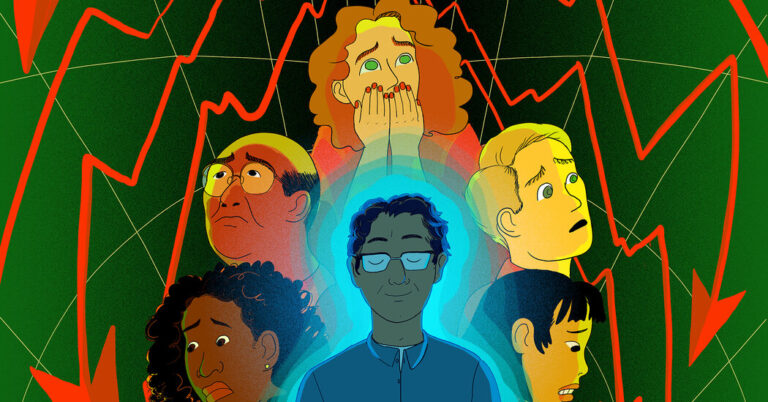
Even before this year’s economic turmoil hit, financial anxiety among Americans was running high. Really high.

Four out of five Americans in a survey for Discover last year said they were worried about their money situation, with inflation, everyday expenses and the state of the economy leading a litany of concerns. Nearly two-thirds said they would be financially unprepared if they lost their job, and more than half felt the same way about a recession.

Now, tariffs and a global trade war, which could raise prices and discourage consumer and corporate spending, have economists raising their odds of such a downturn this year. Coupled with wild swings in the stock market, which is down about 9 percent for the year, it’s no wonder that financial anxiety is spiking to new heights.

“Since Covid, we’ve all just been waiting for the next shoe to drop, moneywise,” said Megan McCoy, a financial therapist and an associate professor of personal financial planning at Kansas State University. “For years now, it’s been one kind of painful financial situation after another. We can’t catch our breath.”

The danger is not just the financial anxiety, which has been linked to higher risk of various health problems, from depression to heart attacks. It’s also that the pressure can drive you to take actions that could ultimately make your financial situation worse.

“The urge people feel to do something to make themselves feel better can be overwhelming,” said Anne Lester, former head of retirement solutions for J.P. Morgan Asset Management and author of the book “Your Best Financial Life.” “But it’s hard to make sound decisions when you’re scared.”

Here are six strategies that experts say will help you keep a cool head and protect your money when anxiety is heating up.

It’s hard not to focus on the most recent hairpin turns of the stock market. In the span of just five trading days this month, the S&P 500 had one of the worst two-day drops on record (10.5 percent) followed by its best one-day climb since 2008 (9.5 percent). Add it up, though, and the index is down 4.4 percent for the month — and April isn’t even half over yet.

But what happens to stock prices in a single week, month or even year won’t matter in the long run to retirement savers, many of whom have decades to go before they stop working, said Brad Klontz, a financial psychologist and author of the book “Start Thinking Rich.” Even retirees often have an investment time frame that could span 20 or 30 years or more.

From that perspective, stocks still look like a smart investment for long-term growth, particularly when paired with fixed-income assets for stability. Over the past 100 years or so, stocks have returned 10 percent annually on average, Dr. Klontz said, handily beating other assets.

And while recessions are painful, he said, they’re a routine part of an economic cycle, happening every few years or so, and the country has always bounced back from them, too.

“What feels in the short term like you’re headed off a cliff is more like a speed bump when you look at it with a long-term perspective,” Dr. Klontz said.

Viewing your 401(k) performance with a different lens is helpful, too, Ms. Lester said.

“We tend to anchor on whatever our highest balance was, so you may be focusing on how much money you’ve lost since then,” she said. “But if you look at your balance from a year ago, you’re probably still up. And compared to five or 10 years ago, you’re likely up even more substantially.”

For some 401(k) investors, the urge to sell stocks as prices tumbled has proved too powerful to resist.

With these savers shifting money from stocks to fixed-income funds, the volume of 401(k) trading during the first quarter of 2025 was the highest in nearly five years, according to Alight Solutions, which tracks workplace retirement plan activity. (The activity involved less than 1 percent of total 401(k) plan balances, but the jump is notable.) The sell-off picked up additional steam after the free-fall in the market on April 3 and 4, with 10 times the usual volume on Monday, April 7, the next trading day — the most transactions in a single day since March 2020.

This shows how easy it is for anxiety to spur action that may not be in your best interest, since those sellers missed out on the surge in stock prices later in the week, which allowed the major indexes to recover a big chunk of the losses incurred so far this year.

“All decisions are bets — we never know if they’re wise or not until time has passed,” said Naomi Win, a clinical psychologist and behavioral analyst with Orion Advisor Solutions, a wealth management tech firm. “Resist the culture of immediacy by learning to pause and be thoughtful and take time on decisions rather than reacting on emotion.”

One way to do this: Impose a rule for yourself that you must wait at least an hour before making a trade; set a timer to hold yourself to it. And seek out advice first from a trusted source — a financial adviser, if you have one, or a knowledgeable friend or colleague with a calm head and experience in up and down markets.

This buys time to reverse the physiological response to acute financial anxiety. When stress rises, Dr. Klontz said, the body’s fight-or-flight response kicks in, enlarging the part of the brain that processes emotions like fear and anxiety (the amygdala) and shutting down the part that helps us evaluate options and make informed choices (the prefrontal cortex).

“It takes a good 30 minutes to an hour to calm down,” Dr. Klontz said. “Then the prefrontal cortex turns back on, and people are left feeling, ‘Why, why did I do that?’”

The pain of losing money is more powerful than the pleasure of making it — a cognitive bias that behavioral finance experts call loss aversion. That’s why constantly checking your 401(k) when the market is falling is a bad idea; seeing your lower balances only makes you feel worse.

It can also increase the likelihood that you’ll lose more money. According to studies from the behavioral economists Shlomo Benartzi and Richard Thaler, investors with long-term goals who rarely check their accounts end up earning significantly higher returns on average than those who monitor more often. Savers who check more frequently will more often see losses, which scares them off investing in stocks, even though stocks, over time, earn substantially more than bonds and cash.

If you check your account daily, for instance, you’re likely to see losses 30 to 40 percent of the time, historical data shows. If you check annually, you might observe a loss only once every three or four years or so. That’s why advisers suggest checking your balances no more than once a quarter and perhaps only once a year.

Try to limit your intake of bad news about the economy and market, too. “We are herd animals, wired to pay close attention to the mood of people around us,” Dr. Klontz said. “If you’re constantly exposed to the panic of others, you’re going to be very vulnerable to doing what everyone else is doing and making bad decisions as a result.”

It may sound counterintuitive, but identifying your biggest fear about your financial situation now, then thinking about how you’d manage the fallout, can be a calming exercise.

“Psychologically, simply knowing there are options reduces anxiety in an otherwise paralyzing situation,” Dr. Win said.

Say, for example, you’re worried about losing your job. The first thing you might do is calculate how long your emergency fund will last, then reach out to professional connections who could help with a job search. If your job hunt lasts a long time and you burn through your savings, what would you do next? Maybe you could move to a cheaper apartment, downsize or even move in with family for a while.

“The worst time to make crisis plans is when you’re in the middle of a crisis, because you’re not thinking as clearly — it’s the reason we do fire drills,” Ms. Lester said. “Hopefully, you’ll never have to pull the trigger on these plans, but it’s helpful to have them, to know what you’d do.”

You cannot control stock prices or whether the economy will tip into a recession. So focus on what you can control, especially actions that could improve your financial situation in a downturn.

Take spending. “If you don’t have enough cash set aside to cover your expenses for three to six months in case you’re laid off, you should be looking aggressively to cut back discretionary spending and get that emergency savings built,” Ms. Lester said. “You may feel like every nickel is already allocated, but for anybody who is getting takeout, traveling or who has more than zero subscription services, you can find places to cut back.”

If you’re worried you might lose your job in a recession, try to make yourself more indispensable by learning a new skill that is in high demand in your field. Or warm up your professional network by connecting with other people in your industry or develop a side hustle for extra income, Dr. Klontz suggested.

Finding other places in your life to assert control that have nothing to do with money can help calm financial anxiety, too — and provide a welcome distraction. Ms. Lester, for example, recently found respite from the market chaos by tidying her home office. Tending your garden, organizing family photos or taking a daily walk are activities that may give you a sense of mastery over your environment when your finances feel outside of your control.

“As soon as you start creating more order, even a little bit of control somewhere, you feel so much better,” Ms. Lester said.

Sometimes compounding the financial anxiety is a sense that you may be partly to blame for your money struggles.

“At times like these, people often see financial failures as personal failures: The market is crashing, and now I’m not going to have enough money because I didn’t make enough or save enough or I didn’t work hard enough or I’m not good enough at managing this stuff,” Dr. McCoy of Kansas State said.

She encourages a gentle reframing: “Tell yourself, ‘I did the best with what I knew at the time.’”

Ms. Lester said she also saw this pattern of self-blame frequently. “Understanding that we are hard-wired to behave certain ways under certain circumstances, and forgiving yourself, is really important,” she said. “Understand that there are many things you can do from this point forward to help yourself financially, take a deep breath, then take that next step.”


Source link

No Phone, No Internet: A First-Time Visit to Casablanca

0


According to my pathetic map, I should have been close to the royal palace. But nothing in Casablanca’s bustling Mers Sultan quarter, where trams rumble past shoe stores and cafes, looked remotely palatial. I tried one street, then the next. Finally, I approached some teenage girls in jeans and head scarves downing Diet Cokes outside a snack bar.

“I’m looking for the palace,” I said in rudimentary French, and pointed to my map. “It says it should be near here.”

One of the girls glanced at the creased sheet of paper, and in a voice laden with teenage contempt, asked, “Don’t you have a phone?”

No, I did not have a phone. Or rather, I did, but I wasn’t using it.

Except for buying my airplane ticket, my plan was to explore Casablanca — a Moroccan city I had never visited — without using the internet. That meant no online research, no GPS, no Ubers or Airbnbs, no virtual dictionary and no mindless scrolling to avoid social awkwardness.

At a time when more and more of us are feeling the need for a digital detox, I am keenly aware of how the internet, for all its benefits, has also changed travel for the worse. Not only does it play a key role in overtourism, but it has also flattened the sense of discovery. By allowing us to peruse restaurant menus, visualize sites and compile must-see lists, the internet tells us what we will experience before we arrive.

I could have used a guidebook, but that seemed contrary to the spirit of the endeavor. After all, my main goal was to see if I might restore the serendipity of exploring — and learn a few retro travel lessons along the way.

After flying into Casablanca’s Mohammed V Airport, my first order of business was to locate a map. I approached a woman seated at what I took to be the information desk. “Of course I have a map,” she replied. “I have a phone.”

She did, however, direct me toward the train to the city center. When I arrived at the airy station, I understood how difficult traveling unplugged here might be. There were no “You are here” signposts, no place to stash my luggage while I got oriented and no clear indications — at least not to this non-Arabic reader — of which direction led to the city center.

Still mapless, I picked a direction and started walking. A palm-lined boulevard seemed like a good bet, and soon I was amid shops and restaurants. Beyond a gate into what I took to be the old medina, I saw a hand-painted sign: “Ryad 91.”

I knew from previous trips to other Moroccan cities that “ryad” or “riad” means “inn.” Soon Mohammed, a tall, bespectacled man, was welcoming me in the cushion-bedecked lobby, and didn’t seem offended when I asked to see the sole remaining room, a bargain at 360 dirhams, or about $37. It was simple and clean, but a little claustrophobic, with a window that opened onto an interior courtyard. I took the room, deciding I would look for something more spacious the next day.

In the meantime, I asked Mohammed for a map. “One minute,” he said, sitting down at his computer and printing one out from Google. About a dozen streets on it bore names; the rest was a tangle of lines.

The good thing about ignorance is that it can turn everything into a discovery. And there was plenty that fascinated me along Casablanca’s winding alleyways: graceful minarets; bakers pulling hot, flat loaves from open-air ovens; the splash of street art, vivid against the whitewashed walls that gave Casablanca its name.

My wanderings began outside the inn’s door. Keeping the harbor to the right, I meandered westward, through the raucous food market, where vendors sold fat walnuts from carts, and leafy squares where men sat at low tables eating fried-fish sandwiches. Walking along bastions built when Portugal ruled the harbor, I saw a massive structure. I asked some boys who were diving into the ocean from a rocky beach what it was. “C’est la plus grande mosquée du monde” was the reply.

Had I really just stumbled across the largest mosque in the world? Alas, my informants were not entirely reliable. The Hassan II Mosque may have one of the world’s largest minarets, but is not itself the biggest. And as the tour buses around the corner proved, it is Casablanca’s chief attraction.

I could see why the boys exaggerated; with a capacity for 25,000 people, the mosque is designed to awe, and not only with its size. Every centimeter is covered in intricate craftsmanship, from plasterwork to mosaics to fretwork. At the accompanying museum, I learned it had taken 12,000 artisans to complete.

My strolls brought more discoveries: downtown streets lined with Art Deco buildings; contemporary Moroccan art at the elegant Villa des Arts; the Abderrahman Slaoui museum, with its Berber jewelry and colonial-era travel posters.

Traveling without expectations also makes you more observant of ordinary life. I loved coming across a man in a square selling coffee from a small pot, and the housewares store where frantic women in djellabas scrambled to get their hands on air fryers that had just gone on sale, some carting off three or four.

Casablanca wasn’t preening for tourists; it was too busy living its own life.

I found my second hotel on a street of bougainvillea-draped villas. The rooms at the Doge (about 2,200 dirham), once a private home, leaned hard into their Jazz Age origins, with velvet-lined walls and at least one Josephine Baker photo. Staying there, amid the inlaid furniture and orange-blossom-scented soaps, I tried not to wonder whether there was even a more exquisite Casablanca hotel I hadn’t found.

Traveling unplugged means letting go of the fear of missing out. The internet can convince us that its best-of lists are objective truths and that any traveler who does not work her way through them has settled for less.

I had to fight a twinge at the Central Market, where dozens of seafood stalls served fresh oysters and fish tagines. How to choose? I settled on Nadia’s because of the local businessmen there. Were the juicy grilled sardines drizzled with pungent chermoula sauce there the best in the market? They were the best I ate.

The same held true for the perfectly spiced chicken shawarma I sampled in the upscale Racine neighborhood, and the delicate gazelle horn pastries at a bakery in the Gauthier quarter — places I had chosen because they were busy with local customers.

But that strategy didn’t work in my quest for a sit-down restaurant serving traditional Moroccan food, since local diners often choose a cuisine different from the one they get at home. So when I walked into Le Cuistot’s tiled dining room, and heard Castilian Spanish, British English and New Jersey accents, I didn’t have high hopes.

But my couscous tfaya was fluffy, the vegetables flavorful, and the caramelized onions and almonds added just the right sweetness and crunch. When Aziz Berrada, the chef and owner, told me his couscous was the best in Casablanca, I believed him.

If so, it was just one of his talents. Before Aziz became a chef, he told me, he had been a photographer for Hassan II, the same monarch who had ordered the construction of the imposing mosque. When that monarch died, Aziz decided it was time for a career change.

My conversation with Aziz — which wouldn’t have happened if I had been buried in my phone while dining — made me eager to see the palace where he had worked. So on my last day, the receptionist at the Doge printed out yet another Google map.

That’s when I got lost. After getting no help from the soda-drinking teenagers, I wandered for blocks, eventually asking directions from an older man who pointed to red flags in the distance: the palace.

Only it wasn’t open to the public. Ever, apparently.

The internet would have revealed this. Yet as I grappled with the realization that I had spent hours to reach those impenetrable walls, I spied a street lined with bookshops. At the very least, I thought, I might find a decent map.

And I did. But the street also led to shops selling handwoven rugs and copper tea sets, a courtyard filled with barrels of olives and a warren of whitewashed alleys that reminded me of Andalusia even before I came across a tiny museum of Andalusian instruments.

The Habous neighborhood almost looked like a stage set of Morocco, which is fitting, since it was designed by the French in the 1920s and ’30s.

I learned this from a woman who introduced herself as Imane, when I stopped for mint tea at the Imperial Café. She was seated near me, and appeared to be either a celebrity or the mayor, so frequent were the salutations from passers-by. I asked if I could talk with her about the neighborhood.

“Of course, sweetheart,” she said in perfect English. “I love Americans. You’re so spontaneous.”

Imane suggested we move our conversation to a nearby location that she promised I would adore. I overcame my skepticism, figuring I might get some local recommendations.

As we walked, Imane’s rapid-fire monologue left little room to ask about her favorite restaurants. But I learned that she had once lived in the United States, selling real estate, working for a jewelry company and driving an Uber.

Finally we arrived at a set of walls only marginally less imposing than the palace’s. The guard ushered us through a carved door into a gorgeous building, with walls of green and blue geometric tiles and intricate plasterwork, and courtyards dotted with orange trees. I still had no idea where I was (later I learned it was a former courthouse and residence for the pasha, and is now used for cultural events). And I was mystified by the staff, including a stern-faced bureaucrat and a cleaning woman who greeted Imane effusively.

Who was Imane? A politician? A movie star?

Finally, it dawned on me. “Are you an influencer?” I asked.

“I don’t like labels,” she replied.

I never did learn Imane’s favorite restaurants. But she told me of her mission to spread the message that we are all connected. Eventually, she pulled out her phone to broadcast us, live, as we chatted.

I had come all this way without my phone. I had gotten lost and found my way, discovered monuments and tiny jewels. I had developed a sense of the city as a place that still existed primarily for its residents, not its visitors.

And there I was on someone else’s live social media feed.


Follow New York Times Travel on Instagram and sign up for our Travel Dispatch newsletter to get expert tips on traveling smarter and inspiration for your next vacation. Dreaming up a future getaway or just armchair traveling? Check out our 52 Places to Go in 2025.


Source link

Tax Tips for Those Who Haven’t Filed Their 2024 Returns

0


If you qualify, you can make tax-deductible contributions to an individual retirement account or a health savings account by the April 15 tax deadline and have them apply to tax year 2024, said Eva Simpson, vice president of member value, tax and advisory services with the American Institute of Certified Public Accountants.

You can contribute up to $7,000 to a traditional I.R.A. for 2024 and an extra $1,000 if you’re 50 or older, the I.R.S. says. The size of your deduction depends on several factors, such as your filing status and whether you or your spouse, if you are married, is covered by a retirement plan at work.

Contributions to H.S.A.s are also tax-deductible, if you have a specific type of health insurance plan with a high deductible. If you’re eligible, you can contribute up to $4,150 (including any employer contributions) for 2024 if you have individual coverage, plus an extra $1,000 if you’re 55 or older, by the filing deadline.

There’s no federal tax deduction for contributing to 529 college savings plans, but some states offer deductions or credits on your state taxes. Most of them require the contributions to be made by the end of the calendar year to qualify, but eight (Georgia, Indiana, Iowa, Kansas, Mississippi, Oklahoma, South Carolina and Wisconsin) let you make contributions up until the tax deadline and get a tax break for the prior year, according to the website Saving for College.

You can get an extension until Oct. 15 by filing Form 4868 by the April deadline.

But note: An extension gives you more time to file, but it doesn’t give you extra time to pay if you owe tax, Ms. DiMaggio said. You should estimate what you owe and send a payment with your extension form. Otherwise, you may face penalties on the balance due for paying late — 0.5 percent of the tax owed for each month the bill remains unpaid, up to a total of 25 percent. That can add up. If you owed $10,000, your penalty would be $50 a month, until the total reached $2,500.


Source link