Home Blog Page 385

Trump Signals New Tariffs on Chips, Calling Exclusions Temporary

0


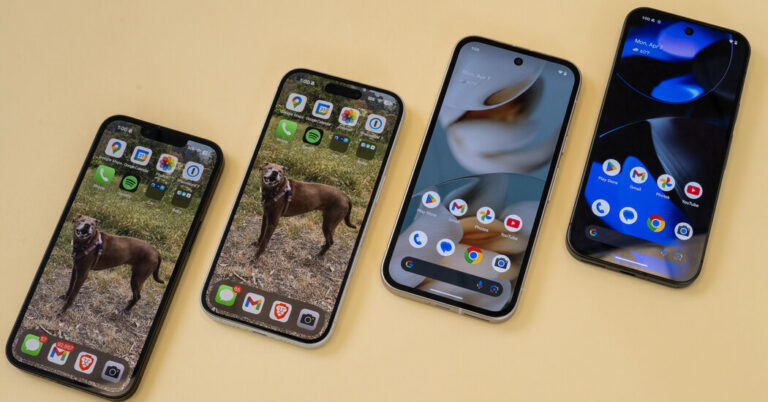
President Trump signaled on Sunday that he would pursue new tariffs on the powerful computer chips inside smartphones and other technologies, just two days after his administration excluded a variety of electronics from the steep import taxes recently applied on goods arriving from China.

The push came as Mr. Trump’s top economic advisers scrambled to explain their shifting strategy, after having insisted for weeks that they would shield no company or industry from any of the fees they have levied in a bid to reset U.S. trade relationships.

The reprieve for technology companies arrived in the form of a Customs and Border Protection rule issued late Friday that spared high-tech imports from Mr. Trump’s so-called reciprocal tariffs, including those on China. While the president paused a set of punishing levies on nearly 60 countries last week, his administration has forged ahead with a new 145 percent tax on Chinese exports, announcing it after Beijing retaliated against the United States.

The exclusions in the C.B.P. rule covered a wide slate of products, such as computers, smartphones, modems and flash drives, and it represented a major victory for Apple, and other U.S. technology giants, which rely on Chinese factories to help manufacture important components and popular devices. Apple executives had even been in contact with Trump administration officials about the Chinese tariffs in recent days, according to two people with knowledge of the company’s efforts. The company declined to comment.

But on Sunday, Mr. Trump and his top aides cast the exemptions in a different light, framing them as only a temporary break while the government prepares more targeted import taxes on key technologies. The administration is expected to take the first step toward enacting the new tariffs as soon as next week, opening an investigation to determine the effects of semiconductor imports on national security.

The approach appears to mirror the process that yielded Mr. Trump’s tariffs on other specific products and sectors, including the high fees he imposed on foreign cars and auto parts this year. On social media, the president signaled Sunday that the scope of his next inquiry would be broad, “taking a look at Semiconductors and the WHOLE ELECTRONICS SUPPLY CHAIN in the upcoming National Security Tariff Investigations.”

“NOBODY is getting ‘off the hook’ for the unfair Trade Balances, and Non Monetary Tariff Barriers, that other Countries have used against us, especially not China which, by far, treats us the worst!” Mr. Trump added.

Howard Lutnick, the commerce secretary, said earlier Sunday on ABC’s “This Week” that Mr. Trump could announce new tariffs “in the next month or two” that would target not only semiconductors but also pharmaceutical imports, another priority for the administration.

Kevin Hassett, the director of the White House National Economic Council, told CNN’s “State of the Union” that it was “always the case” that some of these high-tech imports would be subject to their own tariffs, separate from those broadly imposed on countries in response to their trade practices.

“Semiconductors are a key important part of a lot of defense equipment,” Mr. Hassett added, saying, “I don’t think anything really should be a surprise.”

And Jamieson Greer, the U.S. trade representative, described the move on CBS’s “Face the Nation” as more of a mechanical change, saying of semiconductors that it is “not that they won’t be subject to tariffs” but that they are being done under a “different regime.”

The Trump administration had already excluded various types of semiconductors from the reciprocal tariffs as of April 2. But the chaotic changes in tariffs and exclusions in recent days bewildered businesses that depend on trade with China. Some investors and chief executives publicly praised the decision to walk back tariffs on electronics, which represent roughly a quarter of U.S. imports from China.

“A willingness to adjust a strategy based on new facts and data is a sign of the strength of a leader,” Bill Ackman, the chief executive of the hedge fund Pershing Square, wrote on social media. “It is not an indication of weakness.”

Still, there appears to be no quick end to the trade conflict with China in sight. And the potential for new tariffs on chips threatened to cast another pall over the tech industry, even as major lobbying groups representing Intel, Nvidia and other companies have encouraged the Trump administration to strike trade deals that ultimately lower trade barriers globally.

Asked about the possibility of upcoming tariffs on chips on Saturday, Mr. Trump said, “I’ll give you that answer on Monday.”

“We’ll be very specific,” he added. “But we’re taking in a lot of money. As a country we’re taking in a lot of money.”

Dan Ives, an analyst for Wedbush Securities, said in a note to investors on Sunday that “the mass confusion created by this constant news flow out of the White House is dizzying for the industry and investors and creating massive uncertainty and chaos for companies trying to plan their supply chain, inventory and demand.”

Ultimately, new taxes on chip imports could make it more expensive for U.S. companies to produce smartphones and other devices, cutting into their profits or forcing them to raise prices on American consumers. For Apple, in particular, the tit for tat between the United States and China caused the tech giant to lose more than $770 billion in market capitalization in just the opening days of Mr. Trump’s trade war.

Since then, the two nations have continued to retaliate against each other, causing financial markets around the world to whipsaw in the face of a persistent and costly standoff. U.S. consumers even appeared to rush out to purchase new iPhones last week, anticipating that a protracted trade conflict could push up prices.

Source link

What Antitrust ‘Reformers’ Got Wrong

0


Lina Khan and her allies tried to remake antitrust law. Trump’s team is likely putting an end to that.


Source link

Stocks Notch Gains After More Tariff Whiplash

0


Markets in Asia moved higher on Monday after a weekend that brought more shifts in strategy from President Trump about tariffs.

Stocks in Japan rose a little over 1 percent while benchmarks went up 2 percent in Hong Kong and less than 1 percent in mainland China.

S&P 500 stock futures, which let investors bet on how the index might perform when it opens in New York, were about 0.50 percent higher.

The modest rally followed another chaotic week on Wall Street, with the S&P 500 starting with losses but ending with its best weekly performance since November 2022. The gains were driven by Mr. Trump’s announcement on Wednesday that he would pause for 90 days the “reciprocal” tariffs he had imposed on dozens of countries just a week earlier.

On Friday night, after Mr. Trump had repeatedly said he would spare no industry, U.S. customs officials exempted a host of technology products imported from China. That means smartphones, semiconductors, computers and other equipment would not face most of the 145 percent tariffs Mr. Trump has imposed on China.

The carve outs were viewed as a win for Apple and other American tech giants because tech products and components are a key part of American imports from China. A spokesperson for China’s Ministry of Commerce on Sunday called it a “small step” in “correcting” the tariffs Mr. Trump has put on China.

But on Sunday, President Trump signaled that the exemption would be temporary and that he would pursue new tariffs on semiconductors and other technologies.

Financial markets around the world have whipsawed in recent weeks because of the chaotic rollout of tariffs, which Mr. Trump believes will spur domestic manufacturing. America’s trading partners have scrambled to respond to the extraordinary array of tariffs Mr. Trump has announced, including a 10 percent tax on virtually all U.S. imports. Consumer confidence in the United States has plunged to levels not seen in years.

Some analysts and business leaders have warned that Mr. Trump’s tariffs have already begun weighing on the economy.

“Even a quick tariff resolution with key partners leaves the economy under pressure from structurally higher trade costs and consumer spending headwinds,” Citibank’s equity analysts wrote in a research note on Sunday.

Investors and analysts have also become concerned about sharp swings in the U.S. government bond market, known as the Treasury market.

The 10-year Treasury yield, which is one of the most important interest rates in the world, underpinning debt markets around the world, rose to roughly 4.5 percent on Friday, from less than 4 percent the week before.

Such a sharp rise in yield, which corresponds to a sharp drop in price, is unusual, and signaled a broad shift away from U.S. markets, with the U.S. dollar falling in tandem.

The market swings, propelled by major policy shifts from the White House, have left some in the market feeling paralyzed. Consumers and business leaders have reported feeling similarly stuck, uncertain about the future.

“Right now, we can say with a straight face that the world may look vastly different in a year or two’s time than any other environment we have lived through,” said Henry Peabody, a strategist at Riverhead Research. He added that equities would need to fall further to offer “a margin of safety” before he would recommend buying into the market again. Until then, he said, “It’s hurry up and wait.”


Source link

How Do the iPhone 16E and Google Pixel 9A Compare to More Expensive Models?

0


With all the talk about tariffs driving up costs, the word “cheaper” should bring comfort to just about anyone. That’s why I’m delighted to share that the cheaper smartphone from Google has arrived, a few months after Apple released a somewhat cheaper entry-level iPhone — and that both products are very good.

Google this week released the Pixel 9a, the $500 sibling of its $800 flagship smartphone, the Pixel 9. It competes directly with the $600 iPhone 16e released in February, the cheaper version of Apple’s $800 iPhone 16.

Both of the new phones have the staples that people care most about — great cameras, nice screens, zippy speeds, modern software and long battery life. To cut costs, they omit some fancier extras, like advanced camera features.

Is it a wise idea to save some bucks, or better to spend more on the fancier phones? To find out, I strapped on a fanny pack and carried all four phones with me for the last week to run tests.

The upshot: As is often the case, you get what you pay for. The $800 phones are slightly better in terms of features and performance than the cheaper versions, and the $600 iPhone is faster and has a better camera than the $500 Pixel.

But more important, the cheaper Pixel and iPhone were nearly indistinguishable from their $800 counterparts in several of my tests. In some cases, like battery life, the cheaper phones were even better.

The future of phone prices remains uncertain, but costs will probably go up. On Wednesday, when President Trump announced a pause on most “reciprocal” tariffs, he raised tariffs on China, where many phones are manufactured. So plenty of us may soon be motivated to compromise and consider less expensive alternatives.

Apple declined to comment on whether it would increase prices of its iPhones, but analysts estimate that tariffs could drive up the cost of some iPhone 16 Pro models to anywhere from $1,300 to $2,300. Google said there were no planned changes to the $500 price for the Pixel 9a, but it declined to comment on whether it would amend the price of its $800 Pixel 9.

The cheaper iPhone and Pixel look nearly identical to their more expensive siblings. Here’s a rundown of how they compare:

  • The screens on the phones are the same size. (The iPhones measure 6.1 diagonal inches, and the Pixels measure 6.3 diagonal inches). The iPhone 16e’s screen is slightly dimmer than the iPhone 16’s, but the difference is hardly noticeable.

  • Both cheaper phones lack some camera features found on the more expensive versions. The Pixel 9a’s camera sensor is smaller than the Pixel 9’s, meaning it will capture less detail and light. The iPhone 16e’s camera has one camera lens instead of two, so it can’t create certain types of special effects, such as “ultrawide” photos with a broader field of view for scenic shots of the Grand Canyon.

  • Both less expensive phones are slightly less powerful than their nicer counterparts. All four phones include the same computer processors. But the Pixel 9a has less memory for running multiple apps at the same time, and the iPhone 16e has a slightly weaker graphics processing unit for running games with heavy animation.

  • The iPhone 16e lacks the iPhone 16’s MagSafe feature, which uses a magnet to attach accessories such as power chargers and wallets to the back of the phone. The phone can still be charged wirelessly, however, using a slower charging standard called Qi.

  • Both phones can take advantage of artificial intelligence. The iPhone 16e can use Apple Intelligence to summarize text, generate images and remove photo bombers from pictures. And the Pixel 9a can run Google’s A.I., including the Gemini chatbot and similar photo editing tools. But both companies are still developing their A.I. software, which remains largely unfinished, so this feature may not be that important to most phone users.

Long battery life is high on the priority list for people buying a new phone, and the cheaper Pixel 9a and iPhone 16e are the clear winners here. They have larger batteries partly because they have more space for them, since the phones lack some features found in their more-expensive counterparts.

The iPhone 16e and Pixel 9a lasted about a day and a half with general use, including web browsing, photo shooting and video playing, before their batteries were depleted. The iPhone 16 and Pixel 9 both lasted about a day.

The downsides of buying cheaper phones were most pronounced in their cameras.

I took my corgi, Max, to a park to take photos of him in various lighting conditions, including bright daylight, in the shade and in partly shaded areas. In general, photos taken with both the Pixel 9a and Pixel 9 looked consistently clear, with accurate colors.

But the Pixel 9a’s weaknesses were visible in more challenging lighting conditions, such as when Max sat on a shaded path with sunlight filtering through the trees. The Pixel 9a struggled to distinguish the light from the shade, and Max looked blown out by the sun. (The Pixel 9 did fine in this situation.)

When I tested the iPhone 16e and iPhone 16 cameras, they excelled in all these tests, and the results were nearly indistinguishable.

Both iPhones outperformed the Pixel phones in shooting videos. Videos recorded of Max strolling through the park were clearer and smoother on the iPhones; the Pixel phones’ videos looked choppier.

So the main downside of the cheaper iPhone camera is simply what it can’t do. Because the iPhone 16e lacks a second lens, I wasn’t able to take an ultrawide shot of Max running in a field of grass.

The more expensive phones slightly outperformed the cheaper phones in terms of speed.

According to the speed-testing app Geekbench, the Pixel 9a is about 4 percent slower than the Pixel 9, and the iPhone 16e is 3 percent slower than the iPhone 16.

In real-world use of the phones, most people probably won’t notice a difference. When I put the phones side by side and launched different apps and games, their performance felt about the same to me.

If you care mostly about having a smartphone with long battery life and a good camera, you’d be happy with either the iPhone 16e or Pixel 9a. But if you care a lot about any of the premium features missing from the cheaper phones, such as taking more detailed, better-looking photos or using Apple’s MagSafe to charge your iPhone, then spending more is still a fine idea.

Just get ready to think of a smartphone as a longer-term investment, similar to a car, since prices are likely to go up soon.


Source link

With the Worst U.S. Stock Market In Years, Try Some Old-Fashioned Investments

0


The mood has darkened in the U.S. stock market, and no wonder. Pessimism about the Trump tariffs has set off painful declines.

But the picture has been less dire for people with investments outside the U.S. stock market. Holding plenty of bonds and including stakes in international stock markets were keys to stability and, maybe, even modestly positive returns in the first three months of the year. While there is no guarantee that this approach will work as well in the future, it has held its own over many years and is, I think, a sound strategy for most people.

Just look at what we’ve recently experienced. The quarterly numbers from Morningstar, a financial markets research firm, show that old-fashioned diversified investments like those favored in retirement accounts posted much better returns than the big-name tech stocks, like Tesla and Nvidia, that had buoyed the U.S. stock market over much of the previous couple of years. Tesla, whose chief executive, Elon Musk, has become a lightning rod for critics of the Trump administration, lost more than 35 percent in the three months that ended on Monday. Nvidia, a star of the artificial intelligence boom, lost nearly 19 percent.

There were gains in the first quarter in many markets in Europe, Latin America and Asia, though stocks in those regions have joined in worldwide market declines lately, as the potential for grave global damage from tariffs has sunk in.

Pessimism in the markets is often a contrarian signal — an indication that it’s time for traders to start buying because, at least in comparison with prices before a market fall, bargains are out there. Certainly, sentiment about the U.S. stock market has worsened, both among rank-and-file investors and among people who view themselves as market experts.

But timing the market on this or any other basis is hazardous. While it’s possible that the latest declines will turn out to be a market bottom, stocks may still have a long way to fall, especially if President Trump’s tariff policy leads to a protracted trade war and a domestic recession. The chances of bad outcomes have increased appreciably in the eyes of erstwhile market and economic bulls.

But for truly diversified, long-term investors, market timing is usually a mistake. I’m always invested in global stocks and bonds, and intend to keep buying regardless of the latest news on tariffs.

Mr. Trump imposed his latest series of tariffs on Wednesday, which he called Liberation Day. The enormous size of these tariffs, levied on a wide range of countries simply because they have run trade surpluses with the United States, startled the markets.

Depending on how the tariffs are carried out and whether they stand, the effective U.S. tariff rate could rise from 18 percent, according to a Goldman Sachs estimate, to around 24 percent, according to Capital Economics. That would be the highest level in 125 years. Recall that a rush around the world to raise tariffs in the 1930s made the Great Depression much worse.

The president says tariffs will help rebuild the U.S. manufacturing base and level the playing field for trade worldwide. In addition, he says tariffs will raise substantial revenue — which could allow him and his Republican supporters to cut taxes without unduly increasing the budget deficit.

My colleagues are reporting on the overall toll of the Trump tariffs, and I won’t duplicate that effort here. But in general terms, economists overwhelmingly say the net effect of tariffs is destructive, both for the United States and for many other countries, including its allies and neighbors.

The University of Chicago regularly surveys more than 80 eminent economists on important issues. In September, it asked them to respond to this statement: “Imposing tariffs results in a substantial portion of the tariffs being borne by consumers of the country that enacts the tariffs, through price increases.” Economists tend to have many different opinions, but the degree of consensus on this issue was startling: 95 percent said they “strongly agree” or “agree,” and 2 percent were “uncertain.” Only 2 percent disagreed.

The few dissenters are well represented in the Trump administration.

The higher the effective tariffs turn out to be, the greater the odds that the economy will slow and, perhaps, fall into a recession, many economists say. Recessions usually mean layoffs, wage freezes, households in distress and shriveling stock portfolios.

So of course there’s gloom in the markets. With global alliances fraying and trade conflicts erupting, is this a good time to buy stocks — or is it smarter to prepare for much bigger trouble ahead? Part of the answer will depend on Mr. Trump.

I’m hedging my bets, as I indicated in last week’s column — with a well-diversified portfolio containing low-cost index funds that track just about all tradable global stock and bond markets. That kind of portfolio did rather well in the last quarter, at least compared with domestic stock funds.

Here are some of the average numbers for the quarter, reported by Morningstar:

  • Taxable bond funds: Up 1.9 percent.

  • Municipal bond funds: Down 0.2 percent.

  • International stock funds: Up 4.7 percent.

  • Diversified asset allocation funds with 30 to 50 percent stock and most of the remainder in bonds: Up 1 percent.

And here’s how target-date retirement funds, of various vintages, did on average. Those with longer maturities tend to hold more stocks, which hindered performance this year.

  • 2025 funds, which contain large dollops of bonds: Up 1.2 percent.

  • 2030 funds, with a little bit less in bonds: Up 0.7 percent.

  • 2060 funds, which mainly hold stock: Down 0.8 percent.

Diversification reduced portfolio risk in the last quarter, though diversified strategies don’t produce the best returns.

Nvidia over the last 20 years returned an annual average of 37.8 percent. And in the first quarter, stock funds that were focused on Latin America returned an average 12.1 percent, while precious-metal funds, fueled by rising gold prices, rose 32.8 percent.

Diversified portfolios can never match the absolute best returns in any given period. But they have other virtues.

The past doesn’t predict the future, and we don’t know what will produce eye-popping returns in the years ahead. Are you willing to take the risk that you will place your bet on the wrong horse? Betting may be fun for an afternoon at the track, but it seems foolhardy for the money I’ll need down the road. So I expect to continue with the boring but effective approach that most academic research suggests is wise — broad investments in cheap index funds, divided among different categories of assets.

Hold Treasury bills or money market funds for cash that you need soon. You can get more than 4 percent on those short-term holdings now. I find that if I have enough stashed away in an easy-to-liquidate form, I am calmer, knowing that I can ride out a stock market downturn without touching the core of my portfolio.

Safeguarding your money is even more critical for people who are already in retirement or approaching the end of a regular working paycheck. High-quality bonds, taxable or municipal, depending on your own situation, are likely to be far more dependable than stocks — even dividend-paying stocks — if you need to rely on your investments for day-to-day living.

But despite their shortcomings, which are all too obvious in the middle of big market declines, stocks over the long run have been able to earn inflation-beating returns. Bonds and cash holdings won’t do that. That’s why diversified stock investments make sense for people with decades ahead of them.

These are difficult decisions, and they are especially challenging when the markets are rocky and government policies may be contrary to your own best interests.

Caution is more important than risk-taking for many people now. So check your returns, correct your course if need be and then hang on for a turbulent ride.


Source link

UK Laws Are Not ‘Fit for Social Media Age,’ Says Report Into Summer Riots

0


British laws restricting what the police can say about criminal cases are “not fit for the social media age,” a government committee said in a report released Monday in Britain that highlighted how unchecked misinformation stoked riots last summer.

Violent disorder, fueled by the far right, affected several towns and cities for days after a teenager killed three girls on July 29 at a Taylor Swift-themed dance class in Southport, England. In the hours after the stabbings, false claims that the attacker was an undocumented Muslim immigrant spread rapidly online.

In a report looking into the riots, a parliamentary committee said a lack of information from the authorities after the attack “created a vacuum where misinformation was able to grow.” The report blamed decades-old British laws, aimed at preventing jury bias, that stopped the police from correcting false claims.

By the time the police announced the suspect was British-born, those false claims had reached millions.

The Home Affairs Committee, which brings together lawmakers from across the political spectrum, published its report after questioning police chiefs, government officials and emergency workers over four months of hearings.

Axel Rudakubana, who was sentenced to life in prison for the attack, was born and raised in Britain by a Christian family from Rwanda. A judge later found there was no evidence he was driven by a single political or religious ideology, but was obsessed with violence.

Karen Bradley, the Conservative Party lawmaker who leads the Home Affairs Committee, said “bad-faith actors” exploited the attack. But she added that a lack of accurate information allowed lies to proliferate.

“By failing to disclose information to the public,” she said, “false claims filled the gap and flourished online, further undermining confidence in the police and public authorities.”

The committee’s report pinpointed two false claims that were shared on X. One, posted about two hours after the attack, claimed the suspect was a “Muslim immigrant.” It received more than 3.8 million views.

The second, posted about five hours afterward, falsely suggested the suspect was an asylum seeker named “Ali-Al-Shakati” who was on an “MI6 watch list.” The post received about 27 million views on X within a day. Merseyside Police, the local force investigating the attack, did not announce that the name was wrong until midday July 30.

Hours later, the first riot broke out in Southport. The disorder continued in multiple towns and cities, and many protests targeted mosques and hotels housing asylum seekers. Two buildings were set on fire while people were inside. More than 300 police officers were injured during the riots, and the response cost the police an estimated 28 million pounds, or about $36 million, the report said.

It added that Merseyside Police “were put in a very difficult position” because they were legally barred from disclosing the suspect’s identity and received “inconsistent advice” from prosecutors about whether they could confirm he was not Muslim.

The committee’s report acknowledged that it was impossible to determine “whether the disorder could have been prevented had more information been published.”

But it concluded that the lack of information after the stabbing “created a vacuum where misinformation was able to grow, further undermining public confidence,” and that the law on contempt was not “fit for the social media age.”

In Britain, a law bans the naming of suspects under 18 unless a judge makes an exception. Mr. Rudakubana was 17 at the time of the attack. Another law, designed to protect the right to a fair trial, bans the publication of information that could influence a jury. That rule, part of the 1981 Contempt of Court Act, is lifted once a defendant is found guilty or innocent.

Serena Kennedy, Merseyside’s chief constable, told the committee that the police disclosed on the evening of July 29 that the attacker had been born in Wales, but misinformation had already proliferated.

Ms. Kennedy said she had planned to make an announcement two days later clarifying that Mr. Rudakubana was not Muslim and that his parents were Christian. After notifying the Crown Prosecution Service, the body that brings criminal charges in England, an official told her the information should not be made public, she said.

“This case highlights why we need to look at how we handle releases of information to the public, while also making sure that we do not impact on the criminal justice trial,” Ms. Kennedy said, adding that contempt laws did not “take account of where we are in terms of the impact of social media.”

In a statement, the Crown Prosecution Service said that although an official expressed “different views” on the disclosure of Mr. Rudakubana’s religion, they did not tell the police it would bias a jury.

The statement added, “We support proposals for law reform which will make the application of contempt law clearer and simpler — especially when linked to heightened matters of general public interest such as public safety or national security.”

Since the Southport attack, the Law Commission of England and Wales has been conducting a review of the Contempt of Court Act.


Source link

Explosion in Austin Damages 24 Houses and Injures 6 People

0


A home in Austin, Texas, was leveled and at least 23 others were damaged on Sunday in an explosion of unknown causes that could be heard for miles and left six people injured, the authorities said.

The explosion happened just after 11 a.m. local time in a northwest section of Austin, according to the Austin Fire Department.

The cause of the explosion was under investigation. The authorities said there was no signs of criminal activity in connection with the explosion.

“We believe this is certainly an isolated incident,” said Division Chief Wayne Parrish of the Austin Fire Department.

He said there was no gas service to the residence but it did have propane tanks. A representative for Texas Gas Service said that crews responded on Sunday morning and “confirmed the home did not have natural gas service.”

A two-story house where the explosion happened collapsed and a neighboring home partially collapsed, the authorities said.

Two occupants of the home where the explosion occurred were taken to a hospital. One of them was in critical condition and the other was in serious condition, Capt. Shannon Koesterer of the Austin-Travis County Emergency Medical Services Department told reporters at a news conference.

An occupant in a neighboring home that was damaged was in critical condition, Captain Koesterer said. Another person had minor injuries, and two firefighters also had minor injuries, the captain added.

The authorities said they had accounted for all of the people who were in the affected residences at the time of the blast.

Officials said that garage doors and windows nearby were blown out and a car at the residence where the explosion happened caught fire. Power was out in the surrounding area because of damage from the explosion, the authorities said.

The blast could be heard as far away as Georgetown, Texas, which is about 30 miles north, Chief Parrish said.

The Police Department in Cedar Park, which is about 20 miles away, said on social media that it was aware of the “loud boom that was heard and felt throughout the city.”

Several agencies responded to the scene, including Austin-Travis County E.M.S., the Austin Police Department, the Travis County Sheriff’s Office and the F.B.I., Chief Parrish said. The Travis County fire marshal will lead the investigation, he said.

Alexandra E. Petri contributed reporting.


Source link

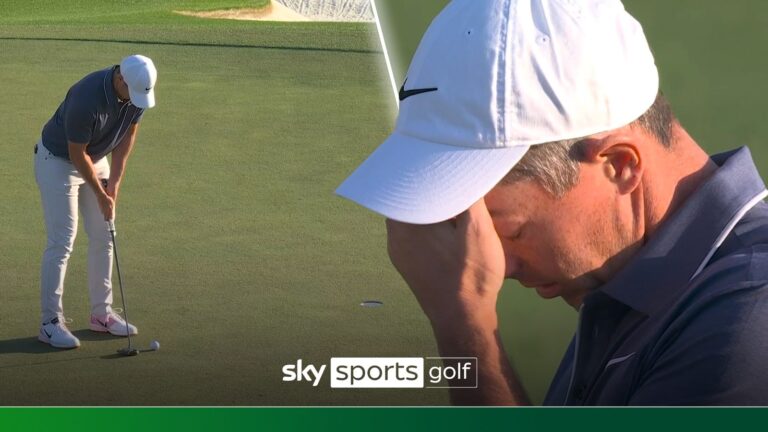
McIlroy bogeys 72nd hole at Masters to drop in to play-off with Rose!

0


Rory McIlroy bogeyed the 72nd hole of The Masters after finding the bunker with his second shot to drop in to a play-off against Justin Rose.


Source link

Bernie Sanders Attacks Trump’s Policies During Surprise Coachella Appearance

0


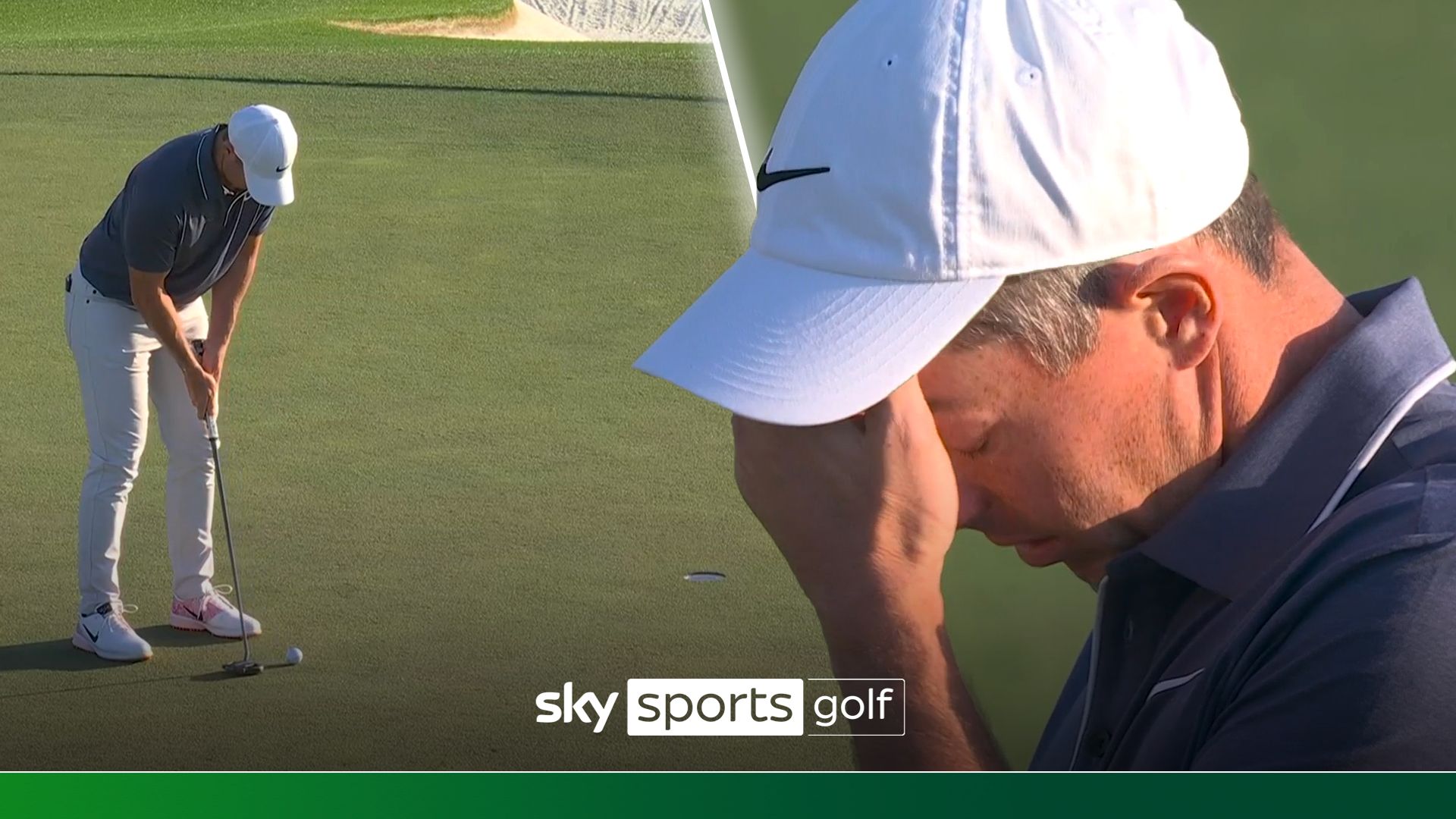
Senator Bernie Sanders of Vermont, one of the country’s leading progressives, delivered an impromptu speech onstage at the Coachella music festival in California on Saturday night in which he implored young people to oppose President Trump’s policies.

Mr. Sanders, who had spoken earlier in the evening at a packed rally in downtown Los Angeles as part of a Western tour, made his comments before introducing the singer-songwriter Clairo.

“This country faces some very difficult challenges, and the future of what happens to America is dependent upon your generation,” Mr. Sanders, 83, said during his brief address, which received cheers from the crowd. “We need you to stand up to fight for justice, to fight for economic justice, social justice and racial justice.”

When Mr. Sanders mentioned the president of the United States, the audience booed, and the senator said, “I agree.”

Mr. Sanders highlighted economic inequality, universal healthcare, threats to abortion rights and climate change as issues demanding action. He said he had come to Coachella to thank Clairo for her activism, and applauded her for speaking up for women’s rights in Gaza, noting that thousands of women and children have been killed in the war.

Mr. Sanders, an independent, sought the Democratic presidential nomination in 2016, losing to Hillary Clinton. He ran again four years later and was the last major Democratic primary rival to Joseph R. Biden Jr., who won the 2020 presidential election.

The senator’s appearance at the Coachella Valley Music and Arts Festival is consistent with his popularity among young progressives who admire him as an uncompromising and outspoken firebrand.


Source link

‘He Finally Shot the Hostage’: Trump’s Trade War Is a Brutal Reality Check

0


Trump imposing new tariffs on top of broader policy uncertainty will mean a hit to growth. The question is how large of a hit it will ultimately be.


Source link