Home Blog Page 386

Neutrinos Are Shrinking, and That’s a Good Thing for Physics

0


On Thursday, researchers unveiled the most precise measurement yet of a neutrino, scaling down the maximum possible mass of the ghostly specks of matter that permeate our universe.

The result, published in the journal Science, does not define the exact mass of a neutrino, just its upper limit. But the finding helps bring physicists closer to figuring out just what is wrong with the so-called Standard Model, their best — albeit incomplete — theory of the laws that rule the subatomic realm. One way physicists know it is not quite accurate is that it suggests that the neutrino should not have any mass at all.

At grander scales, learning more about neutrinos will help cosmologists fill in their ever hazy picture of the universe, including how galaxies clustered together and what influences the expansion of the cosmos since the Big Bang.

“We’re looking at trying to understand why we are here,” said John Wilkerson, a physicist at the University of North Carolina, Chapel Hill and an author of the new study. “And that’s something neutrinos may have a key role in.”

Physicists know a few things about neutrinos. They are prolific across the cosmos, created virtually anytime atomic nuclei snap together or rip apart. But they carry no electric charge and are notoriously difficult to detect.

Neutrinos also come in three types, which physicists describe as flavors. And, oddly, they morph from one flavor to another as they move through space and time, a discovery recognized by the Nobel Prize in Physics in 2015. The underlying mechanism that makes these transformations possible, physicists realized, meant that neutrinos must have some mass.

But only just so. Neutrinos are mindboggingly light, and physicists don’t know why.

Uncovering the exact values of the mass of neutrinos could lead to “some kind of portal” to new physics, said Alexey Lokhov, a scientist at the Karlsruhe Institute of Technology in Germany. “This is, for now, the world’s best limit,” he said of his team’s measurement.

Dr. Lokhov and his colleagues used the Karlsruhe Tritium Neutrino, or KATRIN, experiment to narrow down the mass of a neutrino. At one end of the 230-foot-long apparatus was a source of tritium, a heavier version of hydrogen with two neutrons in its nucleus. Because tritium is unstable, it decays into helium: One neutron converts into a proton, which spits out an electron in the process. It also spits out an antineutrino, the antimatter twin of a neutrino. The two should have identical mass.

The mass of the original tritium is split among the products of the decay: the helium, electron and antineutrino. Neither neutrinos nor antineutrinos can be directly detected, but a sensor at the other end of the experiment recorded 36 million electrons, over 259 days, shed by the decaying tritium. By measuring the energy of the electron’s motion, they could indirectly deduce the maximum mass possible for the antineutrino.

They found that value to be no more than 0.45 electronvolts, in the units of mass used by particle physicists, a million times lighter than an electron.

The upper bound on the mass was measured for only one flavor of neutrino. But Dr. Wilkerson said that nailing down the mass of one makes it possible to calculate the rest.

The latest measurement pushes the possible mass of the neutrino lower than the previous limit set in 2022 by the KATRIN collaboration, of no more than 0.8 electronvolts. It is also nearly twice as precise.

Elise Novitski, a physicist at the University of Washington who was not involved in the work, commended the KATRIN team’s careful effort.

“It’s really just a tour de force,” she said of the experiment and the discovery. “I have full confidence in their result.”

The KATRIN team is working on an even tighter boundary on the neutrino mass from 1,000 days of data, which it expects to collect by the end of the year. That will give the physicists even more electrons to measure, leading to a more precise measurement.

Other experiments will also contribute to a better understanding of the neutrino’s mass, including Project 8 in Seattle and the Deep Underground Neutrino Experiment, spread across two physics facilities in the Midwest.

Astronomers studying the structure of the cosmos at large, thought to be influenced by the vast collection of neutrinos flooding the universe, have their own measurement of the particles’ maximum mass. But according to Dr. Wilkerson, the boundaries set by astronomers staring out into the void don’t match up with what particle physicists calculate in the lab, as they scrutinize the subatomic world.

“There’s something really interesting going on,” he said. “And the likely solution to that is going to be physics beyond the Standard Model.”


Source link

How to Protect Your Retirement Savings Now as Markets Plunge

0


“Inflation is a low drip, like boiling a frog: The impact kind of creeps up on you, but when it hits, it doesn’t feel good,” Mr. Haynes said.

Don’t fool yourself into thinking you can bail out of stocks now, then jump back in when the market stabilizes. Gains historically have come in unpredictable spurts, and the biggest advances often come within days of the worst declines. If you missed the 10 best days over the 20 years from 2005 to 2024, you would have reduced your returns by more than 40 percent, according to J.P. Morgan; if you missed 30 of the best days out of the roughly 5,000 trading days during that period, you’d have lost money, after inflation.

Reducing your spending, even temporarily, will also help your money last.

If you’re still working, every dollar you don’t spend is one you can direct toward saving, to be better prepared if a recession or bear market hits. And if you’re already retired, every dollar you don’t spend is one dollar fewer you need to pull from savings when stock prices may be down.

Look at your discretionary spending and see where you can make a few strategic cuts. “If you budgeted $5,000 or $10,000 for travel, maybe this isn’t the time for a big trip, or if you’re gifting to the kids or grandchildren, pull back a bit,” said Lazetta Rainey Braxton, a financial planner and founder of the Real Wealth Coterie in New Haven, Conn.

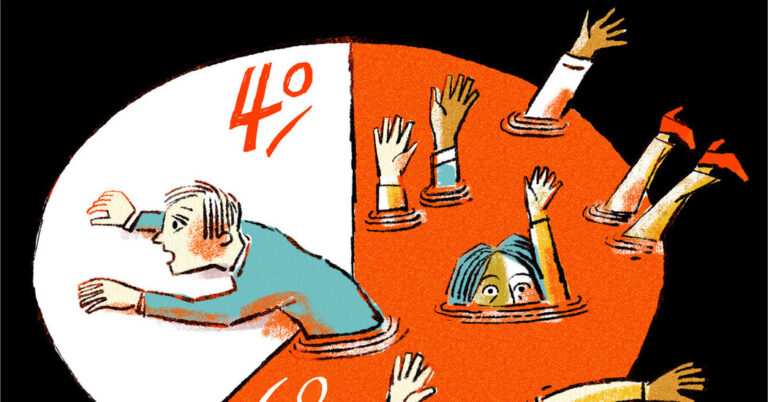
Or take a more systematic approach. Instead of following the standard guidance to keep withdrawals to 4 percent of the balance in your retirement account, then adjust annually for inflation, you might forgo the inflation raise when stock prices are falling, Dr. Pfau said. Or you can install so-called guardrails, limiting withdrawals to, say, 3 percent in bad years for stocks but taking out, perhaps, 5 percent when the market is surging.


Source link

As Ukraine’s Politics Heat Back Up, a Former President Sees an Opening

0


On the first day of Russia’s all-out invasion, President Volodymyr Zelensky of Ukraine and his main political opponent at home shook hands, setting aside their ferocious rivalry to focus on the enemy. The country’s typically raucous politics went largely dormant for the three years that followed.

Now, as peace talks led by the Trump administration have stirred prospects for a cease-fire and eventual elections, the political jockeying has returned.

Ukrainian politicians are maneuvering at home and reaching out behind the scenes to the Trump administration, which has made no secret of its disdain for Mr. Zelensky, despite his lionization on the world stage for standing up to Russia.

Petro O. Poroshenko, a former Ukrainian president and the leader of a rival party, says that the best way to smooth the peace talks is to bring opposition figures into the government.

Mr. Poroshenko had earlier floated the idea of overhauling Ukraine’s politics to form a national unity government, which could benefit his party. He revived the proposal after Mr. Zelensky’s contentious Oval Office meeting with President Trump in February and a call by a Republican senator for him to step down.

Mr. Zelensky has shown no interest in forming a coalition of ministers that would include opposition figures. Instead, his government has ratcheted up pressure on opponents by law enforcement and security agencies.

The mayor of Kyiv, Vitali Klitschko, has said Mr. Zelensky abused martial law powers to overrule the city council. In January, Ukraine’s national security council froze Mr. Poroshenko’s bank accounts while leveling no specific accusations.

“We don’t have any other option other than a coalition of national unity, a government of national unity,” Mr. Poroshenko said in an interview on Wednesday. “We should have unity in the Parliament and demonstrate unity in the country. And the results of this decision should be a stop to the war.”

Mr. Zelensky’s five-year term, which was set to expire last year, was extended under martial law. Elections are legally banned under martial law and impractical as long as Ukraine remains at war.

Nearly a month ago, Ukraine offered a monthlong, unconditional cease-fire that Russia has not accepted. A Trump administration envoy, Steve Witkoff, traveled to Russia on Friday, possibly in an effort to rekindle negotiations.

Mr. Poroshenko said that the talks could get a boost if Mr. Zelensky allowed political opponents to enter the government, given that Mr. Trump has called Mr. Zelensky a “dictator without elections.” That echoed criticism by the Russian president, Vladimir V. Putin, who has said he will not sign a peace settlement with Mr. Zelensky.

Mr. Poroshenko said he disagreed with Mr. Trump’s assessment of Mr. Zelensky as a dictator.

But with the prospect of a cease-fire and elections, Mr. Poroshenko has taken to more openly criticizing the president. The sanctions that the national security council placed on Mr. Poroshenko froze his bank accounts and could exclude him from future elections.

Mr. Poroshenko called the sanctions against him “disastrous, unconstitutional and extrajudicial.” If he were arrested, he said, he would then say that Ukraine is on a path to dictatorship.

The intense rivalry between the two Ukrainian leaders goes back years. Mr. Poroshenko led Ukraine from 2014 to 2019. After Mr. Zelensky soundly defeated him, the new government then questioned Mr. Poroshenko as a witness in a flurry of criminal cases that Mr. Poroshenko called politically motivated.

Even as tanks massed at the border before Russia invaded in 2022, the infighting continued in Ukraine: Prosecutors sought an arrest warrant for Mr. Poroshenko, though it was declined by a judge.

Mr. Poroshenko has a base of support in Ukrainian nationalist politics, particularly in western and central Ukraine, while Mr. Zelensky in the 2019 race won broad support across the country, including from Russian speakers in central and eastern Ukraine.

The two men met on the morning of Feb. 24, 2022, when Russia began its onslaught, to set aside their rivalry. Mr. Zelensky asked what he could do for Mr. Poroshenko. The former president said that he asked for 5,000 Kalashnikovs to arm his supporters against the Russians, and that Mr. Zelensky had provided the guns.

Mr. Poroshenko, 59, has little chance of winning a presidential election, polls show. He has consistently been in third place or lower, behind Mr. Zelensky and a former army commander, Gen. Valery Zaluzhny.

Political analysts say that Mr. Poroshenko may be angling for an electoral alliance with General Zaluzhny, who is serving as ambassador to Britain and is wildly popular in Ukraine. He has remained mostly silent about politics.

In the interview, Mr. Poroshenko said he had met with Mr. Zaluzhny in London, but he declined to disclose details of their talks. An aide to Mr. Poroshenko said he had accepted an autographed copy of the general’s biography, “Iron General.”

As Mr. Zelensky has negotiated with the Trump administration, Mr. Poroshenko has offered advice through intermediaries, he said.

“Trump can ask unexpected questions, I can say even impolite,” Mr. Poroshenko said.

At one meeting during the first Trump administration, Mr. Poroshenko said, Mr. Trump asked if he could get an honest answer to a question. Mr. Poroshenko said yes. Mr. Trump then leaned closer and asked, “‘Tell me, is Crimea Russian?’”

Mr. Poroshenko said he answered that Crimea, the peninsula that Russia seized in 2014, was Ukrainian, and asked what prompted the question. Mr. Trump then said that a Russian friend had told him that the peninsula should be Russian, Mr. Poroshenko said.

Mr. Poroshenko pursued a transactional foreign policy with the United States that partly paid off. That included purchases of coal from Pennsylvania that preserved some jobs in a swing state, even though Ukraine has abundant coal of its own.

Before the end of Mr. Trump’s first term, the administration offered a formal statement, known as the Crimea Declaration, that asserted as a matter of U.S. policy that Crimea was Ukrainian.

“He’s not easy,” Mr. Poroshenko said of Mr. Trump. “But now is the time of diplomacy.”


Source link

Rubio Says 10 More People Have Been Expelled to El Salvador

0


Secretary of State Marco Rubio said on Sunday that the United States had sent 10 members of two gangs — MS-13, which originated in the United States and operates in South America, and Tren de Aragua, rooted in Venezuela — to El Salvador late Saturday.

Mr. Rubio added in a social media post that “the alliance” between President Trump and President Nayib Bukele of El Salvador had “become an example for security and prosperity in our hemisphere.”

The Trump administration has sent hundreds of Venezuelans to a notorious prison in El Salvador at the invitation of Mr. Bukele, who is positioning himself as a crucial regional ally to Mr. Trump and is scheduled to meet with the president in Washington on Monday.

The administration has portrayed those deportees as violent criminals or terrorists, but court papers have shown that the evidence on which the government acted was often little more than whether they had tattoos or had worn clothing associated with the criminal organization.

Mr. Bukele has become Latin America’s most popular leader for his takedown of gangs, even as he has suspended civil liberties and been accused by U.S. prosecutors of secretly negotiating with the same gangs.

A spokeswoman for Mr. Bukele, Wendy Ramos, did not immediately respond to a request for information on the 10 deportees Mr. Rubio referred to.

In early February, Mr. Rubio announced a possible deal with Mr. Bukele, under which the Salvadoran government would hold convicted criminals in its prison system, for a fee. The administration began sending groups of detainees to El Salvador in mid-March, and has so far sent at least five flights carrying Venezuelan and Salvadoran deportees to El Salvador.

The Salvadoran government has released videos and photos showing deportees being removed from planes and marched into a prison outside the capital, San Salvador, called the Terrorism Confinement Center, or CECOT.

Some of the men have been removed from the United States under the Alien Enemies Act, a wartime power dating to 1798, while others were removed under regular U.S. immigration law and had final deportation orders, according to the administration.

The Supreme Court ruled last week that the Trump administration could continue to deport Venezuelan migrants using the Alien Enemies Act for now, overturning a lower court that had put a temporary stop to those deportations.

The decision represented a victory for the administration, though the ruling did not address the constitutionality of using the Alien Enemies Act to send the migrants to a prison in El Salvador. The justices instead issued a narrow procedural ruling, saying that the migrants’ lawyers had filed their lawsuit in the wrong court.

In a separate case, the Supreme Court ordered the administration on Thursday to take steps to return a Salvadoran man, Kilmar Armando Abrego Garcia, who was legally in the United States but was sent to the prison in El Salvador in March as a result of what officials said was an administrative error. But the administration has defied an order by the federal judge handling Mr. Abrego Garcia’s case to provide a written road map of its plans to free him, and in a hearing on Friday, repeatedly stonewalled the judge’s efforts to get the most basic information about him.

On Saturday, a State Department official, Michael Kozak, told the Maryland judge in Mr. Abrego Garcia’s case that the detainee was “alive and secure” and that, according to the U.S. Embassy in San Salvador, he was in being held in CECOT. The embassy has not responded to requests for information from The New York Times.

Following the Supreme Court’s order on Thursday, President Trump said that he would follow the directions of the court if it ordered him to “bring somebody back,” though the court’s ruling indicated that the judiciary might not have the power to require the executive branch to do so.

On Saturday, Mr. Trump wrote of the deportees on Truth Social: “These barbarians are now in the sole custody of El Salvador, a proud and sovereign Nation. And their future is up to President B and his Government.”

President Bukele, who posted a photo on social media that day indicating that he was on his way to Washington, has largely remained silent on Mr. Abrego Garcia’s case.

Eric Schmitt reported from Washington and Annie Correal from Panama City.


Source link

Palin v. New York Times Heads Back to Trial

0


Sarah Palin’s yearslong defamation case against The New York Times, potentially testing the extent of First Amendment protections for journalists, will soon go to trial in federal court in Manhattan.

Again.

Three years ago, a federal jury and judge each ruled against Ms. Palin, the onetime Republican vice-presidential nominee and Alaska governor. She had claimed that an editorial that The Times published in 2017 had defamed her by wrongly suggesting that an ad from her political action committee had inspired a mass shooting.

But Ms. Palin successfully appealed the verdict, and a retrial was ordered. It is scheduled to begin on Monday.

Much of the trial is expected to be a repeat of the first. Most of the witnesses, evidence and legal arguments will be the same, including The Times’s defense that its mistakes were inadvertent and did not harm Ms. Palin. The same federal judge, Jed S. Rakoff, will be presiding in the same courtroom in the Daniel Patrick Moynihan United States Courthouse in Lower Manhattan.

What has changed is the country. Trust in the media has declined, and the Manhattan jury pool may have shifted to the right. A number of defamation lawsuits in the past three years have resulted in eye-popping payments, raising the stakes in the Palin case. And the retrial comes as President Trump and his administration have attacked the notion of an independent press, deploying litigation, investigations and other strong-arm tactics against news organizations.

If Ms. Palin prevails, Mr. Trump and his allies will almost certainly promote the victory as a powerful rebuke of the press. Her lawyers have said they hope to use the case as a vehicle to get the Supreme Court to reconsider longstanding precedents that make it harder for public figures to win lawsuits against journalists and others.

“The case is, in many respects, an old-school media libel action resurrected into a newly complicated defamation landscape,” said RonNell Andersen Jones, a law professor at the University of Utah. “It may prove to be a real barometer of the changing public attitude about the press and the changing appetite for American press freedom.”

A representative for Ms. Palin declined to comment. A New York Times spokesman, Charlie Stadtlander, said in a statement: “We’re confident we will prevail and intend to vigorously defend the case.”

The editorial at the center of the suit condemned violent political rhetoric and action after an anti-Trump leftist opened fire on Republican lawmakers at a baseball field in June 2017.

The editorial mentioned a shooting that had taken place six years earlier in Arizona. A mentally ill gunman had killed six people at an event for the Democratic congresswoman Gabrielle Giffords. Before that shooting, Ms. Palin’s political action committee had circulated a map with cross hairs over numerous Democratic congressional districts, including Ms. Giffords’s. The Times editorial incorrectly suggested that the map had incited the shooting.

The Times swiftly corrected and apologized for the editorial. About two weeks later, Ms. Palin sued, claiming her reputation had been damaged. Thus began an eight-year (and counting) legal odyssey.

To win defamation lawsuits, public figures like Ms. Palin need to prove that publishers acted with “actual malice,” meaning they knew that what they were writing was false or exhibited reckless disregard for a statement’s accuracy. The Supreme Court created that standard in a landmark 1964 decision in New York Times v. Sullivan. It is that precedent that Ms. Palin’s lawyers, as well as Mr. Trump and some other conservatives, are eager to challenge at the Supreme Court.

Ms. Palin’s lawsuit asserted that The Times had every reason to know that she was not connected to the 2011 shooting but disregarded that because of the outlet’s liberal bias against Ms. Palin. The Times argued that the errors were honest mistakes under tight deadline pressure, precisely the type of miscues that are protected under the actual malice standard. Judge Rakoff agreed and dismissed the lawsuit.

But in 2019 a federal appeals court in New York concluded that the judge had reached his decision improperly.

The trial took place three years later. In addition to Ms. Palin, the other key witness was James Bennet, who in 2017 was the head of The Times editorial page and had inserted the inaccurate language. On the stand, he claimed that he had not meant to imply in the editorial that the cross hairs map had directly incited the 2011 shooting.

Mr. Bennet, who is a defendant in the lawsuit and the brother of a Democratic senator, had previously been the editor of The Atlantic. Ms. Palin’s side wanted to tell jurors that while he was running the magazine, it had published pieces debunking the links between the map and the shooting — evidence, Ms. Palin’s camp argued, that he had acted with reckless disregard for the truth six years later. Judge Rakoff excluded that evidence from the trial.

After a 10-day trial, jurors deliberated for about five hours before announcing their verdict: The Times was not liable for defaming Ms. Palin.

Problems soon emerged. While the jurors were deliberating, Judge Rakoff announced that he planned to throw out the lawsuit, regardless of the jury’s verdict. Some jurors later said they saw alerts from news outlets about the judge’s announcement.

Ms. Palin appealed the verdict, citing the exclusion of The Atlantic articles and Judge Rakoff’s announcement, among other things. Last year, the same federal appeals court again ruled for Ms. Palin and ordered a new trial. The court did, however, reject Ms. Palin’s request to reconsider the Supreme Court’s actual malice standard.

After that decision, lawyers for both sides briefly discussed the possibility of settling the lawsuit, according to three people familiar with the negotiations. But the talks stalled when The Times made clear that it would not pay Ms. Palin, the people said.

In recent weeks, lawyers for Ms. Palin and The Times have been jostling in court over which evidence and arguments will be permissible. Ms. Palin wants to tell jurors about Mr. Bennet’s resignation from The Times in 2020, after the publication of an editorial by Senator Tom Cotton that The Times later said fell short of its standards. The Times has asked Judge Rakoff to exclude the evidence, saying it is irrelevant and could prejudice jurors.


Source link

Nintendo Switch Game Console Release Is Whipsawed by Tariff Threats

0


For months, Nintendo, the maker of famed video game series like Super Mario Bros. and Donkey Kong, had expected the morning of April 2 to be a celebration.

To much fanfare, the company announced the price and release date for the Switch 2, its new video game console eight years in the making. At an event in New York City, Doug Bowser, Nintendo of America’s president, took the stage as fans cheered the arrival of new games to accompany the console; Mario Kart, Donkey Kong and Kirby among them.

Then, later that same day, President Trump announced tariffs that sent global stock markets reeling and put the Mario party in jeopardy. The new Switch was made in Vietnam, one of the countries on the tariff list.

Two days later, Nintendo said it was delaying pre-orders for the Switch 2 and possibly raising the price from $450. Just how high was unclear. But on Wednesday, Mr. Trump said he was delaying expanded tariffs on Vietnam and many other countries for 90 days. Nintendo has yet to say how the delay will affect the Switch 2’s price.

Nintendo’s whipsaw experience shows the broader chaos Mr. Trump’s on-and-off tariffs have caused for technology manufacturers, and the uncertainty of what the market will look like for consumer technology in the coming months.

In a statement before Mr. Trump delayed his expanded tariffs on countries other than China, Nintendo said it still planned to release the Switch 2 in June, but it did not set a date for when it would reopen pre-orders or announce a new price.

Gamers had already taken to social media sites like X and Reddit by the thousands to complain. While it’s a common practice in the industry for gamers to blame the high cost of consoles and games on corporate greed, they turned instead to blaming Mr. Trump.

Jake Steinberg, a gamer and a writer from Philadelphia, visited New York last week to play a demo of the Switch 2. Now he’s unsure how much added cost he would be willing to take on.

“There’s an extreme amount of irony, because people always said this refrain, ‘Keep politics out of games,’” Mr. Steinberg said. “Well, here they are.”

For years, Nintendo manufactured its gaming consoles in China. But it moved most of its production to Vietnam in 2019, during Mr. Trump’s first term, to sidestep tariffs and the threat of a trade war between China and the United States.

Those maneuvers appeared to be for nothing as Mr. Trump’s plans announced last week threatened hefty new tariffs on goods from Vietnam (46 percent), Japan (24 percent), Malaysia (24 percent) and Cambodia (49 percent), leaving manufacturers in the region with few options.

But because of the delay announced Wednesday, Nintendo may be one of the lucky ones. A majority of consumer electronics, including smartphones and other gaming consoles, are still made in China. And they are expected to be subject to 145 percent tariffs — bigger than just a few days ago. Products made in Vietnam, like most countries, are still being hit with a 10 percent tariff.

The delay gives Nintendo 90 days to increase production and stock up on inventory in the United States, said Michael Pachter, an analyst at Wedbush Securities. But for other tech companies like Apple, which typically doesn’t start producing new iPhones until months before the release date, that may not be an option.

Nintendo could still end up playing the delicate game of deciding how much it can raise the price without turning away gamers — many of whom already felt $450 was steep enough — or holding out hope that it won’t in the end be hit by the expanded tariffs.

For gaming companies like Nintendo, Sony and Microsoft, selling consoles is only one aspect of their business: If customers choose not to buy a new console, they also won’t be able to purchase the software for the games themselves, which sell at higher margins than hardware.

While the cost of consumer tech products could rise across the board, Mr. Pachter added, price increases on buzzy items that people wait years for — like the Switch 2, the first console released by Nintendo since 2017 — are most likely to create consumer outrage. He estimated that the new cost of the Switch 2 could be increased by as much as $100 if the Trump administration went ahead with the tariffs.

“People aren’t going to notice if the price of TVs go up, because no one’s waiting for June 5th to buy their TV,” Mr. Pachter said. “They’ll notice that gradually. But it’s different for a product launch like this.”

In interviews with the news media before Mr. Trump’s tariffs were announced, Mr. Bowser of Nintendo said the expected cost of future tariffs was not factored into the console’s $450 price. But analysts largely dispute that claim, pointing to the $340 price of the Switch 2 being sold in Japan. (A Nintendo spokesman said the Japanese model is restricted to the Japanese language, which is partly why it has a lower cost.)

Nintendo will probably wait for the dust to settle on Mr. Trump’s tariff chaos before announcing a new price, said Doug Creutz, an analyst at Cowen, an investment firm. And, he added, there was still a possibility that Mr. Trump would back out of the tariffs altogether.

“They don’t want to have to change their price a second time,” Mr. Creutz said. Among the decisions he said that the company is weighing: “Are we willing to take less profit in the U.S.? Do we want to protect our profit margin?”

Nintendo has not delayed pre-orders for the Switch 2 elsewhere in the world, where the cost varies by region; $442 in Britain, $435 in Australia, $450 in Canada. Nintendo still does around 30 percent of its manufacturing in China, which it uses to supply non-U.S. buyers, said David Gibson, an analyst at MST Financial.

What will help offset some of the cost, in the short term, is that by the end of February, Nintendo had already shipped 746,000 units of the Switch 2 to the United States, which are immune to the tariffs if they are reinstated, Mr. Gibson said.

“That will protect them for one quarter,” he added. “But after that, the price will be full tariff.”

Nintendo is not the only tech company weighing the trade-offs of raising prices on its products. Apple similarly moved some of its manufacturing to Vietnam from China in 2019. Other console makers like Sony and Microsoft will face a similar dilemma when they manufacture their next consoles, which are expected to be released sometime around 2027.

“It’s going to hit all the large consumer electronics companies: Samsung, LG, Apple, the big TV manufacturers, the game consoles,” Mr. Gibson said. “It’s everything.”


Source link

Scott Bessent, the Treasury Secretary, Needs Better Data on Your Retirement

0


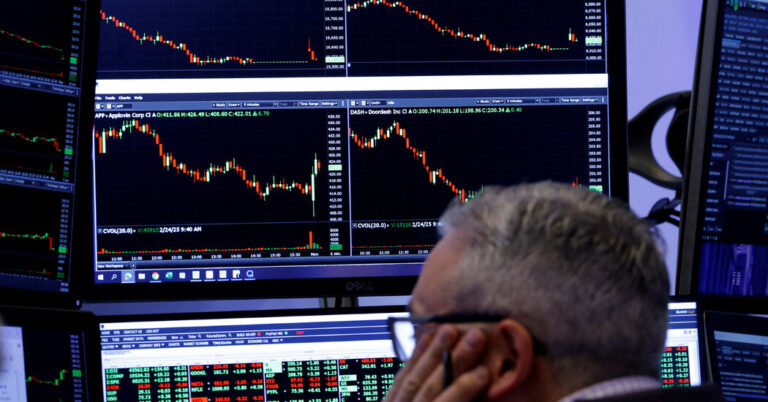
Trump administration officials made the rounds this weekend to try to answer the nearly unanswerable: Why tank the stock market by starting a trade war? And are you subtracting trillions of dollars in unrealized losses out of people’s savings on purpose?

Treasury Secretary Scott Bessent’s appearance on NBC’s “Meet the Press” was particularly odd.

“Most Americans in a 401(k) have what’s called a 60/40 account,” he said, without explaining what he was talking about. These accounts, he added, “are down 5, 6 percent on the year.”

Most Americans in a 401(k) do not have a 60/40 account. By saying so, Mr. Bessent understates the risk in people’s portfolios, the fear they feel and how being frightened can affect their retirement security if they sell while scared.

Let’s take this apart a bit.

A 60/40 fund, for most people in workplace retirement accounts, is a mutual fund that contains 60 percent stocks and 40 percent bonds or other investments that tend not to be as volatile as stocks. Often, funds like these have a target date for a year close to when a person intends to retire.

That 60 percent in stocks may not be all U.S. equities, which is important because many markets outside the United States have done much better this year. And Mr. Bessent is right that these funds are doing better than the overall U.S. stock market this year, which is down around 13 percent.

But while many 401(k) investors do put money in funds with a mix of asset types, this is not the correct way to take the temperature of the nation’s retirement investments.

According to data on millions of 401(k) plan participants collected by the Employee Benefit Research Institute and the Investment Company Institute, 68 percent of participants put money in target-date funds as of the end 2022. But only a small fraction of those funds maintain a 60/40 balance like those that Mr. Bessent mentioned, since each fund on offer at any given employer has a different stock allocation. The stock percentage ratchets down over time to decrease risk as you approach retirement, so younger people are likely to have much more than 60 percent stocks in any given target-date fund.

According to the Investment Company Institute, just 41 percent of 401(k) balances (the actual dollars at stake) were in hybrid funds like target-date ones at the end of last year. And at the end of 2022, 71 percent of all 401(k) assets were in stocks.

The Treasury Department did not respond to a request for comment.

Mr. Bessent is in his 60s and wealthy, and when you write or talk about personal finance, it’s easy to fall into the trap of anchoring to your own stage and place in life.

Most employers are good about nudging investors into balanced funds, but plenty of people lack that assistance because they don’t have a workplace retirement plan. Instead, they’re on their own, either because their employer has no savings vehicle or because they work for themselves. Mr. Bessent now has access to a federal employee workplace retirement plan that is one of the best such plans in existence, and it’s chockablock with low-cost target-date funds.

And while Mr. Bessent may himself have only 60 percent of his money in stocks, younger, less experienced 401(k) investors in their 20s and 30s had close to 90 percent of their investments in stocks at the end of 2022.

That kind of sky-high stock exposure means more volatility at a time like this. More volatility raises the possibility of getting frightened and selling all your stocks, particularly if you don’t have 40 years of experience watching your retirement account balance spike and plunge. And fear-based selling could mean missing out on future gains if you don’t start buying stocks again at the right moment.

Also, big stock market declines can scare young people away from investing in the first place. Not starting early costs people a lot of money over time, since you miss out on the opportunity to let your portfolio ride over decades.

Those 60/40 funds turn out to be a very good thing. My colleague Jeff Sommer regularly points to the merits of a balanced approach to investing. Most of us should allocate our retirement savings this way.

But when Mr. Bessent make those funds into some kind of supposedly reassuring touchstone, it ignores the sheer terror of a moment like this and the real pain of stock market declines.


Source link

U.S. Nuclear Talks With Iran Move Forward

0


The first meeting between the United States and Iran over its expanding nuclear program on Saturday displayed a seriousness of purpose and an effort to avoid what neither side wants, another war in the Middle East. They will talk again next Saturday, but the hard work lies ahead, as hard-liners in both countries, and Israel, are expected to balk at most any deal.

If the first nuclear deal, reached in 2015, was prompted by Iran’s desire to rid itself of punishing economic sanctions, these talks have more urgency. Iran, battered by Israel and with its regional proxies diminished, still wants economic relief. But it also understands that the Islamic Republic itself is under threat and that President Trump, who pulled out of the first deal because he thought it was too weak, may not be bluffing about Iran’s facing “bombing the likes of which they’ve never seen before.”

And Iran’s supreme leader, Ayatollah Ali Khamenei, has given his negotiators at least one last chance to trade Iran’s nuclear ambitions for lasting security.

The talks in Oman also promised some efficiency. The 2015 deal was struck between Iran and six countries — the five permanent members of the United Nations Security Council plus Germany, with the European Union playing the role of intermediary — and took two years.

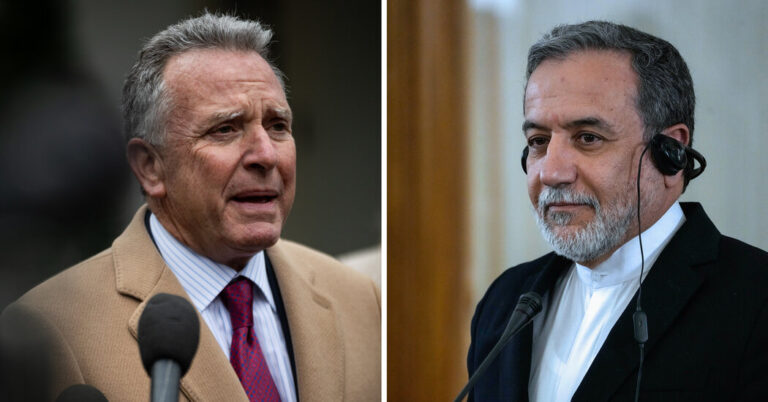
This time the talks are bilateral, with the Europeans but also Russia and China on the sidelines. And although the United States remains “the Great Satan” for Ayatollah Khamenei, it also holds the key to restraining Israel and securing any lasting settlement. While Iran insisted on indirect talks through Oman, and Mr. Trump on direct talks, the two sides managed to fudge the issue, with Mr. Trump’s special envoy, Steve Witkoff, talking directly to Iran’s foreign minister, Abbas Araghchi, as the meeting ended.

“This is as good a start as it gets,” said Ali Vaez, Iran project director for the International Crisis Group. “They could have stumbled, but they agreed to meet again, they met together at the end and they agreed on the ultimate objective.”

Importantly, Mr. Trump and Mr. Witkoff indicated that their real bottom line is ensuring that Iran can never build a nuclear weapon — despite harsh demands from Trump officials before the talks that Iran dismantle its nuclear program entirely as well as abandon its missile program and its support for its regional proxies.

Iran had made it clear that such broad demands would leave it defenseless and would end the talks before they began. So limiting the goal to ensuring that Iran can never build a nuclear bomb, if the administration sticks with that, would sharply enhance the talks’ chance of success.

“The Iranians came prepared for more than an icebreaker, but with the expectation to break the logjam with the U.S., and most important, to hear directly what is the real U.S. bottom line,” said Vali Nasr, a professor at the Johns Hopkins School of Advanced International Studies. “If it’s no weapon, then they can negotiate on levels of enrichment, inspections and so on. But Iran does not want to get into a situation where it cannot deliver and risk more sanctions and war,” he said. “What Iran wants is pretty clear: credible sanction relief and a deal that sticks.”

Iran insists that its nuclear program is solely civilian, but it has enriched enough uranium close to weapons-grade quality to make at least six bombs, according to data from the International Atomic Energy Agency, which implements the Nuclear Nonproliferation Treaty that Iran has signed.

Despite their mistrust of Mr. Trump, the Iranians think he would be better able to guarantee the sustainability of a deal that he makes and face down his own Republican hard-liners, Mr. Nasr said. The Iranians never trusted President Joseph R. Biden Jr. “to follow through and avoid being undermined by Congress,” he said.

“We’re in the best place we could be after this meeting,” said Sanam Vakil, director of the Middle East and North Africa Program at Chatham House. There were positive statements from both sides around a plan to move forward, she said, and “a mutual understanding about the urgency required, the opportunity presented and signs of pragmatism from both sides.”

The she added, “Of course, the hard stuff lies ahead.”

A serious deal will be enormously complicated and technical, and it will take time. It would also need to survive efforts to undermine the talks by hard-liners in both countries and in Israel. Israel, which opposed the 2015 deal, wants a more comprehensive disarmament of Iran and keeps talking about the need to strike it militarily now, when the regime is weak and its air defenses have been badly compromised by Israeli airstrikes.

Iran has in the past vowed to destroy Israel, and Prime Minister Benjamin Netanyahu of Israel says he wants Iran to no longer be able to enrich any uranium at all. Israel, citing the Hamas attack in Gaza, has badly damaged Iranian proxies, including Hamas and Hezbollah in Lebanon, and wants to try to ensure that Iran cannot rebuild them.

But Iran may also be encouraged that Mr. Trump announced the talks in the Oval Office next to Mr. Netanyahu, who did not look or sound very pleased about them. Iran will see “a powerful signal from Trump that he’s not owned by Netanyahu,” Mr. Nasr said.

The hope is that a next meeting or two can produce an interim agreement that gives both sides confidence to move forward, with short-term measures from both sides so long as the talks continue. They could include Iran’s agreeing to freeze uranium enrichment and allow more inspections in return for Washington’s suspending some of its “maximum pressure” sanctions.

Iran is likely to insist on a step-by-step process that could take several years, Mr. Nasr said, “to help the deal grow roots before someone else comes into office and tried to undo it.” A longer process would also provide more security for Iran.

Still, Iran has no reason to stretch out the talks themselves. “Iran’s leverage is its nuclear enrichment, and more time won’t give them more leverage,” Mr. Vaez said. And then there is “the ticking time bomb of the snapback sanctions.”

Those sanctions, suspended under the 2015 deal, can be restored if any signatory — in this case, the Europeans — decides that there is no new deal or significant progress toward one. But that must happen before Oct. 18, when the ability to “snap back” expires. Officials say that the Europeans are exploring whether that deadline can be delayed, but the mechanism to do that is unclear.

In any case, the analysts agree, Iran does not want to be blamed for the failure of these talks. If they do fail and war ensues, the regime wants to be able to blame American perfidy and bad faith.

So if a deal can be done, Iran will want guarantees this time that it will be durable and deliver commercial engagement in a meaningful and long-term way, Ms. Vakil said. Iran will want to know “how Trump can guarantee protection that other presidents have been unable to do.”

And the United States, she said, will want to know what guarantees Iran can provide for the security of Israel and the stability of the larger Middle East.

“A deal must be mutually beneficial, but it requires a lot of trust and accountability along the way that both sides simply don’t have right now,” she said.


Source link

Josh Shapiro and Family Evacuated From Pennsylvania Governor’s Residence After Arson Attack

0


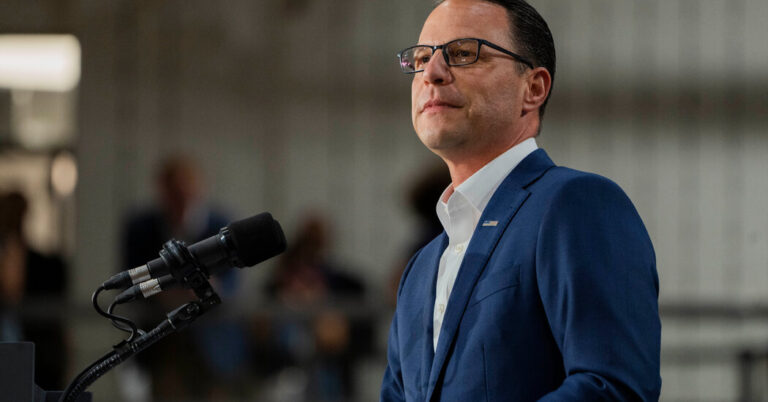
The governor of Pennsylvania, Josh Shapiro, said he and his family were evacuated from their home early on Sunday after an arson attack that significantly damaged a section of the governor’s official residence.

Mr. Shapiro, a Democrat, said on social media that the Pennsylvania State Police woke his family by banging on the door around 2 a.m. to warn them of the fire. He said no one was injured.

The State Police and the Pennsylvania Capitol Police evacuated his family while firefighters extinguished the fire, the governor said.

“Every day, we stand with the law enforcement and first responders who run towards danger to protect our communities,” the governor said. “Last night, they did so for our family — and Lori and I are eternally grateful to them for keeping us safe.”

The State Police said in a statement that the fire caused “a significant amount of damage to a portion of the residence.”

The police did not identify a suspect and said an investigation was underway.

Hours before the fire, Mr. Shapiro wrote on social media that he and his family were marking Passover, which began at sunset on Saturday.

Images posted on social media showed firefighters battling the fire. A portion of the mansion was obscured in dark smoke, and some windows were shattered.

Mr. Shapiro, a Democrat, gained national prominence last year when he was on the short list of possible running mates for Vice President Kamala Harris on the Democratic presidential ticket. She eventually chose Gov. Tim Walz of Minnesota.

Mr. Shapiro’s nearly two decades in public office includes six years as the state’s attorney general. He was elected governor in 2022.

The governor’s residence is a 29,000-square-foot Georgian-style home on the Susquehanna River, according to the state government. Its landscaped grounds occupy a full block about a mile and a half from the State Capitol complex. Eight governors have lived there with their families since it was completed in 1968.

The public is able to tour the residence, which exhibits art and artifacts on the first floor.

A renovation of the property was completed in 2022 to make it more accessible to people with mobility issues and more environmentally friendly, The Patriot-News reported.

This is a developing story. Check back for updates.


Source link

Masters fashion: Stretching the concept of quiet luxury underneath a giant oak tree

0


Follow live coverage of the final round of the 2025 Masters

AUGUSTA, Ga. — The Masters will never be cheugy.

It may be a crime of fashion to be overdone, outdated or, gasp, dressed in millenial-core for 51 weeks a year. But for this week, at Augusta National Golf Club during the Masters, the patrons come dressed for the scene they find when they step on property, and there’s something about the place that makes it all work.

The open space between the clubhouse, the first tee and the practice green at Augusta National is like the Shibuya Crossing of golf. Spectators shuffle in every which direction, creating a dizzying blur of rye green, seersucker and straw hats. The Green Jackets gather under the canopy of the legendary oak tree, schmoozing with VIP guests, while groups of done-up women meander about, greeting each other and dishing out compliments on floral dresses from the latest spring collections: “Oh I love that! Where’s it from?” Meanwhile, the golf bros walk with purpose to find their next vantage point, as spikeless golf shoes and big box brand dry-fit polos do exactly what they are supposed to do: perform.

From the old to the young, to the PGA Tour superfan and the clueless significant other, the patrons at Augusta National all have one thing in common when it comes to their varying fashion choices: They’re trying to say something.

The spectators at the Masters take full advantage of the opportunity to be, well, extra.

For the men, this effort manifests in a competition as old as time. The Country Club Logo Olympics begin at 7:00 a.m. Monday, when the patron gates open for the week’s first practice round. At the Masters, the idea of “quiet luxury” is not just a Hermés bag or a pair of Chanel ballet flats, but also needlepoint whales and acorns stitched onto canvas golf hats.

It’s impossible for a few not to catch your eye: Pine Valley on a navy polo, Seminole Golf Club on a cashmere pullover. Spot the ultra-private Ohoopee Match Club onion? Or the lesser-known but mighty crest for one of Scotland’s finest, North Berwick Golf Club? It might spark a conversation. That’s exactly what they want.

“You see these logos and you’re like, he definitely knows a member. But you’re not sure if he is a member. But if he is a member, I need him to be my friend,” says Stephen Malbon, founder of Malbon Golf, a lifestyle brand that has partnered with PGA Tour pro Jason Day to stretch player fashion past slim-fit golf pants and shades of blue.

That’s the least of it. Turn to the left or right anywhere on property and it won’t take long to find the GOAT: The Augusta National Golf Club logo. It is not to be confused with the Masters logo. These are very different things.

There’s already an exclusivity to the idea of purchasing Masters merchandise because it is only sold on site. When you get there, there are about 19 other elevations beyond what you can take home from the massive merchandise building, which contains 64 check out registers and 385 mannequins and sells everything from $400 cashmere hoodies to scented candles and gnomes. Now Augusta National has Berckmans Place and Map & Flag, two brand new and hot-ticketed hospitality venues that also sell their own apparel. The holy grail is, of course, the club’s intimate pro shop. That’s the only place one can purchase an item that is simply adorned with the coveted “ANGC.” Yes, those four letters make the difference.

“There are people flexing their Berckmans merch. And that’s different from the main merch. And the pro shop merch is different from that merch,” says Malbon. “There’s levels to it. People are showing their social or economic status by wearing this stuff.”


For men at the Masters polos and khakis are de rigueur. (Kyle Terada / USA Today Sports)

For the women of Augusta National, there’s an understanding that you dress for the female gaze. Admit it or don’t, you’re scrolling Pinterest and TikTok in the months leading up the tournament to find outfit inspiration for your Masters outfit, which, if you’re attending Thursday-Sunday, will not be seen on an Instagram feed (unless you film an “outfit check” in the parking lot.) Cell phones are prohibited from the Augusta National grounds and cameras are only allowed on practice round days. You dress to impress, though, even if the internet may not see it.

“The key to fashion at the Masters is not necessarily clothes that you’d wear to play golf. Those outfits are great for other golf tournaments. For me, the Masters is more like the Kentucky Derby of golf, minus the hat and definitely minus the heels,” says Golf Channel’s Kira K. Dixon. “If you wear a hat, it should just be a really good wide-brim hat because sun protection is key.”

“Wear something really cute that you wouldn’t normally wear, blow it out of the water. Wear the wide leg pants, wear the fun blazer, wear the fun print. This is Augusta National. Do it.”

A pop of green is the first aesthetic necessity for women at the Masters, but there are always ways to go above and beyond.

Annie Shoulders and Kylie Shemanksi stood on the ropeline of the fifth fairway at Augusta National, waiting for Jordan Spieth’s Thursday pairing to find the short grass. Shemanski’s name was stitched onto the back of her white sweater in green letters in the style of the traditional Masters caddie bibs — a creative touch. But then Shoulders turned around for the grand reveal.

She had painted her square-shaped crossbody purse by hand to look like a pimento cheese sandwich.

“I knew I was going to do this for about a month,” said Shoulders, an engineer from Little Rock, Ark., attending her second Masters. “I also made sweaters for (Shemanski’s) daughters.”


(Michael Madrid / USA Today Sports)

There’s a decadence to the women at Augusta National. Round, flat-brim straw hats and monochrome matching sets have been two popular trends in 2025. Color combinations of Masters green — also known as Pantone 342 — and Butter Yellow, the season’s hottest spring shade, have been plentiful. Adidas Sambas are the tournament’s most popular shoe, with New Balance 327s coming in as a close second. Dixon, who has received hundreds of direct messages from Masters ticket-holders asking for outfit advice, coined a term to describe the style: “Augustacore.”

The local boutiques in Augusta make it their mission to capitalize on Masters week. The Swank Company prepares inventory with the proper color schemes and accessories for patrons in need of a last-minute shopping trip. The Peppy Poppy says that Masters season is their second-most profitable time of the year, behind only Christmas.

“Masters style is always going to be the same: Something green and something stylish and comfortable to walk around in,” says Dawne Byrd, owner of the Peppy Poppy.

The fashion circus at the Masters feels like it could get old really fast, but somehow, it just never does. There’s a sense of, if you’re at Augusta National, why wouldn’t you go all out?

“When I told my sister that we were going to the Masters, her first question was ‘What are we going to wear?” says Kiara Dowdell, who was wearing a matching cardigan with her sister, Alexis Vega.


(Peter Casey / USA Today)

The players and their sponsors participate in the frenzy too, with pre-planned weekly scripting and outfit choices that they wouldn’t make at any other golf tournament. For example: Cam Smith wore a four-way stretch blazer during Wednesday’s practice round. It was the result of a drunken conversation with the man who makes said blazer.

The tournament participants are focused on the task at hand, but they’re also aware of what’s going on around them.

“When you’re walking the golf course, everyone looks like they’re having a good time. Everyone is dressed up really nice,” Day, who is known for pushing the boundaries with his on-course attire, says. “It’s kind of like a horse racing event when everyone comes out and they’re wearing some really nice clothes. They just do it right here at Augusta.”

The Masters is not just a golf tournament. It is different. So naturally, the patrons, in all sorts of ridiculous ways, are going to treat it like a one-of-a-kind opportunity. And that allure will never go out of style.

(Illustration: Demetrius Robinson / The Athletic; Photos: Andrew Redington, Richard Heathcote / Getty Images; Rob Schumacher, Kyle Terada / USA Today Sports)


Source link