Home Blog Page 414

What Spring? Snow Blankets the Northeast.


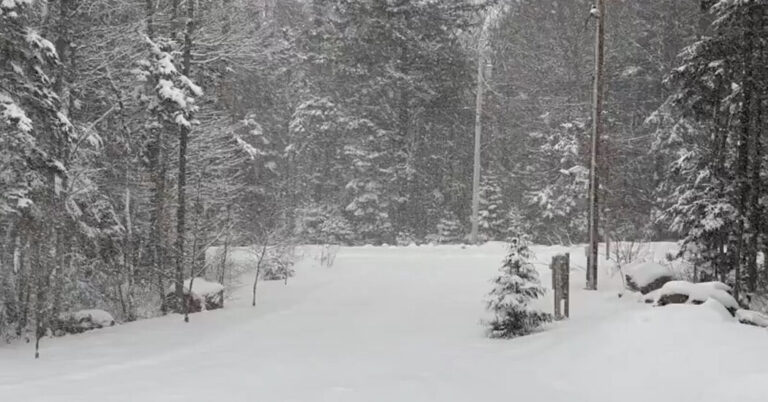
Residents across a broad stretch of the Northeast woke up on Saturday to snow blanketing backyards and frosting trees, just as the pastel colors of Easter promised that spring was near.

An area stretching from around Albany, N.Y., to Maine experienced moderate snowfall, mostly from two to five inches, overnight Friday into Saturday morning, according to the National Weather Service. And while spring technically started on March 20, snowfall at this time of year is far from rare.

“In upstate New York, you know, a couple inches here and there is certainly not unheard-of, even in the early spring,” said Abbey Gant, a meteorologist with the Weather Service office in Albany.

While the Weather Service reported a trace of snow at LaGuardia Airport, there were no reports of snow in other parts of New York City.

In Maine, where two to five inches of snow had fallen by Saturday morning, Michael Clair, a Weather Service meteorologist, said that the snow was “nothing we haven’t seen before.”

It’s also something the state might see again before warmer weather moves in.

“It’s still too early to say we’re done for sure,” Mr. Clair said. “This is sort of what our spring looks like. It’s a mix of things.”

Snow was expected to continue through Saturday, tapering off as the day progressed, before the region dries out next week, forecasters said.

For Jill Woodworth, 58, who grew up in Connecticut and has lived in Orange, Mass., for the past 25 years, waking up to snow in April can be routine, but it’s still shocking.

In Orange, Mass., snow in April is not necessarily unusual but can still come as a bit of a shock, one resident said.Credit…Jill Woodworth

“I’ve lived in this area for most of my life, and it’s not unusual, but it’s just like, ‘Oh my God,’” Ms. Woodworth said. “It feels like it’s been a long ramp up to spring with the flowers and the trees.”

Ms. Woodworth said she remembered past Aprils when up to two feet of snow had fallen. This time around, she estimated that only about two inches had dusted her backyard, with no need to shovel any snow.

“I’ll brush off the car, though,” she said, “before I go get Dunkin’.”

Amy Graff contributed reporting.


Source link

Sudan Clinic Workers Killed in Zamzam Camp

0


Sudanese paramilitaries killed the entire staff of the last medical clinic in a famine-stricken camp in the western region of Darfur, Sudan, as part of a broader assault that killed at least 100 people, aid groups and the United Nations said on Saturday.

The assault on the Zamzam camp, which holds 500,000 people in the besieged city of El Fasher, was notable even by the standards of a civil war that has seen countless atrocities as well as accusations of genocide.

Paramilitaries with the Rapid Support Forces, or R.S.F., broke through the camp perimeter on Friday evening after hours of shelling. They then destroyed hundreds of homes and the camp’s main market before turning their attack on the camp’s last remaining medical clinic, according to Relief International, the aid group that runs the facility.

Nine hospital employees were killed, including the head doctor, the aid group said in a statement on Saturday. “We have learned the unthinkable,” the statement said. “This is a profound tragedy for our organization.”

Kashif Shafique, the group’s Sudan director, said in a phone interview that the aid workers — five medics and four drivers, his entire staff at the clinic — had been shot dead.

Paramilitaries had warned the medics to leave the day before the attack, Mr. Shafique said. But they had to treat civilians wounded by shelling and, in any event, the main routes out of the camp were closed.

“There was no way out,” he said.

The R.S.F. has been battling Sudan’s military since April 2023, in a sprawling conflict that has caused the world’s largest humanitarian crisis. As many as 150,000 Sudanese have been killed, according to U.S. estimates, and 13 million have been forced from their homes.

The head of the United Nations in Sudan, Clementine Nkweta-Salami, said she was “appalled and gravely alarmed” by the violence in El Fasher, which continued into Saturday. At least 20 children were among 100 people killed, she said.

Satellite images posted on Friday by the Humanitarian Research Lab at the Yale School of Public Health showed military vehicles near the camp and fires burning inside it. The group called it “the most significant ground-based attack” on Zamzam camp in a year.

The escalating violence comes days before a major international conference on Sudan that is scheduled to take place in London on Tuesday, the second anniversary of the war. The purpose of the conference is to attract funds for Sudan’s severe humanitarian crisis. So far, donors have committed to just 10 percent of a $4.2 billion appeal by the United Nations.

The conference has stoked criticism from some Sudanese because it will be attended by delegates from the United Arab Emirates, which has been accused of providing military and financial support to the R.S.F.

Human Rights Watch urged the U.N. Security Council to impose sanctions on R.S.F. commanders responsible for abuses, and to condemn “countries providing support to parties in violation of the ongoing U.N. arms embargo.”

“Global leaders need to act,” the organization said in a statement.

Both sides in Sudan’s war have been accused of war crimes by right groups, the United Nations and the United States, although only the R.S.F. has been accused of genocide. Sudan’s military has regularly been accused of indiscriminately bombing crowded markets, often in the Darfur region, in multiple incidents that have sometimes killed more than 100 people at a time.

Earlier this month, the top United Nations human rights official, Volker Türk, said he was “utterly appalled” by reports of widespread summary executions of civilians in the capital, Khartoum, following the city’s recapture by the Sudanese military.

On March 24, the military killed at least 54 people in an attack on a busy market in Toura, a small town in North Darfur.

Most of Darfur, however, is held by the R.S.F., which has been laying siege for more than a year to El Fasher, the last major city in the region that it does not control. It had been expected to step up the assault in recent weeks, since R.S.F. forces were expelled from Khartoum by the military in late March.

There were signs for days before Friday’s violence that a major attack was imminent.

Video of the R.S.F. deputy leader Abdul Rahim Dagalo mobilizing his forces in the area circulated on social media. On Thursday, the R.S.F. began to shell Abu Shouk, another camp in the north of the city, killing at least 12 people, according to local rescue workers.

The fighters also began to attack Zamzam camp with artillery, gunfire and drones, according to aid groups and local activists. A famine was officially declared at the camp last August.

A Sudanese research group, Fikra for Studies and Development, urged the U.N. to begin airdrops of food to Zamzam.

American officials have repeatedly warned of a possible ethnic massacre if the R.S.F. overruns El Fasher. Similar violence against the ethnic Masalit group in late 2023 led to thousands of deaths and was central to the U.S. decision in January to accuse the R.S.F. of genocide.

Abdalrahman Altayeb contributed reporting from Port Sudan, Sudan.


Source link

Football latest: Bayern Munich slip up as Dortmund fight back to earn point

0


Football latest: Bayern Munich slip up as Dortmund fight back to earn point


Source link

Tech C.E.O.s Spent Millions Courting Trump. It Has Yet to Pay Off.

0


The biggest technology companies and their chief executives donated millions to President Trump’s inauguration, hosted black-tie parties and dinners in his honor, and allowed him to announce and take credit for new multibillion-dollar manufacturing projects.

But less than three months into the president’s second term, Mr. Trump has hardly returned their lavish gestures with favors.

The sweeping tariffs he imposed last week will squeeze Apple’s iPhone supply chain and make it much more expensive for Amazon, Meta, Google and Microsoft to build supercomputers to power artificial intelligence. The president has slashed federal funding for research into emerging technologies like A.I. and quantum computing. His immigration clampdown has incited fears that he will cut off pipelines for tech talent.

The Trump administration has also signaled that it will continue an aggressive regulatory stance on reining in the power of the biggest tech companies, beginning next week with a landmark antitrust trial to break up Meta, the owner of Facebook, Instagram and WhatsApp.

Since the inauguration, the combined market value of Amazon, Apple, Google, Meta and Microsoft has fallen 14.6 percent to $11.3 trillion. And the tech-heavy Nasdaq index is down 15.3 percent.

The efforts to court Mr. Trump are a far stretch from the industry’s approach to his first administration, when many tech leaders were openly hostile toward the president. With an about-face and flattery, executives hoped this time around that Mr. Trump might show tech more deference, including it in his efforts to deregulate industries like energy and autos.

Instead, the genuflection of Silicon Valley’s top leaders may be a misreading of how to succeed in Mr. Trump’s Washington, according to Democratic and Republican policy experts.

The relationship that tech executives have with the president has been a “one-way street,” said Gigi Sohn, a former senior adviser to the Federal Communications Commission under the Obama administration. “They give him everything, and he promises nothing, which in this case is a good thing.”

That hasn’t stopped them from trying. Last week, Meta’s chief executive, Mark Zuckerberg, was at the White House to try to persuade the administration to settle the Federal Trade Commission’s antitrust lawsuit against Meta. Tech leaders including Sundar Pichai, the chief executive of Google, have also visited the White House in recent weeks.

The companies have said that they want to engage with Mr. Trump on a variety of issues and that they are looking at the long-range effects of his policies. Apple, Google, Meta and Amazon declined to comment.

The White House did not respond to a request for comment.

The hostilities between the tech industry and Mr. Trump date back to at least 2016, when multiple tech executives endorsed Hillary Clinton for president and donated to her campaign. After Mr. Trump was elected, tech leaders criticized the president’s immigration ban for Muslims and his skepticism about Covid-19 vaccines.

Mr. Trump’s first administration took a tough regulatory stance on the industry, filing antitrust lawsuits against Google and Meta. He railed against social media and other internet giants for censoring him and amassing too much power. He also blamed the platforms for contributing to his election loss in 2020.

The tech industry’s public tone toward Mr. Trump abruptly shifted last year after he was wounded in an assassination attempt.

In the aftermath, Mr. Zuckerberg called him a “badass.” Jeff Bezos, the founder of Amazon, commended Mr. Trump for “grace under fire.” Elon Musk, who leads the rocket company SpaceX, the electric carmaker Tesla and the social media platform X, endorsed Mr. Trump and went on to stump for and donate $300 million to his campaign.

After the election, Apple’s chief executive, Tim Cook, alongside Meta, Google and Amazon, donated $1 million each to the inauguration. Several of the executives made trips to Mar-a-Lago, Mr. Trump’s resort in Palm Beach, Fla. And at the inauguration, Mr. Musk, Mr. Bezos, Mr. Zuckerberg, Mr. Cook and Mr. Pichai all appeared on the dais next to cabinet members.

“If you look at the inauguration, look at the people that were on that stage — here was a who’s who of a world that was totally against me the first time,” Mr. Trump said recently in an interview with Clay Travis of OutKick, a sports and news site owned by Fox.

There have been some benefits. Mr. Musk is now a close adviser to the president, and critics say his businesses are likely to reap rewards from his proximity. Mr. Trump has also signed executive orders delaying a sale or ban of TikTok, as mandated by a law passed last year over security concerns about the app’s Chinese parent company, ByteDance.

Despite slashing its federal funding, Mr. Trump has opened the door to a continued light regulatory touch on A.I., which he has declared his top priority to beat China in a race for global tech leadership. Last month, Google, Microsoft, Meta and other tech giants submitted suggestions, asking for the administration to stay out of the way.

And U.S. regulators have almost entirely dismantled a yearslong government crackdown on the crypto industry, a volatile sector rife with fraud, scams and theft. That benefits companies including the venture capital firm Andreessen Horowitz, a major investor in the space.

But tech companies still face intensifying pressures under the current Trump administration.

The new leaders appointed to the Justice Department and the F.T.C. have shown no signs of backing down on a series of antitrust suits filed against Google, Meta, Amazon and Apple.

Mr. Trump chose Gail Slater, a veteran lawyer and a vocal tech critic, to lead the antitrust division at the Justice Department. Mr. Trump emphasized the importance of her role to quell powerful Silicon Valley giants during his announcement.

“Big Tech has run wild for years, stifling competition in our most innovative sector and, as we all know, using its market power to crack down on the rights of so many Americans, as well as those of Little Tech!” Mr. Trump said in a post on Truth Social, his social media platform.

The president also appointed Andrew Ferguson, who has expressed concerns about social media companies’ power, as chair of the F.T.C. Next week, Mr. Ferguson will lead the antitrust trial against Meta, in which the government accuses Facebook of buying Instagram and WhatsApp nearly a decade ago to cement its monopoly in social networking.

It’s unclear if efforts by Mr. Zuckerberg to secure a settlement will be successful. But ultimately, any decision on whether or not to proceed will be made by the president, Mr. Ferguson said last week at a conference held by the tech start-up incubator Y Combinator in Washington.

“The president’s head of the executive branch, and I think it’s important for me to obey lawful orders,” he said when asked if he would drop a suit like the Meta case if instructed by Mr. Trump.

“I think that the president recognizes that we’ve got to enforce the laws, so I’d be very surprised if anything like that ever happened,” he added.

Perhaps the biggest blow to the tech industry came in the form of tariffs last week. Apple, one of the hardest-hit companies, produces 90 percent of the iPhones it sells around the world in China, where tariffs, which were already at 20 percent, are expected to increase to 34 percent this week.

“These tariffs will raise consumer prices and will force our trade partners to retaliate,” said Gary Shapiro, the chief executive of the Consumer Technology Association, a trade group. “Americans will become poorer because of these tariffs.”


Source link

British Government Takes Control of Country’s Last Major Steel Mill

0


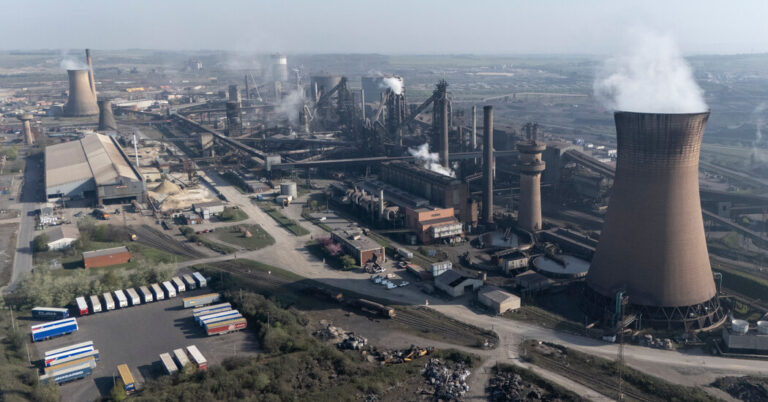
The British government moved swiftly on Saturday to take control of operations at the country’s last large crude steel producing facility, in what appeared to be a major step toward nationalizing the plant.

In an unusual and dramatic move, the government had summoned lawmakers back from vacation on Saturday to approve the government’s emergency legislation.

The government said it was acting to prevent the owners of the British Steel complex in Scunthorpe, a Chinese company called Jingye, from taking steps unilaterally to close the blast furnaces, potentially costing 2,700 jobs.

“Steel is fundamental to Britain’s industrial strength, to our security and to our identity as a primary global power,” Jonathan Reynolds, the business and trade secretary, told Parliament on Saturday in introducing the legislation.

Despite the interest in preserving steel making now, it has long been in decline in Britain. Crude steel output has fallen by about 50 percent over the last decade, according to UK Steel, a trade group.

The industry in Britain struggles with high energy costs as well as competition, mainly from China, which now makes more than half of all global steel.

The 25 percent tariffs that President Trump recently imposed on steel imported into the United States have added a further hurdle.

In this difficult environment, the government of Prime Minister Keir Starmer now risks being stuck with supporting a business whose owners say is losing 700,000 pounds a day or around $915,000.

The government insists that it is not nationalizing British Steel, but it is asserting control over the board and management and, it seems, taking responsibility for the running costs.

In a sign of the increasingly bitter tone of the dispute, the government said Friday that employees who are fired for “defying the orders of the Chinese owners” would be able to be reinstated.

The government says it wants to find a partner to invest in a greener steel-making process, but critics say these moves are tantamount to nationalization.

“This is a botched nationalization plan,” warned Andrew Griffith, the business spokesman for the opposition Conservative Party.

A variety of motivations appear to be behind Mr. Starmer’s approach.

He was wary of letting a large plant close at the cost of thousands of jobs of his trade union supporters.

Last year Tata Steel, the large India-based company, closed much of what was Britain’s other large steel mill at Port Talbot in Wales, leading to heavy job losses.

“We’ve had big concerns about that and a lot of anger,” said Alasdair McDiarmid, assistant general secretary of the Community Union, which represents many steel workers.

In a world of growing economic nationalism, Mr. Starmer seems to have accepted the argument that it is important for a country to retain some domestic ability to make what is known as virgin steel.

The British Steel plant in Scunthorpe, in northeast England, has Britain’s last two operating blast furnaces, huge chambers that produce molten metal using iron ore and coke, a derivative of coal. Other mills then finish the crude steel into products like rails for train lines and beams for the construction industry.

Pressure to keep Scunthorpe open appears to have increased in the wake of the Trump administration’s signals that it was less committed to European security than previous U.S. administrations. President Trump’s tariffs were apparently also part of that calculation.

“Given global economic instability, it is crucial that manufacturing is protected at home,” the government said on Friday.

Mr. Reynolds said he made what he called “a generous” offer of aid to Jingye, which proposed to shift production at Scunthorpe to electric furnaces that would make steel by melting scrap metal.

Blast furnaces like those at Scunthorpe make high quality steel but also spew emissions, and many European steel firms are considering converting to other technologies.

Mr. Reynolds told lawmakers that Jingye wanted what he called an “excessive amount” of government support. The costs of converting to electric furnaces were estimated at £2 billion or more.

He also said that in recent days Jingye appeared to be trying to starve the blast furnaces of raw materials like coke to force a shut down. “The company would, therefore, have irrevocably and unilaterally closed down primary steel making,” he said.

A spokesman for British Steel declined to comment. The company said in a news release last month that it had invested £1.2 billion in British Steel since taking it over in 2020. “Despite this, the blast furnaces and steel making operations are no longer financially sustainable,” it said.


Source link

US markets have spiraled. Americans had doubts about Trump’s tariffs before that.

0


Recent polls showed Americans were wary of tariffs, even before the president launched his plan to realign the global trade order.


Source link

Carlos Alcaraz’s ‘My Way’ documentary trailer and a tennis tweener trick shot from heaven

0


If a player hits a running trick shot to save a break point, but later gets broken off three unforced errors and a double fault, is it good tennis? For Carlos Alcaraz, definitely.

He delivered a signal example of the tension running through his documentary series, ‘My Way,’ just as Netflix released its trailer. While Alcaraz was oscillating between the sublime and the absurd on court against Daniel Altmaier at the Monte Carlo Masters in Monaco, the streaming company put out a snapshot of the series on YouTube.

It asks some fundamental questions of tennis: how much should it require of its stars? How much sacrifice should greatness take? And is there a route to greatness that does not demand everything of the player who seeks it?

Against Altmaier, Alcaraz found himself down 30-40 in his first service game of their match. The German feathered a drop shot just over the net, dragging Alcaraz forward…

He responded with a sharp, cross-court angle…

… but Altmaier read the shot and moved across the court, to send the ball deep down the line on the other side.

Alcaraz, running diagonally to his left, would have to hit a shot through his legs. The easier option was to send the ball back cross-court. Altmaier duly moved to cover that shot; Alcaraz, perhaps obviously, did not hit it.

Instead, he levered the ball down the line, sending Altmaier scrambling to his backhand corner. The German managed to hook the ball back into play, but Alcaraz was waiting to crush a backhand flat into the same corner, which Altmaier could only send into the net.

It was an example of the divine inspiration and at times otherworldly skill — and joy — that Alcaraz brings to the court, and which has carried him to the upper echelons of tennis.

“It’s beautiful to play points like that,” Alcaraz said later, watching the shot back. “I’m trying to put on a show, trying to entertain the people. A point like that… Just to reflect, how my matches are going to be.”

The rest of the match was not so much like that.

Having saved that break point, Alcaraz missed a routine first groundstroke behind his serve. He saved four more break points in the game and held his serve for 1-1. He then broke Altmaier to lead 3-2, before hitting three unforced errors and a double fault to get broken straight back in the next game.

That was the pattern of the first set, oscillating between brilliant points and routine mistakes, before Alcaraz broke again at 5-3 to take it, 6-3.

The second set was more routine, with the Spaniard ultimately triumphing 6-3, 6-1 to set up a quarterfinal against No. 12 seed Arthur Fils.


“I want to do it my way,” Alcaraz says, in the series trailer, of his goal to be the best player in the world. That ambition is intercut with opinions from Rafael Nadal and Roger Federer, who both did it their way.

“To accomplish what Novak (Djokovic), Roger or myself have done,” Nadal says, “you need to feel that the sacrifices are worth it and that they pay off.”

With 66 Grand Slam titles between the three greatest men’s players of all time, there is little argument that they paid off in achievement. What Alcaraz appears to ask is whether or not they pay off in other ways.

Alcaraz, 21, already has four Grand Slam titles. He is the youngest man to win a major on all three surfaces, and still has two more opportunities — at the 2026 and 2027 Australian Opens — to become the youngest man to win all four majors.

If he wins the title in Monaco, he will reassume the No. 2 spot in the men’s rankings, behind only his closest rival and the player with whom he shares the mantle of the best in the world: Jannik Sinner.

His style of play is so singular that both his wins and his losses can appear as if from another world.

When he loses, whether a set or a whole match, he tends to lose badly. The creativity looks like naivety and the shotmaking looks like waste — and it tends to happen against lesser-ranked players. He has 16 defeats and one retirement due to injury since the start of 2024, but only six of those defeats came against top-10 players. Two of those six came in one tournament, the 2024 ATP Tour Finals, during which he was struggling with illness. The average ranking of his opponents in the other 10 losses is 32.

He is making adjustments, mentally and technically, most notably to his serve and his backhand. He has changed the motion on the former and the racket take-back on the latter, which means mistakes sometimes flow like water but also reveals a dedication to on-the-fly improvement, one of the hardest things to do given tennis’ demanding schedule.

Alcaraz describes the challenges of that schedule in the trailer, emphasizing that he wants to be able to spend time at home, to see his family. If he also wants to dominate the sport as Djokovic, Nadal and Federer did, that time will be limited.

As the retired Nadal and Federer hint at in their roles as Netflix talking heads, it’s only possible to find out if all that was worth it in the end.

On the way, there will be tweeners.

There will be errors too.

(Top photo: Valery Hache / AFP via Getty Images)



Source link

Harvard Professors Sue Trump Administration Over Threat to Federal Funds


Two groups representing Harvard professors sued the Trump administration on Friday, saying that its threat to cut billions in federal funding for the university violates free speech and other First Amendment rights.

The lawsuit by the American Association of University Professors and the Harvard faculty chapter of the group follows the Trump administration’s announcement earlier this month that it was reviewing about $9 billion in federal funding that Harvard receives. The administration also sent the school a list of demands that it must meet if it wants to keep the funds.

The suit, filed in the Federal District Court in Massachusetts, seeks a temporary restraining order to block the Trump administration from cutting the funds.

“This action challenges the Trump administration’s unlawful and unprecedented misuse of federal funding and civil rights enforcement authority to undermine academic freedom and free speech on a university campus,” the lawsuit said.

The White House did not respond immediately to a request for comment.

The Trump administration has been on a campaign against elite universities that it views as being too lax on antisemitism. In a recent letter to Harvard, the administration said the school had “fundamentally failed to protect American students and faculty from antisemitic violence.” Other top schools like Columbia and Cornell have also been targeted.

Harvard did not respond to a request for comment on Saturday. In recent weeks, Alan Garber, the university president, has said that Harvard had spent “considerable effort” during the past 15 months addressing antisemitism, adding that there was still more work to be done.

In a statement, Andrew Manuel Crespo, a law professor at Harvard and general counsel of the AAUP-Harvard Faculty Chapter, said the administration’s policies are a pretext to chill universities and their faculties from engaging in speech, teaching and research that don’t align with President Trump’s views.

“Harvard faculty have the constitutional right to speak, teach and conduct research without fearing that the government will retaliate against their viewpoints by canceling grants,” Mr. Crespo said.

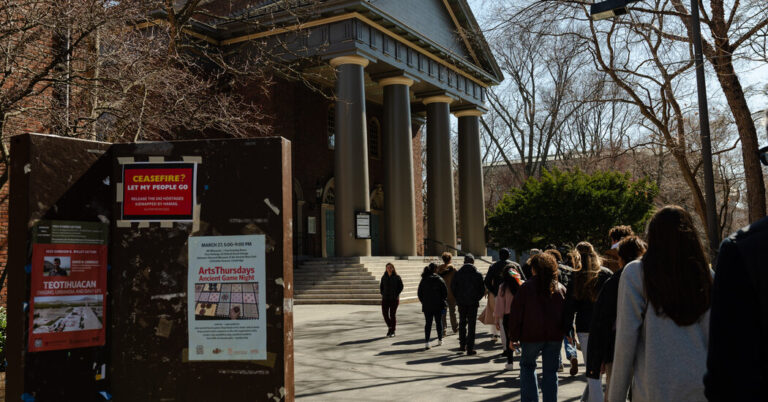
On Saturday afternoon, hundreds of protesters, including students, professors and even the mayor of Cambridge, braved the cold to protest against the Trump administration’s threat to cut Harvard’s funding. At a packed park in Cambridge, Mass., home to Harvard’s campus, they called on the university to lead the charge against the government’s crackdown on higher education.

“Harvard possesses not just the resources to withstand the pressure,” said Mayor Denise Simmons of Cambridge, “but the moral obligation to do so.”

Miles J. Herszenhorn contributed reporting from Cambridge, Mass.


Source link

Bees Are Under Threat from Climate Change, the Trade War and Doge


Under blue skies, where low-rolling hills rise south of the Canadian border in the tiny town of Adams, N.D., a couple braves the stench of old honey, wax, smoke and bee muck.

Nancy and Keith Budke, married 43 years, are migratory beekeepers. They produce honey with the taste of canola nectar, sweet clover and other flowers that their bees pollinate first in North Dakota, then in Texas, after being hauled there by truck, and eventually in California — if the bees make it that far and if nobody snatches them.

This season, the chances of the bees making it to California were much lower. Honeybee colonies are under siege across much of North America. And the Budkes, owners and operators of Budke Bees, a small commercial beekeeping business, know it all too well. Parasites, loss of habitat, climate change and pesticides threaten to wipe out as much as 70 percent or more of the nation’s honeybee colonies this year, potentially the most devastating loss that the nation has ever seen.

“There is a shortage of bees across the entire world,” Ms. Budke said. “It’s a crazy life that we lead because we’re trying to fight so many different battles.”

At the start of their annual migratory journey last August, the Budkes had 2,900 hives. Larger operations manage 10 times as many. But the challenges faced by the Budkes in getting their bees to the plains of Texas, and then to the almond groves of California, mirror those of virtually all beekeepers.

Ms. Budke, who is also a registered nurse, nurtures the millions of tiny insects with the care of a loving pet owner, inoculating them against viruses and pests and making sure they have enough to eat.

Healthy bees mean healthy people and a healthy climate. Though most people fear the winged, golden insects with their fierce stingers, honeybees play a pivotal role in the production of about 100 crops Americans consume, pollinating the blooms on vegetable plants and fruit and nut trees.

Commercial bee businesses make most of their money pollinating fields and orchards, particularly in California, which produces 80 percent of the world’s almonds. Flatbed trucks from all corners of the country haul bees to the state’s almond groves for its pollination season, arriving from October to March. There, the Budkes and other beekeepers earn about $200 for each hive — the most profitable of prizes in the $721 million industry.

“It’s really the Super Bowl of beekeeping,” said Scott McArt, associate professor of pollinator health in the Department of Entomology at Cornell University, where he helps run the Dyce Lab for honeybee studies.

Getting there, though, has increasingly proven difficult. There are the worsening perennial problems for beekeepers, and now, this year, there are new issues emerging downstream from the rapid changes in American government.

The fate of honeybees first became a national focus after headlines in late fall 2006 and early winter 2007 screamed, “Bees Dying: Is It a Crisis or a Phase?” Since then, governments and academics have sought to solve the head-scratching mystery of vanishing bees that laid waste to much of the industry. Some years are worse than others, but there’s been a steady decline over time.

Scientists have named the phenomenon colony collapse disorder: Bees simply disappear after they fly out to forage for pollen and nectar. Illness disables their radar, preventing them from finding their way home. The queen and her brood, if they survive, remain defenseless. The precise causes remain unknown.

Bee colonies have become even more vulnerable because of the increase in extreme weather conditions, including droughts, heat waves, monster hurricanes, explosive wildfires and floods that have damaged or destroyed the bees and the vegetation they pollinate. If that was not bad enough, parasites — and other creatures that researchers refer to as “biotic” threats that prey on bees — proliferate when there is damage to ecosystems.

All that means that the U.S. beekeeping industry has contracted by about 2.9 percent over the last five years, according to data collected by IBISWorld, a research firm.

Annual loss rates have been increasing among all beekeepers over the last decade with the most significant colony collapses in commercial operations happening during the last five years.

And now, compounding the troubles for the bee industry are recent federal cuts proposed by the Elon Musk-led Department of Government Efficiency to the Department of Agriculture, where researchers were studying ways to protect the nation’s honeybees.

These challenges coincide with big changes in federal policy. President Trump’s trade wars could raise prices for imported foods and make it more difficult for farmers to sell their crops abroad. Coupled with a lack of bee colonies, farming could become more expensive and difficult, driving up prices for many staples.

Beekeepers also often depend on immigrants to manage their hives and to help produce commercial honey. The current administration’s deportation of immigrants in the country illegally and revocation of the legal status granted to some foreigners by the Biden administration appears to be discouraging foreign workers from applying for temporary work visas.

“It was a perfect storm,” said Elina L. Niño, a professor of cooperative extension for apiculture, the study of beekeeping, at the University of California, Davis.

Mr. Budke, 70, has worked with bees since his teenage years. He was a hired hand at first. Then Ms. Budke gave him an ultimatum: If he wanted to be with her, he needed to start his own business because his boss would not let him have hives of his own.

“You want to be married to me?” Ms. Budke, 62, said she asked him. “We’re going, we’re leaving.”

So Mr. Budke quit and drove trucks for a chemical plant as Ms. Budke focused on nursing. They socked away their extra cash.

“About a year later, I wrote him out a check for his Christmas present of $30,000,” Ms. Budke said. “We saved up that much money, and I handed it to him and said, ‘There you go. Now you can be your own beekeeper.’” The initial 40 hives the couple bought in the late 1970s have grown to about 3,000. Since the major national colony collapse almost 20 years ago, Ms. Budke said, it seemed every three or four years they suffered massive losses of bees.

Last year, in August, looking over their hives in the weeks before heading from North Dakota to Texas, the Budkes appeared optimistic about the potential of a big payday in California. The state is at times a kind of Wild West for the industry, where beekeepers must register their colonies to help prevent theft by poachers.

Beekeeping isn’t glamorous. It gets sweaty beneath the thick, white jumpsuit, mesh face mask and gloves, particularly in the midday sun. And there’s the putrid smell, all of which has made the work less appealing to U.S. workers and leads the Budkes, like many beekeepers, to employ a couple of migrant workers from Nicaragua.

The Budkes distribute their hives in and around Adams, a tiny town with a population of about 130, across the state line from their home in Minnesota. North Dakota is the nation’s leading honey producer, a place where bright yellow fields of canola flowers, a favorite in beekeeping, are plentiful. The Budkes house the bees in wooden beekeeper crates, about 20 inches long and a little more than a foot wide, stacked several boxes high.

Mr. Budke and one of their sons largely manage the bees. Ms. Budke runs the business and has designated herself the queen of Budke Bees. (The queen, of course, is the center of every hive.)

A thriving population of worker bees means a healthy hive. But threats are everywhere.

One immediate danger: other hungry bees.

When the larger beekeepers remove their honey for commercial sale, their bees start looking for food and sometimes invade other colonies. (Beekeepers supplement with sugar or corn syrup, but the bees don’t like it as much, nor is it as good for them.)

“The big battle is to get the honey off before these big guys,” Mr. Budke said, as he opened the crates to view their yields. “You get this robbing going on. The other bees will come and get anything that isn’t protected.”

As the Budkes pumped smoke into the hives to calm the insects before opening the crates, hundreds of thousands of bees escaped, buzzing as if they were a massive chorus.

It was mid-August, and honey production looked good. The moneymaker, though, awaited them in California — with a roughly 18-hour trek first down Interstate 29 to Texas, where the bees spend the fall before heading to the West Coast.

The tractor-trailer pulled into Mount Pleasant, Texas, the county seat of Titus County, late one afternoon in mid-October. It’s a small cattle and hay crop town of more than 16,000 people about two hours east of Dallas by car.

Mr. Budke settled on Mount Pleasant after scouting locations across Texas for a warm, affordable place during North Dakota’s frigid winter months and before the trip to California. In Mount Pleasant, he found fields of golden rod flowers atop old coal mines with no other commercial hives competing to feed their bees.

Chris Wittrock, a 34-year-old driver for Thompson Trucking, pulled into town with the first load of hundreds of hives he hauled for the Budkes from North Dakota. (The couple drives their own car.)

The trip carries great risk. Some drivers have had hives tip over and land on the highway or on the side of the road. Heat can also harm bees when trucks stay in one place too long.

“You have to keep moving or they’ll die,” Mr. Wittrock said.

There were no disasters on this trip to Texas. Still, as the Budkes unloaded the hives from the flatbed, scores of bees hit the ground lifeless from the stress of the trip. A stowaway mouse arrived with them in the hives.

The rodent was of little concern. The greater threats are skunks and raccoons, which eat bees, and bears, which steal honey and starve the hive. (Mr. Budke sets traps for the animals and sometimes keeps raccoons for townspeople who like to eat them.)

If the bees don’t fall prey to one of those beasts, other perils await them. Chief among them are the pesticides found in the plants the bees feed on, like canola, and pests, such as the varroa mite, a parasite that attacks and feeds on the insects.

The varroa mite has been a major contributor to bee deaths; it weakens their immune systems and spreads viruses. The Environmental Protection Agency believes the pests played a role in a major colony collapse in late 2006, when large numbers of bees unexpectedly disappeared.

“If you go as a colony into winter time with high varroa mite loads, those colonies usually don’t survive,” said Ms. Niño, the University of California, Davis professor. “It is difficult to keep the colonies healthy and strong.”

Things looked good before the Budkes left their bees to hang out in Texas, returning to Minnesota for Christmas.

But weeks later, beekeepers across the country began reporting massive beehive collapses. More than half of the roughly 2.8 million colonies collapsed, costing the industry some $600 million in economic losses.

The Budkes returned to Texas and checked their hives before shipping them to California. The worst-case scenario had happened. Crate after crate turned up empty. About two-thirds of their hives collapsed, leaving just 880 for the trip to California.

“That’s what happens” with colony collapse disorder, Ms. Budke said. “They’re perfectly fine. They all look healthy as can be. You’ll come back in two weeks, and all there’s gonna be there is a queen,” since the queens stay behind in the hive while the other bees roam. “All the bees are missing.”

The impact of these losses on the California almond groves and other vegetation will not be fully known for weeks or months after pollination. The devastation to the colonies surprised the entire industry, leaving the growers scrambling to cover their pollination needs.

“This year, it was much worse than they anticipated,” said Danielle Downey, executive director of Project Apis m, a nonprofit research organization that helps support the health of bees. “In January, they started calling researchers and saying something is wrong. Many of the colonies were dead.”

The growers, Ms. Downey said, not only may have received fewer bees but also weaker ones.

In a statement, a U.S.D.A. spokesperson said that the agency “is aware of the unusual losses to our nation’s honeybee colonies and is concerned about its potential impact on food production and supply. U.S.D.A. Agricultural Research Service scientists are working closely with federal partners, stakeholders, and impacted parties to identify the source of this agricultural challenge.”

But for now, the agency will have to do its work with fewer researchers.

John Ternest, a scientist who studied pollinator health at the U.S.D.A.’s Agricultural Research Service until he was fired in February, said about 15 people involved in bee research lost their jobs at the Agricultural Research Service.

Stakeholders in the beekeeping industry are concerned that the cuts could affect investigations into the bee losses. Scientists from the U.S.D.A. collected samples of live bees in California in January to examine them for pathogens, parasites and viruses.

The timing of the colony collapses couldn’t have been worse. “We have so many crops that are going into bloom and rely on pollination right when all of this was happening — the firings, the crisis of honeybees,” Dr. Ternest said. “What kind of trickle-down effect does that have on, of course, the farmers, but potentially even things like food prices?”

In early February Andrew Beld received the Budkes’ surviving bees at a yard in Firebaugh, Calif., west of Fresno. Mr. Beld, a honeybee broker who runs Circle B Honey Farms Inc. in Hazel, S.D., connects beehives from more than 40 beekeepers with three dozen almond growers. During his peak year in 2022, he’d set 40,000 beehives. This year, it was around 18,500.

Mr. Beld has been in the business for 30 years. This season, he acknowledges, has been one of the toughest.

“Guys were having some real big issues,” Mr. Beld said. “It was definitely a major, major crash.”

After pollination, a process that takes about a month for Budkes Bees, Mr. Beld returned the surviving bees to the Budkes.

Now, the Budkes are in triage mode. To save their business, they’re rebuilding their colonies, moving babies and some adults from their remaining hives into new ones. They’ve tried to buy queens from breeders to fill the new hives, but the national colony collapse and the loss of Florida breeders from Hurricane Milton has made them scarce.

Where queens once cost the Budkes $15 or so, prices now have doubled. The Budkes wanted 2,000 of them, though, so far, they have secured just 200. They are concerned about their ability to rebuild their operation.

Faced with an uncertain future for her business, Ms. Budke has seized on pesticides as a place to focus her anger. (The U.S.D.A says the “sublethal exposure” to them is one of the biggest factors threatening honeybees.)

“We hope somebody’s gonna start listening to us,” Ms. Budke said. “You have to quit spraying your dandelions. Who cares if your lawns have a couple of flowers on it? Do you want to eat?”

Emily Anthes and Catrin Einhorn contributed reporting. Audio produced by Parin Behrooz.


Source link

Bahrain Grand Prix | Ted's Qualifying Notebook

0


Sky F1’s Ted Kravitz reflects on all the big talking points from qualifying at the Bahrain Grand Prix.


Source link