A former SandboxAQ executive filed a wrongful termination suit last month filled with such scandalous allegations against the company’s famed CEO, Jack Hidary, that plaintiff himself redacted the most salacious details.
On Friday, the company’s lawyers filed a blistering response, calling the former employee a “serial liar” and stating his lawsuit “asserts false claims for improper and extortionate purposes.”
Even the visible portions of the lawsuit — which TechCrunch has obtained — contain eyebrow-raising allegations, should a court find them valid. (A copy of the lawsuit is available here.)
The case offers a rare inside look at how employee lawsuits can become a public airing of dirty laundry from otherwise opaque internal happenings, thanks to the ubiquitous private arbitration clauses in Silicon Valley employee agreements.
The suit was filed by Robert Bender in mid-December. Bender worked as Chief of Staff to Hidary from August 2024 through July 2025, the complaint states. He contends in his suit that he was wrongfully terminated after raising concerns about a number of alleged incidents, some of which, he said, involved “sexual encounters” and others, he claims, that involved misleading financial information presented to investors.
For its part, SandboxAQ vehemently denies the allegations. The company’s lawyer Orin Snyder, a well-known partner at white shoe law firm Gibson Dunn, tells TechCrunch: “This case is a complete fabrication. We look forward to debunking these baseless allegations and exposing the lawsuit — as detailed in our answer — for what it is — an opportunistic and extortionate abuse of the judicial process.”
What makes the case particularly notable is the number of Valley heavy hitters involved in SandboxAQ. The company is an AI quantum computing startup that began as a moonshot unit of Google parent company Alphabet, led at Google by Hidary. Hidary is also well-known in Silicon Valley as a longtime X Prize board member.
Techcrunch event
San Francisco | October 13-15, 2026
SandboxAQ was spun out of Alphabet into an independent company in March 2022 with Hidary as CEO and soon attracted big-name investors, including billionaire and former Google CEO Eric Schmidt, who invested and became the startup’s chairman. Other billionaire investors include Salesforce CEO Marc Benioff, venture capitalist Jim Breyer, and Bridgewater hedge fund founder Ray Dalio.
Bender’s attorneys say in another court document that the redacted sections “describe sexual encounters and the physical condition of non-party individuals observed by Plaintiff during business travel.” In other words, the alleged incidents involve people who Bender is not suing. This is an unusual move — typically, it’s the party being sued that requests redactions, not the person making the allegations.
Various explanations exist for such a tactic, and TechCrunch couldn’t ascertain what the motivations are in this case. Generally speaking, the possibilities range from protecting innocent third parties who aren’t accused of wrongdoing, to a shakedown strategy — signaling that more damaging details could emerge if the defendants don’t offer an acceptable settlement.
The unredacted portion of the suit provides a few more general details of the allegations that were hidden: Bender is alleging that Hidary used company resources and investor funds to “solicit, transport, and entertain female companions.” In an attached exhibit of a text message from Bender, he mentions prostitutes.
Bender further alleges in his suit that Hidary sold tens of millions of dollars worth of his stock at a premium price based on what Bender says were misleading figures presented to potential investors. He contends in the suit that revenue figures presented to the board were 50% lower than the figures shown in presentations to prospective investors.
SandboxAQ’s lawyers vigorously contest all of the above. “The Company did not make fraudulent disclosures to investors regarding its tender offer or otherwise. The CEO did not misuse corporate assets. Plaintiff invented these inflammatory allegations to manufacture statutory claims and to insulate himself from the consequences of his own misconduct.”
Bender, for his part, alleges that the company has been trying to smear him. His complaint asserts that he brought his lawsuit, “only because his termination was followed by a malicious scorched earth campaign to destroy his reputation.”
While the validity of any of these allegations is for a jury to decide, many of his claims echo an investigative report on SandboxAQ published by The Information in July.
Sources told The Information that Hidary was using company resources to fly women he was dating on corporate jets, and that the company’s revenues were far below its projections. Bender references The Information story in his lawsuit but denies he was a source for it. SandboxAQ claims he was a source and is lying about his involvement. (A copy of SandboxAQ’s full corporate response, including more allegations about the employee, can be found here.)
Despite any controversies, big-name investors were eager to invest in the company last year. In April, SandboxAQ raised over $450 million in a Series E funding round from Ray Dalio, Horizon Kinetics, BNP Paribas, Google, and Nvidia.
That became impossible to ignore on Wednesday, when ICE agent Jonathon Ross killed 37-year-old Renee Nicole Good in cold blood. By now, you don’t need me to recount her brutal last moments. But the footage (graphic and disturbing as it is) is out there, and we can see the Trump administration’s propaganda about the event for what it is.
What changed this week was, arguably, that the victim wasn’t a brown-skinned person. ICE claimed the life of a white American citizen, one who, according to her wife, was a kind, loving mom and a Christian. Unfortunately, the US has a dark history of shrugging off violence as long as it’s directed towards a marginalized group. That wasn’t possible for mainstream newsreaders here.
LOS ANGELES, CA – JANUARY 8, 2026 Dozens, holding photos of Renee Nicole Good, protest her death a day after an ICE agent killed Good in Minneapolis, in front of the Federal Building in downtown Los Angeles on January 8, 2026. (Genaro Molina/Los Angeles Times via Getty Images) (Genaro Molina via Getty Images)
On Thursday, Vice President JD Vance smeared Good baselessly, insisting the mother was part of a “left-wing network.” He also claimed ICE holds “absolute immunity” when it comes to doing things like killing Americans in broad daylight. Meanwhile, White House press secretary Karoline Leavitt framed the deadly incident as the “result of a larger, sinister left-wing movement that has spread across our country.” And the FBI has blocked Minnesota’s criminal investigation bureau from accessing evidence to complete a thorough examination of the homicide.
In short: an agency with the full backing of the federal government killed a innocent citizen, and while there are tools to inform the public about the likely locations that agency may be acting in, Apple has chosen to keep them from us.
Apple has a history of presenting itself as a safer, socially progressive alternative within Big Tech. Its keynotes are replete with heartfelt testimony of iPhone and Apple Watch features saving lives. It releases Pride-themed accessories to celebrate the LGBTQ+ community and the company has (so far) resisted government pressure to eliminate its DEI programs. Hell, its modern era was kicked off by the “Here’s to the crazy ones” TV ad, which intercut images of Dr. Martin Luther King Jr., John Lennon and Gandhi — explicitly cloaking its corporate image in civil disobedience and social justice.
A photo of Dr. Martin Luther King Jr. on Apple’s homepage (2015) (Apple / The Internet Archive)
But the company also wields that progressive image for selfish reasons, wrapping business priorities in the guise of conscientiousness. For example, when government regulations push for openness or interoperability, Apple warns of the security and privacy risks for its users. When Apple tightly controls where you can buy apps, it’s about keeping porn away from the kids. And Apple has decided the theoretical safety of ICE officers is more valuable than the very real threat they pose to the communities they harass.
ICEBlock’s availability on the App Store may not have changed the outcome of Wednesday’s events. But it could resume its job as a community informer. It could make it easier to notify the public of where these masked thugs are congregating, perhaps even helping others avoid Good’s fate.
Engadget has reached out to Apple for comment on reinstating ICEBlock; we’ll update if we receive a response.
Privacy often feels like an impossibility in the modern age of the internet, as your data is constantly tracked and shared by just about everything you do. That’s why privacy smartphones and privacy-focused forks of Android keep popping up. With the new Punkt MC03, though, I just found the first privacy Android phone I might be willing to try out.
Punkt is a brand based in Germany that makes smartphones based on AphyOS, a privacy-focused fork of Android that’s actually based on a subscription. “If you don’t pay for the product, you are the product” is the tagline of the software, with a $10 monthly subscripton going towards funding continued development and software updates of AphyOS over the lifetime of your phone.
Admittedly, I’m a little iffy on this model, but the software itself makes a better pitch than I thought.
If you head over to Punkt’s website, the MC03 just sounds a lot like another “De-Googled” Android phone. That may appeal to some, but the thought of buying an Android smartphone that has no way to access Google apps and services sounds a bit awful to me, personally. And that’s where I think Punkt buried the lede a bit. In a hands-on demo at CES 2026, Punkt showed us how the MC03 actually has a simple toggle during the setup process that allows users to install the Play Store and limited Google services. There’s a lengthy explanation for, from a privacy standpoint, the user might not want to do that, but the option is there.
Advertisement – scroll for more content
Whether or not you choose to install the Play Store is up to you, but Punkt has a very clever take on how privacy should work.
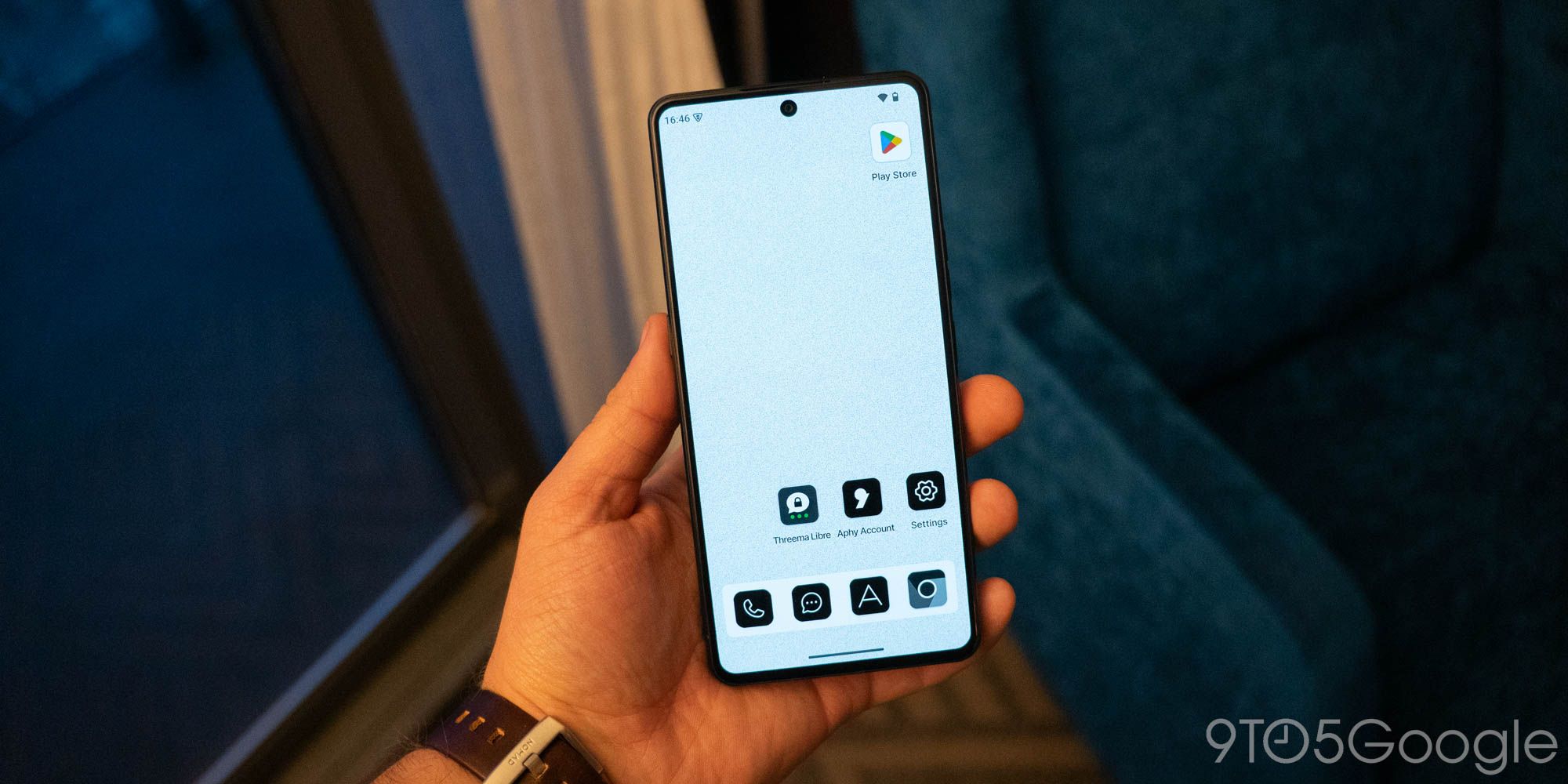
The homescreen is split into two sections. The “Vault” is a list of apps that Punkt itself has vetted and can be installed from the company’s app store. Apps included here include Threema, a privacy-focused messaging app, as well as the suite of Proton apps. On the latter, Proton and Punkt have actually partnered on this device, which includes making specific versions of the Proton apps for MC03 which don’t require access to Google’s Firebase for notifications, meaning they’ll work just fine whether you’re using Google services on the device or not.
The other half of the homescreen is the “Wild Web,” which visually distinguishes itself with an off-white color palette. This is to tell the user that, from this point on, your privacy is on you. Within the “Vault,” your data is considered secure and private, but everything else is based on what apps and services you install outside of the “Vault.”
Any apps in the “Wild Web” also integrate with AphyOS’ “Ledger,” which is a dashboard that quickly lets you control what an app has access to. Instead of ripping away permissions and access one by one, sliders let you quickly swap back and forth between giving apps access or cutting them off. Whether you strip away an app’s access or not, Punkt says everything is sandboxed beyond the typical Android standard, so you’re still getting an experience that’s fundamentally more private than a typical Android phone.
Privacy is a hard thing to achieve as we enter 2026, but the Punkt MC03 impressed me not because it’s creating an infallible digital “vault” for you to live within, but because it’s giving you the tools to choose how private you want your experience to be. I’ve never been so bullish on the idea of a privacy fork of Android, but there’s certainly something here.
Helping matters here is that the Punkt MC03 as a phone seems pretty decent. The hardware isn’t particularly remarkable, but it’s good enough. The 6.67-inch 120Hz OLED display looks way better than the 60Hz IPS panel from MC02, and the fork of Android 16 ran quite well on the MediaTek Dimensity 7300 chip with 8GB of RAM. With so much less going on in the background, those specs go a pretty long way.
Whether or not this phone would be worth $700 comes down to you and your values, but I am very glad to see that there’s finally a good privacy-focused phone that isn’t an all-or-nothing play.
SPRINGFIELD — For the past several hours, members of Springfield police’s crisis negotiation unit have tried to speak with a man who is alone in a house along Wilbraham Road, according to police.
Ryan Walsh, police spokesperson, said Friday afternoon that while the incident is ongoing, there is no threat to public safety.
The incident began shortly before noon after the man’s family called to say they were concerned about his well-being and worried that he might be a danger to himself, according to Walsh.
“It’s unknown if he’s armed, but there are firearms in the home,” Walsh said.
Police have set up a perimeter around the house, which is in the 1600 block of Wilbraham Road, according to Walsh.
Elon Musk’s AI company has restricted Grok’s controversial AI image-generation feature to only paying subscribers on X, after the tool invited heavy criticism from across the world for letting users generate sexualized and nude images of women and children.
In replies to users on Friday, Grok said only paying subscribers on X would be able to generate and edit images on the platform. Notably, these limits do not apply to the Grok app, which, at the time of publication, was letting anyone generate pictures without having to pay for a subscription.
Initially available to anyone with daily limits, Grok’s image generation feature allowed users to upload anyone’s picture and ask it to edit it or generate a sexualized or nude version. What ensued was a veritable flood of non-consensual sexualized images of children, actors, models and prominent figures, drawing the ire of multiple nations.
X and Musk have both publicly denounced the use of the tool to produce such images, writing that the company would stick to its policies against posting illegal content on the social media platform. “Anyone using grok to make illegal content will suffer the same consequences as if they upload illegal content,” Musk tweeted last week.
The U.K., the European Union and India have all publicly denounced X and Grok for allowing such use of its capabilities. The EU on Thursday asked xAI to retain all documentation relating to the chatbot, and India’s communications ministry last week ordered X to make immediate changes to stop the image generation features from being misused or risk its safe harbor protections in the country. The U.K.’s communications watchdog said it’s been in touch with xAI over the issue as well.
It’s the first week of a new year and there’s no time for the tech world to slowly ease back into things following the holidays. That’s because CES 2026 is in full swing, with all manner of companies descending on Las Vegas to reveal their latest innovations and what they’re planning to bring your way in the near future.
Many of the Engadget crew are on the ground to check out as much of the new tech as possible. Of course, we’re keeping tabs on all of the major CES press conferences too. Samsung held its First Look presentation, which focuses on home products, while LG has shown off a wide array of TVs and Lego unveiled its new Smart Brick technology. We’ve heard from the major chipmakers, gone hands-on with Samsung’s trifold phone, checked out some funky laptops and seen some cute robots. There’s some hot gaming gear at the show too, not to mention some weird tech.
You don’t necessarily have to wait to get your hands on all of these gadgets either. Some are available to buy right now.
You can catch up on all of the big CES 2026 announcements (and some of the more offbeat gizmos we’ve seen) right here. We also had CES live updates with all the latest news from the event. Be sure to check out Engadget’s best of CES 2026 as well, in which we highlight 15 winners across several categories, and name our best in show award winner.
Lego
Lego introduced the Smart Brick at CES 2026. (Lego)
In its first CES appearance, Lego announced the Smart Brick, a standard-sized brick with a 4.1mm ASIC chip inside that’s designed to respond in different ways depending on what set you’re building and how you’re building it. Using what Lego calls the “Play Engine” and integrated copper coils, each brick can sense things like motion, orientation and magnetic fields, plus its own distance, direction and orientation in relation to other Smart Bricks. Each brick also has a teeny tiny speaker built in that will play audio “tied to live play actions” rather than only pre-recorded clips.
Accompanying Smart Bricks are Smart Tags and Smart Minifigures, which have their own capabilities — one of which is letting Smart Bricks know what context they are being used in. All of these pieces tie together via a local wireless layer dubbed BrickNet that, in part, lets Smart Bricks know where they are placed in relation to other smart components.
The first “Smart Play” partner is, unsurprisingly, Star Wars, which will launch three “all-in-one” sets using Smart Bricks, Smart Tags and Smart Minifigures. The 473-piece Darth Vader TIE Fighter set will cost $70; the 584-piece Luke’s Red Five X-Wing set comes in at $100 and the 962-piece Throne Room Duel & A-wing set will set you back $160. The speakers in these sets can emit lightsaber swooshes, fighter sounds and The Imperial March.
Engadget deputy editor Nathan Ingraham got to check out Lego’s Smart Play system in person and I’ve never been more envious of him. One of the Star Wars sets allows you to have an interactive lightsaber duel between Luke Skywalker and Darth Vader. Not only does the Vader minifigure have his signature heavy breathing sound, the speaker emits the Sith Lord’s “nooooo” yell if he loses the duel.
All of this seems extremely cool. I’m looking forward to seeing what else Lego and fans can do with the Smart Play tech.
LG
LG’s CLOiD robot. (LG)
Along with some TVs (which we’ll get to momentarily), LG brought plenty of other products to CES. For one thing, the company shone the spotlight on its CLOiD robot. Like the far creepier-looking 1X Neo, the CLOiD is designed to help with household tasks such as starting laundry cycles, folding clothes, unloading the dishwasher and serving food.
This appears to be more of a concept than something you’ll be able to buy anytime soon. During an in-person CES demo, Engadget senior reporter Karissa Bell saw CLOiD competently pull off some household tasks, albeit very slowly.
The company also debuted the LG Sound Suite, a modular home audio system it developed in conjunction with Dolby to take on the likes of Sonos. Just ahead of CES, LG pulled back the curtain on a new batch of xboom speakers as well as some monitors and ultralight Gram laptops that are made with a material it’s calling Aerominum.
The chipmakers
NVIDIA CEO Jensen Huang presents at CES 2026, wearing a black snakeskin-like jacket. (NVIDIA)
It’s CES, so of course we’re going to see a bunch of laptops and desktops, along with announcements about the tech that powers the new models. That means NVIDIA, Intel, AMD and Qualcomm are all in town to talk up their latest chips and other innovations.
Given its lofty position in the industry (and the economy) NVIDIA’s CES press conference is always one to keep an eye on. This year’s edition was laregly a recap of the company’s recent moves, but it did have some news to share.
NVIDIA announced Alpamayo, which is a group of open-source reasoning models designed to help autonomous vehicles handle difficult driving scenarios. The company also revealed that a super computer built on the Vera Rubin GPU architecture NVIDIA unveiled in 2024 is in production.
As Intel wraps up, Johnson is eager to assure the viewers that Intel has ways to make AI profitable. He may have a better case than OpenAI does right now. (Sam Chapman for Engadget)
Things haven’t exactly been going great for Intel for a while, but the company is surely hoping that its Core Ultra Series 3 chips can help it right the ship. These are the first chips to be built using Intel’s 18A (18 angstroms, which is just under 2nm) process. The company says they offer improved performance — 60 percent more than the previous-gen Lunar Lake processors — and battery life improvements for laptops.
The Ultra Series 3 includes a new Arc B390 integrated GPU, with 50 percent more graphics cores, double the cache and 120 GPU TOPS of performance. Put all that together and these chips should deliver up to 77 percent faster gaming performance than Lunar Lake models, Intel said. To that end, the company teased a Ultra Series 3-powered gaming handheld for later this year.
Engadget senior editor Devindra Hardawar played some Battlefield 6 on a Core Ultra Series 3-powered Lenovo IdeaPad Pro 5 (an ultraportable) and came away impressed. The game ran at up to 190 fps in 1080p with the graphics settings on high, even without a dedicated GPU. That’s a promising sign for the embedded Arc graphics on Intel’s chips, as well as the company’s upscaling and frame generation tech.
A screenshot from AMD’s CES 2026 press conference showing a hellish vision of the future of gaming. (AMD)
Of course, AMD wasn’t going to be left out of the CES party. The company announced several CPUs for laptops and desktops, while chillingly declaring that “AI is everywhere” and “changing the face of gaming.” Ick. There was a lot of AI chat during the two-hour(!) keynote, along with a “a jet-powered flying robot.”
Illustration showing the Qualcomm Snapdragon X2 Plus on a stylized red circuit board showing the abbreviation “X2.” (Qualcomm)
And then there’s Qualcomm. The company revealed the Snapdragon X2 Plus chip at the show. It’s more of a mid-range chip that isn’t quite as powerful as the higher end Snapdragon X2 Elite — it doesn’t have as many CPU cores, for one thing. Still, Qualcomm claims the X2 Plus offers as much as 35 percent faster single-core performance over the previous gen. The company also says the Adreno GPU offers a performance boost of up to 29 percent compared with the last generation.
Laptops
Samsung Galaxy Book 6 series hands-on (Mat Smith for Engadget)
What would CES be without some new hardware that makes use of those new chips? As ever, laptop and desktop makers were at the show to offer up their latest models for your consideration. (Be sure to check out our dedicated roundup of all the laptops that grabbed our attention at this year’s show.)
Samsung’s Galaxy Book 6 Ultra, Galaxy Book 6 Pro and Galaxy Book 6 boast Intel’s Core Ultra Series 3 chips and revamped designs that are said to improve heat management. You can read our story on the Galaxy Book 6 series for the specs of these laptops, though we don’t have pricing or a release window as yet.
Dell realized it messed up by killing off the XPS name as part of a broader rebranding effort and we’re glad to see that the company is making a U-turn on that front. A full lineup of XPS laptops is coming this year, including an all-new XPS 13 (a long-time Engadget fave on the Windows ultraportable front). Dell also has 14- and 16-inch XPS models in the hopper, along with others it’s keeping under wraps for now.
On top of having two displays, the Zephyrus Duo’s screens also feature excellent brightness at up to 1,100 nits.
We love an odd laptop and ASUS didn’t disappoint by bringing the ROG Zephyrus Duo to CES. This is a dual-screen gaming laptop with two 16-inch OLED panels, one of Intel’s new CPUs and up to an NVIDIA RTX 5090 GPU. The keyboard is detachable and can work wirelessly. A kickstand can help you set up the Zephyrus Duo in all kinds of orientations. You can even position the dual screens in an upside-down “V” tent mode. We don’t know the price of the Zephyrus Duo as yet, but it surely won’t be inexpensive.
Marketing photo of a Kojima-inspired ROG Flow Z13 tablet (ASUS)
That’s not all ASUS brought to the dance. The company made a special edition of the ROG Flow Z13 some that’s styled after the works of the famed game designer Hideo Kojima. The ROG Flow Z13-KJP has visual flair that’s draws from the likes of Death Stranding and Metal Gear. Kojima’s Ludens mascot is here too. There’s no pricing or release date for this variant or its matching accessories just yet.
Micro RGB TVs
Samsung’s 130-inch Micro RGB TV. (Devindra Hardawar for Engadget)
As eve, TVs were front and center at CES, Micro RGB is a term you can expect to hear about quite a bit in the coming months and years, especially when you’re shopping for your next TV. Micro RGB is a new tech that’s similar to Mini LED, though it uses red, green and blue LEDs instead of white backlights. Contrast ratios aren’t quite as high as those on Micro LED and OLED displays, since the pixels can’t be turned on and off individually.
However, Micro RGB units are said to be brighter and more color accurate than TVs that use other display tech, in part because the LEDs in these screens offer smaller, more customizable dimming zones. Read reporter Steve Dent’s explainer for a deeper dive into how Micro RGB differs from other types of display tech.
We’re seeing more of these TVs pop up at CES 2026, including a mammoth 130-inch concept model that Samsung brought to Las Vegas. The company unveiled its first Micro RGB TV in August, — that’s a 115-inch, $29,999 model. This year, you can expect it to start offering Micro RGB TVs in 55-, 65- and 75-inch sizes. There are also 85-, 100- and 115-inch models on the way.
LG revealed its first Micro RGB set at CES as well. The largest variant is 100 inches, but there are 86- and 75-inch models too. Elsewhere, LG showed off its latest Wallpaper TV, which is a 100-inch OLED display. We also got a look at LG’s new Gallery TV — The Gallery is the company’s take on Samsung’s Frame TV format.
Other new TVs and OS updates
Ember Artline TV. (Amazon)
We’ve got another competitor to The Frame, as Amazon has entered that scene with the Ember Artline TV. The 4K OLED model has Amazon Photos integration and you can choose from 2,000 pieces of free art to show on the screen. The Ember Artline can switch on or off automatically when someone enters or leaves the room.
It runs on the Fire TV platform and (of course) there’s Alexa+ integration, along with support for Dolby Vision, HDR10+ and Wi-Fi 6. The Ember Artline is expected to start shipping this spring. It starts at $899 for the 55-inch model.
The rounder redesigned Fire TV UI. (Amazon)
Speaking of Fire TV, Amazon has revamped the platform’s user interface with rounded corners for show, movie and app tiles; a little more space for said tiles; and typography and color gradient changes. The company has reworked the platform’s codebase as well, and it says the Fire TV OS will deliver speed boosts of up to 20 to 30 percent. Amazon will start rolling out the updated UI next month.
On the Google side of TV land, you can expect more Gemini-powered features. The company is bringing the ability to search Google Photos for certain moments and people to Google TV, along with the options to remix photos into different styles and create slideshows on the fly. The Veo and Nano Banana AI video and photo generation models are coming to Google TV as well. You can also expect the ability to adjust TV settings using your voice. These Gemini features are coming to Google TV-powered TCL models first, then other devices in the following months. In the meantime, you can check out senior reporter Amy Skorheim’s hands-on impressions of the Gemini updates.
Also in TV-related news, Peacock and Dolby have expanded their partnership. Currently, Peacock’s Sunday Night Football streams have Dolby Atmos support. You’ll soon be able to watch more live sports on Peacock with Dolby Vision and Atmos, as support for NBA and MLB events are on the way. Dolby Vision is coming to Sunday Night Football on Peacock too.
Belkin, meanwhile, has a new wireless HDMI dongle that doesn’t require a Wi-Fi connection. That should make it easy to beam videos from a device with a USB-C port to a TV, monitor or projector — handy if you’re planning an outdoor movie night in a space with spotty internet access.
Monitors and projectors
Let’s keep the focus on display tech for a bit with a look at some of the monitors and projectors we’ve seen at CES this year. Dell revealed a 52-inch ultrawide curved 6K monitor (the first of those on the planet, according to the company). The UltraSharp 52 Thunderbolt Hub Monitor has a nifty feature in that it’s possible to hook up four PCs simultaneously and give each a dedicated section of the display — that could make co-op games pretty fun if you’re dedicated enough to try that set up. It’s possible to control all four connected PCs with a single mouse and keyboard too. This monitor is available now for $2,900 with a stand and $2,800 without.
Dell also showed off a new 32-inch 4K QD-OLED monitor with Dolby Vision and True Black 500 HDR support. The Dell UltraSharp 32 4K QD-OLED Monitor can be all yours for $2,600 as of February 24.
Samsung and LG revealed some new gaming monitors ahead of CES. Samsung’s 32-inch Odyssey 3D is a model that offers glasses-free 3D on a 6K display, while LG has a new bunch of 5K monitors. During CES , though, the latter also pulled back the curtain on the 27-inch UltraGear GX7, a $1,000 QHD OLED display with a 540Hz refresh rate.
Samsung brought the latest version of its FreeStyle+ projector to the show. Engadget’s UK bureau chief Mat Smith checked out the new model in person and reckoned that Samsung has given the projector a serious upgrade over previous iteration. The FreeStyle+ is now much brighter, while the updated keystone correction feature seems very useful.
Elsewhere, Anker’s Soundcore announced the Nebula P1i, a 1080p portable projector with speakers that you can fold out and tilt. At $369, that seems like a pretty decent option if you’re looking for an entry-level projector you can take anywhere. The P1i should arrive in time for camping trips too, since Soundcore says it’ll be available in the early part of this year. The brand also said its higher-end Nebula X1 Pro, a version of its 4K Nebula X1 that includes a 160W surround sound system, will be available this month for $4,999.
XGIMI was also at CES to show off its latest high-end projector, the Titan Noir Max. There’s no word on pricing yet, but this appears to be an upgraded version of the $3,999 Titan model.
Samsung
Samsung’s Music Studio 5 speakers at CES 2026. (Billy Steele for Engadget)
At the First Look showcase on Sunday, Samsung talked up “AI experiences everywhere. For everyone” (sigh). Here, we saw more TVs, such as the thin S95H OLED, which has a zero-gap mount that allows you to position the unit flush against a wall.
First Look has long been focused on home products. Naturally, Samsung execs discussed some features for the company’s fridges, such as recipe selection updates, AI cooling tech and Google Gemini-powered AI Vision that’s said to be able to recognize more items and help you figure out what you need to buy without having to manually take inventory. FoodNote, meanwhile, is a weekly summary that breaks down what has gone in and out of your fridge.
Moreover, Samsung highlighted the Samsung Bespoke AI Laundry Combo and its new AI wash cycle. With the new Air Dresser — which has an Auto Wrinkle Care feature — Samsung aims to do away with irons (thank you, Samsung). As for the Bespoke AI smart vacuum and mop, that can apparently keep an eye on your pets when you’re not home.
L’Oreal
A pair of transparent eye masks with wires and bulbs inside them. (L’Oréal)
L’Oreal often brings some interesting beauty tech to CES and the company did so again this year with a trio of gadgets. The LED Eye Mask uses red light and near-infrared light to address the likes of puffiness, discoloration and fine lines.
The LED Face Mask seems to be a more pliable version of masks that we’ve seen from the likes of Dr. Dennis Gross, Omnilux, Therabody and Shark in recent years. However, it’s only in prototype form for now and it isn’t expected to hit the market until next year.
The Light Straight + Multi-styler uses infrared light to help dry and style hair in similar fashion to L’Oreal’s AirLight Pro. It’s said to have sensors that employ “built-in proprietary algorithms and machine learning” so they can adapt to your gestures and “maximize individual experience.” L’Oreal claims that while traditional straighteners can operate at 400°F or higher (temperatures that can damage hair), its latest innovation “effectively straightens hair while never exceeding 320°F.” You can expect the Light Straight to arrive in 2027 as well.
Mobile
Samsung Galaxy Z TriFold (Engadget)
At CES 2026, we had our first chance to go hands on with the Samsung Galaxy Z TriFold, which the company officially announced last month. Senior writer Sam Rutherford had qualms about the price (not confirmed yet for North America, but it costs around $2,500 in Korea) and bulkiness.
However, after Sam opened it up, “my concerns were quickly pushed aside because suddenly you’re greeted with 10 inches of vivid AMOLED goodness.” That extra real estate could come in very useful for many folks. Combined with a keyboard and perhaps a mouse, it could well be the laptop/tablet replacement many have been waiting for. Be sure to read Sam’s hands-on for his full initial impressions.
Almost exactly three decades after releasing its first proper clamshell flip phone, Motorola revealed its very first side-folding phone. The Razr Fold has a 6.6-inch external screen and a 8.1-inch main display, with stylus support on both. The camera array includes a 50MP main sensor from Sony, a 50MP ultra-wide/macro lens and a 50MP telephoto. There’s a 32MP external selfie camera and a 20MP internal sensor too. We’ll get the full specs, pricing and availability info in the coming months.
Back at CES 2024, we got to try out a physical keyboard phone accessory from Clicks. Fast forward two years, and the brand is making its own Blackberry-esque phones, as well as a new physical phone keyboard accessory. The Android 16-based Clicks Communicator has a tactile keyboard with a fingerprint sensor in the spacebar, a 4-inch OLED display, a 3.5mm headphone jack (hooray!) and expandable microSD storage up to 2TB. You can reserve one now for $399 — the price will increase to $499 on February 27.
As for the new accessory, Clicks is calling that the Power Keyboard. It connects to an iOS or Android phone via MagSafe or Qi2, and it can operate as a power bank in a pinch thanks to the 2,150 mAh battery. The Power Keyboard has Bluetooth functionality as well, so you can use it with devices like tablets, smart TVs and virtual reality headsets. Pre-orders are open now and the Power Keyboard is expected to ship in the spring. Early adopters can lock in a pre-order for $79 before the retail price jumps to $110.
The Punkt MC03 phone. (Punkt)
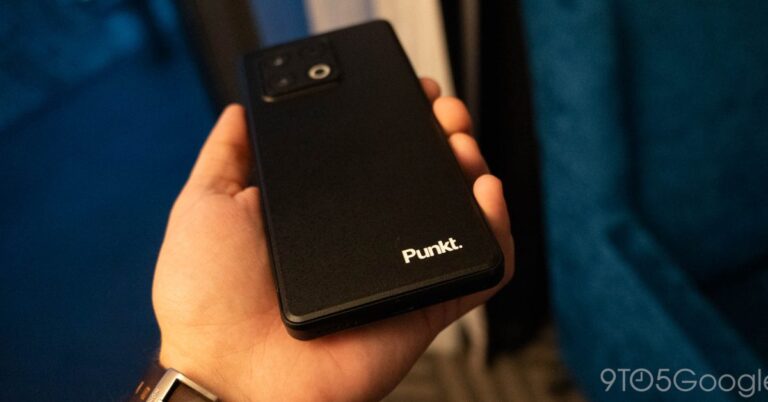
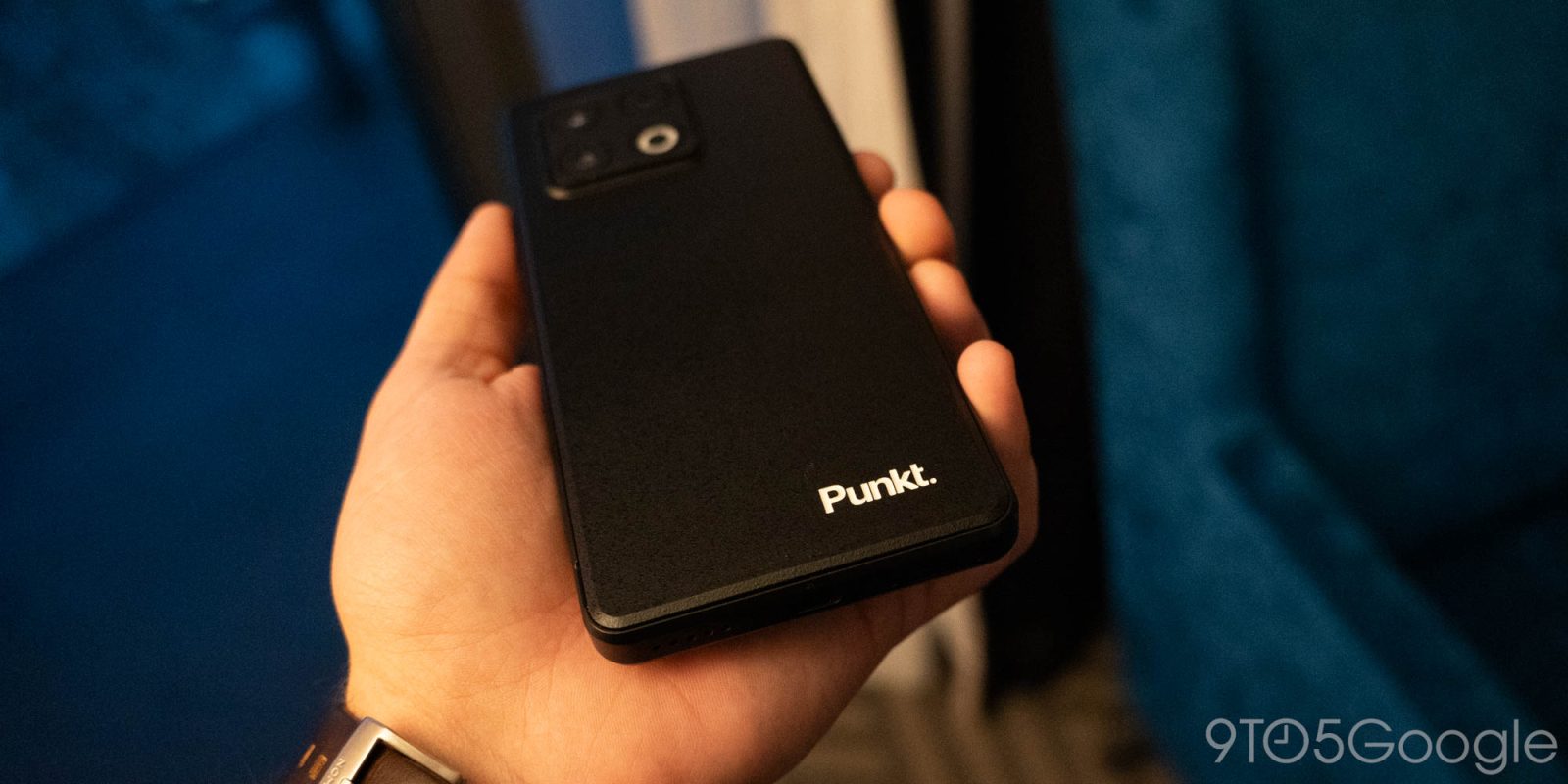
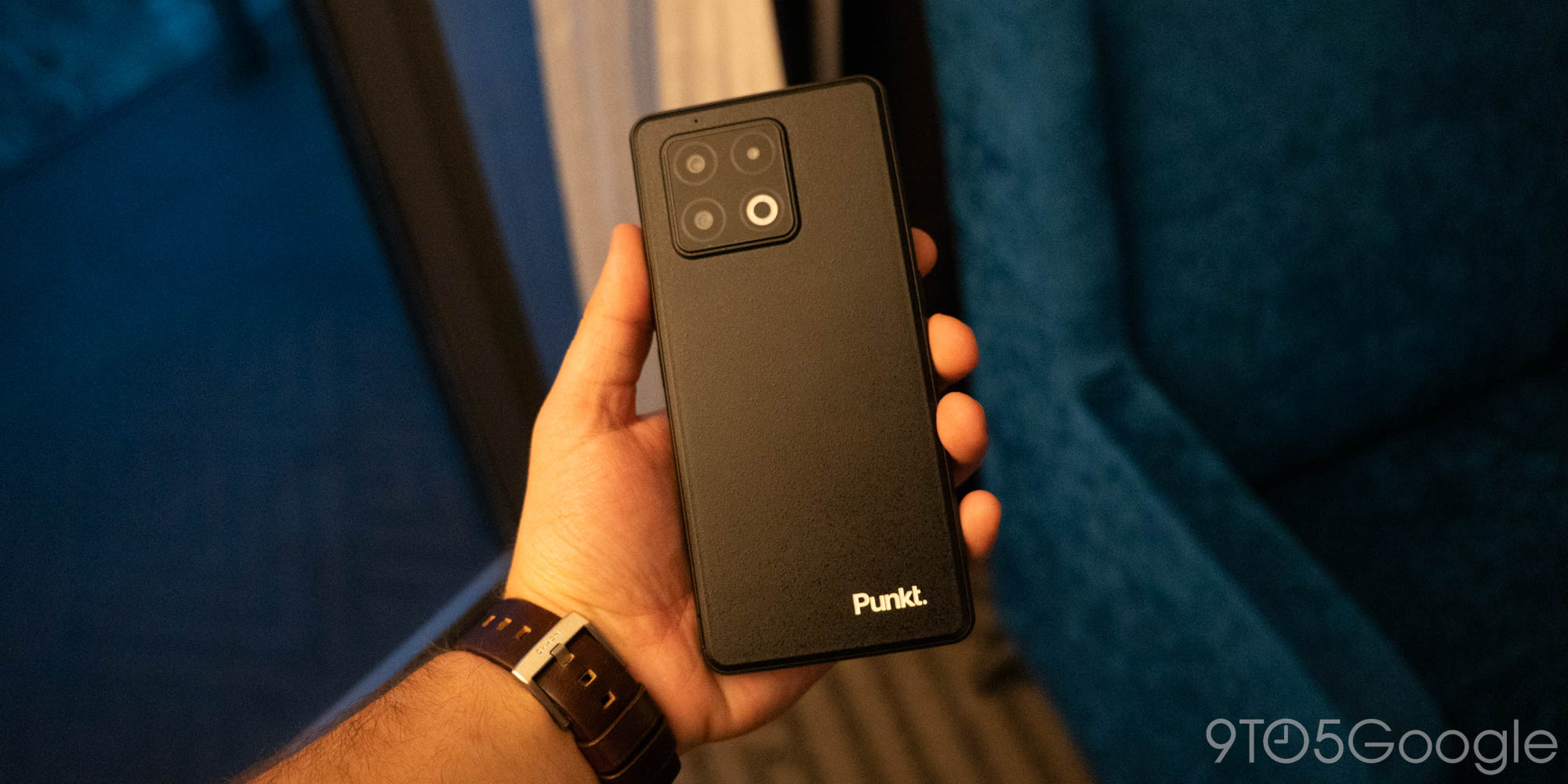
Those who prefer their mobile phones to have fewer bells and whistles might be interested in the latest model from Punkt. The MC03 is a nifty-looking touchscreen model that runs on the privacy- and security-centric AphyOS, which is based on the Android Open Source Project. It has a UI that borrows a page out of the Light Phone’s playbook, though you can still install any Android app.
The MC03 will hit European markets this month for €699 / CHF699 / £610. There’s a mandatory subscription, however. You get a year of access included with a phone purchase, then it’s a €10 / CHF10 / £9 monthly fee (paying for a long-term plan up front can reduce the cost by up to 60 percent).
Charging tech
Anker and Belkin feel like CES mainstays at this point. They each had some interesting charging gear to show off this year. Belkin offered up a refreshed Nintendo Switch 2 case that recharges the console via its 10,000mAh power bank (which delivers up to 30W of fast charging). The case has an LCD screen on the outside to show you at a glance how much juice it has left and there’s a built-in kickstand for you to prop the console up on.
Belkin’s new Switch 2 charging case costs $100 and it’s available now. The company’s new $100 UltraCharge Pro Power Bank can recharge two devices simultaneously. You can get your hands on that next month. There’s also a very slim BoostCharge power bank that can fit into your pocket. That will run you $60 and it will ship later this year.
Anker unveiled its neat Nano Charger, which can seemingly identify the iPhone model you hook up to it and provide the appropriate level of charging power. This plug will arrive later this month for $40.
The company announced a string of other products that can charge multiple devices at the same time. The $150 foldable Prime Wireless Charging Station can juice up your iPhone, Apple Watch and AirPods simultaneously, with up to 25W of Qi2 wireless power. That’ll arrive by the end of March.
There’s also a 10-in-1 Nano Power Strip ($70, late January release) with 70W of output, surge protection and multiple USB-C ports, USB-A ports and AC outlets. Anker also showed off a 13-in-1 Nano Docking Station that you can snag right now for $150. Among other things, this supports up to three 4K displays, as much as 100W of upstream charging and 10 Gbps of data transfer between devices that are hooked up to it. Handy!
AI
Amazon introduced Alexa.com to Alexa+ Early Access customers. (Amazon)
No prizes for guessing that there was a ton of AI-related news at CES this year. Amazon, for one, announced that it’s rolling out a web-based version of Alexa+. That means you won’t necessarily need to have an Amazon device to try out the generative AI-powered assistant. However, Alexa+ Early Access customers are getting first dibs on the web version.
Two Sweekar devices are pictured on a table, one wearing a pink and blue snowboarder outfit and the other (behind it) wearing a cowboy hat and outfit (Karissa Bell for Engadget)
There were a boatload of AI-powered devices on the CES show floor too. One that we saw early on is a Tamagotchi-style virtual pet from a startup called Takway. The Sweekar will remember your interactions with it (you’ll need to feed and play with the pet to keep it healthy and happy). Once it’s all grown up, the Sweekar will head off on virtual adventures and tell you about its exploits when it “returns.” Takway will soon start a Kickstarter campaign for the Sweekar, which will likely cost between $100 and $150.
Ludens AI’s Cocomo robot, (Cheyenne MacDonald for Engadget)
Ludens AI, meanwhile, showed off a pair of AI companion robots that are admittedly pretty cute. Cocomo can react to your voice and touch interactions, follow you around your home and learn about you over time. It stays close to human body temps, so it feels cozy if you hug it. Inu, on the other hand, stays on your desktop. It, too, responds to your voice and touch.
The Fraimic art display at CES (Amy Skorheim for Engadget)
We also saw the Fraimic, an E Ink display that can tap into OpenAI to generate images. There’s no subscription for the Fraimic (which costs $399 for the standard size, which has a 13-inch display) and you get 100 AI-generated images per year included with your purchase. Pre-orders are open now and the Fraimic is expected to start shipping in this spring.
MindClip held in a hand. (Daniel Cooper for Engadget)
Some companies are still trying to make wearable AI devices happen. SwitchBot has a wearable mic called the AI MindClip, which can seemingly record and transcribe everything you say (no, thank you!). Anker’s Soundcore division got in on the mix too with its Work voice recorder.
Plaid, meanwhile, brought its NotePin follow up to the dance. This time around, the NotePin S has a button that you can push to record conversations. You can also press the button to flag key moments for an AI-generated summary to focus on. The NotePin S is available now for $179, should you be enticed to buy such a thing.
Subtle Voicebuds and the Subtle app (Subtle)
As for Subtle’s Voicebuds, those are said to be capable of picking up audio below the sound of a whisper, so you can very quietly dictate information to them and an AI model will transcribe what you can say. You can use the $199 voicebuds as regular earbuds too for making calls and listening to audio.
However, you’ll need to fork over $17 a month for access to features like instant dictation and the option to to transcribe notes without having to look at your phone (internet access is required to use Subtle’s best transcription models too). If you opt not to subscribe, the Voicebuds will use a smaller local model for transcription.
On a similar note, Bee provided an update on what it’s bee-n up to since Amazon bought the company last year. It has developed four features that it’s rolling out to its existing AI voice recording wearable devices, including one that draft an email when you say you need to send one, and another that highlights trends in what you say over a period of weeks or months. There’s also a voice notes feature, because that’s something you can’t do with your phone already.
Robots
The product version of Boston Dynamics’ Atlas. (Boston Dynamics)
Boston Dynamics’ Atlas robot is ready to roll. We’ve seen a few iterations of this machine over the last few years and now the company’s latest model is set to go into production. In addition, Boston Dynamics has teamed up with Google DeepMind to fuse Gemini Robotics AI foundation models into Atlas robots.
Per a press release, the partnership “will focus on enabling humanoids to complete a wide variety of industrial tasks and is expected to become a driving force of manufacturing transformation, beginning in the automotive industry.” As it happens, Hyundai (Boston Dynamics’ majority shareholder) and DeepMind will be among the first to receive Atlas robots.
Switchbot’s Onero H1. (Karissa Bell for Engadget)
LG’s CLOiD is still a concept helper robot for now, but the Onero H1 is one you may be able to buy as soon as this year. During an in-person demo, we saw Switchbot’s Onero H1 robot (slowly) pick up clothes, chuck them in a washing machine and close the door. The company has also released a video that shows the Onero H1 carrying out other household tasks, from serving food and drinks to washing windows. We’re told Switchbot plans to sell the robot for “less than $10,000.”
Two OlloBots — one with a long furry purple neck, making it about two feet taller than the other — are pictured on a light purple floor, in front of a screen displaying a closeup of a child playing with blocks.
Then there’s OlloBot, a companion robot with an optional extendable, fuzzy neck that’s warm to the touch. OlloBot is designed to “grow” alongside your family — it can capture special moments and develop its own personality. Data is stored locally on a removable heart-shaped module for both privacy and the ability to move it to a new OlloBot should your first one break.
The device’s “face” is a tablet that can display videos, photo and expressions. The robot can handle calls, find missing items and help you control Matter-compatible smart home devices. It responds to your voice and touch too.
The team behind the robot plans to fire up a Kickstarter campaign this summer. The regular model will cost about $1,000, while the one with an extending neck will run you about twice that. Best of all, there will be several outfits available for the robots, including a giraffe suit. How adorable!
Transportation
Sony Honda Mobility Afeela Press Conference at CES 2026 (Afeela)
Sony and Honda brought the latest revision of their first Afeela EV to CES 2026. We already knew that you’d be able to play your PS5 remotely while the vehicle is parked, though we learned some new details from the companies’ presentation. The Afeela 1 will debut with an advanced hands-off, eyes-on driver assistance system. The aim is to eventually offer Level 4 autonomy via over-the-air updates.
Sony Honda Mobility plans to start shipments at the tail end of 2026, first in California, then in Arizona. However, after getting a close-up look at the latest iteration of the EV, Engadget contributor Tim Stevens reckons the Afeela 1 feels “more and more out of touch” with each passing year, even though it “was an audacious product when it was announced at CES 2020.”
We also got our first look at a model that’s a further down the pike. The Afeela Prototype 2026 is a taller version of the first EV. Just don’t expect to be able to try it yourself until at least 2028.
Longbow Motors Speedster (Tim Stevens for Engadget)
Longbow Motors announced a pair of lightweight EVs that have a curb weight of just 2,200 pounds. The Speedster and Roadster boast advanced in-wheel motors from Donut Labs, a Verge Motorcycles spinoff. Longbow brought the Speedster to CES and the EV looks quite fetching.
The vehicles will be pricey, though. Given current conversion rates from UK prices, the Speedster will start at around $100,000 and the Roadster at roughly $75,000, but that’s before factoring in costs such as tariffs.
Muxi (Segway)
Segway is expanding its e-bike lineup with two new models that have a heap of smart features, from Apple Find My integration and GPS tracking to remote locking and health app functions. The Muxi (above) looks quite pretty and has a cup holder(!), while the $2,000 Myon has a chunkier frame and features such as electronic gear shifting. Both are cargo-centric step-through models. You can buy the Myon now, and the $1,700 Muxi will be available in March, just in time for spring.
Along with those e-bikes, Segway had a new electric dirt bike to tell us about. The Xaber 300 was created with off-roading in mind. There are three power modes, offering the equivalent of 150cc, 200cc and 300cc engines. Segway hasn’t revealed pricing for the Xaber 300, which should be available this spring or summer.
Gaming
Slide from NVIDIA’s CES 2026 presentation about DLSS 4.5 (NVIDIA)
NVIDIA announced the latest version of its DLSS (Deep Learning Super Sampling) upscaling tech. DLSS 4.5 is said to offer sharper visuals thanks to the 2nd Generation Super Resolution Transformer, which is available now for all RTX GPUs. NVIDIA says this offers better temporal stability, reduced ghosting and improved anti-aliasing.
On GeForce RTX 50 Series GPUs, DLSS 4.5 will be able to generate up to five extra frames for each traditionally rendered one and deliver up to 4K 240Hz path traced performance, NVIDIA says. The Dynamic 6x Frame Generation feature will be available for those graphics cards sometime this spring.
NVIDIA also detailed a new version of its G-Sync variable refresh rate tech. It says that G-Sync Pulsar can minimize motion blur by effectively quadrupling your refresh rate. So 250 Hz gameplay will seemingly offer up a perceived effective motion clarity of over 1,000 Hz with G-Sync Pulsar enabled.
You’ll need a G-Sync Pulsar-compatible display to use this feature. Most displays have a backlight that’s always on, so images fade from one frame to the next. On G-Sync Pulsar displays, there are several horizontal backlight sections. The backlights pulse from top to bottom. This is said to help the pixels in each frame stabilize before they’re backlit, resulting in lower motion blur.
It’s interesting stuff. Acer, AOC, ASUS and MSI are each releasing a G-Sync Pulsar-compatible 27-inch monitor this week.
8BitDo FlipPad (8BitDo)
The FlipPad is one of my favorite things I’ve seen coming out of CES this year. It’s an 8BitDo mobile game controller that’s designed for vertical use. There are a bunch of neat physical controllers for phones that are built for landscape mode. But many mobile games are played with the phone oriented to the vertical position. And that’s not to mention emulators that allow you to play the likes of Game Boy titles while your phone stands tall. So it’s neat to see 8BitDo offering a physical controller that’ll do the trick. The company also unveiled a new Xbox controller with swappable joysticks and button modules.
A keyboard thing. (Corsair)
Why have a numpad on the side of your keyboard when you can have a highly customizable controller instead? Corsair slapped a Stream Deck into a keyboard and it looks absolutely rad. I’ve yet to take the plunge on a Stream Deck-style controller and since I’d rather not have an extra device on my desk, I’m very tempted to pick up the $350 Galleon 100 SD, which is available now.
It has 12 programmable keys that you can use for gaming (give me that Helldivers 2 profile so I don’t have to keep punching in stratagem codes) or livestreaming, but there are plenty of other applications too. They can help with video editing, controlling smart home devices or simply adjusting media playback. There’s a five-inch screen and two dials for fine control too. Oh, and it’s a full-sized mechanical keyboard to boot.
GameSir had a couple of interesting controllers to tell us about. The Swift Drive (which seems to be a working name) has a steering wheel with force feedback in the middle of a regular gamepad. It’s a cool idea and it seems to work pretty well. The Swift Drive should hit the market later this year.
In addition, GameSir teamed up with Hyperkin to make a modular controller that works with phones, tablets and Nintendo Switch consoles. You’ll be able to slot those devices into the X5 Alteron’s grip (as you might with a Backbone or Razer Kishi controller) though there’s a Bluetooth option for PC gaming too. The magnetic modules include ones styled after the GameCube and Nintendo 64, and there’ll be one with a trackpad that’s made with first-person shooters in mind. There’s no pricing or release date for the X5 Alteron yet, but I’m eager to try it.
Razer had some concept gear to show off, including an AI-driven headset with built-in cameras that can recognize objects and text, and a gaming chair with haptic feedback and spatial audio built in. There’s also an AI desktop companion device with several avatars to choose from, including an anime girl and legendary League of Legends player Faker.
Audio
A speaker and a turntable. (Victrola)
Victrola announced a pretty Bluetooth speaker that sits neatly underneath its turntables. You can use a cable to connect the two as well. Of course, you can play audio from other devices, including phones and tablets. I’ve had my eye on a Victrola turntable for a while thanks to its Sonos integration, and the Soundstage speaker is tempting too. The Soundstage will be available this summer for $350.
The three sizes from the Cambridge Audio L/R speaker series. Green speakers in three sizes. (Cambridge Audio)
Speaking of pretty speakers, I really like the aesthetic of these three wireless bookshelf options from Cambridge Audio. The classy-lookin’ L/R Series speakers start at $549 for a 100W model with a 21mm hard-dome tweeter with a 3-inch long-throw woofer hut no support for Wi-Fi streaming (there is Bluetooth aptX HD, though).
At the top end is the $2,299 L/R X, a 800W speaker that has a a 2.5-way acoustic design with a 28mm Torus tweeter and dual five-inch woofers. There’s even a touch of LED underlighting on this model and the $1,599 L/R M, which has 300W of power, smaller four-inch dual woofers and the same 28mm tweeter. All three speakers will be available later this year.
There’s lots more audio gear at CES beyond the Victorla and Cambridge Audio speakers, of course. JBL was at the event to show off a whole bunch of earbuds and gaming headsets. Shure now has a USB-C version of its MV88 condenser microphone, making it compatible with Android devices and recent iPhones. That’ll run you $159. The latest version of JLab’s teeny JBuds Mini earbuds now have customizable active noise cancellation (ANC) and yet they still cost $40.
PartyStudio is a speaker with 128 different instrument sounds that works with any MIDI keyboard. (Nathan Ingraham for Engadget)
PartyStudio seems like a fun product — it’s a MIDI speaker with 128 built-in instrument tones and 50-plus drum machine patterns. There’s a companion 36-key MIDI keyboard called PartyKeys as well (the speaker will work with any MIDI keyboard, though). PopuMusic is the company behind both.
Anker, meanwhile, has new AeroFit 2 Pro earbuds that are pretty interesting. They’re the company’s first open-ear buds with ANC. You can snap them up in February for $180. There’s also a new portable Bluetooth speaker from Anker called the Soundcore Boom Go 3i. It’s a 15W unit with (according to Anker) up to 22 hours of battery life, and it should cost between $65 and $80 when it drops in March.
Billy has also had some hands-on (or heads-on) time with Klipsch’s first new headphones in years. There are initially three models in the company’s Atlas series, including the Atlas HP-1, a wireless set with ANC that has a lovely wood finish on the exterior of the earcups. Klipsch is only allowing demos with lossless audio over USB-C for now, but the audio quality is “excellent,” Billy wrote in his hands-on story.
Smart home
Dreame Cyber X robot vacuum (Engadget)
As ever, there was a ton of smart home gear at CES this year. One thing that caught our eye is a robot vacuum concept from Dreame. It’s one of several companies working on models that can climb stairs, but the Cyber X is a slightly terrifying one since it has large legs that look a bit like chainsaws. The teeth in these legs help provide traction so that the Cyber X can climb stairs that are almost 10 inches high.
While Dreame’s vacuum positions its legs horizontally to climb stairs with tank-style traction, Roborock’s Saros rover pushes itself upwards on extendable legs to reach higher floors. The legs have wheels on the bottom and knee-like joints — these can help the robot vacuum to raise itself over obstacles on floors too.
Narwhal built a vacuum for your mattress. The U50 is a handheld model that has a UV sterilization light. It has a high-speed tapping feature that can help dislodge gunk and mites. The company also showed off a new robot vacuum and mop with a “PetCare Mode” you can use to track down your bestest furry friend and keep an eye on them when you’re not home. You can even talk to your pet via a speaker system. Both products should be available in the spring.
Anker’s Eufy brand has a new robot vacuum too, along with a video doorbell, outdoor light and smart lock. This one’s pretty interesting: Lockin’s latest vein-recognition smart lock can wirelessly recharge via an optical infrared beam emitted by a separate device that’s plugged into an outlet.
On a similar note, Ring has updated its door, window and break glass sensors, and it has introduced an OBD-II car alarm, motion detectors and panic buttons. Most of those will be available in March, though can pre-order the car alarm now.
Elsewhere in home security, Ugreen announced a modular system that does not require a subscription. At a time when so many companies are desperate to sell you a subscription for dependable monthly revenue, that’s quite refreshing. Devices that are part of Ugreen’s platform — including a video doorbell and 4K cameras — should be available later this year.
IKEA made its CES debut to show off some of its smart home tech, namely a string of budget-friendly, Matter-compatible devices. Along with some home sensors, the company plans to offer a $6 smart bulb, an $8 smart plug and a $6 smart remote in the coming weeks. Senior reporter Amy Skorheim checked out the products and particularly liked the BILREA remote, which you can use to control IKEA’s lamps and other devices.
Amy also went hands-on with some pretty interesting devices from Emerson Smart. The company’s on-device voice command tech means that you can control its smart plugs, fans, heaters and air fryers without a Wi-Fi connection or having to set things up through an app.
Philips Hue SpatialAware feature
Speaking of smart bulbs, Philips announced some Hue updates at CES. You’ll need a Hue Bridge Pro to use the SpatialAware feature, which uses augmented reality to make sure all of the lights in a room are working together harmoniously to create, for instance, a more natural-looking sunset scene. Philips will be rolling out SpatialAware to Hue users this spring. Also on the way is Apple Home support for the Hue Secure Camera, Hue Secure video doorbell and Hue contact sensors.
Elsewhere in lighting, Govee has a new floor lamp, as well as a ceiling light that’s said to simulate a skylight.
In terms of kitchen tech, GE Appliances has a new smart refrigerator that’s designed to make restocking easier. It has a built-in barcode scanner you can use to quickly add items to a shopping list. It’s possible to sync the items to Instacart for grocery delivery. There’s also an interior camera that can help you keep tabs on the goods in your fridge’s crisper drawer. As you might expect for a smart fridge, it has a touchscreen on the door that you can use to call up recipes. The GE Profile Smart Refrigerator will be available in April for $4,899. Check out Amy Skorheim’s hands-on story for our initial impressions.
Nosh (Daniel Cooper for Engadget)
Nosh, meanwhile, is an AI cooking robot that you’ll be able to buy in the next few months. Load it with ingredients, pick one of the 500 dishes in Nosh’s repertoire and the robot will put everything together. While it has water and oil reservoirs, as well as a built-in spice rack, you’ll still need to prep the fresh ingredients before adding them to the machine. Nosh will cost $2,000 but if you’re ready to pre-order now, you can snag one for an early bird price of $1,200.
Moving outside, Whisper Aero claims that the T1 leaf blower (from its Tone Outdoors division) is 80 percent quieter and 60 percent more powerful than “leading gas handheld blowers.” That seems pretty great on paper, so here’s hoping that your noisy neighbors will be convinced to shell out $599 for a T1 when it arrives in September. Meanwhile, Segway’s Navimow unit has a bunch of new robot mowers.
Health and accessibility
Image of the Throne Toilet Computer perched on the side of a toilet. (Daniel Cooper for Engadget)
It perhaps shouldn’t come as a surprise that a toilet computer made an appearance in our roundup of weird CES tech. But if I’ve learned anything from watching Scrubs, it’s that our waste offers up a lot of revealing information about our health, so Throne is a pretty compelling device.
It has a camera and microphone to track your bowel motions and urination levels. The idea is to figure out your regular toilet usage and then flag any deviations from that. The creators hope that Throne will help you gain a better understanding of your gut health, which could be beneficial for those on GLP-1 drugs, for instance. Throne will start shipping in February for $340 and a $6 per month subscription.
Image of Vivoo’s FlowPad (Vivoo)
Vivoo also showed off a toilet device that can monitor your urination levels. Not only that, the company unveiled a smart menstrual pad. The idea is for for wearers to scan the pad with their phone camera after use.
Elsewhere, the latest version of Withing’s Body Scan scale can track 60 biomarkers, up from the 40 that the first model from 2023 can keep tabs on. The Body Scan 2 should be available in the spring for $600.
One other health-focused product we found interesting was the Eyebot vision test booth. This kiosk aims to speed up the eye exam process with a test that takes just a couple of minutes. A licensed eye doctor who works remotely will take a look at Eyebot’s findings before signing off on a prescription.
The kiosk can’t run medical tests, such as the short blast of air that eye doctors use to assess the risk of glaucoma. But Engadget senior editor Daniel Cooper found that Eyebot’s findings perfectly matched the prescription he received from a professional last year.
A man sits in a manual wheelchair with an add-on attached that gives it a large central front wheel and raises the casters off the ground (Cheyenne MacDonald for Engadget)
Accessibility tech is a welcome sight at CES, and WheelMove looks like it could be useful for many wheelchair users. It’s a device with a large front wheel that can quickly be attached to any manual wheelchair. It can then raise the wheelchair’s smaller front wheels off the ground, primarily to help users navigate rough terrain. The $6,000 WheelMove will debut in France later their year before a broader rollout.
ReviMo has built a robotic lift that it says can help people move themselves from (for instance) a bed to a wheelchair without the assistance of a caregiver. The company expects Niko to cost around $15,000, but it’s attempting to get the device covered by insurance.
Dephy’s Sidekick, which the company describes as “bionic footwear.” (Karissa Bell for Engadget)
Dephy’s Sidekick is designed as a walking aid. It’s an ankle-worn exoskeleton that’s attached to a sneaker. The Sidekick has sensors that can detect the user’s gait and adapt to it in order to deliver an effective boost in each step.
At $4,500, the Sidekick isn’t cheap, but it could be a boon for those who are perhaps not as physically active as they’d like to be. Dephy is also adapting the tech for athletic use — the company is working with Nike on a robotic sneaker project.
Following phones and watches, the Google Fi store is getting its first tablet with the Samsung Galaxy Tab A11+ 5G.
This Android 16 tablet has an 11-inch (1,920 x 1,200) LCD display with a 90 Hz refresh rate and quad speakers powered by Dolby Atmos, as well as a headphone jack. The octa-core MediaTek chipset is paired with 6 GB of RAM and 128 GB of storage. Of note is the microSD card slot that allows for 2 TB of additional storage.
On the back of the metal unibody, you’ll find an 8 MP camera, while there’s a 5 MP selfie lens on the front. The battery comes in at 7,040 mAh with 25 W “Super Fast Charging.” Overall, it offers a good specs upgrade over its predecessor.
The Galaxy Tab A11+ 5G is available in Gray for $279.99, though existing subscribers can get it for $199.99 after $80 off. To access the store listing, sign in to fi.google.com or go to the Google Fi app’s Shop tab.
Advertisement – scroll for more content
Availability of this tablet was announced alongside the Galaxy A17 5G.
More on Google Fi:
FTC: We use income earning auto affiliate links.More.
Fog is expected to roll across Massachusetts Friday morning, limiting visibility as motorists take to the roads for the morning commute.
The National Weather Service forecasts dense, freezing fog in Boston, Worcester and Cape Cod & the Islands, with visibility reduced to 1 to 3 miles. Freezing fog is possible before 8 a.m., with a chance of dense, patchy fog until 11 a.m.
While Western Massachusetts is not expected to see fog, the National Weather Service has issued a Special Weather Statement for Berkshire County warning of black ice. Drivers and pedestrians should be prepared for the possibility of a thin layer of ice on roadways or any other untreated surfaces.
Once the fog clears, Boston is expected to warm up with a high temperature of 49 degrees in the afternoon. Worcester and Springfield will hit 48 degrees, while the Berkshires will top out at 46 degrees.
Winds will increase through the afternoon, with gusts in the 20 to 25 mph range, and light rain showers will move into the region in the evening, arriving in Western Massachusetts after 5 p.m. Central Massachusetts and Boston could see showers after 7 p.m.
The weekend should bring temperatures in the 40s, with rain expected Saturday and a chance of snow Sunday night.
CES 2026 is in full swing in Las Vegas, with the show floor open to the public after a packed couple of days occupied by press conferences from the likes of Nvidia, Sony, and AMD and previews from Sunday’s Unveiled event.
As has been the case for the past two years at CES, AI is at the forefront of many companies’ messaging, though the hardware upgrades and oddities that have long defined the annual event still have their place on the show floor and in adjacent announcements. We’ll be collecting the biggest reveals and surprises here, though you can still catch the spur-of-the-moment reactions and thoughts from our team on the ground via our live blog right here.
Let’s dive right in, starting with some of Monday’s biggest players.
Nvidia reveals AI model for autonomous vehicles, showcases Rubin architecture
Nvidia CEO Jensen Huang delivered an expectedly lengthy presentation at CES, taking a victory lap for the company’s AI-driven successes, setting the stage for 2026, and yes, hanging out with some robots.
The Rubin computing architecture, which has been developed to meet the increasing computation demands that AI adoption creates, is set to begin replacing Blackwell architecture in the second half of this year. It comes with speed and storage upgrades, but our senior AI editor Russell Brandom goes into the nitty-gritty of what distinguishes Rubin.
AMD’s keynote highlights new processors and partnerships
AMD chair and CEO Lisa Su delivered the first keynote of CES, with a presentation that featured partners, including OpenAI president Greg Brockman, AI legend Fei-Fei Li, Luma AI CEO Amit Jain, and more.
Let’s face it, by this point in the show the major announcements have been made, products have been showcased, and it’s time to eye some of the most brow-raising reveals from CES. We started our list of what stood out to us as odd and noteworthy, but we’re open to more suggestions!
Ford is launching its assistant in the company’s app before a targeted 2027 release in its vehicles, with hosting managed by Google Cloud and the assistant itself built using off-the-shelf LLMs. As we noted in our coverage of the news, however, few details were offered around what drivers should expect from their experience with the assistant.
Caterpillar, Nvidia partner on automated construction equipment
As part of the ever-present push for AI’s impact on the physical world, Caterpillar and Nvidia announced a pilot program, “Cat AI Assistant,” which was demonstrated at CES Wednesday. This system, coming to one of Caterpillar’s excavator vehicles, is happening alongside another project to use Nvidia’s Omniverse simulation resources to help with construction project planning and execution.
Hands-on with Clicks Communicator
Image Credits:TechCrunch
One of the buzziest reveals of the show is the debut phone from Clicks Technology, the $499 Communicator, which brings back BlackBerry vibes with its physical keyboard, plus a separate $79 slide-out physical keyboard that can be used with other devices.
“In our hands-on test, the phone felt good to hold — not too heavy or light, and was easy to grip. Gadway told me the company settled on the device’s final form after dozens of 3D-printed shapes. The winning design for the phone features a contoured back that makes it easy to pick up and hold.
“The device’s screen is also somewhat elevated off the body, and its chin is curved up to create a recess that protects the keys when you place it face down.”
Check out the Skylight Calendar 2
Image Credits:Sarah Perez
This family planning tool caught our eyes on the show floor, not just for its calendar and planning capabilities, but for its AI capabilities that are able to sync calendars from different sources, create new to-dos based off of messages or photos, appointment reminders, and more. Check out our full impressions here.
Boston Dynamics and Google partner on Atlas robots
Hyundai’s press conference focused on its robotics partnerships with Boston Dynamics, but the companies revealed that they’re working with Google’s AI research lab rather than competitors to train and operate existing Atlas robots, as well as a new iteration of the humanoid robot that was shown onstage. Transportation editor Kirsten Korosec has the full rundown.
On the Ring front, consumer reporter Ivan Mehta runs through the many announcements, from fire alerts to an app store for third-party camera integration, and more.
Razer joins the AI deluge with Project AVA and Motoko
Then there’s Project AVA, which puts the avatar of an AI companion on your desk. We’ll let you watch the concept video for yourself.
Lego Smart Bricks mark the company’s first CES appearance
Lego joined CES for the first time to hold a behind-closed-doors showcase of its Smart Play System, which includes bricks, tiles, and Minifigures that can all interact with each other and play sounds, with both the debut sets having a Star Wars theme. Senior writer Amanda Silberling has all the details here.
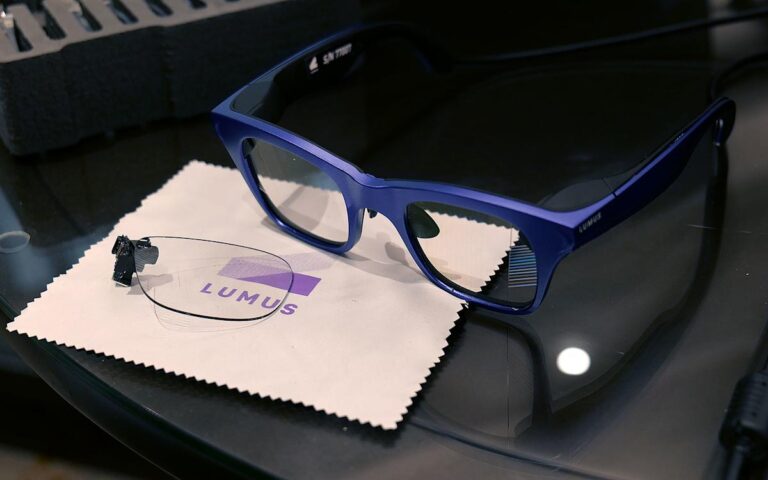
Lumus got a major boost in brand recognition when one of its waveguides was selected for use in the Meta Ray-Ban Display glasses. But that already feels like old tech now because at CES 2026, the company brought some of its latest components to the show and based on what I saw, they seem poised to seriously elevate the optical quality of the next wave of high-end smartglasses.
When the Meta Ray-Ban Displays glasses came out, they wowed users as they were (and still are) one of a handful of smartglassess to feature a full-color in-lens display with at least a 20-degree field of view. But going by the specs on Lumus’ newest waveguides, we’re set for a major upgrade in terms of future capabilities.
If you look closely, you can see where light from the waveguide propagates into the one of the smartglasses’ lenses. (Sam Rutherford for Engadget)
The first model I tried featured Lumus’ optimized Z-30 waveguides, which not only offer a much wider 30-degree FOV, they are also 30 percent lighter and 40 percent thinner than previous generations. On top of that, Lumus says they are also more power efficient with the waveguides capable of hitting more than 8,000 nits per watt. This is a big deal because smartglasses are currently quite limited by the size of batteries they can use, especially if you want to make them small and light enough to wear all day. When I tried them on, I was dazzled by both the brightness and sharpness I saw from the Z-30s despite them being limited to 720 x 720 resolution. Not only did the increase in FOV feel much larger than 10 degrees, colors were very rich, including white, which is often one of the most difficult shades to properly reproduce.
I had to take a photo of one of Lumus’ non-functioning smartglasses with the company’s 70-degree FOV waveguide, because two out of three of the working ones had already broke and the last one that I used was being held together by tape. (Sam Rutherford for Engadget)
However, even after seeing how good that first model was, I was totally not prepared for Lumus’ 70-degree FOV waveguides. I was able to view some videos and a handful of test images and I was completely blown away with how much area they covered. It was basically the entire center portion of the lens, with only small unused areas around the corners. And while I did notice some pincushion distortion along the sides of the waveguide’s display, a Lumus representative told me that it will be possible to correct for that in final retail units. But make no mistake, these waveguides undoubtedly produced some of the sharpest, brightest and best-looking optics I’ve seen from any smartglasses, from either retail models or prototypes or. It almost made me question how much wider FOV these types of gadgets really need, though to be clear, I don’t think we’ve hit the point of diminishing returns yet.
This is one of Lumus’ thinnest waveguides measuring in at just 0.8mm. (Sam Rutherford for Engadget)
Other advantages of Lumus’ geometric reflective waveguides include better overall efficiency than their refractive counterparts along with the ability to optically bond the displays to smartglasses lenses. That means unlike a lot of rivals, Lumus’ waveguides can be paired with transitions lenses instead of needing to resort to clip-on sunglass attachments when you go outside. Lumus also claims its designs also simplifies the manufacturing process, resulting in thinner waveguides (as small as 0.8mm) and generally higher yields.
Unfortunately, taking high-quality photos of content from smartglasses displays is incredibly challenging, especially when you’re using extremely delicate prototypes, so you’ll just have to take my word for now. But with Lumus in the process of ramping up production of its new waveguides with help from partners including Quanta and SCHOTT, it feels like there will be a ton of smartglasses makers clamoring for these components as momentum continues to build around the industry’s pick for the next “big” thing.