Home Blog Page 82

Edith Renfrow Smith, pioneer and witness to history, dies at 111 : NPR

0


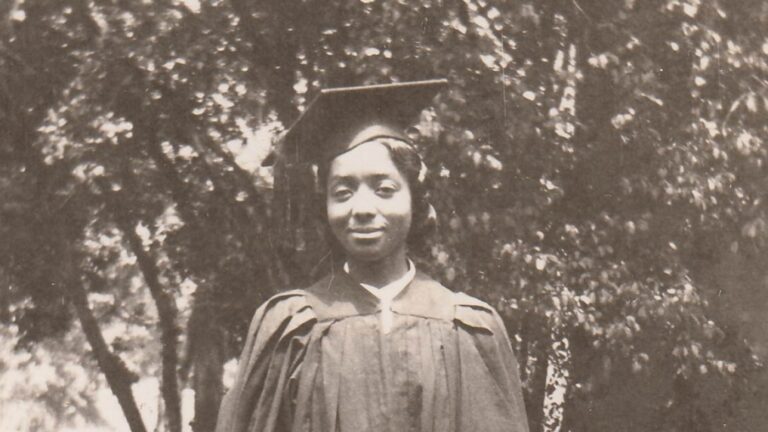
Renfrow Smith in her cap and gown the day she graduated from Grinnell College in 1937.

Renfrow Smith in her cap and gown the day she graduated from Grinnell College in 1937.

Edith Renfrow Smith family collection/Drake Community Library Archive Collection


hide caption

toggle caption

Edith Renfrow Smith family collection/Drake Community Library Archive Collection

Edith Renfrow Smith died Friday at her home in Chicago. She was 111.

In addition to a notably long life — she was one of a very small number of “supercentenarians,” or people who live to at least 110 — she bore witness to major events and came into personal contact with historical figures. She was a pioneering Black woman with an unassuming personality.

Renfrow Smith’s daughter, Alice Smith, confirmed her death to NPR.

Lifting a heavy burden

At the time of Edith Renfrow’s birth, Poweshiek County, Iowa, had 20,000 residents. Just 55 of them were Black. Her grandfather, George Craig, had made his way there after escaping enslavement with the aid of John Brown, and was working as a barber in the town of Grinnell. Her own parents, Lee and Eva Renfrow, worked as a cook and a laundress. It was only a few decades after Plessy v. Ferguson established “separate but equal,” and yet despite it all the Renfrows made sure all six of their children attended college.

“My mother insisted that education was the only thing that could not be taken away,” Renfrow Smith told NPR’s Scott Simon in 2023. “My sister, who was eight years older than I, went into service so she could keep my brother in Hampton Institute in Virginia until he graduated from college. Everybody helped each other.”

Renfrow Smith would attend Grinnell College, the small liberal arts school just blocks from her home. She was at that point the school’s only Black student and with her graduation in 1937 became the first Black woman graduate in the college’s history.

It was during her time on campus that Renfrow Smith met Amelia Earhart. “She was one of the celebrities that came to Grinnell to talk to the students,” Smith recalled. “She was just like another one of us. It was a delightful visit.”

Working outside the home

Renfrow Smith entered the workforce during the Great Depression, when the Black unemployment rate far surpassed the rate for whites and when female Black workers were overwhelmingly in domestic service. She found employment in Chicago as a secretary to Oscar De Priest, first African American elected to Congress in the post-Reconstruction modern era.

“He asked me if I would like to be a teacher,” Renfrow Smith explained. “That’s when I decided to take a methods course where I could join the Chicago system.” She would be a Chicago Public School elementary school teacher for 22 years.

Brushing elbows

Edith Renfrow married Henry Smith in 1940. They had two daughters, Alice and Virginia, and settled on Chicago’s South Side along with many other Black families, such as the Hancocks across the street.

“Mrs. Smith was a dear friend of my mother’s in particular,” Herbie Hancock told NPR in 2023. “We were that close, almost like we were related. She had a regal kind of presence. She didn’t try to convince me to go to Grinnell… just her demeanor was one of absolute respect.”

Hancock would go on to attend Smith’s alma mater, where he found his calling as a musician. He’d later become one of America’s greatest jazz artists.

The Smiths were avid consumers of Chicago Black culture. Renfrow Smith recalls meeting poet Gwendolyn Brooks “in passing because she was giving a program at the YWCA. I went to all the programs … and the YWCA saw to it that we met all the famous Negroes who came to Chicago.”

It was elsewhere that Renfrow Smith came into contact with Dr. Martin Luther King, Jr. “When he came and spoke at a synagogue,” she said, “that was when I met him.”

Giving with gratitude

Renfrow Smith at home in Chicago

Renfrow Smith at home in Chicago

Alice Smith/family photo


hide caption

toggle caption

Alice Smith/family photo

After Renfrow Smith’s 1976 retirement from the Chicago Public School system, she volunteered and indulged a hobby of pie-making. She also regularly welcomed visitors and did so as recently as Dec. 26, reported her daughter Alice Smith, adding that the elder Renfrow Smith herself prepared a fruit cocktail of pineapple and mandarin oranges for her guests.

Renfrow Smith participated as a “SuperAger” at the University of Chicago’s Healthy Aging & Alzheimer’s Research Care Center, and she donated her remains for research.

In the 2023 conversation with Scott Simon, Renfrow Smith reflected on all the history she had seen. “A lot, a lot, a lot,” she said. “A lot of good, and a lot of bad.”

But she still looked forward to each new day. “Wake up every morning and thank the good Lord that you are alive and able to look at his wonderful world,” she advised. “And always go with a smile. A frown does nothing for the person you meet.”


Source link

CES 2026: Everything revealed, from Nvidia’s debuts to AMD’s new chips to Razer’s AI oddities 

0


CES 2026 is in full swing in Las Vegas, with the show floor open to the public after a packed couple of days occupied by press conferences from the likes of Nvidia, Sony, and AMD and previews from Sunday’s Unveiled event. 

As has been the case for the past two years at CES, AI is at the forefront of many companies’ messaging, though the hardware upgrades and oddities that have long defined the annual event still have their place on the show floor and in adjacent announcements. We’ll be collecting the biggest reveals and surprises here, though you can still catch the spur-of-the-moment reactions and thoughts from our team on the ground via our live blog right here

Let’s dive right in, starting with some of Monday’s biggest players. 

Nvidia reveals AI model for autonomous vehicles, showcases Rubin architecture

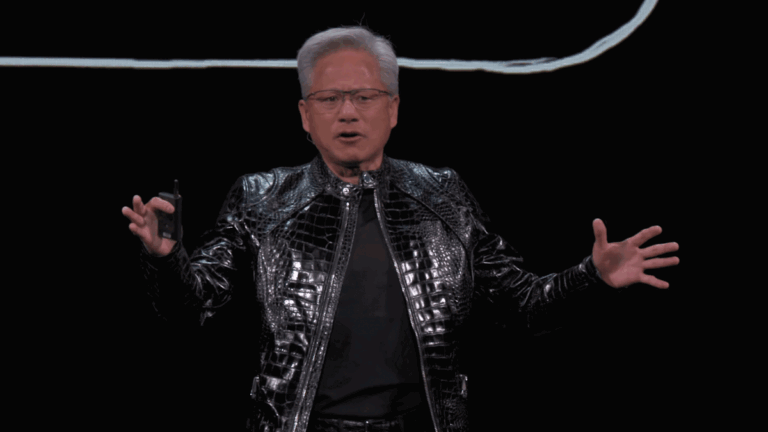
Nvidia CEO Jensen Huang delivered an expectedly lengthy presentation at CES, taking a victory lap for the company’s AI-driven successes, setting the stage for 2026, and yes, hanging out with some robots

The Rubin computing architecture, which has been developed to meet the increasing computation demands that AI adoption creates, is set to begin replacing Blackwell architecture in the second half of this year. It comes with speed and storage upgrades, but our Senior AI Editor Russell Brandom goes into the nitty-gritty of what distinguishes Rubin

And Nvidia continued its push to bring the AI revolution into the physical world, showcasing its Alpamayo family of open-source AI models and tools that will be used by autonomous vehicles this year. That approach, as Senior Reporter Rebecca Bellan notes, mirrors the company’s broader efforts to make its infrastructure the Android for generalist robots

AMD’s keynote highlights new processors and partnerships 

AMD Chair and CEO Lisa Su delivered the first keynote of CES, with a presentation that featured partners including OpenAI President Greg Brockman, AI legend Fei-Fei Lei, Luma AI CEO Amit Jain, and more. 

Techcrunch event

San Francisco
|
October 13-15, 2026

Beyond the partner showcases, Senior Reporter Rebecca Szkutak detailed AMD’s approach toward expanding the reach of AI through personal computers using its Ryzen AI 400 Series processors. 

Boston Dynamics and Google partner on Atlas robots 

Hyundai’s press conference focused on its robotics partnerships with Boston Dynamics, but the companies revealed that they’re working with Google’s AI research lab rather than competitors to train and operate existing Atlas robots, as well as a new iteration of Atlas that was shown on stage. Transportation Editor Kirsten Korosec has the full rundown

Amazon’s AI-centric update with Alexa+ is getting the kind of push you’d expect at CES, with the company launching Alexa.com for Early Access customers looking to use the chatbot via its browsers, along with a similar, revamped bot-focused app. Consumer Editor Sarah Perez has the details, along with news on Amazon’s revamp to Fire TV and new Artline TVs, which have their own Alexa+ push. 

On the Ring front, Consumer Reporter Ivan Mehta runs through the many announcements, from fire alerts to an app store for third-party camera integration, and more. 

Razer joins the AI deluge with Project AVA and Motoko 

In the past, Razer has been all about ridiculous hardware at CES, from three-screen laptops to haptic gaming cushions and a mask that landed the company a federal fine. This year, its two attention-grabbing announcements were for Project Motoko, which aims to function similarly to smart glasses, but without the glasses. 

Then there’s Project AVA, which puts the avatar of an AI companion on your desk. We’ll let you watch the concept video for yourself. 

Lego Smart Bricks mark the company’s first CES appearance 

Lego joined CES for the first time to hold a behind-closed-doors showcase of its Smart Play System, which includes bricks, tiles and Minifigures that can all interact with each other and play sounds, with the debut sets both having a Star Wars theme. Senior Writer Amanda Silberling has all the details here


Source link

Dreame’s robot vacuum with an arm is back at CES 2026 and it can do more than pick up shoes

0


Last year at CES, Dreame showed off a robot vacuum prototype with a mechanical arm. But while we were able to see the arm extend and retract, we didn’t see the device, which was described as a prototype at the time, actually grab anything, which was a bit disappointing.

This year, though, the company has made its arm-enabled vacuum a reality with the Cyber 10 Ultra. Dreame previewed it recently at IFA in Berlin, but has now confirmed it will be on sale later this year.

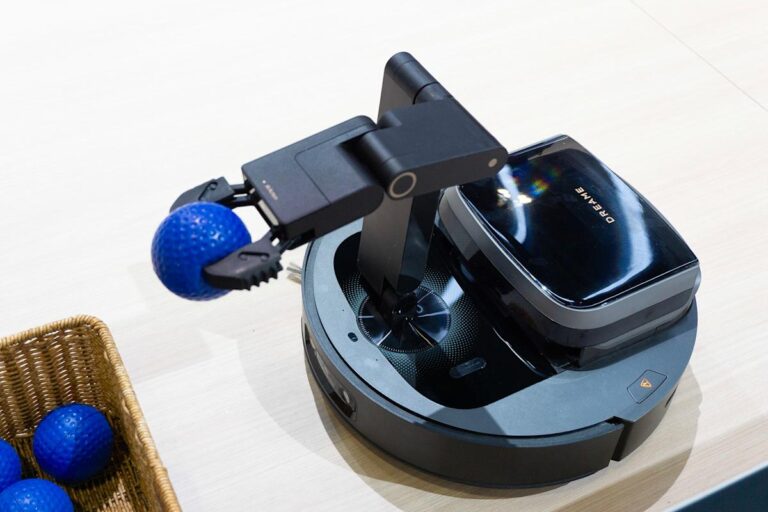
The vacuum has an extendable arm that looks pretty similar to the prototype version we saw last year. It extends from the top of the vacuum and has a claw-like device at the end for scooping up objects. According to Dreame, it can pick up items that weigh up to 500 grams (about 1 pound) so it should be able to grab a wider variety of stuff than the Roborock vac we saw last year, which had a 300-gram weight limit for its arm.

The arm can also do more than pick up stuff from the floor. It supports its own cleaning accessories, and can grab vacuum nozzles and brush attachments from its base station. This allows the arm to act as an extension of the vacuum itself so it can be used similarly to how you might use hose attachments to reach hard-to-get areas with a traditional vacuum.

We were able to see a brief demo of the Cyber 10 arm in action on the CES show floor. It was able to pick up balls and place them in a basket. Unfortunately, we didn’t get to see it lift any heavier object or grab its cleaning attachments, but we were able to get a good look at the base station and the small cubbies where they will be stored.

The base station that holds the attachments for the vacuum's arm.

The base station that holds the attachments for the vacuum’s arm. (Karissa Bell for Engadget)

And, like Dreame’s other robot vacuums, the Cyber 10 Ultra also has mopping abilities and can climb up small steps up to 6cm (about 2.4 inches). That’s not quite as impressive as the tank-like stair-climbing Cyber X prototype it also brought to CES, but should help the Cyber 10 reach a few extra places in the house.

The company hasn’t announced an exact release date, but says it’s targeting August of this year and currently expects the Cyber 10 Ultra to cost around €1799 (about $2,100).

Update, January 6, 2026, 4:17PM PT: This story was updated with new photos, a video and information about the Cyber 10 Ultra.


Source link

Google Drive regains full Material 3 Expressive redesign

0


Last year, Google Drive’s Material 3 Expressive redesign rolled out in a piecemeal fashion and saw one aspect revert. The full revamp with the container component is now available. 

The list of files is once again placed in a container that does not extend all the way to the edge of the screen. There is now increased padding to the left and right. 

This container features rounded corners at the top but is squared at the bottom. As a result of this change, the bottom and search app bars are part of the same background layer. In the Files view, the top tabs for My Drive and Computers get a narrower indicator. 

Old vs. new

Advertisement – scroll for more content

It’s a subtle change that’s more noticeable on your device than in these screenshots, with the M3 Expressive redesign now complete.

We’re seeing this widely rolled out with version 2.25.497.5 of Google Drive for Android this week following a server-side update. 

This joins the search app bar, button group (for the grid/list view switcher), FAB menu, and short bottom bar. Just before the holidays, we saw the Google Docs, Sheets, and Slides redesign completely roll out.

More on Google Drive:

FTC: We use income earning auto affiliate links. More.


Source link

Holyoke School Committee picks vice chair, delays chair vote

0


HOLYOKE — A day after members took the oath of office, the Holyoke School Committee reorganized Tuesday, electing Devin Sheehan as vice chair while postponing a vote for chair until next week.

The vote will take place at the next meeting, scheduled for Jan. 12 at 6 p.m., according to the committee’s administrative assistant.

At that time, Yadillette Rivera-Colón, who was absent Tuesday, will be sworn in as chair.


Source link

Hungarian filmmaker Béla Tarr has died at 70 : NPR

0


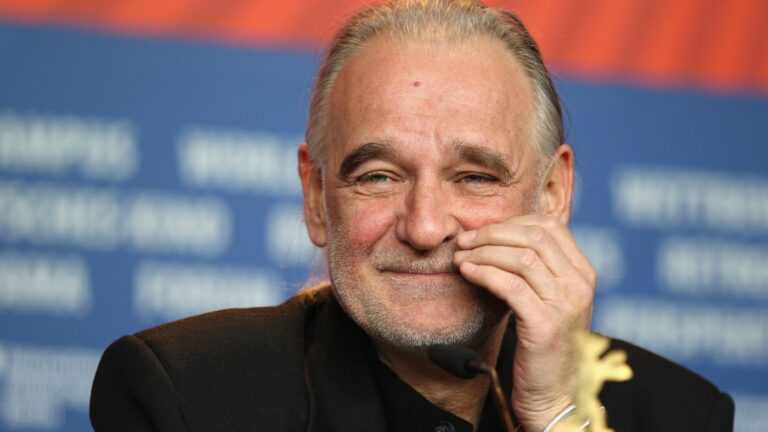
Hungarian director Béla Tarr at the Berlin International Film Festival in 2011.

Hungarian director Béla Tarr at the Berlin International Film Festival in 2011.

Andreas Rentz/Getty Images


hide caption

toggle caption

Andreas Rentz/Getty Images

Béla Tarr, the Hungarian arthouse director best known for his bleak, existential and challenging films, including Sátántangó and Werckmeister Harmonies, has died at the age of 70. The Hungarian Filmmakers’ Association shared a statement on Tuesday announcing Tarr’s passing after a serious illness, but did not specify further details.

Tarr was born in communist-era Hungary in 1955 and made his filmmaking debut in 1979 with Family Nest, the first of nine feature films that would culminate in his 2011 film The Turin Horse. Damnation, released in 1988 at the Berlin International Film Festival, was his first film to draw global acclaim, and launched Tarr from a little-known director of social dramas to a fixture on the international film festival circuit.

Tarr’s reputation for films tinged with misery and hard-heartedness, distinguished by black-and-white cinematography and unusually long sequences, only grew throughout the 1990s and 2000s, particularly after his 1994 film Sátántangó. The epic drama, following a Hungarian village facing the fallout of communism, is best known for its length, clocking in at seven-and-a-half hours.

Based on the novel by Hungarian writer László Krasznahorkai, who won the Nobel Prize in Literature last year and frequently collaborated with Tarr, the film became a touchstone for the “slow cinema” movement, with Tarr joining the ranks of directors such as Andrei Tarkovsky, Chantal Akerman and Theo Angelopoulos. Writer and critic Susan Sontag hailed Sátántangó as “devastating, enthralling for every minute of its seven hours.”

Tarr’s next breakthrough came in 2000 with his film Werckmeister Harmonies, the first of three movies co-directed by his partner, the editor Ágnes Hranitzky. Another loose adaptation of a Krasznahorkai novel, the film depicts the strange arrival of a circus in a small town in Hungary. With only 39 shots making up the film’s two-and-a-half-hour runtime, Tarr’s penchant for long takes was on full display.

Like Sátántangó, it was a major success with both critics and the arthouse crowd. Both films popularized Tarr’s style and drew the admiration of independent directors such as Jim Jarmusch and Gus Van Sant, the latter of which cited Tarr as a direct influence on his films: “They get so much closer to the real rhythms of life that it is like seeing the birth of a new cinema. He is one of the few genuinely visionary filmmakers.”

The actress Tilda Swinton is another admirer of Tarr’s, and starred in the filmmaker’s 2007 film The Man from London. At the premiere, Tarr announced that his next film would be his last. That 2011 film, The Turin Horse, was typically bleak but with an apocalyptic twist, following a man and his daughter as they face the end of the world. The film won the Grand Jury Prize at the Berlin International Film Festival.

After the release of The Turin Horse, Tarr opened an international film program in 2013 called film.factory as part of the Sarajevo Film Academy. He led and taught in the school for four years, inviting various filmmakers and actors to teach workshops and mentor students, including Swinton, Van Sant, Jarmusch, Juliette Binoche and Gael García Bernal.

In the last years of his life, he worked on a number of artistic projects, including an exhibition at a film museum in Amsterdam. He remained politically outspoken throughout his life, condemning the rise of nationalism and criticizing the government of Hungarian leader Viktor Orbán.


Source link

Meta pauses international expansion of its Ray-Ban Display glasses

0


Meta is pausing its plans to sell its Ray-Ban Display glasses outside the U.S. due to “unprecedented demand and limited supply,” the company said on Tuesday. Meta had originally planned to launch the glasses in France, Italy, Canada, and the U.K. in early 2026.

“Since launching last fall, we’ve seen an overwhelming amount of interest, and as a result, product waitlists now extend well into 2026,” the company said. “Because of this unprecedented demand and limited inventory, we’ve decided to pause our planned international expansion.”

Meta says it will continue focusing on fulfilling U.S. orders while it re-evaluates its approach to international availability.

Unveiled in September, the Meta Ray-Ban Display smart glasses are controlled by a wristband called the Meta Neural Band, which detects subtle hand gestures.

At CES this week in Las Vegas, Meta showed off new features coming to the glasses and the Neural Band. The glasses are getting a new teleprompter feature that gives users a portable way to deliver prepared remarks. Plus, users can now jot down messages using their finger on any surface while wearing Meta Neural Band and have those movements transcribed into digital messages.

Meta is also expanding pedestrian navigation to Denver, Las Vegas, Portland, and Salt Lake City.


Source link

Everything NVIDIA announced at CES 2026

0


Jensen Huang took to the CES stage on Monday to share the latest from NVIDIA, and while the presentation was more a refresher of technologies the company has been working on for the past few years, there were a couple of notable announcements.

NVIDIA announced Alpamayo, a family of open-source reasoning models designed to guide autonomous vehicles through difficult driving situations. The centerpiece of the release is Alpamayo 1 , a 10-billion parameter chain-of-thought system NVIDIA says is capable of approaching driving more like a human being would. The model works by breaking down unexpected driving situations into a smaller set of problems before finding the safest path forward. At each step of the way, the model can explain its reasoning.

A sister model named AlpaSim allows developers to do closed-loop training for driving scenarios that are rarely encountered in real life. Huang said the 2025 Mercedes Benz CLA will be the first vehicle to ship with NVIDIA’s entire AV stack, including Alpamayo. “Our vision is that someday, every single car, every single truck, will be autonomous,” Huang said.

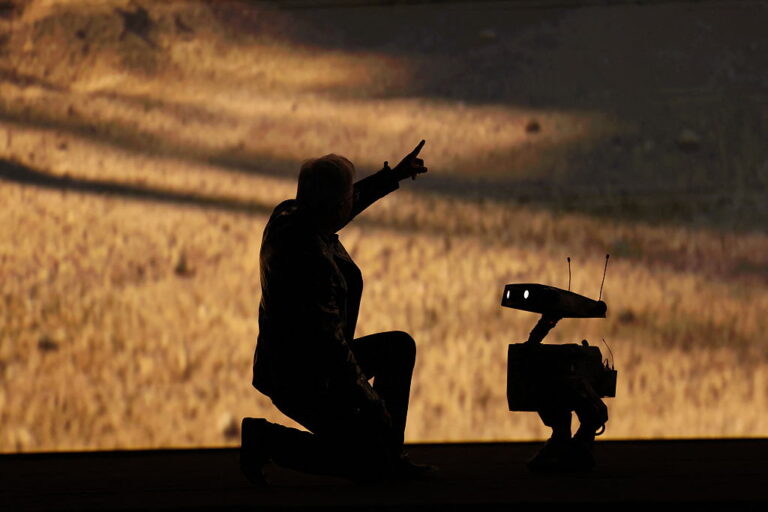
Following the Alpamayo announcements, a pair of BD-1 droids from Star Wars Jedi: Fallen Order joined Huang on stage. We saw one join the executive at last year’s CES. After that, Huang turned to Vera Rubin. NVIDIA first announced the GPU architecture in 2024, and now the company has begun production on a super computer that makes use of the new tech. One Vera CPU has 88 custom Olympus cores and 1.5TB of system memory for a total of 227 billion transistors. Meanwhile, one Rubin GPU features 336 billion transistors. Each Vera Rubin supercomputer has a pair of both components.

Following the presentation, NVIDIA held a separate briefing where it announced DLSS 4.5 and G-Sync Pulsar. The latest version of NVIDIA’s upscaling technology was trained on a second-generation transformer model, which should reduce ghosting and shimmering, leading to a more stable image, even when there’s a lot of movement on screen. As part of DLSS 4.5, NVIDIA is also adding support for 6x multi-frame and dynamic generation. The two features will arrive sometime in the spring. The former allows a 50-series GPU to generate five frames for every traditionally rendered frame. The idea here is to allow a powerful GPU like the RTX 5090 to saturate a 4K, 240HZ display with as many frames as possible. Dynamic frame generation, meanwhile, is exactly what it sounds like. DLSS 4.5 can dynamically scale the number of generated frames to fit the scenario. In demanding scenes, your 50-series GPU will generate more frames, while scaling back during less hectic ones so it only computes what it needs.

As for G-Sync Pulsar, it’s the latest improvement to NVIDIA’s flicker reduction technology. By pulsing a display’s backlight, NVIDIA says it can deliver perceived motion clarity relative to 1,000Hz, leading to greater clarity. Those same displays will also ship with the ability to automatically adjust their brightness and color temperature to ambient lighting conditions. Pre-orders for the first batch of G-Sync Pulsar displays will open on January 7.

Update 01/06/26 9:30AM: Added information about DLSS 4.5 and G-SYNC Pulsar.


Source link

Yes, the Google app icon is now bigger on Android

0


The year in Google updates is well underway today with beta version 17.0 of the Google app on Android increasing the size of the app icon.

This tweak in the beta channel sees the gradient ‘G’ expand a tiny amount to better fill the container. Today’s update addresses how the initial gradient revision in May shrank the icon. The updated ‘G’ for Search joins Gemini, Home, and Photos, while we’re waiting for Maps.

Stable users remain on version 16.49, but Google did release 16.50, 16.51, and 16.52 to testers over the holiday period. As always, the vast majority of updates are rolled out server-side rather than through these releases. 

It remains to be seen what the next stable version will be, but the normal schedule would dictate that 17.0 will be out within a week with this icon change.

Advertisement – scroll for more content

Outside of the Google app, Monday saw a handful of first-party application updates resume on both Android and iOS after the holidays.

FTC: We use income earning auto affiliate links. More.


Source link

Appeals court protects university research funding from Trump admin cuts

0


A federal appeals court affirmed that the Trump administration and federal agencies can’t make cuts to funding that supports cutting-edge medical and public health research.

The unanimous decision on Monday from the United States Court of Appeals for the First Circuit came after Massachusetts Attorney General Andrea Joy Campbell and 21 other attorneys general filed a lawsuit in February last year against the federal government.

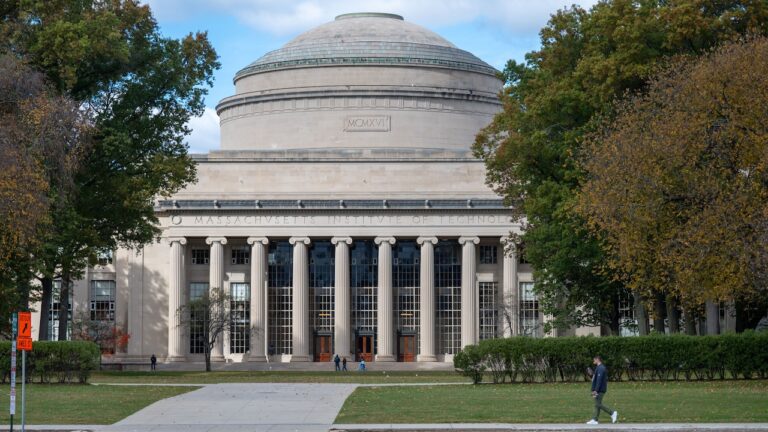
Others also sued, including the Massachusetts Institute of Technology, Brandeis University and Tufts University and over a dozen institutions. Their lawsuit was lumped into the same appeals decision.

The lawsuits challenged the Trump administration and federal agencies, like the National Institutes of Health, over efforts to reduce indirect costs paid to universities and research institutions.

Indirect costs are expenses such as lab maintenance, utilities and administrative staff that universities use federal money to cover. The Trump administration argues that federal dollars should instead go directly to scientific research.

Some universities receive 50% or more of the amount of a grant to put toward support staff and other needs, but that would be capped at 15%, producing major budget shortfalls.

The U.S. District Court for Massachusetts issued a temporary restraining order in February that blocked the funding cuts, then issued a permanent injunction to keep them blocked.

“Universities and research institutions across the country rely on NIH funding to conduct groundbreaking research, and patients and families depend on those medical advancements to improve and even save their lives,” Campbell said. “Today’s victory sends a clear message that the Trump Administration cannot sacrifice the health of our residents for its own political agenda.”

In the 2024 budget year, 219 organizations in Massachusetts received approximately $3.46 billion in NIH funding to support 5,783 research projects, according to Campbell’s office.

Schools that benefited from the money include UMass Amherst, UMass Chan Medical School, Brigham & Women’s Hospital and the Broad Institute of MIT and Harvard.

Indirect costs being cut to 15% would have amounted to a decrease of $30 to $35 million a year at MIT, according to a February letter from President Sally Kornbluth.

That could have impacted research focused on treatments and cures for cancer, Alzheimer’s, Parkinson’s, Lyme disease and autism, she said.

“We believe these proposed cuts are unlawful and pose a direct threat to MIT’s mission — and they fracture the compact between the U.S. government and its research institutions that, since the end of World War II, has fueled America’s innovation economy and ensured the nation’s security, prosperity and quality of life,” Kornbluth said in February.


Source link