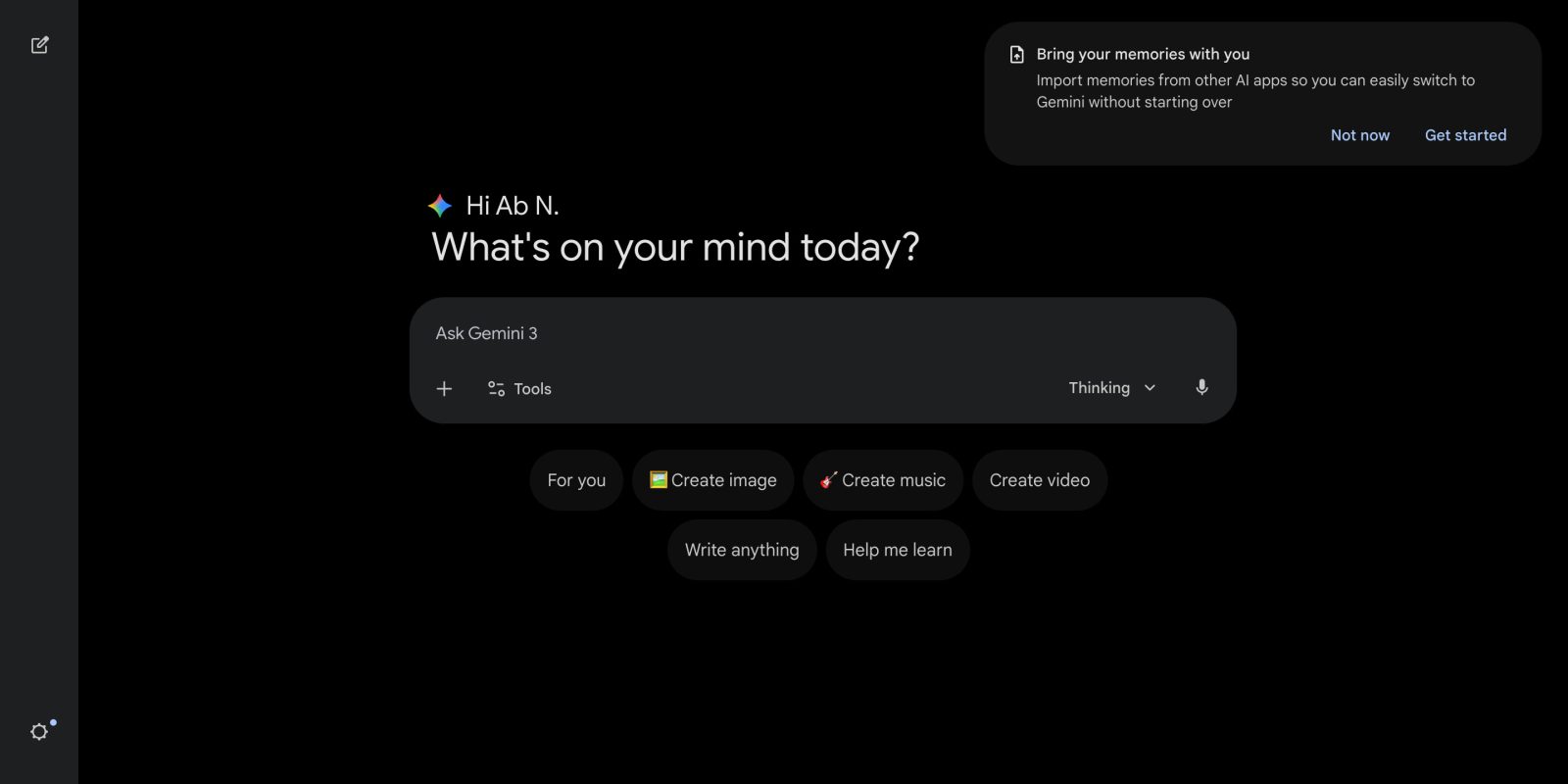
Besides Gemini 3.1 Flash Live today, Google is rolling out the ability to import memory and chats into Gemini from other AI apps.
If you don’t see a prompt, tap the “Settings & help” gear in the bottom-left corner for an “Import memory to Gemini” option.
This takes you to gemini.google.com/import where you have two options. “Import chats” lets you export your data from another AI app and then upload the .zip file (up to 5 GB) to Gemini. Google explicitly names ChatGPT and Claude, with users able to upload up to 5 .zip files per day.
For ChatGPT:
- Click on your username in the bottom left.
- Click Settings and then Data controls.
- Next to “Export data”, click Export and then Confirm Export.
For Claude:
- Click on your username in the bottom left.
- Click Settings and then Privacy.
- Next to “Export data”, click Export.
- Select the data range you want to export and then click Export.
- A download link will be sent to the email associated with your account on the other AI platform.
Imported chats will appear in the usual Gemini side panel, but are marked with an import chat icon. You can search and delete conversations as needed.
- To delete all the imported conversations in an import, find the import entry and next to the entry, click Delete. All imported chats within that .zip file will be deleted.
- If you reupload a .zip file with your exported chats it will add any new conversations and overwrite previously imported ones.

Then there’s the Import memory feature that involves entering the below prompt into another chat app and pasting the results into Gemini.
Importing is currently not available in the EEA, Switzerland, or the United Kingdom.
You are helping me import context from one AI assistant to another. Your job is to go through our past conversations and sum up what you know about me.
In the output, please avoid using any first-person pronouns (I, my, me, mine) and any second-person pronouns (you, your, yours). Instead, refer to the individual you have learned about as “the user” or use neutral phrasing.
Preserve the user’s words verbatim where possible, especially for instructions and preferences.
Categories (output in this order):
1. Demographics Information: Preferred names, profession, education, and general residence.
2. Interests & Preferences: Sustained, active engagements (not just owning an object or a one-time purchase).
3. Relationships: Confirmed, sustained relationships.
4. Dated Events, Projects & Plans: A log of significant, recent activities.
5. Instructions: Rules I’ve explicitly asked you to follow going forward, “always do X”, “never do Y”, and corrections to your behavior. Only include rules from stored memories, not from conversations.
Format:
Divide the content into the labeled section using the categories above. Try to include verbatim quotes from my prompts that justify each entry. Structure each entry using this format:
The user’s name is
. – Evidence: User said “call me
”. Date: [YYYY-MM-DD]. Output:
– Format the final output summary as a text block.


FTC: We use income earning auto affiliate links. More.