Qualcomm’s taking Mobile World Congress by storm, with a collection of networking-centric announcements set to lay the groundwork for the next decade of connectivity.
Starting with the most immediate of its announcements, Qualcomm has a pair of new chips — one modem, one NIC — as we head into 2026 and beyond. Its X105 5G modem is the company’s 5th-gen 5G AI processor, promising to embrace agentic AI to “enhance performance in various user scenarios,” albeit without specific examples worth detailing. The big news for consumers is Qualcomm’s new RF transceiver, which reduces power consumption by 30% compared to last year’s X85 while simultaneously shrinking its footprint by 15%.
That’s good news for your next Snapdragon-powered smartphone, but if you’re concerned more about the future than the here-and-now, Qualcomm’s new FastConnect 8800 is worth paying attention to. Despite the fact that it still feels like the early days for Wi-Fi 7 for all but the most enthusiastic of networking nerds (and trust me, I’m saying that as a compliment), Qualcomm appears ready to move onto its successor with an “AI-Native” Wi-Fi NIC.
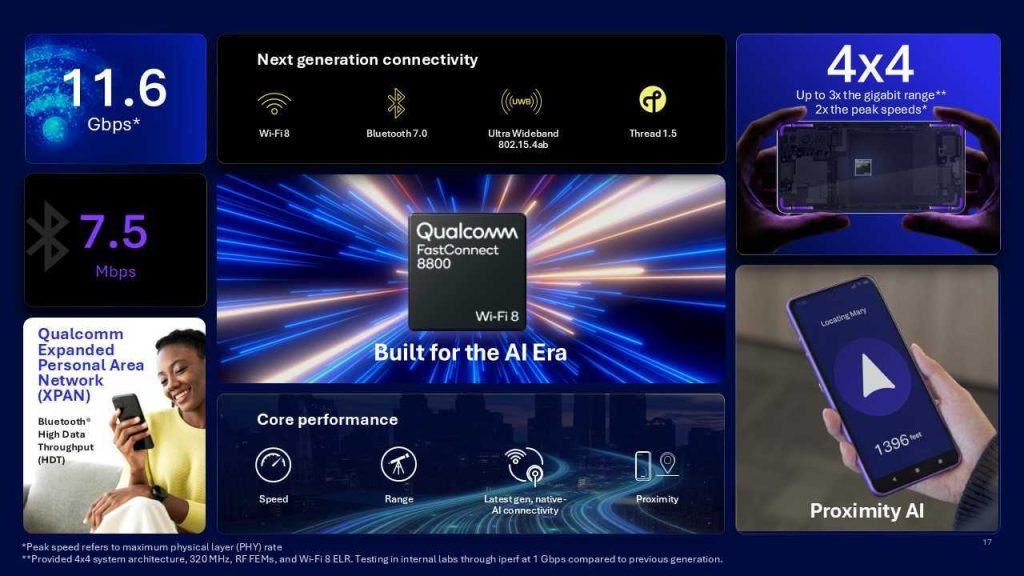
The FastConnect 8800 doubles peak Wi-Fi speeds compared to the company’s previous Wi-Fi 7-powered FastConnect products while keeping the process node at 6nm. To reach these speeds, it’s using a “redesigned” 4×4 radio configuration that simultaneously “enables up to 3x longer gigabit range” compared to previous standards. It’s not the only advancement, though — both Bluetooth 7.0 and Bluetooth HDT (or High Data Throughput) support is here as well. The latter serves as an upgrade to Bluetooth LE, raising the ceiling for data transfer speeds to 7.5Mbps, a rating that far outclasses LE’s 2Mbps cap.
This chip arrives alongside an entire portfolio of IoT and enterprise Dragonwing Wi-Fi 8 products, all of which are expected to launch in late 2026.
Finally, looking even further into the future, Qualcomm has formed a “strategic coalition” with (unspecified) “industry partners” to work towards a global launch of 6G beginning in 2029. The company’s announcement describes 6G networks as “AI-native” and designed for “connectivity, wide-area sensing, and high-performance compute,” a collection of buzz-phrases that don’t paint a completely clear picture on what to expect. Qualcomm’s promises do basically center around AI-based services, but much of what it’s promising to support — including agentic devices for both consumers and enterprise solutions — don’t totally exist yet.
Nevertheless, Qualcomm says its global rollout will kick off beginning in 2029, with a more expansive network buildout to follow. The company says it plans to lock down 6G standards and specs by 2028 to establish an industry standard, which will lead directly to “interoperable commercial 6G systems” one year later.


FTC: We use income earning auto affiliate links. More.